probe

Former Newsom advisor received $50,000 payout after leaving state job amid federal probe

Gov. Gavin Newsom’s former chief of staff, Dana Williamson, left state service with two things: a federal corruption investigation and more than $50,000 in pay for vacation time she accrued but never took.

State payroll records reviewed by The Times show Williamson used approximately $30,000 in unused vacation time to remain on California’s payroll through Jan. 31 — seven weeks after Newsom’s office indicated she had departed — before collecting an additional $22,000 lump-sum payout for the hours she had left.

Large cash-outs for departing state workers with hundreds of hours of time off on the books have been a recurring issue in California. The state’s unfunded liability for vacation and other leave owed to employees has ballooned in recent years to $5.6 billion, fueled by generous time-off provisions and a long-standing failure to enforce policies that cap most employees’ vacation balances at 640 hours.

Many state workers accumulate large balances of unused vacation after decades of being on the government payroll. The typical public employee retires with more than two decades in public service, according the California Public Employees’ Retirement System. Their unused time off is paid when they leave state employment at their final rate of pay.

Williamson, however, amassed 462 hours of unused leave in less than two years on the job. She earned $19,612 a month as the governor’s chief of staff.

John Moorlach, director at the conservative think tank the Center for Public Accountability at the California Policy Center, said that a job like Williamson had probably involved incredibly long workdays but that the pace in which employees accumulate days off is a major financial burden.

“A normal blue-collar worker would say, ‘Really? Really?“” said Moorlach, a former Republican state senator from Orange County. “You don’t find this perk in the private sector.”

Williamson notified Newsom in November 2024 that she was under federal investigation and was put on paid administrative leave through Dec. 16, the governor’s office said.

Federal charges against Williamson, which were filed in November 2025, allege she siphoned $225,000 out of a dormant state campaign account belonging to gubernatorial hopeful Xavier Becerra and illegally claimed $1 million in luxury handbags and travel as business expenses on her tax returns. She pleaded not guilty to the charges.

A status conference in Williamson’s case was moved to April 16 after she recently underwent a successful liver transplant and due to the large volume of discovery — more than 280,000 pages so far — according to court records filed last month.

Williamson’s attorney, McGregor Scott, did not respond to a request for comment.

State payroll records show Williamson earned $40,000 in regular pay in 2025, which the state controller’s office said included her December 2024 and January 2025 paychecks. The governor’s office said Williamson’s December 2024 paycheck included 11 days of paid administrative leave, and the remainder of both paychecks was covered by her unused leave.

With her final cash-out of $22,000 in remaining time off, she made a total of $62,000 last year — all tied to administrative leave and unused vacation time rather than time worked.

“That’s shocking, honestly,” said Assemblyman Josh Hoover (R-Folsom), adding that stockpiled vacation time overall is something the state Legislature should look into.

The state paid $453 million in unused leave benefits to state workers in 2025. That was an average of more than $20,000 to the 21,000 employees who received a lump-sum check. The amount paid to departing or retiring state workers has steadily increased each year. In 2024, the state paid $413 million for unused time off.

“Obviously, employees are an important part of our state and they accrue vacation time,” Hoover said. “But, if this is something being used to pad people’s salaries … we need to look into that and possibly reform that.”

Last year, 80 state employees took home at least $250,000 in unused time off, and 1,081 employees were paid more than $100,000. Those numbers have been increasing each year. For example, the state paid 16 state workers more than $250,000 for unused time off in 2010, and 309 employees were paid more than $100,000.

In 2024, the state paid out a record $1.2 million to a prison supervising dentist for unused time off. Last year, the top amount paid for unused leave was about $650,000 to an assistant fire chief with the California Department of Forestry and Fire Protection.

The state owed nearly $5.6 billion to state workers for unused vacation and other leave benefits in 2024, according to the most recent financial accounting report issued by the state controller’s office. Although that unfunded liability held steady when compared with 2023, it has risen sharply from pre-pandemic amounts.

In 2019, the state owed $3.9 billion for employees’ unused time off before COVID-19 curtailed travel and work-from-home policies resulted in fewer workers taking time off. State employees have argued that under-staffing at state agencies can make it difficult to take vacations.

Nick Schroeder, a policy analyst at the nonpartisan California Legislative Analyst’s Office, said the state has plans to reduce unfunded liabilities for pensions and retiree healthcare, but that isn’t the case with unused time off.

“There isn’t a plan to address it,” Schroeder said.

When an employee retires with a large leave balance, the department where that person worked last is on the hook for the amount.

“It can be a big effect on that individual department’s budget,” Schroeder said.

During budget deficits — including in the current fiscal year — the state has cut employee pay or deferred annual raises in exchange for additional days off, a strategy that helps balance budgets but also adds to workers’ growing vacation balances.

In Newsom’s January budget proposal, which estimated a $3-billion deficit, the governor recommended providing $91 million in ongoing funding to the California Department of Corrections and Rehabilitation to help the prison system pay departing employees for their unused time off. The department said that from 2020 to 2025, it paid about $130 million annually on average to employees leaving state service, according to a Legislative Analyst’s Office report.

When employees cash out banked leave, the state pays them not only for the hours they have accumulated, but also for the additional vacation and holidays they would have earned had they taken that time off.

That means a person with 640 hours of vacation would also be paid for all of the vacation and holidays they would have earned had they taken those 80 days off. Each hour of leave is paid based on an employee’s final salary — not what they were earning when the time was accrued.

Most private-sector employers cap vacation accrual between 40 and 400 hours and stop employees from earning additional time once they reach those limits. Some companies have moved in the opposite direction, adopting “unlimited paid time off” policies. Under those systems, employees do not accumulate vacation days that can be banked or cashed out, but critics say the policies can lead to workers taking less time off because there is no guaranteed number of days and employees may feel pressure not to appear absent.

Jon Coupal, president of the Howard Jarvis Taxpayers Assn., said there appears to be little appetite in the state Capitol to address California’s burgeoning vacation liability.

“This problem is systemic within California government and no one seems willing to take it on,” Coupal said. “At the same time, they are clamoring that there is a budget crisis. I suspect they will continue to kick the can down the road.”

Source link

Advocates push for major probe as US boat strikes in Latin America kill 157 | Donald Trump News

Washington, DC – In September, the United States began launching dozens of deadly military strikes against alleged drug-smuggling boats in the Caribbean Sea and eastern Pacific.

Nearly half a year later, remarkably little is known about the strikes. The identities of the nearly 157 people killed have not been released. Any purported evidence against them has not been made public.

Recommended Stories

list of 3 itemsend of list

But a group of United Nations and international law experts are hoping to change that on Friday, when they testify at the Inter-American Commission on Human Rights (IACHR).

The international hearing will be the first of its kind since the strikes began on September 2, and rights advocates hope it can help lead to accountability as individual legal cases related to the strikes proceed.

Steven Watt, a senior staff lawyer with the American Civil Liberties Union’s human rights programme, said the goal of the hearing will be threefold.

“Our ask will be to conduct a fact-finding investigation into what’s going on,” Watt said.

The second aim, he continued, would be “to assert or to arrive at a conclusion that there is no armed conflict here”, in what would be a rebuke to US President Donald Trump’s previous claims.

Finally, Watt said, he hopes the proceedings will yield long-sought transparency from the Trump administration on “whether or not they have a legal justification for these boat strikes”.

“We don’t think there are any,” Watt added.

‘We don’t know the names’

The experts set to testify at Friday’s hearing said the IACHR has a unique mandate to uncover the truth behind the US strikes.

The commission, based in Guatemala City, Guatemala, is an independent investigative body within the Organization of American States, of which the US was a founding member in 1948.

While the Trump administration has claimed it has a right to carry out the deadly attacks as part of a wider military offensive against so-called “narco-terrorists”, rights groups have decried the campaign as a series of extrajudicial killings.

They argue that Trump’s deadly tactics deny those targeted of anything that approaches due process.

Legal experts have also dismissed Trump’s claims that suspects in drug-related crimes are equivalent to “unlawful combatants” in an “armed conflict”.

Few details have emerged from the air strikes. Several families have come forward, however, to informally identify the dead as their loved ones.

Victims are said to include 26-year-old Chad Joseph and 41-year-old Rishi Samaroo, who were sailing home to Trinidad and Tobago when they were killed in October, according to relatives.

A complaint filed against the US government said both men travelled often between the islands and Venezuela, where Joseph found work as a farmer and fisherman, and Samaroo laboured on a farm.

The family of Colombian national Alejandro Carranza, 42, have also said he was killed in September when the US military attacked his fishing boat off the country’s coast.

The US has yet to confirm the victims’ identities, and only two survivors have ever been rescued in the 45 reported strikes.

A clearer picture of what happened will be a significant step towards accountability, according to experts like Watt.

“[The IACHR] is uniquely positioned to identify who all these persons are,” Watt said. “We just know the numbers from the United States. We don’t know the names or the backgrounds of these people.”

The IACHR has launched a range of human rights investigations in recent decades, including probes into the 2014 mass kidnapping of 43 students in Iguala, Mexico, and a series of murders in Colombia from 1988 to 1991 dubbed the Massacre of Trujillo.

The commission has also examined US policies, including extrajudicial detentions at Guantanamo Bay, Cuba, during its so-called “global war on terror”.

The IACHR has the power to seek resolutions to human rights complaints or refer them for litigation before the Inter-American Court of Human Rights.

Just last week, the court ordered Peru to pay reparations to the family of a woman who died during a government-led forced sterilisation campaign in the 1990s.

The Carranza family has filed its own complaint to the IACHR, and the families of Joseph and Samaroo have also lodged a lawsuit against the US in a federal court in Massachusetts.

Angelo Guisado, a senior staff lawyer at the Center for Constitutional Rights (CCR), said a fuller accounting of the US actions is needed to prevent future abuses. He is among the experts testifying on Friday.

“You can’t normalise assassinating fishermen off the coast of South America,” Guisado told Al Jazeera. “That’s just sadistic and an abomination to the rules-based order that we’ve created.”

“So we hope that the commission can do some investigation.”

A war against ‘narco-terrorists’?

One of Guisado’s goals for Friday’s hearing will be to unpack the Trump administration’s argument that the attacks are necessary from a national security standpoint.

Even before the US strikes began, the Trump administration began framing the Latin American drug trade as an existential threat to the US.

As part of that re-framing, the administration borrowed messaging from its “global war on terror”, taking the unorthodox approach of labelling several cartels “foreign terrorist organisations”.

Speaking last week at a meeting of Latin American leaders, White House security adviser Stephen Miller maintained there is no “criminal justice solution” to drug cartels.

Instead, he affirmed that the US would use “hard power, military power, lethal force, to protect and defend the American homeland”, even if that meant carrying out deadly operations throughout the Western Hemisphere.

Guisado, however, noted that the administration has admitted that the targeted boats were largely carrying cocaine, not the highly addictive fentanyl responsible for the majority of US drug overdoses.

He explained that the administration has done little to prove its claims that drug traffickers are part of a coordinated effort to destabilise the US.

Such hyperbolic language, Guisado added, could be used as a smokescreen to conceal illegal actions.

“When you invoke national security interest, it seems as if scrutiny and any legitimate analysis or condemnation gets pushed to one side in favour of an ersatz martial law,” Guisado said.

“The idea that you could just proclaim anyone a narcoterrorist and do whatever you want with them is just so repugnant to our system of fairness, justice and law.”

Watt, meanwhile, said he hopes the IACHR will draw a clear “line in the sand”, separating drug crimes from what is conventionally considered an armed conflict.

He also would like to see the IACHR clearly outline the US’s human rights obligations.

“But even if there was an armed conflict — of which there isn’t — the laws of war would prohibit the type of conduct that the United States is engaging in here,” Watt explained.

“It would be an extrajudicial killing. It would be a war crime.”

Transparency or accountability

Friday’s hearing will only be an initial step towards accountability, and critics question how effective the IACHR will ultimately be.

The US has regularly shrugged off human rights probes at international forums, and it is not party to entities like the International Criminal Court in The Hague, raising barriers to the pursuit of justice.

Despite being a member of the OAS, the US has also not ratified the American Convention on Human Rights, one of the organisation’s founding documents.

It is, therefore, unclear how binding any IACHR decisions could be, although Watt argued that it is “longstanding jurisprudence of the commission that the declaration imposes obligations on non-ratifying member states”.

Still, legal experts said Friday’s hearing may yield clarity on the Trump administration’s legal argument for the boat strikes.

The IACHR has said US government representatives are set to appear at the hearing.

To date, the US Department of Justice has not released the Office of Legal Counsel’s official reasoning for the boat strikes, considered the foundational legal document for the military actions.

A separate memorandum from that office addressed the US abduction of Venezuelan President Nicolas Maduro on January 3, which it framed as a drug enforcement action.

That memo touched on the boat strikes, but it only served to raise further questions about Trump’s rationale.

“This will be an opportunity for the United States to put its case before the commission,” Watt said.

“But of course, it depends on US cooperation,” he continued. “They’re going down there, but it’ll be interesting to see what they actually say”.

Source link

Video: $5 to sign a ballot petition with someone else’s name? California launches probe

A video circulating online appears to show signature collectors paying people to sign initiative petitions under other people’s names, according to officials, and now the state has opened an investigation.

The video, filmed by videographer JJ Smith, shows a long queue leading to a table set up at 6th and Mission streets in San Francisco. A man in line says they are being offered $5 to sign petitions. At the table, where there are lists with the information of apparent registered voters, a woman confirms the payment and — using a highlighter — instructs a person on the name and address that she is supposed to use.

“I get $5 too?” the videographer asks.

“Yeah,” says the woman.

“And what is it?”

“Just sign it,” she says.

  • Share via

Petitions connected to at least three ballot campaigns — including the billionaire-backed effort to thwart California’s proposed billionaire tax — appear in the video.

“I approached some people and asked them what they were there for,” Smith told The Times. “They told me they didn’t know what they were signing for, that they just wanted the $5.”

Smith said he watched the scene for hours and estimated that a few hundred people cycled through the line over roughly two hours.

Those running the table did not ask for anyone’s identification and gave no explanation of what was actually being signed, he said.

The video showed voter data from San Luis Obispo County that was both visible and, as details were spoken aloud, audible in the footage.

The county acted immediately after becoming aware of the video and initiated an investigation through the fraud unit of the California secretary of state’s office, said Erin Clausen, public information officer for the San Luis Obispo county clerk’s office.

Clausen noted that, although voter registration data can be legally requested from county election offices, the data in this case may have been used inappropriately. The county is also planning on reaching out directly to voters who were specifically mentioned or identified in the video, according to Clausen.

“The activity shown in the video, if verified, would violate California election law,” County Clerk-Recorder Elaina Cano said in a formal statement released Wednesday morning.

The secretary of state’s office confirmed it had opened a formal investigation.

“Under California law, it is illegal to give money or other valuable consideration to another in exchange for their signature on an initiative petition,” a spokesperson said in a statement. “ Those who abuse our system will be held accountable.”

The office is working with local officials and encouraged anyone with information to file a complaint.

One political committee, Californians for a More Transparent and Effective Government, confirmed its petitions were among those whose signature gatherers were allegedly paying people to sign and moved quickly to distance itself from the activity.

“Under no circumstance do we tolerate this type of activity in the signature gathering process,” said spokesperson Molly Weedn. “We’ve taken immediate action and have demanded that the signature gathering firm identify these circulators and reject their petitions.” Weedn said the collectors were subcontractors, not campaign employees, and that attorneys were contacting authorities.

That committee is funded by another group, Building a Better California, which was also among campaigns that appeared in the video. The other was for a proposed initiative called the Retirement and Personal Savings Protection Act of 2026. Representatives for the latter two have not responded to requests for comment.

Smith said this was not the first time he had witnessed this type of activity in the area.

“I saw something similar with ballots three days ago,” he said.

The investigation is ongoing. Anyone with information can submit a complaint to the Office of the California Secretary of State or contact their local county elections office.

Times staff writer Seema Mehta contributed to this report.

Source link

Britain releases files on Epstein probe about ex-ambassador to U.S.

March 11 (UPI) — The British Cabinet Office has released files from its investigation into former ambassador to the United States Peter Mandelson on Wednesday as it digs into his ties to deceased sex trafficker Jeffrey Epstein.

The first batch of documents revealed that Mandelson may have been briefed on classified information before being given security clearance when he was appointed as ambassador. They also show that he requested a large government payout when he was terminated last year.

Mandelson was arrested and then released last month in London over suspicion of misconduct in public office. The allegation stems from emails released in the Epstein files in which Mandelson appears to be sharing market-sensitive confidential information with Epstein.

Documents released by the Cabinet Office share some details after his appointment as ambassador in December 2024. Within days of his being appointed, the Foreign, Commonwealth and Development Office offered to brief Mandelson on highly classified information while he was still being vetted.

Emails about the briefing were shared Dec. 23, 2024, about three days after the announcement of Mandelson’s appointment. It was not until Jan. 30, 2025, that Mandelson received an email confirming that he had cleared the vetting process.

It was in this email that he received a formal offer of employment.

When Mandelson was terminated from his position in September, he requested to be paid the full amount on his contract — more than 500,000 euros or $578,625. Instead, he was paid 75,000 euros or $86,793.75 to terminate the contract.

“As the documents show regarding his severance payment, Peter Mandelson initially requested a sum that was substantially larger than the final payment, not just two or even three times, but more than six times the final amount,” said Darren Jones, chief secretary to the prime minister at the Cabinet office.

“Despite the fact that he was withdrawn from Washington because he had lost the confidence of the prime minister, the government obviously found that to be inappropriate and unacceptable.”

Source link

White House widens probe of 2020 election as it gets data from Arizona

The Republican leader of Arizona’s state Senate said Monday that he has handed over records related to the 2020 presidential election to the FBI in the latest sign that the Trump administration is acting on the president’s long-standing falsehoods about a race he lost to Democrat Joe Biden.

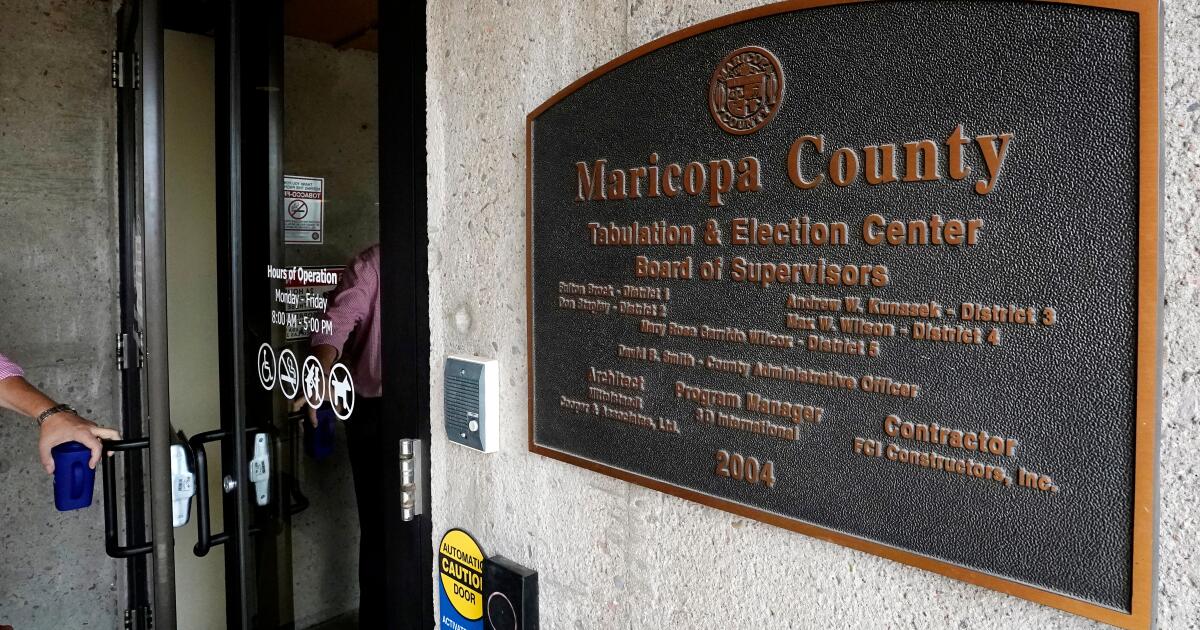
Senate President Warren Petersen said in a social media post that he complied “late last week” with a federal grand jury subpoena for records related to a controversial audit of the election in Maricopa County that had been ordered by legislative Republicans.

“The FBI has the records,” Petersen said.

He did not immediately respond to requests for additional comment, and a spokesperson for Senate Republicans said in an email that Petersen “does not have anything to add outside of his X post at this time.” The FBI office in Phoenix did not immediately respond to a request for comment.

It marks the second time this year that the FBI has obtained records related to the 2020 election from the most populous county in a presidential battleground state, both of which Trump lost as he sought reelection. In January, the FBI seized ballots and other records from Georgia’s Fulton County, which includes Atlanta, after the Justice Department sought a search warrant from a judge. The search warrant affidavit showed that the request relied on years-old claims, many of which had been thoroughly investigated and found to have no connection to widespread fraud.

Arizona Atty. Gen. Kris Mayes, a Democrat, issued a scathing statement in response to Petersen’s post, noting that multiple audits, independent investigations and legal challenges related to the 2020 presidential election found no evidence of widespread fraud that could have affected the outcome.

“Warren Petersen knows all of this. He has known it for years. He spread false stories of election fraud in 2020, and he remains an unrepentant election denier,” Mayes said. “What the Trump administration appears to be pursuing now is not a legitimate law enforcement inquiry. It is the weaponization of federal law enforcement in service of crackpots and lies.”

A firm hired by Republican lawmakers spent six months in 2021 searching for evidence of fraud in the previous year’s presidential election, a process experts said was marred by bias and a flawed methodology. It explored outlandish conspiracy theories, such as dedicating time to checking for bamboo fibers on ballots to see if they were secretly shipped in from Asia.

The audit ended without producing proof to support former President Trump’s false claims of a stolen election — and in fact found that Biden received 360 more votes than stated in the certified results for Maricopa County, which includes Phoenix.

The firm, Cyber Ninjas, also acknowledged that there were “no substantial differences” between its hand count of the ballots and the official count.

Previous reviews of the 2.1 million ballots by nonpartisan professionals who followed state law found no significant problem with the 2020 election in Maricopa County, which was run by Republicans then and now. Biden won the county by 45,000 votes and went on to win Arizona by 10,500 votes.

Federal officials took different routes to obtain election records in the two states. The Georgia case involved a judicially approved search warrant that required the FBI to articulate grounds that probable cause exists to believe a crime was committed. In Arizona, the FBI relied on subpoenas, a law enforcement maneuver that does not require judicial sign-off or prosecutors’ assertion there’s probable cause of a crime.

The investigations into the 2020 election come as the Justice Department has clashed with a number of states, including some controlled by Republicans, over access to detailed voter data that include names, dates of birth, addresses and partial Social Security numbers. Election officials have expressed concerns that providing the information would violate both state and federal data privacy laws, and that it could be used to remove people from state voter rolls.

Arizona is among the states the Justice Department has sued to obtain the voter information. Secretary of State Adrian Fontes, a Democrat, suggested that at least some Maricopa County voter files could be among the records Petersen gave the FBI. In a statement Monday, Fontes said his office was considering legal options “to secure personal voter information in the 2020 data that was shared.”

Calli Jones, a spokesperson for the secretary of state, said the office is assessing what was released to the FBI.

“This could be an end run by the Department of Justice to obtain unredacted voter files,” she said.

Kelety writes for the Associated Press. AP writer Eric Tucker in Washington contributed to this report.

Source link

D4vd ‘target’ of grand jury murder probe into teen found in his Tesla

D4vd is the “target” of a Los Angeles County criminal jury investigation into the death of a teenage girl. The singer’s star was on the rise, with a global tour in his future, before the discovery of the girl’s remains in the front trunk of his Tesla.

The singer, whose real name is David Burke, has been the subject of the probe since November, months after the dismembered body of 14-year-old Celeste Rivas Hernandez was found in the car after it was towed off a street in Hollywood.

According to a grand jury subpoena seeking to have Burke’s father, mother and brother testify in L.A., the musician is described as “Target David Burke,” who may have committed a criminal offense in California, “to wit: One count of Murder.”

The document was part of a legal challenge to the subpoenas filed by the singer’s family in Texas. The newly unsealed documents reveal that, when Los Angeles police opened up the Tesla trunk, they found “a black cadaver bag covered with insects and a strong odor of decay” inside. Investigators had been granted a search warrant to look in the vehicle Sept. 8 after a tow yard worker noticed a rotting smell emanating from the vehicle.

According to the document, detectives partially unzipped the bag and found “a decomposed head and torso.”

Criminalists and medical examiners then processed the body.

“Upon removing the cadaver bag from the front storage compartment, it was discovered the arms and legs had been severed from the body,” the subpoenas noted. “A second black bag was discovered underneath the cadaver bag. Upon opening the second bag, the dismembered body parts were discovered.”

Los Angeles County Deputy Dist. Atty. Beth Silverman issued the subpoenas on Jan. 15, with Superior Court judge Craig Richman approving them.

The First Court of Appeals in Texas on Feb. 9 denied petitions from the three Burke family members to ignore the subpoenas.

Months have passed since the gruesome discovery of the remains of Celeste Rivas Hernandez. Although the LAPD has publicly declined to characterize the girl’s death as a homicide, an LAPD detective referred to the case as a murder investigation in a court filing.

In November, prosecutors began presenting evidence to a grand jury, described at the time as an investigative grand jury, according to a source who spoke on the condition of anonymity because they were not authorized to discuss the case with the media.

Since then, numerous witnesses have been called in to testify, among those, one of the musician’s managers. A friend of D4vd, Neo Langston, was arrested in Montana after ignoring a subpoena and was recently forced to return to L.A. to testify.

In a Texas appeals court footnote, the court refers specifically to the singer’s true name. The court states that the “underlying case” is “The People of the State of California v. David Burke,” pending in the 506th District Court of Waller County, Texas, with Judge Gary W. Chaney presiding. There is no public case with that name, but grand jury proceedings are confidential.

The singer’s father, Dawud, mother, Colleen, and brother, Caleb, reside in Texas, according to court records. Lawyers for the trio could not be reached for comment.

Detectives have spent months investigating the circumstances surrounding the girl’s death, as well as her relationship with D4vd.

His Tesla sat abandoned on a street in the Hollywood Hills for several weeks — potentially months — before its removal.

Authorities uncovered Celeste’s body the day after her 15th birthday. Her family had previously reported her missing.

L.A. Police Capt. Scot Williams, who leads the Robbery-Homicide Division, said the girl had been “dead for at least several weeks.” Williams said the body had not been decapitated or frozen, as some news outlets have reported.

Detectives determined that the Tesla had been parked on Bluebird Avenue since late July — around the time D4vd began a national tour. The tour was canceled soon after the death investigation drew worldwide media attention.

Source link

Rapper Luci4 dies aged 23 at a friend’s house as grandparents ‘claim he was robbed’ and cops launch probe

POPULAR young rapper Luci4 has died, according to his grandparents.

The young musician – best known for his viral hit “BodyPartz” – was just 23 years old.

Luci4 has tragically died at 23, according to his grandparentsCredit: Spotify
The young rapper’s grandparents confirmed his death on MondayCredit: Spotify

His grandparents revealed to TMZ that he had died; however, his cause of death remains unknown.

Police have since launched a probe into his sudden death.

The rising star – whose real name was James Dear – passed away at a friend’s home in Los Angeles on February 22.

The Los Angeles County Medical Examiner has since confirmed his death.

HIP HOP TRAGEDY

Rapper Lil Poppa, 25, dies of ‘gunshot wound to head’


GUNNED DOWN

Rapper Lil OT shot dead in shopping mall car park in ‘targeted’ attack

His grandparents told TMZ they felt suspicious about their grandson’s death.

They have alleged his wallet was completely emptied, saying they had recently warned him about the people he was surrounding himself with as his fame grew.

The circumstances around his death remain unclear.

The rapper’s grandparents said they are now waiting for the results of the police investigation.

Most read in Entertainment

In a statement, the Los Angeles fire department said it had responded to a medical call at the house around 11.40am.

Sadly, he was already dead when help arrived, so the police were called.

It remains unclear if investigators suspect foul play.

Previously known by other stage names including Axxturel, 4jay, and Plasdu, Luci4 showed an interest in music and digital production at a young age.

His career began with music production, where he created beats and tracks that became popular online.

More recently, he had achieved viral fame through social media platforms including TikTok.

Pioneering the microgenre known online as sigilkore, he shot to fame with hit song “BodyPartz” in 2021.

The song was later recognised as a Gold hit by the Recording Industry Association of America (RIAA).

He rose to fame through viral success on TikTokCredit: Spotify
His grandparents suspect foul play, alleging his wallet had been emptied at the time he diedCredit: Spotify

He also penned other popular tracks including All Eyez on Me and Kurxxed Emeraldz.

His success led to him signing with Atlantic Records.

His signing was considered a significant milestone for emerging internet-based artists.

It demonstrated the increasing influence of social media in discovering and promoting new talent.

Luci4 founded the collective Jewelxxet – a primary hub for sigilkore.

The genre is defined by dark, lo-fi atmospheres and bitcrushed vocals coupled with occult imagery.

He was popular largely among the underground music community; however, the new wave of experimental rappers including OsamaSon and Che have credited him as one of their influences.

The young rapper still frequently engaged with his fans and the online music community, staying connected with his roots as an online artist.

His death has sent shock waves through the music community, as fans share their grief online in an outpouring of tributes to social media.

“His 2020/21 run will never b forgotten he changed tiktok,” one person said.

Another posted, “That’s insane wtf.”

“Damn. I’ve been actively listening to him since 2021 casually. Was never a super fan but I have six solid songs that get played weekly. It’s always who u least expect. It makes me so sad listening to songs frm dead artists, never thought I would ever get that sentiment w his,” posted a third.

Another mourner said: “RIP TO A KING.”

“He was definitely one of my favorite artists to listen to during covid era,” said another.

Others have said he “really influenced a whole wave of music”, with some even listening to his songs as early as today.

“I was bumping his music so loud earlier today lil did I know he was gon die the same day,” a fan posted.

Fellow rapper ShowMyFangz posted a tribute to InstagramCredit: Spotify

Source link

FCC reject claims of censorship, announces probe into US show The View | Entertainment News

Brendan Carr, the chair of the Federal Communications Commission (FCC) in the United States, has confirmed that the agency launched an investigation against ABC’s daytime talk show The View over a recent appearance by a politician.

In comments to reporters on Wednesday, Carr indicated the probe would examine whether The View violated a new interpretation of an “equal time” rule implemented under President Donald Trump.

Recommended Stories

list of 3 itemsend of list

Fox News had been the first to report on the investigation in early February. The segment in question involves an appearance from Texas state Representative James Talarico, a Democrat who is vying for the US Senate.

The confirmation comes as Carr attempted to shut down claims that the government censored an interview between Talarico and late-night talk show host Stephen Colbert.

“There was no censorship here at all,” Carr said.

“Every single broadcaster in this country has an obligation to be responsible for the programming that they choose to air, and they’re responsible whether it complies with FCC rules or not, and it doesn’t, and those individual broadcasters are also going to have a potential liability.”

The controversy with Colbert likewise stems from the Trump administration’s decision to shift definitions under the “equal time” rule.

What is the ‘equal time’ rule?

The rule is part of section 315 of the 1934 Communications Act. Under that law, if a broadcaster allows one candidate for public office to use its facilities, it is required to “afford equal opportunities” to all other candidates in the same race.

But the law includes exceptions for “bona fide newscasts” and “bona fide news interviews”.

For nearly 20 years, talk shows and late-night comedy programmes were included in those categories.

In January, however, the FCC issued new guidance (PDF) that significantly narrows how it interprets the “bona fide news” exemption. In a memo, it described daytime talk shows and late-night comedy as “entertainment programs” that fall outside the exception.

“The FCC has not been presented with any evidence that the interview portion of any late night or daytime television talk show program on air presently would qualify for the bona fide news exemption,” the memo reads.

The commission also suggested that many such programmes are “motivated by partisan purposes” and are therefore not “bona fide” news.

The new interpretation of the “equal time” rule, the FCC argued, is designed to “ensure that no legally qualified candidate for office is unfairly given less access to the public airwaves than their opponent.”

Controversy with Colbert

That new interpretation came roaring into the spotlight on Monday, after a broadcast of the CBS comedy programme The Late Show with Stephen Colbert.

In one of his opening segments, Colbert alleged that the network lawyers barred him from airing a planned interview that night with Talarico.

“Let’s just call it what it is,” Colbert told his audience. “Donald Trump’s administration wants to silence anyone who says anything bad about Trump on TV, because all Trump does is watch TV. OK? He’s like a toddler with too much screen time.”

Trump has previously criticised both Colbert’s show and The View for what he considers a left-wing slant.

Instead of broadcasting his interview with Talarico on network television, Colbert instead posted the segment on the programme’s YouTube page, where it has gained more than 6 million views as of 3:30pm Eastern Time (20:30 GMT) on Wednesday.

According to Carr, Colbert’s show could have aired the Talarico interview if it had complied with the equal time rule.

That would have involved allowing other candidates in Texas vying for the Senate seat to come on the show. Carr also suggested that another solution could have been to restrict the broadcast in Texas.

But the FCC has continued to face criticisms for its actions. In Tuesday’s broadcast, Colbert addressed the issue a second time.

He read aloud a statement from his broadcast channel that read, in part, that The Late Show “was not prohibited by CBS from broadcasting the interview” and that it was instead “provided legal guidance that the broadcast could trigger the FCC equal-time rule”.

CBS added, in the statement, that Colbert could have invited onto the show Talarico’s rivals, including fellow Democrat Jasmine Crockett.

“I am well aware that we can book other guests,” Colbert responded. “I didn’t need to be presented with that option. I’ve had Jasmine Crockett on my show twice. I could prove that to you, but the network won’t let me show you her picture without including her opponents.”

Colbert has been a vocal critic of CBS’s parent company, Paramount Global, particularly after it settled a lawsuit last year with the Trump administration for $16m in the run-up to a critical merger for which it needed government approval.

Talarico, meanwhile, accused the FCC of censoring his interviews. Nevertheless, on Wednesday, he noted that the uptick in media attention from the scandal has helped him gather donations.

“Our campaign raised $2.5 million in 24 hours after the FCC banned our Colbert interview,” he wrote on social media.

Source link

New Mexico lawmakers launch probe into Epstein’s Zorro Ranch | Sexual Assault News

The ‘truth commission’ will interview victims who say they were abused at the sprawling property south of Santa Fe.

Lawmakers in the US state of New Mexico have approved the first fully-fledged investigation into Zorro Ranch, a sprawling property where the late sex offender Jeffrey Epstein is alleged to have trafficked and sexually assaulted girls and women.

The legislation, which passed New Mexico’s House of Representatives by a unanimous vote on Monday, forms a bipartisan “truth commission”.

Recommended Stories

list of 4 itemsend of list

Its four members will seek testimony from victims and local residents about the ranch, located about 55km (34 miles) south of the state capital, Santa Fe.

Members are slated to begin work on Tuesday, with an initial update to be delivered in July and a full report by the end of this year.

The move comes in the wake of the release of more than three million previously unpublicised files related to the disgraced financier, who died by suicide in a New York jail cell in 2019 while awaiting trial on federal sex trafficking charges.

State Representative Melanie Stansbury said in a video posted after the vote that the commission will “help to bring forward a full picture of what happened here in New Mexico”.

“The crimes that were reported to federal and state authorities were never fully investigated,” Stansbury said. The probe seeks to “ensure we have safeguards in place not only to hold those individuals accountable, who were complicit, but to ensure that this can never happen again”.

Epstein bought the 7,600-acre (3075-hectare) property, which included a hilltop mansion and private runway, from former New Mexico Democrat Governor Bruce King in 1993.

Victim advocates say Epstein trafficked and sexually abused girls at the so-called “playboy ranch” as early as 1996, including Virginia Giuffre, the prominent victim who accused Epstein and the disgraced British royal Andrew Mountbatten-Windsor of abuse.

Multiple civil lawsuits specify the ranch as a site of abuse. Epstein’s habit of flying “masseuses” to the property – as well as hiring local massage therapists – was also revealed in the Epstein files as part of a ranch manager’s 2007 testimony to the Federal Bureau of Investigation.

Epstein was never charged with crimes related to the site.

“Many of the survivors had experiences in New Mexico, and as we’ve learned, you know, there were local politicians and other people that were aware of what was happening in New Mexico,” said Sigrid McCawley, a lawyer whose law firm has represented hundreds of Epstein survivors.

Yet federal investigators never cast their eye on the property, according to Andrea Romero, a New Mexico state representative who co-sponsored the legislation.

And while New Mexico Attorney General Hector Balderas attempted to kick off a probe in 2019, federal prosecutors asked for it to be put on hold to avoid a “parallel investigation”, he said in a statement.

Epstein “was basically doing anything he wanted in this estate without any accountability whatsoever”, Romero said.

The committee – which will have subpoena power – aims to close that gap by gathering testimony that could be used in future litigation, Romero said. New Mexico’s state attorney general has also allocated a special agent to look into any allegations that arise.

The ranch was sold at a 2023 auction to the family of Don Huffines, a former Republican Texas senator who is now running for Texas state comptroller, the Santa Fe New Mexican media outlet reported. A family spokesperson said they would give investigators “full and complete cooperation”.

Source link