For Angels fans, new team ownership and winning are top priorities
The Angels celebrated their 2026 home opener on Friday, and the fans booed the ceremonial first pitch.
Magic Johnson, the Dodgers’ co-owner and the foremost winner in Los Angeles sports history, threw out the ceremonial first pitch before the Dodgers’ opener. Jeff Kent, just elected to the Hall of Fame, did the honors for the San Francisco Giants.
In Anaheim, John Carpino tossed the first pitch, even with popular alumni such as Torii Hunter and Tim Salmon in the house. Carpino is the Angels’ president, retiring Monday after 16 years in that role and 23 years in all as a loyal executive under Angels owner Arte Moreno.
Moreno thought it would be lovely for Carpino to throw out the first pitch and, under different circumstances, it would have been.
The fans can deal with the aging stadium, the recent lack of marquee signings and the longest playoff drought in the major leagues, but not with Moreno’s spring comment to the Orange County Register that surveys show affordability is the fans’ top priority and “believe it or not, winning is not in their top five.”
So Carpino, as a proxy for Moreno, was booed loudly. Then a few modest choruses of “sell the team” broke out.
Behind the Angels’ dugout, Dave and Chris Bloye of Upland wore red T-shirts. His shirt listed five priorities, in order: Affordability, good experience, safety, peanuts, fan surveys. Her shirt listed five priorities too, starting with “sell the team.” The Bloyes said they have had season tickets for more than 20 years.
“We’ve never had a survey,” Chris Bloye said.
Moreno is competitive, a hardcore fan who regularly attends even spring training games. Perhaps he did not mean his words to come out the way they did.
Moreno declined an interview request from The Times at the owners’ meetings in February. A team spokesman said last week that Moreno would pass on an opportunity to clarify his remarks about fan priorities.
But, if those were indeed the priorities, they would have been reflected by the fans that showed up more than six hours before game time for the free fan festival the Angels throw before the home opener every year.
Surely, the man in the jersey that read “FAN SINCE 81” and the Angels tattoo on his left leg would be here win or lose.

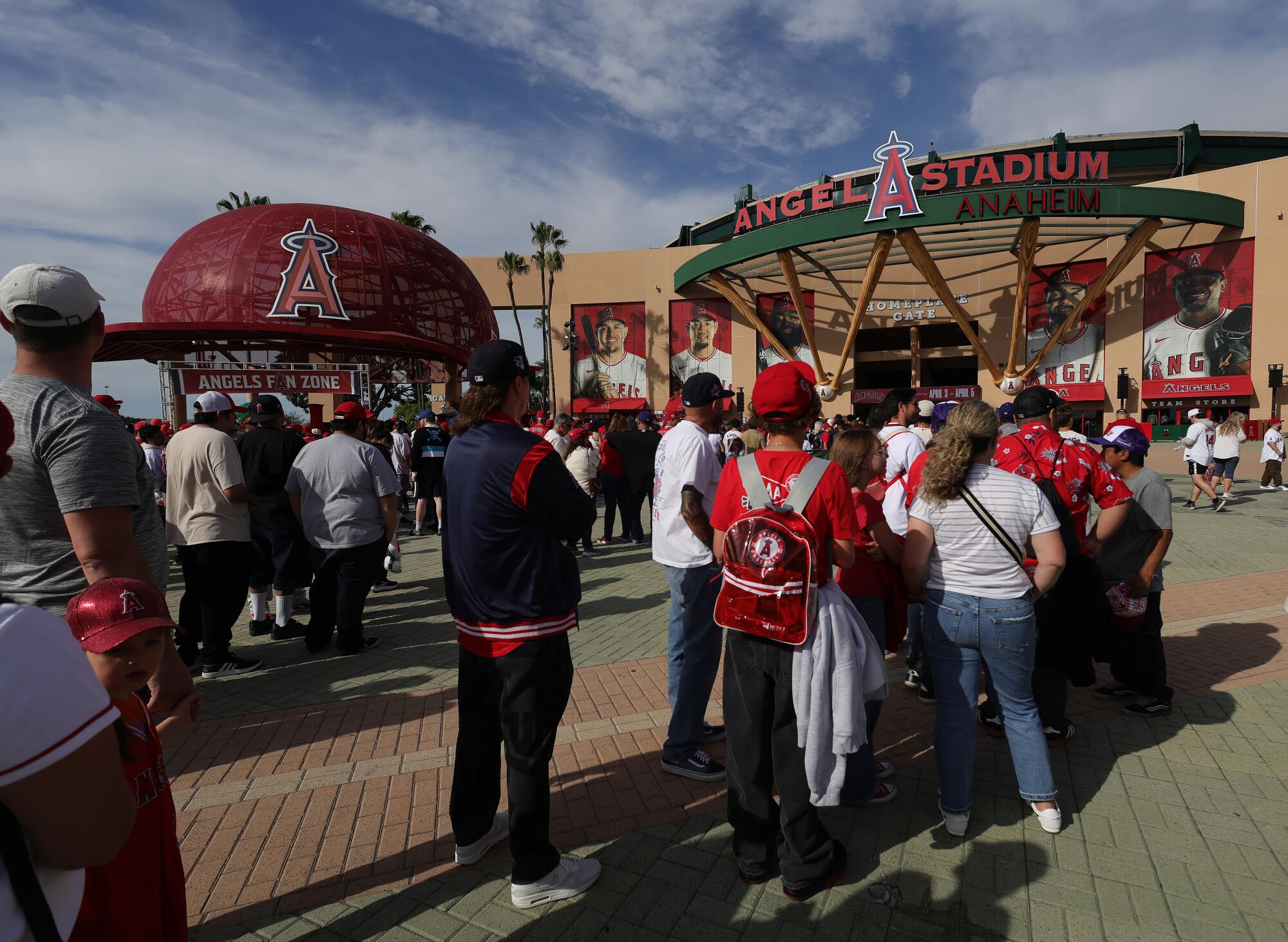
Angels fans stand in front of the stadium before the team’s home opener against the Seattle Mariners on Friday night.
(Ronald Martinez / Getty Images)
Yes, Jose Bocanegra of Chino said, he would be. But for Moreno to say winning was not a top fan priority?
“That’s crazy,” Bocanegra said. “If you’re not in it to win it, then what are we doing?”
How about the fan in the Nolan Ryan jersey? He held his 7-year-old daughter atop his shoulders. She wore a Mike Trout jersey, smiled broadly, and clutched a cup of ice cream.
His name was Nate Ryan, from Hemet. He and his daughter attend Dodgers and Angels games, but they particularly like visits to Angel Stadium. His daughter loves the rally monkey and the free games in the Pac-Man arcade, and he appreciates Moreno’s focus on affordability.
“The Angels are more economical,” Ryan said. “We have a good time.”
At Angel Stadium, $44 gets you four tickets, four hot dogs, and four drinks. At Dodger Stadium, $45 gets you a parking space.
Ryan had one more thing to say.
“I’d like to see a new owner,” Ryan said.
Jarod Venegas of Corona dressed in a white wrap, wearing a red cap topped by a gold halo. He was about to spend nine innings as — you guessed it — an angel in the outfield.
“I believe we have a team that can be the best,” he said.
What exactly do you mean by best?
“I mean World Series champions,” he said.
Venegas had something to say about fan priorities.
“Winning is our No. 2 priority,” he said. “No. 1 is getting a new owner.”
Johnny Estrada of Corona wore a T-shirt with eight lines on the back. All eight lines read the same: “Sell the team.”
He said he loves the team, supports the players, and does not believe Moreno chose his words poorly.
“I don’t necessarily feel it came out wrong,” Estrada said. “I feel he hasn’t cared for a while.”
Anaheim Mayor Ashleigh Aitken, who remains irked by Moreno branding the team with a Los Angeles name, has been a season-ticket holder far longer than she has been mayor. She’ll give Moreno a pass on his comments.
“I think it was a misstep,” Aitken said. “I’m willing to give him the benefit of the doubt. He knows that winning, for a true fan, is one of the most important things. Winning is a priority for our players. Winning is a priority to the loyal fan base.”
Even more so, perhaps, to the casual fans, the ones that determine whether the Angels sell three million tickets in any given year.
The Angels sold 2.6 million tickets last year, a testament to the strength of the market amid a second consecutive last-place finish.

The “Big A” sign outside Angel Stadium on Friday during the team’s home opener.
(Ronald Martinez / Getty Images)
However, attendance has fallen 20% over the past 20 years, a span that includes one postseason series victory and the current streaks of 10 seasons with losing records and 11 seasons without a playoff appearance.
Friday’s home opener was sold out. However, as of Friday afternoon, resale markets listed tickets for as little as $7 for Saturday’s game and $4 for Sunday’s game.
This is a great fan base, to me much more frustrated than angry, waiting to erupt in joy. The fan festival was dominated by fans wearing “sell” jerseys but a variety of Trout jerseys — home white, road gray, alternate red, City Connect, All-Star, World Baseball Classic, even one from the Salt Lake Bees.
Trout’s loyalty has been reciprocated by the fans. Moreno could feel that love too, with a renewed commitment to the excellence the Angels he displayed in his first decade as owner.
In 2002, the year before Moreno bought the team, the stadium was rocking with thunder sticks as the Angels won the World Series. Thunder sticks are so loud that they were banned at the World Baseball Classic finals, even as drums, trumpets and cowbells were permitted.
In Anaheim, the thunder sticks were glorious. Moreno does not want to sell at the moment, so best to demonstrate a dedication to returning October to the Angels’ schedule, lest their fans take home their giveaway calendars from the home opener and start the countdown to “wait ‘til next year.”