President Trump

Ex-CIA Director John Brennan wants ‘favored’ Trump judge kept away from Justice Department inquiry

Lawyers for former CIA Director John Brennan want the Justice Department to be prevented from steering an investigation of him and other former government officials to a “favored” judge in Florida who dismissed the classified documents case against President Trump.

The request Monday is addressed to U.S. District Judge Cecilia Altonaga, the chief judge in the Southern District of Florida, where federal prosecutors have launched a criminal investigation related to the U.S. government assessment of Russian interference in the 2016 presidential election. Brennan and other officials have received subpoenas, and his lawyers say Brennan has been advised by prosecutors that he’s a target of the investigation.

Brennan’s lawyers say the Justice Department is engaged in “judge shopping” and trying to arrange for the case to be handled by U.S. District Judge Aileen Cannon, who issued favorable rulings to Trump during the classified documents case and dismissed it last year. The letter asks Altonaga to exercise her “supervisory authority” as chief judge to ensure that the Justice Department is unable to steer the current election interference investigation into her courtroom.

“In short, we are seeking assurance that any litigation arising out of this grand jury proceeding will be heard by a judge who is selected by the court’s neutral and impartial processes, not by the prosecution’s self-interested maneuvering contrary to the interests of justice,” wrote Brennan’s attorneys, Kenneth Wainstein and Natasha Harnwell-Davis. The New York Times earlier reported on the letter.

It remains unclear what crime prosecutors in Florida believe was committed, but the subpoenas issued last month to Brennan and other former law enforcement and intelligence officials sought documents related to the preparation of the Obama administration’s intelligence community assessment, made public in January 2017, that detailed how Russia waged a covert influence campaign to help Trump defeat Democratic nominee Hillary Clinton.

Trump was investigated but not charged during his first term over whether his campaign conspired with Russia to tip the outcome of the election. He has long sought retribution over the Russia investigation and the officials who played a key part in it.

His Justice Department in September secured a false-statement and obstruction indictment against James Comey, the FBI director at the time the Russia investigation was launched, though the case was dismissed and its future is in doubt because of a judge’s ruling that blocked prosecutors from accessing materials they considered to be key evidence.

Brennan’s lawyers say the Trump administration’s Justice Department tried to “forum-shop” the investigation into Brennan to multiple jurisdictions, including Pennsylvania, before settling in Florida. But they say prosecutors have been unable to answer basic questions about why Florida is a proper venue for the investigation given that the intelligence community assessment at issue was produced by officials in the Washington, D.C., area.

The grand jury investigation is based in the Miami division of the Southern District of Florida, but Brennan’s lawyers say they’re concerned that the Trump administration may be poised to transfer the case to the smaller Fort Pierce division, where Cannon is the only judge. They cited as a basis for that alarm a Justice Department decision to seek an additional grand jury in Fort Pierce even though there’s no apparent caseload need.

“The United States Attorney’s efforts to funnel this investigation to the judge who issued this string of rulings that consistently favored President Trump’s positions in previous litigations should be seen for what it is,” Brennan’s lawyers wrote.

Tucker writes for the Associated Press.

Source link

NSA employee sues Trump administration over order on transgender rights and two ‘immutable’ genders

A transgender employee of the National Security Agency is suing the Trump administration and seeking to block enforcement of a presidential executive order and other policies the employee says violate federal civil rights law.

Sarah O’Neill, an NSA data scientist who is transgender, is challenging President Trump’s Inauguration Day executive order that required the federal government, in all operations and printed materials, to recognize only two “immutable” sexes: male and female.

According to the lawsuit filed Monday in a U.S. District Court in Maryland, Trump’s order “declares that it is the policy of the United States government to deny Ms. O’Neill’s very existence.”

The White House did not immediately respond to a request for comment.

The order, which reflected Trump’s 2024 campaign rhetoric, spurred policies that O’Neill is challenging, as well.

Since Trump’s initial executive action, O’Neill asserts the NSA has canceled its policy recognizing her transgender identity and “right to a workplace free of unlawful harassment,” while “prohibiting her from identifying her pronouns as female in written communications” and “barring her from using the women’s restroom at work.”

O’Neill contends those policies and the orders behind them create a hostile work environment and violate Section VII of the Civil Rights Act. The U.S. Supreme Court ruled in 2020 that Section VII’s prohibition on discrimination based on sex applied to gender identity.

“We agree that homosexuality and transgender status are distinct concepts from sex,” the court’s majority opinion stated. “But, as we’ve seen, discrimination based on homosexuality or transgender status necessarily entails discrimination based on sex; the first cannot happen without the second.”

O’Neill’s lawsuit argued, “The Executive Order rejects the existence of gender identity altogether, let alone the possibility that someone’s gender identity can differ from their sex, which it characterizes as ‘gender ideology.’ ”

In addition to restoring her workplace rights and protections, O’Neill is seeking financial damages.

Trump’s order was among a flurry of executive actions he took hours after taking office. He has continued using executive action aggressively in his second presidency, prompting many legal challenges that are still working their way through the federal judiciary.

Barrow writes for the Associated Press.

Source link

CBS News correspondent accuses Bari Weiss of ‘political’ move in pulling ’60 Minutes’ piece

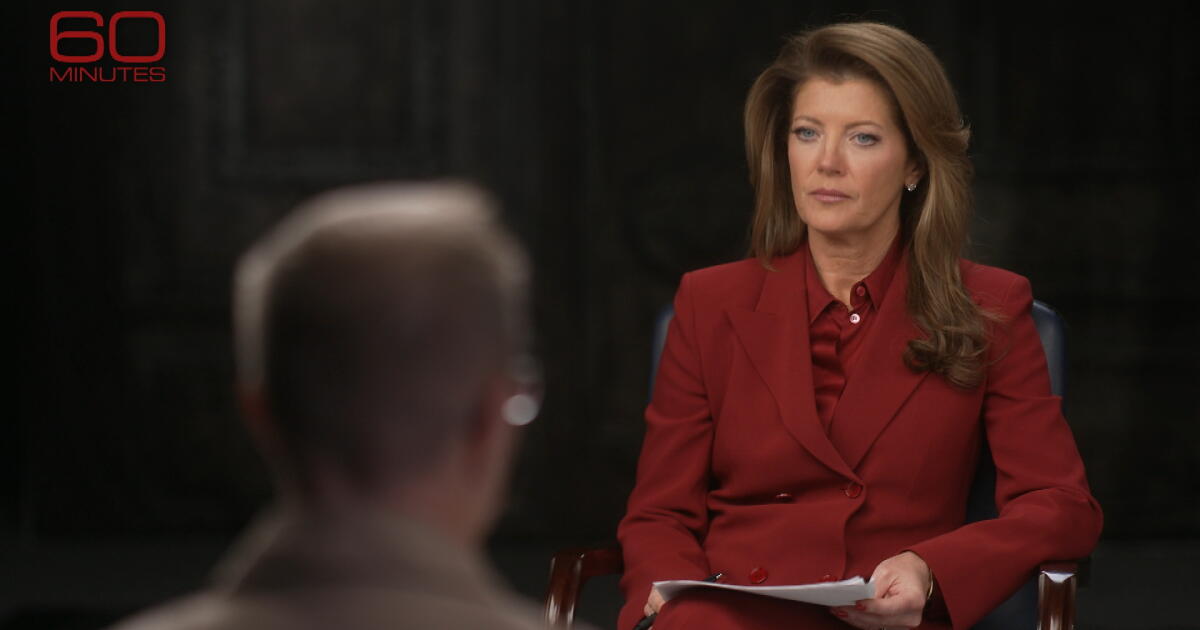
A “60 Minutes” story on the Trump administration’s imprisonment of hundreds of deported Venezuelan migrants to El Salvador was pulled by CBS News Editor-In-Chief Bari Weiss shortly before it was scheduled to air Sunday night.

The unusual decision drew a sharp rebuke from Sharyn Alfonsi, the correspondent for the piece.

Alfonsi said the decision was motivated by politics, according to an email she circulated to colleagues and viewed by the Times. Alfonsi noted that the story was ready for air after being vetted by the network’s attorneys and the standards and practices department.

“It is factually correct,” Alfonsi wrote. “In my view, pulling it now — after every rigorous internal check has been met is not an editorial decision, it is a political one.”

According to the CBS News press department’s description of the segment, Alfonsi spoke to released deportees who described “the brutal and torturous conditions they endured inside CECOT,” one of El Salvador’s harshest prisons.

In a statement, a representative for CBS News said the report called “Inside CECOT” will air in a future “60 Minutes” broadcast. “We determined it needed additional reporting,” the representative said.

Weiss viewed the segment late Thursday, according to people familiar with the matter who were not authorized to comment publicly. She had a number of issues with story and asked for additional reporting, which could not be completed in time for airing on Sunday. A press release promoting the story went out Friday.

Weiss reportedly wanted the story to have an interview with an official in President Trump’s administration.

But Alonsi said in her email the program “requested responses to questions and/or interviews” with the the Department of Homeland Security, the White House and the State Department.

“Government silence is a statement, not a VETO,” Alfonsi wrote. “Their refusal to be interviewed is a tactical maneuver designed to kill the story.”

Alfonsi’s email said she learned the story was pulled on Saturday and that she had not discussed the matter with Weiss.

Even if Weiss’ concerns might be valid, the sudden postponement of a “60 Minutes” piece after it has been promoted on air, on social media and through listings on TV grids is a major snafu for the network.

For Weiss, it’s perilous situation as her every move as a digital media entrepreneur with no experience in television is being closely scrutinized.

As the founder of the conservative-friendly digital news site who was personally recruited by Paramount Chief Executive David Ellison, journalists at CBS News and media industry observers are watching to see if Weiss’ actions are tilting its editorial content to the right.

Before it was acquired by Skydance Media, Paramount agreed to pay $16 million to settle a Trump lawsuit making the dubious claim that a “60 Minutes” interview with Kamala Harris was deceptively edited to aid her 2024 presidential election campaign against him.

Trump recently said “60 Minutes” is “worse” under Paramount’s new ownership following an interview with Rep. Marjorie Taylor Greene, in which she was highly critical of the president and his administration.

Paramount acquired the Free Press for $150 million as part of the deal to bring Weiss over. Her first major move was to air a highly sympathetic town hall with Erika Kirk, the widow of slain right-wing activist Charlie Kirk. Erika Kirk has taken over as head of Turning Point USA, the political organization her husband founded.

Source link

Vance declines to condemn bigotry as conservatives feud at Turning Point

Vice President JD Vance said Sunday that the conservative movement should be open to everyone as long as they “love America,” declining to condemn a streak of antisemitism that has divided the Republican Party and roiled the opening days of Turning Point USA’s annual convention.

After a long weekend of debates about whether the movement should exclude figures such as bigoted podcaster Nick Fuentes, Vance came down firmly against “purity tests.”

“I didn’t bring a list of conservatives to denounce or to de-platform,” Vance said during the Phoenix convention’s closing speech.

Turning Point leader Erika Kirk, who took the helm after the fatal shooting of her husband, Charlie Kirk, has endorsed Vance as a potential successor to President Trump, a helpful nod from an influential group with an army of volunteers.

But the tension on display at the four-day gathering foreshadowed the treacherous political waters that Vance, or anyone else who seeks the next Republican presidential nomination, will need to navigate in the coming years. Top voices in the “Make America Great Again” movement are jockeying for influence as Republicans begin considering a future without Trump, and there is no clear path to holding his coalition together.

Defining a post-Trump GOP

The Republican Party’s identity has been intertwined with Trump for a decade, but he’s constitutionally ineligible to run for reelection despite his musings about serving a third term. Tucker Carlson said people are wondering, “who gets the machinery when the president exits the scene?”

So far, it looks like settling that question will come with a lot of fighting among conservatives. The Turning Point conference featured arguments about antisemitism, Israel and environmental regulations, not to mention rivalries among leading commentators.

Ben Shapiro, co-founder of the conservative media outlet Daily Wire, used his speech on the conference’s opening night to denounce “charlatans who claim to speak in the name of principle but actually traffic in conspiracism and dishonesty.”

“These people are frauds and they are grifters and they do not deserve your time,” Shapiro said. He specifically called out Carlson for hosting Fuentes for a friendly interview on his podcast.

Carlson brushed off the criticism when he took the stage barely an hour later, and he said the idea of a Republican “civil war” was “totally fake.”

“There are people who are mad at JD Vance, and they’re stirring up a lot of this in order to make sure he doesn’t get the nomination,” he said. Carlson described Vance as “the one person” who subscribes to the “core idea of the Trump coalition,” which Carlson said was “America first.”

Turning Point spokesperson Andrew Kolvet framed the discord as a healthy debate about the future of the movement, an uncomfortable but necessary process of finding consensus.

“We’re not hive-minded commies,” he wrote on social media. “Let it play out.”

‘You don’t have to apologize for being white anymore’

Vance acknowledged the controversies that dominated the Turning Point conference, but he did not define any boundaries for the conservative movement besides patriotism.

“We don’t care if you’re white or black, rich or poor, young or old, rural or urban, controversial or a little bit boring, or somewhere in between,” he said.

Vance didn’t name anyone, but his comments came in the midst of an increasingly contentious debate over whether the right should give a platform to commentators espousing antisemitic views, particularly Fuentes, whose followers see themselves as working to preserve America’s white, Christian identity. Fuentes has a growing audience, as does top-rated podcaster Candace Owens, who routinely shares antisemitic conspiracy theories.

“We have far more important work to do than canceling each other,” he said.

Vance ticked off what he said were the accomplishments of the administration as it approaches the one-year mark, noting its efforts at the border and on the economy. He emphasized efforts to end diversity, equity and inclusion policies, drawing applause by saying they had been relegated to the “dustbin of history.”

“In the United States of America, you don’t have to apologize for being white anymore,” he said.

Vance also said the U.S. “always will be a Christian nation,” adding that “Christianity is America’s creed, the shared moral language from the Revolution to the Civil War and beyond.”

Those comments resonated with Isaiah White-Diller, an 18-year-old from Yuma, Ariz., who said he would support Vance if he runs for president.

“I have my right to be Christian here, I have my right to say whatever I want,” White-Diller said.

Turning Point backs Vance

Vance hasn’t disclosed his future plans, but Erika Kirk said Thursday that Turning Point wanted Vance “elected for 48 in the most resounding way possible.” The next president will be the 48th in U.S. history.

Turning Point is a major force on the right, with a nationwide volunteer network that can be especially helpful in early primary states, when candidates rely on grassroots energy to build momentum. In a surprise appearance, rapper Nicki Minaj spoke effusively about Trump and Vance.

Vance was close with Charlie Kirk, and they supported each other over the years. After Kirk’s killing on a college campus in Utah in September, the vice president flew out on Air Force Two to collect Kirk’s remains and bring them home to Arizona. Vance helped uniformed service members carry the casket to the plane.

Emily Meck, 18, from Pine City, N.Y., said she appreciated Vance making space for what she called a wide variety of views.

“We are free-thinkers, we’re going to have these disagreements, we’re going to have our own thoughts,” Meck said.

Trump has spoken highly of both Vance and Secretary of State Marco Rubio as potential successors, even suggesting they could form a future Republican ticket. Rubio has said he would support Vance.

Asked in August whether Vance was the “heir apparent,” Trump said, “Most likely.”

“It’s too early, obviously, to talk about it, but certainly he’s doing a great job, and he would be probably [the] favorite at this point,” he said.

Cooper and Govindarao write for the Associated Press.

Source link

Nicki Minaj takes stage with Erika Kirk, praises Trump and mocks Newsom

Fireworks lit the stage and the audience roared as pop star Nicki Minaj walked out hand-in-hand with Erika Kirk Sunday in a surprise appearance at Turning Point USA’s annual convention in Phoenix.

“I love this woman; she is an amazing woman,” said Kirk, the widow of Charlie Kirk, who headed the right-wing student organization until he was killed in September. “Words are words, but I know her heart.”

Minaj, who has surprised some fans in recent months by embracing the MAGA movement, praised President Trump and mocked California Gov. Gavin Newsom.

“I have the utmost respect and admiration for our president,” Minaj said. “I don’t know if he even knows this but he has given so many people hope that there is a chance to beat the bad guys and to win and to do it with your head held high.”

Minaj then read some of her former social media posts mocking Newsom, calling him “Newscum” and “Gavie-poo.”

“Imagine being the guy running on wanting to see trans kids, haha, not even a trans adult would run on that,” she said. “Normal adults wake up and think they want to see healthy, safe, happy kids — not Gav.”

Minaj then urged boys to “be boys.”

“There is nothing wrong with being a boy,” she said. “How about that? How powerful is that? How profound is that? Boys will be boys and there is nothing wrong with that.”

Minaj praised Turning Point USA, saying the organization is encouraging youth to connect with God.

“There has been a lack of that in our media, in our everyday conversations,” she said. “Christians have been being persecuted right here in our country in different ways.”

Minaj drew attention from the Trump administration in November, when she publicly backed the president’s assertions that Christians face persecution in Nigeria, a claim the Nigerian government has disputed.

Source link

Trump issues a phony pardon for election fraudster Tina Peters

Just in time for the holidays, President Trump has issued another of his dubious pardons. Or rather, make that a “pardon.”

This one comes on behalf of a former Colorado elections official serving a nine-year sentence for election fraud.

“Democrats have been relentless in their targeting of TINA PETERS, a Patriot who simply wanted to make sure our elections were fair and honest,” Trump said in a typically gaseous, dissembling post on social media.

“Tina is sitting in a Colorado prison for the ‘crime’ of demanding Honest Elections,” the president went on. “Today I am granting Tina a full pardon for her attempts to expose voter fraud in the rigged 2020 Presidential Election.”

Actually, Peters’ crime was conspiring to let an unauthorized person access voting equipment as part of a nutty scheme to “prove” the November 2020 balloting was bogus, then lying and covering up her illegal actions.

And she’s not likely to leave jail anytime soon.

That’s because Trump has precisely zero say over Peters’ fate, given the former Mesa County elections chief was convicted on state charges. The president’s pardon power — which Trump has twisted to a snapping point — extends only to federal cases. If we’re going to play make-believe, then perhaps Foo-Foo the Snoo can personally escort Peters from prison and crown her Queen of the Rockies.

That’s not to suggest, however, that Trump’s empty gesture was harmless. (Apologies to Foo-Foo and Dr. Seuss.)

Some extremists, ever ready to do Trump’s malevolent bidding, have taken up Peters’ cause, using the same belligerent language that foreshadowed the Jan. 6, 2021, attack on the U.S. Capitol. In fact, threats have come from some of the very same thugs whom Trump pardoned in one of the first shameless acts of his presidency.

“WE THE PEOPLE ARE COMING TO BREAK TINA PETERS OUT OF PRISON IN 45 DAYS,” Jake Lang, a rioter who was charged with attacking police with an aluminum baseball bat, said on social media. “If Tina M. Peters is not released from La Vista Prison in Colorado to Federal Authorities by January 31st, 2026; US MARSHALS & JANUARY 6ERS PATRIOTS WILL BE STORMING IN TO FREE TINA!!”’

(Capitalization and random punctuation are apparently the way to show fervency as well as prove one’s MAGA bona fides.)

Enrique Tarrio, the former head of the Proud Boys extremist group whom Trump also pardoned, shared a screenshot of the president’s social media post. “A battle,” Tarrio said, “is coming.”

Trump’s pretend pardon is not the first intervention on Peters’ behalf.

In March, the Justice Department asked a federal judge to free her from prison, saying there were “reasonable concerns” about the length of Peters’ sentence. The judge declined.

In November, the administration wrote the Colorado Department of Corrections and asked that Peters be transferred to federal custody, which would presumably allow for her release. No go.

Earlier this month, apparently looking to up the pressure, the Justice Department announced an investigation of the state’s prison system. (Perhaps Peters was denied the special “magnetic mattress” she requested at her sentencing, to help deal with sleep issues.)

Like any child, when Trump doesn’t get his way he calls people names. On Monday, he set his sights on Colorado’s Democratic governor, Jared Polis — “a weak and pathetic man” — for refusing to spring Peters from state prison.

“The criminals from Venezuela took over sections of Colorado,” Trump said, “and he was afraid to do anything, but he puts Tina in jail for nine years because she caught people cheating.”

The only true part of that statement is that Colorado does, in fact, exist.

While Trump portrays Peters as a martyr, she is nothing of the sort.

As Polis noted in response to Trump’s “pardon,” she was prosecuted by a Republican district attorney and convicted by a jury of her peers — a jury, it should be noted, that was drawn from the citizenry of Mesa County. The place is no liberal playpen. Voters in the rugged enclave on Colorado’s Western Slope backed Trump all three times he ran for president, by margins approaching 2-to-1.

If Peters’ sentence seems harsh — which it does — hear what the judge had to say.

Peters was motivated not by principle or a search for the truth but rather, he suggested, vanity and personal aggrandizement. She betrayed the public trust and eroded faith in an honestly run election to ingratiate herself with Trump and others grifting off his Big Lie.

“You are as privileged as they come and you used that privilege to obtain power, a following and fame,” Judge Matthew Barrett told Peters in a lacerating lecture. “You’re a charlatan who used and is still using your prior position in office to peddle a snake oil that’s been proven to be junk time and time again.”

Peters remains unrepentant.

In petitioning Trump for a pardon, her attorney submitted nine pages of cockamamie claims, asserting that Peters was the victim of a conspiracy involving, among others, voting-machine vendors, Colorado’s secretary of state and the Venezuelan government.

To her credit, Peters has rejected calls for violence to set her free.

“Tina categorically DENOUNCES and REJECTS any statements or OPERATIONS, public or private, involving a ‘prison break’ or use of force against La Vista or any other CDOC facility in any way,” a post on social media stated, again with the random capitalization.

Perhaps the parole board will take note of those sentiments when the 70-year-old Peters becomes eligible for conditional release in January 2029, a date that just happens to coincide with the end of Trump’s term.

Which seems fitting.

Keep Peters locked up until then, serving as an example and deterrent to others who might consider emulating her by vandalizing the truth and attacking our democracy.

Source link

Lawmakers weigh impeachment articles for Bondi over Epstein file omissions

Lawmakers unhappy with Justice Department decisions to heavily redact or withhold documents from a legally mandated release of files related to Jeffrey Epstein threatened Saturday to launch impeachment proceedings against those responsible, including Pam Bondi, the U.S. attorney general.

Democrats and Republicans alike criticized the omissions, while Democrats also accused the Justice Department of intentionally scrubbing the release of at least one image of President Trump, with Senate Minority Leader Chuck Schumer (D-N.Y.) suggesting it could portend “one of the biggest coverups in American history.”

Trump administration officials have said the release fully complied with the law, and that its redactions were crafted only to protect victims of Epstein, a disgraced financier and convicted sex offender accused of abusing hundreds of women and girls before his death in 2019.

Rep. Ro Khanna (D-Fremont), an author of the Epstein Files Transparency Act, which required the release of the investigative trove, blasted Bondi in a social media video, accusing her of denying the existence of many of the records for months, only to push out “an incomplete release with too many redactions” in response to — and in violation of — the new law.

Khanna said he and the bill’s co-sponsor, Rep. Thomas Massie (R-Ky.), were “exploring all options” for responding and forcing more disclosures, including by pursuing “the impeachment of people at Justice,” asking courts to hold officials blocking the release in contempt, and “referring for prosecution those who are obstructing justice.”

“We will work with the survivors to demand the full release of these files,” Khanna said.

He later added in a CNN interview that he and Massie were drafting articles of impeachment against Bondi, though they had not decided whether to bring them forward.

Massie, in his own social media post, said Khanna was correct in rejecting the Friday release as insufficient, saying it “grossly fails to comply with both the spirit and the letter of the law.”

The lawmakers’ view that the Justice Department’s document dump failed to comply with the law echoed similar complaints across the political spectrum Saturday, as the full scope of redactions and other withholdings came into focus.

The frustration had already sharply escalated late Friday, after Fox News Digital reported that the names and identifiers of not just victims but of “politically exposed individuals and government officials” had been redacted from the records — which would violate the law, and which Justice Department officials denied.

Among the critics was Rep. Marjorie Taylor Greene (R-Ga.), who cited the Fox reporting in an exasperated post late Friday to X.

“The whole point was NOT to protect the ‘politically exposed individuals and government officials.’ That’s exactly what MAGA has always wanted, that’s what drain the swamp actually means. It means expose them all, the rich powerful elites who are corrupt and commit crimes, NOT redact their names and protect them,” Greene wrote.

Senior Justice Department officials later called in to Fox News to dispute the report. But the removal of a file published in the Friday evening release, capturing a desk in Epstein’s home with a drawer filled of photos of Trump, reinforced bipartisan concerns that references to the president had been illegally withheld.

In a release of documents from the Epstein family estate by the House Oversight Committee this fall, Trump’s name was featured over 1,000 times — more than any other public figure.

“If they’re taking this down, just imagine how much more they’re trying to hide,” Schumer wrote on X. “This could be one of the biggest coverups in American history.”

Several victims also said the release was insufficient. “It’s really kind of another slap in the face,” Alicia Arden, who went to the police to report that Epstein had abused her in 1997, told CNN. “I wanted all the files to come out, like they said that they were going to.”

Trump, who signed the act into law after having worked to block it from getting a vote, was conspicuously quiet on the matter. In a long speech in North Carolina on Friday night, he did not mention it.

However, White House officials and Justice Department leaders strongly pushed back against the notion that the release was somehow incomplete or out of compliance with the law, or that the names of politicians had been redacted.

“The only redactions being applied to the documents are those required by law — full stop,” said Deputy Atty. Gen. Todd Blanche. “Consistent with the statute and applicable laws, we are not redacting the names of individuals or politicians unless they are a victim.”

Other Republicans defended the administration. Rep. James Comer (R-Ky.), chair of the House Oversight Committee, said the administration “is delivering unprecedented transparency in the Epstein case and will continue releasing documents.”

Epstein died in a Manhattan jail awaiting trial on sex trafficking charges. He’d been convicted in 2008 of procuring a child for prostitution in Florida, but served only 13 months in custody in what many condemned as a sweetheart plea deal for a well-connected and rich defendant.

Epstein’s crimes have attracted massive attention, including among many within Trump’s own political base, in part because of unanswered questions surrounding which of his many powerful friends may have also been implicated in crimes against children. Some of those questions have swirled around Trump, who was friends with Epstein for years before the two had what the president has described as a falling out.

Evidence has emerged in recent months that suggests Trump may have had knowledge of Epstein’s crimes during their friendship.

Epstein wrote in a 2019 email, released by the House Oversight Committee, that Trump “knew about the girls.” In a 2011 email to Ghislaine Maxwell, who was convicted of conspiring with Epstein to help him sexually abuse girls, Epstein wrote that “the dog that hasn’t barked is trump. [Victim] spent hours at my house with him … he has never once been mentioned.”

Trump has ardently denied any wrongdoing.

The records released Friday contained few if any major new revelations, but did include a complaint against Epstein filed with the FBI back in 1996 — which the FBI did little with, substantiating longstanding fears among Epstein’s victims that his crimes could have been stopped years earlier.

Sen. Adam Schiff (D-Calif.), one of the president’s most consistent critics, wrote on X that Bondi should appear before the Senate Judiciary Committee to explain under oath the extensive redactions and omissions, which he called a “willful violation of the law.”

“The Trump Justice Department has had months to keep their promise to release all of the Epstein Files,” Schiff wrote. “Epstein’s survivors and the American people need answers now.”

Source link

TikTok creators welcome deal to keep app in the U.S.

Only a few years ago, Keith Lee was a professional MMA fighter, doing food delivery and making social media videos to ease his social anxiety.

On Thursday night, however, Lee found himself under the glare of bright lights and walking the red carpet outside the historic Hollywood Palladium on Sunset Boulevard about to be recognized as TikTok’s “Creator of the Year.”

He and hundreds of other creators had gathered for TikTok’s first American awards show. And they had good reason to celebrate.

Only a few minutes before the start of the inaugural show, they got word about a deal that would allow TikTok to keep operating in the U.S. through a joint venture controlled by a group of U.S. investors that includes tech giant Oracle Corp. TikTok confirmed the deal in an email to employees and said it is expected to close next month.

“[TikTok] is the best way to reach people and I know so many people who rely on it to support their families,” said Lee, who has 17.3 million followers of his casual restaurant reviews. “For me, it’s my career now so I can’t imagine it not being around.”

Creators — many of whom are based in Southern California — rely on the app as a key source of income, while businesses and brands turn to the platform and its influencers to promote their products.

Many had worried that the app might disappear after the Supreme Court upheld a ban on the platform because of national security concerns raised by President Trump in 2020.

Trump subsequently allowed TikTok, which has offices in Culver City, to keep operating in the U.S. and in September signed an executive order outlining the new joint venture.

Comedy creator Adam W., who attended the awards show, called the news “game changing.”

With 22.6 million followers on TikTok, Adam W. has amassed a massive audience for his videos that parody pop culture trends.

In one, he’s a contestant on “The Bachelor,” surrounded by a line of lookalike blond models; in another, he’s drinking matcha lattes with Will Smith.

“That’s so good to hear,” said Adam W. of the new ownership. “So many people are able to make careers off of TikTok. There’s so many people out there who go to TikTok to get away from their reality and it means a lot to them, so I think it’s really valuable for us to have.”

TikTok said the awards show is intended to celebrate the influencers who’ve helped transform the app into a global force that has shaped the way younger Americans shop and consume entertainment.

“You represent a truly global community of over 1 billion people on TikTok,” Kim Farrell, the app’s global head of creators, said at the event. “This year, you showed the world just how much impact creators have.”

Despite the historic moment, the awards show was not without technical glitches. Screens that were intended to display clips of contestants and visuals during speeches were dark the entire night.

The two-hour show, in which creators received awards in several categories, featured a range of skits parodying TikTok cultural moments, from Jools Lebron telling the crowd to “be demure,” to Rei Ami of K-Pop Demon Hunters shooting a Labubu cannon into the crowd.

“TikTok definitely changed my life,” Lee said in an interview. “I always planned my life around food, so I’m blessed to just turn the camera on and do the same thing.”

The new ownership of TikTok should allow the app to rebound after it lost market share amid uncertainty over its future, said Max Willens, an analyst at EMarketer.

“This past year, because a lot of advertisers weren’t really sure whether TikTok was going to stay or go, it did kind of slow the momentum that we had seen on that platform,” Willens said. “We think that moving forward that is going to wind up just being a blip.”

Source link

Jury finds Judge Hannah Dugan guilty of obstruction for helping an immigrant evade federal agents

A jury found a Wisconsin judge accused of helping a Mexican immigrant dodge federal authorities guilty of obstruction Thursday, marking a victory for President Trump as he continues his sweeping immigration crackdown across the country.

Federal prosecutors charged Milwaukee County Circuit Judge Hannah Dugan with obstruction, a felony, and concealing an individual to prevent arrest, a misdemeanor, in April. The jury acquitted her on the concealment count, but she still faces up to five years in prison on the obstruction count.

The jury returned the verdicts after deliberating for six hours. Dugan faces up to five years in prison when she’s sentenced, but no date had been set as of late Thursday evening.

The case inflamed tensions over Trump’s immigration crackdown, with his administration branding Dugan an activist judge and Democrats countering that the administration was trying to make an example of Dugan to blunt judicial opposition to the operation.

Dugan and her attorneys left the courtroom, ducked into a side conference room and closed the door without speaking to reporters. Steve Biskupic, her lead attorney, later told reporters that he was disappointed with the ruling and didn’t understand how the jury could have reached a split verdict since the elements of both charges were virtually the same.

U.S. Atty. Brad Schimel denied the case was political and urged people to accept the verdict peacefully. He said courthouse arrests are safer because people are screened for weapons and it isn’t unfair for law enforcement to arrest wanted people in courthouses.

“Some have sought to make this about a larger political battle,” Schimel said. “While this case is serious for all involved, it is ultimately about a single day, a single bad day, in a public courthouse. The defendant is certainly not evil. Nor is she a martyr for some greater cause.”

U.S. Deputy Atty. Gen. Todd Blanche praised the verdict on X, saying nobody is above the law, even judges.

According to court filings that include an FBI affidavit and a federal grand jury indictment, immigration authorities traveled to the Milwaukee County courthouse on April 18 after learning 31-year-old Eduardo Flores-Ruiz had reentered the country illegally and was scheduled to appear before Dugan for a hearing in a state battery case.

Dugan learned that agents were in the corridor outside her courtroom waiting for Flores-Ruiz. She left the courtroom to confront them, falsely telling them their administrative warrant for Flores-Ruiz wasn’t sufficient grounds to arrest him and directing them to go to the chief judge’s office.

While the agents were gone, she addressed Flores-Ruiz’s case off the record, told his attorney that he could attend his next hearing via Zoom and led Flores-Ruiz and the attorney out a private jury door. Agents spotted Flores-Ruiz in the corridor, followed him outside and arrested him after a foot chase. The U.S. Department of Homeland Security announced in November he had been deported.

Prosecutors worked during Dugan’s trial to show that she directed agents to the chief judge’s office to create an opening for Flores-Ruiz to escape.

An FBI agent who led the investigation testified that after agents left the corridor, she immediately moved Flores-Ruiz’s case to the top of her docket, told him that he could appear for his next hearing via Zoom and led him out the private door.

Prosecutors also played audio recordings from her courtroom in which she can be heard telling her court reporter that she’d take “the heat” for leading Flores-Ruiz out the back.

Her attorneys countered that she was trying to follow courthouse protocols that called for court employees to report any immigration agents to their supervisors and she didn’t intentionally try to obstruct the arrest team.

Richmond writes for the Associated Press.

Source link

Rep. Elise Stefanik ends her campaign for N.Y. governor and won’t seek reelection to House

Rep. Elise Stefanik announced Friday that she is suspending her campaign for New York governor and will not seek reelection to Congress, bowing out of the race in a surprise statement that said “it is not an effective use of our time” to stay in what was expected to be a bruising Republican primary.

Stefanik, a Republican ally of President Trump, said in a post on X that she was confident of her chances in the primary against Bruce Blakeman, a Republican county official in New York City’s suburbs. But she said she wanted to spend more time with her young son and family.

“I have thought deeply about this and I know that as a mother, I will feel profound regret if I don’t further focus on my young son’s safety, growth, and happiness — particularly at his tender age,” she said.

Stefanik has been an intense critic of incumbent Democratic Gov. Kathy Hochul, who is also seeking reelection but faces a primary challenge from her own lieutenant governor, Antonio Delgado.

The announcement marks an abrupt end, at least for now, for a once-promising career for Stefanik. She was the youngest woman ever elected to Congress when she won her first campaign in 2014 at just 30 years old, representing a new generation of Republicans making inroads in Washington. She ultimately rose to her party’s leadership in the House when she became the chair of the House Republican Conference in 2021.

First viewed as a moderate when she came to Washington, Stefanik became far more conservative as Trump began to dominate the party. Once someone who refused to say Trump’s name, she became one of his top defenders during his first impeachment inquiry. She would go on to vote against certifying the 2020 election results, even after a violent mob stormed the Capitol on Jan. 6.

Stefanik was expected to have a bitter Republican primary against Blakeman, who also counts himself as an ally of Trump. The president had so far seemed keen on avoiding picking a side in the race, telling reporters recently: “He’s great, and she’s great. They’re both great people.”

Stefanik’s decision follows a clash with Speaker Mike Johnson, whom she accused of lying before embarking on a series of media interviews criticizing him. In one with the Wall Street Journal, she called Johnson a “political novice” and said he wouldn’t be reelected speaker if the vote were held today.

The tumultuous early December episode appeared to cool when Johnson said he and Stefanik had a “great talk.”

“I called her and I said, ‘Why wouldn’t you just come to me, you know?’” Johnson said. “So we had some intense fellowship about that.”

Still, Stefanik, the chairwoman of the House Republican leadership, has not fully walked back her criticisms. A Dec. 2 social media post remains online in which, after a provision she championed was omitted from a defense authorization bill, Stefanik accused Johnson of falsely claiming he was unaware of it, calling it “more lies from the Speaker.”

State Republican Chairman Ed Cox said the party respected Stefanik’s decision and thanked her for her efforts.

“Bruce Blakeman has my endorsement and I urge our State Committee and party leaders to join me,” Cox said in a prepared statement. “Bruce is a fighter who has proven he knows how to win in difficult political terrain.”

Izaguirre writes for the Associated Press. AP writers Steven Sloan and Joey Cappelletti contributed from Washington.

Source link

Young conservative women find a home in Turning Point with Charlie Kirk’s widow at the helm

Camdyn Glover used to be a quiet conservative. She worried what her teachers would think or if she would lose friends over her convictions. But she said something changed when Charlie Kirk was assassinated in September, and she started crying in her classroom at Indiana University while other students cheered and clapped.

“We can’t be silenced,” Glover decided.

Now she’s visiting Phoenix with her parents and brothers for this year’s Turning Point USA conference, the first to take place since Kirk’s death. Although the organization became a political phenomenon with its masculine appeals to college men, it’s also been expanding outreach to young women like Glover. The shift is poised to accelerate now that Turning Point is led by Erika Kirk, Charlie’s widow, who has embraced her new role at the helm of a conservative juggernaut with chapters across the country.

If successful, the organization that helped return President Trump to the White House could narrow a gender divide that has been a persistent challenge for Republicans. Turning Point offers a blend of traditional values, such as encouraging women to prioritize marriage over careers, and health trends pushed by online influencers.

Glover, 18, said discovering Turning Point in high school gave her an appreciation for dialogue when she felt like an outcast for her beliefs, such as being anti-abortion. At her first conference, she feels like she’s found a political and cultural home for herself.

“They want to promote a strong independent woman who does hold these values and can go stand up for herself,” she said. “But it’s also OK to do it in heels, put some makeup on, wear a dress.”

‘If Erika can do it, I can do it’

One of Glover’s classmates, Stella Ross, said she stumbled upon Charlie Kirk on TikTok in the months before the last presidential election.

She already felt like her perspectives were being treated differently on campus and thought she was receiving unfairly low grades in her political science classes. A devout Catholic, Ross said she was inspired by how Charlie Kirk wasn’t afraid to weave his evangelical faith into his political arguments.

She also noticed how many women posted comments of appreciation on Erika Kirk’s videos, and she joined Indiana University’s Turning Point chapter in the same month that Trump won his comeback campaign.

“I was like, wow, if Erika can do it, I can do it,” Ross said.

Ross has career aspirations of her own — she interns with Indiana’s Republican Party and aspires to be a press secretary for a governor or president. But she hopes to have flexibility in her job to be fully present with her children and believes that a traditional nuclear structure — man, woman and their children — is “God’s plan.”

When she thinks of Erika Kirk, “it’s really cool to see that she can live out that balance and it makes me feel like that could be a more realistic future for me because I’m seeing it firsthand.”

A new messenger

Erika Kirk often appeared alongside with her husband at Turning Point events. A former beauty pageant winner who has worked as a model, actress and casting director, she also founded a Christian clothing line and a ministry that teaches about the Bible.

In a recent interview with The New York Times, she said she had fully bought into “boss babe” culture before Charlie showed her a “healthier” perspective on life. Now she leads the multimillion-dollar organization, which she said at a memorial for her husband would be made “10 times greater through the power of his memory.”

The political gap between young men and women has been growing for years, according to a recent Gallup analysis. Not only have women under 30 become more likely to identify as ideologically liberal, they’ve also embraced liberal views on issues such as abortion, the environment and gun laws.

The schism was clearly apparent in the last presidential election, where 57% of male voters under 30 supported Trump, compared to only 41% of women under 30, according to AP VoteCast.

Turning Point has been working to change that, hosting events like the Young Women’s Leadership Summit and urging attendees to embrace traditional family values and gender roles.

Charlie Kirk said earlier this year that if a young woman’s priority is to find a husband, she should go to college for a “MRS degree.” Matthew Boedy, a professor of rhetoric at University of North Georgia, said Erika Kirk could be a more effective messenger because she was focused on her career before meeting her husband.

“I do think her story resonates more because she tried it out and can tell them it is not for them,” he said.

Some conservative women are turned off by this approach. Raquel Debono, an influencer who lives in New York City, described the event as a “Stepford wives conference,” featuring women in pink floral dresses.

She said Turning Point’s emphasis on being traditional wives “leaves out a lot of women who work,” she said, “and I think they’re going to lose all those voters, honestly, in the next election cycle if they keep it up.”

Debono founded her own organization, Make America Hot Again, where she throws parties intended to make voters feel welcomed into the conservative movement and allow them to get to know people who share their politics.

‘Big time’ growth for some chapters

Aubree Hudson had been president of Turning Point’s chapter at Brigham Young University for only two weeks when she visited nearby Utah Valley University for an event with Charlie Kirk.

She said she was standing only about six feet away when he was fatally shot. She ran to find her husband, who was at the back of the crowd, and they fled to her car.

Hudson, 22, is from a rural farm town in southwestern Colorado. Her conservative convictions are rooted in her family’s faith and patriotism. A copy of the U.S. Constitution hangs in her parents’ home, and her father taught her to value God, family and country, in that order. Her mother stayed at home, telling her children that “you guys are my career.”

Since Kirk’s assassination, Hudson said the number of people — particularly women — getting involved with the organization jumped “big time.”

Emma Paskett, 18, is one of them. She was planning to attend the Utah Valley University event after one of her classes, but Kirk was shot before she made it there.

Although she wasn’t very familiar with Turning Point before that point, Paskett said she started watching videos of Kirk later that night.

Paskett considers Erika Kirk to be a “one in a million” role model, and her role as a leader was a driving factor in signing up.

“That’s exactly what I want to be like,” she said.

Govindarao writes for the Associated Press. AP writer Amelia Thomson-DeVeaux contributed to this report from Washington.

Source link

Rubio fields questions on Russia-Ukraine, Gaza and Venezuela

Secretary of State Marco Rubio weighed in on Russia-Ukraine and Israel-Hamas peace efforts and defended the Trump administration’s increasing military pressure on Venezuela during a rare, end-of-year news conference Friday.

In a freewheeling meeting with reporters running more than two hours, Rubio also defended President Trump’s radical overhaul in foreign assistance and detailed the administration’s work to reach a humanitarian ceasefire in Sudan in time for the new year.

Rubio’s appearance in the State Department briefing room comes as key meetings on Gaza and Russia-Ukraine are set to be held in Miami on Friday and Saturday after a tumultuous year in U.S. foreign policy. Rubio has assumed the additional role of national security advisor and emerged as a staunch defender of Trump’s “America First” priorities on issues ranging from visa restrictions to a shakeup of the State Department bureaucracy.

The news conference is taking place just hours before Trump’s special envoy Steve Witkoff meets with senior officials from Egypt, Turkey and Qatar to discuss the next phase of the Republican president’s Gaza ceasefire plan, progress on which has moved slowly since it was announced in October.

Witkoff and other U.S. officials, including Trump son-in-law and informal advisor Jared Kushner, have been pushing to get the Gaza plan implemented by setting up a “Board of Peace” that will oversee the territory after two years of war and create an international stabilization force that would police the area.

On Saturday, Witkoff, Kushner and Rubio, who will be at his home in Florida for the holidays, are to meet with Russian President Vladimir Putin’s adviser Kirill Dmitriev in Miami to go over the latest iteration of a U.S.-proposed plan to end the Russia-Ukraine war.

Rubio said there would be no peace deal unless both Ukraine and Russia can agree to the terms, making it impossible for the U.S. to force a deal on anyone. Instead, the U.S. is trying to “figure out if we can nudge both sides to a common place.”

“We understand that you’re not going to have a deal unless both sides have to give, and both sides have to get,” Rubio said. “Both sides will have to make concessions if you’re going to have a deal. You may not have a deal. We may not have a deal. It’s unfortunate.”

The U.S. proposal has been through numerous versions with Trump seesawing back and forth between offering support and encouragement for Ukraine and then seemingly sympathizing with Putin’s hard-line stances by pushing Ukrainian President Volodymyr Zelensky to agree to territorial concessions. Kyiv has rejected that concession in return for security guarantees intended to protect Ukraine from future Russian incursions.

On Venezuela, Rubio has been a leading proponent of military operations against suspected drug-running vessels that have been targeted by the Pentagon in the Caribbean Sea and the eastern Pacific Ocean since early September. The Trump administration’s actions have ramped up pressure on leftist Venezuelan President Nicolás Maduro, who has been charged with narco-terrorism in the U.S.

In an interview with NBC News on Friday, Trump would not rule out a war with Venezuela. But Rubio and Defense Secretary Pete Hegseth have publicly maintained that the current operations are directed at “narco-terrorists” trying to smuggle deadly drugs into the United States. Maduro has insisted the real purpose of the U.S. military operations is to force him from office.

Rubio sidestepped a direct question about whether the U.S. wants “regime change in 2026” in the South American country.

“We have a regime that’s illegitimate, that cooperates with Iran, that cooperates with Hezbollah, that cooperates with narco-trafficking and narco-terrorist organizations,” Rubio said, “including not just protecting their shipments and allowing them to operate with impunity, but also allows some of them to control territory.”

Rubio defended Trump’s prerogatives on Venezuela and said the administration believes “nothing has happened that requires us to notify Congress or get congressional approval or cross the threshold into war.” He added, “We have very strong legal opinions.”

Trump has spoken of wanting to be remembered as a “peacemaker,” but ceasefires his administration helped craft are already in trouble due to renewed military action between Cambodia and Thailand in Asia and Rwanda and the Democratic Republic of the Congo in Africa. Rubio, however, said those deals helped create a list of commitments that can now be used to bring both sides back to peace.

“Those commitments today are not being kept,” Rubio said of the Thailand-Cambodia conflict, which now threatens to reignite following Thai airstrikes. ”The work now is to bring them back to the table.”

Rubio’s news conference comes just two days after the Trump administration announced a massive $11-billion package of arms sales to Taiwan, a move that infuriated Beijing, which has vowed to retake the island by force if necessary.

Trump has veered between conciliatory and aggressive messages to China since returning to the Oval Office in January, hitting Chinese imports with major tariffs but at the same time offering to ease commercial pressure on Beijing in conversations with China’s President Xi Jinping. The Trump administration, though, has consistently decried China’s increasingly aggressive posture toward Taiwan and its smaller neighbors in disputes over the South China Sea.

Since taking over the State Department, Rubio has moved swiftly to implement Trump’s “America First” agenda, helping dismantle the U.S. Agency for International Development and reducing the size of the diplomatic corps through a significant reorganization. Previous administrations have distributed billions of dollars in foreign assistance over the last five decades through USAID.

Critics have said the decision to eliminate USAID and slash foreign aid spending has cost lives overseas, although Rubio and others have denied this, pointing to ongoing disaster relief operations in the Philippines, the Caribbean and elsewhere, along with new global health compacts being signed with countries that previously had programs run by USAID.

“We have a limited amount of money that can be dedicated to foreign aid and humanitarian assistance,” Rubio said. “And that has to be applied in a way that furthers our national interest.”

Lee and Klepper write for the Associated Press. AP writer Bill Barrow contributed to this report.

Source link

Turning Point USA’s Erika Kirk backs Vice President JD Vance’s potential 2028 presidential bid

Erika Kirk, widow of Turning Point USA founder Charlie Kirk and the organization’s new leader, endorsed a potential presidential bid by Vice President JD Vance on the opening night of the conservative youth group’s annual conference.

After telling the cheering crowd that Turning Point would help keep Congress in Republican hands next year, she said, “We are going to get my husband’s friend JD Vance elected for 48 in the most resounding way possible.”

Vance would be the 48th president if he takes office after President Trump.

Kirk’s statement on Thursday is the most explicit backing of Vance’s possible candidacy by a woman who has been positioned as a steward to her late husband’s legacy. Charlie Kirk had become a powerbroker and bridge builder within the conservative movement before he was assassinated in September.

Vance was close with Charlie Kirk, whose backing helped enable his rapid political rise. After the assassination, Vance and his wife joined Erika Kirk in Utah to fly her husband’s remains home to Arizona aboard Air Force Two.

Vance is set to speak to Turning Point on Sunday, the conference’s last day. The convention has featured the usual spectacle and energy that have characterized the organization’s events, but the proceedings have also been marred by intense infighting among conservative commentators and estranged allies who have turned on each other in the wake of Kirk’s death.

As Trump’s vice president, Vance is well-positioned to inherit the movement that remade the Republican Party and twice sent Trump to the White House. But it would be no small task for him to hold together the Trump coalition, which is built around personal loyalty to him more than shared political goals.

Various wings of the conservative movement already are positioning to steer the party after Trump’s presidency, a skirmish that’s becoming increasingly public and pointed.

Turning Point, with its thousands of young volunteers, would provide a major boost for Vance in a fractious primary. Now 41, Vance would be the first Millennial president if elected, a natural fit for the organization built around mobilizing youth.

Trump has repeatedly mused about running for a third term despite a constitutional prohibition. However, he’s also speculated about a 2028 ticket featuring Vance and Secretary of State Marco Rubio.

Although Rubio previously ran for president in 2016, he has said he would support Vance as Trump’s successor.

Brown and Cooper write for the Associated Press. Brown reported from Washington.

Source link

Investors ask: Why did Trump free a man convicted of defrauding them?

Jeffrey Rosenberg is still trying to understand why President Trump would free the man who defrauded him out of a quarter of a million dollars.

Rosenberg, a retired wholesale produce distributor living in Nevada, has supported Trump since he entered politics, but the president’s decision in November to commute the sentence of former private equity executive David Gentile has left him angry and confused.

“I just feel I’ve been betrayed,” Rosenberg, 68, said. “I don’t know why he would do this, unless there was some sort of gain somewhere, or some favor being called in. I am very disappointed. I kind of put him above this kind of thing.”

Trump’s decision to release Gentile from prison less than two weeks into his seven-year sentence has drawn scrutiny from securities attorneys and a U.S. senator — all of whom say the White House’s explanation for the act of clemency is not adding up. It’s also drawn the ire of his victims.

“I think it is disgusting,” said CarolAnn Tutera, 70, who invested more than $400,000 with Gentile’s company, GPB Capital. Gentile, she added, “basically pulled a Bernie Madoff and swindled people out of their money, and then he gets to go home to his wife and kids.”

Gentile and his business partner, Jeffry Schneider, were convicted of securities and wire fraud in August 2024 for carrying out what federal prosecutors described as a $1.6-billion Ponzi scheme to defraud more than 10,000 investors. After an eight-week trial, it took a jury five hours to return a guilty verdict.

More than 1,000 people attested to their losses after investing with GPB, according to federal prosecutors who described the victims as “hardworking, everyday people.”

When Gentile and Schneider were sentenced in May, Joseph Nocella Jr., the Trump-appointed U.S. attorney in the Eastern District of New York, and Christopher Raia, a senior official in the Justice Department, called their punishment “well deserved” and a warning to would-be fraudsters.

“May today’s sentencing deter anyone who seeks to greedily profit off their clients through deceitful practices,” Raia said in a statement.

Then, on Nov. 26 — just 12 days after Gentile reported to prison — Trump commuted his sentence with “no further fines, restitution, probation, or other conditions,” according to a grant of clemency signed by Trump. Under those terms, Gentile may not have to pay $15 million that federal prosecutors are seeking in forfeiture.

Karoline Leavitt, the White House press secretary, told reporters this month that prosecutors had failed to tie “supposedly fraudulent” representations to Gentile and that his conviction was a “weaponization of justice” led by the Biden administration — even though the sentences and convictions were lauded by Trump’s own appointees.

The White House declined to say who advised Trump in the decision or whether Trump was considering granting clemency to Schneider, Gentile’s co-defendant. Attorneys for Gentile and Schneider did not respond to a request seeking comment.

Adam Gana, a securities attorney whose firm has represented more than 250 GPB investors, called the White House’s explanation “a word salad of nonsense,” and questioned why Trump granted Gentile a commutation, which lessens a sentence, rather than a pardon, which forgives the offense itself.

“If the government wasn’t able to prove their case, why not pardon David Gentile? And why is his partner still in prison?” Gana said. “It’s left us with more questions than answers.”

‘It hurts a lot’

To Rosenberg, Tutera and two other investors interviewed by The Times, the president’s decision stripped away any sense of closure they felt after Gentile and Schneider were convicted.

Rosenberg has tried not to dwell on the $250,000 he lost in 2016, after a broker “painted a beautiful picture” of steady returns and long-term profits. The investments were supposed to generate income for him during retirement.

“A quarter of a million dollars, it hurts a lot,” Rosenberg said. “It changed a lot of things I do. Little trips that I wanted to take with my grandkids — well, they’re not quite as nice as they were planned on being.”

Jeffrey Rosenberg at his home in Carson City, Nevada.

Jeffrey Rosenberg, a longtime Trump supporter, said he felt “betrayed” after the president granted clemency to convicted fraudster David Gentile.

(Scott Sady / For The Times)

Tutera, who runs a hormone replacement therapy office in Arizona, invested more than $400,000 with GPB at the recommendation of a financial advisor. She hoped the returns would help support her retirement after her husband had died.

“I was on grief brain at the time and just feel I was taken advantage of and really sold a bill of goods,” said Tutera, 70. Now, she says: “I have to keep working to make up for what I was owed.” She has been able to recover only about $40,000.

Tutera said her sister, Julie Ullman, and their 97-year-old mother also fell victim to the scheme. Their mother lost more than $100,000 and now finds herself spending down savings she had planned to leave to her children and not trusting people, she said.

“That’s really sad,” Tutera said. “People, unfortunately, have turned into thieves, liars and cheaters, and I don’t know what’s happened to the world, but we’ve lost our way to be kind.”

Ullman, 58, who manages a medical practice in Arizona, said the financial loss was life-changing.

“I’m going to have to work longer than I thought I would because that was my retirement fund,” Ullman said.

Mei, a 71-year-old licensed acupuncturist who asked to not use her full name out of embarrassment, said a broker introduced her to the GPB investment funds at a lunch meeting targeting divorced women. She eventually invested $500,000 and lost all of it. It was only through lawsuits that she was able to recover roughly $214,000 of her money, she said.

Mei had planned to retire in New York to be close to her children. But the loss of income has forced her to live in China, where the cost of living is much lower, six months out of the year, she said.

Mei fears Trump’s decision to commute Gentile’s sentence will allow these schemes to continue.

“Donald Trump is promoting more white-collar financial criminals, for sure,” Mei said. “How unfair.”

Bob Van De Veire, a securities attorney who has represented more than 100 GPB investors, said he has mostly handled negligence cases against the brokers who touted GPB investments.

“Based on all the red flags that were present, they should have never sold these investments at all,” Van De Veire said.

Gana, the securities attorney, added that he will continue to fight for victims in civil court, noting the clemency only addressed the criminal conviction.

The commutation caught the eye of Sen. Ruben Gallego (D-Ariz.), who sent a letter to the White House last week asking several questions: Why, for example, did Gentile receive clemency while Schneider did not? And what were the trial errors cited as a reason for the commutation? He said victims deserve answers.

“They will not forget that when they needed their government to stand with them against the man who stole their futures, their President chose to stand with the criminal instead,” Gallego wrote.

Rosenberg, the retiree from Nevada, said he still supports the president but can’t help but think Trump’s decision makes him “look like another of the swamp” that Trump says he wants to drain.

“I think Trump does a lot of good things,” he said, “but this is a bad one.”

Still, Rosenberg is hopeful Trump may do right by the victims — even if it’s just by admitting he made a mistake.

“I would like to think that he was fed some bad information somewhere along the way,” he said. “If that is the case … at least come forward and say, ‘I regret it.’ ”

Source link

Who’s running the LAPD? New chief’s style draws mixed reviews

When an LAPD captain stood up during a meeting this fall and asked Chief Jim McDonnell to explain the role of his most trusted deputy, Dominic Choi, other top brass in attendance waited with anticipation for the reply.

Multiple department sources, who requested anonymity to discuss the private meeting and speak candidly about their boss, said McDonnell’s answer drew confused looks.

Some officials had began to wonder how closely the 66-year-old McDonnell, who stepped into the job in November 2024 after recent work in consulting and academia, was involved in day-to-day operations. Choi is often attached to his hip, and McDonnell has privately advised other senior staff to go through the assistant chief for key matters, leaving some uncertainty about how shots are called, the sources said.

At the senior staff meeting, McDonnell joked about not wanting to talk about Choi — who was not present in the room — behind his back, and told the captain that Choi was simply his “eyes and ears,” without offering more clarity, according to the sources.

The awkward exchange reflected the uncertainty that some LAPD officials feel about McDonnell’s leadership style.

Over the last year, The Times spoke with numerous sources, from high-ranking commanders to beat cops on the street, along with recently retired LAPD officials and longtime department observers, to gather insights on McDonnell’s first 12 months as the city’s top cop.

By some measures, McDonnell has been a success. Violent crime citywide has continued to decline. Despite the LAPD’s hiring struggles, officials say that applications by new recruits have been increasing. And support for the chief remains strong in some political circles, where backers lauded his ability to navigate so many challenges, most not of his own making — from the city’s financial crisis and civil unrest to the devastating wildfires that hit just two months after he was sworn in.

At the same time, shootings by police officers have increased to their highest levels in nearly a decade and the LAPD’s tactics at protests this summer drew both public outrage and lawsuits. Some longtime observers worry the department is sliding back into a defiant culture of past eras.

“You’ve got a department that’s going to bankrupt the city but doesn’t want to answer for what it is going to be doing,” said Connie Rice, a civil rights attorney.

In an interview with The Times, McDonnell said he is proud of how his department has performed. He said his bigger plans for the LAPD are slowly coming together.

McDonnell rose through the LAPD’s ranks early in his career, and acknowledged much has changed in the 14 years that he was away from the department. That’s why he has leaned “heavily” on the expertise of Choi, who served as interim chief before he took over, he said.

“He’s been a tremendous partner for me coming back,” McDonnell said.

 Dominic Choi speaks at a news conference

Dominic Choi, who served as interim LAPD chief before Jim McDonnell was hired, speaks at a 2024 news conference with federal law enforcement officials.

(Al Seib / For The Times)

McDonnell added that he has relied just as much on his other command staff, encouraging them to think and act for themselves “to get the job done.”

Retired LAPD commander Lillian Carranza is among those saying the new chief has failed to shake things up after Michel Moore stepped down abruptly in January 2024.

Instead, she said, McDonnell has lacked the decisiveness required to make real changes in the face of resistance from the police union and others.

“It appears that the chief thought he was coming back to the LAPD from 15 years ago,” she said of McDonnell. “It’s been a disappointment because of the individuals that he’s promoted — it just seems like Michel Moore 2.0 again.”

There are notable contrasts in style and strategy between McDonnell and his predecessor.

Moore, who did not respond to a call seeking comment, often used his pulpit to try to get out ahead of potential crises. McDonnell has kept a lower profile. He has largely halted the regular press briefings that Moore once used to answer questions about critical incidents and occasionally opine on national issues.

Unlike Moore, who developed a reputation as a demanding manager who insisted on approving even minor decisions, McDonnell has seemingly embraced delegation. Still, his perceived deference to Choi, who also served as a top advisor to Moore, has led to questions about just how much has really changed. Choi has represented the department at nearly a fourth of all Police Commission meetings this year, a task usually performed by the chief.

Former LAPD Chief Michel Moore

Former LAPD Chief Michel Moore attends an event at the Police Academy on Dec. 7, 2023.

(Irfan Khan / Los Angeles Times)

It’s telling of their closeness, LAPD insiders said, that Choi occupies the only other suite on the 10th floor of LAPD headquarters with direct access, via a balcony, to McDonnell’s own office.

Choi did not respond to a request for comment.

Mayor Karen Bass chose McDonnell as chief after a lengthy nationwide search, picking him over candidates who would have been the first Black woman or first Latino to lead the department. He offered experience, having also served as police chief in Long Beach and as L.A. County sheriff.

McDonnell has mostly avoided the type of headline-grabbing scandals that plagued the department under Moore. Meanwhile, homicides citywide were on pace to reach a 60-year low — a fact that the mayor has repeatedly touted as her reelection campaign kicks into gear.

In a brief statement, the mayor commended McDonnell and said she looked forward to working with him to make the city safer “while addressing concerns about police interaction with the public and press.”

Jim McDonnell and Karen Bass shake hands

Jim McDonnell shakes hands with Mayor Karen Bass after being introduced as LAPD chief during a news conference at City Hall on Oct. 4, 2024.

(Ringo Chiu / For The Times)

McDonnell has taken steps to streamline the LAPD’s operations, including folding the department’s four homicide bureaus into the Robbery-Homicide Division and updating the department’s patrol plan to account for the department being down fewer officers.

John Lee, who chairs the City Council’s public safety committee, said the chief is the kind of experienced and steady leader the city needs as it gets ready to host the World Cup and Olympics. McDonnell, he said, deserves credit for guiding the LAPD through “unprecedented situations,” while largely delivering on promises to reduce crime and lift officer morale.

But among the rank and file, there is continued frustration with the department’s disciplinary system. The process, which critics outside the LAPD say rarely holds officers accountable, is seen internally as having a double standard that leads to harsh punishments for regular cops and slaps on the wrist for higher-ranking officials. Efforts at reform have repeatedly stalled in recent years.

McDonnell told The Times that officers have for years felt that the system was stacked against them. One of his priorities is “making the disciplinary system more fair in the eyes of those involved in it,” he said, and speeding up internal affairs investigations that can drag on for a year or more without “jeopardizing accountability or transparency.”

He said he’d like to give supervisors greater authority to quickly weed out complaints that “are demonstrably false on their face” based on body camera footage and other evidence.”

But the lack of progress on the issue has started to rankle the Los Angeles Police Protective League, the union for officers below the rank of lieutenant. The League urged McDonnell to take action in a statement to The Times.

“The way we see it, the Chief is either going to leverage his mandate and implement change, much to the chagrin of some in his command staff that staunchly support the status quo, or he will circle the wagons around the current system and continue to run out the clock,” the statement read. ”There’s no need to keep booking conference rooms to meet and talk about ‘fixing discipline,’ it’s time to fish or cut bait.”

Perhaps more than anything, the ongoing federal immigration crackdown has shaped McDonnell’s first year as chief.

Although McDonnell is limited in what he can do in the face of raids by Immigration and Customs Enforcement and other federal agencies, some of the chief’s detractors say he is missing a moment to improve relations between police and citizens of a majority-Latino city.

The son of Irish immigrants from Boston, McDonnell drew criticism during President Trump’s first term when, as L.A. County sheriff, he allowed ICE agents access to the nation’s largest jail. As LAPD chief, McDonnell has often voiced his support for long-standing policies that restrict cooperation on civil immigration enforcement and limit what officers can ask members of the public about their status in the country.

“I get hate mail from two extremes: those that are saying we’re not doing enough to work with ICE and those that are saying we’re working with ICE too much,” McDonnell said.

Gregory Bovino surrounded by agents

U.S. Border Patrol Cmdr. Gregory Bovino marches with federal agents to the Edward R. Roybal Federal Building on Aug. 14.

(Carlin Stiehl / Los Angeles Times)

Deputy Chief Alan Hamilton, who runs the department’s detective bureau, said McDonnell has to tread lightly politically and can’t follow the suggestion of some people that “we should use our law enforcement agencies to fight back against the feds.”

“He can’t come out and say, ‘We oppose ICE, get out of our city,’ like some of these other clowns are doing,” Hamilton said. “I mean, what, are you just trying to bring the wrath?”

But the LAPD’s response to the protests against Trump’s agenda has repeatedly led to bad optics. Officers have stepped in to keep the peace when angry crowds form at the scene of ICE arrests, which some said created the appearance of defending the federal actions.

During large demonstrations — which have occasionally turned unruly, with bricks and Molotov cocktails hurled by some in the crowds — LAPD officers on foot or horseback have not held back in swinging batons, firing less-lethal munitions and even launching tear gas, a measure that hadn’t been deployed on the streets of L.A. in decades.

Press rights organizations and a growing list of people who say they were injured by police have filed lawsuits, potentially adding to the tens of millions in the legal bills the department already faces for protest-related litigation from years that predated McDonnell.

Attorney Susan Seager, who is suing the department over its recent protest tactics, said that McDonnell has seemed unwilling to second-guess officers, even when confronted with clear video evidence of them violating court-imposed restrictions.

“I’ve never seen LAPD so unhinged at a protest shooting people,” she said.

LAPD officer pushes back an anti-ICE protester

An LAPD officer pushes back an anti-ICE protester during a rally on “No Kings Day” in downtown Los Angeles on June 14.

(Carlin Stiehl / Los Angeles Times)

McDonnell said that each use of force would be investigated thoroughly, and if necessary discipline would be imposed, but denied that his department’s response had been excessive.

What goes unmentioned by the LAPD’s detractors, he said, is how volatile and “kinetic,” protests have been, requiring officers to use all means available to them to avoid being overwhelmed by hostile crowds.

Reporters and others on the front lines should know the risks of being there, he said.

“If the journalists are in that environment, they sometimes get hit with less-lethal projectiles — as do our police officers who are in that same environment,” he said.

Source link

Trump pays respects to 2 Iowa National Guard troops, interpreter killed in Syria

President Trump on Wednesday paid his respects to two Iowa National Guard members and a U.S. civilian interpreter who were killed in an attack in the Syrian desert, joining their grieving families as their remains were brought back to the country they served.

Trump met privately with the families at Dover Air Force Base in Delaware before the dignified transfer, a solemn ritual conducted in honor of U.S. service members killed in action. The civilian was also included in the transfer.

Trump, who traveled to Dover several times in his first term, once described it as “the toughest thing I have to do” as president.

The two Iowa troops killed in Syria on Saturday were Sgt. Edgar Brian Torres-Tovar, 25, of Des Moines, and Sgt. William Nathaniel Howard, 29, of Marshalltown, according to the U.S. Army. Both were members of the 1st Squadron, 113th Cavalry Regiment, and have been hailed as heroes by the Iowa National Guard.

Torres-Tovar’s and Howard’s families were at Dover for the return of their remains, alongside Iowa Gov. Kim Reynolds, members of Iowa’s congressional delegation and leaders of the Iowa National Guard. Their remains will be taken to Iowa after the transfer.

A U.S. civilian working as an interpreter, identified Tuesday as Ayad Mansoor Sakat, of Macomb, Mich., was also killed. Three other members of the Iowa National Guard were injured in the attack. The Pentagon has not identified them.

They were among hundreds of U.S. troops deployed in eastern Syria as part of a coalition fighting the Islamic State group.

The process of returning service member remains

There is no formal role for a president at a dignified transfer other than to watch in silence, with all thoughts about what happened in the past and what is happening at Dover kept to himself for the moment. There is no speaking by any of the dignitaries who attend, with the only words coming from the military officials who direct the highly choreographed transfers.

Trump arrived without First Lady Melania Trump, who had been scheduled to accompany him, according to the president’s public schedule. Her office declined to elaborate, with spokesperson Nick Clemens saying the first lady “was not able to attend today.”

During the process at Dover, transfer cases draped with the American flag that hold the soldiers’ remains are carried from the belly of a hulking C-17 military aircraft to a waiting vehicle under the watchful eyes of grieving family members. The vehicle then transports the remains to the mortuary facility at the base, where the fallen are prepared for burial.

Iowa National Guard members hailed as heroes

Howard’s stepfather, Jeffrey Bunn, has said Howard “loved what he was doing and would be the first in and last out.” He said Howard had wanted to be a soldier since he was a boy.

In a social media post, Bunn, who is chief of the Tama, Iowa, police department, said Howard was a loving husband and an “amazing man of faith.” He said Howard’s brother, a staff sergeant in the Iowa National Guard, would escort “Nate” back to Iowa.

Torres-Tovar was remembered as a “very positive” family-oriented person who always put others first, according to fellow Guard members who were deployed with him and issued a statement to the local TV broadcast station WOI.

Dina Qiryaqoz, the daughter of the civilian interpreter who was killed, said Wednesday in a statement that her father worked for the U.S. Army during the invasion of Iraq from 2003 to 2007. Sakat is survived by his wife and four adult children.

The interpreter was from Bakhdida, Iraq, a small Catholic village southeast of Mosul, and the family immigrated to the U.S. in 2007 on a special visa, Qiryaqoz said. At the time of his death, Sakat was employed as an independent contractor for Virginia-based Valiant Integrated Services.

Sakat’s family was still struggling to believe that he is gone. “He was a devoted father and husband, a courageous interpreter and a man who believed deeply in the mission he served,” Qiryaqoz said.

Trump’s reaction to the attack in Syria

Trump told reporters over the weekend that he was mourning the deaths. He vowed retaliation. The most recent instance of U.S. service members killed in action was in January 2024, when three American troops died in a drone attack in Jordan.

Saturday’s deadly attack followed a rapprochement between the U.S. and Syria, bringing the former pariah state into a U.S.-led coalition fighting the Islamic State group.

Trump has forged a relationship with interim Syrian President Ahmed al-Sharaa, the onetime leader of an Islamic insurgent group who led the ouster of former President Bashar Assad.

Trump, who met with al-Sharaa last month at the White House, said Monday that the attack had nothing to do with the Syrian leader, who Trump said was “devastated by what happened.”

During his first term, Trump visited Dover in 2017 to honor a U.S. Navy SEAL killed during a raid in Yemen, in 2019 for two Army officers whose helicopter crashed in Afghanistan, and in 2020 for two Army soldiers killed in Afghanistan when a person dressed in an Afghan army uniform opened fire.

Price writes for the Associated Press. AP writers Konstantin Toropin and Darlene Superville in Washington, Isabella Volmert in Lansing, Mich., and Hannah Fingerhut in Des Moines, Iowa, contributed to this report.

Source link

Dan Bongino plans to resign as FBI deputy director next month

FBI Deputy Director Dan Bongino said Wednesday that he will resign from the bureau next month, ending a brief and tumultuous tenure in which he clashed with the Justice Department over the handling of the Jeffrey Epstein files and was forced to reconcile the realities of his law enforcement job with provocative claims he made in his prior role as a popular podcast host.

The departure, which had been expected, would be among the highest-profile resignations of the Trump administration. It comes as FBI leadership has been buffeted by criticism over Director Kash Patel’s use of a government plane for personal purposes and social media posts about active investigations.

Bongino announced his planned departure in a post on X in which he said he was grateful for the “opportunity to serve with purpose.” He did not say precisely when in January he would leave or detail his future plans.

President Trump said earlier Wednesday, in response to a question about Bongino’s fate: “Dan did a great job. I think he wants to go back to his show.”

Bongino was always an unconventional pick for the No. 2 job at the FBI, a position that historically has entailed oversight of the bureau’s day-to-day operations and typically has been held by a career agent. Though he had previously worked as a New York City police officer and Secret Service agent, neither he nor Patel had any experience at the FBI before being picked for their jobs.

Nonetheless, Bongino was installed in the role in March by Trump after years as a conservative podcast host, where he used his platform to repeatedly rail against FBI leadership and to encourage conspiracy theories related to the Epstein sex-trafficking case and pipe bombs discovered in Washington on Jan. 6, 2021.

Once in the position, Bongino struggled to placate elements of Trump’s base who expected him to quickly deliver the reform he had claimed was needed at the FBI and to uncover the truths he had said had been hidden by the federal government.

On the Epstein case, for instance, he had previously challenged the official ruling that the wealthy financier had taken his own life in a New York jail soon after his 2019 arrest. But once in the FBI, he said in a Fox News interview: “I’ve seen the whole file. He killed himself.”

Bongino had separately speculated as recently as last year that the pipe bombs placed on the eve of the Jan. 6 Capitol riot were an “inside job” and part of a “massive cover-up.” But after the FBI earlier this month arrested a 30-year-old Virginia man with no evident connection to the federal government, Bongino was pressed about his prior comments.

“I was paid in the past for my opinions,” Bongino said in a Fox News interview. “One day I will be back in that space, but that’s not what I’m paid for now. I’m paid to be your deputy director, and we base investigations on facts.”

Tucker writes for the Associated Press.

Source link

Trump is previewing his 2026 agenda in an address to the nation as his popularity wanes

President Trump intends to preview his agenda for next year and beyond in a live speech from the White House on Wednesday night. His remarks are coming at a crucial time as he tries to rebuild his steadily eroding popularity.

The White House offered few details about what the Republican president intends to emphasize in the 6 p.m. PST speech. Public polling shows most U.S. adults are frustrated with his handling of the economy as inflation picked up after his tariffs raised prices and hiring slowed.

Trump’s mass deportations of immigrants have also proved unpopular even as he is viewed favorably for halting crossings along the U.S. border with Mexico. The public has generally been nonplussed by his income tax cuts and globe-trotting efforts to end conflicts, attack suspected drug boats near Venezuela and attract investment dollars into the United States.

In 2026, Trump and his party face a referendum on their leadership as the nation heads into the midterm elections that will decide control of the House and the Senate.

Trump has said that he thinks more Americans would back him if they simply heard him describe his track record. Administration officials say investment commitments for new factories will reverse the recent decline in manufacturing jobs and that consumer activity will improve dramatically as people receive increased tax refunds next year.

“It has been a great year for our Country, and THE BEST IS YET TO COME!” Trump said in a Tuesday social media post announcing the speech.

White House press secretary Karoline Leavitt said that Trump would discuss his achievements this year and his plans for the remainder of his second term.

Trump has been omnipresent on social media and television this year with his impromptu news conferences and speeches. But addresses to the nation often can be relatively sober affairs, as was Trump’s June address describing the U.S. bombing of nuclear facilities in Iran.

The president has eschewed the messaging discipline that’s common among most politicians, an authenticity that appeals to some voters and repels others.

In a speech in Pennsylvania last week, he said his tariffs might mean that American children should have fewer dolls and pencils, while confirming a previously denied story from his first term in 2018 that he did not want immigrants from “shithole” countries.

On Monday, Trump on his social media site blamed Rob Reiner’s vocal objections to the president for the killing of the actor-director and his wife, Michele Singer Reiner.

A report released on Tuesday showed a jobs market that looks increasingly fragile, even if the overall economy still appears to be stable.

Employers were adding on average 122,750 jobs a month during the first four months of this year. But since Trump announced his broad tariffs in April, monthly job gains have averaged a paltry 17,000 as the unemployment rate has climbed from 4% in January to 4.6%.

Trump’s team has blamed Democratic lawmakers for shutting down the government for the job losses reported Tuesday during October. The president continues to blame his predecessor, Democrat Joe Biden, for any challenges the nation might face over inflation or ending Russia’s war in Ukraine.

Boak writes for the Associated Press.

Source link

Warner Bros. rejects Paramount’s hostile bid, accuses Ellison family of failing to put money into the deal

Warner Bros. Discovery has sharply rejected Paramount’s latest offer, alleging the Larry Ellison family has failed to put real money behind Paramount’s $78-billion bid for Warner’s legendary movie studio, HBO and CNN.

Paramount “has consistently misled WBD shareholders that its proposed transaction has a ‘full backstop’ from the Ellison family,” Warner Bros. Discovery’s board wrote in a Wednesday letter to its shareholders filed with the Securities & Exchange Commission.

“It does not, and never has,” the Warner board said.

For Warner, what was missing was a clear declaration from Paramount that the Ellison family had agreed to commit funding for the deal. A Paramount representative was not immediately available for comment Wednesday.

The Warner auction has taken a nasty turn. Last week, Paramount launched a hostile takeover campaign for Warner after losing the bidding war to Netflix. Warner board members unanimously approved Netflix’s $72-billion deal for the Warner Bros. film and television studios, HBO and HBO Max.

In its letter, the Warner board reaffirmed its support for Netflix’s proposal, saying it represented the best deal for shareholders. Warner board members urged investors not to tender their shares to Paramount.

Board members said they were concerned that Paramount’s financing was shaky and the Ellison family’s assurances were far from ironclad. Warner also said Paramount’s proposal contained troubling caveats, such as language in its documents that said Paramount “reserve[d] the right to amend the offer in any respect.”

The Warner board argued that its shareholders could be left holding the bag.

Paramount CEO David Ellison attends the premiere of "Fountain of Youth" in 2025. (Photo by Evan Agostini/Invision/AP)

Paramount Chief Executive David Ellison has argued his $78-billion deal is superior to Netflix’s proposal.

(Evan Agostini / Evan Agostini/invision/ap)

Paramount Chairman David Ellison has championed Paramount’s strength in recent weeks saying his company’s bid for all of Warner Bros. Discovery, which includes HBO, CNN and the Warner Bros. film and television studios, was backed by his wealthy family, headed by his father, Oracle co-founder Larry Ellison, one of the world’s richest men.

In its letter last week to shareholders, asking for their support, Ellison wrote that Paramount delivered “an equity commitment from the Ellison family trust, which contains over $250 billion of assets,” including more than 1 billion Oracle shares.

In regulatory filings, Paramount disclosed that, for the equity portion of the deal, it planned to rely on $24 billion from sovereign wealth funds representing the royal families of Saudi Arabia, Qatar and Abu Dhabi as well as $11.8 billion from the Ellison family (which also holds the controlling shares in Paramount). This week, President Trump’s son-in-law Jared Kushner’s Affinity Partners private equity firm pulled out of Paramount’s financing team.

Paramount’s bid would also need more than $60 billion in debt financing.

Paramount has made six offers for Warner Bros., and its “most recent proposal includes a $40.65 billion equity commitment, for which there is no Ellison family commitment of any kind,” the Warner board wrote.

“Instead, they propose that [shareholders] rely on an unknown and opaque revocable trust for the certainty of this crucial deal funding,” the board said.

Throughout the negotiations, Paramount, which trades under the PSKY ticker, failed to present a solid financing commitment from Larry Ellison — despite Warner’s bankers telling them that one was necessary, the board said.

“Despite … their own ample resources, as well as multiple assurances by PSKY during our strategic review process that such a commitment was forthcoming – the Ellison family has chosen not to backstop the PSKY offer,” Warner’s board wrote.

Board members argued that a revocable trust could always be changed. “A revocable trust is no replacement for a secured commitment by a controlling stockholder,” according to the board letter.

David Ellison has insisted Paramount’s Dec. 4 offer of $30 a share was superior to Netflix’s winning bid. Paramount wants to buy all of Warner Bros. Discovery, while Netflix has made a deal to take Warner’s studios, its spacious lot in Burbank, HBO and HBO Max streaming service.

Paramount’s lawyers have argued that Warner tipped the auction to favor Netflix.

Paramount, which until recently enjoyed warm relations with President Trump, has long argued that its deal represents a more certain path to gain regulatory approvals. Trump’s Department of Justice would consider any anti-trust ramifications of the deal, and in the past, Trump has spoken highly of the Ellisons.

However, Warner’s board argued that Paramount might be providing too rosy a view.

“Despite PSKY’s media statements to the contrary, the Board does not believe there is a material difference in regulatory risk between the PSKY offer and the Netflix merger,” the Warner board wrote. “The Board carefully considered the federal, state, and international regulatory risks for both the Netflix merger and the PSKY offer with its regulatory advisors.”

The board noted that Netflix agreed to pay a record $5.8 billion if its deal fails to clear the regulatory hurdles.

Paramount has offered a $5 billion termination fee.

Should Warner abandon the transaction with Netflix, it would owe Netflix a $2.8 billion break-up fee.

Warner also pointed to Paramount’s promises to Wall Street that it would shave $9 billion in costs from the combined companies. Paramount is in the process of making $3 billion in cuts since the Ellison family and RedBird Capital Partners took the helm of the company in August.

Paramount has promised another $6 billion in cuts should it win Warner Bros.

“These targets are both ambitious from an operational perspective and would make Hollywood weaker, not stronger,” the Warner board wrote.

Source link

Rob Reiner’s horrific slaying and Trump’s awful response

Months before his slaying, Rob Reiner talked about the power of forgiveness after the “horrific” assassination of conservative influencer Charlie Kirk.

“Horror. An absolute horror,” the director, actor and political activist said when asked about the shooting in a TV interview with Piers Morgan. “I unfortunately saw the video of it and it’s beyond belief what happened to him, and that should never happen to anybody. I don’t care what your political beliefs are. That’s not acceptable.”

Contrast that with President Trump’s reaction to the killing of Reiner and his wife, Michele Singer Reiner, who on Sunday were found stabbed to death in their Brentwood home. Their son, Nick Reiner, has been arrested in connection with the slayings.

“Rob Reiner, a tortured and struggling, but once very talented movie director and comedy star, has passed away, together with his wife, Michele, reportedly due to the anger he caused others through his massive, unyielding, and incurable affliction with a mind crippling disease known as TRUMP DERANGEMENT SYNDROME, sometimes referred to as TDS,” Trump said in a social media post.

“He was known to have driven people CRAZY by his raging obsession of President Donald J. Trump, with his obvious paranoia reaching new heights as the Trump Administration surpassed all goals and expectations of greatness, and with the Golden Age of America upon us, perhaps like never before. May Rob and Michele rest in peace!”

How is that anyone’s initial reaction to a tragic slaying, let alone an official comment from a sitting U.S. president? That’s a rhetorical question, of course. It’s just another Monday at Trump’s White House.

I’d be screaming into the void if I were to use the rest of this column to argue that the president is not only off his rocker but also has tumbled down the stairs and is in the foyer, mumbling something about speedboats, piggies and ballrooms. In his race to the bottom, he’s broken through the floor. Now we’re in the Trump Upside Down, where empathy and decency are negative attributes.

Even Republican lawmakers were compelled to speak out against their feared leader. “This is a family tragedy, not about politics or political enemies,” said Georgia Rep. Marjorie Taylor Greene in response to Trump’s post.

Rep. Mike Lawler (R-N.Y.) wrote on X, “Regardless of one’s political views, no one should be subjected to violence, let alone at the hands of their own son. It’s a horrible tragedy that should engender sympathy and compassion from everyone in our country, period.”

Don Bacon (R-Neb.) said it short and sweet to CNN’s Jake Tapper: “I’d expect to hear something like this from a drunk guy at a bar, not the President of the United States. Can the President be presidential?”

No, he cannot. When given the chance on Monday to appear leader-like during a White House news conference, Trump doubled down on his dislike for Reiner, saying he “wasn’t a fan” and that the director “was a deranged person.”

Translation: Reiner was a Trump critic and the president has skin so thin it’s practically rice paper at this point. But the filmmaker’s social conscience was evident in everything he did, starting with his role as “All in the Family’s” liberal, hippie son-in law to conservative crank Archie Bunker. It was the 1970s, and Meathead (a.k.a. Michael) consistently called out Archie’s racism, bigotry and sexism on the weekly sitcom. Archie’s rants are now the ugly stuff embraced by feckless politicians and attention-seeking influencers, but back then, his tirades against “queers” and “coloreds” represented old prejudices that needed to be shed if the country were to move forward. Show creator Norman Lear made the ugliness funny by using Meathead to expose Archie’s ignorance. Even back then, Reiner was poking the bear.

Reiner was a staunch critic of Trump and other leaders and movements that sought to curtail the freedoms that were previously believed to be enshrined in the Constitution — until MAGA began shredding them one by one. The comedian was an advocate for democratic ideals, Democratic candidates, same-sex marriage, early childhood education, and government transparency, spearheading California’s Proposition 10 (First 5) to fund early development programs via tobacco taxes. He also helped overturn Proposition 8, California’s brief ban on gay marriage.

Reiner’s understanding that it takes all kinds was evident in his work. He was a director with range, as they say in the industry, helming a string of films that became cultural touchstones, starting with 1984’s groundbreaking mockumentary “This Is Spinal Tap,” a satire that forever changed the language around heavy-metal decibel levels (“Crank it to 11!”). Then came 1986’s coming-of-age drama “Stand by Me,” 1989’s seminal romantic comedy “When Harry Met Sally…,” and the terrifying, psychological horror-thriller, 1990’s “Misery,” about an injured novelist held captive by his biggest fan.

Some of his films directly addressed the inequity and violence that Reiner fought so hard to correct in his lifetime. “Ghosts of Mississippi” explored the 1994 trial of Byron De La Beckwith, a white supremacist accused of the 1963 assassination of civil rights activist Medgar Evers. And Reiner’s 2017 drama “Shock and Awe” told the true story of a team of reporters who countered the Bush administration’s justification for invading Iraq in 2003 when they found evidence of falsified intelligence about weapons of mass destruction.

Though it was already acceptable to speak out against that Middle Eastern war, in the same week of the film’s release, he caught flak for signing a petition led by Palestinian director Annemarie Jacir condemning Trump’s 2017 decision formally recognizing Jerusalem as the capital of Israel. Reiner, who was Jewish, told the National that Trump had “no concept of geopolitical events or how things are interconnected. There was no consideration that went into this decision, no outreach to allies in the Arab world, or even the non-Arab world to see what the impact of something like this is.”

Reiner saw tragedy and sadness in the death of Kirk because he was able to empathize with the loss of life, no matter the difference of opinion.

Source link

From across the table or across the aisle, Rob Reiner was passionate about his pet causes

Whether you sat across the table from him or across the aisle, Rob Reiner left no doubt about what he cared about and was willing to fight for.

I had lunch with him once at Pete’s Cafe in downtown L.A., where he was far less interested in what was on his plate than what was on his mind. He was advocating for local investments in early childhood development programs, using funds from the tobacco tax created by Proposition 10 in 1998, which he had helped spearhead.

I remember thinking that, although political activism among celebrities was nothing new, Reiner was well beyond the easier tasks of making endorsements and hosting fundraisers. He had an understanding of public policy failures and entrenched inequities, and he wanted to talk about the moral duty to address them and the financial benefits of doing so.

“He was deeply passionate,” said Ben Austin, who was at that lunch and worked as an aide to Reiner at the time. “He was not just a Hollywood star … but a highly sophisticated political actor.”

Reiner, who was found dead in his Brentwood home over the weekend along with his wife, Michele, was also co-founder of the American Foundation for Equal Rights, which was instrumental in the fight to legalize same-sex marriage in California in 2008.

Michele Singer Reiner was her husband’s “intellectual partner” as an activist, Austin said, even though he was usually the one whose face we saw. But Michele made her voice heard, too, as she did when emailing me about the inexcusable crisis of veterans living on the street, including on the West L.A. veterans administration campus at a time when it was loaded with empty buildings.

I’d check on the progress and get back to her, and she’d check back again when little had changed. At one point, I told her I’d been informed that beds in a new shelter would be filled by the end of the year.

“And if you believe that,” she wrote back, “I’ve got a bridge for you.”

In choosing his causes, Austin said of Rob Reiner, the actor-director-producer “was not jumping on a train that was already moving.” Universal preschool education was barely a fringe issue at the time, Austin said, but Reiner was more interested in social change than making political points.

Reiner’s aggressive instincts, though, sometimes drew pushback. And not just from President Trump, who established a new low for himself Monday with his social media claim that Reiner’s death was a result of his disdain for Trump.

Reiner resigned in 2006 as chairman of California’s First 5 commission, an outgrowth of Prop. 10, after Times reporting raised questions about the use of tax dollars to promote Proposition 82. That Reiner-backed ballot measure would have taxed the rich to plow money into preschool for 4-year-olds.

In 2014, Reiner was at the center of a bid to limit commercial development and chain stores in Malibu, and I co-moderated a debate that seemed more like a boxing match between him and developer Steve Soboroff.

As the Malibu Times described it:

“Rob Reiner and Steve Soboroff came out with guns blazing Sunday night during a Measure R debate that’s sure to be one of the most memorable — and entertaining — Malibu showdowns in recent town history.”

Reiner threw an early jab, accusing Soboroff of a backroom deal to add an exemption to the measure. That’s a lie, Soboroff shot back, claiming he was insulted by the low blow. Reiner, who owned houses in both Brentwood and Malibu, didn’t care much for my question about whether his slow-growth viewpoint smacked of NIMBY-ism.

“I would say there’s a lot of NIMBY-ism,” Reiner snapped. “You bet. It’s 100% NIMBY-ism. Everybody who lives here is concerned about their way of life.”

But that’s the way Reiner was. He let you know, without apology, where he stood, kind of like his “Meathead” character in Norman Lear’s hit TV show “All in the Family,” in which he butted heads with the bigoted Archie Bunker.

Getting back to President Trump, he, too, unapologetically lets you know where he stands.

But most people, in my experience, work with filters — they can self-sensor when that’s what the moment calls for. It’s not a skill, it’s an innate sense of decency and human consideration that exists in the hearts and souls of normal people.

I did not know much about the history of Nick Reiner’s addiction issues and his temporary homelessness. But it became clear shortly after the bodies were found that the Reiners’ 32-year-old son might have been involved, and he was indeed booked a short time later on suspicion of murder.

What I do know is that with such an unspeakable horror, and with the family’s survivors left to sort through the madness of it all, a better response from the president would have been silence.

Anything but a grave dance.

The Reiners died, Trump said, “reportedly due to the anger he caused others through his massive, unyielding, and incurable affliction with a mind crippling disease known as TRUMP DERANGEMENT SYNDROME … .” The deaths occurred, Trump continued, “as the Trump Administration surpassed all goals and expectations of greatness …”

It was a reaction, Austin said, “that makes the case, better than Rob ever could have, about why Trump has no business being president of the United States.”

steve.lopez@latimes.com

Source link

National Guard troops under Trump’s command leave Los Angeles

Dozens of California National Guard troops under President Trump’s command apparently slipped out of Los Angeles under cover of darkness early Sunday morning, ahead of an appellate court’s order to be gone by noon Monday.

Administration officials would not immediately confirm whether the troops had decamped. But video taken outside the Roybal Federal Building downtown just after midnight on Sunday and reviewed by The Times shows a large tactical truck and four white passenger vans leaving the facility, which has been patrolled by armed soldiers since June.

About 300 California troops remain under federal control, some 100 of whom were still active in Los Angeles as of last week, court records show.

“There were more than usual, and all of them left — there was not a single one that stayed,” said protester Rosa Martinez, who has demonstrated outside the federal building for months and was there Sunday.

Troops were spotted briefly later that day, but had not been seen again as of Monday afternoon, Martinez said.

The development that forced the troops to leave was part of a sprawling legal fight for control of federalized soldiers nationwide that remains ongoing.

The U.S. 9th Circuit Court of Appeals issued the order late Friday but softened an even more stringent edict from a lower court judge last week that would have forced the president to relinquish command of the state’s forces. Trump federalized thousands of California National Guard troops in June troops to quell unrest over immigration enforcement in Los Angeles.

“For the first time in six months, there will be no military deployed on the streets of Los Angeles,” California Atty. Gen. Rob Bonta said in a statement. “While this decision is not final, it is a gratifying and hard-fought step in the right direction.”

The ruling Friday came from the same three-judge panel that handed the president one of his most sweeping second-term victories this summer, after it found that the California deployment could go forward under an obscure and virtually untested subsection of the law.

That precedent set a “great level of deference” as the standard of review for deployments that have since mushroomed across the country, circumscribing debate even in courts where it is not legally binding.

But the so-called Newsom standard — California Gov. Gavin Newsom was the lead plaintiff on the lawsuit — has drawn intense scrutiny and increasingly public rebuke in recent weeks, even as the Trump administration argues it affords the administration new and greater powers.

In October, the 7th Circuit — the appellate court that covers Illinois — found the president’s claims had “insufficient evidence,” upholding a block on a troop deployment in and around Chicago.

“Even applying great deference to the administration’s view of the facts … there is insufficient evidence that protest activity in Illinois has significantly impeded the ability of federal officers to execute federal immigration laws,” the panel wrote.

That ruling is now under review at the Supreme Court.

In November, the 9th Circuit vacated its earlier decision allowing Trump’s Oregon federalization to go forward amid claims the Justice Department misrepresented important facts in its filings. That case is under review by a larger panel of the appellate division, with a decision expected early next year.

Despite mounting pressure, Justice Department lawyers have doubled down on their claims of near-total power, arguing that federalized troops remain under the president’s command in perpetuity, and that courts have no role in reviewing their deployment.

When Judge Mark J. Bennett asked the Department of Justice whether federalized troops could “stay called up forever” under the government’s reading of the statute at a hearing in October, the answer was an unequivocal yes.

“There’s not a word in the statute that talks about how long they can remain in federal service,” Deputy Assistant Atty. Gen. Eric McArthur said.

For now, the fate of 300 federalized California soldiers remains in limbo, though troops are currently barred by court orders from deployment in California and Oregon.

Times staff writers David Zahniser and Kevin Rector contributed to this report.

Source link