The Sports Report: How the Dodgers are preparing for the NLDS
How the Dodgers get ready for the Braves
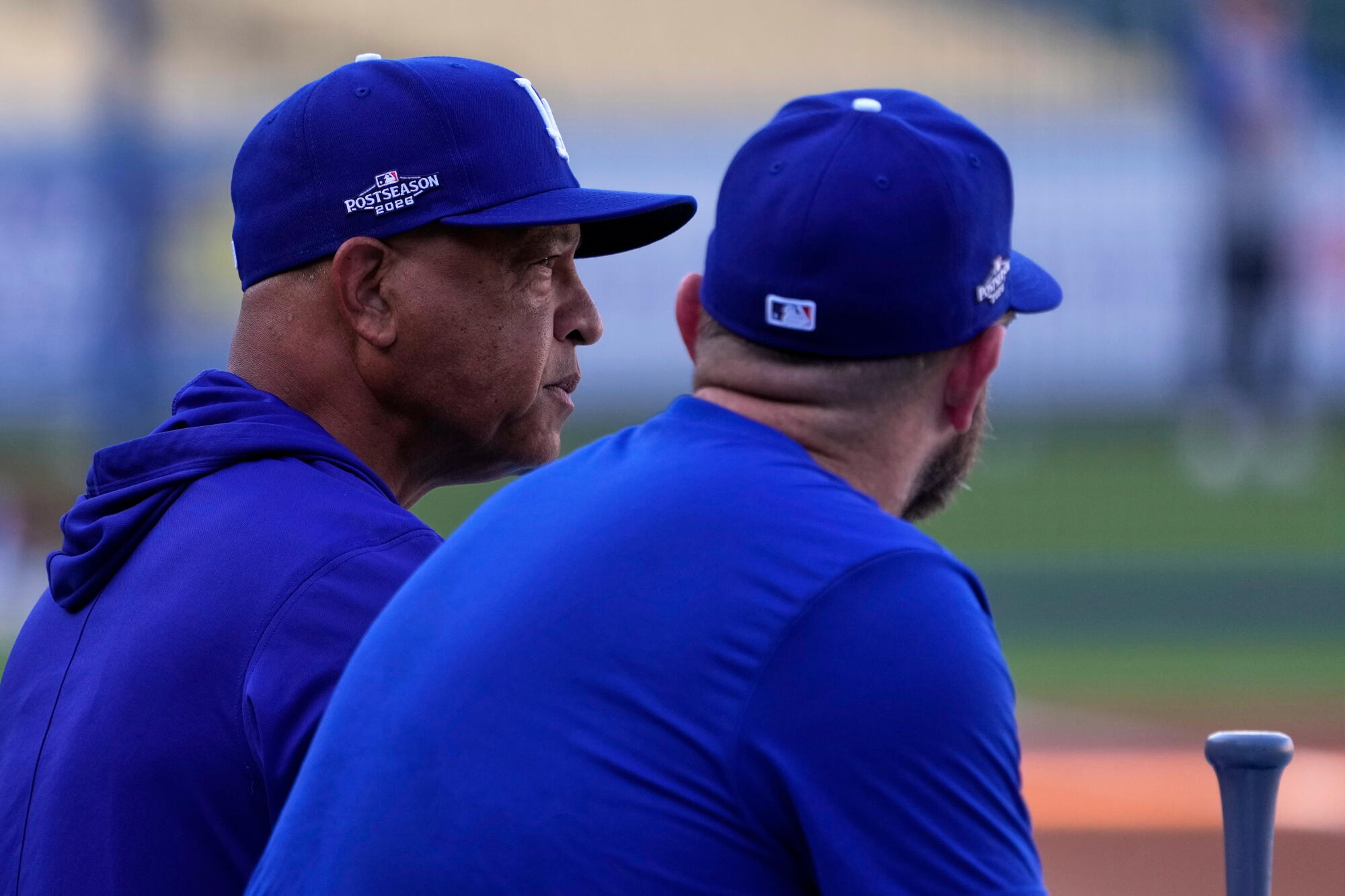
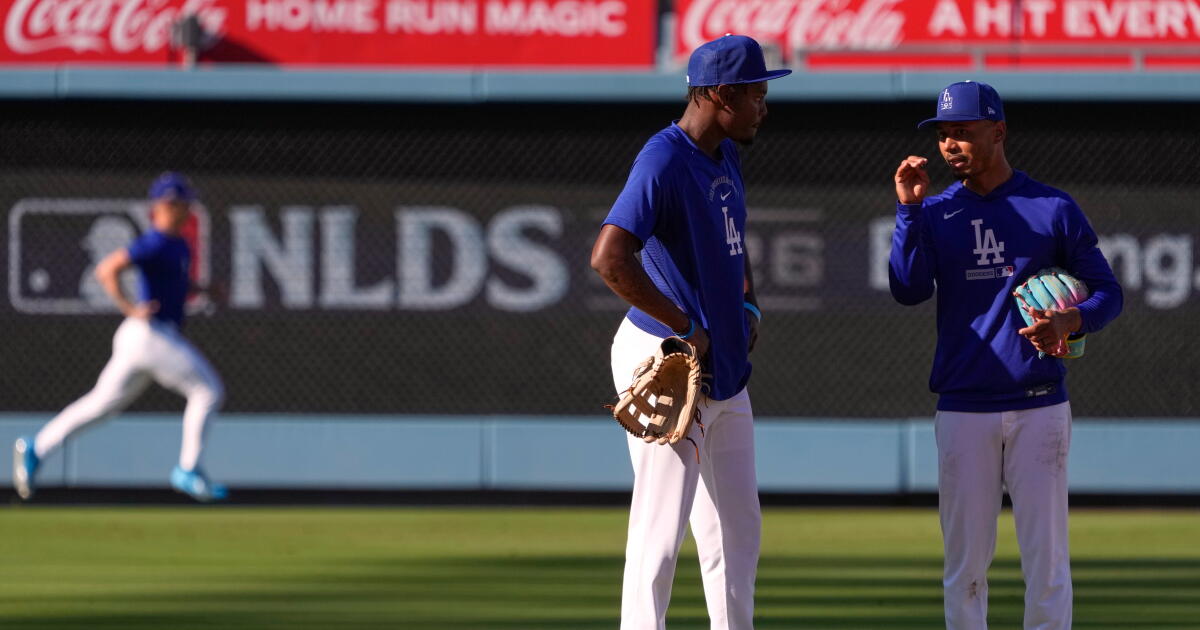
From Maddie Lee: The deciding game between the Philadelphia Phillies and Atlanta Braves played silently on the Dodger Stadium scoreboard Thursday as Dodgers players practiced below.
The Dodgers were less than 48 hours away from the first pitch of the National League Division Series. The “2026 Postseason” decals had been freshly painted up the baselines that afternoon. All that was left to be decided was their opponent — the winner of the game serving as the backdrop of their intrasquad scrimmage.
About a half an hour after the Dodgers cleared the field, the Braves advanced to the NLDS with a 6-2 win over the Phillies. The Dodgers and Braves will open the best-of-five series at Dodger Stadium on Saturday at 1 p.m. PDT.
The Atlanta Braves finished off the Philadelphia Phillies in the wild-card round in three games and move on to face the Dodgers in the NLDS.
“We are the team to beat,” veteran utility player Kiké Hernández said. “We are the team that you have to go through. And that’s all nice words and everything, but we got to take care of business on the field. But I feel great about my team.”
The Dodgers are the reigning back-to-back champions and are aiming to become the first National League team to win three World Series in a row.
“Obviously it’s there, but it’s not something we’re really focused on,” veteran third baseman Max Muncy said of the three-peat chase. “We’re trying to focus on ourselves getting ready this week, paying attention to whoever we might be playing and just trying to get ready for a postseason series the same way we’ve always gotten ready for it.”
Nine concerns the Dodgers should have about facing the Braves in the NLDS
Shaikin: ‘Hired gun’ Tarik Skubal opens up on the pressure, pain and lessons of October
Lakers hire new PA announcer
From Thuc Nhi Nguyen: Derrin Horton’s first job was in public address announcing. His first passion was the Lakers. The longtime sports broadcaster’s new job is the marriage of both.
Horton will take over the mic as the Lakers’ home public-address announcer, the team announced Thursday, stepping into the role for legendary Lakers announcer Lawrence Tanter, who died last week.
“There’s no way you can fill his shoes,” Horton said in an interview with local reporters. “And so you just come here with a passion and a goal to be informative and entertaining and be a part of Showtime.”
Tanter, who provided the smooth, baritone soundtrack for Lakers home games for 43 seasons, suffered a stroke on March 17 and missed the final six regular-season home games and the playoffs last season. Tanter announced his retirement in June, transitioning to a game-day advisory role with the team. Horton, a former KTLA broadcaster who has worked as an anchor, reporter, host, play-by-play announcer and voice actor, reached out to the team about the opportunity.
How UCLA build a formidable rushing attack
From Connor Dullinger: How you do one thing is how you do everything.
UCLA running backs coach A.J. Steward preaches it and it is the mantra adopted by the Bruins’ prolific running backs.
UCLA’s three-headed backfield, composed of fifth-year players Wayne Knight and Anthony Woods and senior Jaivian Thomas, is hailed for its undeniable impact on the ground, ranking first nationally in rushing touchdowns, third in yards per carry and fifth in yards per game this season.
Steward, who works in tandem with offensive line coach and run game coordinator Chris Smith, said it’s what his tailbacks do without the ball and the group’s commitment to each other that separates the group from the rest of the pack.
“The way we play without the ball in our hands is no different. It should be no different than what we do when we have the ball in our hands in terms of trying to make a play for our offense,” Steward said. “You cut the film on any of these guys, you’ll see they’re downfield making blocks. They’re there at the end of the play in case somebody puts the ball down [on] the ground and that’s because they hear it every day how you do anything’s how you do everything.”
Ducks sign defenseman to big deal
The Ducks have signed promising young defenseman Tristan Luneau to a six-year contract extension worth $43.2 million after just 14 NHL appearances.
The Ducks announced the deal Thursday with the 22-year-old Luneau, whose promising career has been slowed by injury. Now healthy and ready for a full-time NHL role, he inked a long-term deal with the team that drafted him in the second round in 2022.
Luneau was the Quebec major junior league’s top defenseman in the 2022-23 season and he made the Ducks’ roster out of training camp the next fall. But Luneau came down with a viral infection that winter while practicing with Canada’s national junior team, forcing him to miss the rest of the year.
MLB postseason schedule
Wild-card series
National League
No. 3 Atlanta vs. No. 6 Philadelphia
at Atlanta 5, Philadelphia 3 (box score)
Philadelphia 4, at Atlanta 3 (10) (box score)
at Atlanta 6, Philadelphia 2 (box score)
Division series
National League
No. 2 Dodgers vs. No. 3 Atlanta
Saturday at Dodgers, 1 p.m., FOX/FOX Deportes/FOX One
Sunday at Dodgers, 5 p.m., FS1/FOX Deportes/FOX One
Tuesday at Atlanta, 3 p.m., FOX/FS1/FOX Deportes/FOX One
*Wednesday at Atlanta, 3 p.m., FOX/FS1/FOX Deportes/FOX One
*Friday at Dodgers, 5 p.m., FOX/FS1/FOX Deportes/FOX One
No. 1 Milwaukee vs. No. 4 San Diego
Saturday at Milwaukee, 5:30 p.m, FS1/FOX Deportes/FOX One
Sunday at Milwaukee, 1 p.m. FS1/FOX Deportes/FOX One
Tuesday at San Diego, 6:30 p.m., FOX/FS1/FOX Deportes/FOX One
*Wednesday at San Diego, 7 p.m., FOX/FS1/FOX Deportes/FOX One
*Friday at Milwaukee, 1:30 p.m., FOX/FS1/FOX Deportes/FOX One
American League
No. 1 Tampa Bay vs. No. 4 New York
Saturday at Tampa Bay, 3:30 p.m., TBS/truTV/UniMas/HBO Max
Monday at Tampa Bay, 5 p.m., TBS/truTV/UniMas/HBO Max
Wednesday at New York, 5 p.m., TBS/truTV/UniMas/HBO Max
*Thursday at New York, 5 p.m., TBS/truTV/UniMas/HBO Max
*Saturday, Oct. 10 at Tampa Bay, 5 p.m., TBS/truTV/UniMas/HBO Max
No. 2 Cleveland vs. No. 6 Chicago White Sox
Saturday at Cleveland, 10 a.m., TBS/truTV/UniMas/HBO Max
Monday at Cleveland, 2 p.m., TBS/truTV/UniMas/HBO Max
Wednesday at Chicago, 1 p.m., TBS/truTV/UniMas/HBO Max
*Thursday at Chicago, 2 p.m., TBS/truTV/UniMas/HBO Max
*Saturday, Oct. 10 at Cleveland, 2 p.m., TBS/truTV/UniMas/HBO Max
NLCS starts Sunday, Oct. 11
ALCS starts Monday, Oct. 12
World Series starts Friday, Oct. 23
This day in sports history
1906 — Canadian world heavyweight boxing champion Tommy Burns KOs American challenger ‘Fireman’ Jim Flynn in 15 rounds to retain his title in Los Angeles.
1950 — Jim Hardy throws six touchdown passes, including five to Bob Shaw, as the Chicago Cardinals pound the Baltimore Colts 55-13.
1970 — Fourteen members of the Wichita State football team are killed in a plane crash in the Rocky Mountains.
1980 — Larry Holmes registers a technical knockout in the 11th round against Muhammad Ali to win the world heavyweight title in Las Vegas.
1983 — The Green Bay Packers score 49 points in the first half, including 35 in the second quarter, in a 55-14 rout of the Tampa Bay Buccaneers.
1988 — Future world heavyweight boxing champion Lennox Lewis, representing Canada, wins super-heavyweight gold medal at the Seoul Olympics; beats American Riddick Bowe by 2nd round TKO.
1991 — Steffi Graf becomes the youngest woman to win 500 matches as a pro when she beats Petra Langrova of Czechoslovakia 6-0, 6-1 in the Leipzig International Tournament.
1993 — In the first all-British world heavyweight title fight, Lennox Lewis retains his WBC heavyweight title with a seven-round knockout of Frank Bruno in Cardiff, Wales.
1993 — California rallies from a 30-0 deficit to beat Oregon 42-41. Dave Barr throws three second-half touchdowns, including a 26-yarder to Iheanyi Uwaezuoke with 1:17 left in the game.
1994 — North Carolina’s 92-game winning streak in women’s soccer ends with a scoreless tie in overtime against Notre Dame.
1994 — Don Shula’s Miami Dolphins beat son Dave’s Cincinnati Bengals 23-7 in the first meeting between father and son coaches in pro sports.
2004 — Rice and San Jose State play in the highest-scoring regulation game in Division I-A history, with the Spartans winning 70-63. The 133 points surpass the total from Middle Tennessee’s 70-58 victory over Idaho on Oct. 6, 2001. The schools combine for 19 touchdowns to break the Division I-A record of 18.
2006 — Tennessee Titans defensive tackle Albert Haynesworth is given a five-game suspension — the longest for on-field behavior in NFL history — for stomping on Dallas Cowboys center Andre Gurode’s head and kicking him in the face.
2009 — Ninth-grader Alexis Thompson shoots a 3-under 69 for a share of the lead with top-ranked Lorena Ochoa and three others after the second round of the Navistar LPGA Classic.
2011 — Dallas has its largest lead blown in a loss in franchise history, frittering away a 24-point third-quarter cushion in a 34-30 loss to Detroit. The Lions turned a 20-point halftime deficit into an overtime win at Minnesota the previous week.
2016 — The United States win the Ryder Cup for the first time since 2008. Ryan Moore two-putts on No. 18 for a 1-up victory over Lee Westwood, giving the Americans a 15-10 lead that seals the win over Europe. The 17-11 victory over Europe is their biggest rout in 35 years at the Ryder Cup.
2016 — Atlanta’s Matt Ryan passes for 503 yards and four touchdowns, while wide receiver Julio Jones has 12 catches for 300 yards and a touchdown in Atlanta’s 48-33 win over Carolina.
Compiled by the Associated Press
This day in baseball history
1969 — Seattle Pilots’ last game in Seattle; crash to 98th season loss, 3-1 to Oakland in front of just 5,473; move to Milwaukee as the Brewers next season.
2001 — Sammy Sosa becomes the first player in major league history with three 60-homer seasons, but the Reds hold on for a 5-4 victory over the Chicago Cubs. Sosa’s solo shot comes in the first inning.
2004 — Jeff Kent becomes all-time home run leader for MLB second basemen when he hits two in Astros’ 9-3 win over the Rockies; 302 overall HR to break Ryne Sandberg’s major league record established in 1997.
2004 — Montreal Expos earn the last win in the franchise’s MLB history, beating New York Mets, 6-3 at Shea Stadium; Brad Wilkerson hits the Expos’ final home run in ninth inning, his 32nd of the year.
2016 — Vin Scully calls his final Dodgers game after a record 67 MLB Seasons.
Compiled by the Associated Press
Until next time…
That concludes today’s newsletter. If you have any feedback, ideas for improvement or things you’d like to see, email me at houston.mitchell@latimes.com. To get this newsletter in your inbox, click here.