premium format

AMC Burbank is the most profitable movie theater in the U.S. and Canada

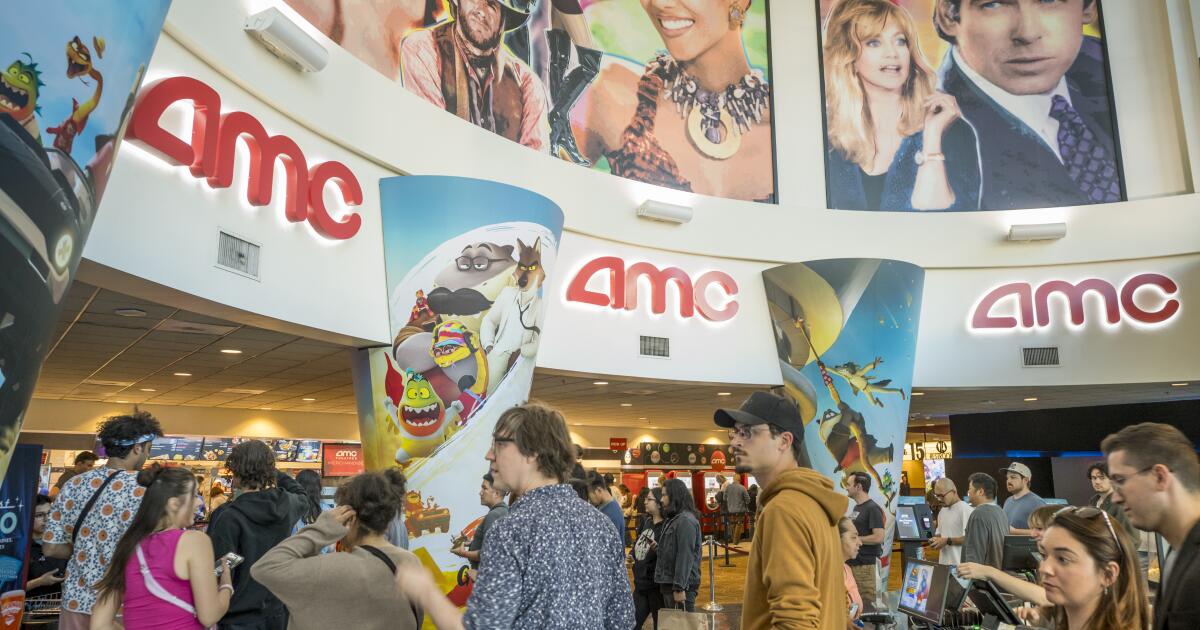
Maybe it’s the leather seats or the free parking. But out of every movie theater in the U.S. and Canada, AMC Burbank 30 had the most lucrative box office in 2025.

The combined efforts of the three theater locations, less than a mile apart (AMC Burbank 16 and Town Centers 6 and 8), brought in the highest box office numbers, according to Comscore. The AMC in New York’s Lincoln Square came in second place. Overall, the theater chain holds seven of the top 10 highest-grossing box offices in the U.S. and Canada, with four locations in L.A., two in New York and one in Florida.

The L.A. AMC locations at The Grove, Century City and CityWalk ranked at numbers five, six and eight, respectively.

“AMC’s longstanding success in Los Angeles is driven by several factors, including the size of the market, the enthusiasm of the Hollywood community and local audiences for seeing films on the big screen, and AMC’s focus on delivering a high-quality moviegoing experience,” said a spokesperson for the theater chain in a statement to The Times.

“Across the region, AMC locations regularly offer a diverse film slate that spans major studio releases, independent titles, and AMC Artisan Films.”

AMC has had a presence in Southern California since 1969, when it opened its first West Coast location in La Habra. By the mid-1980s, the theater chain grew significantly, opening multiplexes in Burbank and Century City. There are now 36 locations in the greater Los Angeles market.

Daniel Loria, the senior vice president at the Box Office Company, a cinema data analytics firm, said Los Angeles and New York being the most profitable cities isn’t shocking. Many studios and theaters typically use the two largest metros to gauge which markets to expand to and how long a movie will be playing in theaters.

“This industry really relies on the power of those two cities for the entire world to function,” Loria said, referring to the film business.

“These are the capitals of cinema. You see this concentration within that top 10 because of the indexing performance they have, not only on a local level, but on a global level as well.”

The number of movies showing in larger cities also plays a key role in box office gross. Loria said that in some regions of the country, local theaters will only get three or four movies showing at a time. Whereas in bigger markets, there is more diversity in showings and more opportunities to go see a movie, as the theaters are usually bigger and have more screens. Beyond the number of screens, a film‘s visual format is also a major factor in profit and ticket pricing.

When seeing a movie in a premium format, like IMAX or Dolby Cinema 3D, at an AMC, an adult ticket can range between $25 and $30 on a weekend, whereas a standard format would cost around $18. Many movie theaters in Los Angeles have these high-quality screens, which can boost box office gross sales more than other theaters that do not offer a premium viewing experience.

Paul Dergarabedian, the head of marketplace trends at Comscore, said major theater chains usually have more drawing power when their locations have high-quality screenings available.

“What’s striking is how premium formats are driving impressive box office [sales] even in an age of price sensitivity among consumers,” said Dergarabedian. “Savvy moviegoers understand that the upcharge is worth the investment, particularly with films that are epic in scope and are best viewed in the grandest format on offer at their local cinema.”

In recent years, movie membership passes have helped bring audiences into theaters more consistently . AMC’s A-list membership allows subscribers to see up to four movies a week, for the monthly price of $27.99. There are nearly 1 million A-listers.

“The greater Los Angeles area is also home to a highly engaged AMC Stubs A-List membership base that makes theatrical moviegoing a priority,” wrote an AMC spokesperson. “The connection between AMC, Hollywood, and Los Angeles moviegoers continues to benefit our studio partners, filmmakers, and audiences.”

Source link

Imax just had a $1-billion year. 2026 looks to be bigger

Imax is having a moment. More than 50 years after debuting at the 1970 Osaka world’s fair with the 17-minute experimental film “Tiger Child,” the format has become the ascendant king of spectacle. Today, Imax counts 1,829 screens in 89 countries — just 1% of theaters — yet makes up an increasingly vital part of the theatrical box office, with 50% market share growth since 2018 and an estimated $1.2-billion take in 2025. And the company shows no signs of slowing down.

“As long as there are filmmakers who are fans as well as studios who are fans, we’re going to make a difference,” says Chief Executive Richard Gelfond, who acquired the company in 1994 with business partner Bradley Wechsler.

Breaking into mainstream Hollywood didn’t come easy. For decades Imax films were largely documentaries, often about space exploration, nature or discoveries, with systems installed in museums and science centers. The flash point came in 2008 with Christopher Nolan’s “The Dark Knight,” which featured 28 minutes filmed with Imax 70mm cameras. Film buff and industry content creator Lizzy Gonzalez vividly remembers when the Joker (Heath Ledger) unmasks himself during the chaotic bank heist. “It was my earliest Imax experience, and my jaw dropped in awe,” she says. Ever since, she’s been hooked, admitting the premium format is “the only legit movie experience that immerses you in the story.”

Directors are now leaning in, with the “Filmed for Imax” (FFI) lineup expanding to 14 titles in 2025 — doubling last year’s total. The program lets filmmakers shoot with Imax cameras or other approved cameras and provides additional production support, such as a longer window with the equipment and more publicity during release. “In previous years, Imax used to do about 10% of the box office in North America, but [with] FFI movies we’ve averaged about 15%. It means more dollars to whoever makes them and more profit to the studio,” says Gelfond.

Regina Hall in "One Battle After Another."

Regina Hall in “One Battle After Another.”

(Warner Bros. Pictures)

Not all movies exhibited in Imax formats are shot under the FFI banner — indeed, from James Cameron’s original “Avatar” to Paul Thomas Anderson’s “One Battle After Another,” the majority of Imax releases are instead enhanced using digital media remastering. But movies that take advantage of FFI, including “Sinners,” “Superman” and “F1,” are seeing box-office benefits and a palpable moviegoing experience.

“Today’s audiences are searching for an emotional connection; they want to feel something, to step inside the filmmaker’s vision. That’s exactly what we wanted to give them by shooting in 65mm Imax,” says “Sinners” cinematographer Autumn Durald Arkapaw, who was the first woman to shoot in the format. “When you sit in a dark theater and take in a full 1.43:1, 15-perf Imax image, it fills your field of view, and you finally understand what cinema can be.”

Claudio Miranda, the cinematographer behind Joseph Kosinski’s “Top Gun: Maverick” and “F1,” agrees. “For me, Imax is all about immersion. It brings audiences more into the movie than any other format, surrounding them from the north, south, east and west with the film, which is needed for a story of the size and scope of ‘F1.’ Joe and I operate under the shared understanding that audiences react more viscerally to a film that’s been shot authentically, and they can feel it in their bones if it’s not. So we gravitate towards telling immersive, human stories.”

Imax is improving technical capabilities too, including a new Imax 70mm film camera system nicknamed “The Keighley” in honor of late Chief Quality Officer David Keighley, who oversaw hundreds of Imax projects. Its most significant improvement is reduced noise. The previous model was bulky, heavy and notoriously loud. Thanks to the quieter design, Nolan’s “The Odyssey” will become the first theatrical movie shot entirely on Imax film cameras, something he couldn’t achieve on “Oppenheimer” due to sound issues.

"Brad Pitt" in "F1."

“Brad Pitt” in “F1.”

(Warner Bros. Pictures)

Nolan’s adaptation of Homer’s epic has already caused a stir, as most Imax tickets sold out a year before its release next July. Imax superfan Shane Short, who saw “Oppenheimer” 132 times and once sat next to Arkapaw during a screening of “Sinners,” says it’s a good thing. “What really pulls me into movies is the emotional aspect when connecting with something. For me, it’s hard to get that in a normal theater. Imax is truly the ultimate immersive experience that draws me in.”

Of course, Imax is not the only big-screen game in town. There’s AMC Prime, Cinemark XD, Regal RPX, Dolby Cinema, Real3D and 4DX, to name a few. All share one thing in common: an extra premium for a ticket. “The upcharges for a lot of people are worth it,” says Comscore senior media analyst Paul Dergarabedian. “When you go into Imax or other premium formats, it’s really about the sound and vision coming together. And for the right movie, the right screen, fans who don’t go to the movies every day are going to splurge.”

How much that will cost audiences going forward is left up to theaters. “By way of our agreement, it’s not our place to get involved,” says Gelfond about pricing. “We believe there could be more elasticity if it’s a big release, but again, it’s up to the exhibitor.” Any indication of a price squeeze on consumers will likely surface in the next two years with the forthcoming “Project Hail Mary,” “Supergirl,” “The Batman: Part Two” and “Dune: Part Three,” for which director Denis Villeneuve shot scenes using the new Imax 70mm cameras.

Our guess? Start saving now.

Source link