polling

Contributor: Kamala Harris is polling well, which signifies nothing

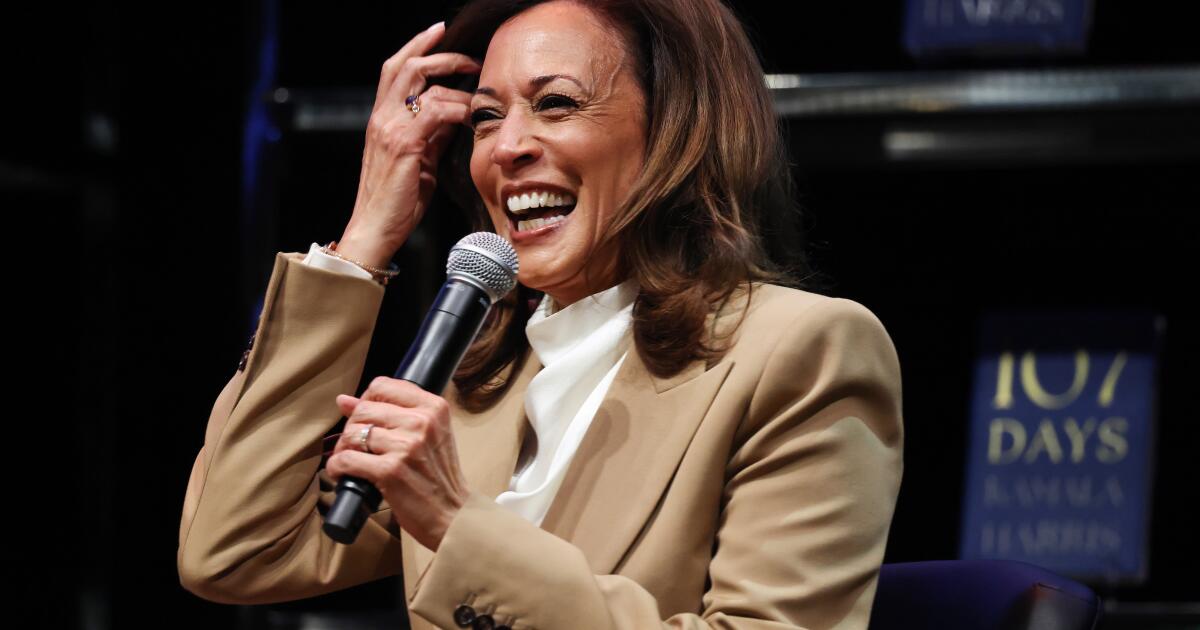
When I read all the hype being heaped on Kamala Harris’ lead in early polls for the 2028 Democratic nomination, I have to chuckle to myself.

The release of a Rasmussen Reports poll in February was titled, “Kamala Harris Still Leads 2028 Field for Democrats.” One headline in the Hill predicted, “Kamala Harris may yet be the Democratic nominee in 2028.” A Washington Examiner piece about polling warned, “Democrats won’t get rid of Kamala Harris that easily for 2028.”

I chuckle not because I don’t believe the numbers, but because I don’t believe any poll this far out in an open contest is meaningful, let alone determinative. I’ve seen this movie before, and it didn’t end well.

In 2003, after managing the successful 2002 reelection campaign of California Gov. Gray Davis, I signed on as an advisor to the presidential campaign of Connecticut Sen. Joseph Lieberman — who, I needn’t remind anyone, had been the Democratic nominee for vice president in the 2000 election, which he and Al Gore lost in a nail-biter to George W. Bush.

Based simply on his high name identification from that hellzapoppin’ race, and the fact his name had been on the ballot in all 50 states just two years before, Lieberman initially led the Democratic field quite handily in almost every national poll.

An ABC News/Washington Post survey in January 2003 found Lieberman leading the Democratic field with 27%. A Gallup poll from that same month also placed him first, ahead of both John Kerry and Richard Gephardt.

A Pew poll in the summer of 2003 also found Lieberman atop the field, as the best-known candidate at 85% name recognition, and 58% support, ahead of Kerry, Gephardt and Howard Dean.

Boy, did we brag about Lieberman’s lead at every stop and in every press release. But in the end, the promising early numbers meant nothing. When actual votes were cast, Lieberman totally flamed out, receiving a measly 8.9% of the vote in the critical first primary in New Hampshire, finishing dead last, and dropping out of the race in February 2004, having lost every primary and caucus up to that point.

Why? A lot of reasons, including mistakes made by the candidate and campaign. But fundamentally because, when Democrats started to take a close look at and assess the full field, they relegated Lieberman to the status of a loser, and they wanted to move on. We heard a lot of, “He had his chance and lost.” Does Harris come to mind?

The fact is, we Democrats tend to put defeated presidential nominees in the rear-view mirror pretty quickly. Think of Michael Dukakis, Gore and Kerry. And let’s not forget, Harris obtaining the nomination in 2024 was a fluke; she didn’t compete in one primary or receive one primary vote. The first time she ran for president, in the 2020 cycle, she also didn’t win one primary or receive a single primary vote, because she ran a bad campaign and hightailed it out of the race before a single vote was cast. Two strikes and you’re out?

We Democrats just don’t renominate losers. The last time we did it was exactly 70 — yes, 70 — years ago, with Adlai Stevenson in 1956 after he had lost the 1952 presidential race to Dwight Eisenhower. Stevenson rewarded Democrats for this recycling effort by losing to Eisenhower a second time — by an even worse margin. Democrats learned their lesson: Reheating doesn’t work with failed candidates.

And, come on, Harris not only lost to Trump, not only lost all seven swing states, but was the first Democratic presidential nominee in 20 years to lose the popular vote. And her weak showing also helped Republicans wrest control of the Senate from Democrats. We’re supposed to imagine that’s a credible record on which to run again for the nomination?

All of these breathless stories about Harris leading the field nationally also never mention her perilous standing in her own home state of California. A Berkeley IGS survey in August revealed that by a margin of 18 percentage points, even her fellow Democrats in California did not want her to run again. A Politico poll this month showed Gov. Gavin Newsom with a 2-to-1 lead in California among voters leaning toward voting in the 2028 Democratic primary.

So have fun, Kamala Harris, enjoying your name-ID high while it lasts (although maybe a mite longer than your 107-day presidential effort).

Garry South is a Democratic strategist who has managed four campaigns for governor of California and played significant roles in three presidential campaigns, including that of Al Gore.
Source link

Democrats excluded from USC governor debate urge rivals to boycott

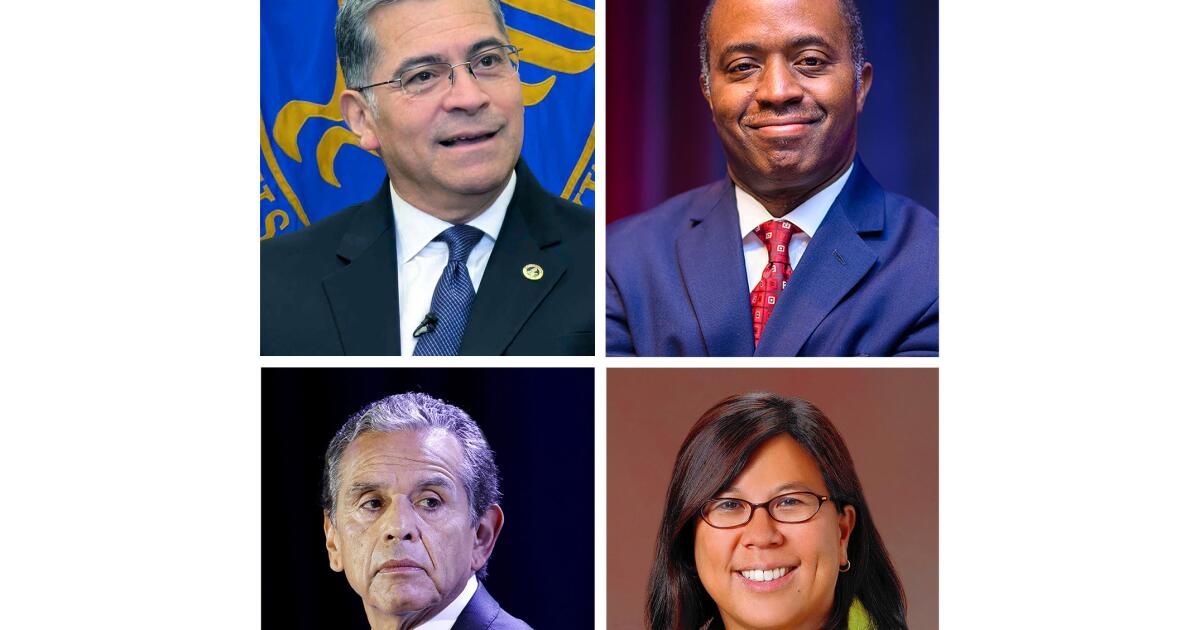
Four Democrats running for governor called on their fellow candidates to boycott an upcoming debate at USC, reiterating concerns that the criteria used to determine who was invited to participate resulted in every prominent candidate of color being excluded from the forum.

“We ask each and every candidate who is in this race to recognize that if we can’t have a fair process for a debate, then we should all not participate,” said Xavier Becerra, the former U.S. Health and Human Services secretary. “We call on them to withdraw from this biased forum.”

Becerra’s call was echoed by former Los Angeles Mayor Antonio Villaraigosa, state Supt. of Public Instruction Tony Thurmond and former state Controller Betty Yee during a Friday afternoon news conference.

The candidate’s request comes a week after some of them raised concerns about the criteria for Tuesday’s debate, arguing that it was engineered to allow the inclusion of San José Mayor Matt Mahan, who entered the race in late January and quickly raised millions of dollars from Silicon Valley executives.

“The rules initially were polling and money. Matt Mahan is [polling] lower than some of us, period,” Villaraigosa said, adding that the debate organizers “then added time in the race,” which resulted in Mahan’s invitation.

Mahan’s campaign did not respond to a request for comment on Friday, but when Becerra raised such concerns last week, Mahan said the former Biden administration official ought to be included in the debate.

The matter is further complicated by Mahan supporters who have notable ties to the university.

Mike Murphy, a co-director of the USC center hosting the debate, has been voluntarily advising an independent expenditure committee backing Mahan. The veteran GOP strategist said last week that he had nothing to do with organizing the debate and that he has asked for unpaid leave at the university through the June 2 primary if he takes a paid role in the campaign.

USC has also received tens of millions of dollars in donations from billionaire real estate developer Rick Caruso and his wife. Caruso, a USC alumnus who served as a trustee for years, is also a Mahan supporter.

A representative for Caruso did not respond to a request for comment.

The debate, hosted by the USC Dornsife Center for the Political Future, KABC-TV Los Angeles and Univision, is scheduled to take place on campus at 5 p.m. Tuesday — less than two months before ballots begin arriving in voters’ mailboxes. The forum will be streamed and broadcast on ABC and Univision affiliates across the state.

USC and the television stations put out a joint statement Friday morning, prior to the candidates’ news conference, justifying the criteria used to determine who was invited to participate and saying none of the debate partners had any influence on the methodology.

“We want to be clear that we categorically, unequivocally deny any allegations that the debate criteria was in any way biased in favor or against any candidate and want to clarify the facts,” they said in a statement, adding that Christian Grose, a USC political science professor, was asked to develop “data-driven” benchmarks to determine which candidates were invited.

“The methodology was based on well-established metrics consistent with formulas widely used to set debate participation nationwide — a combination of polling and fundraising — and developed without regard to any particular candidate.”

After the Democratic candidates called for their competitors to not participate, USC and KABC declined to comment further. Univision did not respond to a request for comment.

Grose defended the methodology he crafted as “objective” in an interview Friday, and said he met with Becerra as well as the staff of other candidates to explain it.

“The idea that it was biased or designed to create some sort of outcome to disfavor the candidates who spoke at the press conference is just not correct,” Grose said, adding that attacks on the methodology have a “chilling effect” on universities and media outlets who sponsor debates.

“I’m not worried about the optics,” he said. “The optics are we are having a debate at USC to inform voters and educate students.”

Jarred Cuellar, a political science assistant professor at Cal Poly Pomona, described Grose’s methodology as “thoughtful” and “empirically grounded,” and characterized the concerns raised by candidates not included in the debate as unfounded and not credible.

“The formula is methodologically sound and represents a clear improvement over how debate participation has often been determined,” he said. “Rather than relying on a single metric such as polling, it takes a multidimensional approach to evaluating candidate viability. That approach better reflects how political scientists measure complex phenomena like electoral competitiveness.”

But the controversy has caused consternation among USC professors past and present.

“It seems like an unforced error that is casting the entire event in a bad light,” said a current USC professor who closely follows politics but is not involved in the debate, and who asked for anonymity to speak candidly. “It’s super important that if the debate happens, it happens correctly.”

Darry Sragow, a veteran Democratic strategist who taught election and environmental law at USC for 19 years, said that while he believes the large field of Democratic candidates needs to be winnowed, that’s not the job of a university or media outlets.

“Every one of these eight [Democratic candidates] is capable of running the state of California,” he said. “ It would certainly be my advice to USC and to Univision and to ABC to allow all the candidates to take part, or to cancel the debate.”

The four Democratic candidates not invited to the debate argued that voters are just starting to pay attention to the thus-far sleepy race and that diverse candidates should be represented.

“We are a minority-majority state, and the idea that the four candidates of color are not going to be on the stage to bring those perspectives, to really speak to those communities, is really not doing right by the voters,” Yee said.

Becerra said some of the candidates had requested to speak with top university leadership, including President Beong-Soo Kim. In other conversations, he said university officials raised the possibility of “either canceling this debate or incorporating more of the candidates in it. Evidently they could not agree to do that. … I think they recognize that there were problems with the way this debate had been organized.”

Becerra said he reviewed the formula and has “never seen” debate criteria like it before during his decades of serving in elected office.

“Your fundraising numbers are divided by the number of days you’ve been out there campaigning in front of voters,” he said. “So you could have raised millions of dollars, but if you’ve been in longer than someone else who just raised millions of dollars very quickly, you get penalized.”

Campaigns for the invited candidates — Democrats Rep. Eric Swalwell of Dublin, former Orange County Rep. Katie Porter, climate activist Tom Steyer and Mahan; as well as Republicans Chad Bianco, the sheriff of Riverside County, and former Fox News host Steve Hilton — did not respond to requests for comment on the call to boycott the debate.

Source link

Federal distrust prompts some Democratic states to protect polling places, election records

Democratic-led states alarmed by the prospect of federal immigration officers patrolling the polls during this year’s midterm elections are taking steps to counter what they see as a potential tactic to intimidate voters.

New Mexico this week became the first state to bar armed agents from polling locations in response to President Trump’s immigration crackdown, a step being considered in at least half a dozen other Democratic-led states.

The moves highlight a deep distrust toward the Trump administration from blue states, which have been the target of his aggressive immigration tactics while threatened with military deployments and deep cuts in federal funding. Their concerns were heightened after the president suggested he wants to nationalize U.S. elections, even though the Constitution says it’s the states that run elections.

The Trump administration said it has no plans to deploy immigration agents to polling locations. Last month, the heads of Immigration and Customs Enforcement and Border Patrol told a congressional committee “No, sir” when asked if they had any plans to guard polling places. The Department of Homeland Security’s deputy assistant secretary for election integrity, Heather Honey, recently told secretaries of state it “is simply not true” that immigration agents will be at the polls this year.

But a group of eight secretaries of state wants that in writing from the nominee to succeed Kristi Noem as secretary of the Department of Homeland Security. In a letter Monday to Trump’s new pick to lead the agency, Markwayne Mullin, the group pressed for assurances “that ICE will not have a presence at polling locations during the 2026 election cycle.”

Federal law already prohibits the deployment of armed federal forces to election locations unless “necessary to repel armed enemies of the United States,” but Democratic lawmakers, election officials and governors remain concerned.

“The fear is that the Trump administration will attempt to evoke a national emergency or execute some other deployment of federal agents or military troops in order to interfere with elections and intimidate voters,” said Connecticut Democratic state Rep. Matt Blumenthal, co-author of a state bill to establish a 250-foot buffer from federal agents at local polls and other restrictions on federal intervention. “And we’re not going to let that happen.”

A potential clash between states and the federal government

Other bills seeking to ban immigration agents at the polls are pending in Democratic-led states, large and small, from California to Rhode Island.

In Virginia, lawmakers are weighing legislation that could prevent federal civil immigration officials from making arrests within 40 feet of any polling place or courthouse. But the provision on polling sites remains under negotiation, and it’s unclear whether it will be in the final bill.

The newly signed law in New Mexico prohibits orders that put any armed person in the “civil, military or naval service of the United States” at local polling locations and related parking areas, or within 50 feet of a monitored ballot box, from the start of early voting.

Under New Mexico’s new law, which takes effect in May and will be in place for the state’s June 2 primary, people who experience intimidation or obstruction at the polls from federal agents or military personnel can file a civil lawsuit seeking relief in state courts. State prosecutors and local and state election officials also can sue, and the courts can apply fines of up to $50,000 per violation.

It also prohibits changes to voting qualifications and election rules and procedures that conflict with New Mexico law, as Trump prods the U.S. Senate to approve a bill to impose strict new proof-of-citizenship requirements in elections nationwide.

Any state measures intended to counter federal election law will face legal hurdles because of the supremacy clause in the U.S. Constitution, which says federal law supersedes state law.

“It could set up a direct clash between state governments and the federal government. We don’t know exactly how that’s going to go,” said Richard Hasen, director of the Safeguarding Democracy Project at the UCLA School of Law. “Given the supremacy clause, there’s only so much states can do.”

‘We will hold free and fair elections’

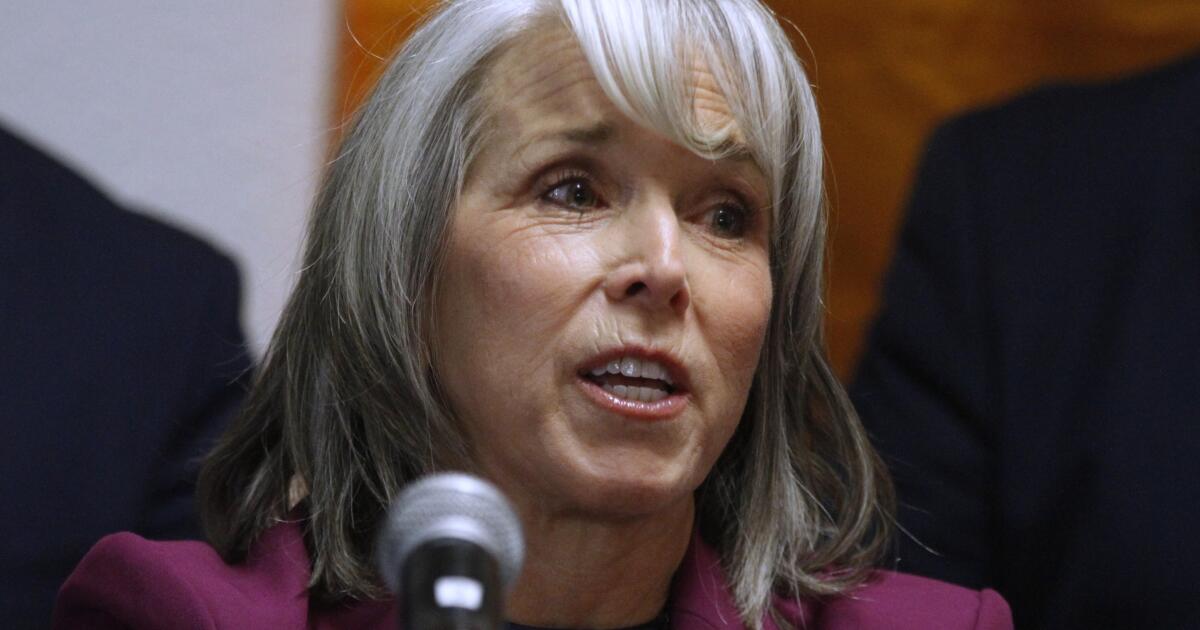
New Mexico Gov. Michelle Lujan Grisham said her own distrust of the Trump administration in election oversight stems from ongoing Department of Justice efforts to get detailed state voter data without explaining why and Trump’s continuing false claims of widespread fraud in the 2020 presidential election.

“Do I believe the federal government and people in the White House? No,” said Lujan Grisham, who terms out of office at the end of 2026.

“We are sending a message to everyone: We will hold free and fair elections, and New Mexicans will be safe in every ballot location and that’s our responsibility,” the Democrat said Tuesday during a news conference. “The Constitution says the states run their elections, and that bill makes that painfully re-clear to the federal government.”

Federal seizure of ballots and election records is a growing concern

New Mexico Republicans, who are in the minority in the legislature, voted in unison against the bill.

“I would question strongly why we have to do this other than just to have to poke the president in the eye,” state GOP Sen. Bill Sharer of Farmington said during floor debate.

State Sen. Katy Duhigg, an Albuquerque Democrat who was a co-sponsor of the legislation, said it’s “better safe than sorry with democracy.” She said she wanted to “make sure that there was some sort of tool that our local law enforcement would have at their disposal if something does happen, if the federal government does in some manner try to interfere with our elections.”

Connecticut’s bill, scheduled for a hearing later this week, also takes aim at federal attempts to seize ballots or other election material. It would require that state officials receive notification of such a move.

Blumenthal said state lawmakers can’t prevent seizures such as the January search by the FBI on an election center in Fulton County, Ga., a Democratic stronghold that includes Atlanta. But he said, “there might be an opportunity for our state attorney general’s office or the secretary of the state’s office to challenge that.”

Lee and Haigh write for the Associated Press. Haigh reported from Hartford, Conn. AP writer Oliva Diaz in Richmond, Va., and David A. Lieb in Jefferson City, Mo., contributed to this report.

Source link

California Dems launch polling effort to winnow gubernatorial field

As anxiety mounts among California Democrats about the potential of a Republican being elected governor, the state party will spend hundreds of thousands of dollars on polling to assess the viability of the sprawling field of candidates hoping to replace termed-out Gov. Gavin Newsom, according to plans released Tuesday.

The move comes after nearly every Democratic candidate refused party leaders’ call last week to withdraw from the race to avoid splitting the vote in the June primary — an outcome that could lead to a Republican being elected to statewide office for the first time in two decades.

“Candidates have filed, and now they’ve got the opportunity to showcase their viability, their path to win. I want to simply ensure that everybody has information to fully understand the current state of the race,” said Rusty Hicks, the leader of the California Democratic Party.

As campaign season ramps up, the series of six polls will allow “candidates, supporters, the media, voters, anyone and everyone to have a clear understanding of what is or is not happening in this particular race,” he said.

The filing deadline to appear on the June 2 ballot was Friday. Three days earlier, Hicks released an open letter urging candidates who did not have a path to victory to withdraw from the race. Of the nine prominent Democrats who had announced runs for governor, only one heeded his call: former state Assembly Majority Leader Ian Calderon.

That means the eight other candidates’ names will appear on the ballot, regardless of whether they decide to later drop out. And that creates the possibility of a Republican winning the race because of how California elections are decided.

The state has a voter-approved top-two primary system, under which the two candidates who receive the most votes in the June primary advance to the November general election, regardless of party.

Two prominent Republicans will appear on the ballot: former conservative commentator Steve Hilton and Riverside County Sheriff Chad Bianco. Even though Democratic voters outnumber Republicans nearly 2 to 1, and the state’s electorate last elevated Republicans to statewide office in 2006, it is mathematically possible for Democrats to splinter the vote, allowing the two GOP candidates to advance.

Under such a scenario, not only would Republicans be guaranteed the leadership of the nation’s most-populous state, but Democratic voter turnout also would probably be depressed in November, potentially affecting down-ballot races such as those that could determine control of Congress.

Hicks’ call last week prompted concerns among candidates of color, including former U.S. Health and Human Services Secretary Xavier Becerra and state Supt. of Public Instruction Tony Thurmond, that the effort was aimed at every nonwhite candidate in the race.

The state party chairman responded that his letter was not aimed at any specific candidate.

“It’s not something I lose sleep over,” Hicks said when asked about the racial claims. But he added that the voter surveys will be conducted by Los Angeles-based Evitarus, the state’s only Black- and Latino-led full-service polling firm, and will oversample historically underrepresented communities: Latino, Black and Asian American voters.

Hicks said the polling will cost “multiple six figures” but did not specify the exact amount.

The first poll will be released on March 24, and then five additional surveys will come out every seven to 10 days until voters start receiving mail ballots in early May.

“We’re putting this forward to ensure everyone is armed with the information they need to clearly have an eyes-wide-open assessment of where the state of the race currently is between now and when ballots land in the mailboxes of voters,” Hicks said.

Source link