poised

New poll finds voters poised to pass Prop. 57 and revamp California’s prison parole rules

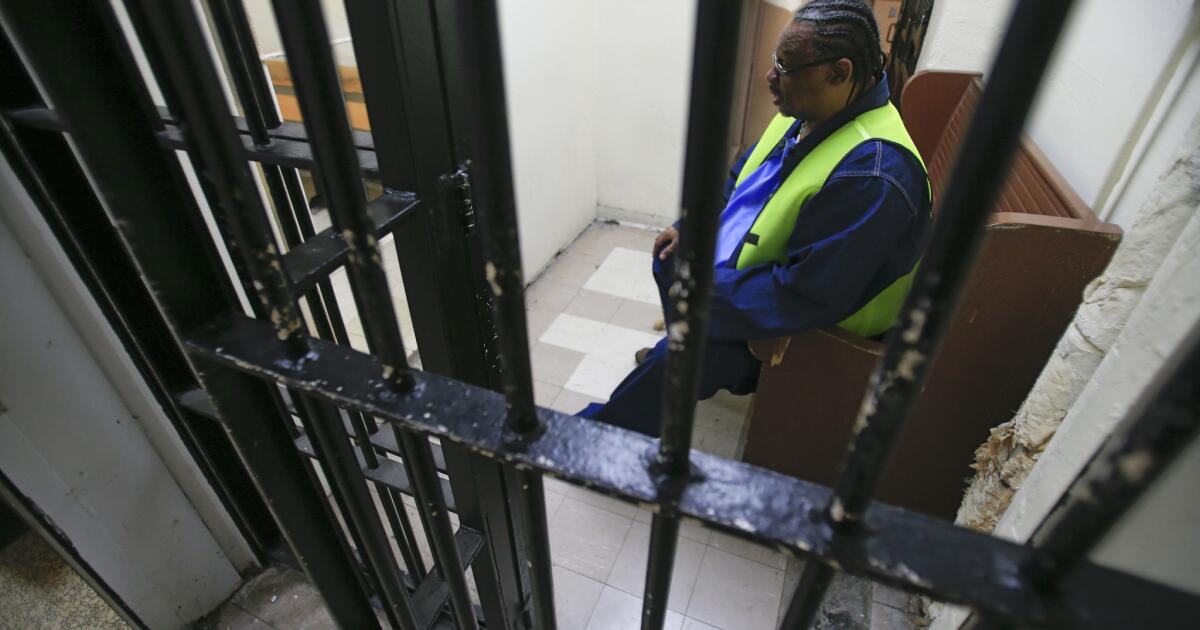
Gov. Jerry Brown’s effort to revise and ultimately loosen state prison parole rules appears to be on its way to passage on Nov. 8, as a new poll finds strong support across a wide swath of California voters.

Fifty-seven percent of likely voters in a new USC Dornsife/Los Angeles Times survey backed Brown’s Proposition 57, and only 31% were opposed. While earlier polling showed an even wider lead, the proposal has had consistently solid backing throughout the campaign season.

“Proposition 57 should pass comfortably,” said Ben Winston of Greenberg Quinlan Rosner Research, the Democratic pollster who makes up the bipartisan team that conducts the survey.

The measure, which would allow more prisoners a chance at parole and give additional authority to prison officials to award good-behavior credits, has wide appeal among the state’s young voters.

As many as two-thirds of the poll’s likely voters under the age of 40 supported Proposition 57, with the highest backing from younger white Californians. Support was at, or surpassed, the 60% threshold among Democrats, white voters who are “independent” of any political party and Latino women.

The only serious opposition came from registered Republicans, self-described conservatives and older, non-college-educated voters.

Young voters may be a harbinger of a dramatic long-term shift on crime and punishment in a state where long prison sentences for sensationalized crimes were once the hallmark of successful campaigns.

“This generation of California voters simply wasn’t alive when a tough-on-crime approach was necessary to win a statewide election,” said Dan Schnur, director of USC’s Unruh Institute of Politics.

Political analysts also point to a potential correlation in the poll between supporters of the parole overhaul and those who support Proposition 64, the effort to fully legalize marijuana. Seventy-one percent of the likely voters who support the marijuana measure also support Proposition 57.

“I think there are parallel issues here,” said Doug Herman, a Democratic strategist. “They’re making the point that the criminal justice system is broken.”

The ballot box guide to California’s propositions »

Brown has fought bitterly with district attorneys across California over Proposition 57, which he contends is simply offering the chance for a prisoner’s request to be heard by the state Board of Parole Hearings. Under the measure, parole commissioners could consider releasing any prisoner whose primary sentence was not for one of the state’s specifically listed violent crimes, and then only for secondary crimes or enhancements added at the time of sentencing.

Prosecutors, on the other hand, argue that Proposition 57 would almost certainly lead to the early release of dangerous criminals. And they believe the initiative’s expansion of good-behavior credits would mean less time behind bars even for high-risk predators.

The USC/Times poll, like most nonpartisan surveys, tested voter opinions by using Proposition 57’s official ballot title and summary — a description that has become a bone of contention during the campaign.

“The ballot title and summary is a gross and blatant misrepresentation of what this measure would do,” said Merced County Dist. Atty. Larry Morse. “It is incredibly dishonest.”

Law enforcement opponents dispute that new parole eligibility would be given only to offender, who are “nonviolent,” a word that Morse said he believes downplays the threat and thus artificially inflates any estimates of true voter support for the governor’s policy proposal.

“He knows damn good and well this applies to crimes that anyone would see as violent,” Morse said of Brown.

Dan Newman, a spokesman for the Proposition 57 campaign, said the measure is “exactly what voters want in a public safety policy — a focus on keeping dangerous offenders locked up while rehabilitating nonviolent offenders before they get out.”

While most of the focus is on the impact of revising prison parole procedures, Proposition 57 also would revoke provisions of a 2000 ballot measure that has sent some juvenile defendants into adult courtrooms. Prosecutors helped lead the campaign for that proposal 16 years ago, but Morse said he and other district attorneys now agree those teenagers should remain in the juvenile justice system.

Sign up for our daily Essential Politics newsletter »

The survey of 1,500 registered voters was conducted for USC Dornsife and the Los Angeles Times by Greenberg Quinlan Rosner Research and American Viewpoint. Support for the ballot initiative was almost identical among the entire sample — 58% in favor — as it was among likely voters.

The poll results come as both sides in the Proposition 57 campaign ramp up efforts to persuade voters. Brown has raised more than $19.7 million in support of the measure, with the largest share of that money spent during the spring on gathering signatures to quickly qualify the initiative for the ballot after skirmishes in court over whether it was properly vetted under state election law. The governor’s effort had enough money left over for campaign mailers and a statewide radio ad blitz, while opponents, having raised less than $1.4 million, have had fewer opportunities.

That imbalance may help explain another strong marker for the initiative in the poll: It was winning with 63% of voters who said they already have cast a ballot.

john.myers@latimes.com

Follow @johnmyers on Twitter, sign up for our daily Essential Politics newsletter and listen to the weekly California Politics Podcast

ALSO:

Detailed poll results

Gov. Jerry Brown’s Prop 57 is a parole showdown with prosecutors

What you need to know about the 17 propositions on the Nov. 8 ballot
Track news on California ballot measures and campaigns


Source link

Folarin Balogun urges U.S. to stay poised despite unjust red card

Like a good striker, Folarin Balogun never loses sight of the goal. And the goal for the U.S. team in this summer’s World Cup hasn’t been just to win, which they’ve done, but to inspire.

And that’s how Balogun found himself on the field, shaking hands with Brazilian referee Raphael Claus, about 45 minutes after Claus gave him a controversial red card in Wednesday’s win over Bosnia-Herzegovina, a red card that will keep him out of Monday’s round-of-16 game with Belgium.

“Little kids are watching, and we have to show them the correct way to handle things, even when you think it’s unjust,” Balogun said Friday.

“It’s not an excuse to be disrespectful, to not do the right thing. I’m aware that the World Cup might be the first time a lot of American viewers are tuning in. So it’s important, whether things happen to you good or bad, just to continue to be yourself.”

That doesn’t mean Balogun didn’t think the red card was unjust. He does. And he definitely thinks something bad happened to him and his team since Balogun, the Americans’ leading scorer with three goals in as many games, will have to sit out the team’s most important game in a generation.

It’s just means that Balogun, who celebrated his 25th birthday Friday, is also mature enough to understand a game — even a World Cup elimination game — is just a game.

“It’s been a roller coaster,” he said before the team’s training session at the University of Washington. “There’s been lots of different emotions. I’ve been upset, I’ve been happy. But for me, it was just important to stay calm. I never want to react out of anger and out of emotion.”

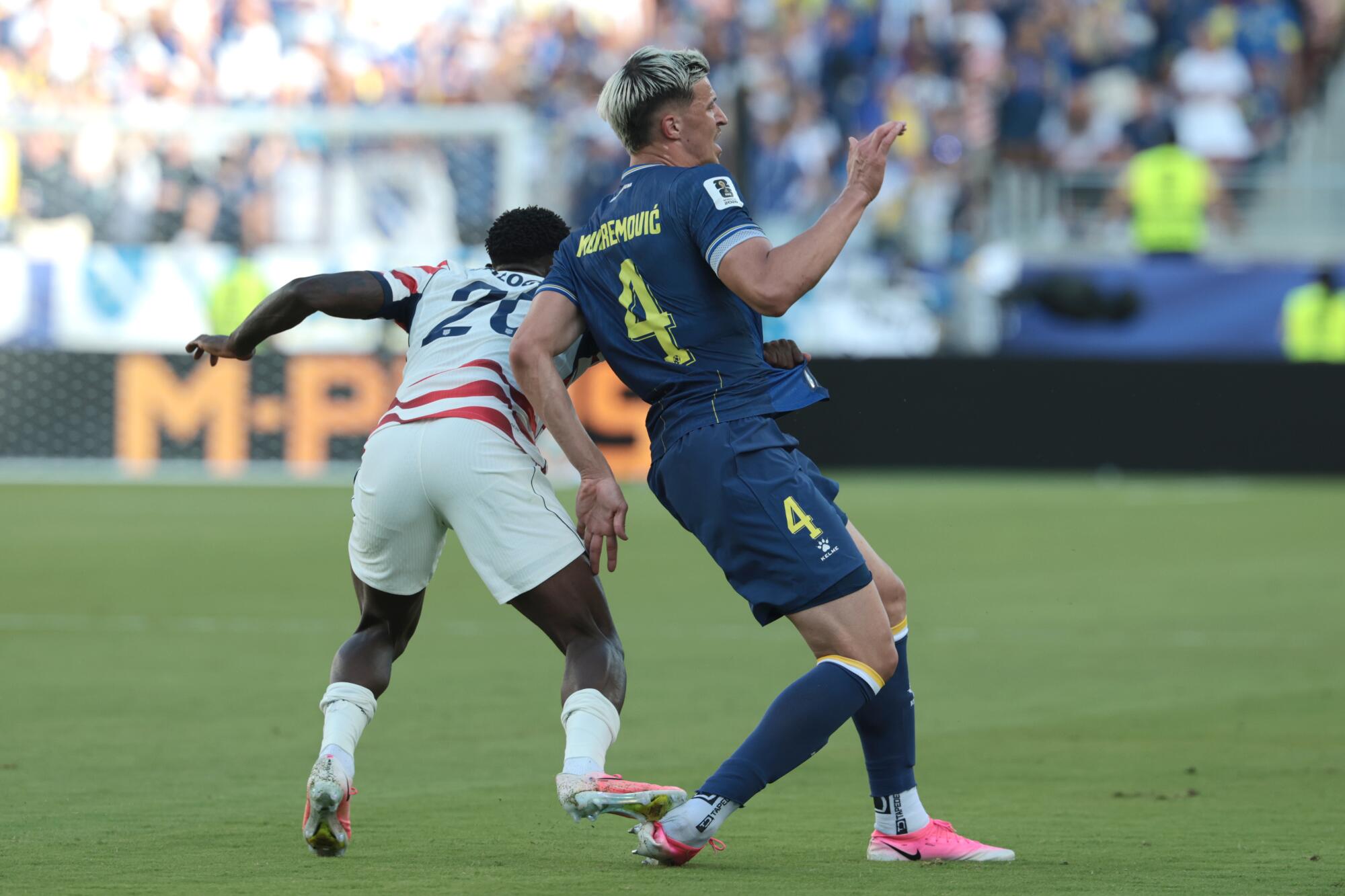
Balogun, who had given his team a 1-0 lead in the waning seconds of the first half, collided with Tarik Muharemovic 16 minutes into the second half, and when the Bosnian defender planted his right leg below Balogun’s right foot, the American inadvertently stomped on his right ankle, twisting it awkwardly.

U.S. forward Folarin Balogun steps on Bosnia-Herzegovina defender Tarik Muharemovic's foot and received a red card.

U.S. forward Folarin Balogun steps on Bosnia-Herzegovina defender Tarik Muharemovic’s foot and received a red card.

(Robert Gauthier/Los Angeles Times)

Both players went down and Claus did not signal a foul or pull card. But after the video assistant referee urged him to watch a replay, Claus walked away from the monitor and flashed the red card. That left the U.S. to finish Wednesday’s game with just 10 men and disqualified Balogun for Monday’s game. U.S. Soccer said Friday FIFA’s disciplinary committee did not add any games to Balogun’s suspension.

“There’s the scenarios that you simply can’t avoid,” he said, “and it has to be taken into context when it’s being reviewed. I felt it wasn’t on this occasion. There’s nowhere else to put your leg. It’s going to be unavoidable.

“I think a yellow card would have been fair. [But] it’s something that’s happened, so we have to move forward, and I have to accept it. The most important thing is just to focus on the bigger picture, which is Belgium.”

Replacing Balogun won’t be easy since he’s emerged as one of the team’s most effective and creative players, either scoring of setting up the go-ahead goal in all three of the U.S. wins.

“We’ve got guys that can fill in and have to be ready for the opportunity to step up,” midfielder Tyler Adams said. “When you miss a player like Balo, obviously things change a little bit. But we’ve been flexible. Guys have shown that they’re ready to play.”

The most likely replacements are Ricardo Pepi and Haji Wright. Pepi, who scored 16 goals for PSV in the Dutch Eredivisie this season, played 90 minutes in place of Balogun in the U.S. loss to Turkey in the final group-stage match. Wright, who had 17 goals for Coventry City in the English Championship, played in all four U.S. games in the 2022 World Cup, scoring once, but he has made just one appearance in this summer’s tournament.

“Balo is an important part of our team, and it’s a disappointing way for him to miss the next game,” said Wright, who grew up in Culver City and spent three years in the Galaxy academy. “But, I’ll always be ready and prepared for whatever comes.”

A victory over Belgium would send the U.S. to the quarterfinals of a World Cup for just the second time. It would also give it four wins in the tournament, double the number of victories in any previous World Cup and marking the first time the Americans have won twice in the knockout stages in the same tournament.

U.S. forward Ricardo Pepi pursues the ball during a World Cup match against Bosnia-Herzegovina at Levi's Stadium.

U.S. forward Ricardo Pepi pursues the ball during a World Cup match against Bosnia-Herzegovina at Levi’s Stadium in Santa Clara , Calif., on Wednesday.

(Robert Gauthier/Los Angeles Times)

It’s a moment, Adams acknowledged Friday, many players have waited for their whole lives.

“You need to embrace the moment, that’s for sure,” he said. “To have the opportunity to play in a round-of-16 game — which, obviously, last World Cup we did, but it was the first knockout game, not the second — it’s exciting. It was nice to get a little bit of a taste of what it feels like to play with something a little bit more on the line in the last game. I think that’s good preparation.

“Advancing and taking this thing as far as we can is the most important thing. We have a good opportunity here to do so.”

Source link

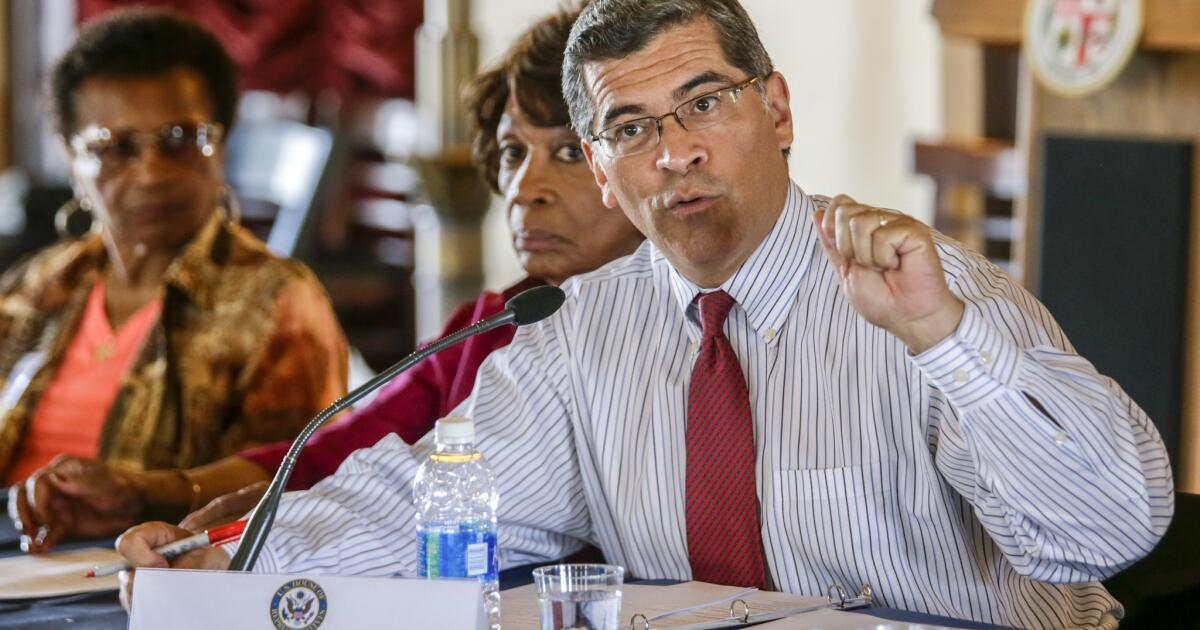
Los Angeles Rep. Xavier Becerra poised to become California’s first Latino attorney general

In a move that suggests a sharp battle to come with the administration of President-elect Donald Trump and upends conventional wisdom about who will emerge as the next generation of statewide elected officials, Gov. Jerry Brown picked House Democratic Caucus Chairman Xavier Becerra (D-Los Angeles) on Thursday to be California’s next attorney general.

If confirmed by both houses of the Legislature, he will succeed Kamala Harris, who was elected to the U.S. Senate in November.

Becerra, 58, has served 12 terms in Congress. Just days before the appointment, he had announced a bid to become the ranking Democrat on the powerful House Ways and Means Committee.

“It’s a phenomenal opportunity,” Becerra said. “It means I get to be home a lot more.”

Few statewide offices are as powerful, or prominent, as that of attorney general. The role has often been referred to as the state’s top lawyer and its top law enforcement officer, a nod to the breadth of responsibilities vested in the office and its leadership of the California Department of Justice.

Attorneys general not only must pursue cases of criminal and civil wrongdoing, they oversee criminal forensic work for most counties and make the final choice about defending state laws — even crafting the language that summarizes ballot measures for voters.

Becerra was beaming during an interview in his House office Thursday morning shortly after Brown offered him the job.

“I’m still processing,” Becerra said with a laugh. “I didn’t expect it.”

Becerra would be the state’s first Latino attorney general. The son of Mexican immigrants, he was the first member of his family to attend college, earning a law degree from Stanford Law School and a bachelor’s degree in economics from Stanford University. Elected to a two-year term in the state Assembly and then to the House in 1992, he rose through the ranks to become the highest-ranking Latino in Congress.

Becerra worked in the civil division of the state attorney general’s office, writing advisory opinions for former Gov. George Deukmejian, a Republican, and defending the state’s constitutional officers from 1987 to 1990 before entering the Assembly. He said he had always wanted to return to the office.

“It was a great place to be,” he said.

Brown’s pick was so sudden that Becerra has not yet had time to reactivate his state law license, though he would not be the first attorney general to have to do so. Inactive status allows attorneys to hold on to their licenses when they are not actively practicing law.

Becerra would also be the first attorney general appointed by a governor since Thomas Lynch, who was chosen by former Gov. Pat Brown in 1964. Few political appointments are likely to be as personal to the current governor as this one, given his own four-year stint as attorney general starting in 2006 and the fact that his father used the office as a steppingstone to governor more than five decades ago.

“Xavier has been an outstanding public servant — in the state Legislature, the U.S. Congress and as a deputy attorney general,” Brown said in a statement. “I’m confident he will be a champion for all Californians and help our state aggressively combat climate change.”

The choice sent political shock waves through California, in large part because Becerra was not on any of the widely circulated lists of potential picks. Brown had offered no details on whom he would pick or when.

Many suspected that he might choose a caretaker, perhaps even a career staffer who would simply carry out the office’s functions through the 2018 election. Virtually no Democrats who heard the news on Thursday believed that Becerra would be that kind of officeholder.

“He has the smarts, political experience and ambitions to run and win reelection,” said state Sen. Steve Glazer (D-Orinda), a former top political adviser to Brown.

If Becerra serves less than two years of Harris’ existing term, he could be eligible to run for up to two additional terms — eight years — as attorney general. Harris has said she plans to hold the position until she is sworn in to the Senate on Jan. 3, and at that point Brown could officially nominate Becerra.

Becerra said Thursday he’s thinking about the confirmation process at this point and not whether he’ll run for a full term as attorney general or another office in 2018. He must be confirmed by the state Senate and Assembly, both controlled by Democrats. Becerra said he hasn’t been told when a confirmation vote might happen.

Earlier, Becerra had flirted with a bid for U.S. Senate when Sen. Barbara Boxer (D-Calif.) announced plans to retire, but Harris’ quick entry into the race kept him and other California Democrats from running.

Holding such a prominent statewide post would raise Becerra’s profile as the Golden State’s foil to Trump, potentially setting him up to run for governor or U.S. Senate in the future. The attorney general, by virtue of the office’s broad power, will likely be a key player alongside Brown in pushing back against Trump’s proposed efforts on issues important to California, including immigration and climate change. In Texas, a state that has its own experience fighting the federal government, attorneys general have been a major force in the battle over states’ rights.

“He has great tenacity and he respects the rights of all Californians — much-needed qualities for an attorney general given the troubling times ahead,” Assembly Speaker Anthony Rendon (D-Paramount) said Thursday.

Several congressional colleagues echoed that sentiment.

“Many of the values that we stand by in California will be under attack in the next few years, and Chairman Becerra is the fighter I want in our corner,” Rep. Tony Cardenas (D-Los Angeles) said in a statement.

Becerra said that with Trump headed to the White House, he’s prepared to protect California’s progressive policies on immigration, the Affordable Care Act, energy and criminal justice. As California politicians embrace their roles in guarding the state against Trump’s policies, Becerra threw down his own gauntlet Thursday.

“If you want to take on a forward-leaning state that is prepared to defend its rights and interests, then come at us,” Becerra said.

A vocal advocate for Hillary Clinton’s presidential bid, Becerra was briefly floated as a potential pick for vice president or a Cabinet position. With Clinton’s loss Nov. 8 and no upward mobility available in House leadership, Becerra’s future political career was unclear.

He’d reached the time limit on serving as caucus chairman, the fourth highest-ranking House Democratic leadership position, and with House Minority Leader Nancy Pelosi (D-San Francisco) and the other two Democrats above him in leadership staying put, there was no path up the ladder headed into the next Congress.

Becerra serves on the powerful House Ways and Means Committee, and made a play as recently as Tuesday to be the committee’s ranking Democrat. He was quickly endorsed by the current ranking member, Rep. Sandy Levin (D-Mich.), who said in a statement Thursday that he respects that Becerra “feels a special responsibility during these difficult times to look after vital legal interests in his home state.”

Democrats across California reacted Thursday with effusive praise for Becerra. Lt. Gov. Gavin Newsom called him “a thoughtful and effective leader, with a keen legal mind and a passion for giving a voice to the voiceless.”

In particular, some pointed out the importance of elevating a Latino politician to statewide office, alongside both Latino leaders of the Legislature and Secretary of State Alex Padilla.

“It’s good for the state’s future,” said Bill Lockyer, who served as attorney general from 1999 to 2007.

The announcement also meant early guessing as to who would replace Becerra in representing downtown Los Angeles and communities to the west and north in Congress. Becerra won reelection in November in the solidly Democratic district. A special election to fill the seat would probably take place in late spring of 2017, though the law gives Brown wide discretion on the precise schedule.

John A. Pérez, the former Assembly speaker and current University of California regent, announced his bid less than an hour after Brown’s announcement, and more contenders may follow.

sarah.wire@latimes.com; john.myers@latimes.com

Follow @sarahdwire and @johnmyers on Twitter

Read more about the 55 members of California’s delegation at latimes.com/politics

ALSO

After beating back rival for House leadership post, Nancy Pelosi says Democrats are ready for Trump

Trump seems ready to fight the world on climate change. But he’s likely to meet resistance

Updates on California politics


Source link