LeBron James’ 30 points can’t save injury-plagued Lakers from loss
DALLAS — The Lakers are as shorthanded as they can be, their dynamic starting backcourt of Luka Doncic and Austin Reaves out with injuries at a pivotal time of the season.
They’re the offensive engines for a Lakers team battling for the No. 3 playoff seeding in a competitive Western Conference.
The 41-year-old LeBron James is now driving the Lakers, and despite falling just a rebound shy of a triple-double, he couldn’t save the Lakers from a 134-128 loss to the Dallas Mavericks on Sunday at American Airlines Center.
James had 30 points, 15 assists and nine rebounds. Luke Kennard delivered his first career triple-double with 15 points, 16 rebounds and 11 assists.
Dallas rookie Cooper Flagg, coming off a 51-point performance against Orlando on Friday, finished with 45 points, nine assists and eight rebounds. He scored 19 points in the first quarter.
“Obviously, Cooper is in a zone over the last couple of games,” James said. “But [he] also has been playing consistent basketball all year so it’s great to see him from early in the season to where he is today.”
For the Lakers, finding ways to win without two of their best players will be their challenge over the final week of the season.
“We’ve got to have the commitment to do it on both ends and that’s the reason that we’ve put ourselves in the position to be in the playoffs,” Redick said, “because we became a really good offensive team and a really good defensive team.”
Doncic was diagnosed with a Grade 2 left hamstring strain and will be out the remainder of the regular season — maybe even longer.
Doncic’s agent, Bill Duffy of WME Sports, confirmed to The Times that his client will seek specialized treatment for his injury in Europe with the hopes of speeding up his recovery.
Reaves was diagnosed with a Grade 2 left oblique muscle injury and will be out for the rest of the regular season, and likely into the playoffs. The time frame for Reaves’ return is more like four-to-six weeks, according to a person with knowledge of the situation not authorized to speak on the matter.

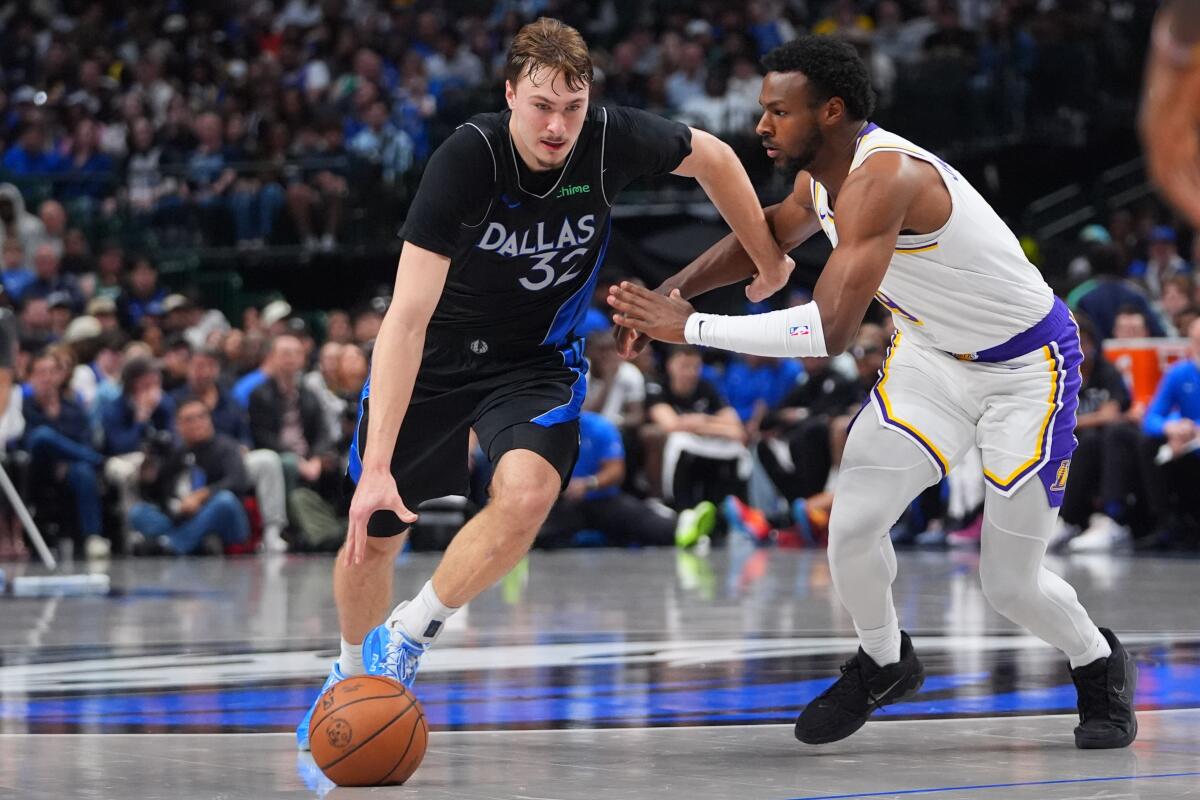
Dallas Mavericks forward Cooper Flagg, left, drives against Lakers guard Bronny James during the second half Sunday.
(LM Otero / Associated Press)
“I took my nap after practice and I woke up with that news and it was like another shot to the [head],” James said about Reaves’ diagnosis. “It was a shot to the heart, obviously, and to the chest and to the mainframe with Luka, understanding that.”
Even Marcus Smart, known for his competitiveness and defensive tenacity, missed his seventh straight game with right ankle soreness.
With Doncic and Reaves out, the Lakers lose a combined 56.8 points per game and 13.8 assists per game. Doncic is fourth in the NBA in assists, with 8.3 per game, and he’s second on the Lakers in rebounding, at 7.7 per game.
“We knew that Austin was likely going to be out for a little bit of time,” Redick said. “Obviously, disappointed and devastated for him to have his regular season finish this way. … Both those guys are going to try to come back and it’s our job to extend the season so that they can come back.”
The Lakers have four regular-season games left, starting with Oklahoma City on Tuesday at Crypto.com Arena. They play at Golden State on Thursday before facing the Phoenix Suns in L.A. on Friday.

The Lakers are tied with the Denver Nuggets for third in the West at 50-28, although the Lakers own the tiebreaker. The NBA playoffs starts the weekend of April 18.
With that in mind, Redick was asked if he had an optimistic view of Doncic being back for the playoffs.
“I just know that he’s gonna do everything he can to try to be back,” Redick said. “I talked to him Friday. I talked to him again yesterday. I talked to him again this morning. He’s going to go through all the necessary things to be back at some point, and it’s our job again to extend the season so both those guys can get back.”