Rodri won the Ballon d’Or in 2024 but missed almost the entirety of last season after sustaining a knee injury and City failed to win a major trophy for the first time in eight years.
He has missed large chunks of this campaign because of a hamstring issue but has played 28 games in all competitions, helping the side to win the Carabao Cup against Arsenal at Wembley.
During his time at City, Rodri has won four Premier League titles, the Champions League, FA Cup and three League Cups.
Rodri previously said to Spanish media: “There have been many players who’ve gone down that path [playing for Atletico and Real].
“Not immediately, but over time. For me, you can’t turn down the best clubs in the world.”
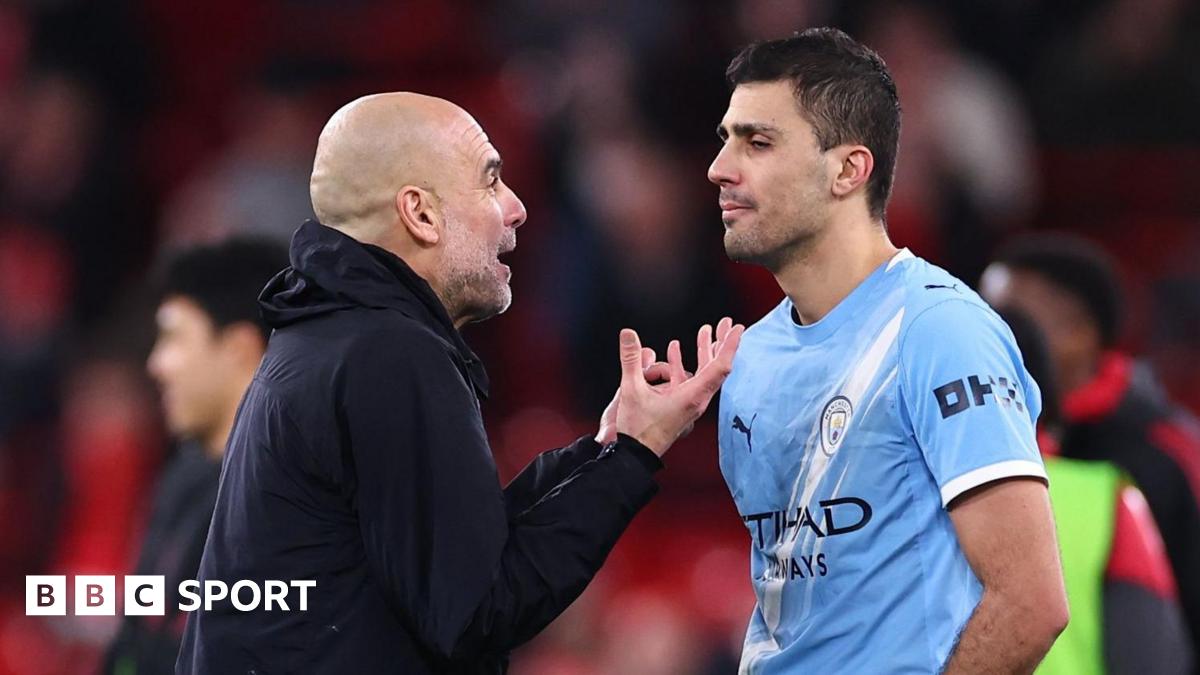
Guardiola said Rodri has shown over time “how attached, how close he is” to City and his “contribution has been massive”.
The manager confirmed he would “absolutely” not stand in the midfielder’s way if he wanted to leave, adding: “The organisation of the club is above all of us – if one player is not happy they have to leave and [we] continue the same always if they are happy – and I think he is happy.
“If he is not happy just knock on the door of the sporting director, accept an offer according to his incredible quality and after that he doesn’t belong to the club – only himself.
“I know what the club wants. They informed me what they want from Rodri – it is to stay, stay, stay. I always had the positive [feeling] with that but at the end I don’t know.”
Following the Carabao Cup final defeat by Manchester City earlier this month, defender William Saliba confirmed he would not be joining up with France because of an ankle injury.
His centre-back partner Gabriel then withdrew from the Brazil squad with a knee problem.
They were later joined by England forward Eberechi Eze (calf), Norway midfielder Martin Odegaard (knee) and Netherlands defender Jurrien Timber (groin) – who all missed the cup final defeat at Wembley through injury – as well as Belgium forward Leandro Trossard (hip).
After players joined up with their respective countries, five more from Arsenal withdrew – England trio Declan Rice (knock), Bukayo Saka (knock) and Noni Madueke (injured his knee against Uruguay) as well as Spain’s Martin Zubimendi (knee) and Ecuador’s Piero Hincapie (undisclosed).
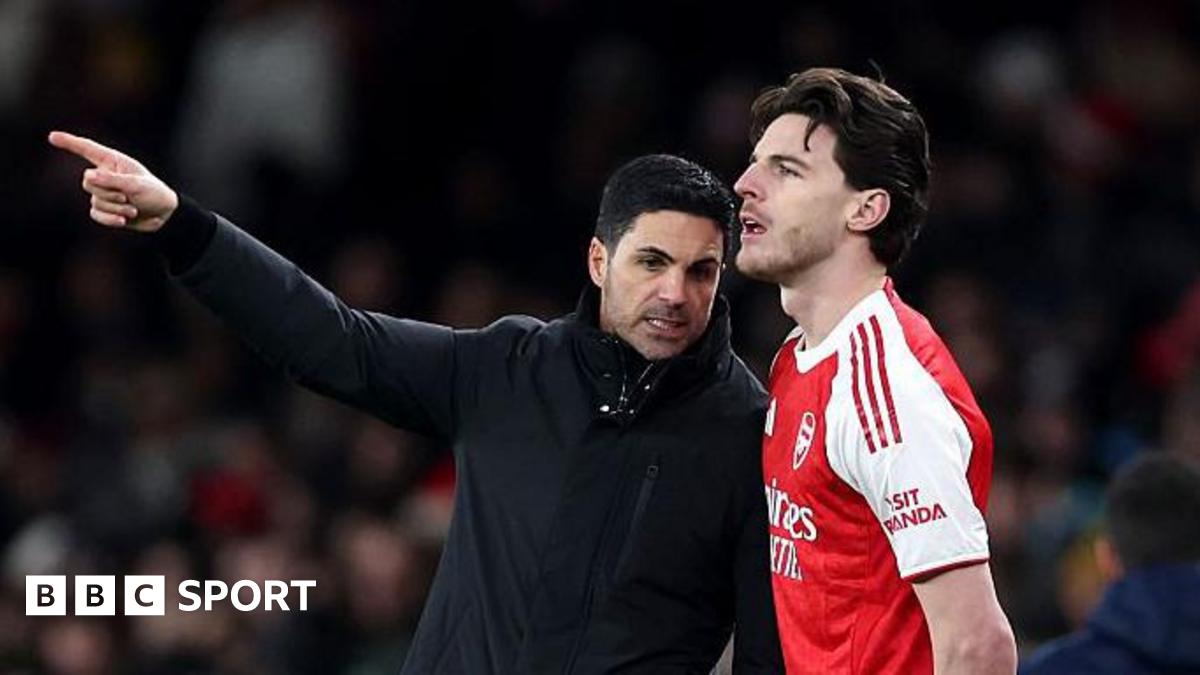
Arteta said his players were “desperate” to play for their countries.
“When you are fit and available to play for the national team, you have to play,” he added.
“It makes us so proud that we had that many players in the national team.
“Players are desperate to play for their nation. I know how important it is to them. We are fully supportive of that and when we can do it, we do it.”
Premier League leaders Arsenal are in FA Cup quarter-final action on Saturday as they visit in-form Championship side Southampton (20:00 BST).
Arteta confirmed Eze will miss the game through injury, but Odegaard and Timber are in contention to return, while Madueke’s injury is not as bad as first feared and is a doubt.
Asked how many of those 11 players who withdrew from international duty will be available for selection against the Saints, Arteta added: “You will see. I will let you do the speculation. You can judge afterwards.
“We are in a position right now where we need to make the strongest line-up we possibly can to win every competition.
“We are two or three games away from the FA Cup and we know how important that competition is for us.”
Jordan Pickford: Japan’s opening goal was the first time Pickford had conceded for England in 922 minutes. He had to produce a smart save in the second half to keep the hosts in the game. 6
Ben White: Beaten once early on but showed the consistency he has done for Arsenal after that. A constant hard-working presence down the right-hand side. One particularly good overlapping run in the first half. 6
Ezri Konsa: In with a big chance of starting the first game at the World Cup. One crucial block to deny Ayase Ueda with the shot hitting the bar and going over. 6
Marc Guehi: Given the armband by Tuchel for the first time. A couple of shaky moments early on but after that as dependable as ever. 6
Nico O’Reilly: Another important game for O’Reilly as he makes the left-back position his own before the summer. He showed his ability on the ball and moved into midfield whenever he could. 7
Kobbie Mainoo: A bright start and some nice footwork when moving the ball around midfield. Beaten a couple of times on Japan attacks when trying to defend. 6
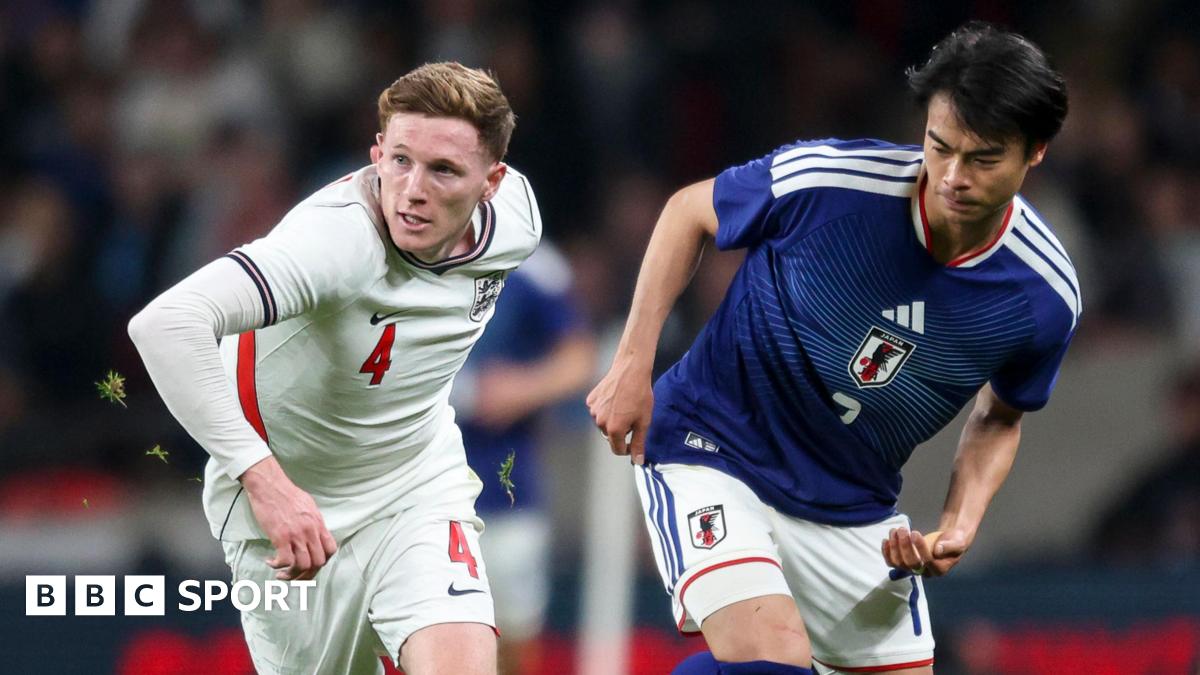
Elliot Anderson: A certain starter at the World Cup. Assured in midfield, provided a drive to England’s play and tried to make things happen. One of the better performers on the night and clipped the crossbar with a good effort. 7
Cole Palmer: The Chelsea attacker was given the nod as the number 10 over Phil Foden who played as a false nine. There was always a sense that something could happen when Palmer was on the ball. However, he was caught on the ball and punished for Japan’s opener. Came off just before the hour mark. 6
Morgan Rogers: Started on the right wing and asked to provide a threat through the middle with no natural striker in the starting line-up. Not his best position but did the job that was asked of him. 6
Anthony Gordon: Put in another energetic performance with lots of hard work but not many moments to threaten the Japan defence. 5
Phil Foden: The Man City forward started as a false nine as Tuchel looks for a position for him in England’s squad. It was not a good night for Foden who will be worried about his place on the plane for the World Cup. Replaced in the 59th minute. 5
Welcome back to this week’s Lakers newsletter, where the vibes are immaculate.
The Lakers have won 15 of their last 17 games. LeBron James continues to set NBA records, most recently tying the all-time mark for wins in the regular season and playoffs with Monday’s win over Washington. Jaxson Hayes hasn’t missed a three-point shot all year. The fans who chanted “We want Bronny!” have gotten their wish.
With seven games remaining in the regular season, we turn our focus to a different cheer.
MVP! MVP!
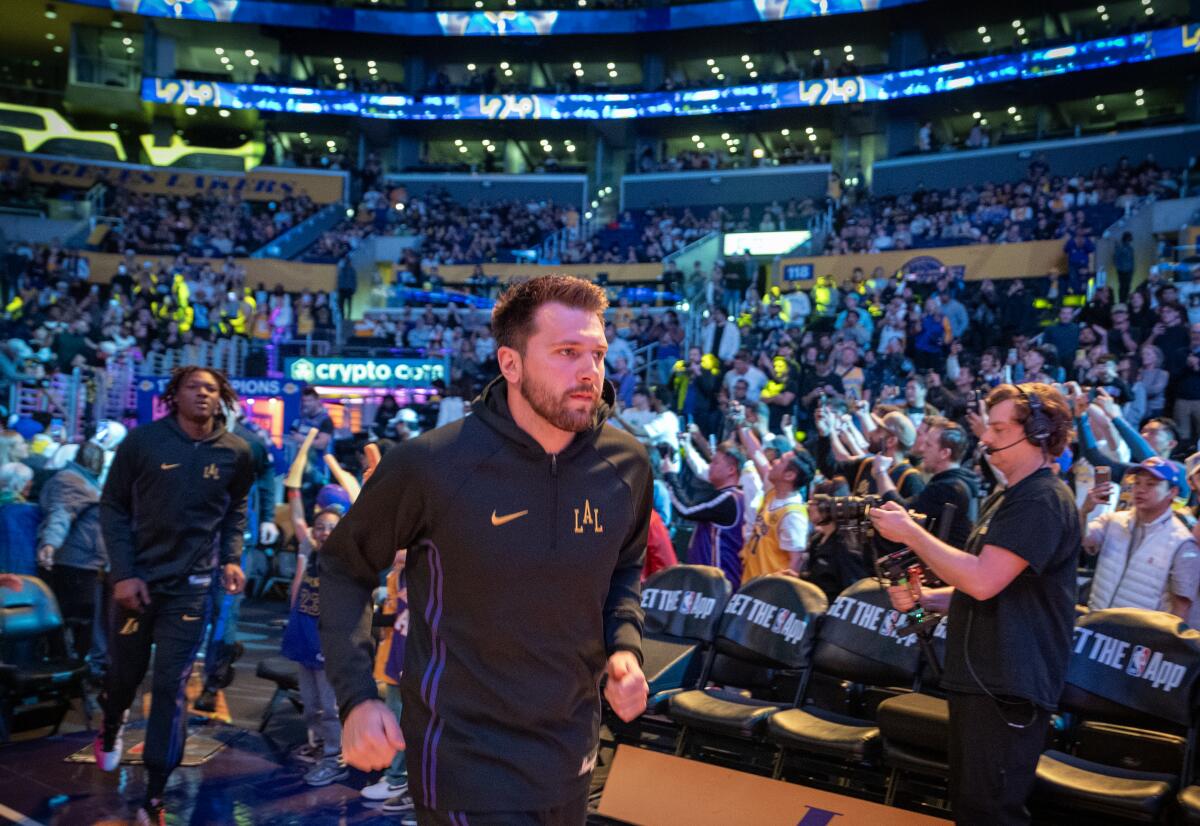
Lakers star Luka Doncic runs onto the court before a game against the Minnesota Timberwolves on March 10 at Crypto.com Arena.
(Allen J. Schaben / Los Angeles Times)
The familiar chant rang out in arenas from L.A. to Miami to Indianapolis. Luka Doncic’s campaign was powerful enough to sway even opposing crowds that showered him with shouts of “MVP.”
With Doncic on a historic season-ending heater, the most valuable player discussion suddenly got piping hot with two weeks left in the season. The NBA’s leading scorer surged back into the race with gaudy numbers over the month of March: 37.2 points, 8.2 rebounds and 7.1 assists per game; 12 straight 30-point games; a 24-hour stretch with 100 points; and the first 60-point performance by a Laker since Kobe Bryant in his final game.
The most important number from March: 14 wins. Approaching the playoffs, the Lakers (49-26) are one of the hottest teams in the league, powered by Doncic’s brilliance.
All things Lakers, all the time.
Get all the Lakers news you need in Thuc Nhi Nguyen’s weekly newsletter.
By continuing, you agree to our Terms of Service, which include arbitration and a class action waiver. You agree that we and our third-party vendors may collect and use your information, including through cookies, pixels and similar technologies, for the purposes set forth in our Privacy Policy such as personalizing your experience and ads.
“If we continue to finish the season the way we’re playing right now, and he continues to play that way, to me, he is the MVP,” Lakers coach JJ Redick said.
Doncic leads the league in scoring (33.7) and is just a hair off from the career-high 33.9 points per game he averaged when he finished third in MVP voting in 2024. Compared to the other top three MVP candidates — Shai Gilgeous-Alexander, Nikola Jokic and Victor Wembanyama — Doncic’s traditional stats paint a competitive picture. He has the second-most assists of the quartet behind Jokic and the third-most rebounds.
Among guards who have played more than 11 games, Doncic ranks third in rebounds per game at 7.8, and his 7.2 defensive rebounds per game is the most of anyone at his position. Doncic’s defense gets picked apart, but he also has a career-best 102 steals. He’s the only player averaging 30 or more points this season with 100 or more steals.
“He’s the engine that’s driving all of our winning,” Redick said.
Advanced statistics have Doncic a tier below his rivals. Doncic’s net rating of plus-4 is a distant fourth among the top contenders and pales in comparison to Wembanyama’s plus-17.3.
Breaking down the MVP race
Jokic appeared to be on his way to winning his fourth MVP before the Nuggets star missed a month with a knee injury. By leading the Oklahoma City Thunder to the best record in the league, Gilgeous-Alexander appeared to be in pole position to win his second consecutive MVP.
Doncic and Wembanyama are making a late charge. The Spurs see the Lakers’ 14-2 record in March and raise them a 25-2 mark since Feb. 1. They won their 10 consecutive game Monday. While Doncic was serving a suspension for technical foul accumulation, Wembanyama scored 41 points with 16 rebounds, four assists and three blocks against the Chicago Bulls.
The MVP chants in Frost Bank Arena are just as loud as anywhere in the league.
All fore one
Lakers guard Austin Reaves shoots a free throw during a win over the Washington Wizards on Monday at Crypto.com Arena.
(Robert Gauthier / Los Angeles Times)
Of all the NBA markets, L.A. presents unique challenges to team building. When Redick played for the Clippers, teammates scattered immediately after practice with hopes of beating traffic on the way home. Redick knew he wasn’t going to drive hours from his home in Manhattan Beach to visit Chris Paul in Calabasas.
But for the Lakers, a round of golf is worth a drive on the 405.
“Finding tee times, being with each other for four hours where you can shoot the proverbial S-H-I-whatever and not have to be in a high pressure moment or on a team bus and kind of be away from the facility,” Redick said, “I think it’s great.”
Golf is the Lakers’ latest bonding activity that’s helped keep the vibes high through the most successful stretch of the season. The Lakers have been intentional with team-building activities in Redick’s second year at the helm. All players and coaches made autobiographical powerpoint presentations to the team during the preseason. Jake LaRavia and assistant coach Beau Levesque won the team-wide pickleball tournament in November. Players and coaches arrange golf outings between games on long road trips. One day after hitting the winning shot in Orlando, newest teammate Luke Kennard got in on the golf action in a scramble match with players facing coaches.
“They had AR,” Redick said sheepishly, “so we can all guess the result of that one.”
Austin Reaves is the leader in the clubhouse. He remembered when teammates gave him grief about his love of golf, which he picked up at 17 and almost immediately excelled at. Seeing his teammates embrace the game “actually means a lot to me,” Reaves said.
“I’m glad that they are addicted,” he added with a satisfied smile.
After the COVID-19 bubble, Redick noticed an uptick in golf’s popularity around the league. Even the Lakers have a handful of players who suddenly decided to start during the last year. Doncic is the most recent convert. He bragged that he beat Reaves on one hole when they played in Indianapolis. Reaves, who got a double bogey compared to Doncic’s bogey, said he let his teammate win.
“It’s a confidence thing,” Reaves said. “We needed him to be at his best at 7 o’clock tonight.”
Doncic scored 43 points against Indianapolis the day after the golf outing.
On tap
Cleveland’s Jarrett Allen shoots between Detroit’s Cade Cunningham, left, and forward Tobias Harris on March 3.
(Sue Ogrocki / Associated Press)
Tuesday vs. Cleveland (47-28), 7:30 p.m. PDT
Center Jarrett Allen returned last week from a 10-game absence, but missed Cleveland’s game on Monday in Utah as he managed right knee tendinitis. Missing the first game of a back-to-back indicates that he’ll likely be available against the Lakers.
Thursday at Oklahoma City (60-16), 6:30 p.m. PDT
The Thunder have won 15 of their last 16 games with the only loss coming against Boston. This game and next week’s rematch at Crypto.com Arena could be critical in the MVP race between Gilgeous-Alexander and Doncic.
Sunday at Dallas (24-51), 4:30 p.m. PDT
Since the trade heard ‘round the league, Doncic has averaged 33 points, nine rebounds and 10 assists in four games against his former team. It’s his highest scoring average against any Western Conference opponent.
Status report
Marcus Smart (right ankle contusion)
Smart remains day-to-day with an ankle injury he sustained against Orlando. He has missed four games.
Adou Thiero (left knee soreness)
The rookie forward landed back on the injury report after playing two minutes in the Lakers’ loss to Detroit. Redick said Thiero was held out for precautionary reasons after his knee didn’t react well to playing in a G League game then playing in Detroit two days later. Thiero previously missed six weeks with a right medial collateral ligament sprain and underwent surgery on his left knee in college, which kept him sidelined at the beginning of the season.
Favorite thing I ate this week
(Thuc Nhi Nguyen / Los Angeles Times)
I have had Ramen Nagi on my list for literal years because former USC center Brett Neilon — who grew up in Tokyo — recommended it. I have changed beats three times since then but never forgot what he said was his favorite ramen place in L.A. The red king, which is a spicy version of their pork broth ramen, was worth the years of anticipation. Every bowl is customizable so I loved getting to add thick ramen noodles.
As part of a view to securing private investment, Middlesex are looking into moving away from their current home where they have been long-standing tenants of the Marylebone Cricket Club (MCC) for 160 years.
In the letter, the former Middlesex players are critical of the fact only one member of the club’s board, former England bowler Steven Finn who joined in 2024, has playing experience in first-class cricket. It is understood no other players have applied in recent years.
Radley, Emburey, Selvey and Ramprakash have all had stints as Middlesex president since 2013. Gatting was on the club’s board until recently.
They have called on the club’s members to attend this month’s Annual General Meeting “in numbers” to “seek answers”.
Middlesex committed to a governance review at a recent members’ forum.
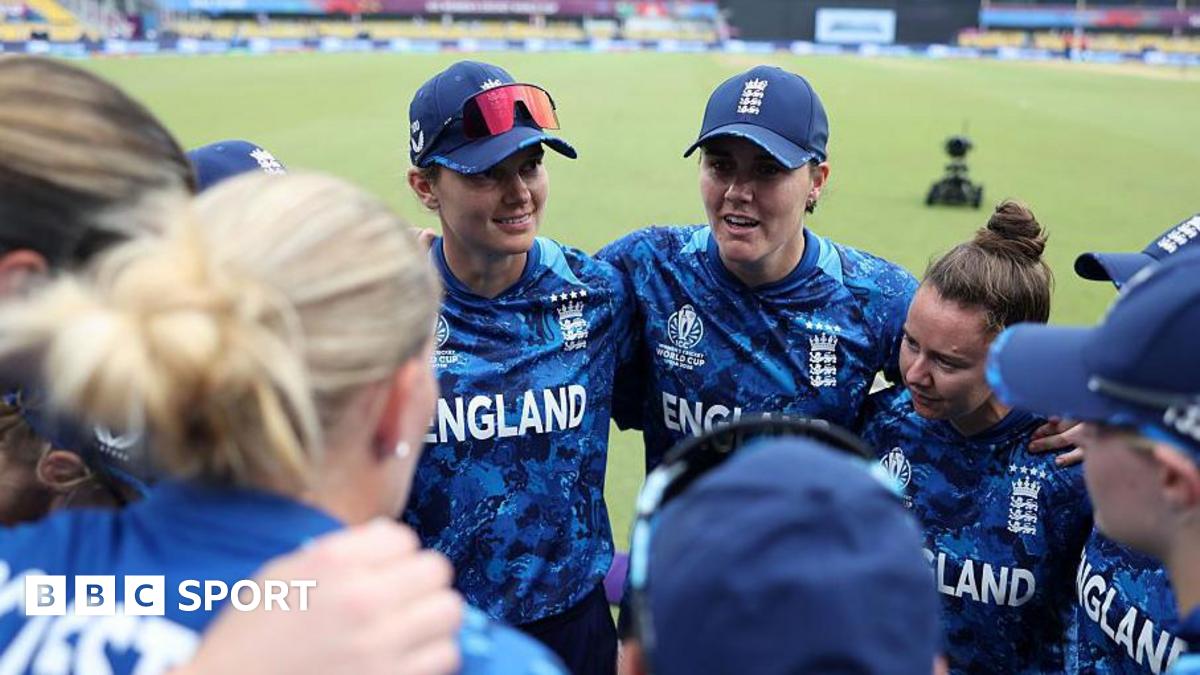
England head coach Charlotte Edwards says her players have categorically addressed the issues surrounding their fitness.
The physical condition of England’s players was a hot topic of debate before Edwards’ appointment.
England’s early exit from the Women’s T20 World Cup just under 18 months ago prompted former spinner Alex Hartley to say some players were “letting the team down” in terms of fitness.
Athleticism again came into focus during the Ashes in January 2025, and former coach Jon Lewis attributed it to a cultural difference between the UK and Australia.
When asked on a BBC Test Match Special debate show if the fitness issue had been put to bed, Edwards responded that it “100%” had.
“We’re in a really good place. The results are all so high. I couldn’t be more chuffed – we’ve made real progress,” Edwards said.
“It’s not just all about whether you can run round a track. It’s all the other elements to it that we’ve tried to make just as important.”
Edwards will celebrate a year in charge of England, who host the T20 World Cup this summer, on Wednesday.
The 46-year-old said the introduction of specific benchmarks relating to fitness have had the desired impact.
“I think once you set out the expectation, the players know what they need to do. And we’ve added in sort of benchmarks over the winter,” Edwards added.
“We’ve got to keep raising the standard. The players have fully bought into that, which, that was, I guess what I set out to do and am really pleased with the buy-in.
“I don’t know if anyone watched the fielding from the recent [intra-squad] series, but it’s some of the best fielding I’ve seen, certainly from our group, the improvements we’ve made.”
Watch the full debate about England’s women’s team on BBC iPlayer or listen to it as a podcast on BBC Sounds.
The Final Four in men’s and women’s basketball is scheduled for this weekend, and Southern California has two players to root for who were high school graduates from the area.
McDonald’s All-American Brayden Burries, a freshman at Arizona from Eastvale Roosevelt, has been a key player in the Wildcats’ season, averaging 16.1 points.
Gabriela Jaquez has helped the UCLA’s women’s team reach the Final Four, averaging 13 points a game for the 35-1 Bruins.
The men’s semifinals and final are Saturday and Monday at Lucas Oil Stadium in Indianapolis.
The women’s semifinals and final are Friday and Sunday at the Mortgage Matchup Center in Phoenix.
This is a daily look at the positive happenings in high school sports. To submit any news, please email eric.sondheimer@latimes.com.
John Murray, BBC Radio 5 Live football correspondent
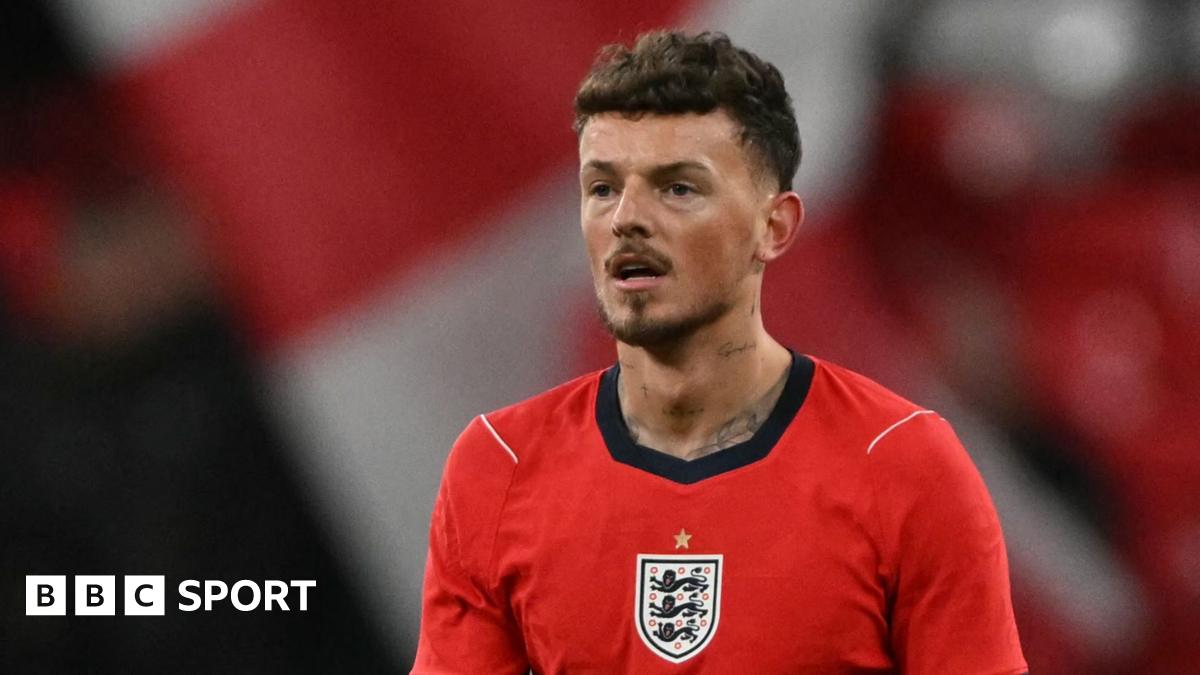
What that match will be remembered for is Ben White.
That’s the only match I have ever seen when an England player has scored his first international goal for England at Wembley and was booed by, I would say, a sizeable minority of the crowd.
When he left the squad in Qatar and went home for what was described as personal reasons – we’ve never really got to the bottom of what it was.
There were stories that there was a fall-out, something happened involving Steve Holland, Gareth Southgate’s assistant. But that was never confirmed by Gareth Southgate.
I thought last night might have been the perfect opportunity for Ben White to put his head above the parapet. He’s made his comeback, he’s just scored his first goal. But, as Thomas Tuchel was saying in advance of the match – and we kind of know this already – he described him as quite introverted, quite shy, and maybe he just doesn’t feel comfortable to do that.
But probably at some stage he will have to grasp the nettle and talk about it.
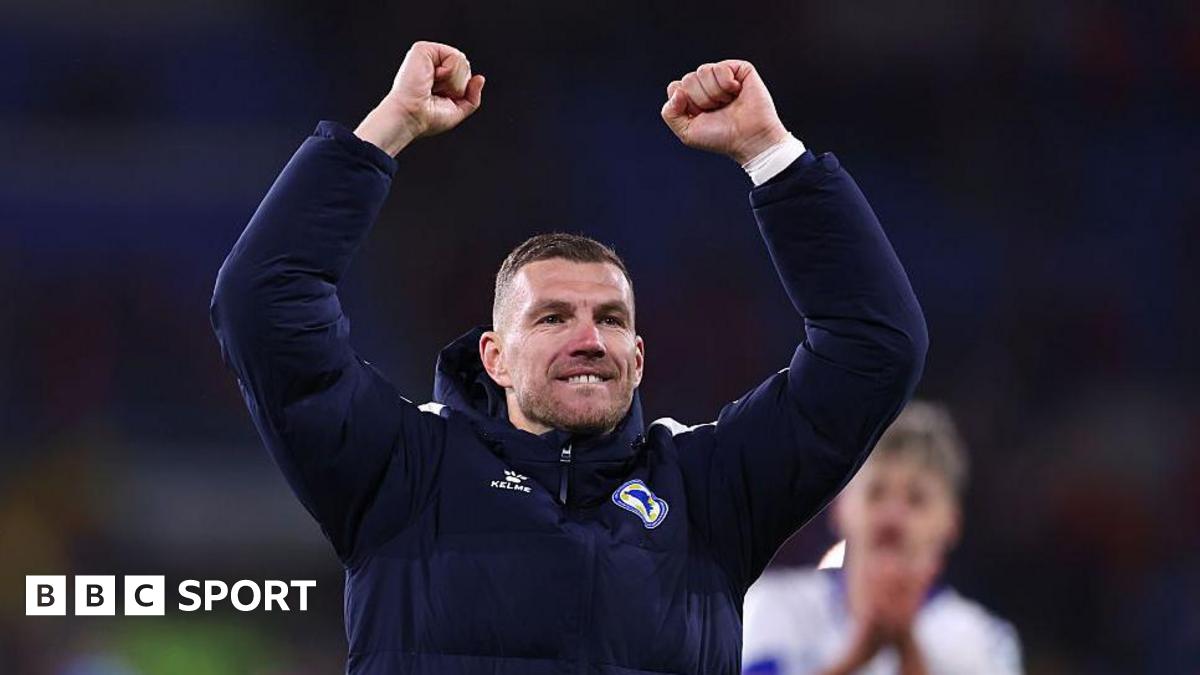
Dzeko has been a crucial player for his country since his international debut in 2007, and has 73 goals in 147 appearances – scoring every year for the past two decades.
Until as recently as last year he was still reaching double figures for goals at club level.
Last summer, he returned to Serie A to sign for Fiorentina and, at the time, dismissed suggestions he was slowing down with age.
“Age doesn’t matter, I’m not a write-off yet,” he said.
“Behind all this is the work that a 39-year-old has to do, even more than others. I feel good, we’re working hard, and this will bring us satisfaction later.”
That move did not quite work out and Dzeko soon found himself out of favour at the club, having failed to score in 11 Serie A games.
But a switch to Schalke in Bundesliga 2 in January has reinvigorated him – possibly at just the right time as the World Cup approaches – and he has scored six goals in eight games for the German side.
On what the future holds for him, Dzeko said recently: “I’ll listen to my body in the summer but at the moment, I still feel very good, and I still score goals.”
But if he does help his country qualify for the World Cup, it is very likely that conversation with his body will be delayed a little longer.
Call them the Geek Squad, the Surfer Dudes or the Genius Squad from Redondo Union High.
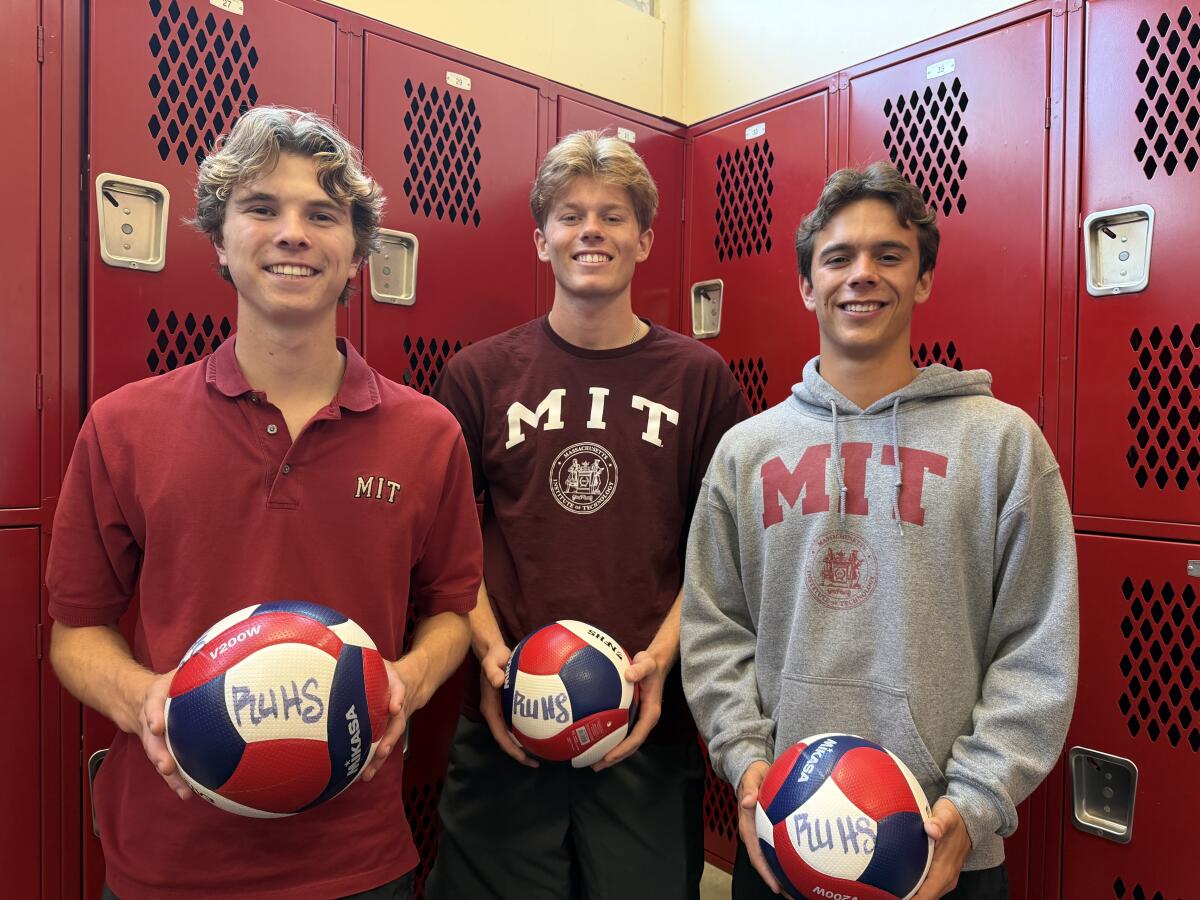
In an unprecedented achievement, three starters for the Sea Hawks’ 13-2 volleyball team — Tommy Spalding, Vaughan Flaherty and Carter Mirabal — are headed to MIT this fall.
Their final assignment in Advanced Placement Physics 2 should be figuring out the astronomical odds of how three best friends from the same volleyball team could be admitted to one of the most prestigious universities in the world.
“There’s no way,” was the reaction of Mirabal’s father when he heard the news.
“It’s crazy,” coach Kevin Norman said.
Steve Jobs and Steve Wozniak founded Apple hanging out in a garage. Who knows what inventions, ideas or technological feats will be imagined in gyms or on surfboards as these three Southern California teenagers unleash their brain power and love for having fun on the East Coast.
“Probably twice a week, I’ll call him, ‘Yo, I have this idea,’” Spalding said of his conversations with Mirabal. “Ninety-nine percent of the time, we usually don’t do anything about it. But it’s throwing ideas out there and hopefully one is going to stick.”
One Spalding idea: “When I was driving home from Joshua Tree, I was stuck in traffic. I was like, ‘Dude, what if we made a Google Maps type of app that utilized AI and had a camera in your car that analyzed the road, tells you what lane to be in to go the fastest and also be able to look at the traffic lights and tell you if this left arrow is red, then go straight, turn left at the next street.”
Elon Musk, beware.
MIT-bound Redondo Union volleyball players Tommy Spalding, left, Vaughan Flaherty and Carter Mirabal.
(Eric Sondheimer / Los Angeles Times)
They’ve formed a band, “Ratiohead,” a parody of the English rock band Radiohead, with lyrics from math. They’re preparing for the battle of the bands. Spalding is the vocalist, Maribal is on keyboard and Flaherty, the 6-foot-5 redhead, plays guitar.
“We’re looking for a drummer,” Spalding said.
Spalding has a 4.65 GPA and 1490 SAT score. Flaherty is at 4.4 and 1560. Mirabal is at 4.4 and 1510. Spalding said his hardest class was AP European history. Mirabal chose honors chemistry. Each received one B in four years of high school. Flaherty has received multiple Bs and said, “I think it goes to show you that you don’t have to be perfect to get into these schools if you have the potential and you’re willing to work hard and be a good fit.”
Flaherty is so witty he might be able to do a comedy routine, with Spalding serving as his wing man.
“Someone might have messed up, but I’m not going to tell them,” Flaherty said of the threesome earning a spot in the MIT class of 2030.
“Maybe it was chemistry,” Spalding quipped.
If they can make a movie, “The Social Network,” about the invention of Facebook. and a TV series, “Big Bang Theory,” about smart geeks, just wait until someone figures out the entertainment value following around this threesome.
Coming Wednesday in L.A. Times is one of my favorite stories. How 3 Redondo Union volleyball players were accepted to . . . MIT. Yes, it’s hard to believe and the players are talented in many things. Here’s Tommy Spalding and Carter Miribal, part of the new band, “Ratiohead.” pic.twitter.com/MBWvPXvIxF
Spalding has all the attributes of a future entrepreneur and loves tinkering with cars. He sent a two-minute video to MIT as part of his application process that showed himself and his father, Michael, turning a 2002 yellow school bus into an RV.
Mirabal has his own YouTube channel, “Carter’s Stuff Review.” He wants to be a mechanical engineer and explore the business side. Flaherty would be happy sending rockets and satellites into space while living near the beach.
All three hang out at the beach, either playing volleyball or surfing. Spalding brought his grandfather’s ping-pong table to the volleyball room at school for more fun. Cornhole is another game they play.
None set out at the beginning of high school seeking a path that leads to MIT, which accepts only about five students for every 100 applicants. “We weren’t taking the classes because we want to go to MIT,” Spalding said. “We just enjoy the subjects.”
There are smart genes in their families. Spalding’s parents are both educators, one an AP physics teacher at Peninsula High, the other a middle school vice principal. Mirabal’s father is an accountant. Flaherty’s father owns two Handel’s ice cream stores (everyone wants to hang out with Flaherty on a hot day).
Each has a story to tell about how they learned of being accepted to MIT.
Mirabal was playing volleyball in his backyard on Dec. 15 with teammates. He was going to wait until his friends left to check the email for fear of rejection. Instead, with them huddled around, he opened the email and everyone started screaming, “Yo!”
Spalding was with Mirabal and headed home to share the moment with his parents when he received a text from the MIT volleyball coach walking out the door congratulating him. “Welcome to the MIT family,” it read.
Flaherty had to wait until March 14 — Pi Day — to see if he was going to make it three for three.
He was driving home from Joshua Tree national park with his girlfriend and Tommy’s girlfriend in the car. The traffic was so bad it came to a standstill so he checked his cellphone.
“I opened it up. I saw the confetti but didn’t realize what it meant until I got a couple lines down,” he said. “The first reaction was disbelief because I thought there was no chance after these two got in.”
In fact, Flaherty said the person doing the MIT interview admitted later, “I’m not going to lie. I thought that was the killer for your application.”
They’ll be playing NCAA Division III volleyball. Mirabal and Spalding will be roommates. “Vaughan will room with someone else because he said he’d be too comfortable with us and be a bad roommate,” Spalding said.
So are they really OK leaving Southern California?
“I wouldn’t say OK with it,” Spalding said.
“It is a sacrifice,” Mirabal said.
Just know the beach will always draw them back to sunny Southern California as the three sat in the Redondo Union volleyball locker room wearing shorts, sandals and their MIT shirts.
“As much as we study, I feel at the end of the day we want to have fun,” Spalding said.
They’re not expecting to re-create “Animal House” at MIT, but let’s see what happens when three surfer dudes from the same high school in California show up with open minds and lots of ideas to explore.
For Nareg Kopooshian, the basketball coach at AGBU High in Canoga Park, there’s a big summer ahead. He’s going to be the head coach for the U16 Armenian national team in the FIBA U16 EuroBasket competition July 4-12 in Yerevan.
It’s the first time Armenia is hosting the event.
Los Angeles has the largest Armenian community in the United States with as many as 700,000 people.
Players selected for the training camp in Armenia include Anthony Sarkesian (Chaminade), Anthony Karayan (Village Christian), Ethan Kazanjian (AGBU), Edward Gemjian (La Canada) and Jivan Dorian (AGBU).
This is a daily look at the positive happenings in high school sports. To submit any news, please email eric.sondheimer@latimes.com.
The Major League Baseball Players Assn. is arguably the strongest union in the United States whose members include some of the most conservative athletes in professional sports. The owners of Major League Baseball’s 30 teams, who made their wealth through the workings of free enterprise capitalism, want to limit what players can be paid. This apparent political and philosophical irony will most likely lead to a shutdown of baseball at the end of this season.
Wednesday is opening day for the 162-game major league season. The 2025 season ended Nov. 1 with an 11-inning Dodgers victory over the Toronto Blue Jays in what was one of the most mesmerizing World Series ever. Last season, the Dodgers attracted more than 4 million fans for the first time. The Dodgers weren’t alone. More than 71 million fans attended major league games — the third straight season of growth. Over the last decade, league revenue has increased 33%.
And yet, despite all this good news about the health of baseball’s finances, team owners have threatened to lock the players out — essentially an ownership strike — at the end of this season over terms of a new collective bargaining agreement soon to be negotiated with the players union.
Major League Baseball, unlike the NFL, the NBA and the NHL, does not have a hard salary cap that limits what teams can spend on players. This is the key issue for the 30 team owners and Commissioner Rob Manfred, who argues that the system is “broken.” Small-market teams can’t effectively compete, Manfred insists, with economic behemoths like the Dodgers and Yankees. But over the past 10 seasons, 14 teams have made it to the World Series, so the league is not dominated by only a few big spenders.
Major leaguers and fans have weathered five player strikes and four owner lockouts since 1972. The 1994-95 strike lasted 232 days, canceling more than 900 games, including the World Series. Unlike in the NFL, where top players like San Francisco 49ers quarterback Joe Montana crossed a picket line during the 1987 NFL Players Assn. strike, unionized baseball players have remained united. So far, no star players have been strikebreakers in baseball. Both Paul Skenes of the Pittsburgh Pirates and Tarik Skubal of the Detroit Tigers — the 2025 Cy Young Award winners for their respective leagues — also serve in players union leadership roles.
A recent report analyzing major league ballplayers’ political affiliation found that among those who live in states that allow public access to voter registration records, nearly 54% of the players were Republicans compared with 8% Democrats. Why does a rightward-leaning membership retain such strong union loyalties?
For Miami Marlins pitcher Pete Fairbanks, who is also a member of the players union leadership, it comes down to recognizing that they stand on the shoulders of players who challenged the baseball establishment.
“If you look at the history of the union, we’ve had a foundation set for us,” Fairbanks said. “They fought for players’ rights and for the general betterment of the whole and it’s the job of the veteran players to pass that history on to the younger players.”
Marvin Miller, a former Steelworkers Union leader, revolutionized the players’ union and baseball when he led the association from 1966 to 1982. He told the New York Times in 1999 that he was “irked” that many players did not know that it was the union that made their enormous salaries and benefits, arbitration and free agency possible. “When you don’t know your history, you tend to relive it,” Miller said.
Miller, who died in 2012, was a labor history buff who realized that highly skilled workers often developed elaborate ethical codes that promoted solidarity with other employees.
Bruce Meyer, the current executive director of the players association, puts the union’s fractious history with the owners at the center of his communications with players. He spent weeks talking with union members during spring training in Florida and Arizona, emphasizing the importance of unity in the ranks. “The bottom line is that our players have always been of the view that they are fighting not just for themselves but for their teammates and for the players that come after them,” Meyer said.
Manfred’s strategy as commissioner of Major League Baseball has been to talk directly with the players himself, especially the lower-earning younger players who he claims are being shortchanged. He argues that “10% of our players make 72% of the money,” numbers that Meyer disputes.
The commissioner is essentially telling players that their union has engaged in malpractice, losing touch with its own members while the economics of baseball changed around them. Meyer regards Manfred’s attempt to divide players as “standard management-labor tactics.”
Top agent Scott Boras said that, unlike in the NFL, baseball’s open salary system works for players because “your talent allows you to earn what you can earn without taking money from anybody else’s pocket.”
Paradoxically, the union has embraced the principles of Adam Smith: Let the free market work. No one forced the Dodgers to pay Shohei Ohtani $700 million. Good for Ohtani, great for Dodger fans. And this year, the Japanese clothing retailer Uniqlo will be a field sponsor at Dodger Stadium. The owners, who embrace team revenue sharing and luxury taxes and demand restrictions on salary competition, sound like socialists.
When labor-management disputes interrupt baseball, many fans undoubtedly feel like they are victims of a squabble between “millionaires and billionaires.” Ryan Long, a 26-year-old minor league pitcher in the Baltimore Orioles system and a union leader, thinks the players association should try to understand how regular working people feel about a potential lockout. “Whether it’s people selling hot dogs at stadiums or cleaning rooms at local hotels, the union should help in whatever way it can for other workers who may be hurt if baseball shuts down,” he said.
In late February at the Yankees spring training field in Tampa, I spoke with season ticket holder Richard Barnitt, who wore a shirt designed like a baseball, looking like he could be scuffed up and pitched. “There has to be some kind of cap because the Dodgers and the New York Mets had unlimited money,” he said. Another fan, Carlos Rodriquez, an airplane mechanic living in Tampa, disagreed. “I don’t think a salary cap would be fair to the players,” he said. “The players association does magical work for those guys.”
If locked out, the players are going to want support from fans, to whom a salary cap might sound reasonable. Owners will do what owners do: maximize profits and franchise values. The players union should find ways to show the fans they are not forgotten.
During a previous owners lockout, the association created a million-dollar fund to help pay the bills of stadium concession workers who were thrown out of work. They can do the same again, letting fans know that they understand that most Americans struggle paycheck to paycheck. And maybe Ohtani can chip in a couple hundred bucks — like former Dodger Mike Piazza did decades ago — for each home run.
Kelly Candaele produced the documentary “A League of Their Own,” about his mother’s years playing in the All-American Girls Professional Baseball League.
Welcome back to this week’s Lakers newsletter, where we are remembering that all good things must come to an end.
The Lakers’ longest winning streak since the 2019-20 season ended in Detroit on Monday much in the same fashion that it was built. The Lakers announced themselves as a legitimate playoff threat by piling up thrilling, clutch time wins. Another team’s clutch time win snapped the Lakers’ nine-game streak. Win or lose, the Lakers are finding new lessons in every one of the close games.
All things Lakers, all the time.
Get all the Lakers news you need in Thuc Nhi Nguyen’s weekly newsletter.
By continuing, you agree to our Terms of Service, which include arbitration and a class action waiver. You agree that we and our third-party vendors may collect and use your information, including through cookies, pixels and similar technologies, for the purposes set forth in our Privacy Policy such as personalizing your experience and ads.
Bend but don’t break
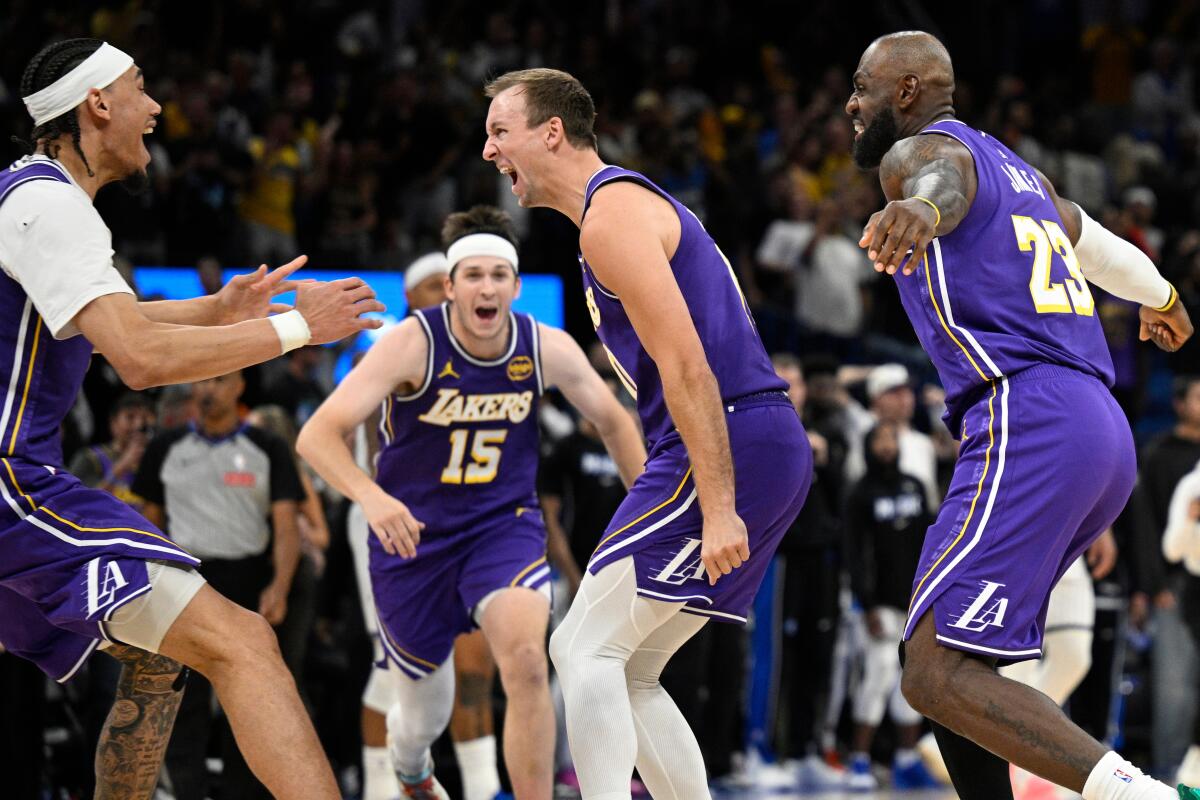
Luke Kennard, second from right, celebrates after his winning basket.
(Phelan M. Ebenhack / Associated Press)
The missed shots. The missed calls. Every missed opportunity against the Orlando Magic could have been a moment for the Lakers to “let go of the rope,” Austin Reaves said.
But why didn’t they?
“I think it’s just …” Reaves said, pausing to find the right word after the Lakers rallied from down five points with 50 seconds left to win by one.
“Belief.”
We thought the Lakers’ early season clutch success might have been a mirage against bad teams. But through the most difficult stretch of the season — nine of 11 games against teams with winning records including seven against teams .600 or better — the late-game execution has remained largely on point.
The Lakers (46-26) still have a league-leading 22-7 record in games within five points in the last five minutes. The Lakers are 6-2 in clutch games in March. Before the loss to Detroit, their 82-point clutch time defensive rating this month is an astronomical improvement from their overall 115.7 points allowed per 100 possessions.
They have played the fewest number of clutch minutes this season, in part because they kept getting blown out earlier this season. Their first 12 losses were all by 10 or more points. Those losses tipped the team’s point differential into the red despite their overwhelming winning record. They were signs that the Lakers bent and immediately broke.
Just as much as the clutch wins, coach JJ Redick looks at recent close losses — the last four came by a combined 14 points against Orlando, Phoenix, Denver and Detroit — as signs of progress.
“Our resolve and resilience — you need to be connected to do that as a team, not just individually,” Redick said. “I think where we were earlier in the year, all of us, probably the coaching staff included, was like, ‘When things go bad, you revert back to your means of self preservation, whatever that may look like for each individual.’ … We’re bending multiple times in a game, and we’re staying the course and trusting each other.”
The Lakers have two of the best individual stars to trust in key situations.
Luka Doncic put on a clutch clinic in Houston: Within five consecutive offensive possessions, Doncic hit a pirouetting step-back three, split a double team with a behind-the-back dribble to throw a no-look lob to Rui Hachimura, spun through another trap for a second alley-oop to LeBron James and nailed the dagger three. The dazzling display elicited roars from his teammates.
Some of James’ recent clutch highlights haven’t been as loud but are just as significant: His Superman dive to save a loose ball against Denver, the forced turnover that gave the Lakers the last possession against the Magic and the hard cut to the basket that drew two defenders to leave Luke Kennard wide open for the game-winning shot. The Lakers never doubted.
“We got Hall of Fame players,” Reaves said, “guys with a lot of talent that compete at the highest level, and when you got that, no game’s ever over.”
LeBron James rewrites another narrative
LeBron James looks for a pass during a game against Sacramento earlier this month.
(Ronaldo Bolanos/Los Angeles Times)
After 23 years of hearing every compliment and every criticism imaginable, James is still smiling through it all. Because through chatter that the Lakers are better without their 22-time All-Star who is making $52.6 million this season, James offered this interview equivalent of a one-handed dunk:
“It sells papers a lot easier and clippings and podcasts if you say ‘LeBron, that their team is better off without him,’ ” James said after he had a triple-double in the Lakers’ win over the Miami Heat during his NBA-record 1,612th regular-season game. “A lot of people will try to, like, view it, so I get it. But they’re absolutely wrong.”
James then scrunched his face into a sarcastic, close-eyed smile.
The Lakers started their winning streak without James, but they couldn’t have continued it if he hadn’t returned in this fashion.
Since missing three games with elbow and hip injuries, James has starred in his new role as possibly most dangerous third option ever. The NBA’s all-time leading scorer’s usage rate dropped from 28.2% in his first 44 games of the season to 21.3% across the six games before Detroit. Before this season, his usage rate has never been lower than 27.6% for an entire year.
But Redick said the team knows it’s at its best when James has the third-highest usage rate. More important, James is playing like he knows that too.
James was held scoreless in the first half against Detroit for just the third time in his career. Redick praised James for his “selfless” play against the Pistons. He finished a rebound short of a triple-double: 12 points, 10 assists and nine rebounds.
“It’s the role that I’m playing for the ball club,” James said. “In order for us to win ball games, it’s the role that I’m playing.”
James is taking three fewer shots a game in the last seven games compared to his season average and averaging a quiet 18 points and 6.1 assists per game. But he has been exceptionally efficient: 58% shooting from the field and he still leads the league with 5.7 fastbreak points per game. Reaves said he sometimes forgets that he’s throwing lobs to a 41-year-old.
“I’m going, I’m going to kill you one day on accident just throwing the ball like I forget that you’re 41,” Reaves said he told James. “I’m still throwing it to 35-[year-old] LeBron.”
On tap
Wednesday at Pacers (16-56), 4 p.m. PDT
The Lakers’ six-game trip ends in Indianapolis with the Pacers, who just snapped the NBA’s longest losing streak Monday. They had lost 16 consecutive games before knocking off the Magic, but still have the worst record in the league. Ivica Zubac is out for the rest of the season after the former Clippers big man fractured his rib.
Friday vs. Nets (17-55), 7:30 p.m. PDT
Michael Porter Jr. is averaging a career-best 24.2 points, 7.1 rebounds and three assists. That’s basically all there is to know about the Nets.
Monday at Wizards (16-55), 7 p.m. PDT
The Wizards’ 16-game losing streak is now the longest in the NBA after the Pacers’ recent win. Anthony Davis was traded to the Wizards from Dallas in February but remains sidelined because of a finger injury. Fellow midseason acquisition Trae Young (quad) is also expected to miss the game.
Status report
Rui Hachimura (right calf soreness)
Hachimura is day-to-day after he got hit in the calf against Miami. The injury bothered Hachimura enough that he went back to the locker room late against Orlando. He got imaging and “it was clean,” Redick said.
Marcus Smart (right ankle soreness)
Smart injured his ankle against Orlando when forward Goga Bitadze fell on the Lakers guard. Smart also has some lingering right hip soreness from another fall during that game, but is day-to-day, Redick said.
Maxi Kleber (lumbar back strain)
Kleber joined the team on the trip in Detroit after missing seven games. During his rehab process, Kleber participated in a practice with the South Bay Lakers last week.
Favorite thing I ate this week
The gumbo at Fixins in downtown Detroit.
(Thuc Nhi Nguyen / Los Angeles Times)
With the weather difference from Orlando to Detroit, I landed in the Midwest in desperate need of comfort food. I fed my soul at Fixins in downtown Detroit, filling up on their gumbo. The hearty stew had chicken and sausage (with an option to add shrimp) and was served over rice with a cornbread muffin. On a chilly Midwest day, it healed me. There’s a Fixins location in L.A. too, so expect to find me there the next time I need my Southern food fix.
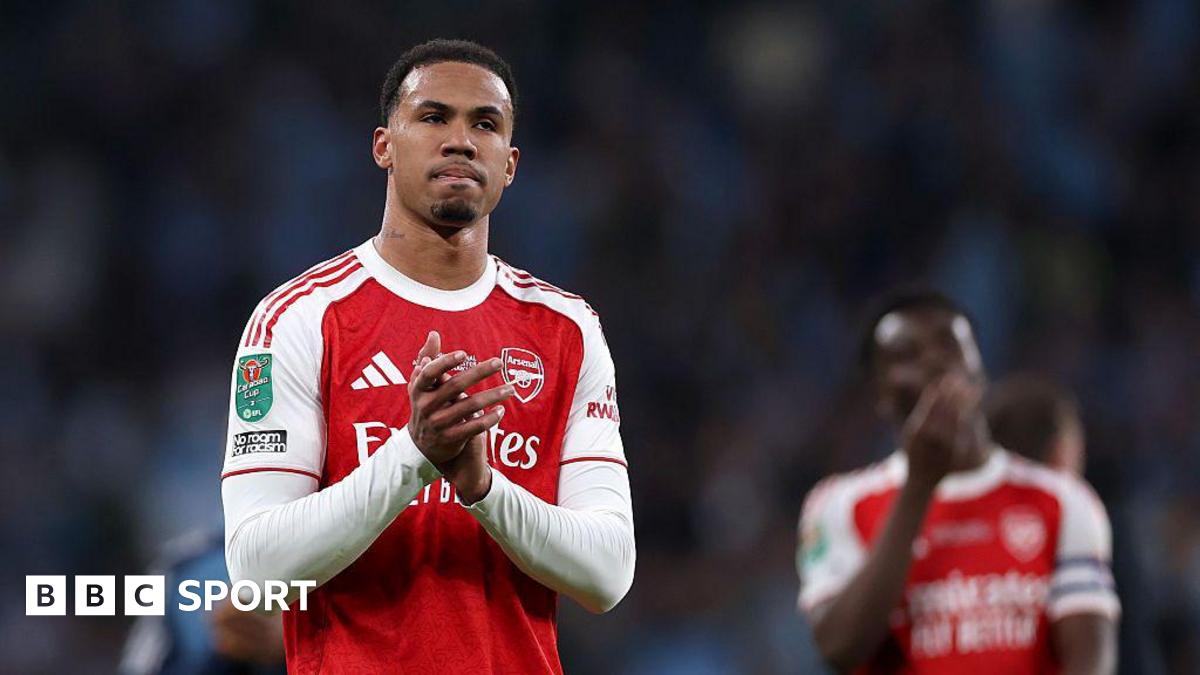
Brazil defender Gabriel Magalhaes has become the latest player from title-chasing Arsenal to withdraw from international duty with injury.
Six of the Arsenal first-team squad have now pulled out or been determined to be unavailable to represent their country in the international window that begins this week.
The Brazil Football Federation (CBF) said that Gabriel will miss the friendlies against France and Croatia, which will take place in the United States, because of “pain in his right knee”.
The CBF says that imaging tests confirmed the 28-year-old’s injury.
His fellow Arsenal centre-back William Saliba has withdrawn from the France squad, with Les Bleus also travelling to the US for their friendly matches against Brazil and Colombia.
England midfielder Eberechi Eze was called up to Thomas Tuchel’s 35-man squad for friendlies against Uruguay and Japan but withdrew with a calf problem.
He suffered that blow in Arsenal‘s 2-0 victory over Bayer Leverkusen in their Champions League last-16 second leg and missed the Wembley defeat on Sunday.
Gunners manager Mikel Arteta has confirmed the club are waiting for Eze to undergo another scan to find out the severity of his injury.
Arsenal winger Leandro Trossard is out of the Belgium squad for their matches against the USA and Mexico because of an injury issue.
Club captain Martin Odegaard was already ruled out of Norway duty because of a knee injury, while Dutch defender Jurrien Timber is also out of action at the moment.
Arsenal are competing to win their first Premier League title for 22 years and lead second-placed Manchester City, who have a game in hand, by nine points.
They are next in action when they take on Southampton in the FA Cup quarter-finals on April 4, before they play the first leg of their Champions League quarter-final against Sporting on April 7.
The Gunners resume their league campaign on April 11 when they play Bournemouth at Emirates Stadium.
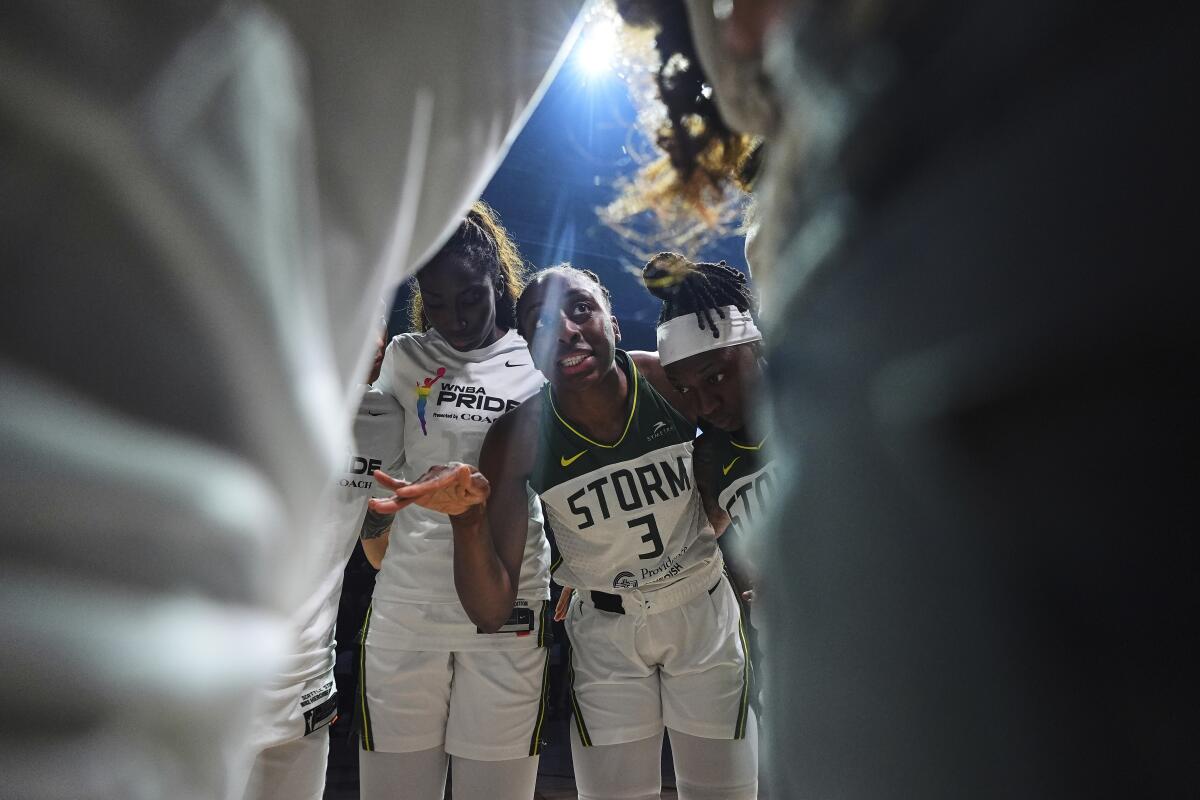
Seattle Storm forward Nneka Ogwumike (3), president of the WNBA players’ union, said for the first time, player salaries will be tied to a meaningful share of league revenue.
(Lindsey Wasson / Associated Press)
The league and players association have not made the terms public yet, but the salary cap will start at $7 million, up from $1.5 million in 2025, and the supermax will start at $1.4 million, up from $249,244 in 2025, a person with knowledge of negotiations not authorized to discuss them publicly told The Times. ESPN was the first to report the figures.
The total salary cap will jump by around 4.64 times the previous amount. The super maximum salary will be elevated by 5.61 times the previous amount. It means the top players will be eligible for larger raises than the league’s middle class.
The average salary will be $600,000, a bump from the previous average of $120,000, and the minimum salary will be more than $300,000, up from $66,079.
“For the first time, player salaries are tied to a truly meaningful share of league revenue, driving exponential growth in the salary cap, increasing average compensation beyond half a million dollars and raising the standard across facilities, staffing and support,” union president Nneka Ogwumike told reporters.
The main sticking point during negotiations was revenue sharing, and that number will be around 20% for the entirety of the multi-year deal. The league had previously offered 15.5%, a source told The Times, and players went down from their 40% ask to around 26% at the end of February, and then reached the agreement around 20% on Wednesday morning. The Athletic first reported the shift in revenue sharing figures.
Players had been negotiating for a percentage of overall revenue without factoring in expenses while the WNBA was seeking sharing tied to net revenue, mirroring the NBA’s structure that deducts expenses before sharing 50% of profits. The players secured a gross revenue deal, which gives them a cut of WNBA revenue without factoring in expenses, a person with knowledge of the deal not authorized to discuss it publicly told The Times.
“This deal is going to be transformational, and you’ll see all the details hopefully soon,” WNBPA vice president Breanna Stewart told reporters on Wednesday. “But it’s gonna build and help create a system where everybody is getting exactly what they deserve and more from on the court and off the court aspects.”
Welcome back to this week’s Lakers newsletter, where we are fully scoreboard watching.
The Lakers have 14 games left and are surging up the Western Conference standings. With six consecutive wins and nine in their last 10, the Lakers (43-25) are third in the West and suddenly have a 1.5-game lead on fourth-place Houston.
The team that couldn’t beat anyone good suddenly has statement wins over four teams with .600 records. The turnaround from fighting to stay out of the play-in to now being in position for homecourt advantage left even JJ Redick struggling to find the right description.
“Is coalesce a word?” Redick said after the Lakers outlasted the Denver Nugget in overtime on Saturday. “Is that the right word? For coming together? Jelling? I think it feels like we’re coalescing right now in a really nice way.”
All things Lakers, all the time.
Lakers’ ‘Big Three’ finds its pecking order
The defining moment of LeBron James’ performance during the Lakers’ game of the season officially went down as a turnover.
His Superman dive to save a loose ball with 54.3 seconds left in regulation against Denver on Saturday turned into one of James’ five turnovers because the Lakers did not corral the jump ball. But the statistical and physical sacrifice of the play showed the type of role James will play on this team coming down the stretch of the season.
“It’s a great example of leadership,” Redick said. “Leadership is not just the voice who’s talking. Leadership is then what you do on the court, and if you want to be a winning team then you need guys who are willing to take the lead and make winning plays.”
With Luka Doncic and Austin Reaves starring, Redick acknowledged that “the best thing for our team is [James] being the third highest-used player.” Since returning from hip and elbow injuries that kept him out of three games, James has had the third-highest usage rate on the team in each of the last three games. All were wins.
Redick acknowledged that “finding the groove” between James, Doncic and Reaves has been “the challenge for all of them, not just LeBron, all season.” It was more difficult because alternating injuries limited the trio’s time together on the court.
The season-long advanced metrics have favored having just Doncic and Reaves on the court, who have a plus-eight net rating together, as opposed to all three (plus-3.2 net rating). But the modest rating of the Doncic, Reaves and James combination has taken dramatic leaps this week alone.
James, Doncic and Reaves outscored opponents by 32.7 points per 100 possessions in wins against the Bulls and Nuggets.
The Lakers have gotten their “best win of the season” four times in the last nine days. Two were without James when the Lakers blew out the Knicks and the Timberwolves. He returned and the wins got grittier: an overtime thriller against Denver and Monday’s tense victory in Houston.
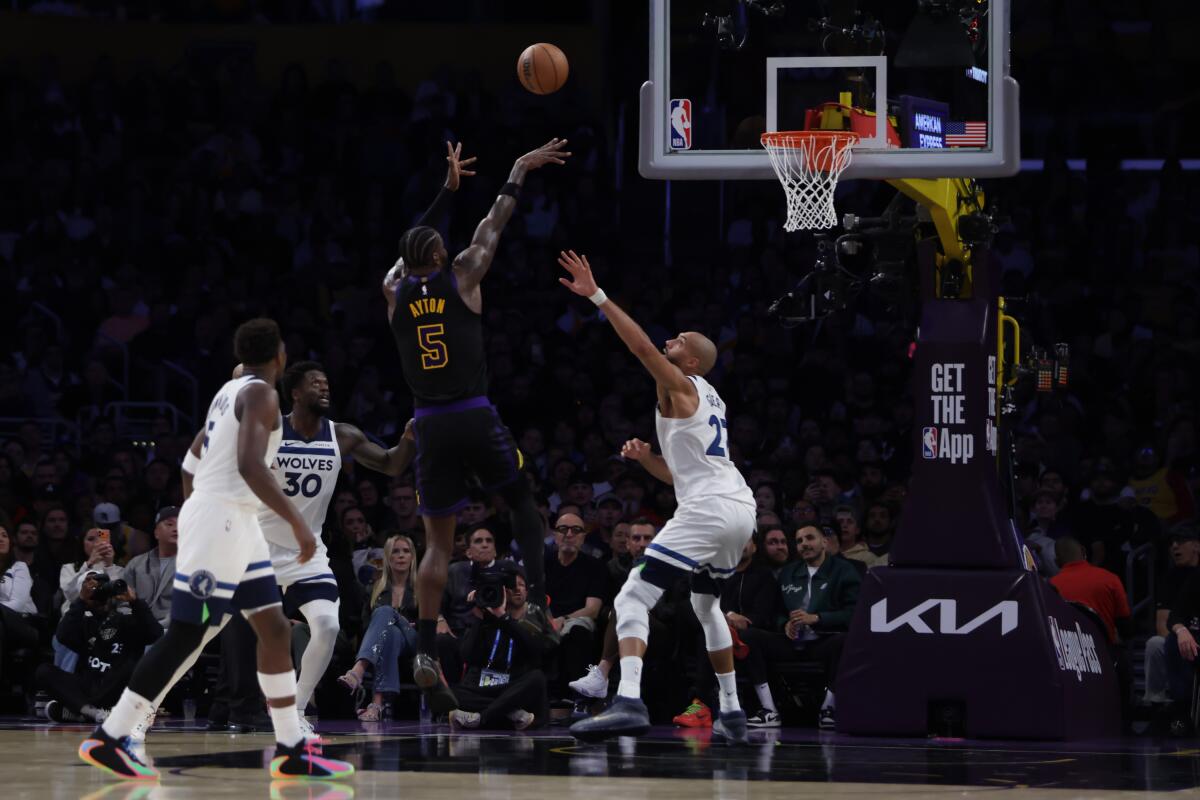
Other teammates made the flashy, standout plays. Doncic nailed the game-winning basket in overtime against Denver, and Reaves forced extra time with a one-in-a-hundred intentionally missed free throw. Deandre Ayton had four consecutive points late in the fourth quarter against Houston that put the Rockets away.
The NBA’s all-time leading scorer, meanwhile, has been a relatively quiet seven-for-13 from the field in each of the last three games, scoring no more than 18 points. He doesn’t mind as long as it adds up to wins.
“If it benefits others, it benefits the team,” James said last week. “The team is most important.”
It won’t count in the stat sheet, but watching James fly across the floor at 41 years old against Denver was “one of the biggest plays of the game,” Reaves said Saturday. Redick joked that after 23 NBA seasons and three years of high school he had never seen James lay out for a loose ball like that.
Because he never had, James replied.
And after sharing a photo on social media of a bright red court burn the size of a nickel, James might never do it again.
“Might be it for diving for the year!” James wrote in an Instagram story showing the wound. “Ouch! Lol!”
Deandre Ayton arrives just in time
Deandre Ayton shoots against the Minnesota Timberwolves.
(Ethan Swope / Associated Press)
Nearly 10 years before teaming up for the Lakers, Rui Hachimura and Deandre Ayton were just teenaged prospects with big dreams. They first met at a Basketball without Borders camp in 2016. The roster that year also included future NBA champions Shai Gilgeous-Alexander and Isaiah Hartenstein. Hachimura recalled Ayton dominating everyone. Then the 7-foot center from the Bahamas inexplicably disappeared.
“That’s what I remember,” Hachimura said with a smile remembering his first impression of his future Lakers teammate. “I was like, ‘Where’s this guy going?’”
When Hachimura shared that anecdote in October, it was an unintentionally fitting description of Ayton’s career. Over the last eight years, the former No. 1 pick has dominated and disappeared in equal measure.
Just in time for the Lakers’ biggest games of the year, the enigmatic center returned to his “DominAyton” mode.
Ayton averaged 13 points and 9.8 rebounds per game in wins over the Knicks, Timberwolves, Bulls and Nuggets after coming back from a one-game injury absence. When Jaxson Hayes and Maxi Kleber were sidelined for games against Minnesota and Chicago, Ayton starred with back-to-back double-doubles.
“Felt like I picked up my energy and my focus,” Ayton said. “I finally caught up with the team.”
One of the surest signs of Ayton’s engagement is his activity on the boards. The Lakers are 29-7 when Ayton has eight or more rebounds and 8-14 when he has seven or fewer. Lately he has been especially clutch with three rebounds and four points in overtime against Denver and five rebounds with six points in the fourth quarter against Houston when the Lakers finished the game on a 13-4 run.
“He is an X factor for us, if not the X Factor,” Redick said after Ayton scored 23 points with 10 rebounds against the Bulls, “because him playing at a high level raises our ceiling. It changes the makeup of our team.”
Ayton had his son Deandre Ayton Jr. in the locker room after that performance against the Bulls. The five-year-old bounced a white rubber ball on the ground while waiting for his dad to finish showering then joined him at his locker for his media obligations. After the game when the Lakers celebrated “Girl Dad Night,” this proud boy dad left a lasting impression.
“Truly a blessing,” Ayton said of having his son join him at the game, “especially being a Laker. Just hope he [is] inspired.”
On tap
Wednesday at Rockets (41-26), 6:30 p.m.
This game will decide the head-to-head tiebreaker between Houston and L.A. In the tight conference race, the Lakers already own head-to-head tiebreakers against Denver and Minnesota, but not against Phoenix, which is lurking in the seventh spot with a 39-29 record, four games behind the Lakers.
Thursday at Heat (38-30), 5 p.m.
The Heat were one of the hottest teams in the East before losing to the Orlando Magic on Saturday in Norman Powell’s return from injury. Powell came off the bench after missing seven games because of a groin injury and scored 20 points. The Heat were 7-0 during the stretch without Powell, even playing without Tyler Herro for two games.
Saturday at Magic (38-29), 4 p.m.
The Magic’s seven-game winning streak came to an end Monday in Atlanta. Franz Wagner (ankle) has played in just four games since Dec. 7, and Paolo Banchero is averaging 24.8 points on 51.4% shooting, 9.3 rebounds and 4.7 assists during the month of March.
Monday at Detroit (48-19), 4 p.m.
The Pistons are cruising toward the top seed in the East. Cade Cunningham has continued his breakthrough year with 24.9 points and 10.1 assists per game.
Status report
Maxi Kleber (lumbar back strain)
The backup big man has missed four games because of a back injury that started earlier this season and recently flared up against. Kleber has good days and bad days, Redick said, and has been shut down for five days. He did not travel to Houston for the beginning of the six-game trip, but the Lakers hope he can join.
Favorite thing I ate this week
Korean short ribs (galbi) with rice and Vietnamese pickled carrots and daikon radish.
(Thuc Nhi Nguyen / Los Angeles Times)
Made possible only through teamwork with my favorite coworker Brad Turner, I did the impossible: I had two uninterrupted weeks at home during the NBA season. After coming home from a month overseas, I needed that time to settle back into my normal life, including my kitchen. I missed it. We kept it low-key for the homecoming with Korean short ribs (galbi) with rice and Vietnamese pickled carrots and daikon radish. Green onions for garnish because my mom would never let a dish touch the table if it wasn’t garnished.
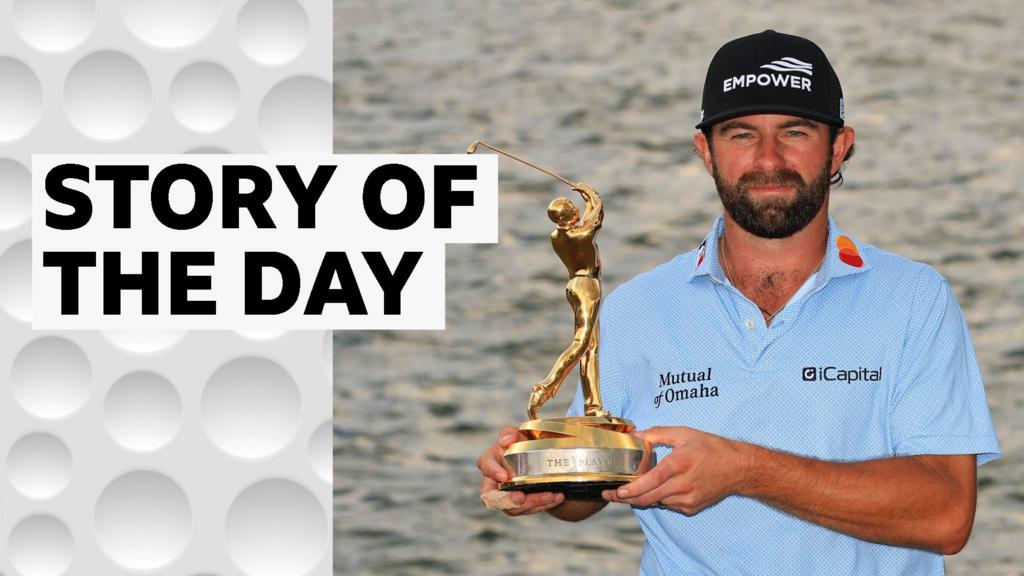
Ryder Cup stars Ludvig Aberg and Matt Fitzpatrick both falter as American Cameron Young comes from behind to win the Players Championship 2026 at TPC Sawgrass.
A fatal shooting near TPC Sawgrass meant spectators were delayed entering the course before day three of the Players Championship.
St Johns County Sheriff’s Office said two people were shot and killed at 22:30 local time on Friday, less than a mile from the course in Florida.
The suspect, who has been named as Christian Barrios, fled on to the course before being arrested in Nassau County at about 08:00 on Saturday after a car chase, according to police.
Sheriff Robert Hardwick said Barrios “made contact” with employees at TPC Sawgrass during his attempted escape.
“He picked up – we believe it was a radio that belonged to the PGA Tour, not one of our radios and we know he dropped it after that. Our canines used it as a scent when they came in there,” Hardwick said.
Gates at Sawgrass were due to open for fans at 07:30 but entry was delayed until 09:00, with the PGA citing “operational considerations” as the reason for their decision.
Third-round play at the PGA Tour’s flagship event began on time.
Sweden’s Ludvig Aberg led the tournament after two rounds having shot a nine-under-par 63 on Friday.
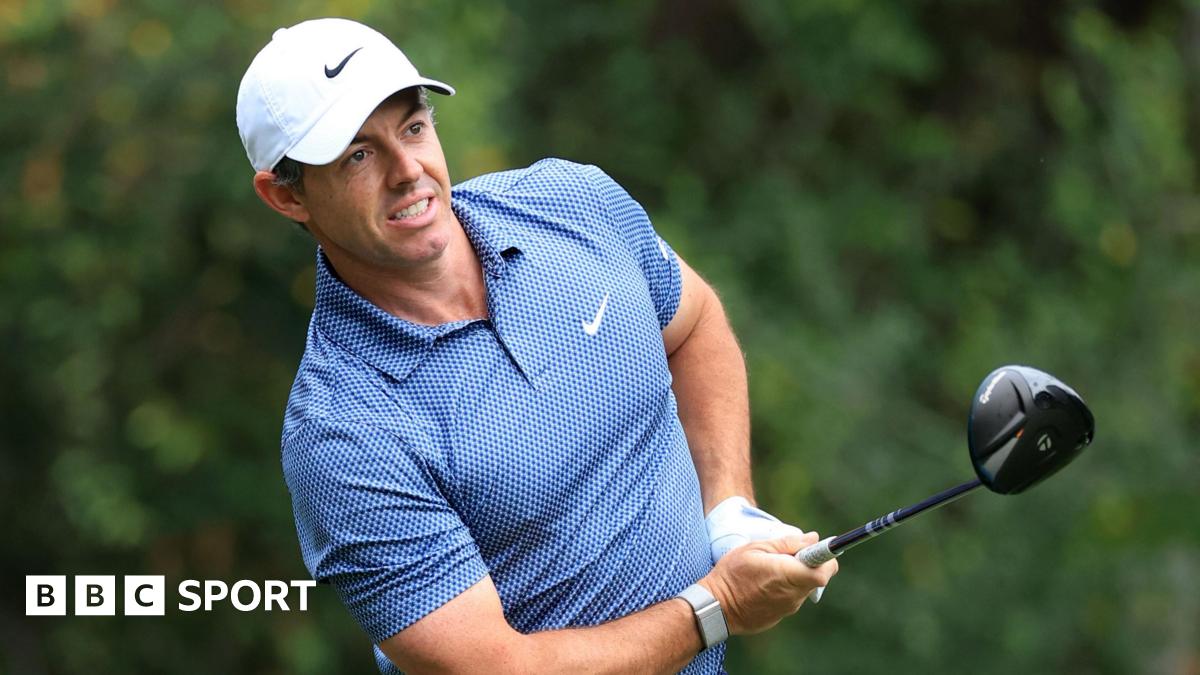
Rory McIlroy recovered sufficiently from a back injury to begin his defence of the Players Championship but he ended round one seven shots off the pace.
The world number two only arrived at TPC Sawgrass on the eve of the PGA Tour’s flagship tournament, having opted to stay at home for treatment on the injury that forced him to pull out of last week’s Arnold Palmer Invitational at Bay Hill.
He showed no obvious signs of discomfort in crushing his opening drive 329 yards down the middle of the fairway, but he took 73 more shots for a two-over par total, with birdie putts on the 16th and 17th holes grazing the edge of the cup.
McIlroy’s Ryder Cup team-mate Sepp Straka is alongside three Americans setting the clubhouse pace on five under.
Austrian Straka chipped in for an eagle three on the par-five 16th in his bogey-free 67 to join Maverick McNealy, Lee Hodges and Sahith Theegala atop the leaderboard.
“We were fortunate to play in the afternoon with hardly any wind and the greens a lot softer,” said Straka, referring to the heavy rain that doused the course earlier in the day.
England’s Tommy Fleetwood was among those playing in the worst of the weather. He briefly reached five under, after a run of eagle-birdie-birdie on Sawgrass’ notoriously difficult 16th, 17th and 18th holes. He called it a “complete bonus of a stretch” of holes.
Having started on the 10th, the world number three then birdied the second but a torrential downpour that halted play for around 25 minutes checked his momentum, and successive bogeys on the fourth and fifth holes dropped him back into the pack.
He is in good company on three under, with Sweden’s Ludvig Aberg, Norwegian Viktor Hovland and American Xander Schauffele also enjoying solid starts.
The rain delay meant four players were unable to finish their opening rounds as the sun set and darkness fell. Among them is unheralded American Austin Smotherman, who will return on Friday morning to face a 15-foot birdie putt on the ninth hole – his 18th – to take the first-round lead.
In rapidly fading light, Smotherman hit his second shot on the par-five hole into the heart of the green, but while his playing partners opted to finish the hole, he decided to mark his ball and wait for the morning light.
Benvenuti a The Times Lakers newsletter, where, after a month in Italy, we are so back.
The Lakers are largely in the same situation as when I left. They’re still safely in the playoff race with a 39-25 record, but flirting with the play-in. LeBron James, Luka Doncic and Austin Reaves are still searching for their three-man chemistry. Deandre Ayton hasn’t dyed his hair again.
But the tl;dr version of February does have one major change for the Lakers.
Hot hand Luke
Lakers guard Luke Kennard reacts after making a three-pointer against the Golden State Warriors at Crypto.com Arena on Feb. 7.
(Gina Ferazzi / Los Angeles Times)
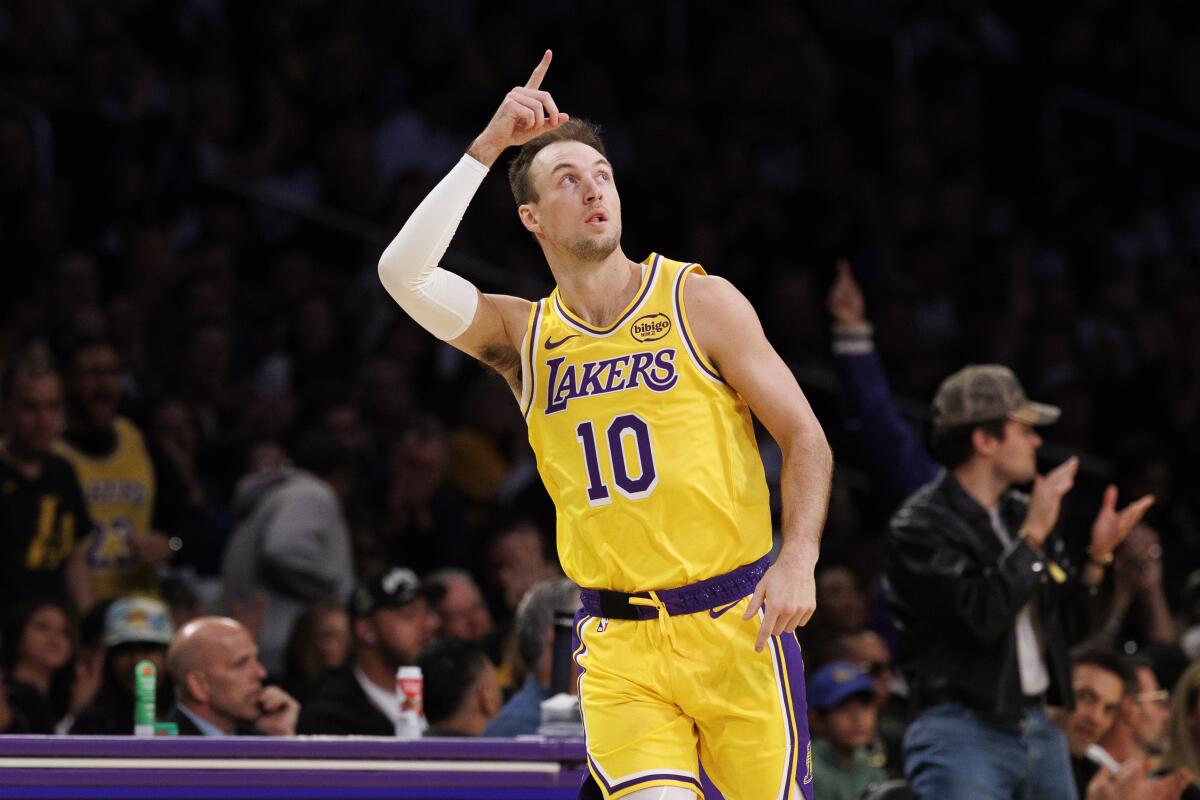
JJ Redick always knew how good of a shooter Luke Kennard was. This former Duke sharpshooter wouldn’t expect anything less from another Blue Devils star. But Kennard’s influence since joining the Lakers in a February trade has gone beyond his league-leading three-point percentage.
The Lakers are 5-1 in the past six games with Kennard shooting a blazing 56.7% from three-point range. He jump-starts the Lakers’ offense with his constant motion and elite floor spacing, making the transition from midseason acquisition to integral bench piece look effortless.
“It all comes down to, like, the point-five decision making,” Redick said. “… That’s where we try to focus a lot of the development [on] being able to recognize when there has been an advantage created, and then playing off that and not giving up the advantage. And we have some guys that have to grow in that area.
All things Lakers, all the time.
“Luke,” Redick added, “that’s what he does.”
The Lakers were shooting 34.9% from three before the trade, 21st in the league. Since acquiring Kennard, the Lakers are shooting 39.2% from three-point range, ranking second in the NBA during that stretch.
Kennard, shooting 50% from the three-point line, is on track to become just the sixth NBA player to shoot 50% or better from three over an entire season. There are some players in the NBA who couldn’t hit 50 out of 100 three-pointers in an empty gym, Redick said.
Redick has known Kennard for more than a decade. Not only was he comfortable with the coaching staff, Kennard also has history with former Memphis teammates Jake LaRavia and Marcus Smart and being in L.A., playing with the Clippers from 2020 to 2023. Kennard said he “lit up inside,” when he heard he would be heading to the Lakers, who sent Gabe Vincent and a 2032 second-round pick to Atlanta in the deal.
The organization is “the biggest stage you can play on in basketball,” Kennard said. And he gets to share it with generational talents.
Playing with Doncic and James has created some of the most open three-point shots Kennard has had in his career, he said. When he gets one wide-open three early, that only helps his rhythm. Then teams start to help too much on his shooting and that opens the paint. It’s the type of chain reaction Kennard watched with envy from the opposite sideline when Doncic, then with Dallas, was slicing up the Clippers in the playoffs.
“It’s definitely something you think about like, ‘Man, I wish that was me there getting those open looks,’” Kennard said. “But now it’s a reality.”
Kennard marvels at his new reality sometimes. When Doncic was in his peak, “Luka Magic” form Friday, banking line-drive step-back threes off the backboard in the Lakers’ rout over the Indiana Pacers, Kennard said he caught himself just gawking at his teammate a few times.
But Doncic, who scored 44 points in the win, was quick to credit the team’s bench contributions. Kennard had 15 points on three-of-five three-point shooting, and Doncic said he has encouraged Kennard to shoot more.
A smile broke across Kennard’s face when he was told of the praise.
“Especially coming from a guy like that,” Kennard said, “one of the best scorers ever to play the game, it just builds confidence in you as a player to play off of him.”
Catching Kareem
Lakers star LeBron James shoots over Denver’s Zeke Nnaji to set the all-time NBA record for most successful field goals on Thursday.
(Chris Swann / Clarkson Creative / Getty Images)
He used it to break the NBA’s most iconic record. It seemed fitting that James used a midrange fadeaway shot to claim another record from Kareem Abdul-Jabbar.
Already the leader in NBA seasons played, minutes played and points scored, James added another record to his resume last week by passing Abdul-Jabbar for most made field goals in NBA history. His record-breaking 15,838th made shot came against Denver on Thursday, and, with a 180-degree pirouette added, looked similar to the shot he used to claim the scoring record from Abdul-Jabbar in 2023.
“At the end of the day, just to be able to link my name to being mentioned with some of the greatest to ever play this game has always been humbling and a pretty cool thing,” James said after the Lakers lost. “I grew up watching, reading [about], idolizing a lot of the greats and if I ever was able to be part of the NBA, I wanted to put myself in position that I can be named with some of the greats by doing something right.”
The record is a true testament to James’ staying power. He established the regular-season scoring record in the same 20 seasons as Abdul-Jabbar played, but the field-goal record would have been well out of reach had James not continued into his historic 23rd season. When comparing their NBA careers, Abdul-Jabbar, who averaged 10.15 made field goals per game across his career to James’ 9.86, made more shots than James in 16 of 20 seasons. Abdul-Jabbar had two 1,000 field goal seasons while James’ highest total was 875 in his third year. Michael Jordan, in 1989-90, was the last NBA player with more than 1,000 made field goals in a season (1,034).
(Thuc Nhi Nguyen / Los Angeles Times)
James’ longevity and productivity at the twilight of his career is so unmatched that even the idea that the James era could end soon barely even registers for some competitors.
“I think he can play forever,” Knicks coach Mike Brown said when asked if he thinks about how any game could be the last he coaches against James. “That’s just my personal opinion. I know he won’t, but the shape that he is in and how he takes care of his body is just amazing.”
James, who is ineligible for postseason awards for the first time in his career because he missed more than 17 games, is questionable for Tuesday’s game with a right hip contusion and left foot arthritis. He has missed the last two games with a left elbow contusion he sustained in the final minutes against Denver. He did not practice Monday.
The next personal milestone for James may be career games played, where he trails Robert Parish’s 1,611 by five.
On tap
Records and stats current before Monday’s games.
Tuesday vs. Timberwolves (40-24), 8 p.m.
With two October wins that feel like a lifetime ago, the Lakers already own the head-to-head season tiebreaker against the Timberwolves, meaning that a win Tuesday could vault the Lakers to third place in the West.
Thursday vs. Bulls (26-38), 7:30 p.m.
This is the only should-win game of the week against a team well outside of the playoff race. The Bulls added Collin Sexton at the trade deadline, but the former Charlotte guard left Sunday’s game against the Sacramento Kings with a leg injury.
Saturday vs. Nuggets (39-26), 5:30 p.m.
This game will decide the season series tiebreaker between the Lakers and Nuggets, who split their first two games.
Monday at Rockets (39-24), 6:30 p.m. PDT
The Lakers and Rockets have consecutive games in Houston on Monday and Wednesday. The Rockets are not the same team that dominated the Lakers on Christmas Day, though. Steven Adams has been out since Jan. 20 with a season-ending ankle injury, and a team that was on pace to be the best rebounding squad in a generation is seventh over the last 15 games with a 51.5% rebounding rate.
Favorite thing I ate this week
Gnocchi with spider crab and tomato sauce and black spaghetti with tuna tartare in Venice, Italy.
(Thuc Nhi Nguyen / Los Angeles Times)
I’ve been back from Italy for a week, but I didn’t share any meals from my post-Olympic vacation. We definitely saved the best for last in Italy.
Possibly my favorite of my entire month was in Venice at Oniga, a cozy restaurant we found away from the otherwise crowded narrow streets. Staying true to Venetian seafood tradition, we began with an appetizer of mussels and clams in a tomato sauce that had me wiping the bowl with our fresh baked bread. Our mains (pictured) were fresh gnocchi with local spider crab and tomato sauce and black spaghetti with tuna tartare and garlic oil. For dessert, we had salted caramel panna cotta and pistachio tiramisu. Squisito!
Call it the Mick Cronin Say Something Nice Challenge.
Not something nice-ish, not a chocolate-covered diss or an insult teased as affirmation. Just a compliment, no chaser.
It’s not impossible, it turns out.
“We have great guys,” Cronin said about his team, which demolished USC 89-68 at Galen Center on Saturday to finish the season 21-10. “I have to make myself yell at some of these guys, because they’re such good guys. And I did that by design.”
He’ll have a funny way of showing it, but Cronin likes the guys he recruited or plucked from the transfer portal. He really, really likes them.
They put up with him, after all. They get him.
Coming after an impressive 72-52 triumph against No. 9 Nebraska on Tuesday, Saturday’s victory launched his Bruins men’s basketball team into tournament play, starting with a third-round Big Ten tournament game Thursday, and then the NCAA tournament.
And, no, the controversial coach won’t likely be excused from his post anytime soon. Not with another four years on his contract, a current buyout price of $22.5 million and now a not-terrible finish to this strange season of all peaks and valleys and no plateaus.
The Bruins are on the way up at the right time, even playing enough defense for Cronin’s taste — though, of course, he’s prepared for that to change.
“I’ve been around these guys for five months,” he said, “so I know that the fight is not over with that. We can go right back to who we were, which was a bad defensive team.”
What can you say? The man’s service might be questionable, but his backhands are unparalleled.
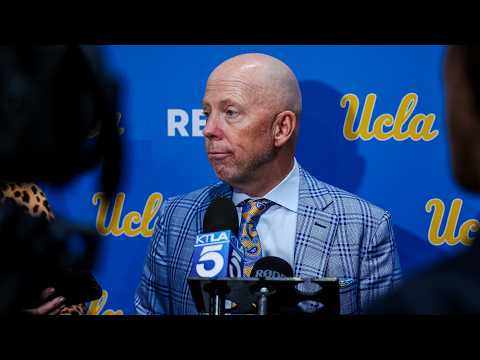
UCLA coach Mick Cronin talks about the Bruins’ win over USC on Saturday.
His opening statement the last time UCLA clocked USC, 81-62 on Feb. 24: “Proud of the guys, they got the job done …” and, wait for it, “I’m well aware you’re going to ask about rebounding, and as I tell people, you can’t be great at everything. And we’re surely not.”
There was the time he actually fell on the proverbial sword after his team’s 86-74 loss to Ohio State: “Blame me — blame me,” he said, only kidding: “I recruited ’em, I signed them as free agents.” (The bums!)
He isn’t exactly dropping jewels of inspiration suited to be posted in classrooms beside John Wooden’s “Pyramid of Success.”
But after five up-and-down months with him, his players say they’re cool with Cronin, who has shaken off what feels like an annual wave of national criticism. This time it hit after he booted his own center Steven Jamerson II from a game at Michigan State on Feb. 17, overreacting because he mistook a clean basketball play for something else.
UCLA coach Mick Cronin shouts instructions to a player during the Bruins’ win over USC on Saturday.
(Allen J. Schaben / Los Angeles Times)
“I’ve adapted to how he coaches and how he runs stuff,” said Donovan Dent, the Bruins’ sure-handed point guard who had 25 points on 11-of-15 shooting to go with his seven assists without a turnover Saturday.
How does he coach? “Fun, very fun,” Dent laughed, acknowledging that, yes, “absolutely” players have to have some thick skin if they’re going to play for Cronin.
“He can get on you,” Dent said, “but he just wants the best for you.”
“I mean,” forward Tyler Bilodeau said, “he’s intense. Coach Cronin has no off days, he is who he is every single day. You gotta respect that.”
And Cronin’s bait-and-switch bit? It would kill at a comedy club, but working a locker room? Maybe he’s found the right audience of young athletes.
“I’m at a point in my career, I want guys who are good guys,” said Cronin, whose team went 17-1 at Pauley Pavilion and 4-9 away from it. “I don’t want to be fighting with guys, I don’t have the energy for it. I won enough games, it’s not worth it.”
Well, about that.
The Bruins will have made the NCAA tournament five times in Cronin’s seven-year tenure with the team, and they’ve advanced to the Final Four and twice to the Sweet 16. But the Final Four run was six seasons ago, and in the past two years, UCLA made just one tournament appearance and got only as far as the second round.
That hardly seems sufficient for a UCLA program that’s regularly supposed to be breathing rarefied air without caveats or qualifiers.
But he thinks he’s found the right players to roll with his punchlines, and to play defense too.
“We can keep winning games,” Cronin said, “if we stop the other team.”