These stunning destinations are exempt from the new system launching in April.
14:45, 31 Mar 2026Updated 14:45, 31 Mar 2026
These countries will not use the Entry/Exit system(Image: Getty)
Following months of preparation, the new Entry/Exit System (EES) will finally be implemented across the Schengen area from April 10.
The new EES will require all non-EU nationals travelling to 29 European countries to register their biometric data, such as a facial scan and fingerprints, rather than receiving a traditional passport stamp. Numerous popular holiday destinations including Portugal, Italy and Spain will be impacted by the new system.
However, there are 14 countries (15 including the UK) outside the Schengen Area and therefore not implementing the new travel system.
Laura Evans-Fisk, head of digital and engagement at eurochange, anticipates a surge in travellers heading to non-Schengen countries as a consequence, reports the Express.
She said: “The introduction of this new border control system may be off-putting to some people who want to book last-minute trips this Easter, especially those who like to keep travel as fuss-free as possible.
“I think we should expect to see an increase in Brits travelling to countries that are exempt from the legislation over the next few months – including the Easter and summer holidays.”
For those looking to sidestep the hassle and make their travels a little more straightforward, Laura has identified three fantastic holiday destinations that will be unaffected by the EES, meaning British tourists can explore freely without the need to provide biometric data.
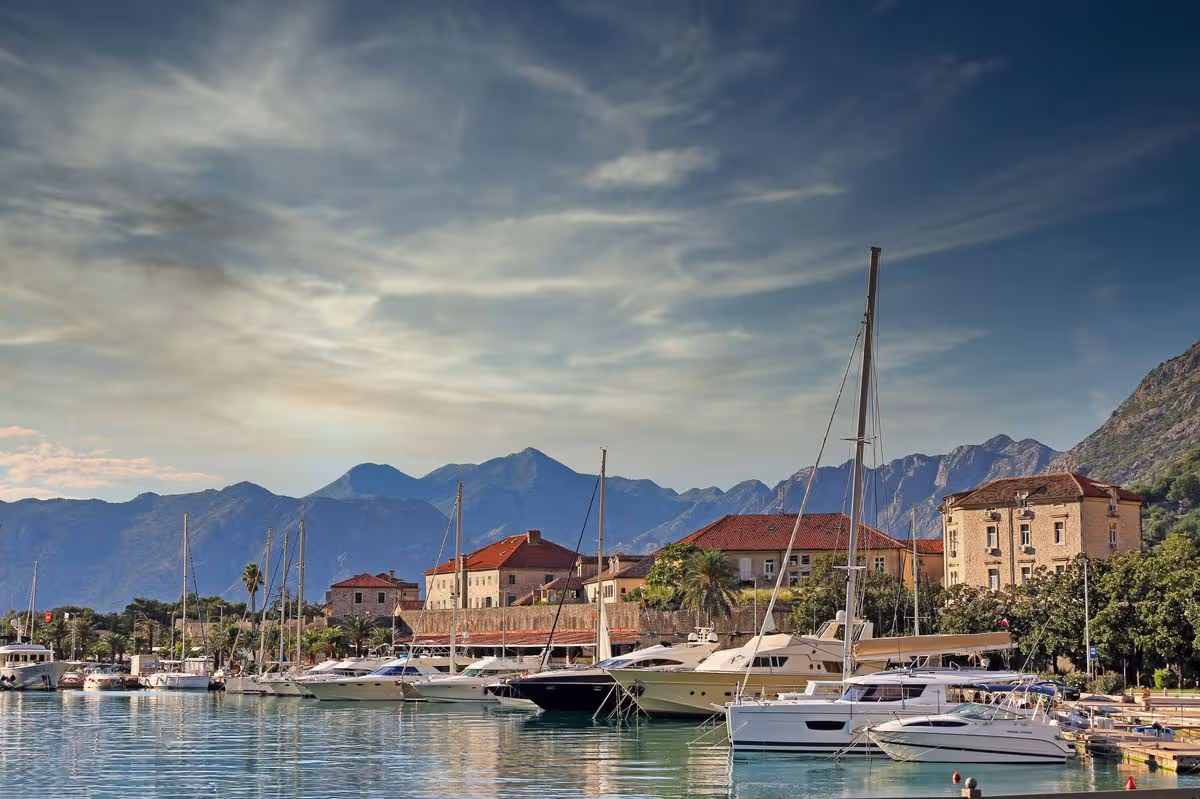
Kotor, Montenegro
She explained: “Montenegro is quickly becoming one of the most popular up-and-coming destinations in Europe. A less crowded alternative to Croatia, it offers similar quaint towns, gorgeous beaches and a stunning coastline, but it is around 20-30% cheaper.”
For instance, accommodation in Montenegro begins at £23 per person per night, while a three-course meal will cost you £31.78.
Kotor sits on the coast, boasting stunning beaches and a relaxed atmosphere, ideal for unwinding. Laura remarked: “This is a great spot if you’re after a chilled, slow-paced holiday, without having to pay huge prices.”
Tirana, Albania
This vibrant capital city is brimming with culture and a food lover’s dream destination. Laura noted: “One of the best ways to explore is by taking a stroll through the streets, following the eccentric street art, graffiti and murals.
“Remember to order Albanian favourites, Fërgesë Gjize (baked cheese with peppers) and Trilece (a tasty pie made with sponge cake and three different kinds of milk) for dessert.”
Sarajevo, Bosnia
Laura said: “It is one of the only places where you can visit a Mosque, a Catholic church, an Eastern Orthodox church and a synagogue in one place.
“Tucked inside a long, thin valley and surrounded by forested mountains, the city has a picture-perfect backdrop. Its broad mix of cultural influences means its architecture is also absolutely beautiful, and its restaurant scene is an eclectic mix of Turkish and Bosnian-inspired offerings.
“And, with prices averaging just £30 per person for a three-course meal, your money really does go far here.”
Term limits were supposed to usher fresh faces and new ideas into California’s Capitol and city halls. That was the promise when voters approved the limits for state officials in 1990 and for city of Los Angeles officeholders in 1993. Lawmakers who had turned elected offices into perpetual sinecures would be forced out and eager citizen-politicians, unbeholden to the special interests, would step in. Well, it’s a decade later and the faces are more recycled than fresh.
Witness the Los Angeles municipal elections that will take place April 10. Mayor Richard Riordan has hit his two-term limit. Four of the six leading mayoral candidates are being forced out of other offices and are looking for a soft landing in City Hall. Kathleen Connell cannot run again for state controller, City Atty. James K. Hahn and Councilman Joel Wachs have hit city term ceilings, and Antonio Villaraigosa maxed out in the state Assembly.
For the record:
12:00 a.m. Feb. 17, 2001 For the Record Los Angeles Times Saturday February 17, 2001 Home Edition Metro Part B Page 9 Editorial Writers Desk 2 inches; 38 words Type of Material: Correction Term limits–An editorial Sunday incorrectly said Los Angeles City Councilman Mike Feuer is approaching the two-term limit for city officials. Feuer won a midterm special election to the council in 1995 and won his first full term in 1997. He is allowed a second full term.
The influence of term limits rolls through the municipal ballot. Termed-out Councilman Mike Feuer and Rocky Delgadillo, a Riordan deputy mayor soon to be unemployed like his boss, are vying to be city attorney. Council member Laura Chick is running for controller.
Other termed-out politicos are vying for City Council seats whose current occupants are also termed out. Tom Hayden, whose 18 years in the Assembly and Senate are up, and state Sen. Richard Polanco are trying to parlay their Sacramento expertise into an advantage, arguing that they know how to fight for Los Angeles’ fair share of state money.
In the past, local politicians often moved up the ladder to Sacramento and on to Washington; now they arc back to City Hall as well. It’s a safe bet that this electoral whirl is not what most voters thought they’d get. The professional politicians stay in motion but stay on the public payroll, and when new faces do appear they often come to view public service and its attendant perks as a career rather than an interlude in a career.
The pattern is not new. Yvonne Brathwaite Burke and Mike Antonovich, after stints in Congress and the Legislature, respectively, landed on the county Board of Supervisors, which, with no term limits, is the jackpot for local career pols.
Theoretically, there is an upside to all this churning in that the city could benefit from a politician’s previous experience. Meanwhile, the pool gets shallower in Sacramento. In the mid-1990s the Legislature had its first big term limits-induced exodus. By last year, there had been a complete turnover in the state Senate. The learning curve is now steep on such urgent issues as electricity deregulation, especially for the freshman Assembly members–a third of that house–who are still finding their way to the restroom. In this void, the Assembly speaker and the Senate president pro tem are wielding more power than ever–along with the special-interest lobbyists, permanent players with ample access to expertise and cash.
Ten years after voters approved Proposition 140, the consequences of term limits are still playing out. How much better it would have been to enact campaign finance reform; it was mostly fiscal inequality that kept out new faces. But because incumbent politicians declined to handicap themselves with real reforms, they–and voters–now live instead with a merry-go-round.
IT MIGHT feel like we have been waiting forever for spring and now you can enjoy it by seeing lots of different sights in bloom.
National Trust sites and properties across the UK are home to an abundance of plants and trees.
Sign up for the Travel newsletter
Thank you!
There are tons of places to see blossom across the UK this spring, including National Trust propertiesCredit: Shutterstock EditorialAnglesey Abbey is less than six miles from Cambridge and features a country house that was built on the remains of a prioryCredit: AlamyThe house is surrounded by gardens, which is where you will find the blossomCredit: Alamy
And with that, there’s a lot of blossom to see.
Whether it be an apple or cherry tree, here are some of the top National Trust sites to see blossom this spring.
Acorn Bank, Cumbria
Acorn Bank is known for having an extensive herb collection as well as sprawling orchards and a working watermill.
And tucked behind its 17th-century walls, visitors will find the orchard with over 175 apple varieties.
From early May, many of the trees bloom with a soft pink-white blossom.
It costs £11 per adult and £5.50 per child to visit.
Anglesey Abbey, Cambridgeshire
Less than six miles outside of Cambridge, Anglesey Abbey features a country house that was built on the remains of a priory.
The house is surrounded by gardens, which is where you will find the blossom.
Back in 2021, Olympian Way was planted with cherry blossoms that bloom pink in March and April.
Visitors will also be able to find cherry blossom in the woodland and Rose Garden.
It costs from £19 per adult and £9.50 per child to visit.
Ardress House, County Armagh
Found in the ‘Orchard County’ of County Armagh, Ardress House features a 17th-century house with 18th-century interiors, as well as a traditional farmyard.
Each May, the property’s apple blossom appears and visitors can also head on a walk which encircles the farmhouse to see more blossom.
Attingham Park, Shropshire
Attingham Park is an 18th-century estate with a mansion and around 200 acres of parkland.
Blossom appears on the apricot trees each year in the Walled Garden from around mid-March, and then other trees follow, such as peach, pear and apple.
Admission to the house and gardens costs from £18 per adult and £9 per child.
Attingham Park in Shropshire has over 130 apple trees in totalCredit: PA:Empics SportBatemans used to be the home of Rudyard Kipling who wrote The Jungle BookCredit: Alamy
Bateman’s, Sussex
Bateman’s in Sussex is the family home of the writer of The Jungle Book, Rudyard Kipling, and was built in 1634.
Each year the orchard becomes alive with blossom from April to mid-May including apple trees and pear trees.
It costs £18 per adult and £9 per child to visit the estate.
Beningbrough, Yorkshire
At Beningbrough, visitors can explore a hall and gallery, eight-acre garden and even a wilderness play area.
And during the spring, the blossom emerges in the walled garden.
The blossom comes from many traditional and newly planted fruit trees.
It costs £16 per adult and £8 per child to visit Beningbrough.
At Beningbrough, visitors can explore a hall and gallery, eight-acre garden and even a wilderness play areaCredit: AlamyThe blossom at Beningbrough comes from many traditional and newly planted fruit treesCredit: Alamy
Blickling Estate, Norfolk
At Blickling Estate, visitors can see a Jacobean mansion which boasts a large collection of books as well as a 55-acre garden.
In the West Garden is where visitors will find magnolias blooming from March in shades of white and pink.
The orchard also features fruit trees which blossom.
It costs £18 per adult and £9 per child to visit.
Brockhampton, Herefordshire
Brockhampton estate features a medieval manor house and is home to the largest orchard in the National Trust, spanning more than 145 acres.
In the orchard, visitors will find prune damsons as well as apple varieties, all of which bloom between March and May.
There are also five interlocking ‘orchard rooms’ which have been designed to reflect the structure of an apple.
Admission to the entire estate costs £12 per adult and £6 per child.
Brockhampton estate features a medieval manor house and is home to the largest orchard in the National Trust, spanning more than 145 acresCredit: AlamyCalke Abbey has 50 varieties of rare and local apple treesCredit: Alamy
Calke Abbey, Derbyshire
At Calke Abbey, visitors can see a Baroque-style mansion that has peeling paintwork and abandoned rooms, as well as the physic garden and a sprawling estate.
In the garden, there are around 50 varieties of rare and local apple trees which means by May the garden is full of pink and white flowers.
At the beginning and end of the season, visitors can also enjoy Calke’s Festival of Blossom with a number of activities.
To visit the house, it costs £15 per adult and £7.50 per child and to visit the park and gardens it costs £8.50 and £4.25 per child.
Coleton Fishacre, Devon
Coleton Fishacre is a 1920s country retreat which also has a tropical garden.
In the garden, visitors can see apple and cherry blossom on a number of self-led trails.
As part of the Festival of Blossom, visitors can also write haiku or tanka poems using blossom poetry cards.
And there are guided mindful walks on March 31, April 13 and 29.
Coleton Fishacre costs £18 per adult and £9 per child to visit.
What’s it like to visit Coleton Fishacre?
TRAVEL Reporter Cyann Fielding has visited Coleton Fishacre and here’s what she thought:
Growing up I visited Coleton Fishacre several times and with each visit, I fell in love with it more.
The 1920s country house with a thatched roof sits on a hill overlooking the Devon coastline.
And inside the house, it is just as special with kitsch interiors that feel cosy.
Make sure to spend some time in the Library and the Saloon.
In the Library, you see tonnes of books with a huge painted map above the fireplace.
And then in the Saloon, there is a theatre-like atmosphere with lots of Art Deco features.
Coleton Fishacre features a subtropical garden with lots of blossomCredit: Alamy
Cotehele, Cornwall
Cotehele in Cornwall is a Tudor house with a mill, garden and estate.
On the estate, the orchard is the earliest to bloom with apple, cherry, plum and pear trees.
Across spring the estate also hosts a number of events including walks, music, creative workshops and community activities.
It costs £18 per adult and £9 per child to visit.
Just outside of Durham, you will find Crook Hall Gardens with a medieval hall and pretty gardensCredit: Alamy
Crook Hall Gardens, Durham
In the north of England, you can head to Crook Hall Gardens.
Here you will find a medieval hall with pretty gardens, just outside of Durham city.
In the orchard all the apple varieties bloom and as the season goes on, more species in the orchard flower.
It costs £10 per adult and £5 per child to visit the gardens.
Dunham Massey in Manchester is often noted as one of the best places to see blossom in Northern EnglandCredit: AlamyThere is also the Orangery, with small waterways and seasonal flowers to exploreCredit: Alamy
In the spring, cherry blossom blooms and is often noted as one of the best places in Northern England to see blossom.
There is also the Orangery, with small waterways and seasonal flowers to explore.
It costs £20 per adult to visit and £10 per child.
Dunster Castle and Watermill, Somerset
Dunster Castle doesn’t just feature a castle, but also a country home and subtropical gardens.
Throughout spring, blossom inspired decorations welcome visitors as well as there being a blossom themed display at the Stables Shop.
Families can also head on the ‘Bees and Blossoms Spotter Trail’ and toward the end of April, there will be a new willow sculpture by artist Woody Fox.
Outdoors, blossom will also appear in the subtropical and riverside gardens.
It costs £19 per adult and £9.50 per child to visit.
Dunster Castle doesn’t just feature a castle, but also a country home and subtropical gardensCredit: Alamy
Dyffryn Gardens, Vale of Glamorgan
At Dyffryn Gardens, visitors can see a number of small themed gardens that reflect different countries and styles, as well as a kitchen garden, arboretum, glasshouse and natural play areas.
During the spring, visitors can expect Dyffryn Gardens has a self-led Blossom Watch Walk through the estate and Edwardian garden rooms.
Visitors can grab a dedicated map which helps to show the highlights of the gardens.
It costs £14 per adult and £7 per child to visit.
Erddig Hall and Garden, Wrexham
Erddig Hall is a late 17th-century country house with an 18th-century Grade I listed walled garden.
Across the 1,200 acre estate there are meadows, lakes, ponds and rivers, to explore.
During the spring, Erddig has blossom across its walled garden, orchards and lime tree avenues.
Visitors can also see cherry, plum, pear and apple blossom appearing in stages across the garden’s fruit trees.
It costs £19 per adult and £9.50 per child to visit.
Felbrigg Estate is home to a 17th-century Hall with one of the largest collections in the National trustCredit: Alamy
Felbrigg Estate, Norfolk
Felbrigg Estate is home to a 17th-century Hall with one of the largest collections in the National Trust.
In the Walled Garden visitors can see blossom across fruit trees as well as historic varieties.
It costs £16 per adult and £8 per child to visit.
Gibside, Tyne and Wear
At Gibside – a Georgian landscape garden – visitors can explore pear, apple and apricot trees all blooming from March to May.
The Walled Garden is also colourful, with lots of pink blossom.
There are a number of events too including blossom bathing sessions, beekeeping demonstrations, pollinator counts, and creative workshops.
It costs £18 per adult and £9 per child to visit.
Greenway Mansion used to be the home of crime author Agatha ChristieCredit: Alamy
Greenway, Devon
Agatha Christie’s home in Devon is a great spot to explore the life of the crime writer as well as see blossom in spring.
Between March 21 and April 30, Greenway has its Festival of Blossom, with large magnolias blooming overhead, lots of fruit trees in bloom and wild hedgerow flowers appearing.
Admission to the whole property costs £18 per adult and £9 per child.
Gunby Estate, Hall and Gardens, Lincolnshire
Gunby Estate features an 18th-century country house with Victorian walled gardens near the Lincolnshire Wolds.
During the spring, visitors can expect to see the fruit trees in the walled gardens spring into bloom with different pastel pinks.
There is also a cherry walk which is great to visit in late April and pear blossom appears in the kitchen garden, alongside apple blossom in May.
Between March 29 and April 23, visitors can also catch some blossom indoors as the ‘Springtime Wonderland’ exhibition by Laura Andrew will be on.
And from April 13 to May 31, there is the Blossom Wellbeing Trail – a self-guided route to appreciate the sights, scents, and sounds of the season.
It costs £12 per adult and £6 per child to visit Gunby Estate.
At Hanbury Hall, there is an 18th-century house featuring original wall paintings by Sir James Thornhill as well as formal gardens.
The site is home to several species of blossom trees, including pear, apple, and cherry blossom, which all flower anytime from March to May.
Later in April and May, visitors can try out blossom bathing in the walled orchard, which has 56 varieties of heritage apple trees.
It costs £19 per adult and £9 per child to visit.
Ham House, London
Ham House is a Stuart house situated on the banks of the River Thames and boasts a unique collection of antiques and furniture.
The house even has its own cherry garden, with lavender and a 17th-century statue of Bacchus.
In the Outer Courtyard, lots of new blossom trees have been planted and even though they are young, more and more sprigs of colour are appearing each spring.
It costs £18 per adult and £9 per child to visit.
Hinton Ampner was rebuilt and today features a large house with a pretty gardenCredit: Alamy
Hinton Ampner, Hampshire
Following a fire in 1960, Hinton Ampner was rebuilt and today features a large house with a pretty garden.
During the spring blossom can be found across the orchard and wild garden.
And don’t miss the sweeping views of the Hampshire Downs.
It costs £18 per adult and £9 per child to visit.
At Killerton in Devon, visitors can head on a waymarked blossom trailCredit: Alamy
Killerton, Devon
Killerton is home to a Georgian house as well a chapel and historic garden and the gardens are one of the first to awaken in Devon according to the National Trust.
Visitors can head on a waymarked blossom route, which is around one-mile.
Along the way, they can read gardener’s notes that highlight the different blossoms.
It costs £18 per adult and £9 per child to visit.
Lyme, Manchester
Lyme in Manchester features a 600-year-old house with 1,400-acre grounds.
Visitors can explore ornamental cherry trees with soft pinks as well as creamy white blossoms.
In the Vicary Gibbs area of the garden, there’s a mindful walk where visitors can bathe beneath the Japanese Mt. Fuji cherry tree.
It costs £19 per adult to visit and £9.50 per child.
Visitors at Nostell in Yorkshire can explore a large Georgian house, landscaped gardens, parkland and stables courtyardCredit: Alamy
Nostell, Yorkshire
Nostell in Yorkshire boasts a large Georgian house, landscaped gardens, parkland and stables courtyard.
Visitors can see blossom across the Kitchen Garden, orchard and pleasure grounds with the season beginning in March.
There’s also a nice walk from the rose garden and orangery to the orchard’s heritage pear espalier.
In the pleasure grounds, make sure to look out for the magnolia with large flowers budding overhead.
It costs £14 per adult and £7 per child to visit.
Paycockes House and Garden, Essex
Paycockes House and Garden is a Tudor merchant’s house and in the gardens this spring, visitors can see blossom across the entire garden,
It costs £12 per adult and £6 per child to visit.
Sissinghurst in Kent has 1,100 fruit trees blooming each springCredit: Alamy
Sissinghurst, Kent
Sissinghurst is a castle with a world-renowned garden, where you will find 1,100 fruit trees blooming each spring.
The garden also has a particularly large blossom tree, known for its fluffy white flowers.
It costs from £20 per adult and £10 per child.
Waddesdon Manor, Buckinghamshire
Waddesdon Manor is a French Renaissance-style château, built by Baron Ferdinand de Rothschild, and it boasts Victorian-style gardens with statues and a wooded playground.
Between March 25 and April 12, visitors can head to Waddesdon’s Festival of Blossom which has fresh floral displays and a blossom trail inside the house.
In the gardens, visitors can see horse chestnut trees which have creamy-white or pink blossom in May.
It costs £27.50 per adult and £13 per child to visit.
Between March 25 and April 12, visitors can head to Waddesdon’s Festival of Blossom which has fresh floral displays and a blossom trail inside the houseCredit: Alamy
Wimpole Estate, Cambridgeshire
Wimpole Estate is home to a 17th-century mansion with Georgian interiors, a walled kitchen garden, and parkland.
Visitors heading to Wimpole’s orchard will see over 300 fruit trees which blossom between April and May.
Also in the Walled Garden are a number of cherry trees which have soft pink blossom.
It costs £21 per adult and £10.50 per child to visit.
What’s it like to visit Wimpole Estate?
TRAVEL ReporterAlice Penwill has visited Wimpole Estate and here’s what she thought:
One of my favourite National Trust spots that I visit throughout the year, in rain or shine is Wimpole Estate in Cambridgeshire.
It’s enormous, all spaced around its 17th-century hall and has a pretty garden which you can visit in the springtime.
But I love to explore the grounds (and it’s free of charge), you can walk for miles through cow fields, around the large ponds and up to the ruins in the folly – which if you’re a Slow Horses fan was used for filming in season one.
Afterwards you can duck into The Old Rectory to get a drink or something to eat, but what lots of visitors do, and myself included, is pack up a picnic and have it on the grass outside.
ONE town in Wiltshire has been named one of the best places to live in the UK – and it was once very popular with royalty.
Malmesbury in Wiltshire sits just outside of the Cotswolds border with a pretty high street, stone cottages and it is home to what is considered England‘s oldest hotel.
Sign up for the Travel newsletter
Thank you!
Malmesbury is a small market town in WiltshireCredit: AlamyIt was just was named one of the best places to live in the UK by The TimesCredit: Alamy
They added: “Our room was a delight, dominated by a vast, comfy bed covered in a rainbow of soft throws and cushions, while a menagerie of monkeys and peacocks danced across the wallpaper.
“The helpful team at The Old Bell can arrange a guided tour of the King’s gardens in nearby Highgrove House, a visit to Westonbirt Arboretum or paddleboarding at Cotswold Water Park.
“However, it’s just as nice to potter around Malmesbury.”
If you want to explore out of the town, a 22-minute drive away from Malmesbury is Cotswold Country Park and the UK’s biggest inland beach.
Along with swimming, there’s an AquaVenture inflatable course and boat hire.
On land there is more to do with mini golf, playgrounds and lake walks.
It opens for the new season on March 27, 2026.
The town is also close to Castle Combe Race Circuit, Lake 32 Outdoor Centre and Brinkworth Golf Course.
These are the top 10 places to live in the UK…
The Times revealed the top 10 places to live in the country…
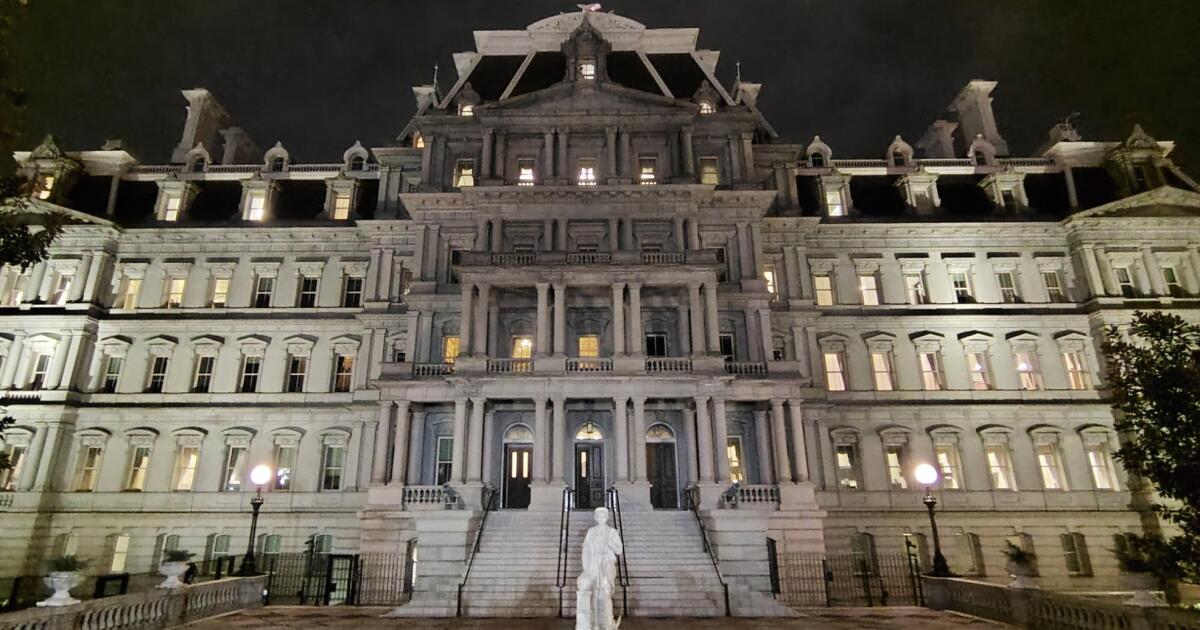
ANNAPOLIS, Md. — A statue of Christopher Columbus has been placed on the grounds of the Eisenhower Executive Office Building adjacent to the White House, the latest effort by President Trump’s administration to recognize the controversial explorer.
The statue is a replica of one that was tossed into Baltimore’s harbor in 2020 during Trump’s first term at a time of nationwide protests against institutional racism.
Trump endorses a traditional view of Columbus as a leader of the 1492 mission seen as the unofficial beginning of European colonization in the Americas and the development of the modern economic and political order. In recent years, Columbus also has been recognized as a primary example of Western Europe’s conquest of the New World, its resources and its Native people.
“In this White House, Christopher Columbus is a hero, and President Trump will ensure he’s honored as such for generations to come,” the White House posted on X.
“We are delighted the statue has found a place where it can peacefully shine and be protected,” said John Pica, a Maryland lobbyist and president of the Italian American Organizations United, which owns the statue and agreed to lend it to the federal government for placement at or near the White House.
The statue, made mostly of marble, was created by Will Hemsley, a sculptor based in Centreville on Maryland’s Eastern Shore.
The original statue was toppled by protesters July 4, 2020, and thrown into Baltimore’s Inner Harbor during the national social justice reckoning in the months after the police murder of George Floyd in Minneapolis. It was one of many statues of Columbus that were vandalized around the same time, with protesters saying the Italian explorer was responsible for the genocide and exploitation of Native peoples in the Americas.
In recent years, some people, institutions and government entities have displaced Columbus Day with the recognition of Indigenous Peoples Day. President Biden in 2021 became the first U.S. president to mark Indigenous Peoples Day with a proclamation.
Trump dismisses the shifting views on Columbus as the work of “left-wing arsonists,” bending history and twisting Americans’ collective memory. “I’m bringing Columbus Day back from the ashes,” he declared last April. Echoing his 2024 campaign rhetoric, he complained that “Democrats did everything possible to destroy Christopher Columbus, his reputation, and all of the Italians that love him so much.”
Plus, every time you drive, you can see the escalating average cost for a gallon of gas throughout the state that ranges from $5.77 in Orange County, $5.78 in San Diego County, $5.80 in Los Angeles County and $5.86 in San Francisco County to the high of $6.57 in Mono County, according to AAA.
It can easily make anyone think having fun is unaffordable.
Fortunately, our Travel and Experiences team has put together a list of 75 fun things to do for under $20.
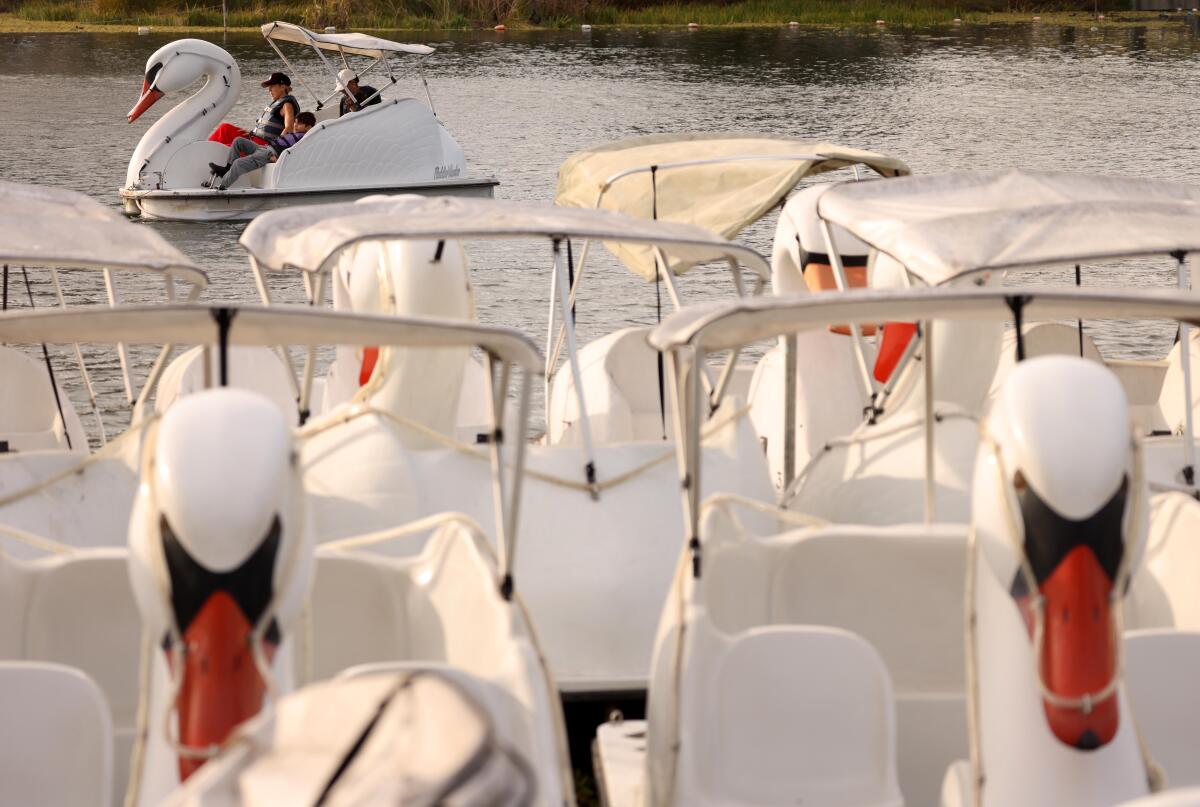
On warm days, it’s hard to beat a ride on the swan boats at Echo Park.
They’re powered by foot paddles, and the pedaling is easy because you’re in no hurry. Maybe you’ll want to do a circuit of the lake (really a man-made reservoir). Maybe you’ll sidle up to the towers of whitewater rising from the mid-lake fountain.
Maybe you’ll wait until after dark (because the swans light up).
(Christina House / Los Angeles Times)
Experience L.A.’s esoteric history at the Philosophical Research Society (Los Feliz)
Cost: Free to visit, workshops and lectures from $10 and up.
Located at the intersection of Los Feliz and Griffith Park boulevards, the Philosophical Research Society has long been a place of mystery, intrigue and, for some, apprehension.
The Mayan Revival campus painted in Southwestern shades of clay, cream and sage was built in 1935 by the celebrated author and esoteric lecturer Manly P. Hall.
Today, it hosts a dizzying array of events each week including poetry readings, death cafes, sound baths, a weekly class on Buddhism, tarot and astrology salons and musical performances — some of which have a suggested donation of just $10.
If you visit, make sure to make time to browse the excellently curated metaphysical bookstore.
(Gina Ferazzi / Los Angeles Times)
Find the perfect meditation spot at the Self-Realization Fellowship Lake Shrine (Pacific Palisades)
Cost: Free.
Whether or not you’re familiar with the work of Paramahansa Yogananda, who founded the Self-Realization Fellowship in 1920, if you live in Los Angeles you owe him a debt of gratitude for the smattering of lush, meditative gardens in Southern California that are still open to the public today.
Among those is Lake Shrine, a beautifully landscaped 10-acre property in the Pacific Palisades surrounding a spring-fed lake that is dotted with quiet meditation spots.
It is free to visit, but you will need to make a reservation online before you go. (Reservations open each Saturday at 10 a.m. for the week ahead, and they can fill up quickly.)
(Wally Skalij / Los Angeles Times)
Cozy up with a flick at the Paramount Drive-In Theater (Paramount)
Cost: $14 per adult, $7 per kid (ages 3-11).
For a night out that feels as cozy as a night in, head to the Paramount Drive-In Theater. In the comfort of your own car, you can spread out, munch popcorn and make all the commentary you want without getting looks from other moviegoers.
Tickets are purchased on arrival, and the parking lot is huge, so you’re bound to secure a good view of the big screen. There is a concession store on site with candy, chips and drinks, but you are free to bring all the snacks you want from home. Recline your seat all the way back, relax and enjoy the show.
You’re reading the Essential California newsletter
Sign up to start every day with California’s most important stories.
By continuing, you agree to our Terms of Service, which include arbitration and a class action waiver. You agree that we and our third-party vendors may collect and use your information, including through cookies, pixels and similar technologies, for the purposes set forth in our Privacy Policy such as personalizing your experience and ads.
The week’s biggest stories
(Irfan Khan / Los Angeles Times)
Heat wave and environmental news
Los Angeles mayor, city council news
Cesar Chavez fallout
California governor’s race
Crime, courts and policing
What else is going on
Must reads
Other meaty reads
For your downtime
(Illustrations by Lindsey Made This; photograph by Myung J. Chun / Los Angeles Times)
Going out
Staying in
L.A. Affairs
Get wrapped up in tantalizing stories about dating, relationships and marriage.
Have a great day, from the Essential California team
Jim Rainey, staff reporter Hugo Martín, assistant editor, fast break desk Kevinisha Walker, multiplatform editor Andrew J. Campa, weekend writer Karim Doumar, head of newsletters
IF there’s ever a time to sink a pint of Guinness, it’s got to be today, which is St Patrick’s Day.
You’ll likely find the best pour in its birthplace of Ireland, but there are plenty of bars all over the world pulling stouts for punters.
Sign up for the Travel newsletter
Thank you!
Sophie Swietochowski shares her pick of unlikely destinations to pick up a Guinness, along with some holiday deals for those who are tempted.
NEPAL
Namche Bazaar, Nepal, boasts the Irish PubCredit: Getty
THE aptly named Irish Pub is not only in one of the most off-grid locations in this list — being in the small town of Namche Bazaar — it’s also one of the highest boozers in the world.
Many claim it’s the most difficult pub to reach because of its position in the gateway to Mount Everest.
OK, it may be a two-day hike to get there but it’s well worth it for the views — and at least you can reward yourself with a well-deserved pint at the end.
Find the pharmacy-like bar Svanen in OsloCredit: TONO BALAGUER
ON Paddy’s Day, punters sink Guinness like its medicine, so what could be a more fitting setting than a 19th-century pharmacy?
Svanen, in the Norwegian capital Oslo, ranks 32 in the 50 Best Bars in the world list, with its traditional glass medicine cabinets, marble columns and black and white tiled floors still intact.
You’d be hard pushed to find a quirkier joint for sipping the dark stuff.
GO: NORWAY
Seven nights’ B&B at the 3H Scandic Fornebu is from £409pp including flights from Stansted on April 8.
A pint of Guinness will set you back a fiver at Rick’s Cafe in JamaicaCredit: Getty
RICK’S Cafe has to be one of the most spectacular spots to enjoy a pint, with sweeping views of the Caribbean Sea that are best enjoyed at sunset.
The bar-cum-restaurant in the town of Negril has become a popular spot for cliff jumpers thanks to its hilltop perch, 35ft above a clear and perfectly blue ocean.
A pint of Guinness will set you back a fiver.
GO: JAMAICA
Seven nights’ all-inclusive at the 5H Riu Negril is from £1,264pp including flights from London Gatwick on May 4 with 23kg hold luggage and transfers.
You can enjoy a pint of the black stuff on the Faroe IslandsCredit: Getty
THIS collection of volcanic islands, floating in the sea between the UK, Norway and Iceland, are so unspoilt that it’s hard to picture a bar here being anything more than a few tables and a weathered gent serving only the local poison.
But the Irish Pub (again) is a little more than that.
Located in the capital Torshavn, this charming spot offers lovely views of the harbour.
You may even spot seals, whales and dolphins, too.
GO: THE FAROE ISLANDS
Seven nights’ room-only at the 4H Hotel Foroyar is from £902pp including flights from Heathrow on May 4.
Guinness is even available in IcelandCredit: Getty
IT may be better known for attracting geography enthusiasts than stout-loving stags, but that doesn’t mean there aren’t places serving the black stuff in the Land of Fire and Ice.
Den Danske Kro is a lively spot in capital Reykjavik with Danish-style furnishings and a wide selection of beers on tap — including the Irish favourite for £9.
GO: ICELAND
Seven nights’ B&B at the 4H Reykjavik Lights Hotel is from £705pp including flights from Manchester on April 22 with 23kg hold luggage and transfers.
Price also includes two excursions: Hunt For The Northern Lights and Golden Circle tour. See tui.co.uk.
CZECH REPUBLIC
Head for Waxy Malone’s in PragueCredit: Harald Nachtmann
IN capital Prague, pints are poured with a side serving of history.
Its Old Town dates back more than 1,000 years and is dominated by the Baroque Church of St Nicholas and the dramatic Kinsky Palace.
And just off the square you’ll find Waxy Malone’s.
A pour of Guinness here will set you back around a fiver.
GO: CZECH REPUBLIC
Three nights’ B&B at 4H Plaza Prague Hotel starts at £200pp including flights from Gatwick on May 31 with hand luggage only.
V&A Storehouse was named one of TIMEs best places in 2026Credit: PAAs a working museum, the concept is more seeing behind the scenesCredit: PAIt has some fascinating pieces if you know where to lookCredit: Getty
Many European destinations and warming up, and spring is definitely on the way. But which short-haul spot is most likely to give you sunshine and dry days over Easter? Here’s the destination with the best odds.
This article contains affiliate links, we will receive a commission on any sales we generate from it. Learn more
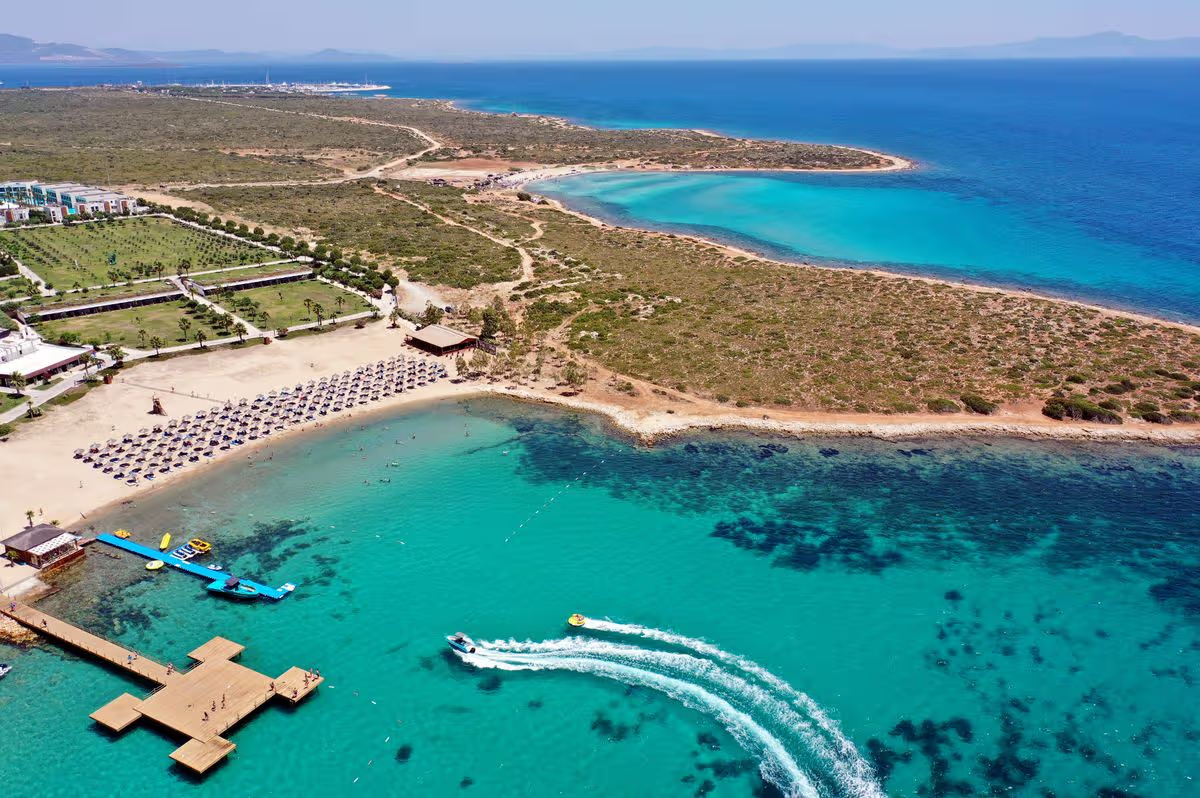
This is the destination to book for the best possible chance of Easter sunshine(Image: Ferdi Uzun/Anadolu via Getty Images)
It feels like winter has dragged on forever this year, and many parts of the country are only just emerging from months of endless rain and grey skies to see a little bit of sunshine. With Easter on the way, which can be an unpredictable time for UK weather, many people will be looking to get away to the sunniest spot they can find for a few days.
Luckily, TUI has put together a list of the Easter getaways that are most likely to give you the ideal weather conditions, analysing historic data on the average rainfall, wind speed, and temperature in early-April to work out a Good Weather Score. Brits will be pleased to hear that topping the rankings is a destination just over four hours away from the UK that’s expected to see highs of 19C over the next couple of weeks.
According to TUI’s rankings, Turkey historically has the “most ideal weather conditions” during the Easter holidays, usually offering holidaymakers average temperatures of 18C. It’s also the destination where you’re least likely to be caught in an April shower. In the Easter holiday months, the amount of rainfall is just 0.01mm on average.
When the data was broken down into individual destinations, Marmaris in Turkey was the place most likely to give holidaymakers the best Easter weather conditions. It often reaches highs of 19C around Easter, and is usually dry with only light winds. Marmaris is in southwest Turkey in an area dubbed the Turkish Riviera. This lively port town has a marina, bustling grand bazaar, and historic sites such as the 16th-century Marmaris Castle.
Marmaris also has an amazing selection of sandy beaches that sit alongside its turquoise seas. Marmaris Long Beach (Uzunyali), is around six miles long, starting at the city centre, and has a lively promenade full of hotels, restaurants, and bars. A quieter alternative can be found at İçmeler Beach, just south of the city, where you’ll find sandy coves and incredible mountain views.
Second on the list for good weather was Greece, and this time of year brings mean temperatures of around 16C and long sunny days. Meanwhile, Bulgaria ranked third for its “pleasant and balanced climate”. Like Turkey it offers light winds and low rainfall, and Easter can be a good time to explore as tourist don’t have to contend with the intense summer heat. Bulgaria is becoming a major hiking destination, especially around the Rila and Pirin mountain ranges which combine gentle trails with more intense, steep climbs.
Bulgaria is also known for its stunning beaches. The Black Sea coast has 200 beaches to choose from and resorts to suit all sorts of holidaymakers. Sunny Beach is known for its lively nightlife and cheap drink deals, while Varna is a historic and cultural hub that has soft golden sand beaches and clear blue seas.
Anyone planning an Easter break can also check TUI’s holiday weather guide, which gives a breakdown of weather by month for popular tourist spots.
Europe’s top 10 destinations for good Easter weather
Turkey
Greece
Bulgaria
Spain
Croatia
Italy
Hungary
Portugal
Montenegro
Gibraltar
Have a story you want to share? Email us at webtravel@reachplc.com
Whether you’re Irish by blood or Irish just for the day — you want to head to the best spots in the UK to ring in the festivities — and that’s where we come in.
Let the Guinness and the good times roll.(Image: AFP via Getty Images)
St Patrick’s Day is just around the corner and it’s the one day of the year people really like to let loose and celebrate.
Every year on March 17, people all over the world outside of Ireland — but especially the UK — come out in hordes to celebrate St Paddy’s Day. We’re talking lively parades, a sea of endless green, and booze. Lots and lots of booze.
Whether you’re Irish by blood or Irish just for the day — you want to head to the best spots in the UK to ring in the festivities. And that’s where we come in.
It goes without saying that the capital cities of Belfast in Northern Ireland and Dublin in the Republic of Ireland are must-visits if you’re looking for the ultimate St Paddy’s celebrations, but for those of you who can’t make it all the way to Ireland — don’t worry, we got you.
We’ve compiled a list of the best cities in Britain where you can celebrate St Patrick’s Day this year, so whether you’re planning to head out with a group of mates or go on a solo adventure, make sure to give these spots a whirl.
Let the Guinness and the good times roll.
London
It’s no surprise London is on this list. The UK’s capital city hosts a massive St Paddy’s Parade every year, and this year it’s going to be bigger and better than ever.
March 15 will see the official parade weave its way from Hyde Park to Trafalgar Square, with Irish music, pageantry, dance troupes, floats, and marching bands on display, along with a free-for-all party in Trafalgar Square for the public to enjoy featuring live music, comedy, food and drink.
It’s not just the parade that’s a draw — the weekend closest to March 17 always sees a flurry of activity as London’s thriving Irish community comes out in full force — along with just about every other person looking for a fun time. The Guinness Open Gate Brewery has also recently arrived in the city, hosting a line-up of craic, comedy, and electric music.
Look no further than London for a truly epic time.
Birmingham
The UK’s second largest city is undoubtedly one of the best to celebrate St Patrick’s Day in. In fact, it was one of the first cities in the country to begin hosting St Patrick’s Day celebrations, with a dedicated parade for the day since 1952.
With endless welcoming pubs, restaurants and clubs, there’s no dearth of exciting ways to celebrate the Irish holiday in Birmingham.
While the city’s annual St Patrick’s Day Parade has unfortunately been cancelled once again this year, there’s still more than enough to do in Brummy to get the celebrations going.
Revellers can instead head to St Patrick’s Family Fun Day at the Irish Centre on March 15 which will see a host of activities and entertainment including live bands, music and plenty of food and drink.
Or you can just head down to one of the local pubs — because parade or no parade, St Paddy’s Day is always a rip-roaringly fun time in Birmingham.
Manchester
There’s no way Manchester wasn’t going to be on this list. The city is all set to host its Irish parade for Paddy’s Day on March 15 and revellers can enjoy foot-tapping live Irish music, mouthwatering food, drinks and much more.
Expect to see “plenty of bright costumes, lively parades, and fun events happening across the city”.
In fact, the 10-day Manchester Irish Festival has been running since March 7 and will go on till March 17, with the parade on Sunday being the event’s highlight.
Liverpool
Liverpool is another UK city that’s always a good time on St Patrick’s Day. Irish pubs, karaoke bars and top-class entertainment means if you’re in Liverpool, it’s going to be a hell of a time.
Those hoping for a more peaceful and religious St Paddy’s Day can make their way to Liverpool Cathedral which is Britain’s biggest.
The 10th Annual Liverpool St Patrick’s Day Parade will take place at the Old Irish Centre on March 17, Tuesday. The anniversary parade promises to be “the biggest and best yet — with music, dance, colour, and Irish pride filling the streets. Bands, floats, and community groups are all welcome, and the whole city is invited to join in the festivities”, as per the official website.
AS SPRING emerges, your Instagram feed will soon look like a sea of pink as people head off to find cherry trees blossoming – and the UK has some great free spots to see them.
Known as ‘hanami’, the tradition of seeing cherry blossoms is a centuries-old Japanese custom.
Sign up for the Travel newsletter
Thank you!
There are a number of places you can see blossom trees for free across the UKCredit: AFP
Taking place in the spring, the tradition celebrates the blossoms which symbolise new beginnings, mortality and the beauty of life.
While the UK doesn’t have anywhere near as many blossom trees as Japan does, there are several locations across the UK where you can catch them blooming for free – here’s some of the best.
Battersea Park, London
In South West London, head to Battersea Park and you will find a long run of cherry blossom trees on Cherry Tree Avenue.
If heading to the park, make sure to enjoy a wander next to the River Thames whilst seeing the 40 blossom trees.
The Meadows is a large public park south of Edinburgh‘s UNESCO World Heritage Old Town.
The park is even protected by an Act of Parliament, that was created in 1827.
During the spring, there are avenues of cherry trees.
They are known to bloom a little later than other places, usually starting to bloom in April.
In Edinburgh, The Meadows has an avenue of cherry treesCredit: Getty
Pittencrieff Park, Dunfermline
Up in Dunfermline, Scotland, head to Pittencrieff Park and walk along the path near the main entrance to enjoy a row of cherry trees that line the path.
The cherry trees usually blossom here in late April and whilst you are exploring the park, make sure to look out for its resident peacocks and the Andrew Carnegie statue.
Nearby, you can also visit Dunfermline Abbey and Palace.
Castle Park, Bristol
Castle Park in Bristol is an open space between the city’s Shopping Quarter and the Floating Harbour.
In addition to ruins in the park, visitors will be able to find different cherry trees.
One spot is the cherry avenue, with 21 trees.
And the other spot is a singular, white Japanese Cherry Tree that was planted in 2014 to mark the 70th anniversary of Hiroshima.
This type of cherry tree had actually died out completely in Japan, but was saved when a single specimen of the tree was found in England in 1923.
Paid-for spots to see cherry blossom in the UK
Kew Gardens, London – has a dedicated cherry walk and Sounds of Blossom festival
Alnwick Garden, Northumberland – home to the world’s largest orchard of Taihaku (Great White) cherry trees
Batsford Arboretum, Cotswolds – over 120 Japanese flowering cherry trees
RHS Wisley Garden, Surrey – an avenue of 140 Yoshino cherry trees
THE world’s greatest places of 2026 have been named and there are two on the list from the UK.
TIME’s annual World’s Greatest Places list looks at everything from hotels and cruises to attractions and experiences.
Sign up for the Travel newsletter
Thank you!
TIME’s World’s Greatest Places has included everything from hotels to attractionsCredit: APThe ew V&A East Storehouse in London was includedCredit: AlamyAn afternoon tea experience in Somerset was also namedCredit: Instagram/thenewtinsomerset
This year, this included Disney cruises, new museums and beautiful coastal regions, mainly looking at anything “new, exciting, and relevant”.
The museum’s collection is broken down into three ‘themes’ – items that have a story, items inspired by the V&A and items that show a working museum.
Having opened last years, TIME explained: “At a time when many museums’ permanent collections have so far outgrown their galleries that only a fraction of their holdings can ever be exhibited at once, the new V&A East Storehouse is taking a radically different approach.
“The real game-changer is theOrder an Object system, which lets guests search a digital catalog of more than half a million items and select up to five pieces to be pulled from the shelves and presented one-on-one by a museum staffer for up-close inspection during a future visit.
She said: “An element I loved was the lack of walls where you can see everything while standing in one spot.
“It almost reminded me of an IKEA warehouse with the simple plywood and metal structures and open concept.
“But the variation of items (of which there are 250,000) means there is something for everyone.”
It’s free to visit, with free lockers and an on-site cafe.
Also making the TIME top 100 list is The Maid of Somerset, a very fancy afternoon tea experience.
Guests enter the Creamery at Castle Cary Station, with the afternoon tea taking place in a “British Pullman style” saloon car.
TIME said: “Unlike the stereotypical snooty high tea, the Maid’s service is steeped in the good humor – and obsession with quality – that typifies Roos’ and Bekker’s projects.
“The friendly attendants prepare 11 loose-leaf teas – a mix of house blends and Prince & Sons selections – and serve finger sandwiches like cucumber and Waterlip, a tangy feta-style cheese made on site at the Creamery.
“A three-tiered sweets tower follows, featuring cardamom-scented orange cakes and scones paired with the Newt’s strawberry-rose preserves.”
The experience costs £35, or £45 with alcohol.
The experience takes place on a luxury trainCredit: Instagram/thenewtinsomersetThe Grand Egyptian Museum in Giza was also mentionedCredit: Alamy
SANTA FE, N.M. — Democratic-led states alarmed by the prospect of federal immigration officers patrolling the polls during this year’s midterm elections are taking steps to counter what they see as a potential tactic to intimidate voters.
New Mexico this week became the first state to bar armed agents from polling locations in response to President Trump’s immigration crackdown, a step being considered in at least half a dozen other Democratic-led states.
The moves highlight a deep distrust toward the Trump administration from blue states, which have been the target of his aggressive immigration tactics while threatened with military deployments and deep cuts in federal funding. Their concerns were heightened after the president suggested he wants to nationalize U.S. elections, even though the Constitution says it’s the states that run elections.
The Trump administration said it has no plans to deploy immigration agents to polling locations. Last month, the heads of Immigration and Customs Enforcement and Border Patrol told a congressional committee “No, sir” when asked if they had any plans to guard polling places. The Department of Homeland Security’s deputy assistant secretary for election integrity, Heather Honey, recently told secretaries of state it “is simply not true” that immigration agents will be at the polls this year.
But a group of eight secretaries of state wants that in writing from the nominee to succeed Kristi Noem as secretary of the Department of Homeland Security. In a letter Monday to Trump’s new pick to lead the agency, Markwayne Mullin, the group pressed for assurances “that ICE will not have a presence at polling locations during the 2026 election cycle.”
Federal law already prohibits the deployment of armed federal forces to election locations unless “necessary to repel armed enemies of the United States,” but Democratic lawmakers, election officials and governors remain concerned.
“The fear is that the Trump administration will attempt to evoke a national emergency or execute some other deployment of federal agents or military troops in order to interfere with elections and intimidate voters,” said Connecticut Democratic state Rep. Matt Blumenthal, co-author of a state bill to establish a 250-foot buffer from federal agents at local polls and other restrictions on federal intervention. “And we’re not going to let that happen.”
A potential clash between states and the federal government
Other bills seeking to ban immigration agents at the polls are pending in Democratic-led states, large and small, from California to Rhode Island.
In Virginia, lawmakers are weighing legislation that could prevent federal civil immigration officials from making arrests within 40 feet of any polling place or courthouse. But the provision on polling sites remains under negotiation, and it’s unclear whether it will be in the final bill.
The newly signed law in New Mexico prohibits orders that put any armed person in the “civil, military or naval service of the United States” at local polling locations and related parking areas, or within 50 feet of a monitored ballot box, from the start of early voting.
Under New Mexico’s new law, which takes effect in May and will be in place for the state’s June 2 primary, people who experience intimidation or obstruction at the polls from federal agents or military personnel can file a civil lawsuit seeking relief in state courts. State prosecutors and local and state election officials also can sue, and the courts can apply fines of up to $50,000 per violation.
It also prohibits changes to voting qualifications and election rules and procedures that conflict with New Mexico law, as Trump prods the U.S. Senate to approve a bill to impose strict new proof-of-citizenship requirements in elections nationwide.
Any state measures intended to counter federal election law will face legal hurdles because of the supremacy clause in the U.S. Constitution, which says federal law supersedes state law.
“It could set up a direct clash between state governments and the federal government. We don’t know exactly how that’s going to go,” said Richard Hasen, director of the Safeguarding Democracy Project at the UCLA School of Law. “Given the supremacy clause, there’s only so much states can do.”
‘We will hold free and fair elections’
New Mexico Gov. Michelle Lujan Grisham said her own distrust of the Trump administration in election oversight stems from ongoing Department of Justice efforts to get detailed state voter data without explaining why and Trump’s continuing false claims of widespread fraud in the 2020 presidential election.
“Do I believe the federal government and people in the White House? No,” said Lujan Grisham, who terms out of office at the end of 2026.
“We are sending a message to everyone: We will hold free and fair elections, and New Mexicans will be safe in every ballot location and that’s our responsibility,” the Democrat said Tuesday during a news conference. “The Constitution says the states run their elections, and that bill makes that painfully re-clear to the federal government.”
Federal seizure of ballots and election records is a growing concern
New Mexico Republicans, who are in the minority in the legislature, voted in unison against the bill.
“I would question strongly why we have to do this other than just to have to poke the president in the eye,” state GOP Sen. Bill Sharer of Farmington said during floor debate.
State Sen. Katy Duhigg, an Albuquerque Democrat who was a co-sponsor of the legislation, said it’s “better safe than sorry with democracy.” She said she wanted to “make sure that there was some sort of tool that our local law enforcement would have at their disposal if something does happen, if the federal government does in some manner try to interfere with our elections.”
Connecticut’s bill, scheduled for a hearing later this week, also takes aim at federal attempts to seize ballots or other election material. It would require that state officials receive notification of such a move.
Blumenthal said state lawmakers can’t prevent seizures such as the January search by the FBI on an election center in Fulton County, Ga., a Democratic stronghold that includes Atlanta. But he said, “there might be an opportunity for our state attorney general’s office or the secretary of the state’s office to challenge that.”
Lee and Haigh write for the Associated Press. Haigh reported from Hartford, Conn. AP writer Oliva Diaz in Richmond, Va., and David A. Lieb in Jefferson City, Mo., contributed to this report.