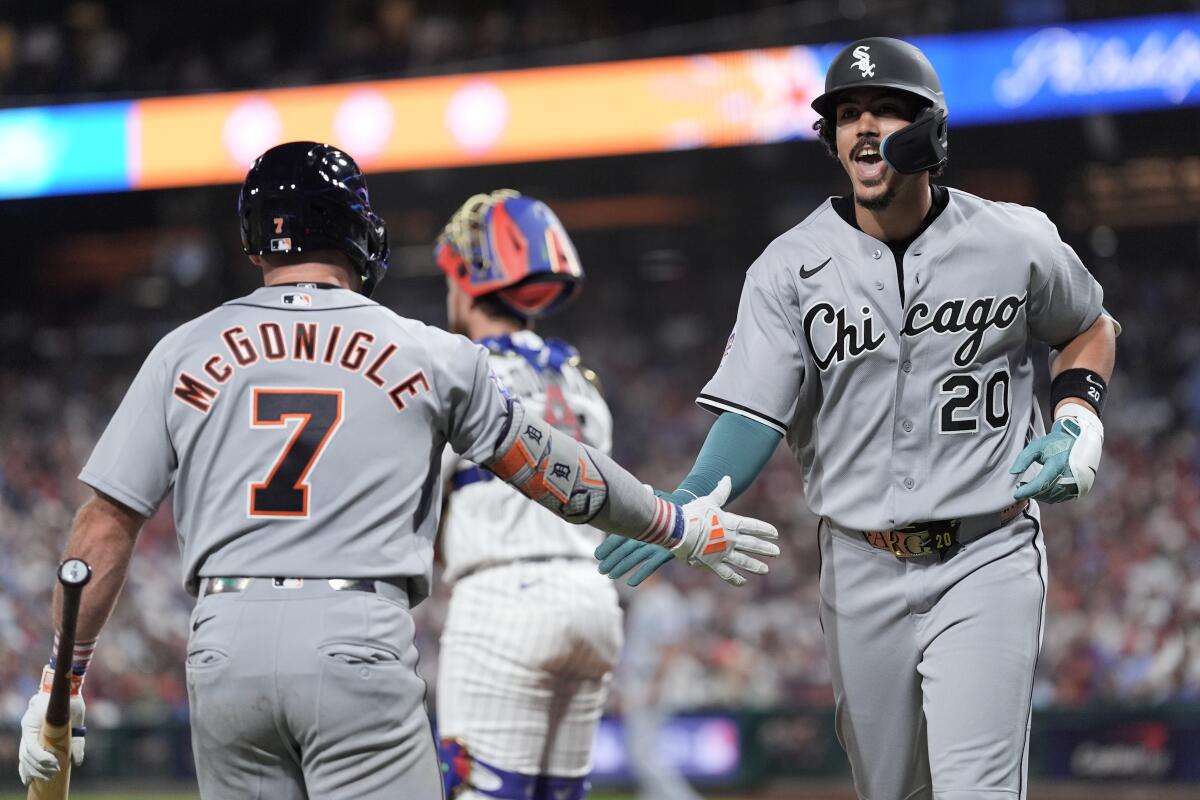
Nick Kurtz had three hits and five RBIs, Brent Rooker and Zack Gelof homered and drove in three runs apiece as the Athletics beat the Angels 14-6 on Tuesday night.
The Athletics scored 12 of their runs with two out.
Kurtz, the reigning American League rookie of the year, sparked a six-run third inning with an RBI single, keyed a two-run sixth with a two-run single and added a two-run double in a four-run eighth.
Reliever Justin Sterner (2-3) escaped a first-and-third, two-out jam in the fourth and earned the win for the AL West-leading A’s, who snapped a three-game skid.
Mike Trout hit his 12th homer of the season, a solo shot, and finished with two RBIs for the last-place Angels, who have lost 22 of 28 games since an 11-10 start.
Angels starter Reid Detmers (1-5) was tagged for eight runs and eight hits in 5 2/3 innings. The left-hander retired seven straight batters to open the game, five by strikeout, before Jeff McNeil and Darell Hernaiz singled in the third.
Shea Langeliers flied out before Kurtz punched an RBI single to center to extend his on-base streak 42 games, the sixth-longest in franchise history. Colby Thomas followed with a two-run double, Rooker added an RBI single, Henry Bolte hit a ground-rule double, and Gelof had a two-run single for a 6-0 lead.
Trout led off the bottom of the third with his 43rd career homer against the A’s. That tied him with Rafael Palmeiro and Alex Rodriguez for the most since the A’s moved to California in 1968. Trout also scored his 600th Angel Stadium run on the play, the most in franchise history.
The Angels pulled within 6-4 in the fourth on Trout’s bases-loaded walk and Vaughn Grissom’s two-run single, which knocked A’s starter Jacob Lopez out of the game. But Sterner got Jorge Soler to fly out, ending the inning.
The A’s, who pounded out 15 hits, pulled away with eight runs over the final four innings, with Kurtz driving in four, Gelof hitting a solo homer in the seventh and Rooker a two-run shot in the eighth.
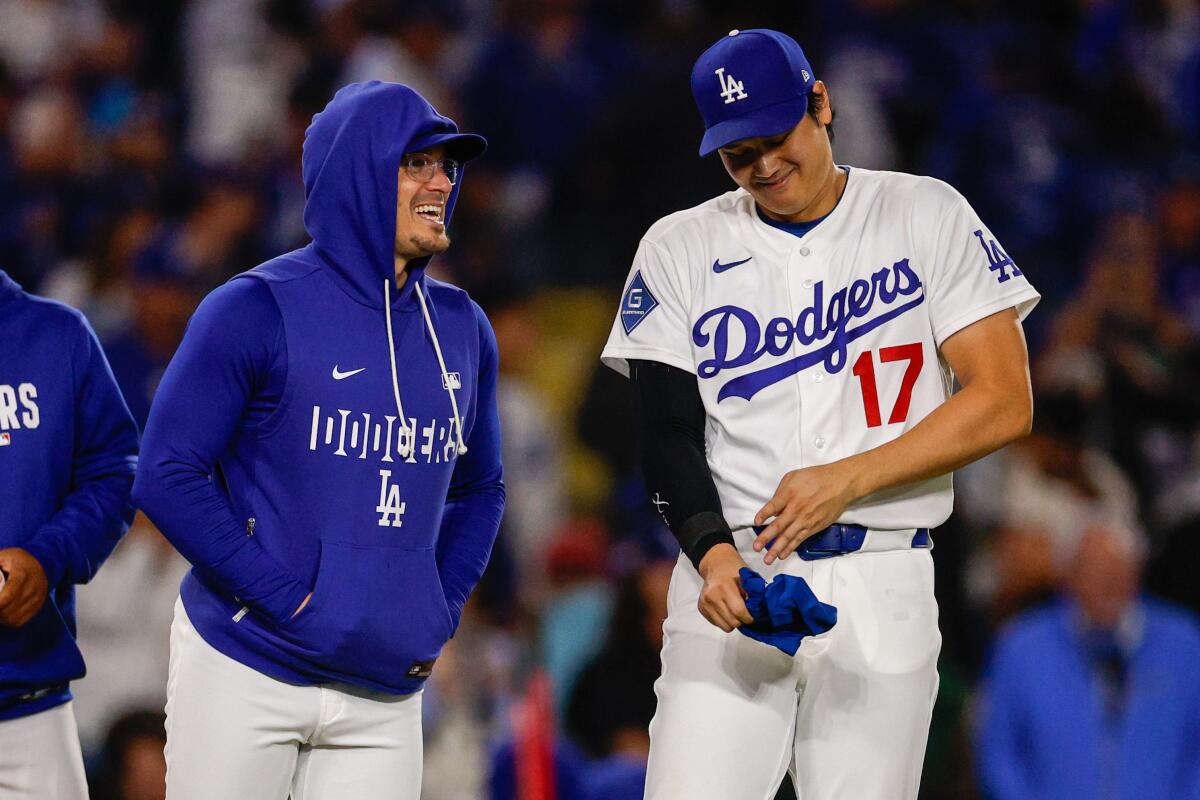
As the Dodgers navigate the ripple effects of a series of recent pitching injuries, they added bullpen depth on Sunday by acquiring left-hander Eric Lauer from the Blue Jays for cash considerations.
The Blue Jays designated Lauer for assignment last week, after a bumpy start to the season. Lauer had yielded a league-leading 11 home runs in eight appearances.
It was a contrast to the far steadier presence he’d provided on the mound last year en route to an American League pennant, when he posted a 3.18 ERA in the regular season and 3.12 in the postseason. Lauer didn’t give up a run against the Dodgers in two World Series appearances, including 4 2/3 innings in Game 3.
To make room on the 40-man roster, the Dodgers transferred right-hander Brusdar Graterol (right shoulder surgery recovery) to the 60-day injured list.
They put left-hander Jack Dreyer on the 15-day IL with left shoulder discomfort. Imaging showed “nothing relevant,” other than inflammation, manager Dave Roberts said. The Dodgers hope he’ll be ready to be reinstated after a minimum stint.
“He was warming up yesterday and then felt something in his shoulder, some soreness,” Roberts said. “We just wanted to be proactive.
There are lots of coaches in the Southern Section Division 1 baseball playoffs glad to see that Villa Park is in the Division 2 playoffs because of the Spartans’ strong pitching.
Villa Park, the No. 1 seed in Division 2, has a terrific one-two starting duo in junior Logan Hoppie (10-1, 1.28 ERA) and senior Jack McGuire (6-2, 1.62 ERA).
McGuire is 6 feet 5 and has 82 strikeouts in 60 2/3 innings. He had a 16-strikeout performance this season. Hoppie has a two-hit shutout of Crestview League champion Cypress on his resume.
Villa Park finished the regular season at 19-8-1 under veteran coach Burt Call and in second place in league. If the Spartans can get some hitting help, the pitchers will handle the rest. Villa Park opens the playoffs on Thursday at home against Elsinore.
This is a daily look at the positive happenings in high school sports. To submit any news, please email eric.sondheimer@latimes.com.
Chris Clarke had gone the traditional route, pitching for three years at USC after starring at Newbury Park High, then toiling for six more seasons in the Chicago Cubs’ minor league system after being a fourth-round draft pick in 2019.
But his big-league dream abruptly became a wake-up call last August when the Cubs released him a week before his wife gave birth to their first child. No more paychecks. No more health insurance.
“It was surreal,” Clarke said. “In fact, it was so incredible, I didn’t feel anything. My body went numb. There was a moment in the third inning when everybody was screaming. I couldn’t hear myself talk.”
It was the most people ever crammed into Kyle Field, the nation’s fourth-largest college stadium, trailing only Michigan (107,601), Oregon (106,572) and Ohio State (102,780).
Clarke pitched for the opposing team, the Texas Tailgaters, one of five squads created by Bananas founders Jesse and Emily Cole that serve as touring partners to face the yellow-clad star attraction. All six teams practice at a complex in Savannah, Ga.
The game in College Station attracted the largest crowd in the Bananas’ six-year history, and Clarke shined, striking out five in four innings. He also entertained, as all players in the Banana Ball Championship League are cheerfully required to do.
“The amount of joy it brings to fans and even people online, it’s really something,” Clarke said. “There definitely is a winner and a loser — which holds some weight — but for the most part, fans are there because it’s a really good show.”
Clarke, a 6-foot-7 right-hander, was the third overall pick in the inaugural Banana Ball draft held in November. Tailgater coaches contacted him beforehand to gauge his interest and he told them, “Pick me.”
March 2019 photo of former USC pitcher Chris Clarke during the 2019 Dodger Stadium Classic.
(John McGillen/USC Athletics)
That level of bold fits right in. Banana Ball is fast-paced, hilarious and maximizes fan engagement. It features innovative rules: Fouls caught by fans count as outs, for example, and batters who walk get to run the bases until all nine defensive players have touched the ball. Choreographed dances, acrobatic tricks, a pitcher on stilts and other antics keep the entertainment flowing.
“I like to think of every game as a stepping stone to the next show,” Clarke said. “Whether it goes well or is terrible, we will make it better for next time. Banana Ball is a relaxed culture, so when it comes to the entertainment stuff, there is no fear of failure. We are seeing what works and what doesn’t.”
Guest stars are frequent and on Saturday, the Bananas sent Texas-grown YouTube sensation Tyler Toney, a member of the sports comedy troupe Dude Perfect, to the plate as a pinch-hitter. Clarke struck him out on four pitches: a called strike, a swinging strike, a ball Clarke purposely launched high into the stands for laughs, then strike three swinging on a cut fastball.
It was a rare humbling moment for Toney, who, with fellow Dude Perfect members Cody Jones, Garrett Hilbert, and twins Cory and Coby Cotton, generates more than $20 million annually from YouTube, merchandise and tours.
Clarke had watched Dude Perfect videos religiously when he was at USC and was starstruck to meet them in person.
“Dude Perfect is the reason I failed econ twice,” he said. “I watched every single Dude Perfect video. To meet them and shake their hands was fun. It was the only moment in my life where I was a fanboy.”
He’s also a breadwinner again for his family. The burgeoning popularity of Banana Ball has made the gig more lucrative than playing in the minor leagues.
“I’m making five times as much and playing half the time,” Clarke said. “My contract is also for 12 months of the year. In affiliated baseball, it’s only six months. So, there’s that. I’ve never met anyone in baseball who has had the luxury to spend time with a newborn child. To come to Banana Ball and actually feel like there is respect, a culture and guidelines, that was something I hadn’t experienced.”
It is also giving him notoriety. Twenty-five Banana Ball games this year are being streamed on the ESPN app and Disney+, with select games airing across ESPN networks and ABC. The first Bananas broadcast on ABC will take place at Autzen Stadium in Eugene, Ore., June 27 and 28. The games have been sold out since October.
Highlights from Saturday’s game flooded social media and traditional outlets alike. Family friends and former teammates reached out to Clarke. What was it like pitching in front of 100,000 people? Are you improving your dance moves?
“The entertainment side of it takes pressure off performance,” he said. “Performing well is still very much there, but there is a level of relaxation that makes it easier.”
Clarke admits he thinks back to USC and the 2019 season, when he posted a stellar earned-run average of 1.03. He also occasionally misses the heightened competition and quest to make the major leagues of affiliated baseball.
He pitched two seasons in triple A and is only 27. Would he leave Banana Ball next year if an MLB team offered him an invite to spring training?
“I’m not in a situation to close any doors,” he said. “That’s the mindset that got me here. I wanted to investigate Banana Ball and I told them I’d give them a full year for us both to evaluate it. Either way, I think it’s a win. Just comes down to what’s best for my family.”
Meanwhile, more games in packed stadiums await. In addition to a handful in football stadiums against the Bananas, the Tailgaters will play three games a week against other Banana Ball League teams throughout the summer, mostly in minor league baseball stadiums from Tulsa, Okla., to El Paso, Texas, to Nashville, Tenn., to Charlotte, N.C.
Exponentially larger crowds than those venues are accustomed to are a given.