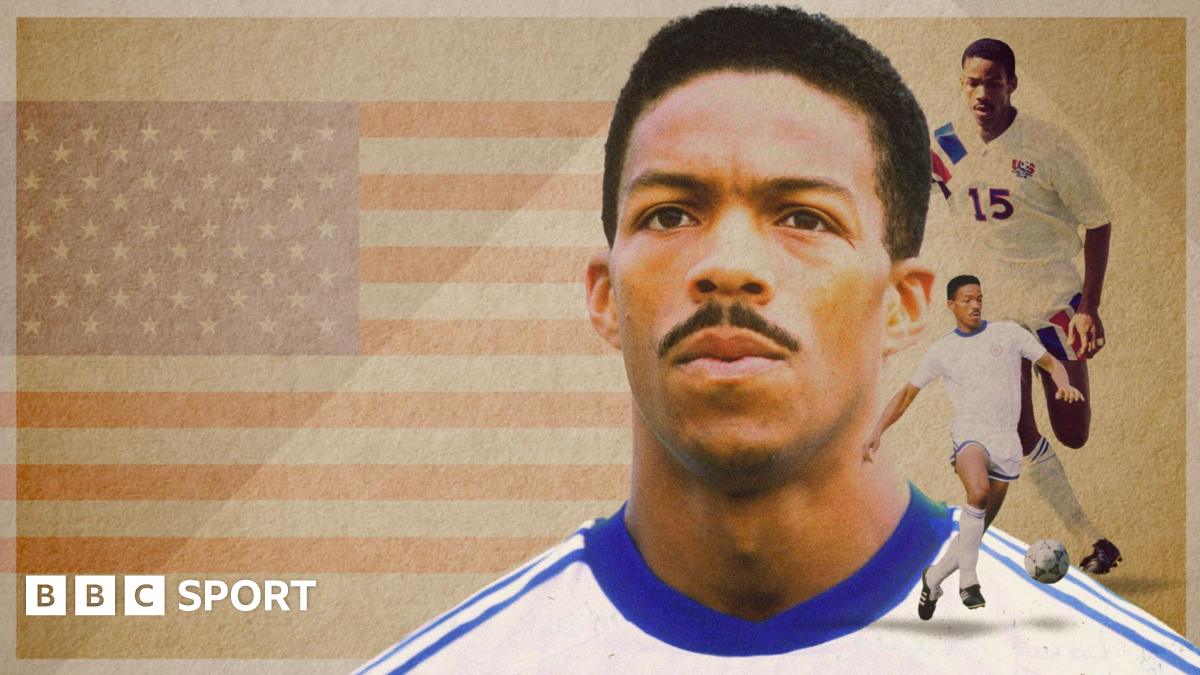
World Cup 2026: USA pioneer Desmond Armstrong and his legacy
Football came to Armstrong, via a television set, in suburbia.
His family moved from the Southeast part of Washington DC when Armstrong was young and later settled in a largely white neighbourhood in Maryland, where he befriended a soccer coach’s son. One afternoon, the coach called Armstrong over to the television.
He was pointing to a Brazilian in a New York Cosmos jersey.
“It was Pele,” says Armstrong.
“His movement reminded me of a lot of the point guards that played basketball, but he was doing it with a ball at his feet.
“He was one of the few black players on the team, so that connected me.”
While Pele was popularising a game he’d learned barefoot on the streets of Brazil, much of the American grassroots version was being built on privilege.
Unlike the developing youth academies of Europe and South America, where clubs like Ajax and Barcelona were putting money into young talent, development in the US has long run on a pay-to-play model.
Families must meet significant costs or seek sponsorship to give their children a shot at advancing – creating a system that has seldom favoured those from less affluent households.
“It’s kind of antithetical to what this game’s all about,” says Frank Dell’Apa, who has spent 40 years as the Boston Globe’s football columnist, covering the game since the days of the original North American Soccer League (NASL).
“This is the simplest game with the easiest access. Everybody plays it around the world with no money, no soccer balls, no shoes. And here, we had just the opposite thing going on.”
Armstrong knows just how easily his story could have been different.
“If my folks didn’t move into the suburbs, then hands down I’m not playing soccer,” he says.
Socioeconomics was not the only hurdle.
The NASL going under in 1985 during Armstrong’s time as a college player limited professional pathways for him and his peers before their careers had even begun.
“For me, personally, that was crushing,” Armstrong says.
He turned to the Major Indoor Soccer League to play professionally, where his performances earned him a US men’s national team debut in 1987, followed by a spot at the 1988 Seoul Olympics.
“I remember being on the field, hearing the national anthem and just thinking ‘this is where I’m supposed to be’,” he says.
That same year, world football’s governing body Fifa had selected the USA to host the 1994 World Cup finals – the first time the tournament had gone to a country outside Europe or Latin America.
They would be under the global spotlight.
“The US was not a factor in world soccer at all,” says Dell’Apa.
“I remember Des playing a lot of games on artificial turf. It was hard for those guys. They had to fight to get into line-ups, to get a playing field, to get a stadium.”
With no elite outdoor professional league in the country, the player pool was a fragmented mix largely consisting of college, semi-pro and indoor players like Armstrong.
The federation looked to work around this by securing a core group of them on full-time contracts, essentially turning the national team into the country’s professional set-up. It was an unorthodox approach, not unlike something from the Eastern Bloc playbook.
They appointed a German-Hungarian head coach named Bob Gansler. Armstrong was now among a group of young players who were handed a near impossible task: qualify for the 1990 World Cup in Italy.