patterson

USC coach Lincoln Riley wraps staff mixing continuity, new energy

When D’Anton Lynn abruptly left for Penn State on the eve of USC’s bowl game, the hope within the program had been to keep what remained of his defensive staff intact. All while also attracting a top-notch defensive coordinator to take Lynn’s place.

But Lincoln Riley, after four years of regular churn with his staff at USC, was also realistic. The coach had learned by now how quickly plans could change with the coaching carousel.

“It really doesn’t matter what team you are,” Riley said in December. “It doesn’t matter what staff you are. Doesn’t matter what your postseason situation is like. … We’ve been through this now for a few years. So you can’t always predict everything that’s going to happen, but this time of year, you have to be ready to adjust. It’s just the nature of the game.”

Some adjustments, as Riley suggested then, were probably inevitable.

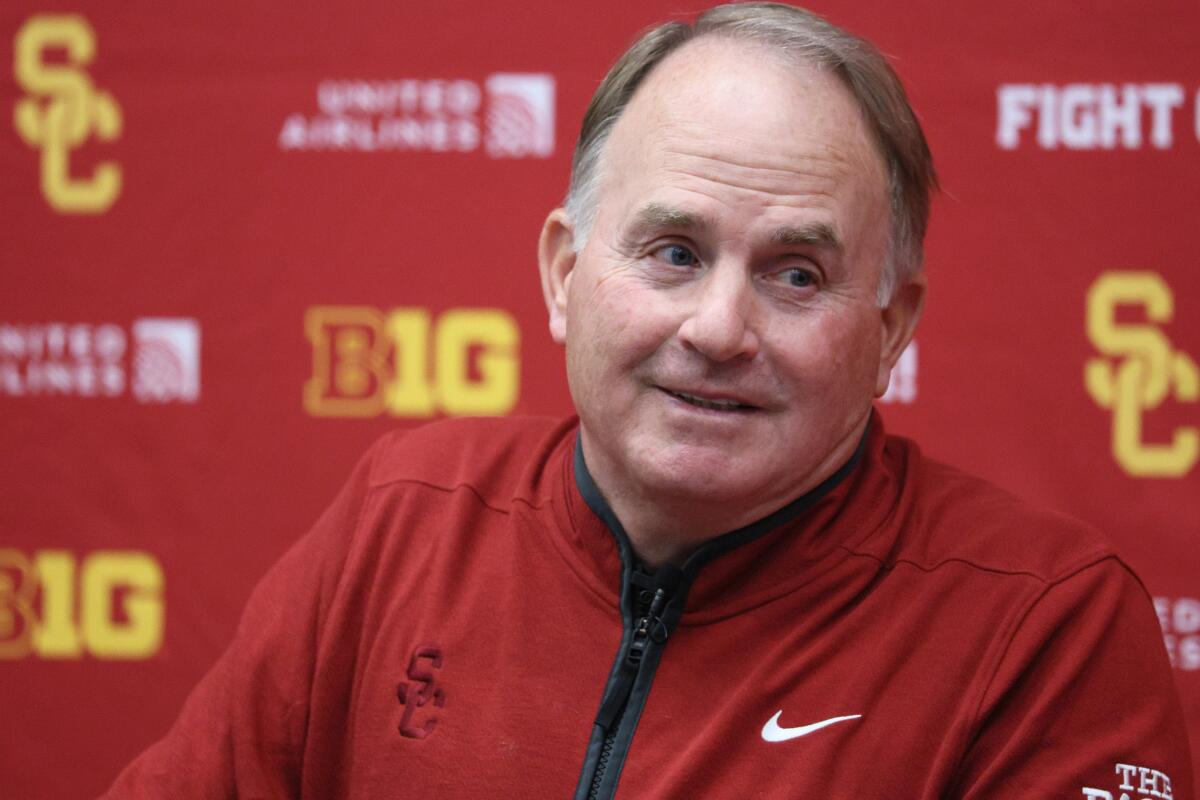
New USC defensive coordinator Gary Patterson takes questions from the media during a news conference.

New USC defensive coordinator Gary Patterson takes questions from the media during a news conference.

(Ronaldo Bolanos/Los Angeles Times)

The worst of it came late in the carousel, when defensive line coach Eric Henderson elected to return to the NFL, departing for the same position with the Washington Commanders. Losing Henderson, from a recruiting perspective alone, is significant. He finished the last recruiting cycle as the nation’s top-ranked recruiter, according to 247 Sports.

It was Henderson who took over the defense for USC’s bowl game, which led some players to voice their belief he should get the full-time gig. His name was floated for other jobs, too, including the coordinator position at his alma mater, Georgia Tech.

USC hoped to retain him as defensive line coach. But with the program determined to go outside of its staff for a new coordinator, Henderson ultimately chose to leave.

USC also moved on from secondary coach Doug Belk, who’d also been mentioned as a potential internal candidate. He spent the previous two seasons as a leading voice on USC’s defensive staff. But his contract was not renewed.

In hiring longtime Texas Christian coach Gary Patterson, Riley found the rare coordinator happy to blend in with a staff that’s largely in place already. Last month, in his first meeting with reporters, Patterson said he viewed himself more as “that last piece” on USC’s staff. He even assured he’d adapt his 4-2-5 defensive scheme to what USC did under Lynn.

“The group that’s here, they improved the defense last year,” Patterson said. “So instead of just coming in and saying, ‘Well this is how we’re gonna do it, it’s been a little bit more work of trying to put both of them together, understanding they did a great job and recruiting really good players. So you gotta really kind of listen a little bit more before you say this how we [do it].”

Some unique aspects of Patterson’s scheme, however, are probably best left in familiar hands. That’s especially the case with his secondary, which is called separately from the front seven.

It stands to reason then that Patterson would bring Paul Gonzales, a defensive backs coach who worked with Patterson for nearly half of his tenure at TCU. He left Baylor to join USC’s staff and is expected to lead the Trojans entire secondary. He’ll be joined by Sam Carter, a former all-Big 12 safety who played under Patterson.

The rest of the staff remains largely intact from last season. Defensive ends coach Shaun Nua stuck with USC amid rumors of interest from his alma mater, Brigham Young. Trovon Reed will continue to coach cornerbacks and Rob Ryan, for the time being at least, remains as linebackers coach.

After a debut that produced mixed results with a thin linebacker room, Ryan’s status has been up in the air over the past two months. Whether he returns or not, his unit will have another voice in the linebacker room in Year 2. Mike Ekeler, who previously coached at USC under Lane Kiffin in 2013, was hired away from Nebraska to coach both special teams and linebackers.

Two defensive analysts were also promoted to full-time roles, as Skyler Jones, in his third season on staff, will coach defensive tackles and AJ Howard, entering his second, will coach outside linebackers.

That makes nine coaches on USC’s defensive staff alone, three more than it employed last season.

As of 2024, there are no longer limits on the number of coaches who can provide on-field instruction, meaning the Trojans can have as many assistants on staff as they please. But only 10 total, plus the head coach, are allowed to recruit off-campus. It’s unclear who among USC’s current staff will fill those 10 roles.

On the other side of the ball, Riley was able to keep the whole band together. Offensive line coach Zach Hanson was pursued heavily by his alma mater, Kansas State, to be offensive coordinator under new coach Collin Klein, who Hanson considers to be one of his closest friends.

Still, Hanson chose to stick with USC and Riley, whose offense will return not just every member of its staff, but also its entire offensive line, its star running back and a Heisman candidate at quarterback.

Source link

What will USC’s defense look like under Gary Patterson?

Welcome back to the Times of Troy newsletter. When you read this, I will hopefully be lying on a beach somewhere on Maui. Which means the Times of Troy will be taking a brief break next week. A tanner — read: redder — version of me will be back and recharged the following Monday. With the whole family coming and three kids under three in the mix, though, hopes of reaching peak relaxation may be slim!

But before I’m off, let’s dive a little deeper into the defense that the Trojans’ new defensive coordinator, Gary Patterson, plans to bring with him to USC.

Fight on! Are you a true Trojans fan?

In the 1997 edition of the American Football Coaches Assn.’s annual Summer Manual, Patterson, then just 37 and in his second year as New Mexico’s defensive coordinator, laid out his vision for the scheme that later became his calling card.

The 4-2-5, at that time, was unique in college football. The spread offense was just starting to take root, and Patterson wanted a scheme built to stop it. What he designed, it turns out, would still stand up almost three decades later.

That’s primarily because Patterson’s defense was built specifically to be adaptable, year to year, week to week, even play to play.

“Defenses must have enough flexibility in their scheme to limit offenses in their play selection, but be simple enough to be good at what they do,” Patterson wrote in 1997. “During a game we must look like we do a lot, but only do enough to take away what offenses do best.”

Patterson’s scheme has evolved plenty since then. But the principles remain the same. At its most basic level, the scheme uses four down linemen, two linebackers and a “five-spoke secondary” that utilizes three safeties (strong, weak and free). The safeties, in Patterson’s defense, are the glue that binds the scheme together. At any point, two of the three can walk up — to defend the run, for instance — and the look becomes more of a 4-4 defense. Or one can move up for a 4-3 look. It all depends on the offense’s personnel and tendencies.

“He’s going to scout you until his eyeballs come out,” former Texas coach Tom Herman said back in 2018.

The ability of Patterson’s defense to adapt on the fly to fit the situation makes it difficult to exploit. The idea, as Patterson sees it, is to confuse the offense as much as possible, both at the line of scrimmage and in the defensive backfield.

That’s not a revolutionary concept. What makes his approach especially distinctive is that every play includes two separate calls on defense, one for the front six and another for the secondary. The secondary is actually split into two as well, allowing Patterson to have each side playing different coverages, if he so desired. Meaning on any given play, one cornerback might be in man coverage while the other is in zone.

Sounds complicated, right? Well, that’s the idea.

“At first, I thought, ‘Man, it’s gonna be hard,’” said David Bailiff, who was Patterson’s first defensive coordinator at Texas Christian. “But it’s like algebra. When you get it, it’s a piece of cake. And he’s a great teacher of it, too.”

How his defense might look at USC is still to be determined. As of last week, Patterson was still learning his new players’ names, let alone understanding how to use their skillsets. But he said last week that he expects to “add to what we do” at USC now that he can get bigger, faster and stronger athletes on the field than he had at TCU.

He’d initially conceived of the 4-2-5 to account for a talent disparity at New Mexico and TCU, where Patterson only cracked the top 20 in recruiting class rankings once in two decades as coach. At USC, though, that won’t be a problem. Which begs the question: What might Patterson’s defense look like with a host of four- and five-stars at his disposal?

“The better the athlete we have, the more an offense must contend with our individual ability, plus the multiplicity of the scheme,” Patterson wrote in 1997. “We want offenses to guess what they should spend most of their time working on. Our job is to find out what their answer is.”

Patterson hasn’t led a defense since 2021. But as he sets out to install his scheme in the coming months at USC, the hope is that it’s the answer to what’s been missing through four years of Lincoln Riley.

Way-too-early game-by-game prediction for 2026

The Big Ten rolled out its schedule for 2026, and USC’s slate is just as challenging as we expected. There are way too many questions still to be answered to have any real idea how the season might shake out for the Trojans. But as a thought exercise, why not give it a go, anyway?

Aug. 29 vs. TBD: USC hasn’t finalized who will fit into this slot (more on that below), but whoever it winds up being won’t stand a chance of upending the Trojans in their season opener.

Sept. 5 vs. Fresno State: The Bulldogs were no pushover in Year 1 under Matt Entz, who traded his post as USC’s linebackers coach for Fresno. But USC has too much firepower.

Sept. 12 vs. Louisiana: The Ragin’ Cajuns have one of the best nicknames in college football. And that’s where their advantages over USC stop.

Sept. 19 at Rutgers: Traveling as far east as possible for a Big Ten opener isn’t ideal, and I could see USC opening a bit rusty. The Trojans still roll.

Sept. 26 vs. Oregon: Here’s where things get interesting. It will have been almost a decade since USC last beat the Ducks when they meet this fall in the Trojans’ conference home opener. Dante Moore is back, but I think this game will be more evenly matched in 2026. My instinct says it’s a loss, but I reserve the right to change later.

Oct. 3 vs. Washington: This is a tricky one, especially right after the Oregon matchup. Husky quarterback Demond Williams is the real deal, even if he did try to bail for LSU in the offseason. That shouldn’t be an issue when he hits the field. Especially since the defense backing him up could be among the best in the nation. USC barely escapes with a win in this first simulation.

Oct. 10 at Penn State: Woof. USC travels to State College at the end of a three-game gauntlet that could decide its season. We don’t know much about the Nittany Lions yet, but I believe in Matt Campbell, and playing at Beaver Stadium — and probably in a White Out game — is no joke. Another toss-up, but if USC’s beat-up at all by this point, it could struggle.

Oct. 24 at Wisconsin: Camp Randall is one of college football’s best venues, but the Badgers won’t be able to keep up with USC.

Oct. 31 vs. Ohio State:Halloween at the Coliseum delivers USC’s most frightening matchup of 2026. My guess — and I’m going out on a limb here — the Buckeyes will be dominant again. If USC can score a win here, making the Playoff should be a foregone conclusion.

Nov. 14 at Indiana: The defending champs may look a lot different next season, but I still trust Curt Cignetti to get it done. Especially at home. USC starts 3-4 in the Big Ten.

Nov. 21 vs. Maryland: The loss to Maryland two years ago was one of the worst in my tenure on the USC beat. The Terps are better now, but I don’t see USC slipping up again.

Nov. 28 at UCLA: It’s impossible to say what UCLA will look like in the fall, but I wouldn’t be surprised if Bob Chesney has them competing right away. For now, I’ll stick with USC as my crosstown winner.

Final record: 8-4.

USC will need to reach 10 wins to make the College Football Playoff. But it might be an uphill climb just to reach nine. USC will need to win at least one of its matchups against Oregon, Indiana and Ohio State, then also survive toss-up games against Penn State and Washington.

Southern California wide receiver Zachariah Branch (1) runs toward the end zone.

Zachariah Branch helped USC defeat San Jose State 56-28 in 2023.

(Jae C. Hong / Associated Press)

—USC has just 11 games scheduled for 2026. What’s going on with that 12th game? With Notre Dame and USC unable to reach a deal to extend their rivalry, USC still has one slot left to fill in its 2026 non-conference slate. That open game will be played at the Coliseum, during Week Zero on Aug. 29 because by opting to play in Week Zero, USC will get the privilege of a second bye during the season, where other Big Ten schools only have one. The problem is playing that early requires an exemption from the NCAA. So if USC intends to play the game at home, that means its only path to playing in Week Zero is to find a team that’s also playing at Hawaii. Any team playing Hawaii is allowed an exemption to play a 13th game in its season. Very few teams fit that criteria and still have an opening in Week Zero. But one makes the most sense, and it’s an opponent that USC opened the season against not that long ago: San Jose State. Don’t be surprised to see the Spartans come to the Coliseum again for the season opener in August 2026.

—Gary Patterson is bringing at least one defensive assistant of his choice to USC. Paul Gonzales, who spent last season as Baylor’s defensive pass-game coordinator, will be the Trojans’ defensive backs coach, taking the place of Doug Belk. Gonzales worked closely with Patterson from 2013 through his 2021 exit at Texas Christian, where he worked with cornerbacks and safeties. USC already has a cornerbacks coach in Trovon Reed. So we can assume that Gonzales will work with the safeties, which are critical in Patterson’s scheme.

—Defensive line coach Shaun Nua and offensive line coach Zach Hanson are staying put. Both had opportunities to leave USC after the season and ultimately opted to stay. Keeping Hanson is especially significant. The Trojans’ standout offensive line coach was in the mix to become an offensive coordinator at his alma mater, Kansas State, where his close friend, Collin Klein, is now the head coach. Yet Hanson still opted to stay, which I think is telling.

—The USC women’s win over No. 8 Iowa might have saved the season. Hopes of a postseason run were looking a bit bleak for USC before last Thursday night’s impressive home upset of the Hawkeyes. But the Trojans are now up to 20th in the NET rankings, with three Quad 1 wins, while a softer part of the schedule approaches. USC still can’t afford to drop too many of its nine remaining games, but the Iowa win is a sigh of relief on that front.

—New Dedeaux Field is still under construction. And will be when USC’s baseball season opens against Pepperdine on Feb. 13. That shouldn’t be a problem when it comes to playing actual baseball games. But the baseball offices, press box and concession stands aren’t finished yet (though, there will be temporary options). As such, baseball games will be free to fans this season. But USC not being able to deliver on the amenities that were promised by the time the stadium opens is a big miss for a baseball program that deserves more respect and could’ve used a boost in fan support. USC chose to prioritize finishing the football facility. Most schools probably would have done the same. For what it’s worth, Andy Stankiewicz, who just led the Trojans to their first NCAA tournament in a decade, has been very understanding of the whole situation.

Olympic sports spotlight

Freshman Max Exsted has been with USC’s men’s tennis program for just a few weeks, but he’s already made quite an impression. The mid-year addition from Minnesota has already won Big Ten Freshman of the Week twice in the first three weeks of the season.

That’s a great sign for a men’s tennis program that must replace an ITA All-American and All-Big Ten player in Peter Makk. The Trojans are 4-3 to start this season under seventh-year coach Brett Masi, whose contract was extended through 2028 in October as part of USC’s wider efforts to lock up its reliable Olympic sports coaches long term.

USC has made the NCAA tournament in four of six seasons under Masi. The expectation should be that that continues this year.

Times of Troy survey results

We asked,”How do you feel about the Gary Patterson hire?”

The results, after 414 votes

Cautiously optimistic it could work, 69.6%
Thrilled! We got a Hall of Famer!, 16.8%
Mildly concerned it will fail, 8.9%
Convinced this will be a disaster, 4.7%

In case you missed it

Ezra Ausar helps USC hold on for a win over struggling Rutgers

Kennedy Smith and USC women stun No. 8 Iowa in a huge statement win

New USC defensive coordinator Gary Patterson outlines his vision for the Trojans’ defense

USC faces brutal Big Ten football slate in 2026

What I’m watching this week

Jon Bernthal and Tessa Thompson in "His & Hers."

Jon Bernthal and Tessa Thompson in “His & Hers.”

(Courtesy of Netflix)

The mystery thriller genre has really hit a stride recently, with shows like “All Her Fault,” “Beast in Me” and “Task” all getting mentions in this space over the last several months. I don’t think “His & Hers” belongs in that group of standouts, but I’m willing to see it through.

That’s mostly on account of the always-charming Tessa Thompson, who plays a former TV anchor drawn back into an investigation when a murder takes place in her small Georgia hometown. Her estranged husband, played by Jon Bernthal, just happens to be the detective assigned to the case. Both are under serious suspicion right from the jump.

There’s high off-the-rails potential here, as tends to be the case with Netflix thrillers. But it’s also an easy binge, and now that I’ve watched a few episodes, I need to know where this mystery goes.

Until next time …

That concludes today’s newsletter. If you have any feedback, ideas for improvement or things you’d like to see, email me at ryan.kartje@latimes.com, and follow me on X at @Ryan_Kartje. To get this newsletter in your inbox, click here.

Source link

New USC defensive coordinator Gary Patterson outlines his vision for the Trojans’ defense

When Gary Patterson resigned as coach of Texas Christian in October 2021, midway through his 21st season with the Horned Frogs, the now-65-year old coach decided to take a step back and reevaluate where he and the college game were headed.

“I’d had a job since I was 9 years old,” Patterson said. “Just kind of wanted to take a break.”

For decades, football had been at the forefront of his and his family’s life, so much so that his wife joked she was merely his “mistress.” He wanted to spend time with her, with his grandkids. Plus, after a few seasons, he knew he’d be eligible for the College Football Hall of Fame, which was important to him.

Patterson ended up filling that time with football, anyway. He watched the game from afar, helping out as a consultant on staffs at Texas and Baylor, even working with Amazon Prime’s football coverage, just to score a subscription to Catapult, all along biding his time for the right opportunity to come along.

It came earlier this month, four years after his departure from Fort Worth, in the form of a text message from USC coach Lincoln Riley, whom he knew from their days coaching across from each other in the Big 12. The Trojans’ defensive coordinator, D’Anton Lynn, had left in late December for the same job at Penn State. Riley needed a replacement.

“He wasn’t going to jump back into this for anything,” Riley said Wednesday. “It had to be the right opportunity, the right kind of place, the right kind of setting. I know he knows and believe he’s found that.”

No one is more invested in that than USC’s head coach. Whether Patterson turns out to be the right fit at the right time for the Trojans may ultimately determine the trajectory of Riley’s future with the program. Patterson will be Riley’s third defensive coordinator in five seasons at USC.

“I think it’s an unbelievable hire by Lincoln,” said David Bailiff, who worked with Patterson at New Mexico and TCU. “For him not to be intimidated with Gary’s background, that all he wants to do is get USC better — a lot of coaches probably wouldn’t hire Gary because he’s been a head coach for so long.”

For Patterson, who never beat Riley in seven meetings while at TCU, it was a particularly ideal partnership.

“Any time that I was ever part of a team that had a great offense and scored a lot of points, we won a lot of ball games,” Patterson said.

Patterson, however, hasn’t been a full-time assistant since the turn of the 21st century. He last served as defensive coordinator under Dennis Franchione, who brought Patterson with him from New Mexico to TCU in 1998. He was promoted to head coach in 2000, when Franchione left for Alabama. A week later, across the country, USC hired Pete Carroll.

That’s how deeply entrenched Patterson was for more than two decades at TCU, where his tenure, by any measure, was a staggering success. Over 22 seasons, Patterson led the Horned Frogs to 181 wins and six conference titles. Throughout, defense remained his calling card. Five different times during his tenure, TCU finished No. 1 in the nation in yards allowed, as Big 12 offenses struggled for years to adjust to his multifaceted 4-2-5 scheme.

But by 2021, while Patterson’s TCU defense had largely remained strong, the luster of his long tenure in Fort Worth had faded. The bottom fell out that fall, as the Horned Frogs started the season 3-5. Informed that he wouldn’t be back the following season, Patterson instead resigned with four games left.

Now he returns not as a head coach, but as a coordinator, a step down that Patterson seemed just fine with when asked Wednesday.

“I love it, to be honest with you,” Patterson said.

The entire landscape of college football has also been turned on its head since Patterson last coached, with the advent of revenue sharing and the rise of the transfer portal. But he didn’t seem all that concerned by those changes Wednesday. Mostly because he doesn’t expect it to affect what USC is asking him to do.

Trojans fans hope Gary Patterson's hire leads to more of this, when three USC players brought down a running back last year.

Trojans fans hope Gary Patterson’s hire leads to more of this, when three USC players brought down a Northwestern running back last season.

(Eric Thayer/Los Angeles Times)

“My job is defense,” Patterson said. “I don’t deal with NIL. I don’t deal with all those different things.”

His reputation as a mastermind on the defense certainly precedes him, and at USC, that’s where he’ll be needed most. Bailiff, who worked with Patterson at New Mexico and served as his first defensive coordinator at TCU, said that hisability to diagnose what a defense needs is “superior from any person I’ve ever seen.”

His signature 4-2-5 defense was designed, in part, to allow for such adaptability. With five defensive backs on the field most of the time, Patterson’s scheme is intended to adjust to any offense, allowing for his defense to limit substitutions and match up against most personnel groupings.

That scheme, after four years away from the game, is likely to be different by the time it’s installed at USC. Patterson said he plans to marry his original 4-2-5 at TCU with concepts he learned at Texas and Baylor. He also plans to integrate some of what USC’s defense was already doing, with most of the assistants from last season expected to remain on staff.

“Instead of just coming in and saying, well, ‘This is how we’re going to do it,’” Patterson said, “it’s been a little bit more work of trying to put it all together.”

It’ll be up to Patterson to put it all together on USC’s defense, which in four seasons under Riley, has never put things together for long.

“Hopefully,” he said, “[I can] be that last piece to help SC get over the bar, get into the playoffs, to bring out a championship.”

Source link