patriot

‘Cheap’ Patriot Interceptor Costing Under $1 Million Now Being Sought By Army

The U.S. Army is pressing defense contractors to come up with proposals for a new interceptor for the Patriot surface-to-air missile system with a unit cost under $1 million. This is far cheaper — about a fifth of the price — than what the Army is paying for current-generation Patriot PAC-3 Missile Segment Enhancement (MSE) interceptors now.

As a supplement to existing interceptors, a lower-cost alternative would improve Patriot’s cost-per-intercept ratio, especially against lower-tier threats like drones and cruise missiles. The design could also be easier to produce at scale, helping address increasingly worrisome strains on stockpiles and supply chains. These are issues TWZ has been calling attention to for years now, and that have been magnified by Patriot’s heavy use during the latest conflict with Iran.

Last Friday, the Army’s Capability Program Executive (CPE) for Defensive Fires quietly put out a call for information about prospective new low-cost interceptor designs for Patriot.

“We are running a very aggressive Low Cost Interceptor (LCI) missile and missile sub-system competition,” Army Maj. Gen. Frank Lozano, the Army’s Portfolio Acquisition Executive for Fires (PAE Fires), wrote in a post on LinkedIn yesterday, calling attention to the contracting notice. “We will be holding an Industry Day in DC in the very near future. We are looking to generate the greatest amount of interest and participation across the entirety of the missile technology industrial base as possible! This effort is intended to result in multiple awards that can lead to multiple different capable yet affordable missile interceptor solutions!”

Army Maj. Gen. Frank Lozano, at far right, stands in front of a Patriot surface-to-air missile launcher at Redstone Arsenal during a visit by Secretary Pete Hegseth, seen second from the left, in December 2025. DoW/USN Petty Officer 1st Class Alexander Kubitza

The contracting notice itself breaks the $1 million unit price target into four component groups, each of which the Army wants to cost no more than $250,000. These are: Low-Cost Interceptor All-Up Round (AUR) and Fire Control, Low-Cost Rocket Motor, Low-Cost Seeker, and Fire Control and Flight Guidance Implementation. The Army is also seeking information about a potential contractor to serve as the central integrator for all of those “best of breed” elements, which could come from different sources.

When it comes to the complete missile, or AUR, and associated fire control system elements, the Army wants to integrate the missiles into existing M903 trailer-based launchers and leverage the service’s new Integrated Battle Command System (IBCS) network. The M903 is already capable of accommodating newer PAC-3 series interceptors, including the MSE variant, as well as older PAC-2 types that remain in inventory.

A graphic showing various load configurations for the M903 launcher, as compared to the previous M901 and M902 launchers. Lockheed Martin

Northrop Grumman’s IBCS was designed from the outset with a modular, open-systems approach to make it easier to integrate new systems and functionality as time goes on. You can read more about IBCS in detail in this past TWZ feature.

Northrop Grumman Integrated Air Missile Defense Battle Command System (IBCS) Flight Test thumbnail

Northrop Grumman Integrated Air Missile Defense Battle Command System (IBCS) Flight Test


“The Government seeks a component-level solid rocket motor (SRM) capable of meeting the rigorous kinetic and kinematic requirements necessary for an AMD interceptor and capable of being integrated as part of a MOSA AMD interceptor,” according to the contracting notice. “The Government seeks a component-level seeker capable of threat acquisition, tracking, and terminal guidance in support of AMD missions against the stated threat sets within contested and degraded environments (e.g., active electronic warfare, harsh weather, cluttered terrain, etc.).”

“The Government seeks a component-level fire control and flight guidance implementation capable of providing engageability options to the IBCS and providing post-launch management of interceptor flight and communications messaging,” the contracting notice adds.

Maj. Gen. Frank Lozano included this rendering of a notional missile in his post about the low-cost interceptor effort on LinkedIn this weekend. US Army

Overall, the new low-cost interceptors are intended to “serve as supplementals to the Integrated Fires Air and Missile Defense mission against Air Breathing Threats (ABT), Cruise Missiles, Close-Range Ballistic Missiles (CRBM), and Short-Range Ballistic Missiles (SRBM),” per the notice. SRBMs are typically defined as ballistic missiles with maximum ranges under 620 miles. The U.S. military also uses the term CRBM to categorize ballistic threats that can hit targets out to no more than 186 miles.

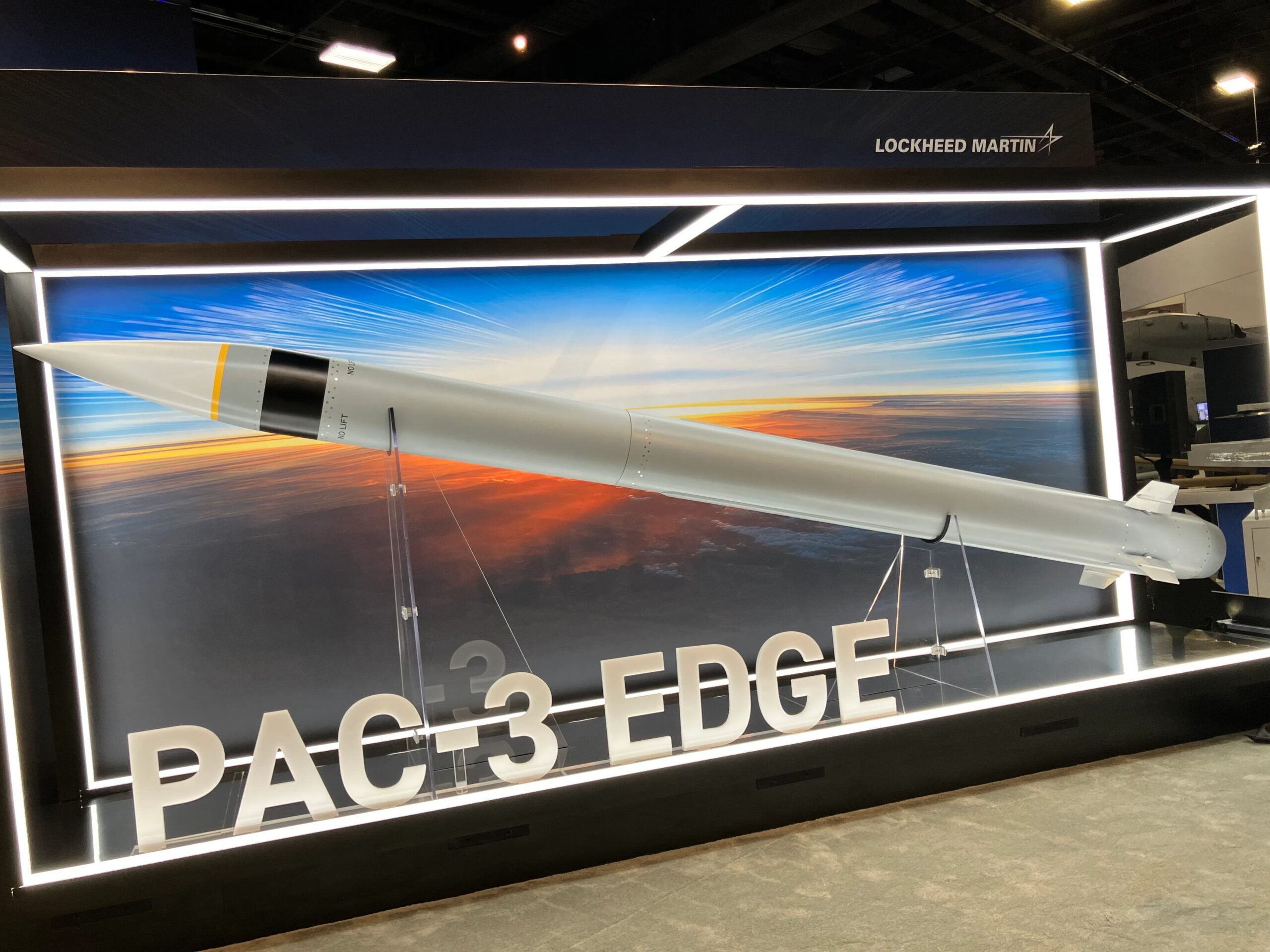
The Patriot system currently has the ability to engage all of the threats listed above, but that capability comes at a cost. The unit price of each PAC-3 MSE interceptor has risen to approximately $5.3 million, according to the Army’s latest proposed budget for the 2027 Fiscal Year. This is up from a historical average of around $4 million for each one of these missiles. These are also exquisite munitions that take years of lead time to produce, something we will come back to later on.

An overview of the PAC-3 MSE, including details about its improved capabilities compared to its predecessors. Lockheed Martin

In 2024, the Army announced that it had axed plans for a new interceptor for Patriot, previously called Lower-Tier Future Interceptor (LTFI), in large part due to projected costs.

“So, right now, the Army has decided that we are not going to move forward on what we were calling a Lower Tier Future Interceptor,” then-Brig. Gen. Lozano said in a live interview with Defense News‘ Jen Judson from the floor of the Association of the U.S. Army’s (AUSA) main annual conference that year. “That was going to be a very expensive endeavor. … Interceptors in that family or class of interceptors are very capable, but also very expensive.”

There had been subsequent signs that a follow-on of some kind to LTFI was in the works. “This year we’re starting a new interceptor program that will have longer range [and] higher altitudes,” Army Lt. Col. Steven Moebes, Product Manager for Lower Tier Interceptors, told Secretary Pete Hegseth during a show-and-tell at the service’s Redstone Arsenal last December, at which media outlets were also present.

War Sec. Pete Hegseth Visits The New Site For U.S. Space Command Headquarters In Huntsville, Alabama thumbnail

War Sec. Pete Hegseth Visits The New Site For U.S. Space Command Headquarters In Huntsville, Alabama


“We want to see if we can bring, from scratch, an interceptor that we can own the IP [intellectual property] for, then go find contract manufacturing,” Secretary of the Army Dan Driscoll also told reporters at the Pentagon just earlier this month, according to The Wall Street Journal.

Driscoll reportedly indicated at that time that the total price point the service was aiming for was $250,000. As mentioned, we now know that this is the cost target for each of the four elements that would combine to form an interceptor costing $1 million or less.

A goal to acquire an anti-air interceptor that is capable of engaging everything from lower-tier air-breathing threats to SRBMs, but does not cost more than $1 million, is still ambitious. It is also in line with Pentagon-wide initiatives to expand the acquisition of lower-cost munitions, including by leveraging new, non-traditional industry partners well beyond established prime defense contractors, and open-architecture approaches. Secretary Driscoll’s mention of Army ownership of the IP also highlights another important aspect of these initiatives, which is aimed at preventing vendor lock, and allows for new competitions to be readily run for AURs and subcomponents.

To reiterate, the new low-cost interceptor is intended to be a supplement to existing options for the Patriot system. At the same time, not all threats require something like a PAC-3 MSE. So, as noted, adding a new relatively cheap alternative to the mix would offer benefits in terms of cost-per-intercept ratio. The price associated with using the system to knock down lower-tier threats, particularly long-range kamikaze drones with unit prices measured in tens or hundreds of thousands of dollars, has become a major talking point in the past decade. Patriot also offers an important layer of defense against shorter-range ballistic missiles in the terminal phases of their flight, which present real threats, as underscored by the latest conflict with Iran, and are increasingly proliferating. As such, being able to provide lower-end terminal ballistic missile defense at a reduced cost point will also be increasingly valuable going forward.

A PAC-3 interceptor seen at the moment of launch. US Military

A new, but still capable interceptor for Patriot that is relatively cheap compared to existing types like the PAC-3 MSE could be beneficial when it comes to stockpile management and supply chains, especially if it is also faster to produce at scale. The recent conflict with Iran and other crises in the Middle East in recent years, along with support to allies and partners, particularly Ukraine, have underscored the need for new steps to ensure sufficient numbers of anti-intercepts and other critical munitions remain in U.S. inventory.

Though the Pentagon has insisted that America’s arsenal is still sufficiently stocked to address current and future contingencies, U.S. officials have openly called attention to the potential impacts of high expenditure rates and the importance of diversifying the industrial base that supplies these weapons. The up-front need for a large stockpile of anti-air and other munitions, and the ability to refill it rapidly, not on a timeline measured in years, would only be even pronounced in any future high-end fight, such as one against China in the Pacific.

When it comes to Patriot, there is a separate, but directly related issue of overall capacity. The Army’s Patriot force continues to be inadequate to meet existing demands, let alone what would be required in a future major conflict against an adversary like the Chinese People’s Liberation Army (PLA).

The Army has been working to expand the total size of its Patriot force, as well as improve the capabilities of the system through the addition of new radars and other functionality. The Pentagon has also reached deals with the PAC-3 MSE’s prime contractor, Lockheed Martin, to ramp up production of those interceptors. The service is now looking toward new containerized launchers for the Patriot system, which could be carried by future uncrewed trucks, as well.

The PATRIOT Missile in Action thumbnail

The PATRIOT Missile in Action


However, many of these developments are still likely years away from fully materializing and are subject to their own supply chain limitations. The Navy is now working to integrate PAC-3 MSE into the Mk 41 Vertical Launch System (VLS), adding a valuable new anti-air interceptor to its sea-based arsenal, but also further increasing demand. Growing U.S. demand around the Patriot, overall, including as a result of heavy use of the system in the latest conflict with Iran, has had second-order impacts on other customers globally.

Altogether, a new lower-cost interceptor for the Patriot system could be an important, if not increasingly essential, addition to the Army’s arsenal. At the same time, whether the service can meet its goal of finding a missile that meets its significant requirements, but still costs less than $1 million, remains to be seen.

Contact the author: joe@twz.com

Joseph has been a member of The War Zone team since early 2017. Prior to that, he was an Associate Editor at War Is Boring, and his byline has appeared in other publications, including Small Arms Review, Small Arms Defense Journal, Reuters, We Are the Mighty, and Task & Purpose.


Source link

Patriot PAC-3 Missiles To Arm Navy Arleigh Burke Class Destroyers

The U.S. Navy has handed Lockheed Martin a formal contract to integrate the Patriot PAC-3 Missile Segment Enhancement (MSE) surface-to-air missile with the Aegis Combat System. The Navy’s main Aegis-equipped ships today are its Arleigh Burke class destroyers. The service is also seeking just over $1.73 billion to order its first-ever tranche of PAC-3 MSEs, 405 in total, as part of its proposed budget for the 2027 Fiscal Year.

The idea of combining PAC-3 MSE and Aegis, as well as the Mk 41 Vertical Launch System (VLS), first emerged in 2023. Since then, TWZ has highlighted how this offers the Navy a valuable alternative source of anti-air interceptors, and maybe even eventually a replacement for the venerable Standard Missile-2 (SM-2).

A rendering of an Arleigh Burke class destroyer firing a PAC-3 MSE missile. Lockheed Martin

Lockheed Martin announced it had received the PAC-3 MSE/Aegis integration contract, said to be a multi-million dollar deal, earlier today, around the Navy League’s annual Sea Air Space exposition, at which TWZ is in attendance. The Navy has separately shared more details about its PAC-3 MSE acquisition plans as part of the full rollout of the Pentagon’s budget request for Fiscal Year 2027, which also occurred today.

Per the Navy’s Fiscal Year 2027 budget request, the service sees PAC-3 MSE integration with Aegis as providing an additional means of intercepting “a wide range of threats, including tactical ballistic missiles, air-breathing threats, cruise missiles, and unmanned aerial systems.” As mentioned, Arleigh Burke class destroyers make up the vast majority of American warships equipped with the Aegis Combat System today. There are also a steadily shrinking number of Ticonderoga class cruisers with this combat system.

PAC-3 MSE has been in full-scale production since 2018. Pairing it with Aegis “has been in the works, I probably think, close to 10 years,” Chandra Marshall, Vice President and General Manager of the Multi-Domain Combat Solutions business unit within Lockheed Martin’s Rotary and Mission Systems division, told our Jamie Hunter on the floor of Sea Air Space. She added that the goal now is for the Navy to achieve initial operational capability (IOC) with this combination in approximately 18 months, or by the end of 2027 if the clock starts now.

A briefing slide offering a general overview of the PAC-3 MSE missile, as well as its improvements over the previous PAC-3 CRI surface-to-air interceptor. Lockheed Martin An overview of the improvements found on the PAC-3 MSE variant over its predecessors, including a “New LE [lethality enhancer].” Lockheed Martin

“So, there’s two pieces of it. So the PAC-3 missile, there’s a small update to it to be able to communicate with S-band radar. So, currently it communicates with X-band [radars]. So, now with this update, it will be able to communicate both with S and X-band,” Marshall explained. “And then we have to integrate PAC-3 as a missile type with the Aegis Combat System.”

“We have a very open architecture [with Aegis], so the way that we componentize everything, we feel like it’s a very short putt for the Aegis integration of the PAC-3 missile,” she added. “So, it’ll just be another missile in the inventory for the Navy to be able to diversify based on the threat.”

You can read more about the Aegis Combat System and how it has evolved to adopt a modular, open architecture approach, specifically to make it easier to add new capabilities and functionality, in this previous TWZ feature. Lockheed Martin has already demonstrated the ability of a modular and scalable version of the system, called the Virtualized Aegis Weapon System, to fire a PAC-3 MSE from a containerized Mk 41-based launcher on land.

Aegis: Capable. Proven. Deployed. thumbnail

Aegis: Capable. Proven. Deployed.


No changes to the Mk 41 VLS – another Lockheed Martin product – are planned or required as part of the PAC-3 MSE integration. Work has been ongoing on adapting the interceptors into launch canisters, allowing them to slot right into existing Mk 41 cells. At just over 17 feet long, PAC-3 MSE should fit in shorter so-called tactical length versions of the Mk 41, as well as one with longer strike-length cells.

A graphic showing existing missiles compatible with tactical and strike-length versions of the Mk 41 VLS. Lockheed Martin A graphic showing various missiles already compatible with the tactical and strike-length versions of the Mk 41. Lockheed Martin

Lockheed Martin has said in the past that each canister will contain a single PAC-3 MSE missile. At around 11 inches wide, the PAC-3 MSE is just over half the maximum diameter available in a Mk 41 cell. This raises the question of whether future canisters could be designed to hold multiple interceptors, which would give ships valuable additional magazine depth.

From a capability standpoint, PAC-3 MSE is generally discussed in comparison to SM-2 surface-to-air missiles in the Navy’s arsenal today. In terms of missiles that can be fired via the Mk 41, SM-2 is a middle-tier anti-air capability that sits between shorter-range RIM-162 Evolved Sea Sparrow Missiles (ESSM; which can also be quad-packed into a single cell) and upper-tier SM-6s and SM-3s. The SM-6 is a multi-purpose weapon that can also be employed against targets on land and at sea. SM-3s, of which there are multiple variants in service today, are specifically designed as anti-ballistic missile interceptors.

“A lot of places the Navy has said ‘I got red or yellow challenges that I can’t deal with.’ This missile does a really good job at that. When you marry them all together, it is very complimentary to SM-6,” Chris Mang, Vice President of Strategy & Business Development at Lockheed Martin’s Missiles and Fire Control, told TWZ at last year’s Sea Air Space conference. “You’d always want a layered defense, right? I’ll pick the longest shot I can get, but then at a certain point, MSE really starts to outperform in certain envelopes.”

An SM-6 seen at the moment of launch. USN

For the Navy, PAC-3 MSE also presents important logistics, cost, and supply chain benefits. The latest conflict with Iran has only underscored now long-standing concerns about U.S. munition expenditure rates, especially when it comes to anti-air interceptors. A large-scale, high-end fight with a near-peer adversary like China would put much more pressure on munition stockpiles and the U.S. industrial base working to restock them. As such, it would be a boon for the Navy to have an additional stream of interceptors to arm its warships.

As noted, the Navy is already moving to buy hundreds of what documents currently refer to as the “PAC-3 MSE / Navy” missile, as well as launch canisters. The service’s Fiscal Year 2027 budget request puts the unit cost for each missile at $4.05 million. The canister adds another $200,000 to the price tag. The Army’s Fiscal Year 2027 proposed budget says the unit cost for standard PAC-3 MSEs has risen now to $5.3 million. The exact reasons for the cost discrepancy between the Army and Navy versions are unclear.

A PAC-3 MSE missile seen being fired from a ground-based launcher. US military A Patriot launcher fires a newer PAC-3-series missile during a test. DoD

“Both quantities and unit cost are estimates based on U.S. Army contract pricing. Both quantities and unit cost will adjust based on award of DoN CLINs [Department of Navy Contract Line Item Numbers] on ARMY contract in execution and final cost of the Navy components (radio, canister, etc),” per the Navy’s latest budget request.

At $4.05 million, the Navy’s PAC-3 MSEs will be slightly cheaper per missile than the Block IA version of the SM-6. The service’s latest budget request puts the unit cost of the latter missiles at $4.348 million. The cost of a current-generation Block IIICU variant of the SM-2 is unclear, given that they have often been procured as upgrades of existing Block IIICs rather than new-production missiles. Historically, the average price point for an SM-3 Block IIIC has been around $3.6 million.

“By leveraging the high-volume Army PAC-3 MSE production contract, the Navy achieves significant cost avoidance through economies of scale, as unit price decreases with larger quantities,” the Navy’s latest budget documents also note.

Lockheed Martin announced in January that it had reached an agreement with the U.S. government to ramp up annual PAC-3 MSE production, for domestic and foreign customers, from 600 to 2,000 missiles. Last week, the company received a contract to help further accelerate production of these missiles. This could all help drive down the unit cost of the missiles going forward, as well as speed up their delivery.

Lockheed Martin Receives Contract to Accelerate PAC-3® MSE Production thumbnail

Lockheed Martin Receives Contract to Accelerate PAC-3® MSE Production


It is worth pointing out here that PAC-3 MSE’s performance in the Middle East, as well as in Ukraine in recent years, has also prompted a significant increase in demand from the U.S. Army, as well as foreign Patriot operators. The overall Patriot user base is also expanding.

Adding the Navy to the mix will add to that demand, even with the production ramp-up, and could add to already growing concerns about production backlogs now. Integrating PAC-3 with Aegis and the Mk 41 VLS could also spur additional interest from other navies globally that have ships with that combat system and/or launchers.

Reuters reported just last week that U.S. officials had informed allies and partners in Europe that deliveries of unspecified munitions could now be delayed due to American needs in relation to the war with Iran. When it comes to PAC-3 MSE, the budget documents the Army released today, at least, do not appear to show any changes to the delivery schedule for foreign customers.

🇺🇸 Is the US re-sequencing scheduled PAC-3 MSE deliveries away from FMS customers to the US Army’s inventory?

The J-books say no. In fact, FMS customers are scheduled to receive the majority of production.

Delivery schedule unchanged from last year. Only 252 missiles from… pic.twitter.com/iZdXlAYQ82

— Colby Badhwar (@ColbyBadhwar) April 21, 2026

Regardless of any of these issues, the Navy is now pushing full steam ahead on integrating PAC-3 MSE with Aegis and the Mk 41 VLS.

Jamie Hunter contributed to this story.

Contact the author: joe@twz.com

Joseph has been a member of The War Zone team since early 2017. Prior to that, he was an Associate Editor at War Is Boring, and his byline has appeared in other publications, including Small Arms Review, Small Arms Defense Journal, Reuters, We Are the Mighty, and Task & Purpose.


Source link

On This Day, April 18: Patriot Paul Revere begins midnight ride

1 of 5 | On April 18, 1775, U.S. patriot Paul Revere began his famous ride through the Massachusetts countryside, crying out “The British are coming!” to rally the minutemen. File Image courtesy of the Library of Congress

April 18 (UPI) — On this date in history:

In 1506, the cornerstone was placed for St. Peter’s Basilica in Rome.

In 1775, U.S. patriot Paul Revere began his famous ride through the Massachusetts countryside, crying out “The British are coming!” to rally the minutemen.

In 1906, an earthquake estimated at magnitude-7.8 struck San Francisco, collapsing buildings and igniting fires that destroyed much of what remained of the city. Researchers and historians concluded that about 3,000 people died in the quake and its aftermath, and roughly 250,000 were left homeless.

In 1912, three days after the sinking of Titanic, her survivors arrived in New York City aboard the RMS Carpathia.

In 1923, the original Yankee Stadium opened in New York. The stadium was demolished in 2010 after it was replaced a year prior by the new Yankee Stadium.

File Photo by Monika Graff/UPI

In 1942, Lt. Col. James Doolittle led a squadron of B-25 bombers in a surprise raid against Tokyo in response to the Japanese sneak attack on Pearl Harbor on Dec. 7, 1941.

In 1945, U.S. journalist Ernie Pyle, a popular World War II correspondent, was killed by Japanese machine-gun fire on the island of Ie Shima in the Pacific.

In 1949, the Republic of Ireland formally declared itself independent from Britain.

In 1968, McCulloch Oil Corp. paid $2.24 million to buy London Bridge, which was sinking into the Thames under the weight of 20th century traffic. The oil company rebuilt the bridge bloc by block over Lake Havasu in Arizona.

In 1980, Rhodesia became the independent African nation of Zimbabwe.

In 1983, the U.S. Embassy in Beirut, Lebanon, was severely damaged by a car-bomb explosion that killed 63 people, including 17 Americans.

In 1992, an 11-year-old Florida boy sued to “divorce” his natural parents and remain with his foster parents. The boy eventually won his lawsuit.

In 2002, former U.S. Sen. Bob Kerrey, D-Neb., revealed that at least 13 civilians were killed by his U.S. Navy unit in a Vietnamese village in 1969.

File Photo by Ezio Petersen/UPI

In 2007, more than 125 people were killed in a suicide car-bomb explosion near a Baghdad market.

In 2014, an avalanche on what is known as a particularly dangerous route to the top of Mount Everest in the Himalayas killed 16 Sherpa guides.

In 2018, the first movie theaters in Saudi Arabia opened with a public screening of Black Panther.

In 2024, police arrested more than 100 protesters at Columbia University for refusing to leave a large pro-Palestinian encampment on campus. The incident sparked more protests at the school and other campuses across the country.

File Photo by John Angelillo/UPI

Source link