parliamentary

Russia’s parliamentary election: Who’s on the ballot, and why it matters | Elections News

Russians head to the polls from Friday to Sunday to elect members of the State Duma, the lower house of Russia’s parliament, in the first parliamentary election to be held since the country launched its full-scale invasion of Ukraine in 2022.

The vote comes as Russians face a slowing economy as well as Ukrainian drone strikes on refineries and warehouses far from the front line.

United Russia, the governing party that backs President Vladimir Putin, is expected to keep its dominant position.

The authorities are presenting the election as a chance for voters to have their say. Critics argue that with no genuine opposition on the ballot, the result is largely settled in advance.

So why are the elections worth watching? Here is what you need to know:

How do Russia’s elections work?

Starting Friday and lasting through Sunday, Russians will elect members of the lower house, the State Duma.

They will also cast ballots in local elections.

Voters in 11 regions will elect their governors, and 39 regions will elect members of regional legislatures.

Voting is spread over three days to boost turnout among the 111 million eligible voters and includes areas Russia occupies in Ukraine. Electronic voting is allowed.

Half of the Duma’s 450 seats are filled by party lists and the other half are contested in single-ballot races.

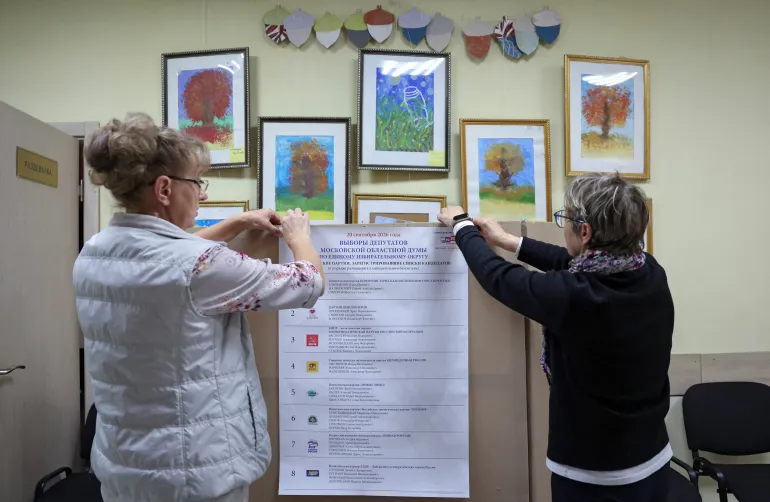
Election officials hang a list of political parties at a polling station ahead of the parliamentary elections in Podolsk, Moscow region, Russia, September 17, 2026. REUTERS/Ramil Sitdikov
Election officials hang a list of political parties at a polling station before the parliamentary elections in Podolsk, Moscow region [Ramil Sitdikov/Reuters]

What is United Russia?

Russia’s governing party, formed in 2001 from a merger of pro-Kremlin parties, has backed Putin and dominated the parliament ever since.

United Russia won more than two-thirds of the Duma’s seats in the 2021 election. It is again poised to dominate the body.

The party’s list is led by political heavyweights: Foreign Minister Sergey Lavrov, Russia’s top diplomat for 22 years, and Sergei Sobyanin, Moscow’s powerful mayor.

In an apparent bid to add fresh faces to what is widely seen as a party of bureaucrats, its third-highest-ranking official is war correspondent Yevgeny Poddubny, who was badly wounded by a Ukrainian drone.

Members of United Russia have pledged to back the war effort and Putin’s maximalist goals in what the Kremlin calls the “special military operation” in Ukraine.

epa13243927 Deputy Chairman of the Russian Security Council and leader of the United Russia political party Dmitry Medvedev holds a meeting with secretaries of the party's regional branches via videoconference at the Gorki state residence outside Moscow, Russia, 16 September 2026. Russia will elect the new State Duma, the lower house of parliament, during unified voting day, on September 18-20. EPA/EKATERINA SHTUKINA / SPUTNIK / GOVERNMENT PRESS SERVICE / POOL MANDATORY CREDIT
Deputy Chairman of the Russian Security Council and leader of the United Russia political party Dmitry Medvedev [Ekaterina Shtukina/Sputnik/Government press office/EPA]

Who else is running in Russia’s elections?

Alongside United Russia, other “systemic opposition” parties that vote in sync with the government on key issues are also expected to remain.

The liberal Yabloko Party, the only registered political party that opposes the war, was initially on the ballot, but the Supreme Court ordered it removed in August.

It cited, among other reasons, that the antiwar stance was akin to seeking the violation of Russia’s territorial integrity. Yabloko now runs only single-ballot races.

The Communist Party has been a leading force in the Federal Assembly since the 1990s, led for more than three decades by 82-year-old Gennady Zyuganov, a former Soviet official.

Throughout Putin’s rule of more than a quarter-century, the Communists have criticised some aspects of government policy but carefully avoided any criticism of him. They steadfastly support the war in Ukraine.

Alexander Bratersky, a political analyst and independent journalist, told Al Jazeera that the race for second place is worth watching.

If the Communist Party nab second, it would “suggest voters are angry about economic hardship and falling living standards”.

epa13243911 Russian Communist Party (CPRF) leader Gennady Zyuganov (C) and Deputy Chairman Dmitry Novikov (2-R) take part at the ‘Reds in the City’ all-Russian patriotic rally organized by the Communist Party of the Russian Federation (KPRF), ahead of parliamentary elections, in downtown of Moscow, Russia, 16 September 2026. Russia will elect the new State Duma, lower house of parliament, during unified voting gay, on September 18-20. EPA/MAXIM SHIPENKOV
Russian Communist Party leader Gennady Zyuganov, centre, and Deputy Chairman Dmitry Novikov, second right, take part at the ‘Reds in the City’ all-Russian patriotic rally [Maxim Shipenkov/EPA]

The Liberal Democratic Party, an ultranationalist force that has been a significant presence in the legislature since the early 1990s, will also likely retain some influence in the Duma.

Like the Communists, it staunchly supports the war and boasts of having multiple veterans as members.

Other smaller parties round out the ballot.

The party known as A Just Russia has been on Russia’s political scene for 20 years. A social-democratic party, it competes with the Communists for older and middle-aged voters nostalgic for the Soviet past, and it supports the war in Ukraine.

The New People Party was founded shortly before the last parliamentary election in 2021, seeking to position itself as a liberal voice representing younger voters and technocrats. It won just more than 5 percent of the vote, allowing it to form a small faction.

Bratersky described the party as “a liberal-leaning party backed by some Kremlin people who are more technocratic and more pro-peace”.

He said it appeals to the “middle-class audience”, and after the Kremlin banned Yabloko, it has been viewed as its substitute.

“So, if they come third with a good number of votes, this is a sign that those who are antiwar used them as their legal avatar,” he said.

Other parties seeking seats include Communists of Russia, a small rival of the main Communist Party; the Party of Pensioners; the Green Party; the Party of Direct Democracy; and the Motherland Party.

Polina Lermant, 24, a candidate for Russia's liberal Yabloko party running in a single-mandate constituency in the upcoming parliamentary election, hands out flyers to passers-by on a street in Moscow, Russia, September 3, 2026. REUTERS/Yulia Morozova
A candidate for Russia’s liberal Yabloko party running in a single-mandate constituency in the upcoming parliamentary election, hands out flyers to passers-by on a street in Moscow, Russia [File: Yulia Morozova/Reuters]

Why do the elections matter to the Kremlin?

While these elections may seem routine, the fact that they are the first since Russia’s full-scale invasion of Ukraine is what makes them important, Bratersky told Al Jazeera.

He said that Putin has linked the elections to support for the war: Endorsing United Russia at its party congress in August, Putin said the party’s duty was “to do everything for victory” in the war in Ukraine.

“This shows that the Kremlin is a bit worried since the elections are the only legal way to show disrespect for the Kremlin,” Bratersky said. “Even Putin’s core fans hate United Russia as a corrupt force.”

How have past elections gone?

Since Putin first came to power in 2000, United Russia has won every Duma election, usually by a wide margin.

The results have repeatedly been disputed.

In 2011, allegations of vote-rigging set off the largest street protests of Putin’s rule.

After the 2021 vote, independent monitors and statisticians said the party’s real support was far lower than the official count.

The authorities have rejected claims of widespread fraud. Opposition parties and critics of the war have increasingly been kept off the ballot.
Source link

​Bangsamoro’s parliamentary election is a turning point | Elections

On Monday, the Bangsamoro Autonomous Region in Muslim Mindanao (BARMM) in the Philippines will hold its first parliamentary election since it was established in 2018. The vote will officially mark the end of the transition period under the Bangsamoro Transition Authority (BTA), an interim regional government appointed in 2019.

The election is a significant milestone in the Bangsamoro struggle. It is the outcome of decades of armed conflict and negotiations between the Moro Islamic Liberation Front (MILF) and the government of the Philippines.

The vote will test the Philippine government’s commitment to the peace process and the MILF’s commitment to the democratic process.

The struggle for self-determination

BARMM is located on Mindanao, the second-largest island in the Philippine Archipelago, and it covers roughly the territories inhabited by the Moro people, a native Muslim-majority group. For centuries, the Moro enjoyed self-governance in independent states and resisted Spanish colonialism. Following the Philippines’s independence in 1946, they continued their struggle for self-determination.

In 1989, the Autonomous Region in Muslim Mindanao (ARMM) was created by Manila to give some devolved rights to the Moro. However, ARMM largely failed to address local grievances and demands due to its weak structural power. It was given limited autonomy in political and fiscal decision-making, but it did not manage to improve socioeconomic conditions in the region. The MILF continued the armed struggle.

In 2012, President Benigno Aquino III recognised the ARMM as a “failed experiment”. Under his administration, the Framework Agreement on the Bangsamoro was signed between the government and the MILF, paving the way for a new political entity.

Six years later, under President Rodrigo Roa Duterte, the Organic Law for the Bangsamoro Autonomous Region in Muslim Mindanao was promulgated. This legislation granted the region greater fiscal autonomy, a regional government, a parliament, and a justice system.

Then the Comprehensive Agreement on the Bangsamoro was concluded to outline the mechanism of transition from ARMM to BARMM and set up the MILF-dominated BTA to lead it. All of this is culminating in the parliamentary election, which will determine the makeup of the region’s first legislative body.

A contested election

The vote comes at a time of heightened tensions in BARMM and internal divisions within the MILF. Two camps have emerged within the movement – one loyal to MILF Chair Al Haj Murad Ebrahim and another supporting Chief Minister Abdulraof Macacua.

Last month, Macacua joined the newly formed Bangsamoro Federalist Party (BFP), which will compete in the elections against the MILF’s political wing, the United Bangsamoro Justice Party (UBJP). Shortly after, his convoy was attacked, but he survived unscathed.

In early September, Macacua and 40 commanders were dismissed from the MILF’s military wing for alleged insubordination.

These tensions have prompted increased public anxiety about possible post-election unrest. There are other factors that could overshadow the vote.

In past elections, vote-buying was widespread, election-related violence was rampant, and electoral fraud and manipulation were pervasive. If these practices repeat at a large scale, the electoral outcome may not necessarily provide a straightforward measure of the will of Bangsamoro’s people. It may also not be an accurate reflection of whether they are satisfied with the transitional government or not.

The MILF presents itself as a champion of moral governance. If it is to retain this label, it should not give in to widespread vote-buying and electoral manipulation. It should also not let internal rivalries turn violent.

But there are already some alarming signs. Prominent MILF figures have conveyed that if the UBJP, the front’s political wing, sees manipulation and fraud, its members are ready to fight. They have also suggested that since the MILF led the transition, it should remain in power. On social media, some citizens have condemned the MILF camp’s threats, calling such tactics un-Islamic.

Before the vote, Manila has deployed military forces in key areas. This has heightened people’s fears that fighting with the MILF may erupt. The tense situation might lead to a low voter turnout.

Under these circumstances, the future of the Bangsamoro is riddled with uncertainties.

Whatever happens in the election, we must remember that the future of BARMM is a shared responsibility. The Philippine government and the Bangsamoro parties are duty-bound to honour the peace agreement. In addition, the people must exercise their civic rights and responsibilities to help sustain the peace achieved after a long and painful armed conflict and to move toward a prosperous Bangsamoro land.

The views expressed in this article are the author’s own and do not necessarily reflect Al Jazeera’s editorial stance.

Source link

Kazakhstan holds parliamentary election expected to cement president’s grip | Elections News

Only state-approved parties loyal to President Tokayev permitted to take part amid a sweeping constitutional overhaul.

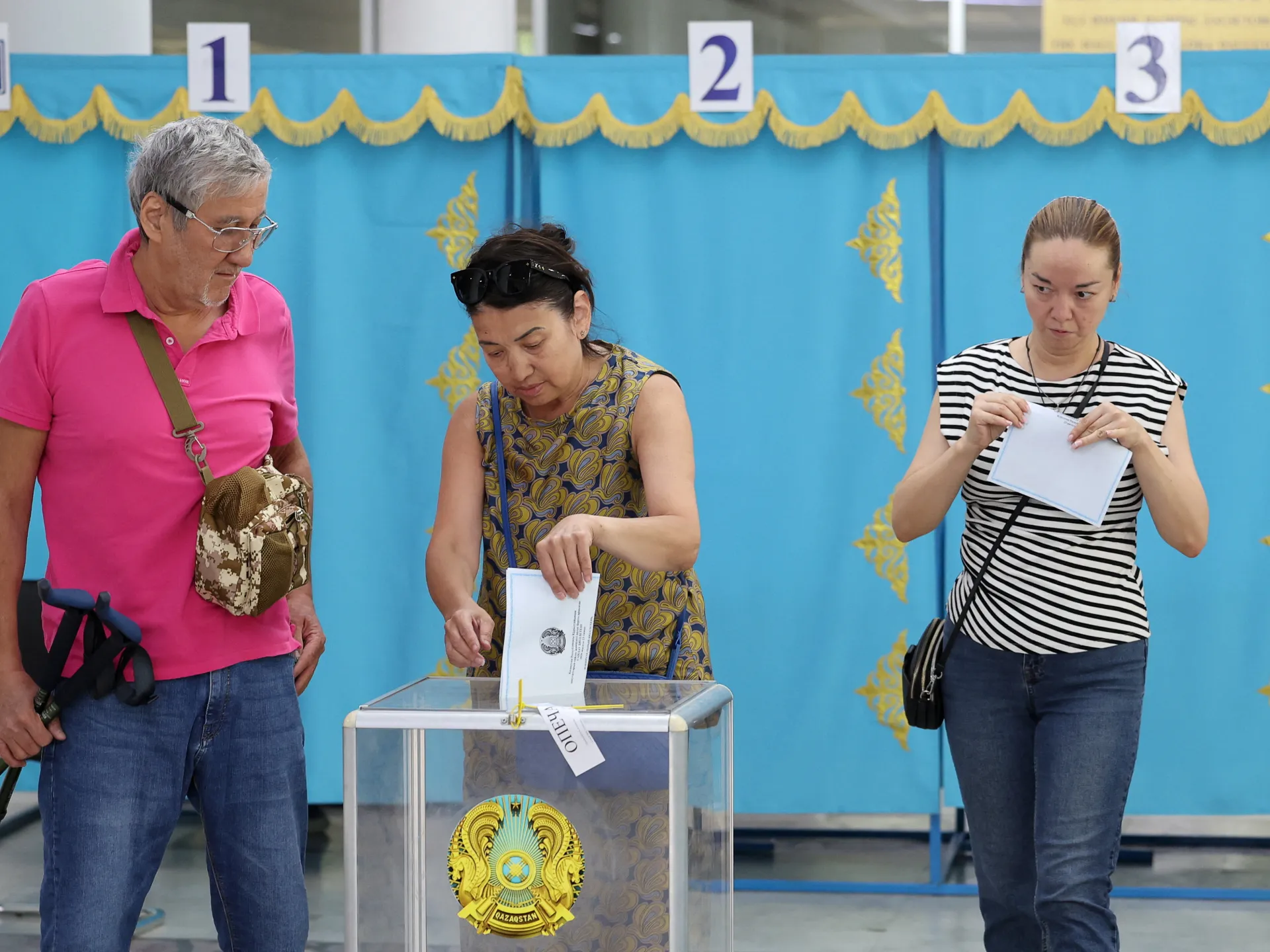
Voters are heading to the polls in Kazakhstan’s snap parliamentary election, which critics say will strengthen the power of the president.

Polling stations opened at 7am local time (02:00 GMT) and are scheduled to close at 8pm (15:00 GMT). More than 12 million of Kazakhstan’s 20 million people are eligible to vote.

Recommended Stories

list of 4 itemsend of list

The election will usher in a new 145-member unicameral legislature that is expected to be dominated by supporters of President Kassym-Jomart Tokayev, who has led the Central Asian country since 2019.

Constitutional overhauls earlier this year abolished Kazakhstan’s upper house in favour of a one-body parliament. Officials claim the change will give parliament more weight in political decision-making, having previously been confined to a mostly auxiliary role.

However, only seven state-approved parties, all loyal to Tokayev, have been allowed to put forth candidates.

The constitutional changes also reset term limits to allow Tokayev to run again in 2029.

The 73-year-old was the chosen successor of longtime leader Nursultan Nazarbayev, who ruled for almost 30 years from the 1990s. But he broke with his predecessor amid cost-of-living protests in 2022 that led to the deaths of 238 people, and has since touted a reform agenda called “Just Kazakhstan”.

A former Soviet state, Kazakhstan balances relations with China, Europe and Russia, with Tokayev navigating recent tensions over Moscow’s war with Ukraine.

Kazakhstan is oil-rich and makes up about 2 percent of daily world supply, mostly exporting to European countries through the Caspian Pipeline Consortium to Russia’s port of Novorossiysk.

Source link