park city

Our 9 favorite movies at Sundance, plus some personal memories of Park City

p]:text-cms-story-body-color-text clearfix”>

This year’s Sundance felt marked by great uncertainty. Personally, I was never quite sure how to feel, as the many unknowns of next year’s move to Boulder meant that it was unclear how much this year was supposed to feel like the end of something or the start of a new beginning. I didn’t know just how mournful to be, though, as the festival marched along, it became clear there was a space for nostalgic reflections.

The first movie I ever saw at Sundance was Andrew Fleming’s comedy “Hamlet 2” in the Library Center Theatre. Which means it was 2008 and I was then an intrepid freelancer who talked my way into sleeping on a recliner at a condo rented by The Times until staffers trickled out and I eventually had the place to myself because of the vagaries of an extended rental agreement. Which is how I found myself, entirely unexpectedly, in a room interviewing all of Crosby, Stills, Nash and Young, who were in town for their tour documentary “CSNY/Déjà Vu.”

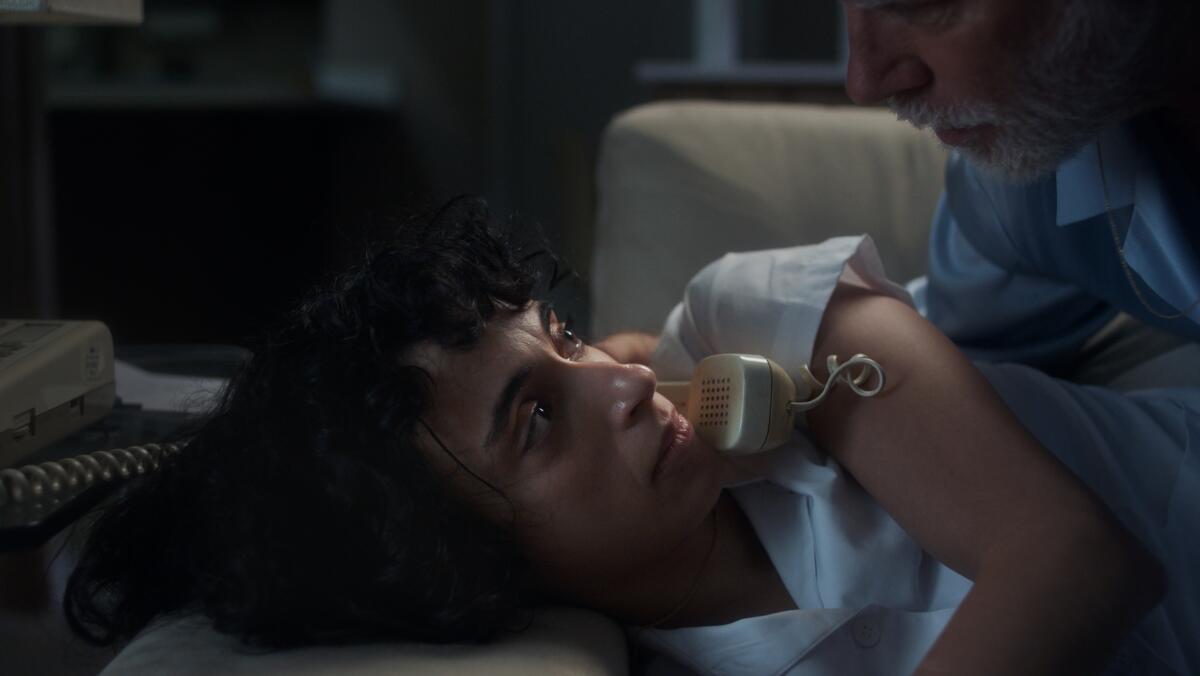
That sense of surprise and discovery — and in-person interactions that likely wouldn’t happen anywhere else — are what have brought me back to the festival every year I could manage since. It’s exactly why I have been a huge fan of the festival’s NEXT section, made up of films that don’t quite fit elsewhere in the program. A standout this year was Georgia Bernstein’s debut feature, “Night Nurse,” a film of assured poise about a young woman (a compelling Cemre Paskoy) who takes a job at a retirement home only to find herself drawn into a series of phone scams, erotic role play and psychosexual transference with one the clients. Recommending the film to colleagues feels a little like an HR violation, but the kinky undercurrents and unsettling emotions are worth it.

A woman on the phone is seen by another person.

Cemre Paksoy and Bruce McKenzie in the movie “Night Nurse.”

(Lidia Nikonova / Sundance Institute)

Many conversations around the festival seemed to firmly center on “The Invite” and “Josephine,” but another film people consistently brought up was “Wicker.” Written and directed by Eleanor Wilson and Alex Huston Fischer, adapting a short story by Ursula Wills-Jones, the film takes place in an unspecified time and place: a sort of medieval-ish middle European village of the mind, in which an unmarried woman (Olivia Colman) asks a local basket weaver (Peter Dinklage) to make her a husband. That he comes out looking like Alexander Skarsgård sets the whole town into a tizzy. Nimble and inventive, with convincing special effects work, the film is a charming parable that continually finds ways to reset itself.

It is unclear just how planned it was, but there could have been no better film than “The Only Living Pickpocket in New York” to be the final fiction feature to debut in the Eccles Theatre, one of the festival’s most storied venues. Character actor Noah Segan’s directorial debut, the movie is a warmly elegiac portrait of the city and the pain of recognizing when your time has passed. Led by a quietly commanding lead performance by John Turturro, the film also features Steve Buscemi and Giancarlo Esposito in supporting roles.

As the trio took the stage with Segan and other cast members after the film, it quickly became apparent how special it was to have those three actors there in that moment. Buscemi rattled off a quietly astounding number of films he has appeared in with “New York” in the title — “New York Stories,” “Slaves of New York,” “King of New York” — while Turturro spoke movingly about his relationship with Robert Redford, whose absence hung heavy over the entire festival.

A man in a trenchcoat walks on a New York street in Chinatown.

John Turturro in the move “The Only Living Pickpocket in New York.”

(MRC II Distribution Co. L.P. / Sundance Institute)

As Esposito began talking about what Sundance has meant to him over the years, his words took on a fierce momentum. He recalled when he first came to the festival in the ’90s, he was “ecstatic because it gave a voice to those who didn’t have a voice. … We didn’t come to sell a film to a big studio. We came to share our small movie with human beings that could really see themselves in a mirror on the screen.”

Of Redford, he added, “His vision is priceless. It’s the gem that we all hope for. It’s the juice of why we live. It’s the connection of why this movie works. It’s the love of what we do. This, to me, will stick with me for the rest of my life. My interactions with this man who started this festival will always be a beacon of light in my creative process.”

It was a beautiful and inspiring way to leave that theater for the last time and, in turn, leave Park City behind for a future that, while full of unknowns, will for now also hold the promise of new discoveries to come.

Source link

Why Sundance is the best launchpad for Oscar documentaries

As the Sundance Film Festival winds down its final edition in Park City, Utah, this week, ahead of its move to Boulder, Colo., next year, its sway over the nonfiction field at the Oscars remains as steady as ever. All five current Academy Award nominees for documentary feature premiered at last year’s festival, with Sundance films winning the category six times over the last decade.

“Sundance has been a kick-starter for my entire career,” says Ryan White, director of “Come See Me in the Good Light,” his fourth film to premiere at the festival. The intimate portrait of Colorado poet laureate Andrea Gibson, who faces a terminal diagnosis with a spirit of resilience, needed the boost. “The lead words are poetry and cancer, and it’s a character-driven film about a non-binary person,” White says. “It wasn’t the easiest film to get off the ground.” A similar challenge could apply to other nominees, including “Mr. Nobody vs. Putin” and “Cutting Through Rocks,” which focus on everyday individuals taking on oppressive systems in Russia and Iran, respectively. “There are the types of films that can get lost because they’re not about a celebrity, and they don’t have these marquee descriptors. Sundance does such an amazing job of discovering these diamonds.”

Andrea Gibson, left, and Megan Falley in “Come See Me in the Good Light.”

Andrea Gibson, left, and Megan Falley in “Come See Me in the Good Light.”

The exposure at the start of the film festival season “gives you that one-year runway that allows you to play festivals all year long,” says White, who was back at Sundance to celebrate the end of an era. He also knows the pain of not making the cut. “My first two films didn’t get into Sundance, and then my third one did. I’m always telling young filmmakers to use the Sundance rejection as fuel.”

A festival berth was strong motivation for “Mr. Nobody” filmmaker David Borenstein, who collaborated with his subject, a schoolteacher near the Ural Mountains named Pavel (“Pasha”) Talankin, as he quietly documented Russian propaganda efforts to rally his young students around the war in Ukraine. “That was the goal the entire time making this film,” says the director, an American based in Copenhagen. “I never thought once about anything after Sundance.” When the Danish Film Institute submitted his film as the country’s entry for the international feature Oscar, he had a new goal. “We were the last to start campaigning because we didn’t have a streamer behind us.”

Borenstein interrupted a family vacation in the Dominican Republic to return to Sundance for meetings and figure out next steps. “Forget winning or losing,” he says. “You have six weeks where you have a voice, where Pasha has a voice. How do you use it?” Talankin, who fled his home — first for Turkey, then the Czech Republic — is, for the moment, no longer “Mr. Nobody,” but as Borenstein notes, “He sacrificed his whole life to do this.”

Iranian American filmmakers Mohammadreza Eyni and Sara Khaki were well into the eight-year production of “Cutting Through Rocks” when they became recipients of a 2020 Sundance Documentary Fund grant. “The timing was perfect and we really, really, really needed that support,” says Khaki, joining Eyni on a video conversation from Park City, where their film won the Grand Jury Prize in the world cinema category last year. “Sundance is something beyond only the festival for us,” Eyni says. “It’s more about persistence as a filmmaker and the cinematic approach to the stories and sense of community.”

“Cutting Through Rocks” follows Sara Shahverdi, the first woman elected to the council of her northwestern Iranian village, as she challenges the practice of child marriage and other patriarchal norms and empowers young women by showing them how to ride motorbikes, as she does herself. The message of resistance feels relevant worldwide, but most urgently in Iran, where estimates of deaths during recent protests top 30,000 people. “We want small stories and anecdotes to remind us that we can bring change,” Eyni says, “even when it’s tough, even when it seems impossible.” Although the film is the first documentary from Iran to be nominated for an Oscar, the news has been hard to share there because of the government’s weeks-long internet blackout.

“We are experiencing a lot of complex emotions,” Eyni says.

Sara Shahverdi, the subject of Oscar-nominated documentary feature "Cutting Through Rocks."

Sara Shahverdi, the subject of Oscar-nominated documentary feature “Cutting Through Rocks.”

(Gandom Films)

Sundance thrives on exactly those kinds of feelings. The dramatic premiere of “Come See Me in the Good Light” was, for its filmmaker, “The best night of my entire career.” What began as a film about the end of Gibson’s life quickly became a story about the joy of a life well-lived, experienced alongside the charismatic subject’s wife, poet Megan Falley. When White broke the news about the film’s acceptance, “Andrea was so emotional saying, ‘You’re telling me if I survive for six more weeks, I might see this movie?’” he recalls. And they did.

“I think people fell in love with Andrea during the course of that film, but they probably assumed that Andrea had passed away, and they were about to see a card at the end of the film,” White continues. Then Gibson walked up. “It was like a rock star rising from the ashes. You could literally feel the theater vibrating.”

Source link