padres

Brewers eliminate Padres, will face Dodgers in NLCS

Garrett Mitchell tripled and scored the tiebreaking run in the fifth inning before making a pivotal catch on Manny Machado’s drive to the wall in the eighth, and the Milwaukee Brewers advanced to the National League Championship Series for the second straight season with a 3-1 victory over the San Diego Padres on Wednesday night, winning their best-of-five Division Series in four games.

Mitchell also drove in Sal Frelick with Milwaukee’s first run as the Brewers ended their 12-game postseason road losing streak and reached the team’s fifth League Championship Series.

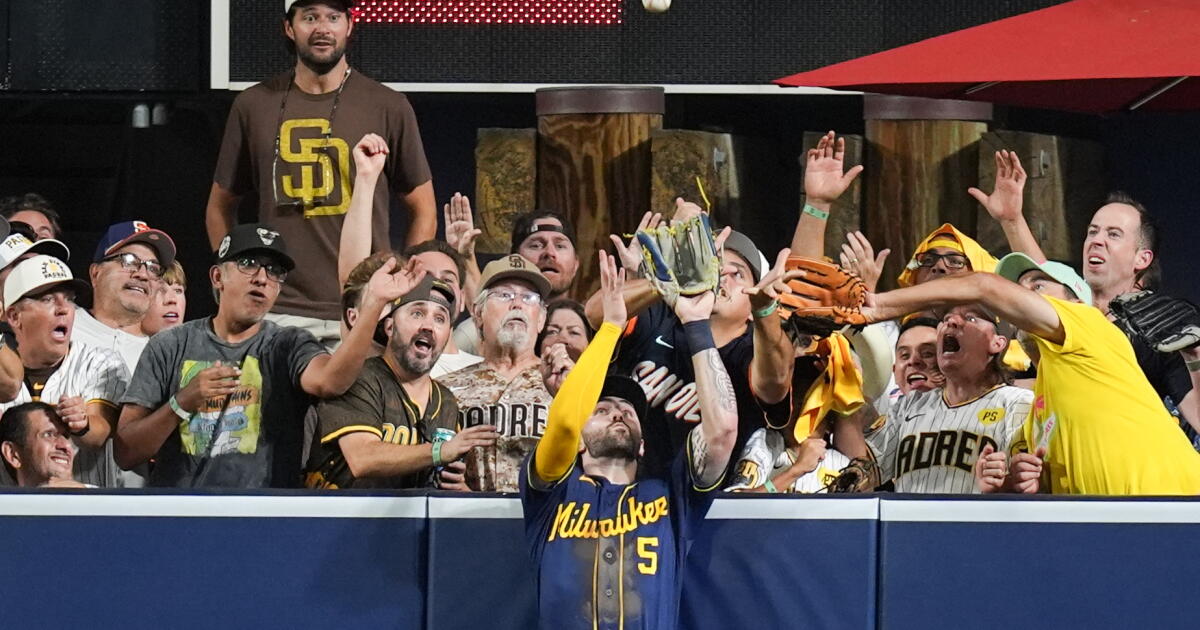
Machado nearly tied Game 4 with a 406-foot drive off reliever Abner Uribe, but Mitchell coolly tracked it down and reached just above the short wall in right-center to keep it in the yard.

Second baseman Brice Turang then ended the eighth with an acrobatic catch of Ty France’s tailing popup in foul ground.

After fending off the surging Padres in four tight games decided by a combined five runs, the 103-win Brewers will get an NLCS rematch with the Dodgers, who eliminated Atlanta on Wednesday.

The Dodgers swept Milwaukee last October on the way to their second consecutive World Series title.

Fernando Tatis Jr. hit a 429-foot homer on an otherwise tepid offensive night for the Padres, who repeatedly tested the majors’ best regular-season team before falling short of only the fourth NLCS appearance in team history.

One night after the Padres avoided elimination in Game 3, Milwaukee claimed its first road playoff win since the 2018 NLCS by sticking to its season-long formula for success.

While four Brewers pitchers combined on a three-hitter and the defense made nearly every big play, Milwaukee’s lineup calmly worked counts, pounded 10 hits through the Padres’ defense and manufactured enough runs to head home smiling.

Game 2 hero Jackson Chourio capped his high-impact series by driving in Mitchell to become the Brewers’ career leader in postseason RBIs at just 22 years old. Chourio has 17 RBIs, including six in this series, in 16 playoff games.

Milwaukee opened the scoring in the third when Frelick reached on an infield single, stole second and came around on a single by Mitchell, an Orange County native and UCLA product.

Brewers starter and former Padres draft pick Robert Gasser threw four innings of three-hit ball, but Tatis ended his 1-for-19 skid since San Diego’s playoff opener with a long shot to center in the third. It was the longest homer ever hit in the postseason at Petco Park by a San Diego player.

Padres starter Walker Buehler yielded just three hits and a run, but manager Craig Stammen replaced him with Game 1 starter Robbie Ray after William Contreras’ leadoff single in the fourth.

Mitchell then stroked a mild liner perfectly over first base and into the right-field corner leading off the fifth, and he scored on Chourio’s single through the drawn-in infield. Chourio surpassed Ryan Braun for the most postseason RBIs in Brewers history.

Jake Bauers singled leading off the sixth and went to third on Cooper Pratt’s ground-rule double before scoring on Frelick’s sacrifice fly.

The Padres were already down 3-1 in the seventh when Mason Miller allowed three baserunners, but no runs. The vaunted closer missed Game 3 for the birth of his first child.

After sitting below .500 and in 11th place in the NL in late July, San Diego roared into the first wild-card spot and then swept the Cubs in the wild-card series last week. The Padres had won 19 of 22 before losing three of four to Milwaukee.
Source link

Legendary Angels and Padres scout Bob Fontaine Jr. dies at 73

The baseball world was captivated by left-handed pitching prospect Jim Abbott ahead of the 1988 major league draft mostly because he didn’t have a right hand. Seven teams passed on him before the Angels picked him.

Why? Largely because Angels scouting director Bob Fontaine Jr. ignored the potential limitations that others fixated on when evaluating Abbott. Rather than dwelling on the absence of a right hand, Fontaine saw something wondrous coming out of Abbott’s left hand — a cut fastball.

“He’s actually more suited to the pro game than the amateurs with the aluminum bats,” Fontaine told The Times after the draft. “He’s going to be breaking off a lot of these wood bats with that cut fastball.”

As usual, Fontaine, who died Saturday at age 73, was prophetic in his assessment. Abbott became the rare pitcher to go straight from college — he’d starred at Michigan — to the major leagues, skipping the minors entirely and enjoying a 10-year MLB career while inspiring numerous fans in disabled communities.

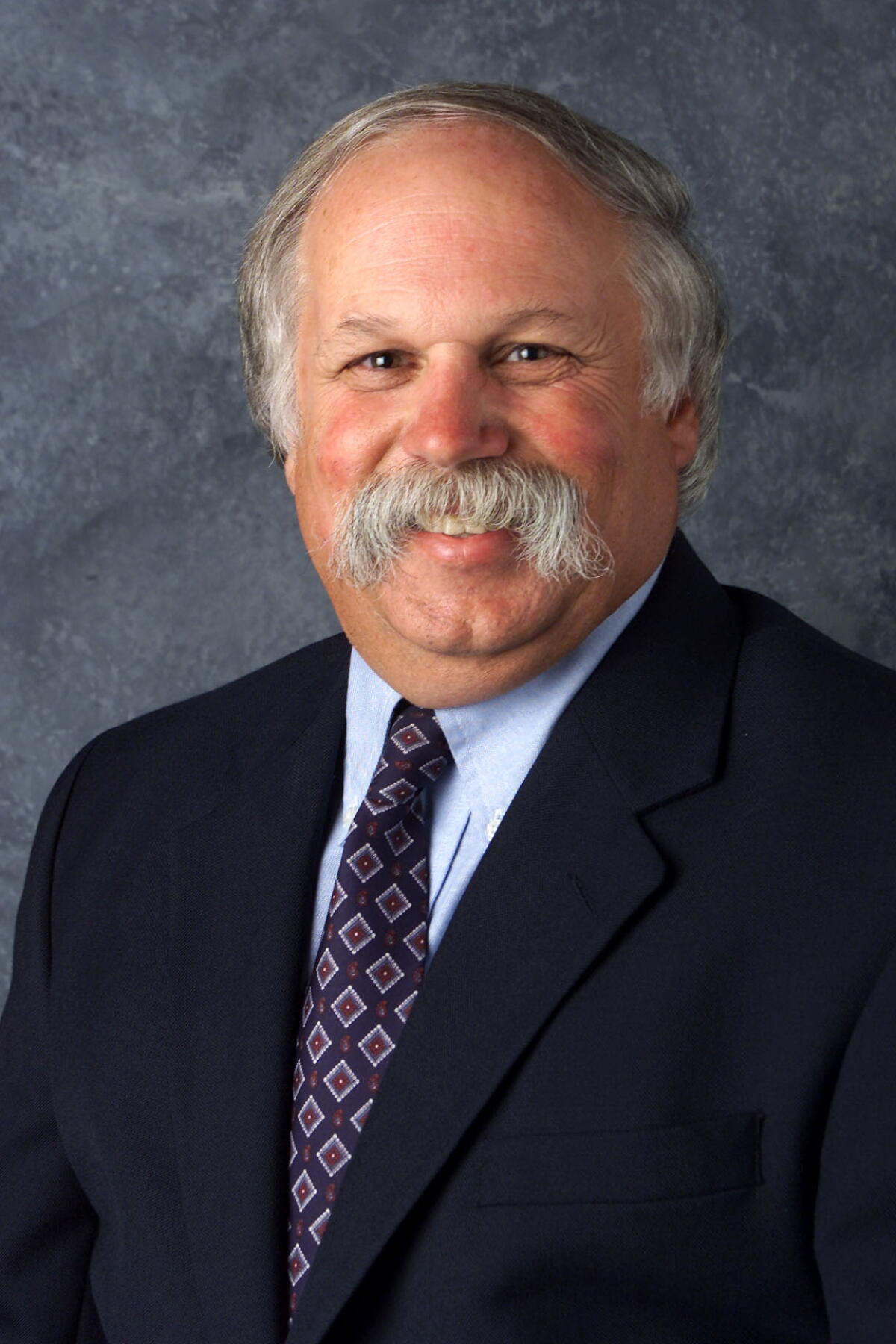
Bob Fontaine Jr. as director of player development for the Seattle Mariners.

Bob Fontaine Jr. as director of player development for the Seattle Mariners.

(Seattle Mariners)

“I think every scout, if they scout for any length of time, is going to have one player that just is special to you. Jimmy Abbott was that,” Fontaine told JapanBall in 2022. “There were people that were even kind of saying, ‘Oh, they did it for a publicity stunt.’ I remember saying, ‘Yeah, we took the eighth player in the country for a publicity stunt? Give us some credit!’”

Fontaine was showered with plenty of posthumous credit over the weekend. He scouted for six teams, and a highlight of his resume was drafting the nucleus of the Angels’ roster that won the 2002 World Series.

“What a character … what a storyteller … and what a talent evaluator … there is no 2002 World Series title for the #Angels without Bob Fontaine Jr. … RIP,” wrote former longtime Times baseball writer Mike DiGiovanna on X.

“Crushed regarding Bob Fontaine Jr.’s passing, as he was a special man who I was lucky to work closely with three times @WhiteSox @Mariners, and @BlueJays. Fun as hell, elite evaluator, and phenomenal people skills. RIP, Robert,” added former Dodgers general manager Dan Evans.

“A gifted talent evaluator and mentor, Bob helped shape generations of Angels by overseeing the signing and development of numerous Halos, including Jim Abbott, Jim Edmonds, Garret Anderson, Tim Salmon and Darin Erstad,” the Angels said in a statement. “Bob left a lasting mark on baseball by devoting over five decades to the game. Our thoughts are with his family and loved ones.”

The Angels frustrated Fontaine at times by declining to spend big on players from talent-rich Latin America. Rather than sulk, however, he scoured the globe, in 1992 signing three players from Russia and a fast-pitch softball player from New Zealand named Gus Leger.

Asked by The Times’ Bill Shaikin if he had ever played baseball, Leger responded, “I haven’t. Would it help?”

The experiment failed — none of the quartet advanced beyond Class A — yet Fontaine maintained the sunny outlook he inherited from his father. Bob Fontaine Sr. was a scout who worked under the legendary Branch Rickey with the Brooklyn Dodgers before becoming scouting director of the Pittsburgh Pirates for 18 years and the first scouting director of the expansion franchise San Diego Padres. He also served as general manager of the Padres from 1977 to 1980.

“[My father] told me when I got started, ‘Don’t you ever, ever not appreciate where you are and what you’re doing, because you’re lucky. You’re going to a ballpark to make a living, so your bad days aren’t that bad,’” Fontaine Jr. said. “I never forgot that, I never forgot how lucky I am.

“Hey, you’re looking at a guy that barely squeaked through high school, who doesn’t have any ability, and I lasted almost 50 years. It’s because in baseball, if you listen, and you’re not afraid to take a chance once in a while, even somebody with my lack of ability can stay around for a while,” he said.

Fontaine got his foot in the door through his father. His first job as a teenager was as a minor league bat boy with the Pirates. Next he became a peanut vendor at Forbes Field. By age 19, he caught on with the Padres as an area scout.

Both Fontaines were scouts well ahead of the deep empirical and objective analysis of baseball data — sabermetrics is the catchall term — that some believe has made scouts obsolete. Fontaine maintained the best evaluations come when scouting is utilized along with numbers.

“What the traditional scout gives you is personal reference, like with things I learned on players that I missed on,” he said. “Analytics didn’t do that. I’m a firm believer that the best video camera is your eyes, the best model is your brain, and the best way to make a tough decision is with your heart.”

Fontaine’s methods produced results. Under his guidance in 1977, the Padres drafted future Hall of Fame shortstop Ozzie Smith in the fourth round. Four years later Fontaine plucked another future Hall of Famer, taking outfielder Tony Gwynn in the third round.

And when Fontaine moved to the Montreal Expos in 1985, he took a 6-foot-11 left-handed pitcher out of USC named Randy Johnson in the second round — another Hall of Famer.

Fontaine co-authored a memoir in 2021, “In Search of Millionaires (The Life of a Baseball Gypsy): The Accounts of Bob Fontaine Jr.”

“Baseball has provided me with a fabulous opportunity to see the world and work in an industry that most people envy,” he wrote in the book. “I didn’t get rich, except in experiences. To meet and work against so many fine people, as well as some great general managers and owners, has been a privilege.”

Times sports columnist Bill Shaikin contributed to this story.

Source link

Shohei Ohtani gets a hit in his return, but Dodgers fall to the Padres

Shohei Ohtani’s swing was a little out in front of a slider delivered by Padres left-hander Robbie Ray. But Ohtani held back his hands long enough to extend them to the pitch and shoot it through the right side of the infield.

It wasn’t flashy. But considering it was his first at-bat in more than two weeks, in a tough matchup no less, it was a promising sign.

“It’s been a while since he’s played in a game, but it just felt like he wasn’t sped up at all,” manager Dave Roberts said after the Dodgers’ 5-1 loss to the Padres. “And I think he came out of it pretty well.”

The good news quickly dried up for the Dodgers after that, as they missed a chance to clinch a first-round bye with a win. But Ohtani’s return was still significant, and the success of his end-of-season tune-up will have playoff implications.

Ohtani did not address reporters Wednesday and has only done so once in the last five weeks, despite multiple requests.

The Dodgers activated Ohtani, who went one-for-four Wednesday, from the 15-day IL before the game and optioned rookie Josue De Paula to Triple A. De Paula is still under consideration for the National League Division Series roster as a bat off the bench.

“This was the original thought, that once Shohei gets back, we’re going to send him out,” manager Dave Roberts said. “We had a runway to give him, which we gave him and he performed more than admirably. This also, as far as the timing, just gives us an opportunity to potentially have him back for the postseason. He’s a part of the conversation, and he’s earned that, and that’s what I told him last night.”

De Paula joined triple-A Oklahoma City for Game 2 of the PCL Championship on Wednesday. And Ohtani slid into the Dodgers lineup, hitting second in the batting order for the first time this season, with Mookie Betts leading off against the Padres southpaw.

“I know Shohei, Mookie, they’re always on board with whatever I decide to do,” Roberts said. “I think it just makes it tougher to navigate versus left. There’s a Mookie tax [to get to Ohtani]. If you want to get to Freddie [Freeman], there’s a Will Smith tax. I like that. And versus a right-hander, I like kind of flipping those two for the same reasons.”

Ohtani, welcomed back in his first at-bat by a partial standing ovation, walked in his second plate appearance. And with two out and the bases loaded in the bottom of the fourth inning, he appeared to have walked again.

Then Padres catcher Ethan Salas tapped the top of his head to challenge the ball call. And an ABS review showed the fastball had clipped the top of the strike zone. Ohtani fouled off the next two pitches before whiffing on a sinker to end the inning.

That missed opportunity rolled right into a sloppy fifth inning for the Dodgers defense.

Starting pitcher Yoshinobu Yamamoto had given up a two-run homer to Manny Machado the previous inning but had otherwise avoided damage.

To open the fifth, he induced Salas to hit the ball on the ground, but it got away from second baseman Tommy Edman as he dove up the middle, for a single.

Yamamoto then got a soft grounder out of Fernando Tatís Jr. But it was too soft, giving Tatís time to reach first before third baseman Max Muncy could get off a throw.

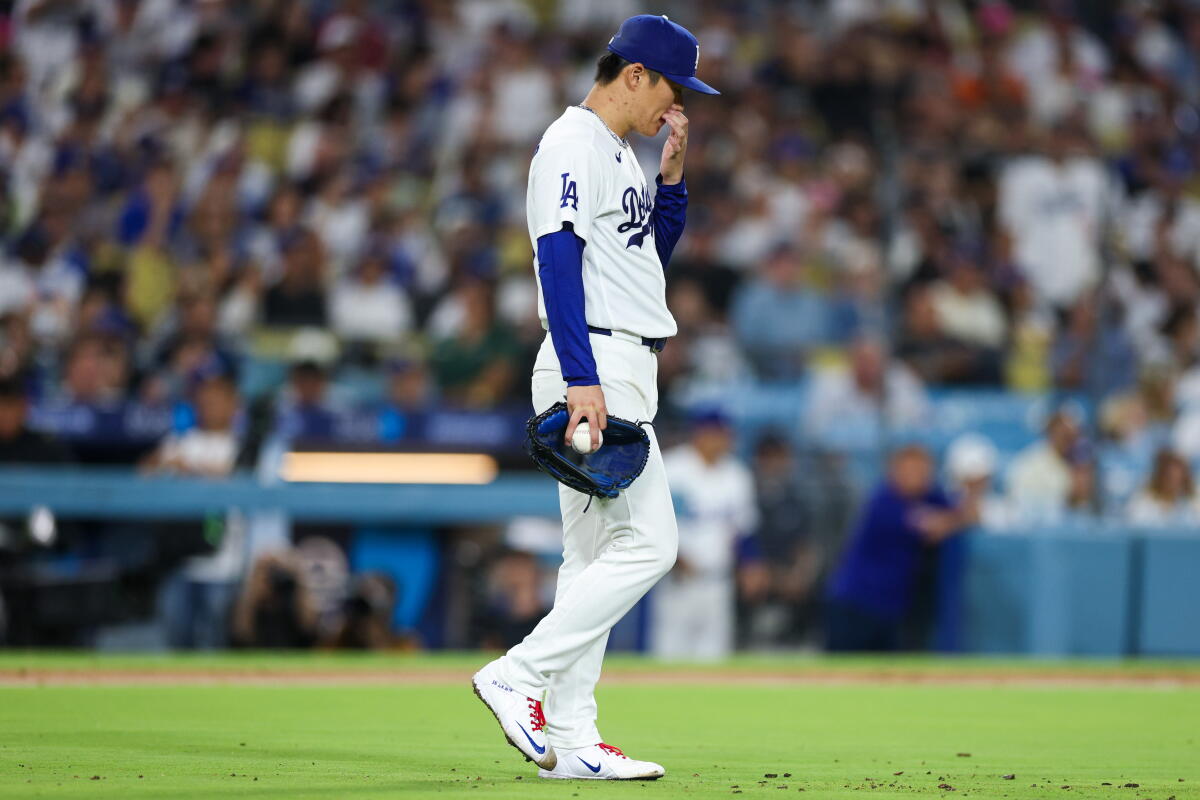
With runners on first and second, Yamamoto had a chance to contribute on defense, fielding Dustin Harris’ comebacker bunt. But Yamamoto’s throw to third sailed wide, allowing a run to score. Machado then made it a 4-1 game with a sacrifice fly.

Yoshinobu Yamamoto reacts after a throwing error to third base in the fifth inning.

Yoshinobu Yamamoto reacts after a throwing error to third base in the fifth inning.

(Ronaldo Bolaños / Los Angeles Times)

Ohtani came up to the plate again in the seventh inning and put Dodgers fans on the edge of their seats by sending a long fly ball to straightaway center field. But the cheers died down as it fell shy of the fence.

“I think if you look back at the last couple weeks when he was active, he wasn’t really getting to that pitch,” Roberts said of the high fastball. “I think there might have been one pitch late that he squared up to left field that was at the top of the zone. But outside of that it was hard for him to catch up. I think tonight showed that he’s in a good spot physically.”

The top of the Dodgers order got one last chance to start a rally in the ninth inning, against star closer Mason Miller. Only Will Smith reached base, on a walk, and advanced to third on defensive indifference. Ohtani struck out on a slider.

“[Ohtani] certainly feels way better with the rest,” president of baseball operations Andrew Friedman said before the game. “The biggest thing with five games to go is get him as many at-bats as we can, some rhythm and timing.”

Ohtani could get a day off in that span, Friedman said, but the Dodgers will make those decisions based on how he’s feeling.

“Just getting as many at-bats as he can and that rhythm and timing back before we head into October is going to be really helpful,” Friedman said.

Ohtani was not in rhythm before he landed on the IL. In the last three weeks before the Dodgers finally shelved him, he had a .130 batting average. And he only had two hits in his last seven games (26 at-bats) before the move.

“You end up making subconscious adjustments where you’re protecting yourself,” Friedman said, “and there’s just slight degradation as that’s happening that compounds over time.”

Though the Dodgers downplayed the correlation before Ohtani landed on the IL, they now hope that Ohtani’s improved health will go hand-in-hand with better performance.

“Shohei says he feels back to where he was earlier in the year, which is great, which is a good start,” Friedman said. “As they are coming back, it’s important for them to feel that way … now the question is, as you start to load on real games and that intensity and that workload, it’s making sure that what we’ve done keeps guys in position to be at their best.”

Source link