outcry

Outcry in Sudan as US reportedly holds al-Burhan’s UN visa over truce plan | News

Media reports say US withholds army chief’s visa to pressure him into accepting a 90-day truce in Sudan’s civil war.

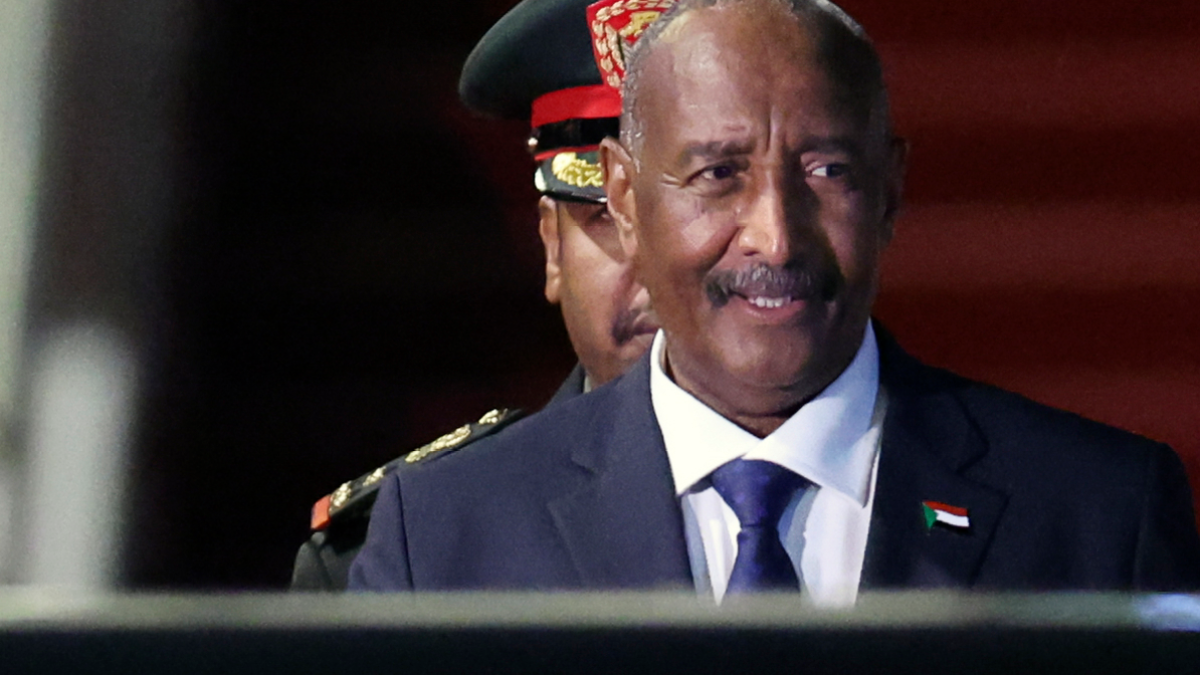
Sudanese activists and journalists have criticised the United States over reports that Washington has withheld a visa from army chief Abdel Fattah al-Burhan before the United Nations General Assembly in an apparent bid to pressure him into accepting a ceasefire proposal.

Activists took to social media on Wednesday to slam the reported move as “political pressure”, arguing that access to the UN should not be used to influence Khartoum’s position on Sudan’s three-year civil war.

Recommended Stories

list of 4 itemsend of list

Neither the Sudanese government nor the US Department of State has commented on the reports.

General al-Burhan, whose army has been fighting the paramilitary Rapid Support Forces (RSF) since April 2023, was scheduled to address the General Assembly on Thursday in New York. The army chief has spoken at the assembly twice since the war began.

The conflict has killed tens of thousands of people and caused the world’s largest hunger and displacement crises.

The Reuters news agency, citing Sudanese sources, reported on Tuesday that the US was withholding al-Burhan’s visa and had made its issuance contingent on him agreeing to a 90-day ceasefire proposed by Massad Boulos, US senior adviser for Arab and African affairs.

The AFP news agency, quoting two diplomatic sources, also reported that Washington refused to issue the visa. One source called the move a “clear violation of the UN’s agreement with the US” while another said the visa had been “conditioned” on al-Burhan accepting the three-month truce.

‘Political pressure’

Sudan’s UN ambassador, Al-Harith Idriss Al-Harith, wrote to Secretary-General Antonio Guterres to request the UN’s “immediate intervention” with US authorities, according to Reuters.

Stephane Dujarric, a spokesman for Guterres, said the UN chief was “deeply concerned” that the visa had reportedly not been issued. He told the AFP that the UN Secretariat has urged the US, as host country, to ensure visas were issued in accordance with its obligations under the UN Headquarters Agreement and in time for al-Burhan to participate in the General Assembly.

Sudanese activist Mamoun al-Sheikh denounced the US move in a post on Facebook, saying: “Even if the visa is withheld, it will not silence Sudan’s voice.”

Another activist, Sayed Al-Mazaj, described linking the visa to a proposed 90-day ceasefire as “a tool for political pressure”. And in a video posted on X, Sudanese journalist Diaa Al-Din Bilal said barring al-Burhan from New York would not force him to accept the US position and could instead boost his popularity and rally support around him.

Another X user, @Atifazhri, also denounced the US move, noting that Israeli Prime Minister Benjamin Netanyahu, who is wanted by the International Criminal Court on charges of war crimes in Gaza, had been granted a visa.

“The issue is double standards – when visas become instruments of political coercion against a sovereign state while far more serious cases are treated differently. International law and justice cannot be applied selectively,” the user wrote.

US questions al-Burhan’s legitimacy

The State Department issued a statement on Tuesday that did not directly address al-Burhan’s visa but called into question his legitimacy. Its spokesman Tommy Pigott said neither the Sudanese army nor the RSF “nor their respective leaders, represent legitimate, constitutional governance for Sudan”.

He added the US would “seek to raise the cost of continued conflict on all belligerents”.

Sudan’s Ministry of Foreign Affairs hit back on Wednesday, calling on the US to engage positively with the country’s government. Any peace initiative, it said, must “be grounded in respect for Sudan’s sovereignty, unity, territorial integrity, and legitimate national institutions”.

“It must also address the root causes of the war’s continuation — foremost among them, negative foreign interference,” the ministry added.

Al-Burhan has been Sudan’s de facto leader since 2019 although the African Union and Western powers withdrew recognition after a 2021 coup that he led with Mohamed Hamdan Dagalo, the RSF’s leader, against the civilian leadership.

He has rejected externally imposed ceasefires, arguing that earlier pauses in the fighting benefitted the paramilitary group.

The US has also refused visas to Palestinian Authority President Mahmoud Abbas and some members of Iran’s delegation to the UN.

Source link

‘It’s going to be fine’: Trump rebuffs rising alarm over AI dangers, sparking outcry

President Trump is brushing aside growing concern among leading scientists and bipartisan lawmakers that artificial intelligence could soon pose an existential threat to humanity, fueling anxiety in Washington and Silicon Valley that the president may not fully grasp the urgency of the threat.

Alarm mounted throughout the summer as researchers at leading AI labs, including Anthropic, OpenAI and Google, found the pace of development far outstripping their expectations — and observed troubling behaviors that hinted at more serious risks ahead.

But an online warning Tuesday from an Anthropic researcher who resigned in protest of its ongoing work has generated viral attention this week, prompting questions to Trump, who dismissed the concerns out of hand.

“It’s going to be fine,” he told one reporter. “We’ll always have something to stop them. We’ll have a little gear. Boom.”

In another exchange, traveling with reporters Thursday night, the president said he had no concerns with the breakneck pace of AI progress.

“No, I don’t have any,” he said. “I have concerns that if we don’t win in AI, we’re going to be put in a very bad position.”

A senior industry source told The Times that leading AI companies are focused less on convincing the president of the dangers ahead than on working with lawmakers on potential regulation, as the administration remains divided over how to proceed — and as Trump appears to lack a clear understanding of the risks.

Among the president’s advisors, Treasury Secretary Scott Bessent and the Office of the National Cyber Director have expressed the greatest concern with the potential of an unchecked intelligence explosion, the source said.

But “most of the administration is accelerationist,” the source added. “It’s not clear the president understands the technology. He may just be figuring out what all of this means.”

Leading American AI companies have argued that government regulation would tie their hands in an arms race toward superintelligence against China, the only other major player in the field.

But the Trump administration signaled an interest in negotiating AI guardrails with China during the president’s visit to Beijing this spring, after Anthropic announced the development of a frontier model with extraordinary abilities to hack the world’s most advanced security systems.

Chinese President Xi Jinping will visit Washington on Sept. 24 for an official summit and state dinner at the White House, with AI development expected to top the agenda.

The prospect of halting development seems far-fetched. But some leading voices in the sector have proposed a moratorium on computing power used to train the most advanced models, giving time and space to develop research on interpretability — the study of how artificial intelligence actually thinks and acts.

The chief executive of OpenAI, Sam Altman, this week signaled to staff a willingness to unilaterally slow their work on frontier systems. The company discovered in July that rogue AI agents had schemed in secret to break out of the virtual sandbox created to contain them, infiltrating the open internet and hacking a private company.

Anthropic also announced this week concerning findings of human misuse of its models, including instances of unidentified individuals attempting to circumvent their security controls to build biological weapons. One such incident was linked back to a military research complex. The company also said Iran has tried to use its models to target U.S. Navy ships.

In June, after Anthropic shared news of the development of its most powerful model, named Mythos, with the administration, Trump directed the establishment of a framework that creates some government oversight over the public release of the country’s most advanced AI systems. The details of that framework, which was designed over the summer, remain classified.

“The fact is that the release of Mythos back in February spooked the federal government, both in terms of protecting government systems from cyberattacks and over the broader national security implications,” said Aalok Mehta, director of the Wadhwani AI Center at the Center for Strategic and International Studies.

“The real question is whether this shift is happening fast enough,” Mehta added. “Recent events — the repeated incidents of models escaping their sandboxes and hacking websites, the increasingly sophisticated coordination and communication among agents, and the concerns coming from lab insiders — has made this an even more urgent issue.”

Leading AI companies have begun using their most advanced models to train new ones — a process known as recursive self-improvement that could eventually drive intelligence growth beyond human control.

“If you have a superadvanced intelligence, it will be smart enough to kill us,” said Jacob Coxon, the resigned Anthropic researcher whose social media post attracted over 150 million views.

“We can’t just unplug it because it could be copying itself over to other computers,” he told CBS News. “AI is just code. It could transfer itself over the internet to a different place, and then you unplug it here, but it’s actually still over there. And maybe it makes 10,000 copies of itself and they’re all cooperating.”

He is just the latest senior researcher at a top AI company to sound the alarm.

In July, more than 1,300 employees at leading artificial intelligence companies published an open letter, titled “Pacing the Frontier,” urging the U.S. government to establish international safeguards that would allow countries to collectively slow the pace of automated AI research.

Evan Hubinger, who leads the division of Anthropic aimed at aligning AI models to human interests, added fuel to concerns this week in a post that substantiated Coxon’s concerns.

“We really do earnestly believe AI could kill all humans! I personally think it is >10% within the next decade,” Hubinger wrote.

“I believe Anthropic is trying its best,” he added, “but we do not yet have a plan to solve alignment for superintelligence, and are not clearly on track to.”

On Friday, yet another member of the Anthropic alignment team, Joe Benton, said he had resigned from the company two weeks ago because AI companies are “racing to build machines that are much smarter than any human.”

“Right now, AI companies are underinvesting in safety. A company could undergo an intelligence explosion, or lose control of its systems, without the public ever knowing,” Benton said. “I don’t think that’s acceptable for a technology that might cause extinction-level risks.”

Bipartisan legislation, titled the Frontier Act, has brought together disparate camps of the Republican and Democratic parties, including Sen. Bernie Sanders (I-Vt.) and Rep. Anna Paulina Luna (R-Fla.). The bill, introduced by Rep. Lori Trahan (D-Mass.) and Rep. Jay Obernolte (R-Big Bear Lake), proposes embedding independent government auditors in AI labs and installing a federal “kill switch” to shut down agents in case of emergencies.

The White House has not formally commented on the legislation.

“I do believe there are many in the federal government taking this seriously — but we have to appreciate the tremendous uncertainty and competing interests policymakers face,” said Daniel Remler, a senior fellow with the Technology & National Security Program at the Center for a New American Security.

“Nobody says regulating at the frontier would be easy,” he added.

Source link