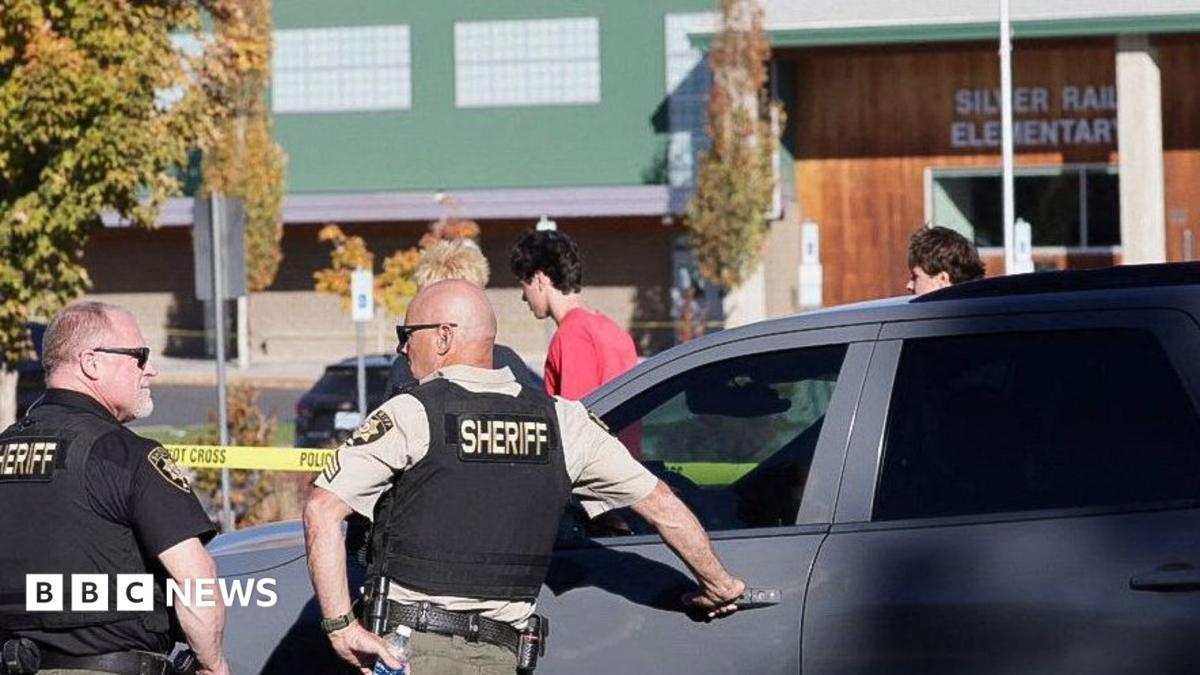
The 16-year-old who killed three children and a teacher at an elementary school in the US state of Oregon was a former special-needs student at the school, police and school officials have said.
A teacher fought the teenage shooter and a parent shot him dead, police say on Friday, a day after four people were killed.
Published On 17 Oct 202617 Oct 2026
The 16-year-old who killed three children and a teacher at an elementary school in the US state of Oregon was a former special-needs student at the school, police and school officials have said.
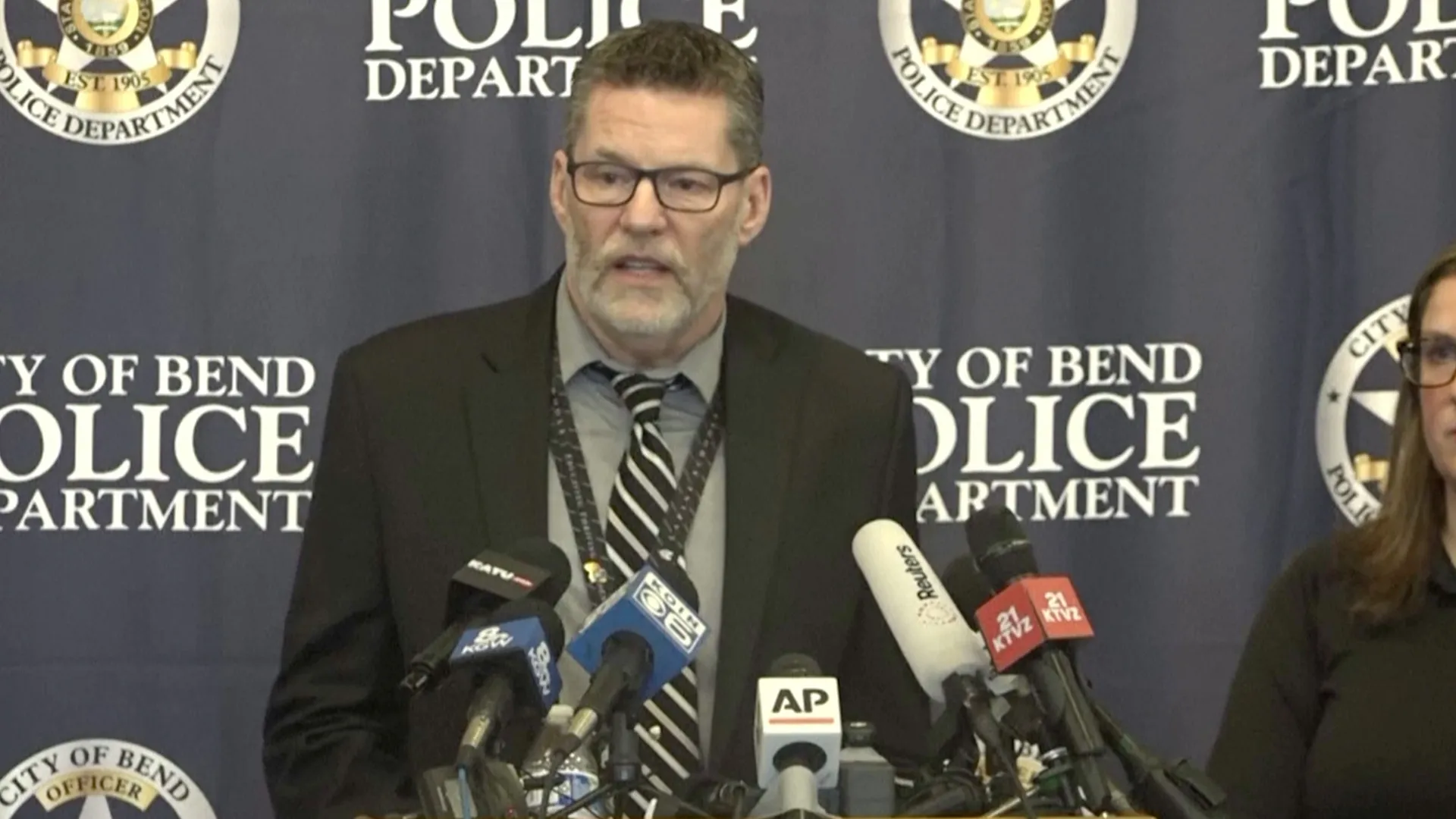
Bend Police Chief Mike Krantz identified the attacker on Friday, a day after the shooting at Silver Rail Elementary School, as Griffin J. John II.
Recommended Stories
list of 3 itemsend of list
He said the teenager attacked a classroom of special-needs students, where all the victims were shot.
Steven Cook, superintendent of Bend-La Pine Schools, said John was not enrolled in the local public school system at the time.
“That classroom was a special needs classroom, and the suspect was a special needs student in that school,” Cook told a news conference.
Krantz said John shot his way through locked doors with a 12-gauge shotgun, firing as many as 15 shots, and had about 44 rounds left when he was killed. Police are still trying to determine how he obtained the gun.
Under Oregon law, a minor may possess a shotgun if provided by a parent or with a parent’s consent.
The shooter’s mother, Shauntai Nickerson, separately told reporters outside her apartment: “I’m so sorry, I wish I could have done something.”
A teacher threw her phone at the gunman, then tackled and fought him, likely saving lives, Krantz said, calling her actions “heroic”. She was not injured.
A 36-year-old father, Kaylub Giamanco, who has two children at the school, then followed the gunman inside and shot him dead minutes after the first 911 call.
US President Donald Trump called Giamanco a “great hero”. “It’s a terrible thing, but thank goodness for a man that had a gun and knew how to use it,” Trump said.
People mourn next to a cordoned-off area at Silver Rail Elementary School in Bend, Oregon, on October 16, 2026, the day after a shooting [David Ryder/Reuters]
The children killed were aged five, eight and 11, and the teacher was Meghan Lambert, 25, police said.
A seven-year-old child and a 54-year-old teacher were taken to hospital in critical condition.
The shooting is the 28th mass killing in the US this year, according to a database by The Associated Press, USA Today and Northeastern University.
The Gun Violence Archive in the US has documented 369 mass shootings in 2026, defined as incidents in which four or more people are shot.
The Everytown for Gun Safety group has counted at least 100 incidents of gunfire on school grounds this year, with 34 deaths.
“We are stunned and heartbroken by this senseless tragedy,” Bend-La Pine Schools Superintendent Steven Cook said in a statement.
“No words can adequately express the grief our community is experiencing.”
Local law enforcement responded to reports of an active shooter at Silver Rail Elementary in Bend, Oregon, at 12:59 local time, Bend Police Department spokeswoman Sheila Miller told reporters.
The first call indicated that an unknown suspect had shot into a car, she said. Photos released from the scene show a red truck with bullet holes.
Minutes later, the local county dispatch received a flood of 911 calls and law enforcement were sent to the scene.
The suspected shooter was shot dead at around 13:02pm, Miller said.
While police said the shooter was a local 16-year-old boy, they declined to add further details pending the ongoing investigation.
It marked the first time UCLA defeated Oregon since 2017. The win was the Bruins’ first at Autzen Stadium since 2004. And Bob Chesney became the first UCLA head coach to start his tenure 5-0.
Sunday came with one more breakthrough: The Bruins cracked the top 15 in the Associated Press’ Top 25 for the first time since 2022.
UCLA’s 17-15 victory over Oregon proved that the Bruins deserved a spot in the upper echelons of the Big Ten. Not only did UCLA leave Oregon with an undefeated record — one win away from being bowl eligible — but the Bruins also will returned to Los Angeles with three consecutive home games on the schedule, a stretch that could push them farther up the totem pole.
“It doesn’t matter. Now we have to get better,” Chesney told reporters after the win. “How do we get better? We go back and look at the things we need to fix. We evaluate our personnel and see where we stand once we figure out whether some of these guys are coming back next week. There’s a lot of football left to be played, so it doesn’t matter. Getting better is always the message when we turn the corner.”
Newsletter subscription change
Starting Sept. 21, this newsletter will be available to Los Angeles Times subscribers only. A free press isn’t free, and we depend on reader support to report on the stories that make a difference. If you’re already a subscriber, nothing will change. If you’re not, there’s never been a better time to sign up. Get started here.
Here are three takeaways from UCLA’s fifth win, which kept the Bruins among nine remaining undefeated Football Bowl Subdivision schools and avenged one of Chesney’s two losses last season when his magical run at James Madison ended against Oregon.
Colin Hitschler can bounce back with the best
The week leading up to defensive coordinator Colin Hitschler’s rematch against Oregon featured reminders about how the Ducks steamrolled his Dukes’ defense last season in the College Football Playoff, finishing with 51 points and 514 yards.
And Hitschler acknowledged that Ducks coach Dan Lanning’s offense got the best of him, leaving him with a chip on his shoulder.
His “Bruin Bullies” made their presence felt from the first whistle to the last, forcing seven turnovers — five fumble recoveries and two interceptions, categories in which UCLA now ranks first and second, respectively, in the nation.
And while Oregon quarterback Dante Moore remained sidelined because of a head injury, backup Dylan Raiola — who spent the previous two seasons as Nebraska’s starter — was a highly regarded talent and expected to challenge the UCLA defense, particularly after throwing for 289 yards and two scores against USC last month.
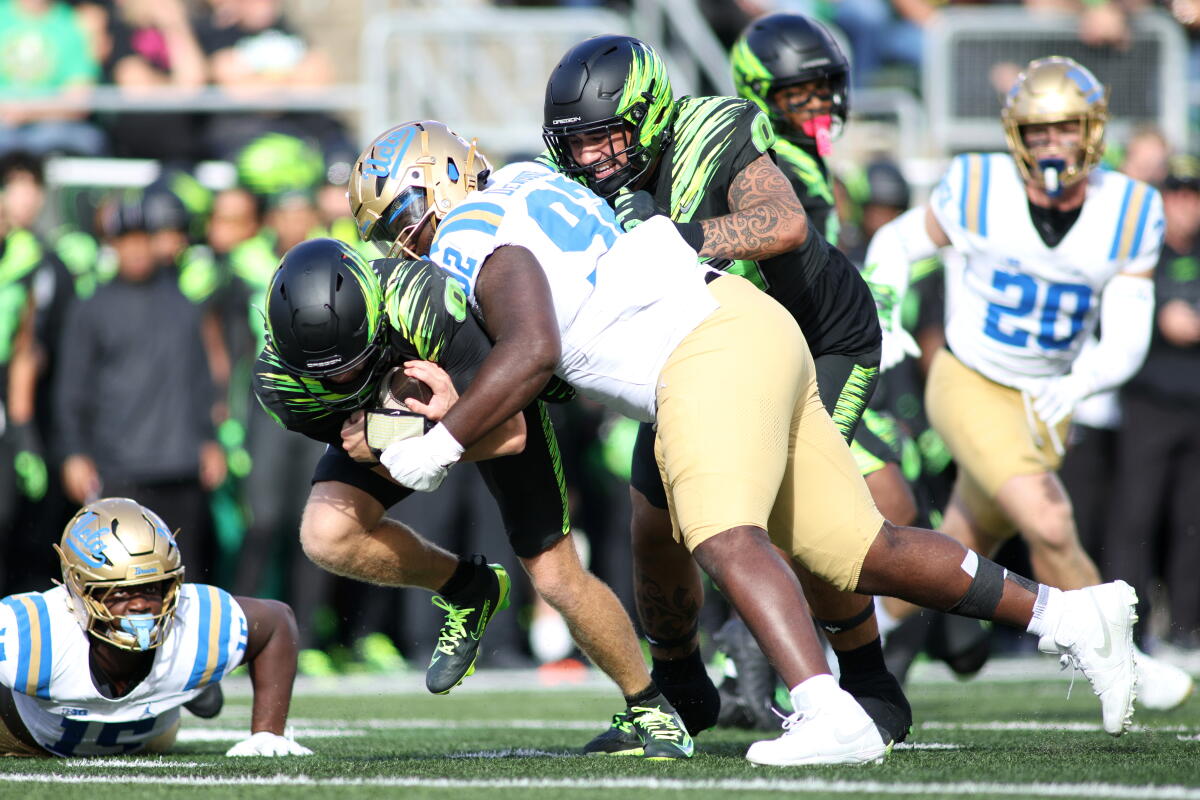
UCLA defensive lineman Darold DeNgohe tackles Oregon quarterback Brock Thomas on Saturday in Eugene.
(Lydia Ely / Associated Press)
The Bruins gave Raiola more headaches than anything else as he finished with 43 passing yards and three turnovers before he was benched for third-stringer Brock Thomas in the fourth quarter.
And even when Thomas entered for Raiola, the Ducks’ offensive weapons largely flatlined despite their perceived superior status.
Running back duo Dierre Hill Jr. and Jordon Davison — who combined for 238 all-purpose yards and three touchdowns against the Trojans — and tight end Jamari Johnson, who torched the USC defense for seven catches and 119 yards, were limited to a combined 111 all-purpose yards and just one score.
The Bruins’ defense was everywhere in Eugene, limiting the run game to 2.7 yards per carry, largely blanketing pass catchers in coverage downfield and forcing turnovers at every level.
“We don’t focus on outside chatter,” senior linebacker Sammy Omosigho said after the win. “That has no meaning to us, no focus to us, no value to us. We focus on ourselves.”
Bruins’ QB concerns aren’t going anywhere
Many observers who watched Saturday’s showdown will tell you the Bruins should have won more handily.
The Bruins almost doubled the Ducks in time of possession, yet there was a chance for Oregon to win on the last drive of the game.
UCLA had to overcome its own problems, with quarterback Nico Iamaleava battling Raiola for most turnovers and questionable decisions under pressure.
UCLA coach Bob Chesney calls to his players.
(Lydia Ely / Associated Press)
Iamaleava got off to a slow start this season as UCLA relied on its potent rushing attack. He rebounded against Purdue and Maryland, combining for 485 yards and four touchdowns with zero turnovers.
While Iamaleava went 10 for 17 for 162 yards in the first half, his mistakes came at especially costly times for the Bruins.
During UCLA’s second drive, the Bruins were pinned on their 10-yard line. With Oregon outside linebacker Nasir Wyatt blitzing, Iamaleava attempted to throw the ball away to the flat and instead fumbled, giving the Ducks the ball on the Bruins’ one-yard-line. Oregon scored one of its two touchdowns immediately after the turnover.
Later in the half, Iamaleava threw two interceptions, the first at midfield and the second coming at Oregon’s 22-yard line, wiping out a field-goal opportunity.
Iamaleava struggled with accuracy and timing, underthrowing a deep ball to wide receiver Aidan Mizell on the first play of the game — a pass that arguably could have been a touchdown if Mizell was hit in stride — and mistiming a pass to running back Jaivian Thomas, who was wide open in the end zone, on third and goal during the same drive.
Iamaleava was facing a formidable Ducks defense, the best unit the Bruins have played to date, and was injured during the second interception. He did not return to the field after sustaining a leg injury near the end of the first half, and it is unclear how long he will be sidelined.
Backup Ty Dieffenbach steered UCLA to a win, but the Bruins need better quarterback depth.
UCLA is a playoff contender
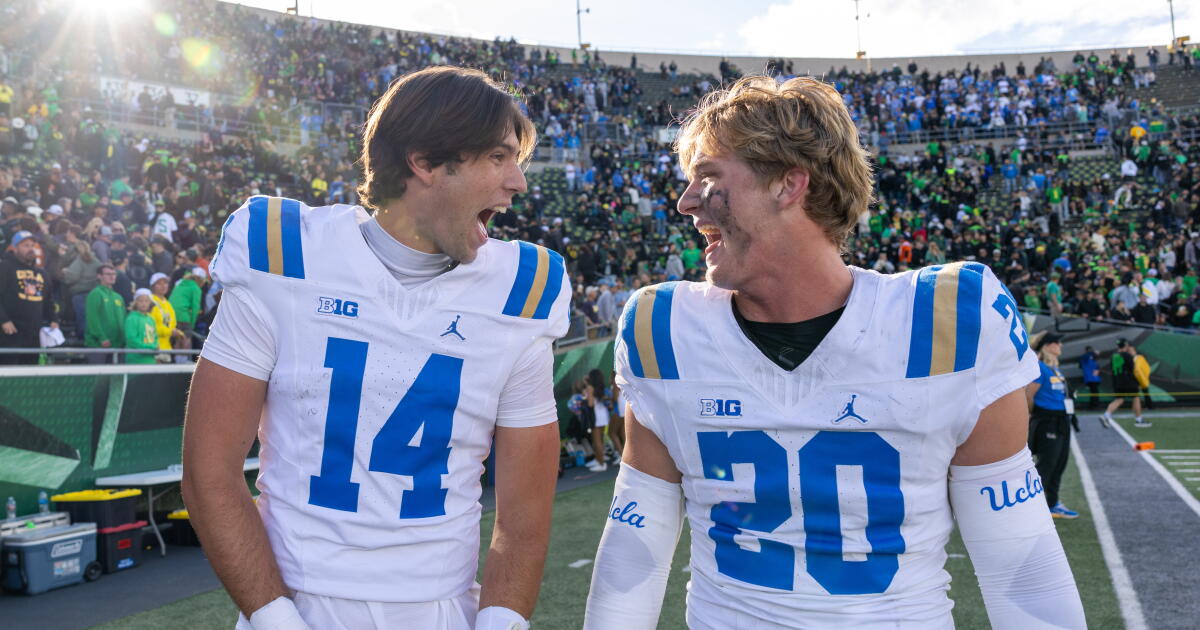
The Bruins celebrate their win over the Oregon Ducks.
(Tom Hauck / Getty Images)
Saturday was more than just a win. It was a bold announcement to the rest of the Big Ten and the nation that UCLA is a playoff contender.
Chesney told fans during a UCLA men’s basketball game shortly after he was hired that the football team is playing for banners. And Saturday’s win proved that his plan to pursue championships — something that seemed absurd amid a lost 2025 season — has a real possibility of paying off with one.
The Bruins have one of the easier schedules in the Big Ten with seven games remaining. UCLA will play five home games, including with 2-4 Michigan State, 2-3 Nevada of the Mountain West and 3-3 Illinois.
While UCLA still has road games at Michigan and Minnesota and competitive home games against Wisconsin and USC, the Bruins proved Saturday that they can hang in any environment, frustrating the Ducks at hostile Autzen Stadium.
Sign up for UCLA Unlocked
A weekly newsletter offering big game takeaways, recruiting buzz and everything you need to know about UCLA sports — exclusive to L.A. Times subscribers. Free Members receive a partial preview of each edition.
By continuing, you agree to our Terms of Service, which include arbitration and a class action waiver. You agree that we and our third-party vendors may collect and use your information, including through cookies, pixels and similar technologies, for the purposes set forth in our Privacy Policy such as personalizing your experience and ads.
Big Ten confirms a big mistake
The Big Ten released a statement Sunday announcing its officials placed the ball at the wrong spot during Oregon’s final failed two-point conversion attempt after a UCLA penalty. The ball should have been placed at the half-yard line instead of the 1½-yard line. The lead officially announced the correct placement, but the crew never moved the ball.
UCLA’s defense stuffed the two-point conversion attempt, and the Bruins went on to secure a 17-15 win.
The mistake has drawn limited outrage, with fans more concerned about the number of errors by Big Ten officials this season than about them potentially thwarting Oregon’s chance to tie the score. That probably has a lot to do with the number of mistakes the Ducks made and the perception the Bruins outplayed them.
Dieffenbach has long embraced change
Before Ty Dieffenbach was asked to lead UCLA’s offense in the second half at Oregon, he began his high school career in Southern California as a wide receiver.
The Times’ Eric Sondheimer spoke with Dieffenbach ahead of his senior season about his switch to playing quarterback for Agoura, a team that needed a signal-caller and quickly developed a prolific one.
Agoura coach Dustin Croick told Sondheimer he wouldn’t have asked Dieffenbach to play the position just because of the 6-foot-5 athlete’s arm strength. Croick detected something else.
“We can teach kids how to throw, how to read defenses, but the leadership has to be a natural thing,” Croick said.
The two have stayed in touch as Dieffenbach spent two seasons at Pittsburgh without playing before transferring to Cal Poly and starting for one season. Dieffenbach then joined UCLA during the offseason and prepared as though he could be asked to play at any time.
Dieffenbach celebrated with the high school coach who first believed in his quarterback skills via Facetime after UCLA’s win.
Agoura football coach Dustin Croick was busy with relatives in town. He turned off his phone. Then he saw 173 text messages. Then he faced timed with his former QB Ty Dieffenbach after UCLA beat Oregon. Emotional day. pic.twitter.com/eyn5YD6Uva
The Valkyries became the first WNBA expansion team to reach the playoffs in its first season and the Finals in its second.
“I told them that I was proud of our whole team, the whole 14, because I saw another level of fight tonight,” Nakase said after the clinching win. “And that’s what I was really proud of. We talked about leveling up one more as a team and I think that overtime proved strength in numbers. We really left it all out there on the floor. We really emptied the tank.”
Golden State hosts the Atlanta Dream at 12:30 p.m. Saturday to open the Finals. The Dream notably are led by UCLA alum Jordin Canada, the the starting point guard and ignition to their offense.
Bruins on deck
Wednesday, Oct. 14 Women’s basketball at California (exhibition)
Thursday, Oct. 15 Women’s tennis at ITA Regional Championships, all day Men’s tennis at ITA Regional Championships, all day
Friday, Oct. 16 Women’s tennis at ITA Regional Championships, all day Men’s tennis at ITA Regional Championships, all day Women’s golf at Stanford Intercollegiate, all day Men’s golf at Golf Club of Georgia Collegiate Invitational, all day Men’s soccer at Wisconsin, 5 p.m. Women’s volleyball vs. Penn State, 7 p.m. Women’s soccer vs. Washington, 8 p.m.
Saturday, Oct. 17 Women’s tennis at ITA Regional Championships, all day Men’s tennis at ITA Regional Championships, all day Cross country at UC Riverside, 8 a.m. Men’s water polo at USC, 1 p.m. Football vs. Wisconsin, 4:30 p.m.
Sunday, Oct. 18 Women’s tennis at ITA Regional Championships, all day Men’s tennis at ITA Regional Championships, all day Women’s volleyball vs. Ohio State, 3 p.m.
Do you have a comment or something you’d like to see in a future UCLA newsletter? Email newsletters editor Houston Mitchell at houston.mitchell@latimes.com. To get this newsletter in your inbox, click here.
Sports editor Iliana Limón Romero contributed to this report.
NEW YORK — UCLA jumped to No. 12 in the latest Associated Press top 25 poll following its upset of Oregon and USC retained its No. 19 ranking following its win at hostile Penn State.
The poll saw many changes following a Saturday filled with upsets.
Georgia moved up to No. 1 after its win at Alabama, Texas dropped six spots to No. 7 after its loss to rival Oklahoma and Oregon was unranked for the first time in four years after losing for the second time in the past month.
The Bulldogs, who had been No. 2 for five straight polls while rolling off five straight lopsided wins, went on the road and beat Alabama 20-17 with the help of what appeared to be a missed pass interference call in the end zone late in the game.
Georgia received 66 first-place votes from the panel of 70 media members after its first victory in Tuscaloosa since 2014 and ascended to the top of the poll for the first time since Sept. 8, 2024.
Notre Dame, which tuned up for this week’s top-10 matchup at BYU with a 58-7 rout of Stanford, moved up one spot to No. 2. The Fighting Irish got one first-place vote and have their highest ranking since they were No. 2 in the final poll of the 2024 season.
No. 3 Miami, which received two first-place votes, is followed by Ohio State and Indiana. The Hoosiers, who received the remaining first-place vote, got a two-spot promotion after their narrow win at Nebraska.
Alabama remained No. 6, and Texas, BYU, Mississippi and Texas Tech completed the top 10.
Oregon came into the season with its highest preseason ranking ever at No. 2. The Ducks’ turnover-fueled 17-15 home loss to UCLA dropped them to 3-2 and knocked them out of the poll for the first time since they went from No. 11 to unranked following a 49-3 loss to Georgia in the 2022 opener.
No. 12 UCLA and No. 15 Kentucky got the biggest promotions. The Bruins moved up nine spots with their win over Oregon, and the Wildcats went from unranked to No. 15 with their 35-34 overtime win over LSU, which dropped from No. 10 to No. 22.
In and out
In: Kentucky, which dropped out last week after beating South Carolina, is back in the poll with its highest ranking since early October 2022.
In: No. 21 Wake Forest is 5-1 and ranked for the first time since late October 2022.
In: No. 25 Northwestern, at 4-1, earned its first ranking under fourth-year coach David Braun.
Out: Oregon hasn’t lost two of its first five games since the 2016 team opened 2-5 and finished 4-8.
Out: Florida has gone from No. 8 to No. 16 to out of the rankings in two weeks following its 38-19 home loss to South Carolina.
Out: Pittsburgh managed just one touchdown on eight second-half possessions in a 21-17 home loss to North Carolina.
Poll points
— This is the second time in three years there have been three or more No. 1 teams in the first six polls. Georgia, Texas and Alabama took turns holding the top spot in the first six polls in 2024. The only other time in the Top 25 era that three teams had been No. 1 at this point of a season was 1990.
— Notre Dame and Miami, dubbed “Catholic vs. Convicts” rivals since their classic game in 1988, haven’t been together in the top three since Nov. 9, 1993.
— Texas’ six-spot fall from No. 1 to No. 7 matched its drop following a season-opening loss to Ohio State last year.
When No. 21 UCLA football faces off against No. 13 Oregon on Saturday afternoon at Autzen Stadium, defensive coordinator Colin Hitschler wants the Bruins to toe the line between playing with emotion and playing emotional.
“Big-time environments tend to bring a little extra out of your guys, and when you do a little bit extra, you tend to do too much,” Hitschler said. “Football is a hard game, but you can’t make it harder than it already is. Sometimes when you press, you tend to give up big mistakes. In the Purdue game, looking back, we definitely pressed a little bit too hard and got a little emotional. … Got to play with emotions, but we can’t play emotional. We’re in a good spot of growing and understanding that. But this is a new atmosphere, a new environment.”
Aside from the national rankings, the long history between these former Pac-12 rivals and both teams’ chances to contend for the College Football Playoff, the memory of Oregon knocking James Madison out of the Dukes’ first playoff appearance last December remains fresh for many of their players and assistants who followed coach Bob Chesney to the Bruins.
And the 51 points and 514 total yards the Ducks garnered against Hitschler’s defense left a chip on his shoulder.
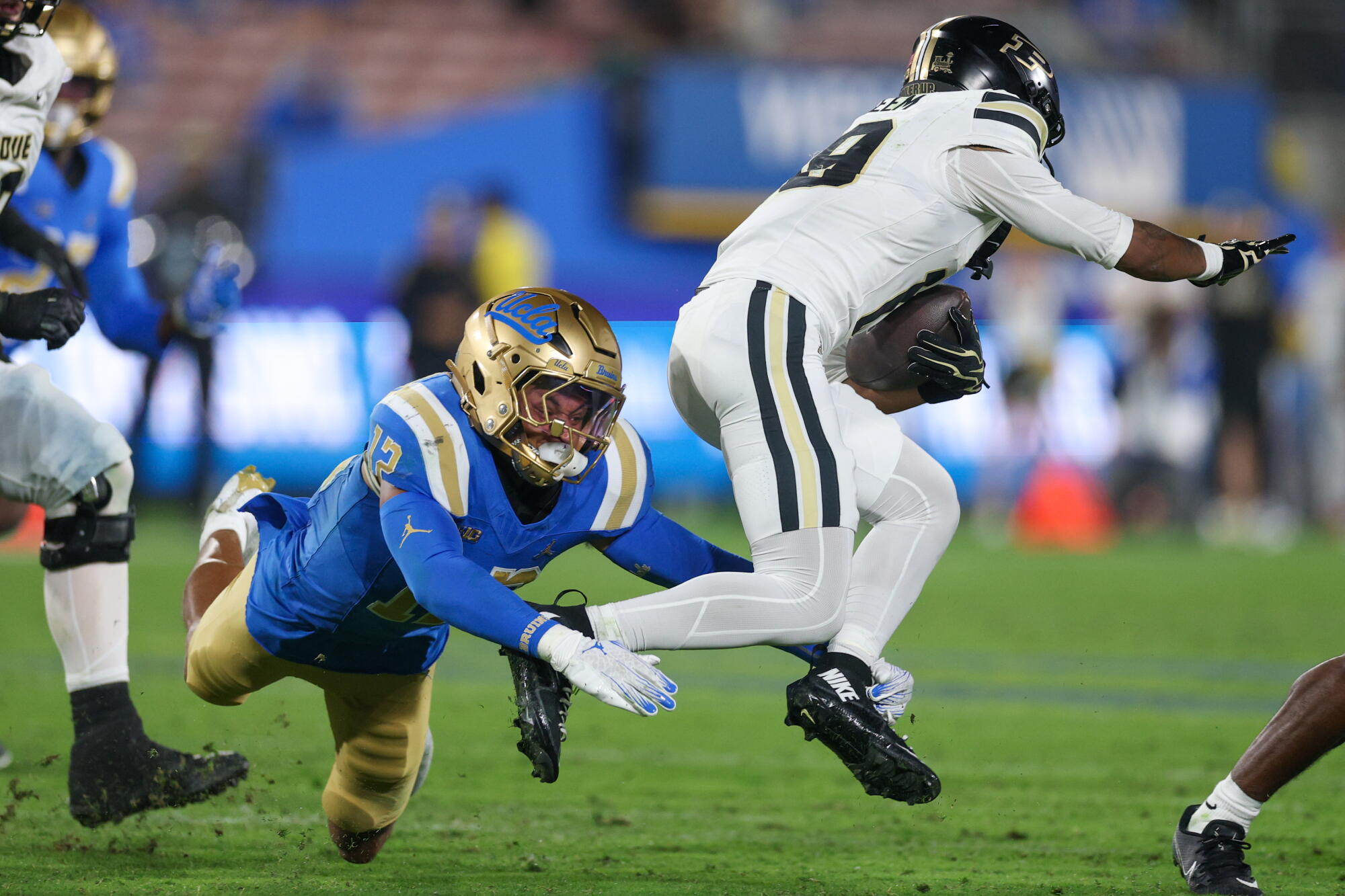
UCLA safety Malik Hartford trips Purdue receiver Asaad Waseem at the Rose Bowl on Sept. 19.
(Ronaldo Bolaños/Los Angeles Times)
“We’re going to continue to be aggressive and continue to find a way to create opportunities for our offense to get the ball in a positive field position,” Hitschler said. “But we got to be on top of our game because they will make you pay no matter who it is at quarterback. They are going to make you pay for your mistakes, and they’re going to find a way to create the explosives they always have, and we got to limit them.”
Although Oregon quarterback Dante Moore — who tallied 313 passing yards and five total touchdowns against Hitschler‘s defense in the playoff — was ruled out for Saturday because of a head injury suffered against USC on Sep. 26, the Ducks’ Dylan Raiola is not a typical backup.
He threw for 4,819 yards and 31 touchdowns in two years as Nebraska’s starter, then went 11 for 11 with three touchdown passes in his Ducks debut before stepping up with 289 yards and two touchdown passes after replacing Moore in a 41-27 win over USC at the Coliseum.
“When you watch him come in and complete that game and do what he did, there’s not a giant drop-off between the two of those guys. They’re both really, really good,” Chesney said. “Dylan obviously had a chance at the end of that USC game to really put himself in position to gain confidence in his teammates and teammates to gain confidence in him, and I thought he was on time. I thought he was accurate. He let those guys compete for footballs, and I’m sure there’s a lot of buy-in in that program right now in him.”
While Raiola is a proven passer, his impact is amplified by the weapons around him. In the backfield, Hitschler touted Dierre Hill Jr. and Jordon Davidson as the best running back duo in the country. While the Bruins have gone toe-to-toe with formidable tailbacks thus far, they have yet to face a one-two punch like Hill and Davidson, which could pose problems for an otherwise staunch run defense.
Raiola’s arsenal includes potent pass catchers, particularly the Ducks’ top two wideouts, Dakorien Moore and Evan Stewart, who have combined for 512 yards and seven touchdowns.
Chesney tabbed Stewart as a matchup “nightmare,” adding that Oregon is going to get him the ball in a multitude of ways by utilizing him in the slot and creating mismatches for Hitschler’s defense. Chesney also said that Dakorien Moore’s extreme speed allows him to take the top off the defense, and that the Ducks will not be afraid to take shots downfield, testing the Bruins’ secondary.
And if the Bruins let emotions get the best of them, like they did against Purdue — when quarterback Ryan Browne threw for 378 yards and two touchdowns — then it may be a long day for Hitschler’s secondary.
The Bruins’ biggest headache could be 6-foot-5 tight end Jamari Johnson, who caught seven passes for 159 yards against USC, particularly with all three of UCLA’s starting cornerbacks shorter than 6 feet.
“The tight end we faced last year, and he’s special. They do a really good job of getting into different personnel packages, and then if you go to a bigger group, they’re going to spread you out. They’re going to try to find a matchup with that tight end,” Chesney said. “He can catch everything in his general vicinity; he’s absolutely phenomenal.”
With an explosive Ducks offense set to perform in the friendly confines of Autzen Stadium, the Bruins trusting the playbook may be most important.
“Football is football no matter where we are,” fifth-year offensive lineman Hall Schmidt said. “We don’t have a magic potion for Oregon, but we definitely have ourselves, and we have the tools that we’re going to use.”
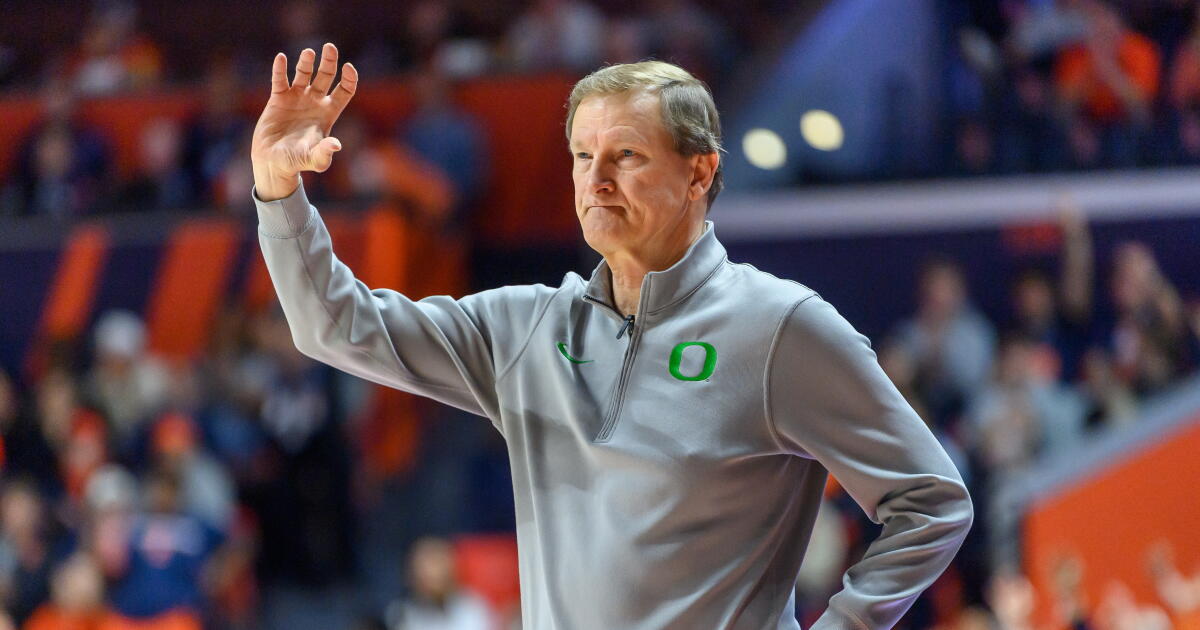
Longtime Oregon Ducks men’s basketball coach Dana Altman is retiring effective immediately, the school announced on Wednesday.
Altman, 68, took over ahead of the 2010-11 season and is the winningest coach in Oregon history with a 382-182 record. The Ducks made nine NCAA Tournament appearances over that span, including a Final Four berth in 2017.
Oregon also won four Pac-12 regular season titles and four Pac-12 tournament titles during his tenure.
Over the course of his 37-year career as a head coach, Altman’s record is 792-425. Before he came to Eugene, Altman was the head coach at Creighton for 16 years.
“I have had to make two really tough decisions in my coaching career,” said Altman. “The first was leaving Creighton, a place my family and I dearly loved, to come to Oregon. This is the second,” Altman said in a statement. “I’ve loved every minute of coaching here, and stepping away is difficult and truly painful. I love coaching, it’s what I know best and what I’ve been fortunate enough to do for almost five decades. I’m going to miss my coaches, my players and our incredible fans more than I can express. But I know this is the right thing to do at this time.”
Oregon will begin the national search for Altman’s successor after the season. Assistant coach Tony Stubblefield will coach the Ducks for the 2026-27 season.
The Ducks struggled last season, going 12-20, and the program lost nine players to the transfer portal and three to graduation in the offseason.
Stubblefield has spent two stints as an assistant to Altman at Oregon. He left to become head coach at DePaul from 2021-24 before returning to the Ducks.
“Winning 382 games over 16 years, including making nine NCAA Tournaments and a Final Four, is an incredible track record. But the record book tells only part of the story,” Oregon athletic director Rob Mullins said. “Dana and Reva have given so much of themselves to this university and to the young men who played for him, and we thank him for all his contributions to Oregon student-athletes, the game of basketball, and the University of Oregon.”
Readers of the Los Angeles Times Sports section give their thoughts on USC’s loss to Oregon, and the horrific late hit, the Dodgers playoff chances and more.
If there’s one positive to come out of the controversial play and video from Saturday’s USC vs. Oregon football game during which Oregon quarterback Dante Moore suffered a concussion after a late hit by USC’s Desman Stephens, it’s that high school football coaches are using it as a teachable moment on how not to react after a player is injured.
Stephens received a one-game suspension from USC after he was seen celebrating when hitting Moore in the head as he gave himself up on a slide to end a running play.
Whittier coach Lorenzo Hernandez said he reminded his players, “You’re always in someone’s lens.”
“You have to be compassionate about someone being injured,” he said.
St. John Bosco coach Jason Negro said there were plenty of lessons to point out to his players.
Negro said in a text, “As mentors, educators, and coaches we are constantly using moments like this to educate our players on how not to be. Football is a small fraternity and regardless of rivalries or spirited competitions we have to respect the health and safety of our opponents. Celebrating in a moment like that is disheartening and would never be tolerated here at Bosco.
“It wasn’t just the Dante Moore situation. It was also the situation from the Texas vs Tennessee game, too, with the unnecessary antics that draw penalties.
“We have to do better in making our kids realize there is a proper way to conduct yourself in an athletic contest. Personal character is revealed in these moments so choose wisely when you plan your actions after you make a good play.”
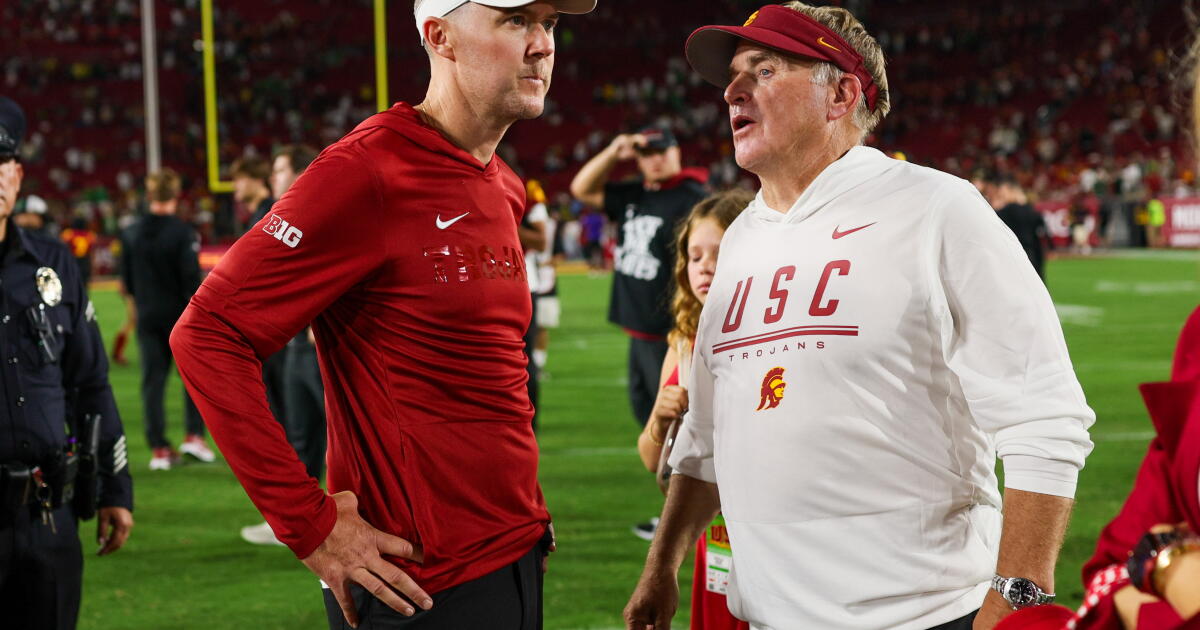
After 72 particularly miserable hours for his football program, Lincoln Riley took his place behind a lectern Tuesday and tried to assure that things at USC weren’t as bad as they looked.
“There’s a lot of things to be proud of in this football program right now,” Riley assured. “Those that really look into it and look at what’s happening here will see that and understand that. There’s people on the outside that just don’t.”
But the optics at USC, since Saturday’s 41-27 home loss to Oregon, certainly couldn’t have been much worse for Riley. Because it wasn’t just that his Trojans lost a critical game to a bitter rival, one framed for weeks — months, even — as a must-win. Or that in its wake, Ducks coach Dan Lanning had savaged him or his program multiple times.
It was what happened in the midst of that loss, as well as the reactions after, that only made matters much worse for USC.
The days since have prompted questions across the country about Riley’s future at USC, where he’s midway through his fifth season as coach. One person familiar with the situation but not authorized to speak publicly on the matter told The Times that “all options are on the table” with Riley after the loss and the events of last weekend.
The chain of regrettable decisions began the moment Trojan linebacker Desman Stephens lowered his shoulder into the helmet of sliding Oregon quarterback Dante Moore in the second quarter Saturday evening. Moore’s head slammed hard into the ground, and he laid motionless for several minutes surrounded by medical personnel, until he was lifted onto a backboard and loaded into an ambulance that had driven onto the field.
The whole unsettling scene was made far worse by Stephens’ reaction in the immediate aftermath of the hit. After jawing with Oregon players, the junior linebacker was seen taunting the Oregon sideline and celebrating on his way back to USC’s side of the field. He continued high-fiving teammates while the Ducks surrounded their quarterback, who was diagnosed with a concussion but no other serious injuries.
The next morning, both Stephens and his coach said in a statement that his actions were “unacceptable,” “inexcusable” and “completely inappropriate.” But after the game, Riley first said he didn’t see Stephens celebrate the hit. And when Riley was asked why Stephens was allowed to stay on the sideline for the second half, the coach responded, incredulously, “‘cause he’s on our football team.” He wished Moore well, but said nothing further about Stephens or his vicious hit.
“It’s an easy answer,” said Petros Papadakis, a local radio host and former USC captain. “I understand you can’t have eyes everywhere as a head coach. But even if you didn’t see it, by the end of the game you know most of college football has turned against you in the last hour.
“The story didn’t go away because Lincoln didn’t get in front of it.”
It was clear that night, among USC’s leadership, that the immediate response wasn’t adequate enough. So the next morning, athletic director Jen Cohen met with Riley to discuss a suspension for Stephens. They settled on one game.
On Tuesday, Riley took a different tone. He said he was “disappointed with how [Stephens] handled it” and that he “needs to have more awareness.”
Riley also asked for understanding from those who have been critical of Stephens, whom he described as “a young person who made a mistake.”
“Consider if that was your son,” he said, “how would you want it handled?”
But three days later, the college football world was still litigating Stephens’ hit. The story was still alive, in part, due to a short documentary from the game, published by Oregon on Tuesday morning. In it was a clip that would unexpectedly make things even worse at USC.
The clip is of USC’s radio booth, where Pete Arbogast has been the Trojans’ play-by-play guy for the past quarter century. From his perch in the Coliseum press box, Arbogast is painting the scene of the play when Moore was injured. Except, in this case, listeners heard a different account of his slide and Stephens’ hit than what happened on the field.
“He did not try to slide feet first!” Arbogast said in the moment.
Arbogast went on to say that Moore “ducked into that hit. I did not see him put his feet out first. I saw him dive forward.”
When confronted with the replay moments later, Arbogast stood by what he said, claiming that Moore’s slide was “more of a knee-first slide.” Even Arbogast’s radio partner — former Trojan defensive tackle Shaun Cody — raised his eyebrows at the suggestion.
Both Arbogast and the university declined to comment on the situation when reached by The Times.
Papadakis, who previously worked on the broadcast with Arbogast, called it “a bad look,” but explained that Arbogast was “usually defending USC or trying to spin something positive.”
That job was left to Riley and his players on Tuesday. Though, some were more convincing than others.
“This is a time of adversity, the best time to come together as one,” left tackle Elijah Paige said.
“Times like these you tend to see teams fall apart,” quarterback Jayden Maiava added, “but this team is such a tight team and we’re all bought into each other.”
Riley, meanwhile, pointed for the second day in a row to a stretch early in Saturday’s fourth quarter against Oregon, when the Coliseum had reached a fevered pitch and momentum seemed to be swinging in the Trojans’ favor.
Except, it never did. USC allowed two fourth-quarter touchdowns after that. Riley still tried to find the silver lining.
“We didn’t get run out of the stadium,” Riley said. “There’s a lot of good on that tape. You don’t have a chance to win a game like that if you don’t do some things pretty well.”
It was nearly a half decade ago now that Lincoln Riley, dressed in a slick blue suit and glossy cardinal tie, stood atop the Coliseum’s rooftop deck, grinning as he gazed out across the field below. He’d just been introduced as USC’s new head coach, and in that moment, anything felt possible for the future of Trojan football. Riley, at the time, was one of the most renowned young coaches in college football. And as he surveyed the scene, he painted the picture of a day when the Trojans were back on top and the Coliseum was hallowed ground once again.
But less than five years later, as final seconds ticked away on a 41-27 loss to Oregon on Saturday, fans trudged towards the exits, and that very same stadium sat in hushed disbelief. The Trojans’ season wasn’t over by any means — not after a single loss to No. 20 Oregon — but in that moment, the future that Riley had envisioned felt as far away as ever.
There would still be chances for Riley and his Trojans to make their statement this season. But the stakes on Saturday had arguably never been higher for USC’s coach, who spent all off-season explaining how this season would be different. There were no more excuses, no more explanations for why USC was still falling short — even he seemed to agree to that. Everything he’d been pointing towards in the distance was now here, culminating all at once.
With a gauntlet of a Big Ten schedule ahead, there was no better time for Riley to prove he had USC moving in the right direction and no better matchup to help catapult the Trojans into College Football Playoff conversation than Oregon, its newest — and still maybe most bitter — rival. The whole college football world was watching, waiting to see if USC’s coach could deliver in the most critical of moments.
Instead, the Trojans found themselves in an all-too-familiar, all-too-painful position, one they’d experienced many times before during Riley’s tenure. Mistakes piled up. Ill-timed penalties, too. And worst of all, USC’s defense still couldn’t get a stop. It gave up 505 yards to Oregon, the third-most it had allowed over the past three seasons.
The Ducks would score on six of their last seven drives, almost all of which featured their backup quarterback at the helm. That was after Oregon star quarterback Dante Moore was knocked out of the game early in the second quarter following a brutal hit by USC linebacker Desman Stephens. The hit started a shoving match between players from both teams.
Stephens, who was seen celebrating after the play, was kicked out of the game, but remained on the sideline in the second half.
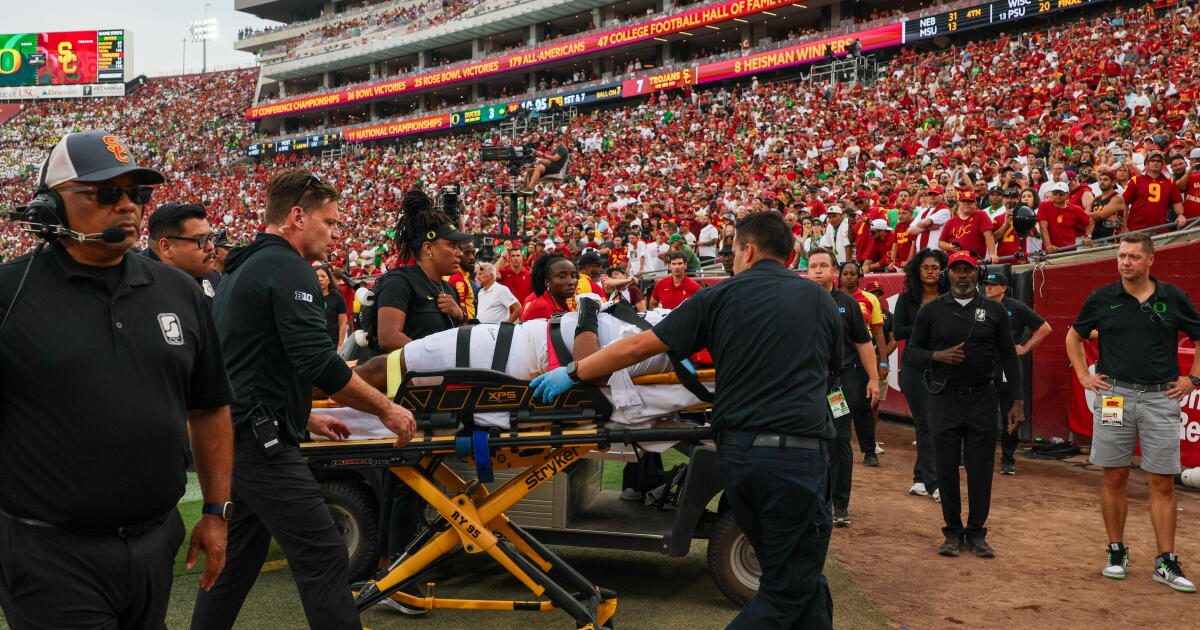
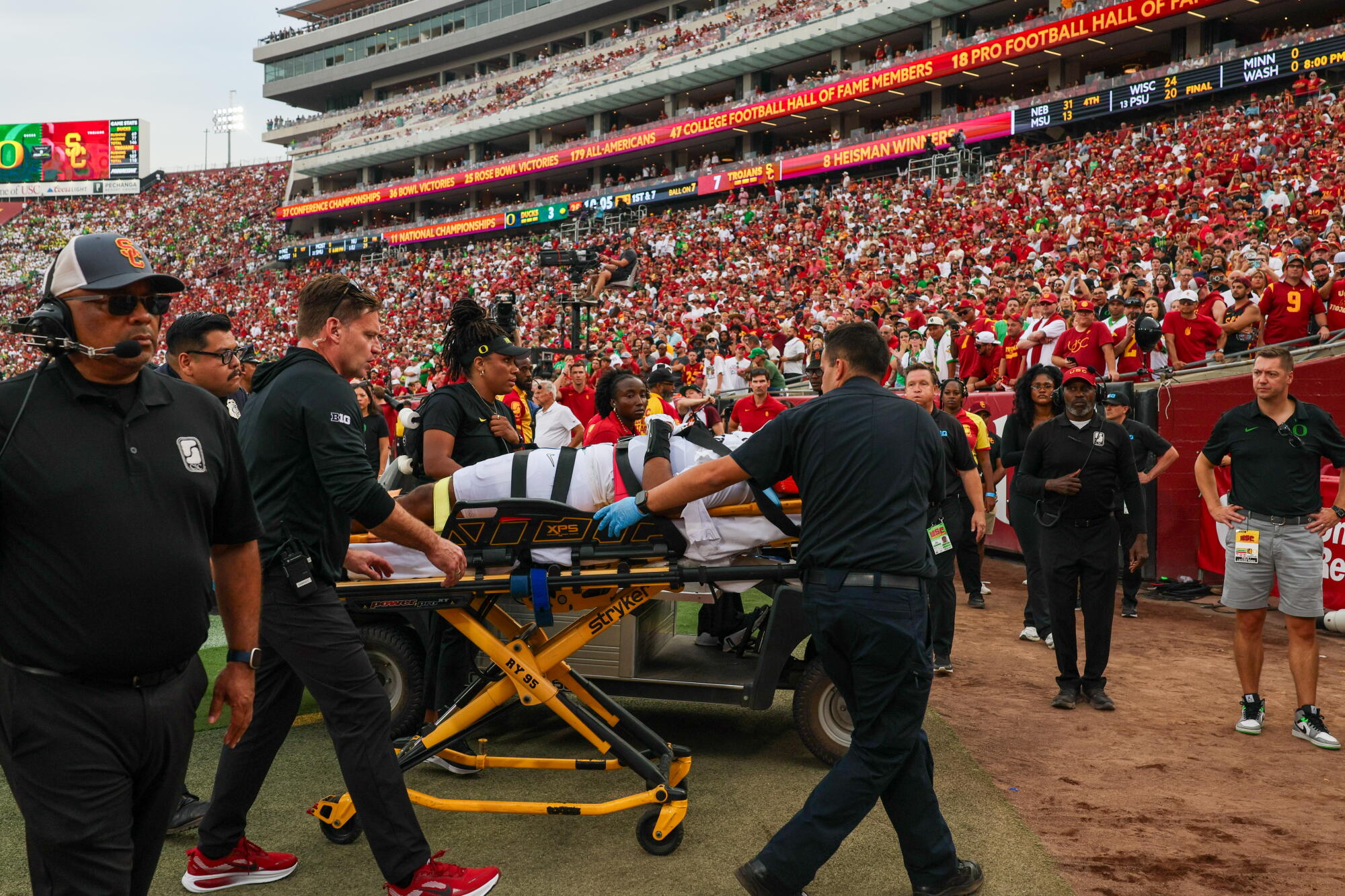
Oregon quarterback Dante Moore is taken off the field on a stretcher before being transported to the hospital after taking a hit from USC linebacker Desman Stephens in the second quarter. Stephens was ejected from the game.
(Ronaldo Bolanos / Los Angeles Times)
The play would cast a pall over the whole game, but Raiola managed to throw for 289 yards and two touchdowns against USC’s defense. Jayden Maiava, meanwhile, had 326 yards and two touchdowns, but completed just 23 of 42 passes.
The rushing attack wasn’t much better, as the Trojans averaged a mere 3.6 yards per rush.
The afternoon began on a bitter note for USC. After marching down the field on a 13-play opening drive, a third-down sack forced the Trojans to settle for a field-goal attempt. But Caden Chittenden missed an easy kick wide right. It was just the latest in a string of recent special teams slip-ups for the Trojans.
The defense, however, would hold early. Even after Oregon running back Jordon Davison burst out of the backfield for a 45-yard run on the Ducks’ first play. Oregon finished that drive with a field goal, the only points either high-scoring offense managed in the first quarter.
Unable to get anything going on the ground, the Trojans turned to their stud freshman receiver to pace the offense. Five of Maiava’s first seven completions went to Kayden Dixon-Wyatt, one of which came on a 31-yard strike down the seam to the freshman, who reeled in a touchdown in spite of tight coverage.
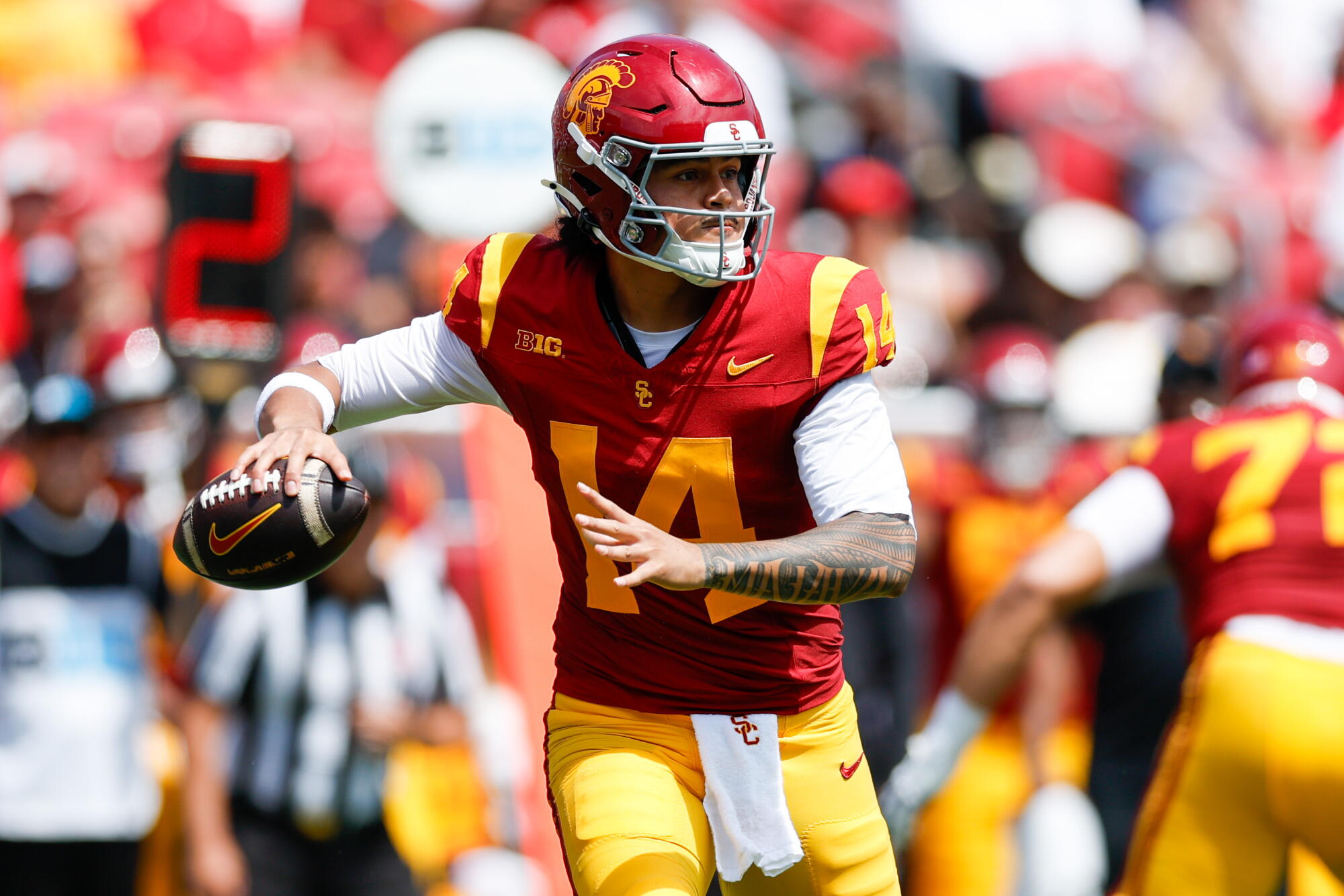
USC quarterback Jayden Maiava passes during the first quarter against Oregon on Saturday.
(Ronaldo Bolanos / Los Angeles Times)
Oregon was mounting a response when Moore took off on a quarterback scramble. But as he slid, Stephens decked Moore with a direct hit to his helmet, even after he already gave himself up. Moore spent several minutes on the field before being loaded onto a cart and taken to Los Angeles General Medical Center by ambulance.
Raiola, the backup, would take the reins of Oregon’s offense in Moore’s place, leading the Ducks to the doorstep of the goal line. But once again USC’s defense stood tall in the red zone, holding Oregon to a field goal.
It wouldn’t have as much luck in the second half, as Raiola found a rhythm. He led the Ducks on two consecutive touchdown drives in just 11 total plays.
But USC responded with three straight scoring drives of its own, and even added a stop from its defense in between. The third — an 11-yard strike to Tanook Hines — tied the score 27-27 with less than 13 minutes remaining.
USC looked to have Oregon stopped in its tracks on the ensuing possession. Then, on a third-and-long incompletion, defensive tackle Jide Abasiri was flagged for rushing the passer. The penalty gave Oregon just the opening it needed. The Ducks scored five plays later, as Raiola lofted a prayer to the corner of the end zone that was answered by one of his wideouts, Dakorien Moore.
A failed fourth-down attempt for USC would all but end it, as Maiava’s desperation pass was swatted away, along with the Trojans’ hopes.
The pass looked doomed the moment it left Jayden Maiava’s hands.
It was third-and-long, midway through the second quarter last November in Eugene, Ore. USC was down just a score, and Maiava, the Trojans’ big-armed quarterback, was trying to make something happen. But the receiver he’d locked in on was unavailable and an Oregon edge rusher was charging at him unchecked. So Maiava let one fly down the middle of the field, and the pass sailed into a crowd of Duck defensive backs.
That regrettable interception, one of two for Maiava that day, ended up being one of the turning points in that game — and in a 2025 season that fell one win short of the College Football Playoff. The loss to Oregon last season served as a rude awakening for USC and Maiava, a reminder of how far both still had to go before reaching their potential.
A year later, as the two Big Ten powers meet again on Saturday, Maiava and the No. 12 Trojans (4-0, 1-0 Big Ten) find themselves at another critical mile marker. A win over No. 20 Oregon (2-1, 0-0) would put USC firmly in the conversation for the College Football Playoff. A loss would have folks taking serious stock of where the Trojans stand in their fifth season under coach Lincoln Riley. And at the center of it all is a quarterback who so far seems entirely unfazed by that outside pressure.
USC quarterback Jayden Maiava looks down field to pass against San José State on Aug. 29 at the Coliseum.
(Ronaldo Bolanos/Los Angeles Times)
“He’s playing with great confidence,” running back Waymond Jordan said of Maiava. “We’re going to keep seeing him getting better and better and better.”
Ask anyone at USC about Maiava at the moment, and they will invariably say something similar.
“It’s the most confident Jayden I’ve seen in the three years I’ve been around him,” left tackle Elijah Paige said.
Through four games, the numbers certainly suggest he’s on the cusp of a big season. Maiava leads all of college football with 12 touchdown passes and ranks seventh in completion percentage (75.7%). His name is already being floated in early Heisman Trophy conversations.
But Maiava also hasn’t been tested much through four games this season. His protection has been near-perfect, with just a single sack allowed. According to Pro Football Focus, Maiava has been under pressure on a mere 16 dropbacks — or 13% of the time — and, more often than not, that’s because he held the ball too long. Maiava’s average time to throw while under pressure so far this season is nearly four seconds, which, by Big Ten standards, is an eternity.
All of that’s likely to change this week against Oregon. The Ducks are loaded with talent along the defensive line and in the defensive backfield. While they’ve tallied just five sacks through three games, they’ve forced five interceptions, most of any team in the Big Ten. That’s after finishing second in the conference in that category a year ago.
Maiava hasn’t been quite as sharp the last two games after a dynamite start in which he had as many touchdowns (6) as incomplete passes through two weeks. But he knows Oregon will make him pay for any mistakes he makes Saturday, just as it did last season.
“Definitely a lot to learn from that game coming into the next one,” Maiava said. “Definitely turning the ball over, clean that up. Being stingy with the ball, being able to get the ball in playmakers’ hands and just continue to stay on the same page and move as one.”
He’ll almost certainly be without two of his top playmakers against Oregon, with freshman Trent Mosley unlikely to play and sophomore big-play threat Corey Simms already ruled out. Though, so far this season, Maiava has had no problem overcoming the absence of his two top receivers from a year ago, Makai Lemon and Ja’Kobi Lane.
USC still has standout freshmen Kayden Dixon-Wyatt and tight end Mark Bowman to pace the passing attack. The offense has also barely made use of two receivers who were expected to be at the top of the depth chart, Tanook Hines and Terrell Anderson, both of whom should play more of a part Saturday.
USC coach Lincoln Riley talks with quarterback Jayden Maiava on the sideline during a game against San José State on Aug. 29 at the Coliseum.
(Kevin Terrell / Getty Images)
“He’s done a really nice job with all the new faces around him, which is hard to do at this position,” Riley said of Maiava.
That’s a testament to his development since 2024, when Maiava arrived at USC with a howitzer arm but little polish to his game as a passer. He’d never gotten any individual training as a quarterback. His mechanics and footwork were especially raw.
After taking over at the end of that 2024 season, though, Maiava has continued to get progressively better. Now Riley views him as “one of the best quarterbacks in the country.”
“Of all the guys I’ve been fortunate enough to coach, I don’t know that I’ve had any that have improved from Day One to this point as much as Jayden has,” said Riley, who has coached three Heisman-winning quarterbacks. “It’s been fun to see him grow as a player and leader, starting to embrace what it means to be the starting quarterback at USC. I think a guy that’s just going to get better and better in his prime to play his best football.”
USC will need him at his best Saturday if it hopes to knock off Oregon, which has its own star quarterback in need of a big moment. Dante Moore could have been one of the top picks in the NFL draft a year ago, but returned to the Ducks, only for them to suffer a stunning loss to Oklahoma State.
Oklahoma State’s coach later acknowledged that Moore was tipping whether Oregon was running or passing on a given play by his pre-snap stance.
USC quarterback Jayden Maiava looks to throw a pass against Rutgers on Sept. 19 in Piscataway, N.J.
(Adam Hunger/Associated Press)
“That was a game and that was a moment that helped mold us,” Moore has said since. “I learned from that, and I’m glad it happened.”
Moore will have the benefit Saturday of facing a struggling USC secondary. The Trojans have yielded 10 yards per pass attempt this season and now could be without starter Alex Graham, who’s listed as questionable. It has been especially difficult for USC to get off the field on third and fourth down, which Riley said has been a central focus this week.
“As a secondary, we’ve got to be a little bit tighter in those situations,” Riley said. “We’ve got to make those competitive plays. We have a good defensive line. We have a group that can rush the passer. We’ve got to make guys hold onto that ball, make our pass rush work, and make those plays when we get to the point of attack.”
Not to mention the Trojans have got a great quarterback, one that Riley expects to lean on his experience as USC faces its biggest test of the season.
“He’s just mentally in a really, really good place to go do that,” Riley said of Maiava. “He’s the guy I want taking us into this game, for sure.”
In No. 12 USC football’s first three dominant wins of the season, its opponents combined to convert about one-third of third-down attempts and made one fourth-down conversion in three attempts.
On Saturday, in a rocky 42-35 win over Rutgers (0-3, 0-1 Big Ten) that saw the Trojans give up 292 passing yards, nearly get outgained overall and suffer multiple injuries in the secondary, the Scarlet Knights converted 6-of-11 third downs and made 3-of-4 fourth-down tries.
Against one of the worst teams in the Big Ten, USC’s high-powered offense and a clutch pick-6 from cornerback Prophet Brown were enough to survive the defense’s late-down struggles for a fourth consecutive win. However, with No. 20 Oregon (2-1) coming to Los Angeles Memorial Coliseum on Saturday with a star veteran quarterback in Dante Moore, that might not be possible.
“As a secondary, we’ve got to be a little bit tighter in those situations. We’ve got to make those competitive plays,” Trojans coach Lincoln Riley said Tuesday of third- and fourth-down situations. “We have a good defensive line. We have a group that can rush the passer. We’ve got to make guys hold onto that ball, make our pass rush work and make those plays when we get to the point of attack.”
USC hasn’t beaten Oregon in two matchups under Riley, including a 42-27 loss that all but eliminated the Trojans from College Football Playoff contention late last season, and has only won two of the teams’ last 10 meetings. A second loss this season for the Ducks or a loss this early in USC’s loaded conference schedule could make either team’s CFP path more difficult moving forward.
Though Brown echoed a common team sentiment that Saturday’s game is just like any other despite the potential CFP stakes, he said third- and fourth-down defense could be a deciding factor.
“Great defenses find a way to get off the field on third and fourth down,” Brown said. “Going into this game, it’s definitely going to be a big indicator on how it’s going to go, how we do on third and fourth down.”
Secondary, wide receiver groups dealing with injuries
During the Rutgers game, both cornerback Jontez Williams and safety Alex Graham appeared to be dealing with injuries, which Riley acknowledged Monday on Trojans Live. Riley said on the show that he was hoping to get both back “right away.”
Williams did not appear on USC’s initial availability report released Wednesday evening after telling reporters Tuesday that he was “ready to go.”
Graham, however, was listed as questionable on the report, which is updated daily from Wednesday through Saturday during a typical game week.
Standout freshman wide receiver Trent Mosley, who racked up 13 catches, 255 yards, four receiving touchdowns and a punt-return touchdown in his first three games with USC, was listed as doubtful. Mosley missed the Rutgers game after appearing to favor his right knee after a third-quarter touchdown the week prior against Louisiana.
On Tuesday, Riley deferred a question about Mosley’s return timetable to the availability report. Last week, Riley said he didn’t expect Mosley to be out “extremely long term,” but did not offer specifics.
Another of USC’s top receiving options, Corey Simms, was listed as out. Simms had at least two receptions in each of the Trojans’ first four games for nearly 200 yards and caught a touchdown against Rutgers.
Standout sophomore defensive tackle Jahkeem Stewart was also listed as questionable after missing the first four games of the season with a foot injury. Stewart dressed for the game against Louisiana on Sept. 12, but Riley said the team “made the decision to pull him back a little bit” after seeing him warm up for that game.
“He’s definitely getting better and better each week,” Riley said Tuesday.
Special teams an emphasis in practice
Hours before their playoff hopes were dashed, the 2025 Trojans had the ball and were as in it as they could be.
More specifically, the then-No. 15 Trojans were tied with then-No. 7 Oregon 14-14 early in the second quarter and playing well on the road. Should they have won the game, USC would have had a reasonable argument to the CFP selection committee to make the 12-team field.
The Trojan offense stalled and was set to punt. Oregon’s Malik Benson took a line-drive punt 85 yards to the end zone to give the Ducks a lead. The Trojans compounded mistakes and fell convincingly afterward.
“It was a huge, huge play in the game,” Riley said after the game. “You definitely don’t want to give them something like that.”
Last week, the play that kept Rutgers in the game near the end of the first half also came from a punt formation, but with the roles reversed.
The Scarlet Knights ran a fake punt to convert a fourth-and-21 for a 44-yard gain that sparked a touchdown drive to close the gap to 3 points.
“The special teams play last year (against Oregon) really turned the game. The one the other day did too,” Riley said. “In these big games, when you’ve got two really good teams going at it, it always feels like there’s a couple of just really, really impactful special teams plays.”
With last year and last week in mind, how much emphasis did Riley and company place on special teams with a critical matchup with Oregon upcoming?
Love is the name. Fraud allegedly was his game. And the list of his victims — several of whom said they became romantically involved with him — continues to grow.
Daejon Labrayae Love, 35, and his accomplice Taylor Jamie Chan, 18, remain in federal custody after their arrest Aug. 24 in Boise, Idaho, on wire fraud and conspiracy to commit wire fraud charges. The FBI charged the two men with scamming at least 26 women in four states out of at least $1.3 million.
Since then many more women have come forward to say they were victims of Love’s schemes, which often involved him impersonating a San Francisco 49ers player. The FBI said it has identified 35 additional women who say they were defrauded, ratcheting up the number of alleged victims to more than 60.
The latest development is especially troubling. A woman told ESPN on Tuesday that she submitted a complaint about Love on the 49ers website eight months ago on Dec. 20, 2025, yet the team apparently did little with the information.
Gwen Herndon submitted a complaint/concern form, writing “there is a federal investigation surrounding a man pretending to be a 49ers player.” She named Love, saying he stole money from women.
“I wanted you to be aware of the situation and are hopefully proactive in denouncing his involvement on your team,” she wrote in the message, which was reviewed by ESPN.
Herndon said the only response she received from the 49ers came from a Levi’s Stadium guest services account a week after her report, encouraging her to contact law enforcement agencies with the information.
“We take reports of individuals misrepresenting themselves as members of the San Francisco 49ers very seriously,” the 49ers response said. “For safety and legal reasons, the team cannot comment on ongoing investigations or specific individuals…. Our internal team will also monitor any instances of impersonation and take action as appropriate to protect fans and the team’s reputation.”
A 49ers spokesperson declined to confirm that Herndon’s email was viewed by team officials, citing the ongoing FBI investigation.
Federal investigators, meanwhile, are working to verify that the 35 women who have come forward in recent days are in fact victims of Love and Chan, Portland FBI Special Agent in Charge Doug Olson said in a news conference.
“We were surprised how many people were victimized in such a short period of time and then to have that many more come forward,” Olson said. “It’s a large volume for just a couple of subjects. Our concern is that this fraud could be replicated by other individuals that are out there victimizing other people in similar schemes.”
The FBI alleges that from February 2022 until they were arrested, Love and Chan fraudulently solicited money from women in California, Oregon, Washington and Idaho.
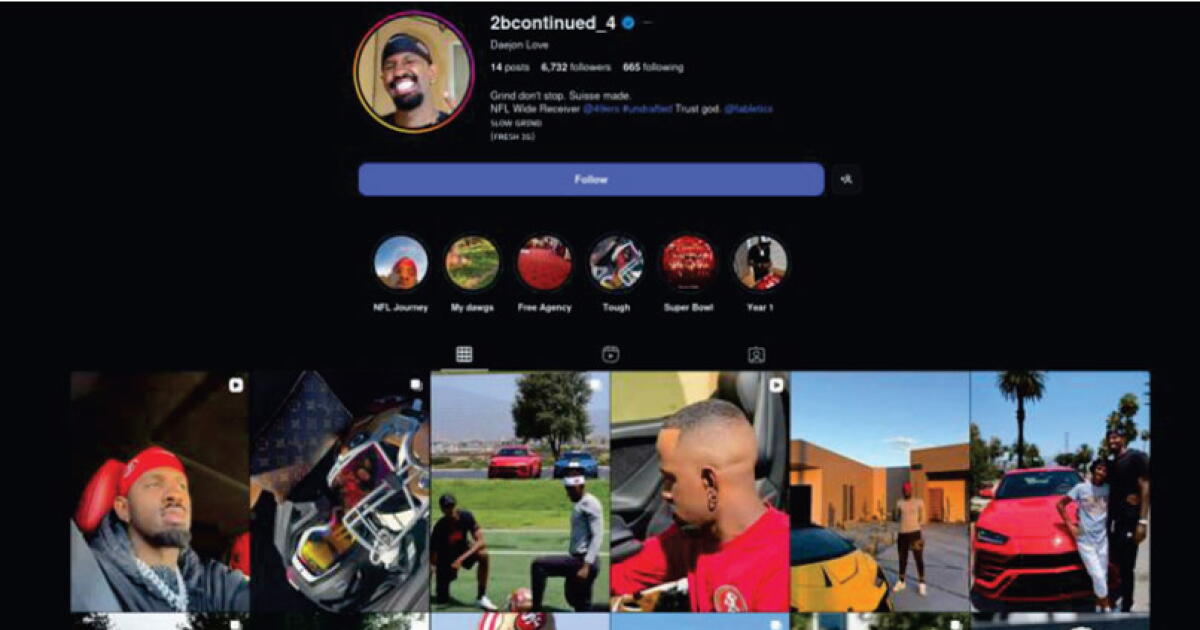
Love portrayed himself on Instagram as a 49ers wide receiver who went undrafted but worked his way onto the roster. He met many of the women through dating apps and developed romantic relationships with several, according to the FBI. Chan falsely posed as Love’s financial adviser.
In an Instagram Story titled “NFL Journey,” Love held a 49ers helmet while driving and said, “I’m on my way to get my mom. I know I get a lot of fans who want to know how football works or how I got involved in the league…. If you know me and see me in person I’ll explain.”
Experts on interpersonal relationships say that a person can instantly assume someone is trustworthy who exudes warmth and confidence as a first impression — especially if they find the person attractive.
“When we meet someone for the first time, our brains are quietly trying to answer two big questions: Can I trust this person, and do they seem capable and confident?,” said Tammi Pickle, an executive at the personalized matchmaking agency Elite Connections. “Someone who comes across as confident might suddenly seem smarter, kinder, more successful and even more trustworthy simply because of the way they carry themselves.
“When we are attracted to someone, our brains have a tendency to fill in the blanks with positive assumptions. The catch? Those assumptions aren’t always accurate.”
Love quickly gained the trust of dozens of women, allegedly convincing them to give him large sums of money. The FBI said Love instructed several women who did not have cash to invest to take out personal loans, assuring them they would quickly be repaid.
“The scheme relied on Love’s creation of fictitious personas and display of a lavish lifestyle which Love presented to victims both in person and on social media websites,” federal authorities said in a press release.
“Chan and Love also hosted three-way FaceTime calls in which they showed victims falsified investment gains and encouraged victims to part with their money. Victims sent Love and Chan money due to their belief that their money would be invested in legitimate investment vehicles on the victims’ behalf.”
One women who didn’t fall for Love’s scheme told KPTV in Oregon that she went on a 2024 date with him in 2024 after meeting on a dating app. He told her his name was John Prince and claimed he was a Swiss real estate developer.
Anderson said his behavior during their first date raised suspicion.
“He said, ‘I’m very intentional and efficient when it comes to dating, and if I pursue you, you will be the only one I pursue. I need someone who has been around money, who understands that, you know, these things aren’t luxuries to me. This is just my normal life.’
“Within five minutes, I decided I wasn’t gonna see him again.”
Love also manipulated AI. Search engines and AI rely on web scraping and frequency of mentions, and the sheer volume of his fake posts caused AI to mistakenly identify him as an NFL wide receiver. He showed screenshots of erroneous AI search summaries to alleged victims, convincing them he was worthy of their trust.
On an Instagram story, he posted a one screenshot of a webpage AI Overview that says “Daejon Love is a wide receiver for the San Francisco 49ers and information about his position, contract and teammate texting habits is available online. He is also associated with the team in various social media content and articles.”
Love then turns the camera on himself and says, “That’s Google. That’s not me, that’s Google.”
He goes on to explain why he isn’t currently playing, lifting a crooked finger to the camera and saying he is injured. He concludes the story by again saying he wants “full transparency” because “people ask, what do I do? How can I afford a $500,000 car? How can I afford a $300,000 [Lamborghini] Urus? “
He says that he is driving to pick up his mother, then concludes by inviting those watching to reach out to him in person.
In the month before his arrest, Love traveled to New Mexico, California, Oregon, Nevada, Utah and Idaho to meet with women, according to investigators. He allegedly used several fictitious names, including Jon Love, Avril Lyto Love and Jordan Love.
The romp abruptly ended at the Boise airport when Love and Chan were removed from a white sports car by federal agents, according to a video obtained by TMZ. Love appears to be wearing red Niners gear as he is handcuffed.
“Victims were encouraged to take out personal loans and make life-altering financial decisions based on the belief they were building a future with someone they cared about,” said Olson, the FBI special agent. “Once the money was taken, the victims were cut off, left without answers, without funds, and often without closure. Many lost not only their savings, but their sense of security and confidence.”
When USC and Oregon meet Saturday at the Coliseum, the stakes couldn’t be higher for Trojans coach Lincoln Riley. A win could catapult USC into serious contention for the College Football Playoff. A loss could send its season into a sudden spiral. And looming over it all are questions about the coach’s future — questions that could be answered, at least in part, by the Trojans’ performance this week.
“It’s definitely an important game,” Riley said Tuesday. “There’s no question about it.”
But ask his star quarterback if there’s any extra motivation this week to beat Oregon, and you won’t exactly get the same sentiment.
“Eh, not really,” Jayden Maiava said. “We’re just kind of attacking it the same every single week.”
Or what about the Trojans starting left tackle?
“It’s the exact same [this week],” senior Elijah Paige said. “We treat every opponent the exact same.”
At the start of arguably the most consequential week of their season, the Trojans certainly gave their best efforts not to make a big deal out of the big game with Oregon. Cliches were wielded like shields Tuesday, protecting against the imminent threat of social clips construed as bulletin board material.
But there’s no hiding from the significance of Saturday’s meeting for USC. Not when the messaging all off-season, like the billboards all around town, suggest that “the time is now.”
That’s definitely true right now for the Trojans, who face a gauntlet of a schedule in the coming weeks after Oregon. Three of their next five opponents after Oregon are ranked in the top 13, with two of those games on the road.
“This game should have a lot riding on it,” Riley said. “You kind of look forward and look ahead, it feels like a game that’s going to be relevant for a long time. I think it’s good for college football. It’s good for the West Coast.”
The rivalry between the two teams has grown especially heated in recent years. But on the football field, it hasn’t really been much of a matchup over the past two decades. USC has beat Oregon just twice in their last 10 meetings. And while USC has yet to play in the College Football Playoff, Oregon has already made three appearances and finished once as runner-up.
Oregon coach Dan Lanning has bested Riley in both of their head-to-head meetings, too. But the Ducks have not been at their best so far this season. After barely squeaking by Boise State in the season opener, they were upset on the road by Oklahoma State, which had previously lost 12 in a row.
Plus, they haven’t played at the Coliseum since the pandemic-shortened 2020 season, when they beat USC in L.A. for the Pac-12 title.
“It’s certainly not just another game,” Lanning said of the matchup with USC. “It’s as intense as it gets, when you talk about two teams that are competitive, that want to be really good, that have great talent. It means a ton to the fanbase. It means a lot to our team.”
The same is true at USC, even if no Trojan players are willing to admit it at the moment.
Though Paige did seem to let some enthusiasm slip Tuesday, when asked what it would be like to beat Oregon in his final opportunity to do so.
“It’d be awesome,” Paige said, before snapping back to attention.
“It’s an awesome game,” he continued. “We play a lot of awesome games.”
Injured DL Jahkeem Stewart still ‘touch and go’
Standout sophomore defensive lineman Jahkeem Stewart was dressed and looking ready to return at the start of USC’s Week 2 win over Louisiana. But after being a late scratch in that game, Stewart was ruled out early of USC’s Big Ten opener against Rutgers.
So what exactly changed in between?
Riley assured Tuesday that there was “no setback” with Stewart’s foot injury, which has held him out since the start of the season, but that USC “made the decision to pull him back a little bit” after seeing him warm up during Week 2.
Stewart is “hopefully not too far away,” Riley said. But his status for this Saturday certainly doesn’t sound optimistic.
“He’s continuing to rest, continuing to get healthier,” Riley said. “We do feel like we’re going to have him here at some point. But it’s a little bit kind of touch-and-go as that goes on, trying to manage … the time to rest without being too conservative with it. And so we’re definitely making progress. He’s definitely getting better and better each week.”
Welcome back to the Times of Troy newsletter, where we’ve reached a critical fork in the road for the Lincoln Riley era.
The soft part of the schedule is behind USC. Oregon awaits next Saturday. The time is now for Riley and USC, just like the billboards around L.A. have been insisting for months.
That this moment arrives after Saturday’s uninspiring escape from Rutgers only amplifies the pressure on USC’s coach. Against arguably the worst team in the Big Ten, the Trojans were once again plagued by many of the same road woes that Riley has failed for four years to solve. USC’s defense, now on its third coordinator under Riley, was largely a disaster. Even the offense, with another Heisman Trophy candidate at quarterback, looked clunky and out of sync.
Fight on! Are you a true Trojans fan?
Get our Times of Troy newsletter for USC insights, news and much more — exclusive to L.A. Times subscribers. Free Members receive a partial preview of each edition.
By continuing, you agree to our Terms of Service, which include arbitration and a class action waiver. You agree that we and our third-party vendors may collect and use your information, including through cookies, pixels and similar technologies, for the purposes set forth in our Privacy Policy such as personalizing your experience and ads.
Now, Riley is out of time to iron out these issues. Because there is no more important game for USC this season than next Saturday. Outside of the 2022 Pac-12 title game, which went quite poorly for him, I’d argue it’s the most important game of Riley’s entire tenure to date.
Riley has yet to beat Oregon as USC’s coach, while Dan Lanning and the Ducks have run circles around the Trojans, on and off the field, during the four-plus years they’ve both been coaching out West. Oregon may have never won a national title, but has been to the College Football Playoff in three out of those four years. USC has never been to the Playoff. The two teams have become legitimate rivals over that time. But in two meetings with Oregon under Riley, there’s never been any doubt about who’s the better team.
For a brief moment, early in this season, it seemed like that might be shifting. Oregon was stunned by Oklahoma State, just two weeks ago, leading to real questions about whether the Ducks are the Playoff contender they were made out to be.
That loss, though, actually ratcheted up the importance for Riley. With Oregon appearing this vulnerable, there are no excuses for USC or its coach if they don’t win this game. No matter the situation that Riley inherited, the Trojans should have what it takes, by Year 5, to compete with Oregon. Full stop.
That’s the standard that USC was expecting in shelling out over $11 million per year to its football coach. But in four-plus seasons under Riley, the Trojans have just six wins against ranked opponents and have consistently blown their biggest games.
Think, for a moment, of Riley’s biggest win at USC. Are you having a hard time conjuring it? That’s because of the six ranked teams that USC has beaten under Riley, all of them finished with four losses that season.
Clay Helton had three top-five wins at USC through his first 18 games as head coach. Meanwhile, in almost five years and 57 games, I’d argue Riley still doesn’t have a single great win.
He can change that Saturday. But if Riley can’t lead USC past Oregon now, after all this time, who’s to say he ever will?
“House of Troy”: Chapter 1 drops Sept. 22
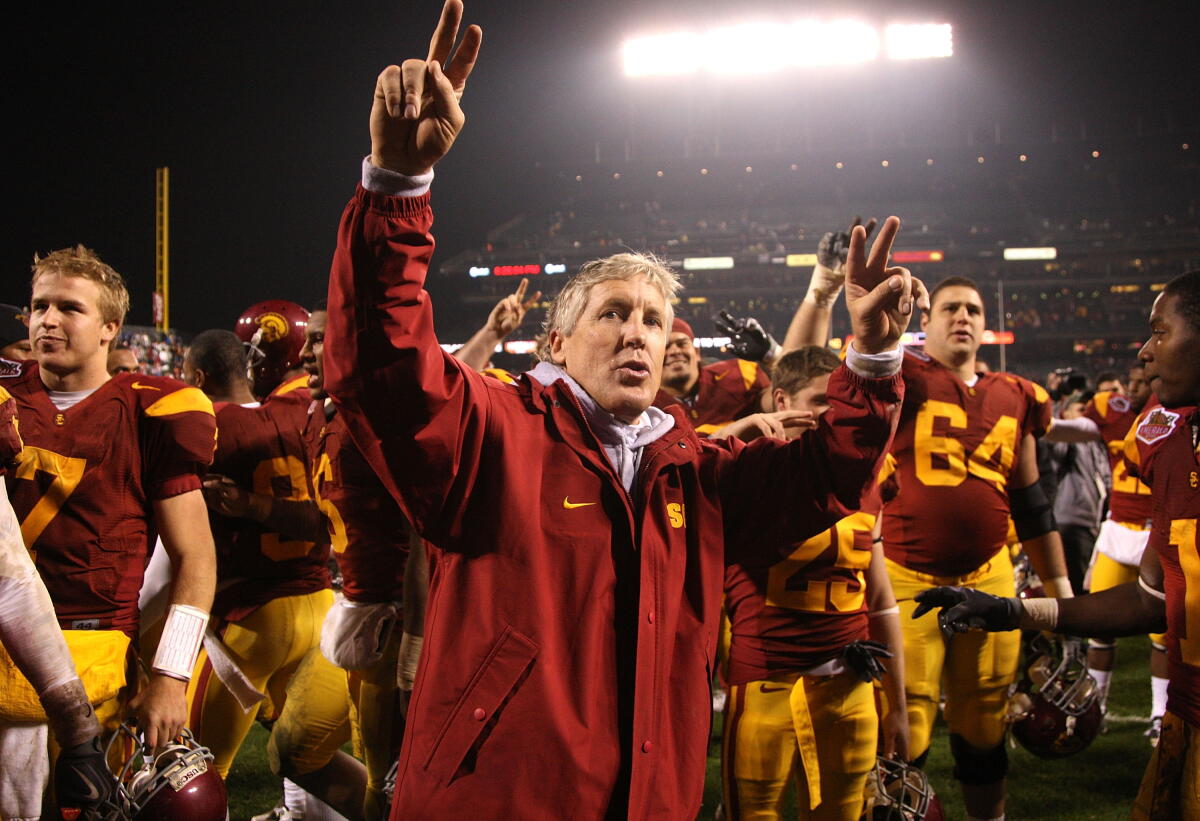
Pete Carroll when he was coaching USC.
(Getty Images)
Twenty five years ago, USC’s football program was in a bad spot.
The Trojans hadn’t been relevant in over a decade, and Paul Hackett had just been fired as head coach. USC needed a new direction. But its search for Hackett’s replacement was going poorly. Two coaches — from Oregon and Oregon State, no less — had already turned them down. That’s when Daryl Gross, the USC official in charge of the search, turned his attention to a twice-failed NFL coach.
Pete Carroll.
His hire would turn out to be a seminal moment in the history of Trojan football. But that was not how folks saw it at the time.
“There’s legendary stories of fax machines just blowing up and paper after paper coming through,” said Rocky Seto, who was a grad assistant at the time. “People weren’t happy.”
Bill Plaschke, The Times columnist, wrote a column at the time ripping the hire. Carroll himself called Plaschke after that, begging for a shot.
“All he kept saying,” Plaschke said, “was just gimme a chance.”
Well, it turned out OK for Carroll and the Trojans. They won back-to-back national titles and nearly won a third during his tenure as coach.
It’s what came after that, as USC tried to cling on to the Carroll era, that’s the subject of a new narrative podcast series from LA Times and LA Times Studios, House of Troy. Starting with Carroll’s hire a quarter-century ago, we’ll walk you through how USC rose to college football prominence and how it all came crashing down once Carroll left.
The first chapter of House of Troy drops on Sept. 22, with new episodes coming every week after that. Before then, be sure to subscribe wherever you get your podcasts.
King Miller runs past Rutgers defensive lineman Farell Gnago in the first half.
(Adam Hunger / AP)
—King Miller is the clear RB1 at the moment. USC may view Miller and Waymond Jordan as starting running backs, but there’s no doubting who has taken the reins at the top of that rotation. Both are averaging over five yards per carry. But Miller has at least 15 carries in all four games, while Jordan hasn’t eclipsed 11. Personally, I’m a bit surprised by that divide given how great Jordan looked before his injury last season. It makes me wonder if he’s all the way back from his ankle surgeries.
—The receiver rotation is still up in the air right now. With Trent Mosley out indefinitely, USC opened the game with Kayden Dixon-Wyatt, Corey Simms and Zacharyus Williams as its top three wideouts. Dixon-Wyatt is deservedly locked in that spot, while Simms balled it in his 20 snaps, catching four passes for 72 yards despite missing some time during the game due to injury. Hines ended up playing more snaps, but had a key drop on third down that we’d be talking much more about if USC hadn’t gone for it and converted on fourth. Williams played in the slot, but had just one catch. The real mystery here is Terrell Anderson, who was dressed and not on the injury report, but didn’t play a single snap on offense. Anderson was viewed, at one point, as a key contributor, so it’s not clear what happened.
—Kaylon Miller replaced Hayden Treter as the starting left guard. The move was a bit unexpected, given how Treter played through three games. Treter still played 28 snaps to Miller’s 40 against Rutgers, but with a very good Oregon defensive line on tap, the offensive line will be tested next week unlike it has all season. Miller has always had the respect of offensive line coach Zach Hanson. We’ll know at the start of the game next week whom he trusts the most in that spot.
—USC isn’t built to withstand injuries in the secondary. No unit on the entire roster has more doubts about its depth, and against Rutgers, USC had to test that depth more than it would like. Top corner Jontez Williams only played 22 snaps, while slot corner Alex Graham only played 15. Kennedy Urlacher and Rock Hill took their places, and while they did a fine job, the ripple effects of one injury on the position could be significant. Behind those players are a lot of question marks. So USC better hope that they’re all healthy heading into Oregon.
—USC men’s hoops will play four Big Ten road games in 10 days to start 2027. Which, on its face, seems patently insane. But after a screwy start to the Big Ten schedule a year ago, coach Eric Musselman actually asked for a slate exactly like this. The reason? His team doesn’t have to travel back and forth twice to the East Coast. In this case, they will have to travel from Bloomington, Ind. to College Park, Md. But that’s much more doable than an extra 10 hours of flying.
This week, in 2006 …
After hosting College Gameday and beating No. 19 Nebraska at home, USC opens its Pac-10 season on the road with a dominant defensive performance at Arizona, winning 20-3.
Led by new inside linebacker Rey Maualuga, the Trojans didn’t allow a single point until the fourth quarter. The offense, meanwhile, finally found a running back to lean on. With Reggie Bush and LenDale White both off to the NFL and USC still waiting for someone to step up in their place, Emmanuel Moody heeded the call. He rushed for 130 yards and a score as the Trojans stood pat at No. 3 in the AP poll.
Polling the people
We asked, “After three comfortable wins in the non-conference schedule, do you feel better about the Trojans’ trajectory than you did at the start of the season?”
After 1,523 votes:
Nothing has changed, 47.4% Yes, I feel better, 45.8% No, I feel worse, 6.8%
Olympic sports spotlight
A brutal start to the season isn’t getting much better in Big Ten play for USC’s women’s soccer team. After starting the conference slate by being shut out, 5-0, by Michigan State, USC was shut out again by Purdue, 2-0, and then managed a tie against Oregon, 1-1.
The Trojans have scored one or fewer goals in seven of their nine matches this season and are 0-5-2 in those scenarios. They need to produce more offense — and stat.
What I’m watching this week
Domhnall Gleeson as Ned in “The Paper.”
(Aaron Epstein/Peacock)
It tends to take at least a season for a sitcom to really find its rhythm, and so far, that’s been the case for “The Paper,” the spinoff of The Office which dropped its second season on Peacock recently. The first season got the journalism right, but the narrative was a bit clunky, as it sorted out who of its characters should be leading the way.
Fortunately, it seems like they’ve figured it out. Especially in the case of Domnhall Gleeson’s lead editor character, Ned Sampson, who I find far more likable in Season 2.
That concludes today’s newsletter. If you have any feedback, ideas for improvement or things you’d like to see, email me at ryan.kartje@latimes.com, and follow me on X at @Ryan_Kartje. To get this newsletter in your inbox, click here.
Somewhere in the overlap between William Friedkin’s 1977 action thriller “Sorcerer” and Kelly Reichardt’s 2020 Pacific Northwest pioneer indie “First Cow” lies Padraic McKinley’s directorial debut “The Weight.”
“Sorcerer” is about a group of fugitives driving a load of dynamite across the jungle; “The Weight” follows a group of Depression-era convicts transferring gold through the forest. “First Cow” is about the sweetness of friendship and French pastries in the wilds of Oregon during westward expansion; “The Weight” is about the corrupting forces of capitalism. McKinley’s movie marries the instincts of modern indie filmmaking with a New Hollywood ethos, while bringing an authenticity to the details of the period.
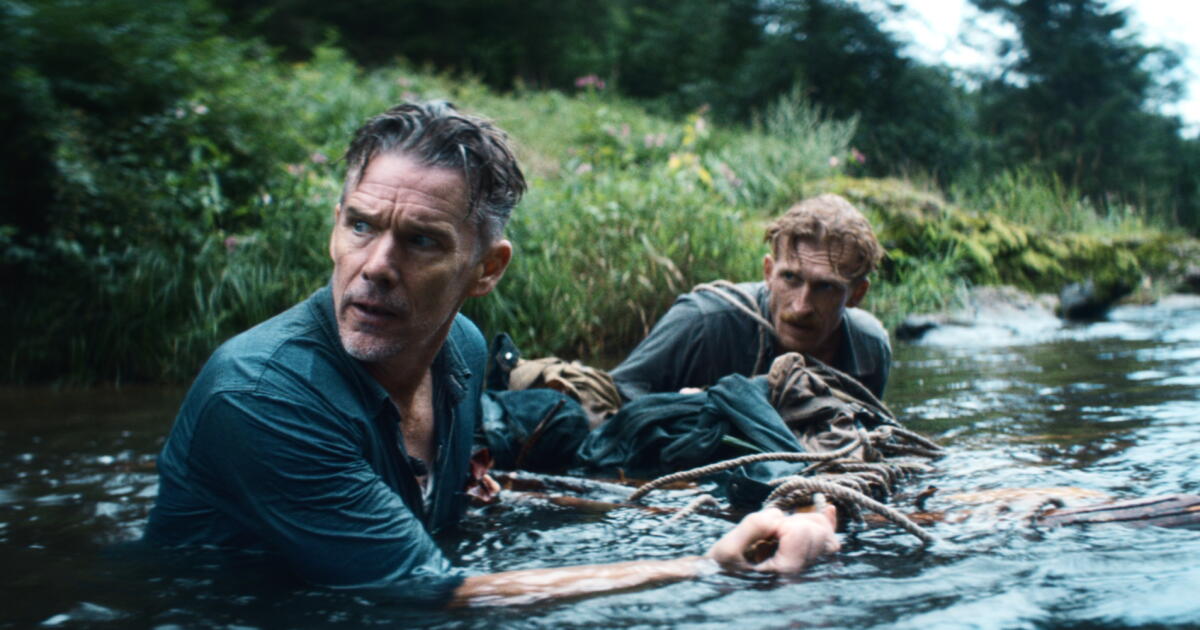
We follow the story of Murphy (Ethan Hawke), a World War I vet and single father in Eugene, Ore., struggling to provide for his daughter, Penny (Avy Berry), three years into the Great Depression. After an unfortunate run-in with the law, Murphy finds himself in a prison labor camp, building a road and trying to shorten his sentence so he can get out before his daughter is adopted by a new family.
Opportunity presents itself in Murphy’s foreman, Clancy (Russell Crowe), who takes a shine to him after he fixes his car and devises an ingenious way to remove boulders without dynamite. Cuddly but dangerous, Clancy makes a seemingly simple offer to Murphy: He and three friends can earn their freedom if they hike a load of gold out of a mining camp on the eve of President Franklin D. Roosevelt confiscation of all gold stockpiles.
The how and why details aren’t that important; the story is merely that the prisoners have to get from point A to point B through a rugged forested terrain, under the watch of two intimidating chaperones, Amis (Sam Hazeldine) and Letender (George Burgess). A mining camp servant, Anna (Julia Jones), joins their group as a runaway and while it seems a straightforward task, the arduous and brutal journey is one that is liable to turn these convicts into runaways.
Murphy’s gang weren’t really outlaws to begin with — he was imprisoned for defending his daughter from some undercover cops, while Singh (Avi Nash) was arrested for his associations with socialism. Olson (Lucas Lynggaard Tønnesen) was part of a group going after a judge for seizing Scandinavian farms, while the most hardened criminal among them is Rankin (Austin Amelio), who grew up in juvie. But in order to survive the woods, Murphy will have to dig deep into his wartime past and rely on his own skills and smarts to make out it out intact.
McKinley pours his craft into authentically representing the era, from the perfectly worn denim of the costumes to the refreshingly real and craggy faces of the cast (and thank goodness Hawke and Crowe are respectably aging into their character-actor looks). The Bavarian forest beautifully stands in for 1930s Oregon and cinematographer Matteo Cocco balances ’70s-inspired slow zooms with composed, high-contrast images that hark to early 20th century styles of photography. A score by Latham and Shelby Gaines balances discordant, atonal tones with suspense-driven sound design that captures the creaking noises of the forest and the concealed dangers it holds.
McKinley stages a few bullet-sweating sequences of peril, including a particularly brutal transport of gold bars across a crumbling rope bridge and an underwater accident exacerbated by floating logs. Both are nail-biters but you can’t help but think he could have pushed it even further. Tonally, the film is torn between wanting to be brutally bleak and offering some kind of hope for Murphy and his precocious, adorable daughter.
When “The Weight” leans into its nasty, mean and grim moments, it gets at something that seems closer to truth than the saccharine resolution we fear is coming. It seems like McKinley wants to deliver a crushing blow, but then feints at the last minute, opting for a more optimistic kind of fantasy.
Politically and culturally, what “The Weight” speaks to is as ugly as the violence that occurs in the mud and fog of the forest. But it ends on an oddly cheery note that doesn’t square with what we’ve seen. It’s a cutesy ’70s nod that feels more “Smokey and the Bandit” than “Sorcerer.” The bolder choice would have been to commit to expressing the despairing lessons of this world. We want to see these characters changed by what they’ve experienced, even if it’s dark. We want to see them actually carry the weight.
Katie Walsh is a Tribune News Service film critic.
‘The Weight’
Rated: R, for language and some violence/bloody images