Security threats prompt US and Australia to suspend diplomatic operations in Brazil before pivotal election day.
Published On 3 Oct 20263 Oct 2026
The United States has suspended consular services in Brazil, prompting Australia to close its embassy in the Brazilian capital, two days before Brazil’s presidential election on Sunday.
In a statement released on Thursday, the US embassy said it would suspend consular services starting on Friday and advised American citizens seeking assistance not to visit its embassy, consulates or other diplomatic facilities.
Recommended Stories
list of 3 itemsend of list
The statement cited security concerns but gave no further detail on the nature of the threat or any link to the election.
The US State Department said it was working closely with Brazilian counterparts to address the security concerns, adding that embassies and consulates routinely issue alerts about local threats and developments.
Australia’s ambassador to Brazil, Sophie Davies, said on social media that the Australian embassy would also close on Friday, citing the US alert, and advised Australians to avoid US diplomatic facilities.
Brazil’s federal police said they carried out preventive search and seizure warrants in Sao Paulo and the Federal District, the administrative region surrounding the capital, Brasilia, as part of an investigation into suspected plans that could threaten US diplomatic facilities.
Police said the operation followed cooperation with foreign intelligence agencies, but that investigators had found no evidence corroborating the initially reported threat, nor identified any suspects linked to criminal organisations.
An investigation was continuing after the seizure of communications equipment, according to the police.
The closures came two days before the Brazilian presidential election, which pits incumbent Luiz Inacio Lula da Silva, who is seeking re-election, against Senator Flavio Bolsonaro, son of former President Jair Bolsonaro. Jair Bolsonaro is serving a 27-year sentence for attempting a coup.
If neither candidate wins more than 50 percent of the vote on Sunday, a runoff will be held on October 25.
Edinho Silva, president of Lula’s Workers’ Party, called the closures “unprecedented”, saying: “It makes no sense at all. It’s one of Trump’s ways of trying to influence Brazilian public opinion.”
Lula’s allies have pointed to US tariffs and an effort by Washington to send officials to Brazil to “discuss electoral integrity” as evidence of foreign interference.
Brazilian intelligence officials briefed French and German delegations in Brasilia this month on what they described as US and Russian interference in the race.
US President Donald Trump has publicly praised Flavio Bolsonaro, a close ally, without formally endorsing him, saying he is “watching that election very closely”.
Eaton (ETN) to acquire COL Group from Oaktree’s Power Opportunities strategy for an enterprise value of €810M, expanding its manufacturing capacity and power distribution capabilities in Europe.
Eaton said the acquisition will enhance its ability to address growing demand from
The lawsuit comes two months after the state filed a similar lawsuit against competitor Kalshi.
New York State has filed a lawsuit against prediction market company Polymarket amid allegations that it violated state laws against illegal gambling.
The suit, filed on Thursday by New York State Attorney General Letitia James, comes two months after the state filed a similar lawsuit against competitor Kalshi. That followed the state suing Coinbase and Gemini for offering users the ability to bet on “sports, entertainment, and elections, in violation of New York laws”, according to a release from the attorney general’s office at the time.
Recommended Stories
list of 4 itemsend of list
The state accused all the companies of operating without licences from the State Gaming Commission.
“Our gambling laws exist to protect New Yorkers, prevent the potential harms of problem gambling, and ensure funding for educational and public benefit programs,” James said in a statement announcing the suit.
“By skirting New York’s laws, Polymarket is targeting the most vulnerable and depriving New York families of critical services and support. My office will never hesitate to take action to defend our laws and keep New Yorkers safe.”
The suit also alleges that the company encouraged gambling among young people. It accuses Polymarket of targeting users as young as 18, while state law requires users to be at least 21 years old to take part in mobile sports betting.
“By running an unlicensed gambling operation, Polymarket has done more than just knowingly violate state law, they have put New Yorkers at risk, especially those underage who are most vulnerable to problem gaming,” New York Governor Kathy Hochul said in a statement.
The more than 30-page lawsuit claims that Polymarket, which is valued at more than $20bn, has advertised sports betting in particular since July 2025. It pointed to a post on X from August 17, 2025, about the launch of its US mobile app that said it was “BAD NEWS (For sportsbooks)”.
Prediction markets allow users to wager on so-called event contracts, covering political events, sports, elections and even award shows. Concerns about the role of prediction markets came to a head earlier this year when wagers were made in the hours before the United States and Israel first struck Iran, prompting widespread backlash in Washington.
Polymarket pushed back on the allegations.
“We chose to engage with them directly on the substance and address their concerns,” chief legal officer Neal Kumar said in a statement.
“They preferred the media hit. Any time the [attorney general’s] office wants to swing by, our door is open for a conversation about how we protect consumers and offer fair, transparent and legal markets.”
Kalshi is facing similar allegations in New York State. Kalshi has been critical of reporting on lawsuits against it and allegations that it is akin to a sports betting or gambling platform.
Polymarket did not respond to Al Jazeera’s request for comment.
The Polymarket lawsuit comes days after reporting from the Wall Street Journal that alleged a wave of users had linked stolen bank debit cards and then used them to make wagers, effectively draining the accounts. According to the report, when CEO Shayne Coplan was made aware of the issue, he responded: “Just keep growing and pay a fine if regulators ever find out.”
Political pressure
New York State’s lawsuit joins a growing list of states that have sued prediction market platforms, including Arizona, Massachusetts, Nevada and many others. Those states are at odds with the federal government, as the Commodity Futures Trading Commission has claimed that the federal agency exerts authority over the regulation of prediction markets.
Polymarket has close ties with the family of US President Donald Trump. The prediction market platform has investment from 1789 Capital, a venture capital firm backed by Donald Trump Jr, the president’s eldest son, who also serves on the company’s advisory board.
Nestle (NSRGY) is reviewing its options after Russia placed the Swiss food company’s local operations under temporary state administration, adding to mounting pressure on Western businesses that still hold assets in the country.
The 31st Marine Expeditionary Unit’s (31st MEU) recent deployment to the Middle East marked the first time the United States Marine Corps (USMC) used its Expeditionary Advanced Base Operations (EABO) concept in a combat setting, the service confirmed to TWZ on Thursday. At its core, EABO involves relatively small groups of Marines quickly establishing bases of operation in forward areas, often within the enemy’s weapons range. During operations in the fight against Iran, Marines refueled and rearmed their own aircraft, as well as those from the joint force, at these austere locales. They also set up remote sensing locations, among other actions from the EABO playbook.
This employment of EABO for Epic Fury is a highly significant development. After years of progressively evolving the EABO playbook, it was no longer an experimental exercise. This meant that Marines were forward deployed in a contested area in a region where established bases were taking heavy fire from Iranian missile and drone barrages. Troops were killed in some of these attacks and U.S. aircraft, buildings and equipment were damaged and destroyed across the Middle East. Pushing aircraft from the MEU, as well as the joint force, to FARPs (forward arming and refueling point) would have been a relevant asset preservation tactic as well as one that would help accelerate combat operations, and it’s exactly what EABO is meant to do.
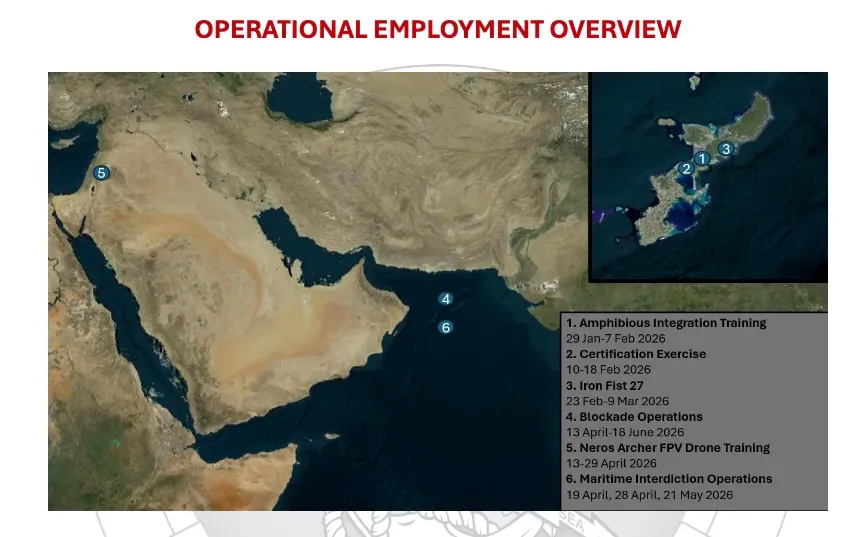
The 31st MEU’s six-month deployment began in January in the Pacific, before the unit was ordered to the Middle East in March, returning to Okinawa, Japan, in July. That’s where it is stationed as the USMC’s only continuously forward-based MEU.
A map of the 31st MEU’s deployment. (31st MEU)
“This was the first time we were able to implement EABO in combat operations since the concept was created for the force,” Capt. Steven J. Keenan, a USMC spokesperson, told us. “We have practiced it many times, but this was a first for supporting a Joint Force named operation with forward FARPs and forward bases that supported joint ops and combat power sustainment.”
EABO was first introduced in 2020 by then-Commandant Gen. David Berger in his Force Design 2030 plan for the future of the Corps. It was created with a fight against China in mind, especially utilizing small Pacific islands. The idea is to have highly mobile, low-signature forces deployed forward in austere, contested or potentially contested maritime locations. The mission is to “support sea control operation, conduct sea denial operations within the littorals, contribute to maritime domain awareness, provide forward command, control, communications, computers, combat systems, intelligence, surveillance, reconnaissance, targeting, and counter-targeting capability and forward sustainment,” according to the Marines.
A Marine holding a Stinger missile launcher stands in front of a Combat Rubber Raiding Craft on Ukibaru Island off the coast of Okinawa during Exercise Hagatna Fury 21. (USMC) A Marine holding a Stinger missile launcher stands in front of a Combat Rubber Raiding Craft on Ukibaru Island off the coast of Okinawa during Exercise Hagatna Fury 21. USMC
The news of the first activation of the EABO concept in combat came Wednesday during a media roundtable with Col. Chris P. Niedziocha, who commanded the 31st MEU during its deployment to the Middle East in support of Operation Epic Fury. Now director of the USMC Expeditionary Warfare School, Niedziocha discussed EABO and a range of other operations during that deployment, including boarding vessels during the blockade of Iranian ports.
The 31st MEU was embarked aboard the Tripoli Amphibious Ready Group (ARG), which consisted of the America class amphibious assault ship USS Tripoli, San Antonio class amphibious transport dock ship USS New Orleans, and Whidbey Island class dock landing ship USS Rushmore. You can read more about the ARG/MEU and its assets in our initial story about the deployment to the Middle East here.
USS Tripoli. (Staff Sgt. Samuel Ruiz)
“You’re starting to see this has been validated,” the colonel said of the EABO concept during the roundtable TWZ attended virtually. “It’s still nascent, but we actually, for the first time, demonstrated what we thought we were able to do, which I think is pretty exciting. And then things like forward arming and refueling to extend the operational reach of aircraft and expeditionary reloading, and then the ever-present logistic challenge of doing something like that. So that’s pretty significant.”
“We successfully implemented critical Expeditionary Advanced Base Operations (EABO), establishing sensor expeditionary advanced bases and forward arming and refueling points (FARPs) where none existed,” the colonel added. “Through our forward logistic elements, we proved that an agile Marine Air-Ground Task Force can sustain itself and generate ready, lethal power in contested maritime environments, directly setting the theater for follow-on joint forces.”
“There was all manner of tankers all the time, but the FARP is to extend the operational reach, and if you can do it, you reduce the load on that,” Niedziocha noted. “Because there’s some aircraft that are basically for expeditionary austere operations, especially the F-35B,” the Marine Corps’ variant of the aircraft designed for short take off and vertical landing.
“There are some trade-offs associated with the Bravo,” Niedziocha pointed out, using a slang for the jets. “There’s less internal fuel, but you have the lift [system], which gives you the option to do these kinds of things. So, the goal there was to walk that fine line between providing the full sortie over wherever you needed it, and keeping the ships far enough away to make them as survivable as possible.”
An F-35B Lightning II aircraft taxis to a forward arming and refueling point in the U.S. Central Command area of responsibility, May 26, 2026. (U.S. Marine Corps photo by Cpl. Maksim Masloboev) Cpl. Maksim Masloboev
In addition to the F-35Bs and other aircraft organic to the 31st MEU, the FARPs were also used by Army helicopters, Keenan told us. Imagery posted on the Pentagon’s image distribution site also showed U.S. Army Gray Eagle drones and Marine MV-22B Osprey tiltrotor aircraft were included.
A Gray Eagle drone lands at a forward arming and refueling point in the U.S. Central Command area of responsibility, May 26, 2026. (U.S. Marine Corps photo by Cpl. Maksim Masloboev) Cpl. Maksim MasloboevU.S. Marines with the 31st Marine Expeditionary Unit transport AIM-120 AMRAAMs to a forward arming and refueling point in the U.S. Central Command area of responsibility, May 26, 2026. (U.S. Marine Corps photo by Cpl. Maksim Masloboev) Cpl. Maksim Masloboev
Niedziocha did not provide details about where the FARPs were set up, but a U.S. defense official told us they were “disaggregated throughout the Middle East.” The official declined to provide further information, citing operational security concerns since they are still being used.
“Throughout the deployment, the Tripoli ARG and 31st MEU successfully conducted over 1,600 mishap-free flight hours of combat aviation missions, including precision strikes, transporting 800,000 pounds of cargo, and moving 5,000 personnel,” a 31st MEU overview of the deployment explained. “The units also provided sustained combat support to joint force operations by delivering critical intelligence and refueling over 300 aircraft ashore and underway.”
The colonel also didn’t provide details about the sensor expeditionary advanced bases. According to the Marines, “a sensing expeditionary advanced base (SEAB) brings together coastal surveillance radars, electronic sensors, and Marines ashore to extend maritime domain awareness, complementing the radars and sensors already at work aboard naval ships off the coast.”
“When SEAB systems identify surface vessels in nearby sea lanes, small unmanned aircraft system (sUAS) operators launch their platforms to visually identify and track the contacts,” the Marines added. “Sensor data and imagery are transmitted in real time across the blue-green command network to decision-makers.”
U.S. Marines with 12th Marine Regiment, 3rd Marine Division, prepare to set up a Ground/Air Task Oriented Radar (G/ATOR) system during a routine unit level training exercise on Iejima, Okinawa, Japan, July 15, 2023. (U.S. Marine Corps photo by Staff Sgt. Manuel A. Serrano) Gunnery Sgt. Manuel Serrano
This capability could have been used to track Iran’s remaining fleet of small boats that it has used to harass shipping and mine the Strait of Hormuz, as well as larger vessels trying to transport oil. Other sensors, like radars and counter-drone systems, could also help identify incoming threats and provide general situational awareness. The EABO concept was employed as part of the 31st MEU’s larger role in supporting the blockade and mine clearance efforts.
The 31st MEU interdicted four vessels during the deployment, three of which led to boardings. On April 19, Marines boarded the MV Touska; on April 28, the MV Blue Star III; and on May 19, the MT Celestial Sea.
The Touska was boarded after USS Spruance fired multiple 5-inch rounds, targeting the engine room and disabling the vessel’s propulsion. The crew of the vessel was retained for about two weeks before being repatriated.
Niedziocha told us that none of the crews offered any resistance.
“At two in the morning, when 30 Force Reconnaissance Marines fast rope onto your vessel, [you are] just compliant with a capital C. They did exactly what they were directed to do. The overmatch that you put onto that vessel is pretty surprising. And then there’s overwatch provided by UAS and manned aircraft, so you create this bubble around the vessel. So yeah, they complied.”
You can see the Touska being boarded in the following video.
The U.S. just released a video of its forces boarding and seizing the Iranian container ship M/V Touska near the Hormuz Strait after it tried to break the U.S. naval blockade pic.twitter.com/FpB2obb3jY
Two years ago, as the EABO concept was maturing, TWZ was invited to get an exclusive look at how an advanced EABO concept would be put into action, including how squadrons operated the F-35B out of an austere combat environment while generating combat sorties. It was an unprecedented and exclusive peek into the EABO playbook and what a real fight in the Pacific with the USMC’s most advanced fighter aircraft could actually look like. You can read about that in our story here. It appears the operations in the Middle East mirrored this exercise closely.
James Deboer
Now back in Japan, the ARG/MEU is getting ready for a new deployment, said the colonel.
“We got back to Okinawa, I think July 22nd, and they had already begun their workup cycle in earnest to be on the water in early January to go out and do another Iron Fist [training exercise] with the Japanese, and then long periods of a crisis response,” said Niedziocha, who relinquished command in August before moving on to his new role. “Just being there, present in the First Island Chain to partner with your allies, demonstrates the resolve and commitment to deter whatever needs deterring.”
As noted earlier in this story, the EABO concept was designed with a Pacific fight in mind. Its first combat employment in the Middle East clearly offers lessons that can now be adapted to enhance EABO operations globally.
MANILA: Saudi Arabia’s new national carrier Riyadh Air launched its first flight to Manila on Wednesday, marking the latest addition to its growing network of global destinations.
Riyadh Air operated a 290-seat Boeing 787-9 Dreamliner aircraft for the route between the Saudi and Philippine capital, with its arrival at the Ninoy Aquino International Airport around 3:55 p.m. marking the first operation of the service.
“The new … service adds another option for passengers traveling between the Philippines and Saudi Arabia, and another international carrier to NAIA’s growing network. Welcome to Manila, Riyadh Air!” NAIA said in a statement announcing the Riyadh Air service.
There are more than 910,000 Filipinos living and working in Saudi Arabia, as the Kingdom hosts the biggest number of overseas Filipino workers and was their top destination in 2024, according to Philippine government data.
In that year alone, almost 22 percent of Filipinos, or more than 480,000, who sought work abroad chose the Kingdom, driven in part by the Saudi Vision 2030 economic diversification program.
Saudi tourists are also one of the Philippines’ fastest-growing and highest-value markets, according to the Philippine Department of Tourism, with tourism receipts reaching over $37 million in 2024, a 46-percent rise from the previous year.
The Saudi carrier has swiftly expanded its air links with Asia with the launch of multiple flights across the region in recent months, including to Malaysia, Pakistan, India and Thailand.
Riyadh Air’s Manila route followed the airline’s launch of its Bangkok service last week, with Thailand eyeing more high-value tourism from the Middle East.
The Tourism Authority of Thailand is expecting about 600,000 travelers from the Middle East this year, after recording about 210,000 arrivals in the first half of 2026.
It shows similar trends across Asia, where popular holiday destinations are increasingly targeting tourists from the Middle East as part of their tourism growth strategy.
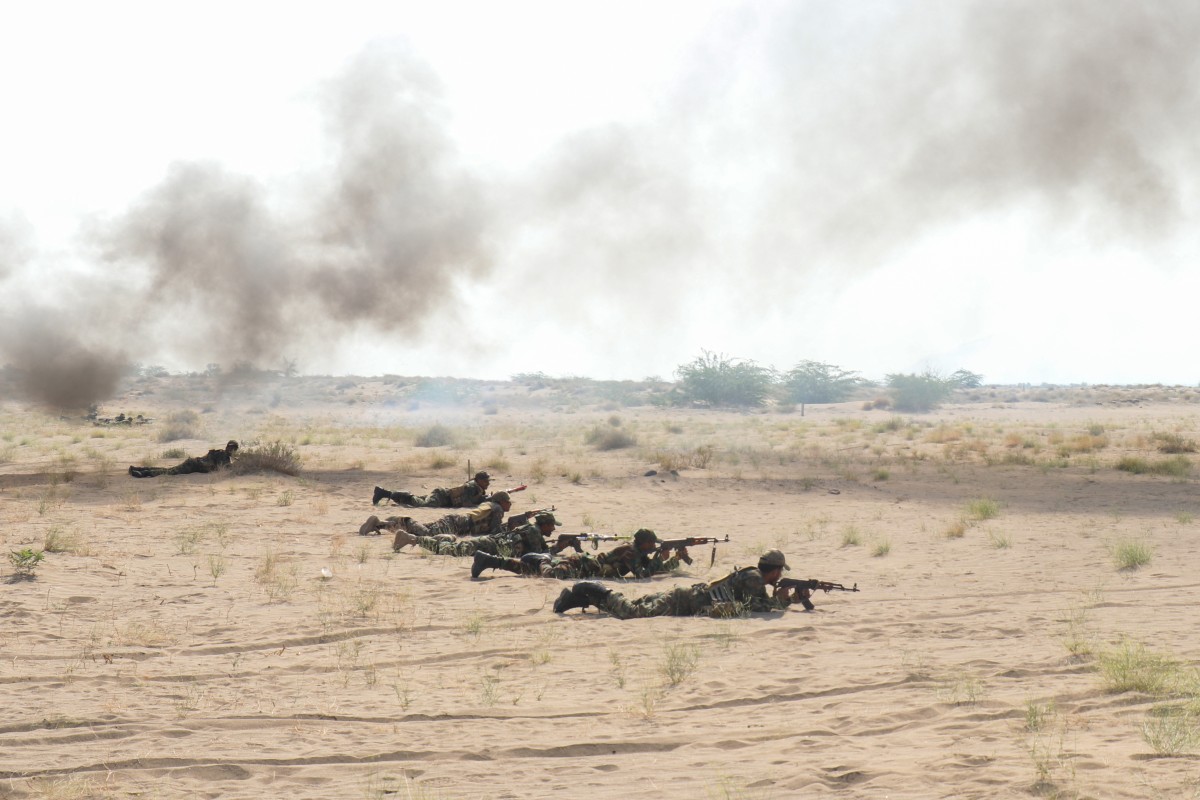
Military operations in Yemen intensified on Wednesday with clashes expanding across several fronts, according to reports by Saudi-owned news channels Al Arabiya and Al Hadath.
The Yemeni armed forces reported that fighting with the Iran-backed Houthi militia has been continuing on the Taiz fronts of Toil and Al-Barah, and claim to have inflicted heavy losses on the group.
Al Arabiya and Al Hadath have reported that Yemeni government forces have captured areas in southern Mahreb, as well as several positions in the northern and southern sectors.
The forces have also reportedly captured new positions and villages on the Al-Kaddah front west of Taiz during an operation against the Houthis.
The offensive was accompanied by heavy clashes, artillery fire and airstrikes targeting Houthi positions, gatherings and reinforcements in the area.
Al Arabiya and Al Hadath sources also said the Yemeni armed forces had launched a counterattack against Houthi positions on the Meris front north of Al-Dhale Governorate.
The sources also reported that Yemeni military aircraft had carried out several airstrikes on the Houthi-held Helan Mountains west of Marib.
Costa Rican President Laura Fernandez has suggested that United States military operations in the country’s territory could bring national security benefits.
But she added caveats. In an interview published on Friday, Fernandez emphasised to the news service Reuters that such measures would require approval from the national legislature.
Recommended Stories
list of 3 itemsend of list
She also added there were no plans in the works for US forces to operate in the country.
“It would obviously be very good for national security if it were about pursuing a common objective against transnational crime, transnational drug trafficking, transnational terrorism,” said Fernandez, a right-wing populist who took office in May.
Fernandez succeeded her mentor, former President Rodrigo Chaves, after a February election in which concerns about security and rising violence in the Central American country played a prominent role.
Though she ran on a tough-on-crime platform, Fernandez has said that she is not currently considering a state of emergency to address the problem.
Such emergency declarations typically suspend key constitutional rights, in favour of giving police or the military added powers to crack down on violence.
That model has been popularised under the right-wing president of El Salvador, Nayib Bukele.
But critics point out that the states of emergency are meant to be short-term measures, not permanent ones. El Salvador has been under an emergency declaration since 2022, with the government extending it dozens of times.
Crime has become a top voter concern in Costa Rica. The Central American country’s homicide rate has doubled in the last decade, reaching 17.2 per 100,000 inhabitants in 2023.
That figure still places the country’s average well below many others in the region, but the change, partly attributed to increased drug trafficking activity, has startled many residents.
Fernandez’s remarks also reflect growing pressure from the US to reduce crime across the Western Hemisphere.
Since returning to office for a second term, US President Donald Trump has pushed to expand his country’s influence across Latin America, notably through military engagements.
Earlier this year, he launched the “Shield of the Americas”, also known as the Americas Counter Cartel Coalition (ACCC), to bring together right-wing leaders across the region to address drug trafficking.
Trump used the inaugural meeting to encourage Latin American governments to embrace a military-driven approach to crime, despite concerns about human rights.
He has also carried out and threatened military operations in sovereign countries, on the premise of combatting crime.
Some countries, such as Mexico, have baulked at the prospect of US military forces carrying out operations on their territory. Critics point to Washington’s long record of interventions and rights abuses in the region.
But other countries have been more receptive. US forces, for instance, have recently carried out military operations with the right-wing government of Ecuador, in an effort to lower crime rates.
Ecuador’s armed forces, however, have been accused of crimes such as torture and enforced disappearance, abuses that experts warn could be worsened by support from the US.
A July report from Human Rights Watch warns that the military collaboration between Ecuador and the US has already had dire consequences.
Ecuadorian fishermen have reported facing attacks at sea, and in one case, Ecuadorian soldiers allegedly detained and tortured four Colombian farm workers, using methods such as mock executions, beatings and electric shocks.
That incident reportedly took place during a raid near the border carried out with US support.
“The two countries’ security relationship is deepening at a moment when both governments have engaged in serious human rights violations fueled by their insistence on framing their confrontations with organised crime groups as a kind of war,” the report says.
Those raids come after Ecuadorian voters rejected a referendum last year that would have allowed foreign countries to set up military bases in the country.