Oman

Oman confirms US-Iran talks will take place in Geneva on Thursday | Politics News

Oman’s Foreign Minister Badr Al Busaidi has confirmed that further talks between the United States and Iran will take place on Thursday amid spiralling tensions between the two countries.

“Pleased to confirm US-Iran negotiations are now set for Geneva this Thursday, with a positive push to go the extra mile towards finalizing the deal,” Albusaidi said in a social media post on Sunday.

Recommended Stories

list of 3 itemsend of list

The announcement comes as the US continues to amass military assets in the Middle East, raising concerns about an all-out war against Iran.

Hours before Oman’s announcement, Iran’s Foreign Minister Abbas Araghchi said Tehran was ready to put in place a “full monitoring mechanism” to guarantee the peaceful nature of its nuclear programme and ease tensions.

Asked by Face the Nation moderator Margaret Brennan why Iran would want to pursue enrichment on its soil rather than buy enriched uranium from abroad, given the US military build-up and risk of an escalation, Araghchi said the issue was a matter of “dignity and pride” for Iranians.

“We have developed this technology by ourselves, by our scientists, and it is very dear to us because we have created it – we have paid a huge expense for that,” he said.

Araghchi cited among the costs two decades of US sanctions, the targeted killings of Iranian scientists, and US-Israeli attacks on nuclear facilities in June.

“We’re not going to give [our nuclear programme] up; there is no legal reason to do that while everything is peaceful and safeguarded” by the United Nations nuclear watchdog, the International Atomic Energy Agency (IAEA), Araghchi said.

As a “committed member” of the Non-Proliferation Treaty (NPT), which requires non-nuclear-weapon states not to seek or acquire nuclear weapons, Iran is “ready to cooperate with the agency in full”, Araghchi added.

But he stressed that under the treaty, Tehran also has “every right to enjoy a peaceful nuclear energy, including enrichment”.

“Enrichment is a sensitive part of our negotiations. The American team knows about our position, and we know their position. We have already exchanged our concerns, and I think a solution is achievable,” the minister noted.

Enrichment is the process of isolating and garnering a rare variant, or isotope, of uranium that can produce nuclear fission. At low levels, enriched uranium can power electric plants. If enriched to approximately 90 percent, it can be used for nuclear weapons.

US officials, including President Donald Trump, have previously suggested that Washington is seeking “zero enrichment” by Tehran.

Earlier this month, US Secretary of State Marco Rubio said any deal with Iran would need to include agreements on ballistic missiles and support for its allies in the region.

Araghchi, however, said on Sunday that Iran was “negotiating only nuclear” at the present time.

“There is no other subject,” he told CBS News, adding that he was optimistic that a deal could be reached.

The second round of nuclear talks concluded in Geneva on February 17. The US and Iran also held indirect talks in Oman earlier this month.

The Iranian delegation is working ahead of the meeting to present a draft that includes “elements which can accommodate both sides’ concerns and interests” to reach a “fast deal”, Araghchi said.

The top Iranian diplomat added the agreement would likely be “better” than the Joint Comprehensive Plan of Action (JCPOA), negotiated by former US President Barack Obama in 2015.

“There are elements that could be much better than the previous deal,” he said, without elaborating. “Right now, there is no need for too much detail. But we can agree on our nuclear programme to remain peaceful forever and at the same time, for more sanctions [to be] lifted.”

Some observers were less optimistic about the chances of striking a deal. Trita Parsi, executive vice president of the Quincy Institute, told Al Jazeera that Iran is likely to put forward a proposal that goes beyond anything they ever offered, but even that may not be enough.

“Trump has been sold a narrative by the Israelis that portrays Iran far, far weaker than it actually is. As a result, he’s adopting maximalist capitulation positions that are simply unrealistic based on how the power reality actually looks,” Parsi told Al Jazeera.

“Unless this gets corrected, even if the Iranians put forward a very far-leaning proposal that is extremely attractive to the US, Trump may still say no because he’s under the false belief that he can get something even better.”

Source link

‘Non-negotiable’: Iran says missiles off the table in talks with the US | Politics News

Iranian Foreign Minister Abbas Araghchi says he hopes talks with the United States will resume soon, while US President Donald Trump pledged another round of negotiations next week following mediated discussions in Oman.

Araghchi told Al Jazeera on Saturday that Iran’s missile programme was “never negotiable” in Friday’s talks, and warned Tehran would target US military bases in the Middle East if the US attacks Iranian territory.

Recommended Stories

list of 4 itemsend of list

He added that despite the negotiations in Muscat being indirect, “an opportunity arose to shake hands with the American delegation”. The talks were “a good start“, but he insisted “there is a long way to go to build trust”.

Iranians in the capital, Tehran, however, seemed less positive.

“In my opinion, like previous times, negotiations will end without results because both sides are sticking to their own positions and not willing to back down,” a woman who asked to remain anonymous told Al Jazeera.

Abdullah al-Shayji, a US foreign policy expert at Kuwait University, said he hopes for a new deal between the two foes but is not feeling optimistic.

“There is a strong position” from the US and “being provoked by” Israel to “clamp down on the Iranians because they feel that Iran is at its weakest point” so that it will be easy to extract concessions from it, especially after last month’s antigovernment demonstrations, al-Shayji said from the Al Jazeera Forum in Qatar’s capital Doha.

INTERACTIVE - USS Abraham Lincoln - JAN 26, 2025-1769422995

‘Inalienable right’

Despite calling the talks “very good” on Friday, Trump signed an executive order effective from Saturday that called for the “imposition of tariffs” on countries still doing business with Iran.

The US also announced new sanctions against numerous shipping entities and vessels aimed at curbing Iran’s oil exports.

More than one-quarter of Iran’s trade is with China, including $18bn in imports and $14.5bn in exports in 2024, according to World Trade Organization data.

Nuclear enrichment is Iran’s “inalienable right and must continue”, Araghchi said, adding, “We are ready to reach a reassuring agreement on enrichment. The Iranian nuclear case will only be resolved through negotiations.”

Iran’s missile programme is non-negotiable because it relates to a “defence issue”, he said.

Washington has sought to address Iran’s ballistic missile programme and its support for armed groups in the region – issues that Israel has pushed to include in the talks, according to media reports.

Tehran has repeatedly rejected expanding the scope of the negotiations beyond the nuclear issue.

“The Iranians are vehemently opposed to any concessions,” said al-Shayji, as is the US, which makes it extremely hard for countries leading mediation efforts to “get them closer together”.

Friday’s negotiations were the first since nuclear talks between Iran and the US collapsed last year following Israel’s unprecedented bombing campaign against Iran, which triggered a 12-day war.

Following widespread antigovernment protests in Iran last month, Trump ramped up threats against the country, deploying the USS Abraham Lincoln to the Middle East.

(FILES) This January 19, 2012 image provided by the US Navy, shows the Nimitz-class aircraft carrier USS Abraham Lincoln transiting the Arabian Sea.
The Nimitz-class aircraft carrier USS Abraham Lincoln transiting the Arabian Sea in 2012 [File: AFP]

‘Peace through strength’

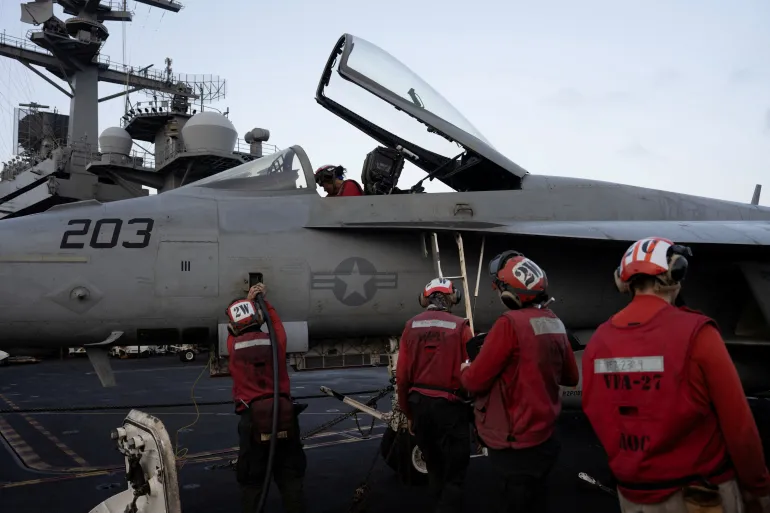
Trump’s lead negotiators in Oman, special envoy Steve Witkoff and presidential adviser Jared Kushner, visited the aircraft carrier stationed in the Arabian Sea on Saturday.

In a social media post, Witkoff said the aircraft carrier and its strike group are “keeping us safe and upholding President Trump’s message of peace through strength.”

Witkoff said he spoke with the pilot who downed an Iranian drone that approached the carrier “without clear intent” on Tuesday.

“Proud to stand with the men and women who defend our interests, deter our adversaries, and show the world what American readiness and resolve look like, on watch every day,” said Witkoff.

While Trump has sought to use the aircraft carrier’s deployment as a means to exert pressure on Iran, al-Shayji said this cannot be a long-term strategy.

“He [Trump] can’t keep his forces at alert stage for too long. This would really discredit Trump’s administration regarding being very harsh and hard-liners on Iran,” he said.

Israeli Prime Minister Benjamin Netanyahu is set to meet Trump on Wednesday to discuss the Iran talks, his office said in a statement.

Netanyahu “believes any negotiations must include limitations on ballistic missiles and a halting of the support for the Iranian axis”, it said, referring to Iran’s allies in the region.

During the 12-day war, US warplanes bombed Iranian nuclear sites.

Araghchi expressed hope that Washington would refrain from “threats and pressure” so “the talks can continue”.


Source link

Germany’s Merz warns of potential escalation as US, Iran prepare for talks | Nuclear Weapons News

Friedrich Merz said concerns about a further escalation with Iran have dominated his trip to the Gulf region.

German Chancellor Friedrich Merz has warned of the threat of a military escalation in the Middle East before talks between Iran and the United States in Oman on Friday.

Speaking in Doha on Thursday, Merz said that fears of a new conflict had characterised his talks during his trip to the Gulf region.

Recommended Stories

list of 3 itemsend of list

“In all my conversations yesterday and today, great concern has been expressed about a further escalation in the conflict with Iran,” he said during a news conference.

Merz also urged Iran to end what he called aggression and enter into talks, saying Germany would do everything it could to de-escalate the situation and work towards regional stability.

The warning came in the run-up to a crucial scheduled meeting between officials from Tehran and Washington in Muscat.

Mediators from Qatar, Turkiye and Egypt have presented Iran and the US with a framework of key principles to be discussed in the talks, including a commitment by Iran to significantly limit its uranium enrichment, two sources familiar with the negotiations have told Al Jazeera.

Before the talks, both sides appear to be struggling to find common ground on a number of issues, including what topics will be up for discussion.

Iran says the talks must be confined to its long-running nuclear dispute with Western powers, rejecting a US demand to also discuss Tehran’s ballistic missiles, and warning that pushing issues beyond the nuclear programme could jeopardise the talks.

Reporting from Washington, DC, Al Jazeera’s Kimberly Halkett said the US is eager for the talks to follow what they see as an agreed-upon format.

“That agreed-upon format includes issues broader than what the US understands Iran is willing to discuss in this initial set of talks,” she explained.

US Secretary of State Marco Rubio said on Wednesday that talks would have to include the range of Iran’s ballistic missiles, its support for armed groups around the Middle East and its treatment of its own people, in addition to its nuclear programme.

A White House official has told Al Jazeera that Jared Kushner, US President Donald Trump’s son-in-law and a key figure in his Middle East policy negotiations, and Steve Witkoff, Trump’s special envoy, have arrived in the Qatari capital, Doha, in advance of the talks.

Halkett said that Qatar is playing an instrumental role in trying to facilitate these talks, along with other regional US partners, including Egypt.

“We understand, according to a White House official, that this is perhaps part of the reason for the visit – to try and work with Qatar in an effort to try and get Iran to expand and build upon the format of these talks.”

Pressure on Iran

The talks come as the region braces for a potential US attack on Iran after US President Donald Trump ordered forces to amass in the Arabian Sea following a violent crackdown by Iran on protesters last month.

Washington has sent thousands of troops to the Middle East, as well as an aircraft carrier, other warships, fighter jets, spy planes and air refuelling tankers.

Trump has warned that “bad things” would probably happen if a deal could not be reached, ratcheting up pressure on Iran.

This is not the first time Iranian and US officials have met in a bid to revive diplomacy between the two nations, which have not had official diplomatic relations since 1980.

In June, US and Iranian officials gathered in the Omani capital to discuss a nuclear agreement, but the process stalled as Israel launched attacks on Iran, killing several military leaders and top nuclear scientists, and targeting nuclear facilities. The US later briefly joined the war, bombing several Iranian nuclear sites.

Source link