Olympics

Winter Olympics: Ilia Malinin, U.S. win gold in team figure skating

Believe in the Quad God.

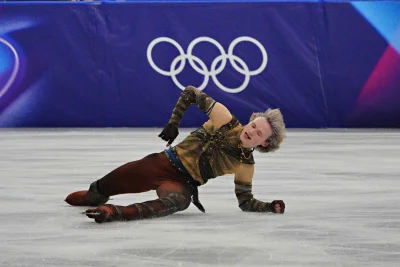
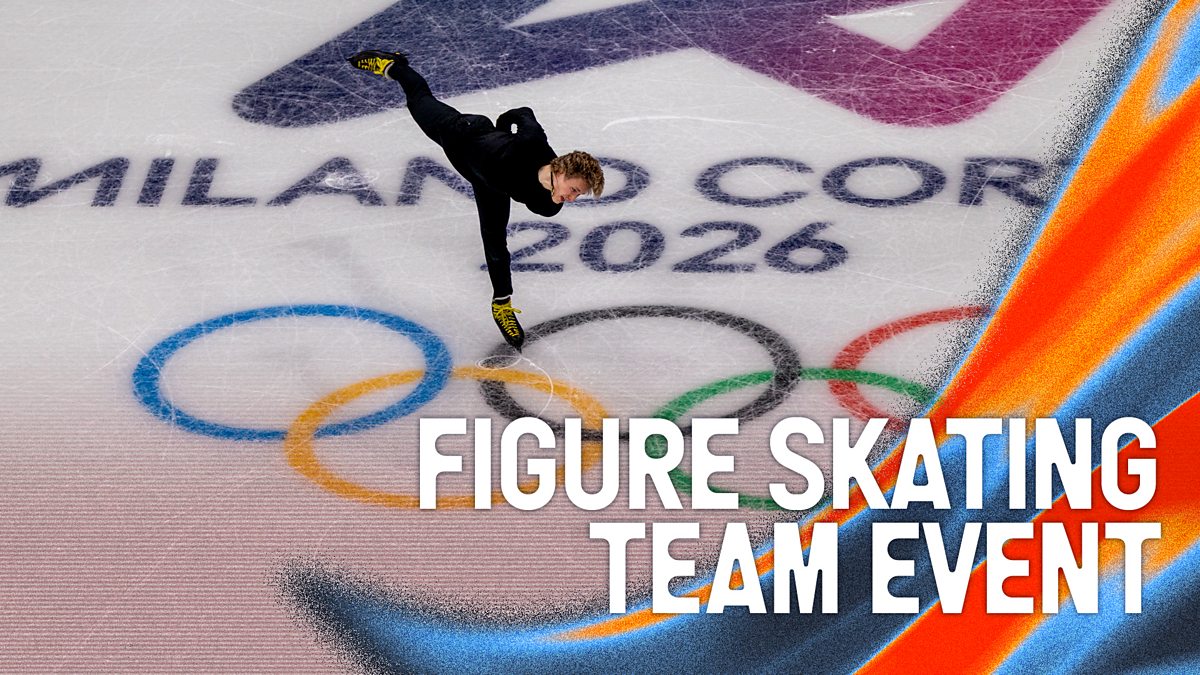
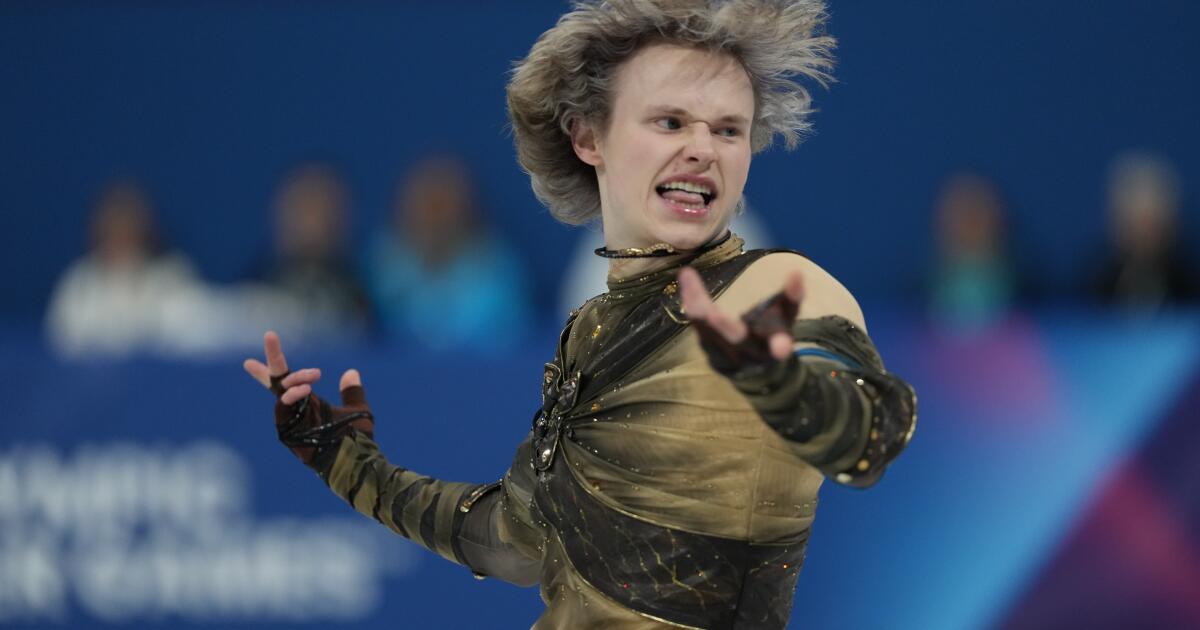
Ilia Malinin’s clutch free skate that scored 200.03 points gave the United States its second consecutive team figure skating gold medal Sunday at the Milan-Cortina Olympic Games.

After Amber Glenn fought through a shaky free program that finished third and lost the United States its two-point lead, Malinin stepped up as only he could. He executed five quad jumps and won by nearly six points, even if he did not perform his signature quad axel. He even put his hand down after a jump, but the mistake only seemed to fuel him as he finished with a flourish, changing the back-half of his program to earn back extra points.

His U.S. teammates, cheering from the sideline box rose to their feet and pumped their fists after each of Malinin’s jumping passes. When he landed his back flip, skating flawlessly through one foot, the packed crowd at Milano Ice Skating Arena roared.

While Japan’s Shun Sato scored a season’s best to finish the competition, he could not match the technical prowess of Malinin, who is also the favorite to win individual gold this week.

In front of a raucous home crowd, Italy held off Georgia for the bronze medal behind a dazzling free skate from Matteo Rizzo, who dropped to his knees on the ice and cried after his performance had fans chanting “Italia!” before he even finished. He cried into the Italian flag in the kiss-and-cry after his season’s best 179.62 points.

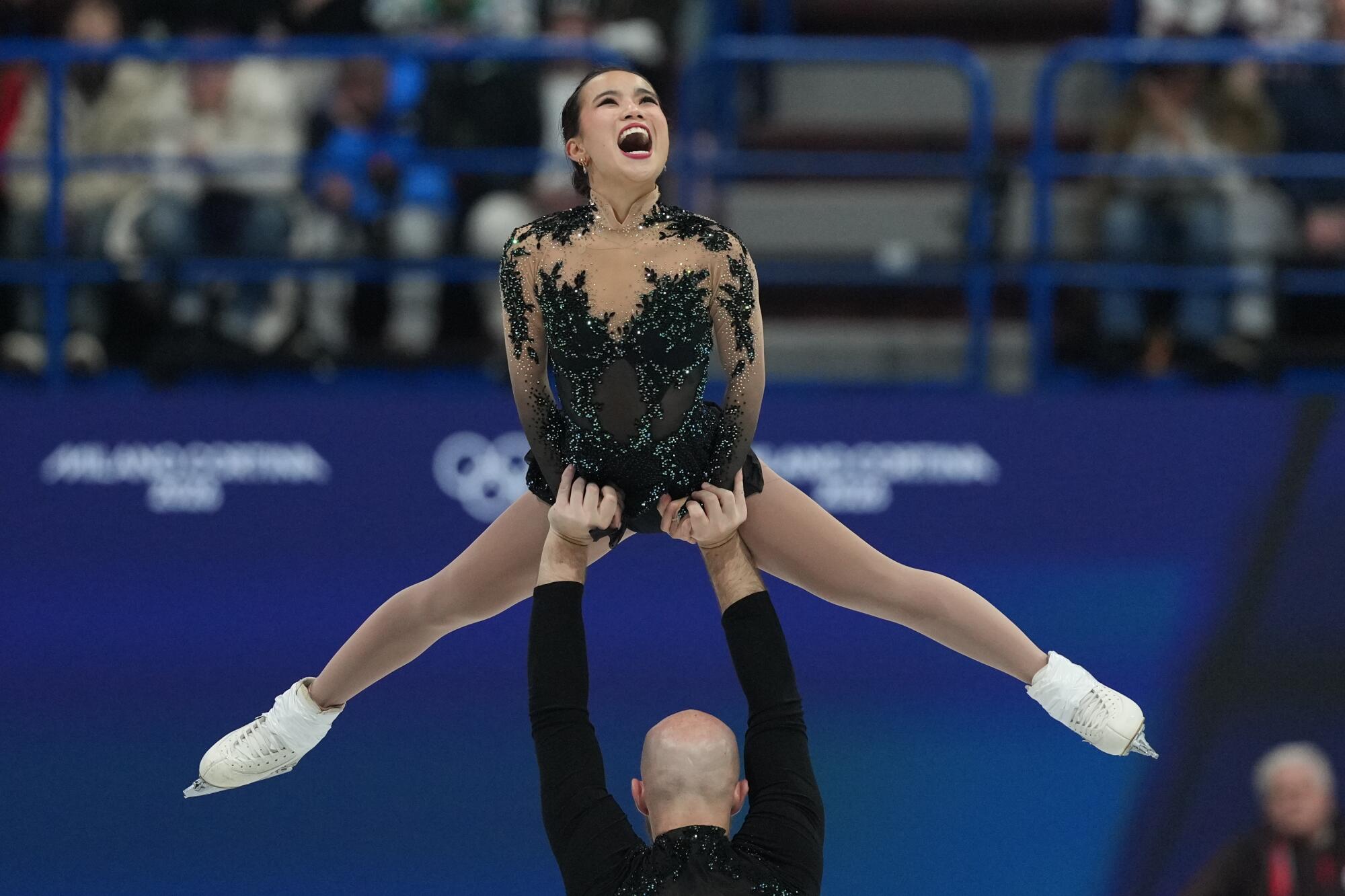
With the first figure skating medal of the Milan-Cortina Games on the line, every skater fought for every fraction of a point. U.S. pairs skater Ellie Kam went deep into a one-legged squat to hold on to the first throw jump. The United States led by five points entering the final day, but still had no room for error as Japan finished first in qualifying in all of Sunday’s disciplines. With the dominance of Japan’s Riku Miura and Ryuichi Kihara in pairs, Kam’s partner Danny O’Shea knew the strategy for the U.S. pair was to simply try to stay as close as possible.

Ellie Kam and Danny O'Shea perform in pairs figure skating during the team competition at the Milan-Cortina Games.

Ellie Kam and Danny O’Shea perform in pairs figure skating during the team competition at the Milan-Cortina Games on Sunday.

(Stephanie Scarbrough / Associated Press)

Kam fought for the landing on a throw loop so hard that she could feel her leg cramping.

“I was like, ‘I’m not going down,’” Kam said, “I got this. We got this.”

They looked at each other before their next element and said “calm.” Their message cut through the energized crowd that cheered louder and louder with each jump. At the end, Kam’s and O’Shea’s celebratory screams simply joined the crowd’s roar. As they saluted the crowd, O’Shea pointed toward Kam to acknowledge her effort.

The pair’s fourth-place finish in the free program was a one-point improvement from their qualifying spot, earning a slim, but vital cushion entering the men’s and women’s free skates.

Instead of sending world champion Alysa Liu back for the free skate after she performed the short program, the U.S. selected the three-time national champion Glenn. The 26-year-old was making her Olympic debut.

On the Olympic stage for the first time, Glenn has tried to embrace the opportunity while treating the competition as if it were any other one. But the larger stage has created additional stress for Glenn after she was asked in a news conference about President Trump’s approach to the LGBTQ+ community in recent years and how it’s affected her personally.

U.S. figure skater Amber Glenn competes during the team competition on Sunday at the Milan-Cortina Games.

U.S. figure skater Amber Glenn competes during the team competition on Sunday at the Milan-Cortina Games.

(Ashley Landis / Associated Press)

Glenn, who identifies as bisexual and pansexual, encouraged people in the queer community to “stay strong in these hard times” and recognized that it wasn’t the first time the community had to unite to “fight for our human rights.” Glenn then received threats on social media after the news conference and posted on Instagram that she would be taking a break from social platforms to focus on the competition.

But it wasn’t the social media hate that rattled Glenn, she insisted. She was simply tired, sore and disoriented from the unfamiliar Olympic team competition format.

All of Glenn’s other competitors did the short program portion of the competition on Friday. She came in with several good days of training at the venue, but did not get the same kind of opportunity to get used to the stage. Glenn fought through a shaky triple axel to open her program and stepped out of a triple flip that prevented her from completing a planned combination for her second jumping pass.

Waiting in the kiss-and-cry, Glenn bowed her head and stared at the ground. She struggled to muster even a fake smile.

“I’m grateful that the team is so supportive.” said Glenn, who finished behind Japan’s Kaori Sakamoto and Italy’s Lara Naki Gutmann. “But I do feel guilty that I could be the reason that we don’t win the gold, and I don’t know how I will ever apologize for that.”

Glenn clasped her hands in her lap waiting for Sato’s score after the Japanese skater performed a clean program that had his teammates in tears. But his technical score was about five points less than Malinin’s. Glenn was the first skater to hug Malinin in the United States’ team celebration, lifting him off the ground as he extended arms out wide.

Source link

Italy’s Meloni condemns anti-Olympics protesters in Milan | Olympics News

Prime Minister Giorgia Meloni slams anti-Olympics protesters as ‘enemies of Italy and Italians’.

Italian Prime Minister Giorgia Meloni has condemned anti-Olympics protesters as “enemies of Italy and Italians” after violence on the fringes of rallies in Milan and the alleged sabotage of train infrastructure.

The International Olympic Committee (IOC) also joined the criticism on Sunday, condemning violence linked to the protests in Milan on Saturday, stating such behaviour has no place at the Games.

Recommended Stories

list of 4 itemsend of list

The incidents ⁠happened on the first full day of competition in the Winter Games that Milan is hosting along with the Alpine town of Cortina d’Ampezzo.

Meloni praised thousands of Italians who are working to keep the Games running smoothly, many of whom are volunteers.

“Then there are those who are enemies of Italy and Italians. The protesters demonstrate ‘against the Olympics,’ causing these images to end up on televisions around the world. After others cut the railway cables to prevent the trains from leaving,” the prime minister wrote in a statement on Facebook on Sunday.

The Italian Transport Ministry said that an investigation into suspected “terrorism” had been launched after the railway sabotage near the city of Bologna on Saturday and that those responsible would face a multimillion-euro damages claim.


Thousands of people took to the streets in Milan on Saturday to protest against the Olympics’ environmental and social consequences, including concerns over excessive public spending and ecological damage.

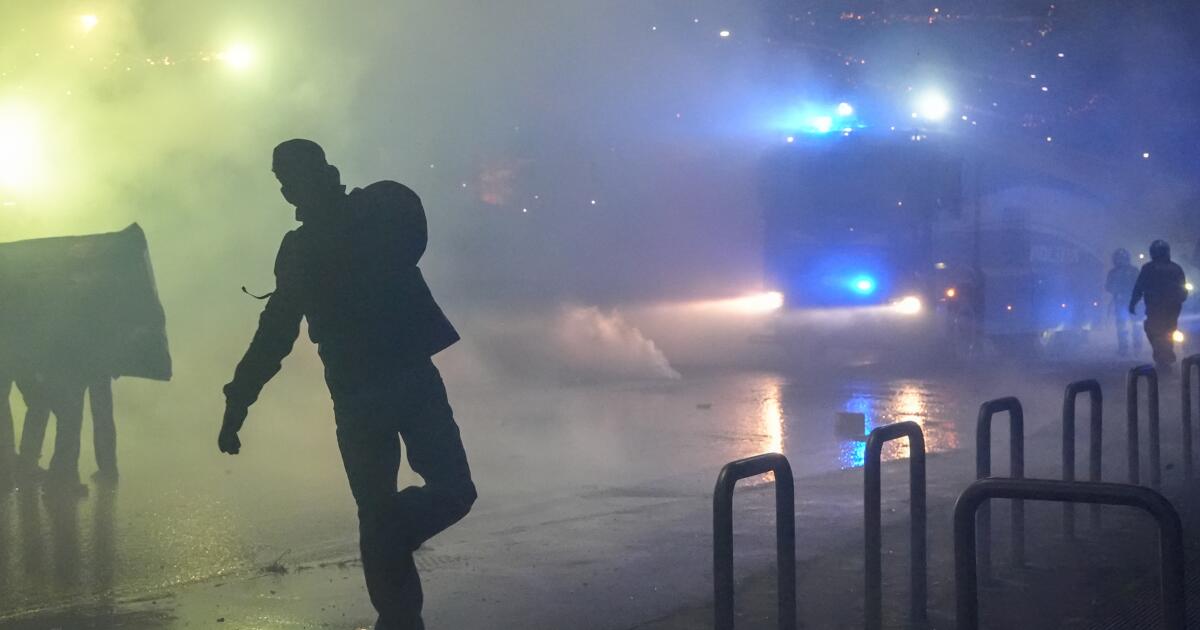
The march, which began peacefully, turned tense when some protesters set off smoke bombs and firecrackers near Olympic venues. Milan police responded with tear gas and water cannons to disperse the crowds, leading to clashes in areas close to the Olympic Village and a nearby highway.

International Olympic Committee spokesperson Mark Adams told reporters on Sunday that peaceful protest is legitimate, but “we draw a line at violence”, which “has no place at the Olympic Games”.

Separately, protesters have also rallied against Israel’s participation in the games and against US Immigration and Customs Enforcement, or ICE, which has deployed agents to provide security to the US delegation at the Games.

During Friday’s opening ceremony, Israel’s small delegation marched into Milan’s San Siro Stadium to a smattering of “boos” from the crowds. The four Israeli athletes, waving their national flag and smiling, saw the jeers quickly drowned out by the loud music and overall festive atmosphere.

United States Vice President JD Vance and his wife, Second Lady Usha Vance, received a similar hostile reception when they appeared on the stadium’s big screen.

Source link

Americans poised to win their first Winter Olympics medal

Welcome to your daily review and preview of this year’s Milan-Cortina Olympics. My name is John Cherwa and I’m your tour director for the Games wondering when the United States will get off the schneid and win a medal. Educated guess alert: How about today? Can you say team figure skating?

Saturday was the first day that medals were awarded at the Milan-Cortina Games and not unexpectedly, the host country is doing the best, sweeping all three medal types with a gold in the women’s 3,000 speed skating (Francesca Lollobrigida—before you ask, yes, a grand-niece to Gina) and silver and bronze in the men’s downhill (Giovanni Franzoni and Dominik Paris).

The U.S. squeezed out a 21st in speed skating with Annika Belshaw and 10th in the downhill courtesy of Kyle Negomir.

There is no doubt there is a home country advantage for a variety of reasons: familiarity with the competition venues, easier qualification (the home country gets in every event) and enthusiastic crowds urging them on.

Let’s look. 2022 Beijing, China had 15 medals, only nine in South Korea; 2018 PyeongChang, 17 in 2018, eight in Sochi; 2014 Sochi, Russia had 29 that year to 13 four years earlier; 2010 Vancouver, closer with a 26-24 edge for Canada; 2006 Turin, no edge as Italy had 11 compared to 13 in Salt Lake City; 2002 Salt Lake City, the U.S. had 34 medals in Utah and only 13 in 1998 in Nagano.

Italy had 17 medals in Beijing, meaning it has only 15 more medals to top 2022.

Elsewhere on Saturday:

— The U.S. women’s hockey team beat Finland, 5-0, to go 2-0 in pool play.

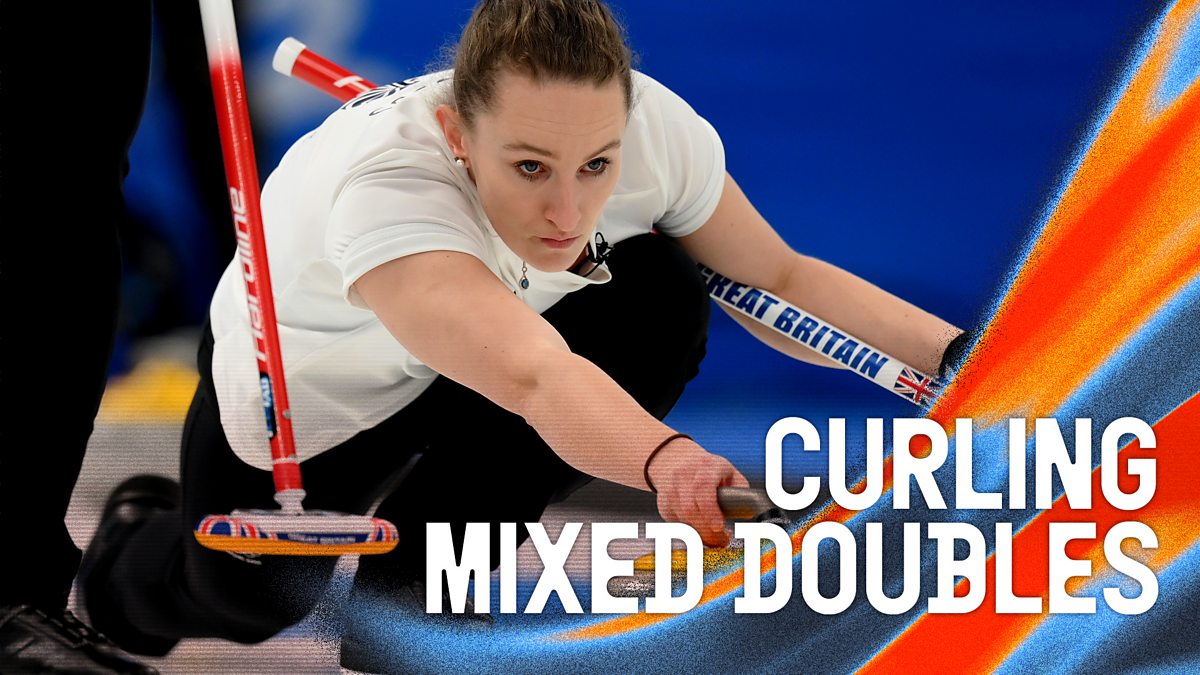
— The U.S. mixed curling team, after starting 2-0, lost both matches on Saturday to Britain (6-4) and South Korea (6-5).

— Sweden went 1-2 in the women’s 10K skiathlon as Jessie Diggins topped the U.S. team finishing eighth after a crash on the first lap. The U.S. has never won a medal in cross-country skiing and Diggins was a pre-race medal contender.

— Norway won the women’s normal hill ski jumping competition, with Annika Belshaw being the tops at 21st for the U.S.

— Japan won gold and silver in the men’s snowboard Big Air competition. Ollie Martin of the U.S. was bounced off the stand by the last competitor and finished fourth.

— Despite a mediocre second-place performance by the “Quad God” Ilia Malinin, the U.S. holds the lead with one day to go in the team figure skating. Madison Chalk and Evan Bates of the U.S. won Saturday’s ice dance competition.

NBC GoldZone gets demoted

We have taken the unusual step to demote NBC’s GoldZone (on Peacock) to the SilverZone after a dreadful gaffe on Saturday. In the U.S.-South Korea mixed team curling match, the U.S. rallied with three points in the final frame to tie South Korea sending it to an extra frame. It was down to the last stone to be sent by South Korea with the match on the line. GoldZone, at this moment, cuts to commercial seconds before the final throw. When it came back from the break it went to a canned package on Malinin before picking up figure skating coverage. South Korea won on the last stone and the U.S. and NBC (now) SilverZone lost. Another big gaffe and they could drop to the BronzeZone. Presumably, NBC won’t repeat and pull a Heidi (from 1968) during today’s Super Bowl game.

In case you were wondering

During the Games, we’ll try and answer some questions you might have but didn’t know who to ask. Now you have a spot. We’ll generate a lot of the questions but if you have one, please send to my boss, newsletter editor Houston Mitchell at his email. He prefers to be called Mr. Mitchell as he’s really tired of people saying “Houston, we have a problem.”

In honor of today’s big events:

Why do they indicate winners when only about a fourth of the downhill field has gone down the course? Unlike sports in which the best people start last (like golf, figure skating etc.) the best skiers go first . So, if you are seeded higher than 15th, your chances of winning are small and highly unusual. The seeding is decided by FIS points and a random bib draw of the top 15 skiers. There are two reasons, the course gets choppier every time a skier goes down the hill so the earlier you run the better chance of fresh and fair snow you have. And, the later in the day it is, the less firm the snow is because of the sun.

— What’s the difference between ice dancing and pairs in figure skating? In short, pairs is way more athletic. In ice dance there are generally no jumps or throws as there are in other disciplines. Skaters also have to stay within two lengths of each other, unlike pairs. Ice dancing is also the most scandal plagued discipline because of the subjectivity of scoring since there are few jumps, throws or lifts. There have also been rumors of deals made between countries. There have been fixing scandals in 1998, 2002 and 2014.

Best Thing to Watch on TV today

It’s going to sound a lot like Saturday, but the big story today is the likely first medal for the United States in the team competition in figure skating. It starts with the pairs at 10:30 a.m. PST and ends with the men’s singles, starring Ilia Malinin , at 2:55 p.m. Anything short of a gold will be a disappointment. If you are up early enough, the other big event is the women’s downhill with the return of Lindsey Vonn, who tore her ACL last week. It starts at 2:30 a.m. PST with Vonn being the 13th woman down the hill. If you want to just hang all day, there are four medal events today in snowboard, starting around 4 a.m. PST and going until about 6 a.m. PST.

Sunday’s full Olympic TV and streaming schedule

Sunday’s live TV and streaming broadcasts for the Milan-Cortina Winter Olympics unless noted (subject to change). All events stream live on Peacock or NBCOlympics.com with a streaming or cable login. All times Pacific. 🏅 — medal event for live broadcasts.

MULTIPLE SPORTS
7:45 p.m. — “Primetime in Milan” (delay; after Super Bowl): Figure skating, skiing, luge, curling, cross-country skiing and more. | NBC

ALPINE SKIING
2:30 a.m. — 🏅Women’s downhill | USA
6:20 a.m. — Women’s downhill (re-air) | NBC

BIATHLON
5:05 a.m. — 🏅Mixed 4X6-kilometer relay | Peacock
5:45 a.m. — Mixed 4X6-kilometer relay (delay) | NBC

CROSS-COUNTRY SKIING
3:30 a.m. — 🏅Men’s skiathlon | USA
8:50 a.m. — Men’s skiathlon (re-air) | USA

CURLING
Mixed doubles (round robin)
1 a.m. — Norway vs. Czechia | Peacock
1 a.m. — South Korea vs. Estonia | Peacock
1:55 a.m. — Mixed doubles highlights | USA
5:30 a.m. — U.S. vs. Estonia | USA
5:35 a.m. — Canada vs. Sweden | Peacock
5:35 a.m. — Britain vs. Switzerland | Peacock
5:30 a.m. — Italy vs. Czechia | Peacock
10 a.m. — U.S. vs. Sweden | Peacock
10 a.m. — Canada vs. South Korea | Peacock
10 a.m. — Italy vs. Britain | Peacock
10 a.m. — Switzerland vs. Norway | Peacock
2 p.m. — U.S. vs. Estonia (re-air) | CNBC
4 p.m. — U.S. vs. Sweden (delay) | CNBC
6 p.m. — Italy vs. Britain (delay) | CNBC

FIGURE SKATING
🏅Team competition
10:30 a.m. — Pairs, free skate | USA
11:45 a.m. — Women’s free skate | USA
12:55 p.m. — Men’s free skate | USA
10:30 p.m. — Team competition, final day (re-air) | USA

HOCKEY
7:40 a.m. — France vs. Sweden | Peacock
12:10 a.m. — Czechia vs. Finland | Peacock
2 p.m. — Czechia vs. Finland (delay) | USA
5:30 p.m. — France vs. Sweden (delay) | USA

LUGE
4:30 a.m. — Men’s doubles, training | Peacock
8 a.m. — Men’s singles, Run 3 | USA
9:45 a.m. — 🏅Men’s singles, final run | USA
7:30 p.m. — Men’s singles, runs 3-4 (re-air) | USA

SKI JUMPING
10 a.m. — Men’s normal hill, training | Peacock

SNOWBOARDING
Midnight — Men’s and women’s parallel giant slalom, qualifying | USA
4 a.m. — 🏅Men’s and women’s parallel giant slalom, finals | Peacock
4:30 a.m. — 🏅Men’s and women’s parallel giant slalom, finals (in progress) | NBC
4:30 a.m. — Men’s big air, final (re-air) | USA
7:30 a.m. — Men’s and women’s parallel giant slalom, finals (re-air) | USA
10:30 a.m. — Women’s big air, qualifying | Peacock
3:30 p.m. — Women’s big air, qualifying (delay) | USA

SPEEDSKATING
7 a.m. — 🏅Men’s 5,000 meters | NBC

In case you missed it …

Check out the following Milan-Cortina Olympics dispatches from from the L.A. Times team on the ground Italy:

Doctors explain how Lindsey Vonn can ski at Olympics with a ruptured ACL

‘Quad God’ Ilia Malinin conserves energy in Olympic debut; U.S. still leads team skate

Hilary Knight and U.S. women’s hockey routs Finland, works to avoid norovirus

Italian police fire tear gas in clash with anti-ICE protesters near Olympics venue

Meet the ‘Quad God.’ Why Olympic star Ilia Malinin might revolutionize figure skating

NBC juggles emotions of Savannah Guthrie’s family tragedy, celebrating the Winter Olympics

Italians embrace unity — except with JD Vance — during Olympics opening ceremony

Review: Winter Olympics opening ceremony was a sleek Italian spectacle, as only they could deliver

Photos from the sweeping 2026 Milan-Cortina Olympics opening ceremony

NBC’s Mike Tirico ready to pull off an Olympic-sized feat at Super Bowl

Inside the Milan Olympic village: real beds, free tech and other athlete perks

From cathedrals to Dolomites: Milan-Cortina Olympics pose a massive logistical test

How climate change is threatening the future of the Winter Olympics

Alysa Liu 2.0: How retirement, perspective helped the U.S. star reach new heights

The power of teamwork: Inside U.S. figure skating’s new Olympic golden age

Hilary Knight’s hockey achievements go beyond gold medals and championships

Everything you need to know about ski mountaineering, the newest Olympic sport

Ten U.S. athletes to watch at the Milan-Cortina Winter Olympics

Until next time…

That concludes today’s Sports Report Olympic Edition newsletter. If you have any feedback, ideas for improvement or things you’d like to see, email newsletter editor Houston Mitchell at houston.mitchell@latimes.com. To get this newsletter in your inbox, click here and select The Sports Report.

Source link

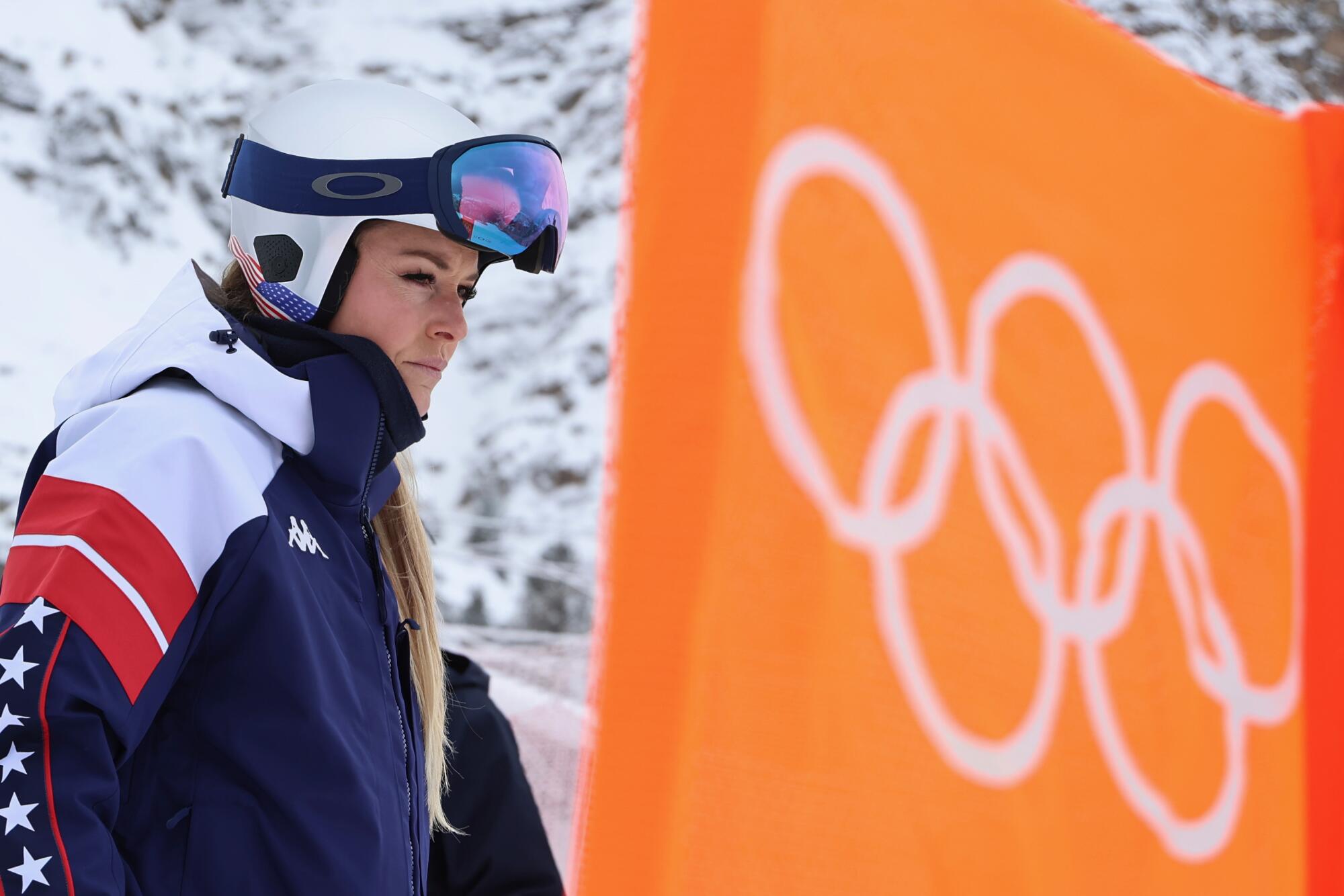
Lindsey Vonn ⁠crashes out; Breezy Johnson wins downhill at Winter Olympics | Winter Olympics News

Skiing icon Vonn cried in anguish and pain after her awful fall high up the course days after sustaining an ACL injury.

Lindsey Vonn’s Winter Olympic dream ended in screams of pain after she crashed out of the women’s downhill, failing in her audacious bid to medal in her favoured discipline at the Milan-Cortina Games.

Vonn’s United States (USA) teammate and world champion Breezy Johnson won the race to claim gold on Sunday.

Germany’s Emma Aicher took the silver medal, 0.04 of a second slower, and Italy’s home ‌favourite Sofia Goggia had to settle for bronze, according to ‌provisional results.

Johnson’s Olympic title, ‌on Cortina d’Ampezzo’s ⁠sunlit Olimpia delle Tofane piste, came exactly a year ‌after she won world championship gold at Saalbach, Austria.

American star Vonn had been trying to claim her fourth Olympic medal despite suffering a ruptured anterior cruciate ligament in her left knee just over a week ago, but her race ended early in Cortina d’Ampezzo.

She cried in anguish and pain after her awful fall high up the course, medical staff surrounding the distraught 41-year-old on the Olimpia delle Tofane piste where she has enjoyed much success in the past.

The 2010 Olympic downhill champion hit the firm snow face first after just 13 seconds of her descent. She then rolled down the slope with her skis still attached, which could likely cause further serious damage to her knee.

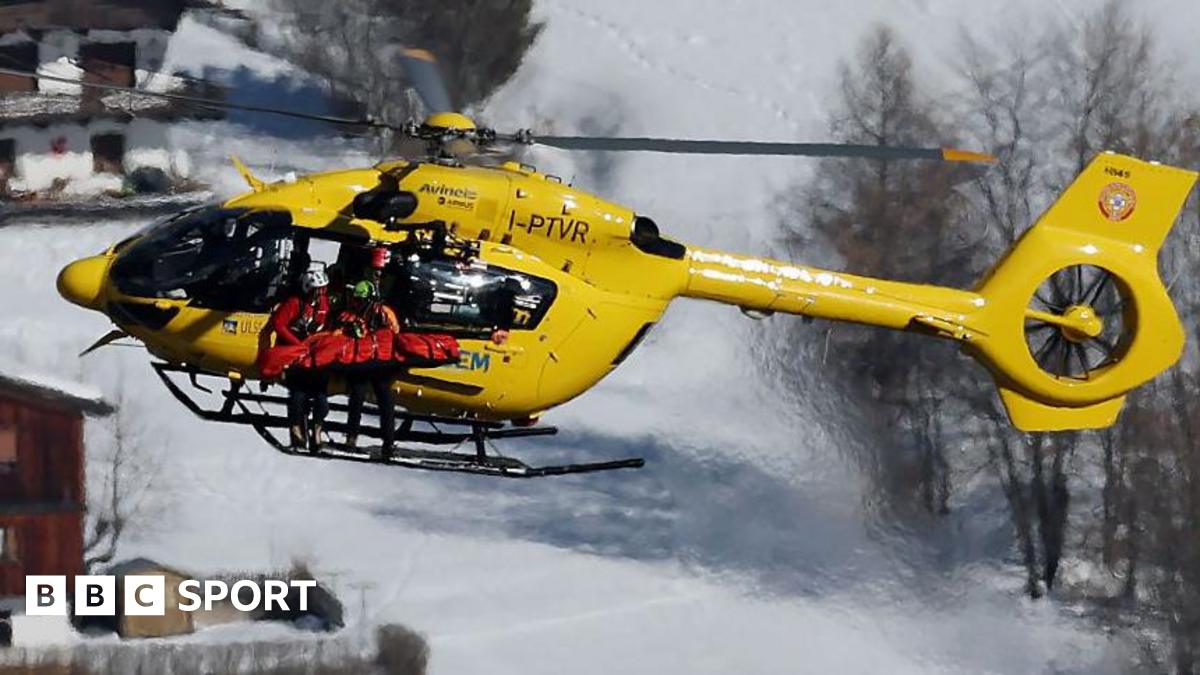
Vonn’s Olympic dream now lies in tatters after her brave effort to achieve the seemingly impossible, an attempt which ended with her being taken away in a helicopter as fans in the stands saluted her with loud applause.

One of world sport’s most recognisable faces and an alpine skiing icon, Vonn has insisted that she could not only compete but win against the world’s best women skiers, some of whom like Aicher are nearly half her age.

Vonn said ahead of the Games that she was planning on also competing in the team combined event on Tuesday and the super-G two days later.

But that now looks unlikely, a potential long lay-off perhaps heralding the end of her comeback to skiing in her early 40s.

Vonn retired in 2019 but returned to competition in November 2024 following surgery to partially replace her right knee to end persistent pain.

Vonn had finished on the podium in every previous World Cup downhill race this season, including two victories in St Moritz and Zauchensee, and claimed two more top-three finishes in the super-G.

But retirement looms for Vonn following a disastrous end to one of the biggest stories of the Winter Olympics.

Source link

Lindsey Vonn crashes out in women’s downhill final at Winter Olympics

Vonn knew the risk she was taking by competing on Sunday and had even hit back at a doctor on social media who claimed the injury was “not a fresh tear”.

She responded by saying her ACL is “100% torn” and had hoped to defy the odds by replicating the Olympic downhill gold medal she won in Vancouver in 2010.

Videos on social media had shown her training in the gym after she said she had no pain or swelling of the knee, while two smooth runs in the build-up to the race had given her, and her team and fans, confidence.

Four-time British Olympian Chemmy Alcott was emotional on BBC coverage and said she “never believed” it would end in this way.

“What we saw [is] that the top of the piste is really hard for a fit athlete. It is brutal, think about her family, her team and herself.

“We have to be realistic – the risk was really high, the risk she takes when she falls will double that. Her body will not be able to take that.”

Alcott added that the long delay would also mean the snow on the piste would begin to melt in the midday sun, and therefore it would be unlikely that anyone would beat Johnson’s time of one minute 36.10 seconds.

Source link

Alleged arsonists damage Italian rail cables as Winter Olympics start

Ilia Malinin of United States slides across the ice during the Men’s Singles Figure Skating Team Event in Milan, Italy, after several fires damaged Italian rail lines on Saturday morning. Photo by Richard Ellis/UPI | License Photo

Feb. 7 (UPI) — Several fires damaged Italy’s northern rail line on the first day of the Winter Olympic Games in what investigators are calling acts of sabotage by arsonists.

Local authorities said three separate fires damaged railroad infrastructure and disrupted travel along the Bologna and Venice rail lines, causing travel delays of up to 2.5 hours on Saturday morning.

Rail service to Venice also was disrupted, and another fire was reported along tracks leading to the coastal city of Pesaro.

Italian railway officials ruled out any technical problems or accidents as the cause of the fires and damage and are treating them as deliberate acts of sabotage.

Investigators found an explosive device and severed cables, which officials for Italy’s Ministry of Transport described as “serious sabotage” that is similar to damage done to French rail lines during the Paris Summer Olympics in 2024.

“These actions of unprecedented seriousness do not in any way tarnish Italy’s image in the world, an image that the Games will make even more compelling and positive,” Matteo Salvini, deputy prime minister and transport minister, told the BBC.

No one has claimed responsibility for the damage that briefly stopped rail service on Bologna’s high-speed line, which was running again by the afternoon.

The rail line is among several that enable spectators to visit various events that are held in an area spanning hundreds of miles in northern Italy’s Alps and Dolomite mountains.

Transportation and anti-terrorism law enforcement teams also are investigating the matter.

Source link

Jeers target US, Israeli delegations during Winter Olympics opening ceremony in Milan – Middle East Monitor

The opening ceremony of the Milano Cortina 2026 Winter Olympics on Friday was marked by audible boos from the crowd as delegations from the US and Israel entered the San Siro stadium, Anadolu reports.

US Vice President JD Vance and Secretary of State Marco Rubio led the American delegation.

As Vance appeared on the stadium’s big screen, waving the US flag, the crowd responded with jeers, according to live coverage of the event.

“There is the Vice President JD Vance and his wife Usha. Oops — those are a lot of boos for him,” an announcer was heard saying during the broadcast.

The reaction followed days of tension surrounding the participation of US Immigration and Customs Enforcement (ICE) agents in Olympic security.

The Department of Homeland Security confirmed the presence of Homeland Security Investigations personnel in Milan, prompting widespread protests and opposition from Italian lawmakers and citizens.

READ: Israel’s Netanyahu again dodges responsibility for Oct. 7 failures, blames army, past governments

“They’re not welcome in Milan,” said Milan Mayor Giuseppe Sala in a radio interview, calling ICE a “militia that kills.”

Thousands gathered in Piazza 25 Aprile last weekend to demonstrate against the agents’ presence and raise concerns about civil rights violations.

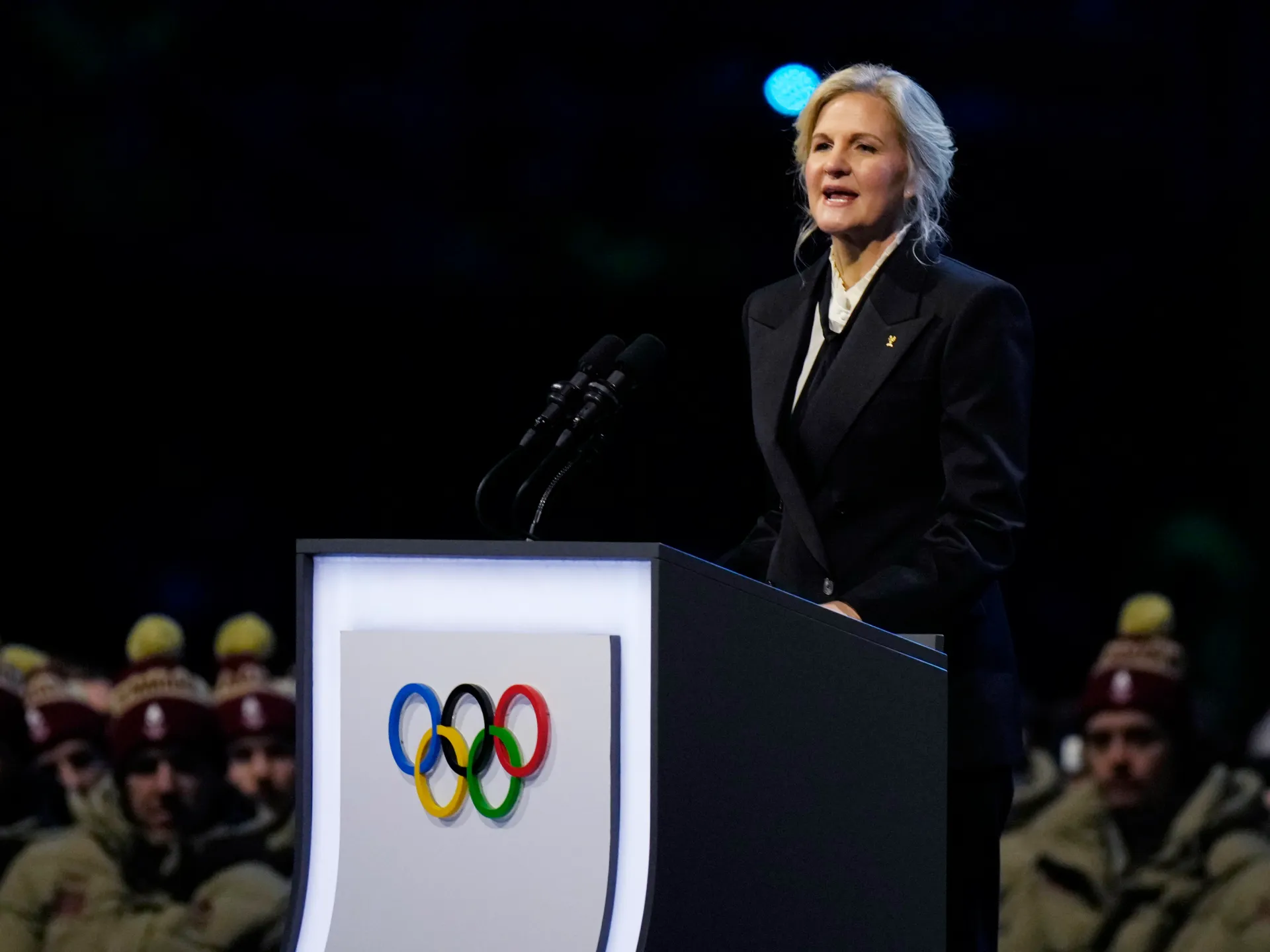
International Olympic Committee President Kirsty Coventry responded to concerns ahead of the ceremony, saying: “I hope that the opening ceremony is seen by everyone as an opportunity to be respectful of each other.”

The Israeli delegation, which included nine Olympians and one Paralympian, also faced a “smattering of boos” as they entered the stadium, though the crowd noise was largely drowned out by music.

Additional protests were reported in Cortina d’Ampezzo and Predazzo, where simultaneous parades were held.

Security remains a top concern for several delegations, with increased attention to political sensitivities throughout the Games.

More than 800 athletes have been killed in Gaza since the start of Israel’s offensive on Oct. 7, 2023, as the sports community continues to suffer under bombardment, famine, and the collapse of infrastructure, according to Palestinian officials.

READ: US lawmaker calls for halt to weapons transfers to Israel amid Gaza violence

Source link

Italian police fire tear gas in clash with protesters near Olympics venue

Italian police fired tear gas and a water cannon at dozens of protesters who threw firecrackers and tried to access a highway near a Winter Olympics venue Saturday.

The brief confrontation came at the end of a peaceful march by thousands highlighting the environmental impact of the Games and the presence of U.S. Immigration and Customs Enforcement agents in Italy.

Police held off the demonstrators, who appeared to be trying to reach the Santagiulia Olympic ice hockey rink. By then, the larger peaceful protest, including students and families with small children, had dispersed.

Earlier, a group of masked protesters had set off smoke bombs and firecrackers on a bridge overlooking a construction site about half a mile from the Olympic Village that’s housing about 1,500 athletes.

Police vans behind a temporary metal fence secured the road to the athletes’ village, but the protest veered away, continuing on a trajectory toward the Santagiulia venue. A heavy police presence guarded the entire route.

There was no indication that the protest and resulting road closure interfered with athletes’ transfers to their events, all on the outskirts of Milan.

The demonstration coincided with U.S. Vice President JD Vance’s visit to Milan as head of the American delegation that attended the opening ceremony Friday, during which Vance was booed.

He and his family visited Leonardo da Vinci’s “The Last Supper” closer to the city center, far from the protest that denounced the deployment of ICE agents to provide security for the U.S. delegation. ICE has drawn international condemnation for its role in the Trump administration’s aggressive immigration crackdown in U.S. cities, including the fatal shooting of two people in Minneapolis last month by ICE and U.S. Border Patrol agents.

U.S. Homeland Security Investigations, an ICE unit that focuses on cross-border crimes, frequently sends its officers to overseas events like the Olympics to assist with security. The ICE arm at the forefront of the immigration crackdown in the U.S. is known as Enforcement and Removal Operations, and there is no indication its officers are being sent to Italy.

At the larger, peaceful demonstration, which police said numbered 10,000, people carried cardboard cutouts to represent trees felled to build the new bobsled run in Cortina d’Ampezzo. A group of dancers performed to beating drums. Music blasted from a truck leading the march, one a profanity-laced anti-ICE anthem.

“Let’s take back the cities and free the mountains,” read a banner by a group calling itself the Unsustainable Olympic Committee. Another group called the Assn. of Proletariat Excursionists organized the cutout trees.

“They bypassed the laws that usually are needed for major infrastructure projects, citing urgency for the Games,” said protester Guido Maffioli, who expressed concern that the private entity organizing the Games would eventually pass on debt to Italian taxpayers.

Homemade signs read “Get out of the Games: Genocide States, Fascist Police and Polluting Sponsors,” the final one a reference to fossil fuel companies that are sponsors of the Games. One woman carried an artificial tree on her back decorated with the sign: “Infernal Olympics.”

The demonstration followed another recently at which hundreds protested the deployment of ICE agents.

Like that protest, demonstrators Saturday said they were opposed to ICE agents’ presence, despite official statements that a small number of agents from an investigative arm would be present in U.S. diplomatic territory, and not operational on the streets.

Barry and Rosa write for the Associated Press.

Source link

Doctors explain how Lindsey Vonn can ski at Olympics without use of ACL

One short week after Lindsey Vonn crashed in Crans-Montana, Switzerland, and tore her left anterior cruciate ligament, she was tearing down the hill in Cortina d’Ampezzo, Italy, a light knee brace warping the fabric of her racing suit the only obvious sign of anything amiss. When she finished the training run Friday, clocking the third-fastest time for a U.S. woman on the day, she casually fist bumped an American teammate at the finish line.

She made the feat look effortless. Sports medicine experts can say it’s anything but.

“It’s atypical to be able to compete without an ACL, at anything, but especially at a high level like Lindsey Vonn’s going to compete at,” said Clint Soppe, a board certified orthopedic surgeon and sports medicine specialist at Cedars-Sinai. “So this is very surprising news to me as well.”

The ACL, which connects the shin bone to the femur, is a main stabilizing force in the knee and protects the lower leg from sliding forward. Straight-line movement doesn’t stress the major knee ligament and some day-to-day tasks such as walking are easily accomplished without an ACL. But what Vonn is doing is far from normal.

“If you add cutting, pivoting, changing directions, in 95% of humans, you need an ACL to do that,” said Kevin Farmer, an orthopedic surgeon and professor at the University of Florida’s department of orthopedics and sports medicine. “She’s obviously fallen into that 5%.”

Farmer calls the rare group “copers.” They overcome the lack of an ACL by strengthening and engaging other muscles. It’s primarily the hamstrings and quadriceps, but everything, including the glutes, calves, hips and core, counts.

Vonn will have had just nine days between the Olympic downhill race and her injury when she stands at the start gate Sunday. But the 41-year-old has had her whole career to develop the type of strength and control necessary to carry her through the Games without an ACL. She’s already done it before.

Lindsey Vonn concentrates ahead of a downhill training run in Cortina d'Ampezzo on Friday.

Lindsey Vonn concentrates ahead of a downhill training run in Cortina d’Ampezzo on Friday.

(Marco Trovati / Associated Press)

Vonn skied on a torn right ACL for more than a month until withdrawing just before the 2014 Sochi Olympics. In 2019, she won a bronze medal at world championships without a lateral collateral ligament and three tibial fractures in her left knee. She said this week that the same knee feels better than it did during that bronze medal run.

“She’s dealt with knee injuries in this knee before, so she’s been able to develop mechanisms and strategies,” Farmer said. “She probably doesn’t even realize that, but just from years of practicing with a knee that’s not normal, her body has developed mechanisms of firing patterns that allow her knee to have some inherent stability that most people don’t have.”

For athletes who suffer major injuries for the first time, pain often prevents them from firing their muscles, said Jason Zaremski, a nonoperative musculoskeletal and sports medicine physician and clinical professor at the University of Florida’s department of physical medicine and rehabilitation. But Vonn, whose injury history is almost as long as her resume, looked calm during training, her coach Aksel Lund Svindal told reporters in Cortina on Saturday.

So even if she’s one ACL short, Vonn’s team knows she has more than enough of the intangibles to get her not only down the mountain, but into medal contention.

“Her mental strength,” Svindal told reporters in Cortina on Saturday. “I think that’s why she has won as much as she has.”

Vonn completed her second training run Saturday with the third-fastest time before training was suspended after 21 athletes. She was 0.37 second behind compatriot Breezy Johnson, who is intimately familiar with what Vonn is attempting.

Johnson, a medal contender for the United States who led the second training run at 1 minute and 37.91 seconds, attempted to ski in Cortina without an ACL in 2022. She had one successful training run, but crashed on the second one, sustaining further injuries that forced her to withdraw from the Beijing Olympics.

Johnson, like many, gasped when she saw Vonn’s knee buckle slightly on a jump during training Saturday. She said coming off jumps on this course are especially difficult.

“There are, I think, more athletes that ski without ACLs and with knee damage than maybe talk about it,” Johnson said at a news conference from Cortina. “… I think that people often are unwilling to talk about it because of judgment from the media and the outside.”

Critics say Vonn is taking a spot from a healthy teammate or that she simply refuses to give up the sport for good. But Vonn has already come to terms with the end of her career. She said she came out of retirement with a partially replaced right knee simply wanting an opportunity to put the perfect bow on her ski racing career at a course she especially loves.

The stage is different, but the sentiment is familiar to Zaremski. The doctor has worked with high school athletes who beg for a chance to play a final game after suffering a torn ACL. Through bracing, taping and treatment, sometimes there are temporary fixes for the biggest moments.

“If we’re trying to get a huge event like the Olympics, I would never put anything past [Vonn],” Zaremski said. “She’s an amazing, once-in-a-generation athlete.”

Source link

Winter Olympics: U.S. women’s hockey dominates vs. Finland

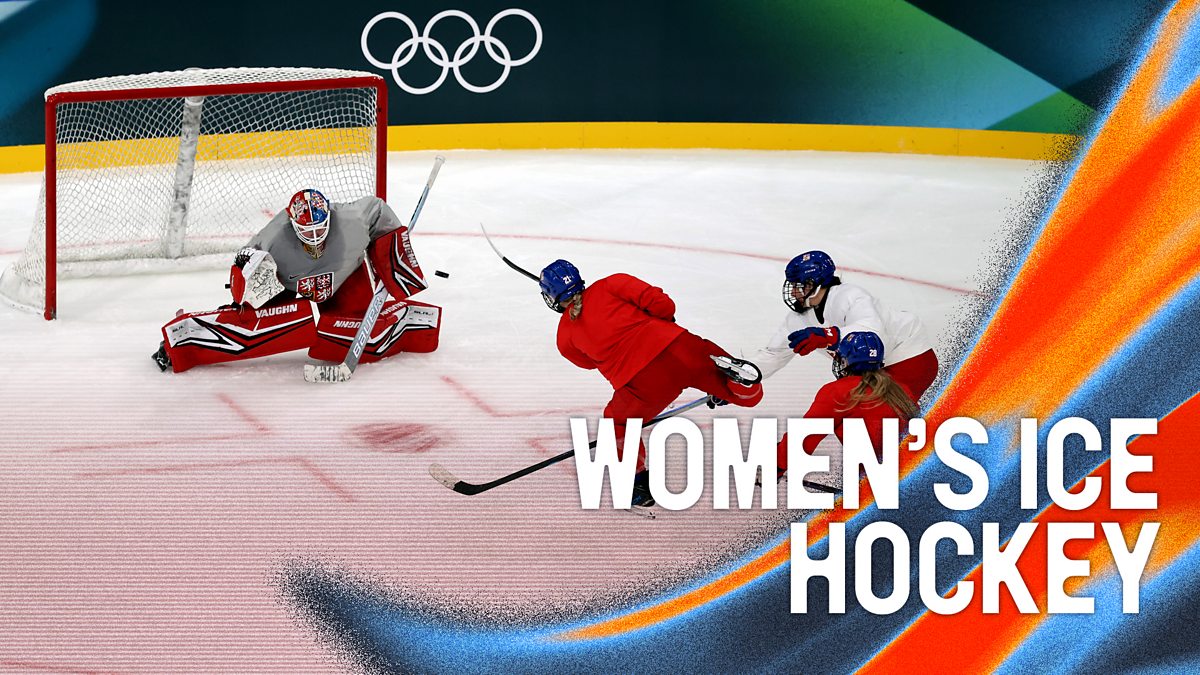
The U.S. women’s hockey team came into the Milan-Cortina Winter Games ranked No. 1 in the world. And two games into group play, it’s shown that ranking might be something of an understatement.

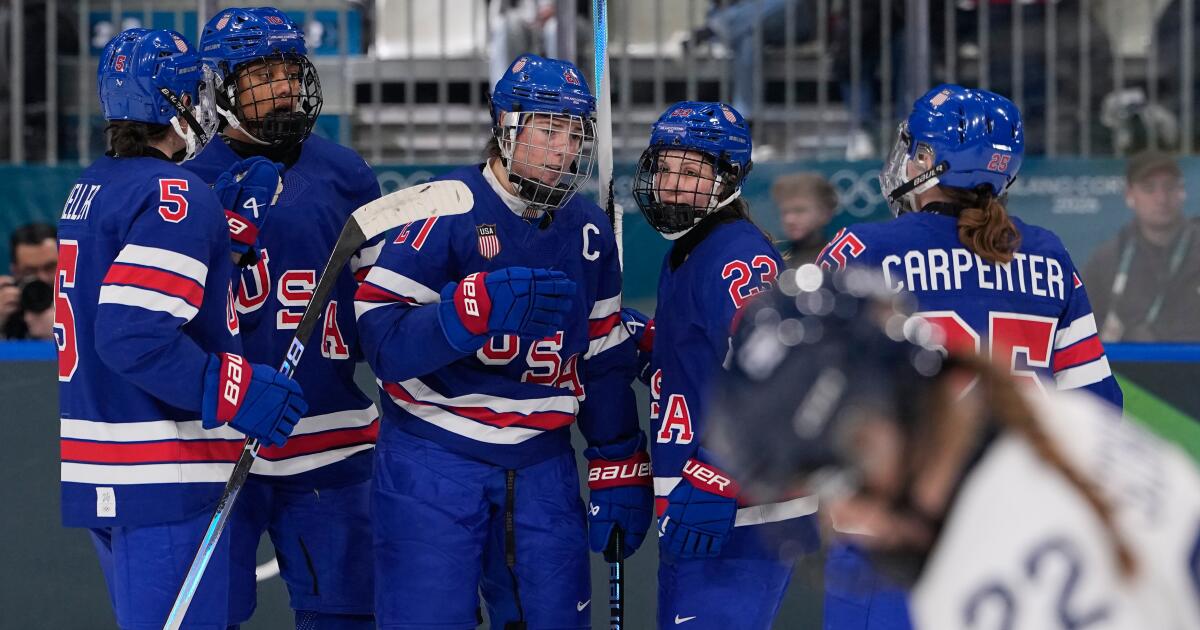
With Saturday’s 5-0 victory over No. 3 Finland, the unbeaten Americans have outscored their two opponents 10-1 and outshot them 91-25. The goals Saturday came from Alex Carpenter, Taylor Heise, Megan Keller, Hilary Knight and Abbey Murphy. Keller and Laila Edwards each had two assists.

In goal, Aerin Frankel faced just 11 shots in posting the first shutout of the Olympic tournament.

Just as in its opening win over No. 4 Czechia, the U.S. eased its way into the game before going ahead to stay late in the first period on a power-play goal from Carpenter. The score came seven seconds after Finland’s Susanna Tapani was sent off for hooking.

The Americans doubled the advantage 2½ minutes into the second period at the end of a beautiful passing sequence that saw Britta Curl feed Murphy, whose cross-crease pass found Heise on the doorstep for the easy goal.

Sixty-six seconds later Keller’s unassisted goal made it 3-0 and the rout was on.

Next came a power-play goal from Knight, her 14th in Olympic play, equaling Natalie Darwitz and Katie King for the most in team history. Murphy closed out the scoring, banging in a rebound at the right post with less than five minutes to play.

With 10 goals, the U.S. is tied with Sweden for most in the tournament while the Americans’ goal differential of plus-nine is the best. It was the 11th straight Olympic win for the U.S. over Finland, the bronze medalist four years ago.

Source link

Olympic committee: New transgender policy consensus reached across sports | Olympics News

A proposed new consensus between sports leaders across the globe about gender policy would be a first uniform criteria.

Global sports leaders ‌have reached consensus on a new set of eligibility criteria for transgender athletes, with the new policy expected to be announced within the first half of this year, the International Olympic Committee (IOC) said on Saturday.

It would be the first uniform policy adopted by the IOC and international sports federations, applying to major events in dozens of sports, including the Games and world championships. Currently, federations have ⁠their own rules, which can vary.

Recommended Stories

list of 4 itemsend of list

Details of the new policy are unclear, but it is expected to severely restrict the participation of transgender athletes who compete in women’s categories if they have undergone full male puberty before any subsequent medical transition.

The IOC, under its first female president, Kirsty Coventry, took the lead in June, opting for a uniform approach.

“Protecting the female category is one of the key reforms she wants to bring in,” IOC spokesman Mark Adams ⁠told a news conference at the Milan-Cortina Winter Games on Saturday.

“I would say it is going to happen shortly, within the next few months.

“It has been out to consultation phase and we had the ‘pause and reflect’ (period) on it,” Adams said. “Generally speaking, there is consensus within the sporting movement. I think you will have a new policy in the first half of this year. Don’t hold me to it, but that is roughly the timescale.”

In September, Coventry set up the “Protection of the Female Category” working group, made up of experts as well as representatives ‌of international federations, to look into how best to protect the female category in sport.

Before Coventry’s decision, the IOC had long baulked at any universal rule on transgender participation for the Games, instructing international federations in 2021 to come up with their own ‌guidelines. Under current rules, still in force, transgender athletes are eligible to take part in the Olympics once cleared by their respective federations.

Only a handful of openly ‌transgender athletes have taken part in the Games. New Zealand’s Laurel ⁠Hubbard became the first openly transgender athlete to compete in a different gender category to that assigned at birth when the weightlifter took part in the Tokyo Olympics in 2021.

Currently, for example, World Aquatics allows transgender athletes who have transitioned before the age of ‌12 to compete. World Rugby bans all transgender athletes from elite-level competitions.

United States President Donald Trump has banned transgender athletes from competing in school, college and pro events in the female category in the US, as Los Angeles prepares to host the 2028 Summer Olympics.

Trump, who signed the “Keeping Men Out of Women’s Sports” order in February, has said he would not allow transgender athletes to compete at the LA Games.

Source link

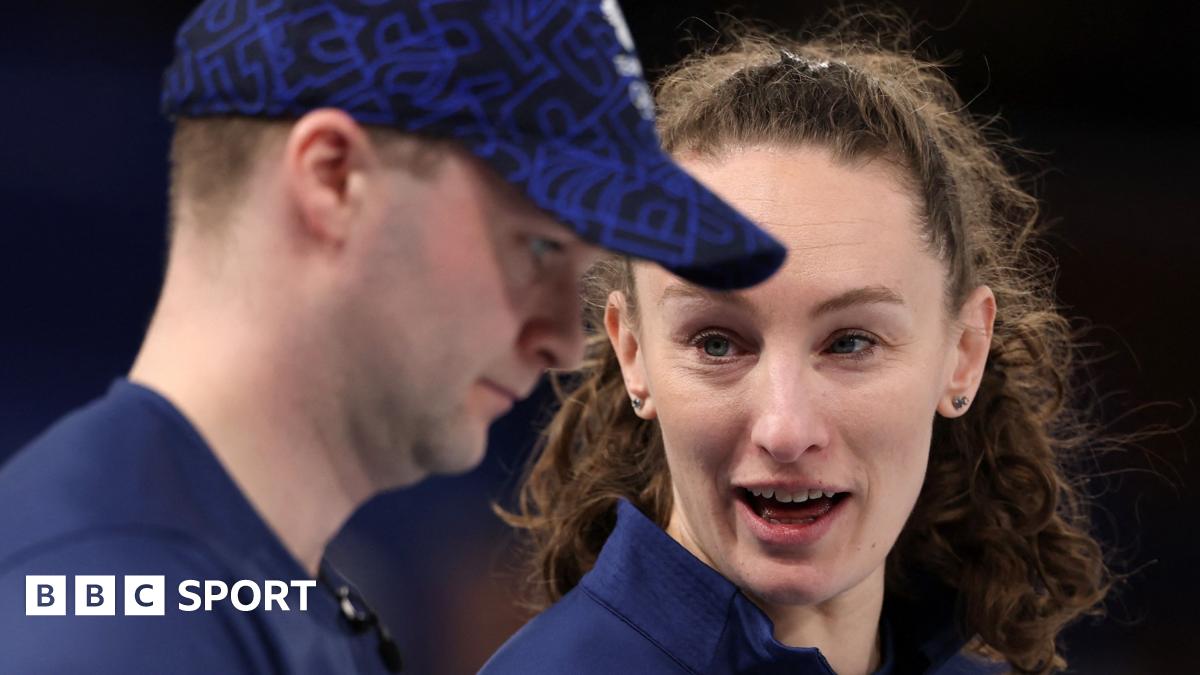
Winter Olympics 2026: Bruce Mouat and Jen Dodds beat United States to clinch semi-final

Elsewhere, Kirsty Muir enjoyed a confident start to her Olympic campaign, placing third in freeski slopestyle qualifying.

Muir, one of Team GB’s best medal hopes, scored a best of 64.98 from her two runs in Livigno.

That put the 21-year-old behind Switzerland’s Mathilde Gremaud and China’s Eileen Gu – the gold and silver medallists from Beijing 2022 respectively – in the standings.

“I am feeling really relieved. I was really nervous this morning. Putting a good run down in the qualifications was important for me because I wanted to be in that final,” Muir told BBC Sport.

“In the qualifying, it is sometimes more nerve-wracking, whereas, in the final you go all out and you either get it or you don’t. That’s what I am going to be ready for.”

Gu, a triple medallist from four years ago, is one of the biggest global stars at these Games but avoided an early shock after crashing off the first rail of her opening run.

After almost a year out with an anterior cruciate ligament (ACL) injury, Muir has won three World Cup golds in the past year, including two in slopestyle.

The Olympic final takes place on Monday from 11:30 GMT.

Chris McCormick couldn’t match Muir in reaching the men’s slopestyle final, missing out on a place in the top 12 with a best score of 33.90.

The 27-year-old, who learned to ski on Bearsden dry slope, came into his debut Olympics nursing an ankle injury.

“To even make it to the start gate is a small victory,” McCormick – who will also compete in big air – told BBC Sport.

“I really wanted to show my best skiing. But I’m super happy to be here, especially when I think of where I’ve come from, from the dry slope to here, that’s a big achievement. And I’ve had a lot of fun, despite all the pain I’ve been skiing through.”

In Tesero, Anna Pryce made history by becoming the first British athlete to compete in the women’s 10km + 10km skiathlon at an Olympic Games.

Pryce, who switched allegiance from Canada last year, came 42nd – finishing seven minutes and 24 seconds behind gold-medal winner Frida Karlsson of Sweden.

Pryce said she was so excited to make her Olympic debut that she was “giggling at the start”.

“Maybe I should have felt more nervous, I don’t know. But I feel pretty relaxed and maybe that translated into my skiing – which was great,” she said.

Source link

Winter Olympics opening ceremony review: A sleek Italian spectacle

The Olympics are back, wearing their warm Winter Games gear. Although there were will be a couple of weeks of sports competitions to come, none are possible without an opening ceremony, a combination of solemn official protocol with a fantastic representation of the host country’s culture and character, evoking the Olympic spirit itself. There are few opportunities to mount an entertainment of this scale — not even a Super Bowl halftime show can compare.

This year we are in Italy, for the bi-metropolitan Milan-Cortina games, held in the city’s San Siro Stadium and in the north where the mountains are. The ceremonies, too, were split geographically, with Olympic cauldrons in both cities, with the athletes’ parade further shared with Livigno and Predazzo, national delegations divided according to where their events would be held.

1

Three dancers in black wearing giant heads of older men.

2

Dancers in white and black leotards surround a conductor in the middle of a stage.

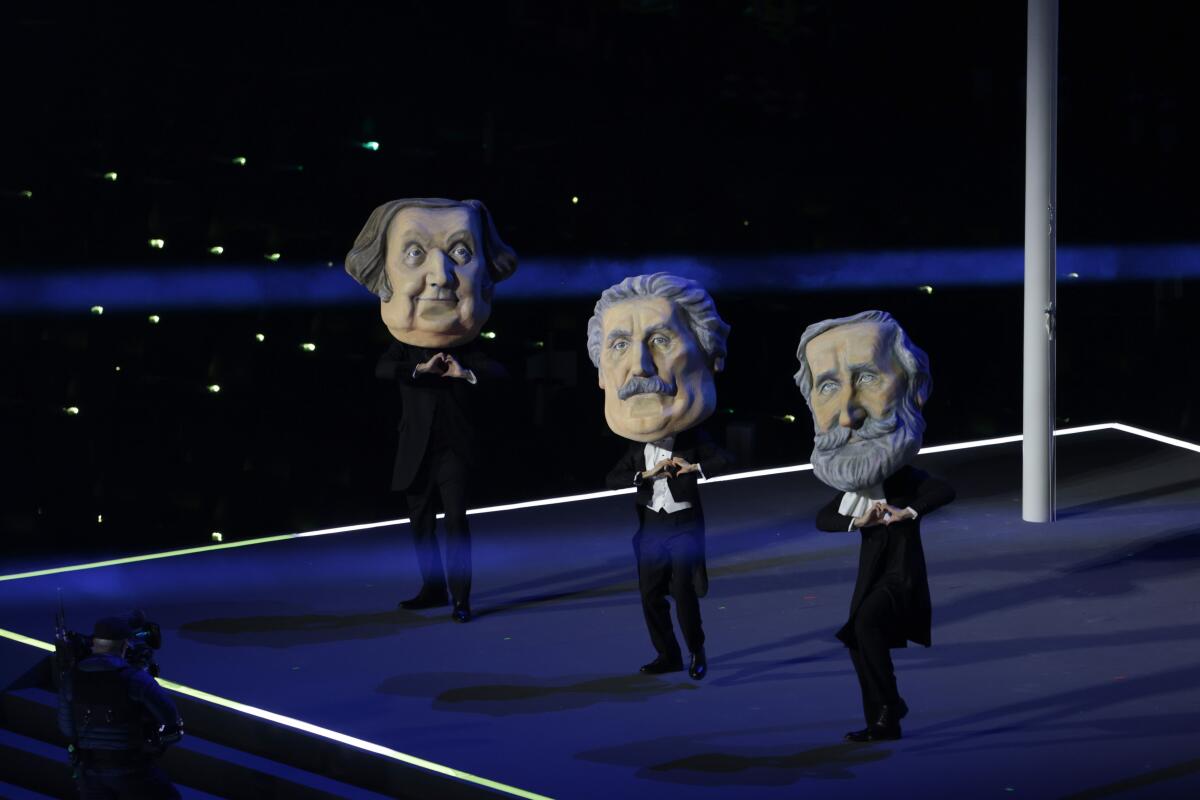
1. Human bobbleheads of Italian composers Rossini, left, Puccini and Verdi. (Robert Gauthier/Los Angeles Times) 2. Dancers on stage in San Siro Stadium. (Robert Gauthier/Los Angeles Times)

The main business took place in the arena. Directed by Marco Balich, who specializes in big shows, it was elegant, in a sleek, clean-lined Italian way, and over the top, also in an Italian way. Color played a great part, the program beginning in white (a balletic interpretation of Antonio Canova’s sculpture “Psyche Revived by Cupid’s Kiss”), moving to to black and white (a nod to Fellini’s “La Dolce Vita” and its paparazzi), and then to a riot of color, as giant floating tubes of paint sent streams of colored fabric stageward.) There were dancing human bobbleheads of opera composers Verdi, Puccini and Rossini, as if they were mascots for Team Rigoletto, Team Tosca and Team William Tell. There were dancing gladiators and moka pots, a phalanx of runway models dressed (in Armani) in green, white and red, to represent the Italian flag.

In white and shiny silver, with an ostrich feather boa and a reported $15 million worth of diamond jewelry, there was a statuesque, statue-still Mariah Carey, who is not Italian, but sang in Italian, the standard “Nel blu, dipinto di blu,” known here as “Volare,” which merged into her own “Nothing Is Impossible.” (She must by now be accounted a citizen of the world.) Why did I find this so moving? I am not someone who ordinarily cares anything about Carey, but she was marvelous in this context.

A woman in a white gown singing on a stage.

Mariah Carey performed the Italian tune “Volare,” before leading into “Nothing Is Impossible.”

(Robert Gauthier/Los Angeles Times)

The parade of nations is also a fashion show; for whatever reason, the cold weather gear is generally better looking than the togs of summer. (As usual, Ralph Lauren designed the American outfits — white puffy jacket with knit caps of a Scandinavian pattern.) As ever, the countries arrived alphabetically (apart from Greece, who always gets to march first; Italy, coming in last as the host country; France, in penultimate position as the host of the next Winter Games; and the U.S., third to last as the host of the games, in 2034, after that). It makes neighbors of Lebanon, Lichtenstein and Lithuania, and so on, equal in standing if not in size. (I have a special fondness for the small delegations from the less imposing nations.) There was an especially big hand for the Ukrainian team, dressed in their national colors.

The second half opened with a cartoon in which an animated Sabrina Impacciatore (of “The White Lotus” and, “The Paper,” which NBC happily did not cross-promote), traveled backward through previous Winter Games before coming to life to lead an energetic production number that traveled back to now. (She should get some sort of athletic medal for this performance.) The Chinese pianist Lang Lang accompanied Cecilia Bartoli singing the Olympic anthem, and the great Andrea Bocelli, flanked by strings, offered a thrilling reading of Puccini’s “Nessun Dorma.” Surrounded by dancers, the Italian rapper Ghali read an antiwar poem by Gianni Rodari.

A woman in a silver and gold leotard surrounded by dancers on a stage.

Sabrina Impacciatore leading a group of dancers during the ceremony.

(Robert Gauthier/Los Angeles Times)

The theme of the evening, and of evenings going forward, it is hoped, was “Armonia,” or harmony, not just between the city and the country (expressed symbolically through dance), but, as a series of speeches made clear, among everybody, everywhere.

“At a time when so much of the world is divided by conflict, your very presence demonstrates that another world is possible. One of unity, respect and harmony,” said Giovanni Malagò, president of the organizing committee, addressing the athletes. Kirsty Coventry, the first female president of the IOC, noted that while Olympic athletes are fierce competitors, they “also respect, support and inspire one another. They remind us that we are all connected, that our strength comes from how we treat each other, and that the best of humanity is found in courage, compassion and kindness.”

And then there was Charlize Theron, of all people, quoting her countryman Nelson Mandela: “Peace is not just the absence of conflict; peace is the creation of an environment where all can flourish, regardless of race, color, creed, religion, gender, class, caste or any other social markers of difference,” This is, of course, exactly what some portion of this nation would call “woke,” and though such divisions are not the exclusive province of the United States, it was easy enough to read this as a message delivered to the White House.

A woman in a black gown stands on a stage with a microphone.

Charlize Theron quoted her fellow countryman Nelson Mandela in her speech.

(Robert Gauthier/Los Angeles Times)

Finally, two Olympic torches were lit two Olympic cauldrons, in Milan and Cortina, their flames at the center of shape-shifting spheres. Almost inevitably, the ceremonies flirted with, or embraced, corniness at times, but even (or especially) when it was corny, it was terrifically affecting. I ran through half a dozen handkerchiefs over the course of the proceedings. Admittedly, I might be unusually susceptible to these things, but I doubt I’m the only one.

Let the games begin.

Source link

Italians embrace unity, boo JD Vance at Olympics opening ceremony

Spread across more than 265 miles in four different cities from the snowy Dolomites to the sunny — for now — streets of Milan, the Milan-Cortina Olympics delivered one message.

Unity.

The most widespread Olympic Games in history showcased Italy’s idyllic snow-capped mountains, cutting-edge city life and celebrated winter legacy in the opening ceremony of the Milan-Cortina Games on Friday. The unique setup that required four ceremonies in Milan, Livigno, Predazzo and Cortina d’Ampezzo used movie magic on video screens, a golden ring and Italian icon Andrea Bocelli to bridge the distance between host cities Milan and Cortina and unite the Olympics behind the athletes who will compete across seven sports zones in the next 16 days.

“Let these Games be a celebration of what unites us, of everything that makes us human,” International Olympic Committee president Kirsty Coventry said in her speech, her first at an Olympic Games under her leadership. “This is the magic of the Olympic Games: inspiring us all to be the best that we can be — together.”

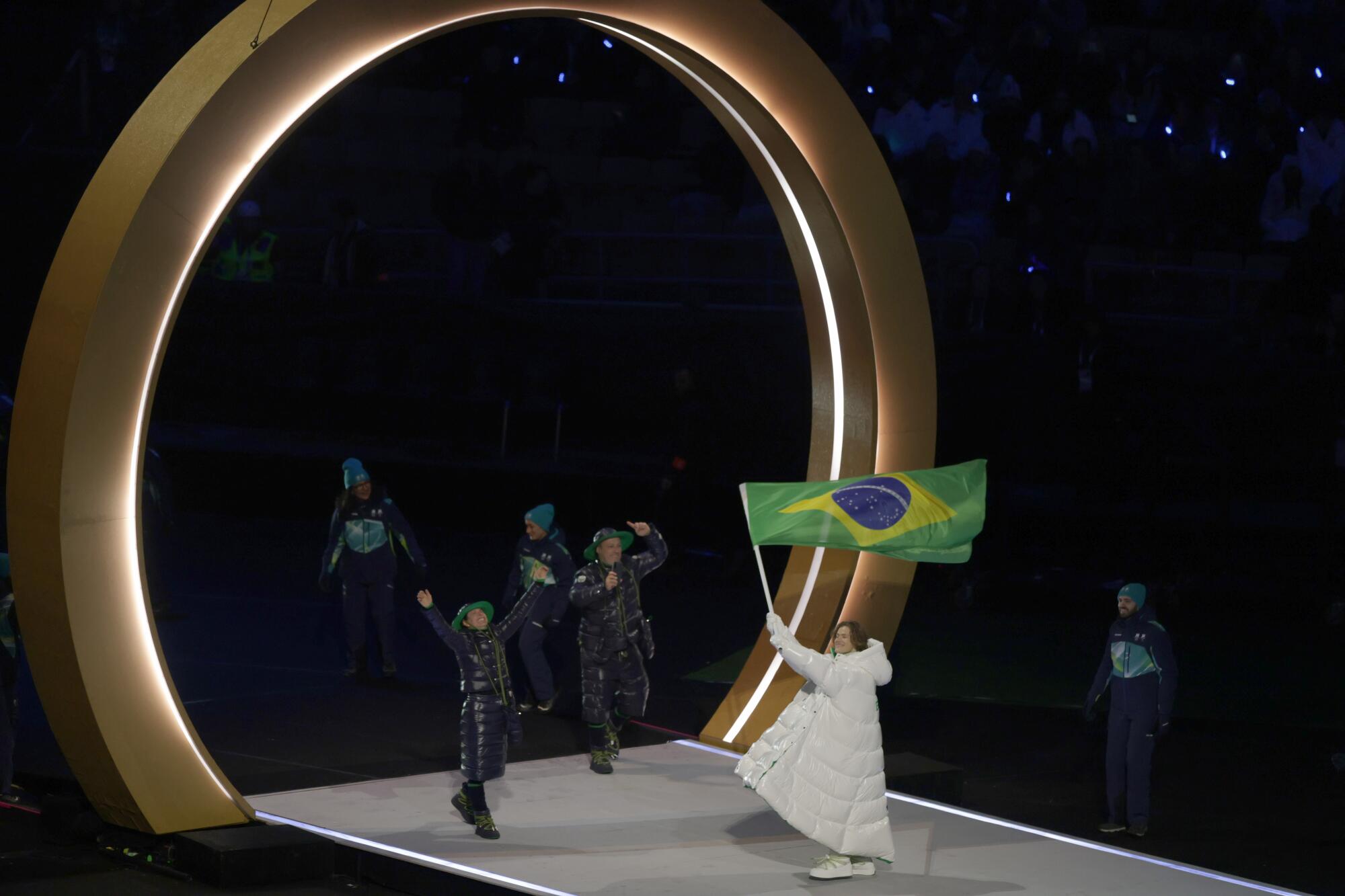
Lucas Pinheiro waves Brazil's flag while leading his teammates during the opening ceremony ofthe 2026 Winter Olympics.

Lucas Pinheiro waves Brazil’s flag while leading his teammates during the opening ceremony of the 2026 Winter Olympics at San Siro Stadium in Milan on Friday.

(Robert Gauthier / Los Angeles Times)

The theme for Milan-Cortina’s opening ceremony was armonia, or harmony. The Games needed it.

These Olympics appear to be the most disconnected ever. The sprawling footprint covers seven different competition zones. The 2026 Games are the first to be officially hosted by two cities.

But the geographical distance is small compared to the geopolitical canyon the Games hope to bridge.

The ongoing war in Ukraine is keeping most Russian athletes out of the competition. Only 32 athletes with Russian or Belarusian passports were allowed and will have to compete as individual neutral athletes. They will not hear their national anthems or wear their national flags. Ukrainian athletes marched into San Siro Stadium — where athletes competing in ice sports participated in the opening ceremony — to loud cheers.

When talk of protest or political conflict arose this week, Coventry tried to downplay it to keep the focus on the Games. She called controversy about LA28 chairman Casey Wasserman and ICE agents in Milan “sad” distractions. The United States was at the center of much of the contention after reports concerning the presence of U.S. immigration agents in Milan prompted anti-ICE protests. The U.S. Olympic and Paralympic Committee tried to cool tensions by clarifying that the organization does work with the federal government to help secure the Games, but the USOPC works with the Diplomatic Security Service, which falls under the jurisdiction of the State Department and not Homeland Security, which oversees ICE.

President Trump’s recent comments about the United States taking control of Greenland from Denmark also angered European allies.

On Friday, an American fan walked around the concourse at San Siro Stadium in a sweatshirt that read in multiple languages: “Sorry for our president.”

When Vice President JD Vance, sitting in the presidential suite, was shown on the video screen at San Siro, the cheers that showered U.S. athletes when they entered the stadium turned into jeers. Vance attended multiple events this week, including the U.S. women’s hockey’s group stage opener Thursday and the team figure skating competition Friday.

Flagbearer Erin Jackson of Team USA walks with her teammates during the opening ceremony at the 2026 Winter Olympics.

Flag bearer Erin Jackson of Team USA walks with her teammates during Friday’s opening ceremony of the 2026 Winter Olympics at San Siro Stadium in Milan, Italy.

(Robert Gauthier / Los Angeles Times)

The 323-athlete U.S. delegation led by flag bearers speedskater Erin Jackson in Milan and bobsled athlete Frank Del Duca in Cortina was the largest in the nation’s Winter Olympics history and the largest of any country at the Milan-Cortina Games.

Athletes marched into Milan’s San Siro Stadium, the home of AC Milan and Inter Milan, across a spiral-shaped stage. The four ramps converging into a circle represented the connection between Milan, Livigno, Predazzo and Cortina.

Even if athletes of a country were not competing in Milan and were unable to attend the opening ceremony, a sign-holding volunteer dressed in a silver floor-length puffer dress strutted across the stage while screens showed athletes marching in during ceremonies at other Olympic locations around Italy.

In Cortina, a Brazilian athlete did a backflip after talking through a golden ring portal, a shared symbol at each ceremony. While Olympians in Milan walked into a packed stadium with flashing lights and thumping techno music played by a DJ at a turntable that looked like ice, the mountain ceremonies took place through the streets. Fans assembled on either side of the walkway for the parade of athletes.

Dancers perform during the Milan-Cortina Olympics opening ceremony Friday.

Dancers perform during the Milan-Cortina Olympics opening ceremony Friday.

(Robert Gauthier/Los Angeles Times)

The ceremony hit on the quintessential northern Italian experience. A plate of risotto was among the first images shown on the video board in the countdown video as the ceremony approached, followed by the picturesque snowy peaks of the Dolomites. As a fashion capital of the world, Milan used runway models dressed in green, white and red outfits designed by Giorgia Armani to represent the Italian flag. There was even a two-minute video on Italian hand gestures.

Italy, as the host nation, marched in last to deafening applause and cheers from the crowd in Milan. In about two years, the United States will have the honor of closing the parade of athletes when L.A. hosts the 2028 Summer Games. The opening ceremony is also planned to take place in multiple locations, with the Coliseum and SoFi Stadium co-hosting the event.

To unite the Italian host cities, the Olympic flame was passed out of the stadium as Bocelli belted and the torch simultaneously reached two cauldrons in each city. In Milan, the pulsating cauldron inspired by the sun will burn at Arco della Pace. In Cortina, it will light up Piazza Angelo Dibona.

Call them twin flames.

Source link

Milan-Cortina Winter Olympics officially start with opening ceremony

Feb. 6 (UPI) — A handful of events began earlier in the week — curling, figure skating and ice hockey — but the 2026 Milan Cortina Winter Olympics officially got underway Friday afternoon in Italy.

The opening ceremony started at 2 p.m. EST at Milan’s historic, 100-year-old San Siro Stadium in Milan, a nearly 4-hour celebration of the Games that is expected to include a range of performances, the parade of nations and, finally, the lighting of the Olympic cauldron.

The Milano Cortina Olympics will be the first to include two venues in the opening ceremony and the first to light two caldrons for the Games: one in Milan at the Arco della Pace and another at Piazza Dibona in central Cortina d’Ampezzo.

Organizers have said that lighting two cauldrons is meant to represent harmony between the two cities of Milan and Cortina — which are jointly hosting the Games — as well as other areas that the Games are being held.

In addition to dance, light and special effects shows at San Siro, performances by Maria Carey, Andrea Bocelli, The White Lotus and The Paper star Sabrina Impacciatore, Italian actor Pierfrancisco Favino and Italian singer Laura Pausini have been announced.

Events at this year’s Winter Games have been spread among several towns in northern Italy, in addition to the two towns, which the Olympic ceremony director, Maria Laura Iascone, told NBC News is among the efforts of Italy chart “a new course” and innovate “a new spirit” of the opening ceremonies.

The Big Show

The majority of the intricate, ornate opening ceremony is being held at San Siro Stadium, which opened in 1926, has hosted several World Cup-linked events and is home to two Italian soccer clubs.

The Olympics is set to be its final event before the owners of those two teams demolish the stadium to build a newer, more modern facility for the two clubs.

In addition to San Siro, the cauldron will be lit elsewhere in Milan, and athlete parades are set to be held at other venues in the city as organizers have sought to show off Milan, Cortina and other parts of the country. Overall, there are 13 venues hosting Olympic competition this year.

The two cauldrons — at Milan’s Arco della Pace and Corina’s Piazza Dibona — are in addition to opening ceremony events in Cortina, Livigno and Predazzo.

On top of splitting up the ceremonies, there are multiple Olympic villages that athletes are staying in, a decisions made so that they will not need to travel far between lodging, sporting venues and the opening and closing ceremonies.

Events get underway

The ceremony opened with the Italian Olympic Committee spotlighting the southern European country’s position as a “Winter wonderland,” which included video presentations of mountains and towns that gave way to dance routines focused on community, love and harmony, according to organizers.

The glittery winter look moved toward an ode to Italian operat with actors dressed as Gioachina Rossini, Giuseppe Verdi and Giacomo Puccini performing to Rossini’s William Tell Overture.

Maria Carey, who performed for free, sang the Italian classic “Volare” in Italian blended with some of her song “Nothing Is Impossible,” and wowed the crowd ahead of introductions of the President of Italy and of the International Olympic Committee were introduced.

In a significant tribute to legendary fashion designer Giorgio Armani, dozens of models decked out in loose red, white and green suits — the colors of the Italian flag — filed out into the center stadium.

Model Vittoria Ceretti, who is also known for dating Leonardo Dicaprio, carried an Italian flag out to an honor guard before Pausini sang the Italian national anthem, “Fratelli d’Italia” and Favino recited the Giacomo Leopardi poem “L’inifnito.”

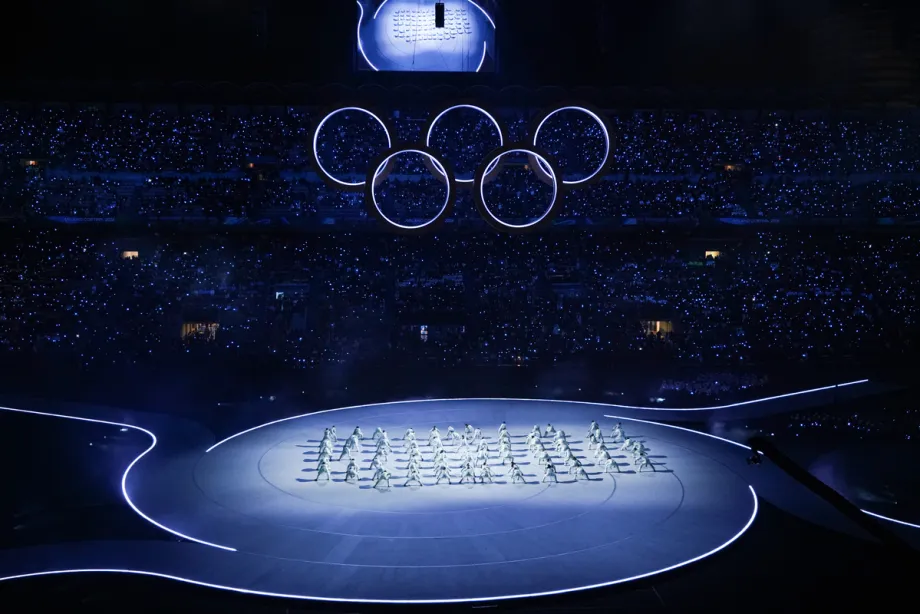
As dancers once again filled the center of the arena, two rings — with actors reclining on them — floated out to the stage. Once the actors got off the rings, they joined three others high above the crowd to form the Olympic rings.

This is a developing story. Please check back for updates throughout the afternoon and evening.

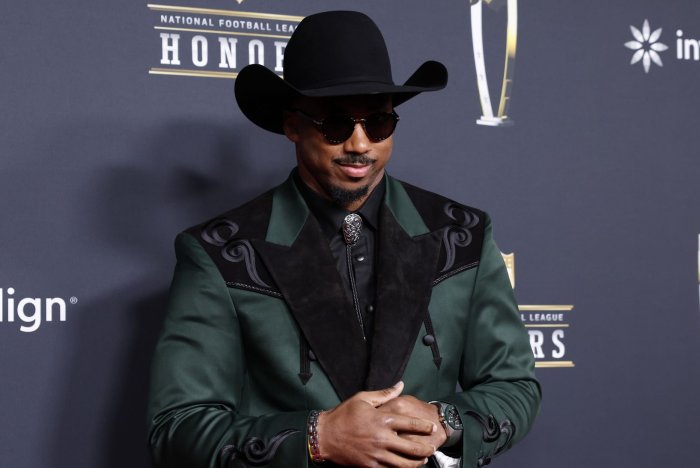
Myles Garrett arrives on the red carpet at the 2026 NFL Honors in San Francisco on February 5, 2026. Garrett won Defensive Player of the Year. Photo by John Angelillo/UPI | License Photo

Source link

2026 Winter Olympics: Inside Italy’s massive logistical challenge

History didn’t begin in Italy, but it made a number of significant advances there. The foundations for representative government, the 365-day Julian calendar, modern sanitation, newspapers, roads and the postal system were established in Rome.

Centuries later, the rest of the world is still doing as the Romans do.

But if Rome is Italy’s past, Milan is its present and future.

It is the country’s financial center, home to the Italian stock exchange. It’s the world’s fashion center, home to luxury brands including Prada, Versace, Armani and Dolce & Gabbana. And it has one of the largest concentrations of millionaires in the world, one for every 12 of the city 1.37 million residents.

“It’s a city that’s becoming more global and global,” said Giorgio Ricci, the chief revenue officer for Inter Milan, the city’s top soccer club. “Milano is now a real ambassador of that Italian culture, from lifestyle to design to food and whatever.”

And now, like Rome in the summer of 1960, it also has the Olympic Games.

The Milan-Cortina Games are the first Olympics officially shared between two host cities and the most logistically complex Winter Games ever, taking place over 8,500 square miles of northern Italy. And though most of the medals will be awarded in the surrounding mountains at Cortina d’Ampezzo, Valtellina and Val di Fiemme, Milan will be the beating heart of the Games, much as it is the beating heart of the country.

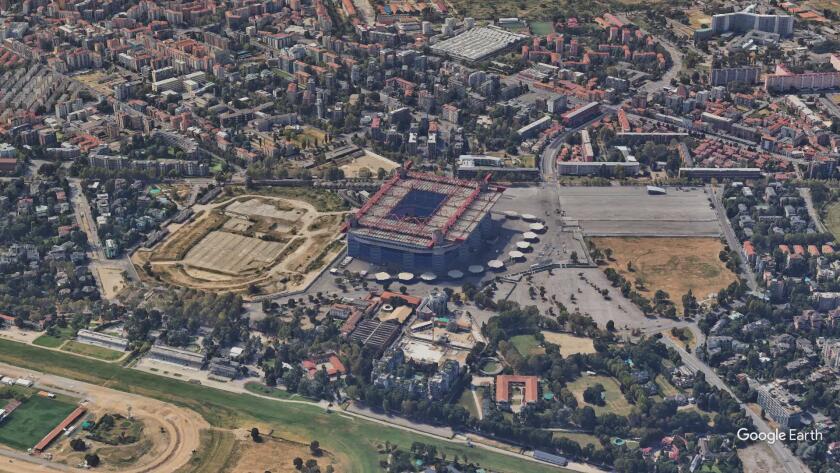
The main opening ceremony will take place at San Siro, the 75,000-seat stadium that is home to the city’s two first-division soccer teams, Inter Milan and AC Milan. Figure skating, speedskating and men’s and women’s hockey will also be held at four other venues across the city.

San Siro in Milan will host the opening ceremonies for the 2026 Milan-Cortina Winter Olympics.

And that will happen, organizers say, whether the venues are ready or not — and one of them is not. The 11,800-seat Unipol Dome, which will be known as Milano Rho Ice Hockey Arena during the Olympics, is one of just two competition venues that had to be constructed for the Games. It played host to the first games of the women’s hockey tournament Thursday despite the fact that construction crews were still administering the final touch-ups outside the building as Sweden was beating Germany in the opener.

“Do we have every area of that venue finished? No,” said Christophe Dubi, the International Olympic Committee‘s executive director for the Olympic Games said earlier this week. “Is it absolutely necessary for the Games? No. Everything that is public-facing, whether for media or athletes, will be first-class.”

Organizers certainly hope so because there’s a lot riding on these Games. If Milan can pull off an efficient, modern, sustainable and technologically “smart” event, it will reinforce the city’s status as one of the world’s top-tier global capitals, one with financial roots and a trendy multicultural image.

Fail in any one of those categories and Milan could suffer significant financial and reputational damage.

A singer busks late at night in Piazza del Doumo.

A singer busks late at night in Piazza del Doumo in Milan ahead of the Winter Olympic Games.

(Robert Gauthier / Los Angeles Times)

The competition is expected to draw 2.5 million people to Milan — many of them first-time visitors — while generating more than $7 billion in economic activity. Much of that spending went to upgrade the city’s and regional rail lines, which are expected to be overwhelmed given the spread-out nature of the Games.

Days before the Olympic torch was lit at San Siro, Milan’s Piazza del Duomo, which fronts the city’s elaborate Gothic cathedral, was packed with Olympic visitors, many wearing sweatshirts and jackets bearing the flags of their homelands. NBC will anchor its 700 hours of linear TV coverage from a temporary studio tower built in the square, with the iconic church as its backdrop.

Around the corner along the Via Orefici, which dates to the Middle Ages, many of the neighborhood’s trendy boutiques have hung neon signs with the Games logo, proclaiming themselves proud sponsors of the Olympics. At night, a singer who calls herself Anna Soprano performs a solo street opera.

However many locals have failed to catch Olympic fever with high ticket prices and fears about traffic, security measures and crowded Metro trains dampening enthusiasm.

An opera singer performs in Milan ahead of the 2026 Winter Olympics.

Buried beneath Milan’s rush to the modern from the Middle Ages — just beyond the Duomo Cathedral, which was begun in 1386, is the massive 15th Century Sforza Castle — lies a more recent history the city would just as soon forget. Milan was Italy’s Munich, the birthplace of Benito Mussolini’s fascist movement.

Yet it later became the center of anti-fascist resistance, with partisans seizing control of the city in the final days of World War II and executing Mussolini, hanging his corpse from the roof of an Esso station in the Piazzale Loreto. Milan marked that day by naming a prominent square in the city’s center April 25 Plaza for the day the uprising that liberated Milan began.

If Milan is modern Europe, some of the competition clusters outside the city, spread from Valtellina on the Swiss border in the north to Cortina d’Ampezzo, 27 miles south of the Austrian border, represent both the rustic and gentrifying Italy.

The scenic Fiemme Valley, site of cross-country skiing, ski jumping, and Nordic combined , is made up primarily of three small villages — Carano, Daiano and Varena — in the Dolomites mountain range. Despite a history of human activity that dates back more than 6,000 years, the area wasn’t officially established as the municipality of Val di Fiemme until the three townships merged in January 2020.

Today it is a major outdoor-sports destination, having played host to the FIS Nordic World Ski championship numerous times; in the summer it is a favored destination of hikers.

Valtellina, a 75-mile-long valley that runs along the Swiss border, will be the site of Alpine skiing, snowboarding, freestyle skiing and the debut sport of ski mountaineering. The region is known as the heart of the Alps and is a premier Alpine wine area, famous for the elegant reds that come from grapes grown on steep, terraced vineyards.

Cortina d’Ampezzo in northern Italy will host multiple events during the 2026 Olympics.

Cortina d’Ampezzo, meanwhile, is a breathtakingly beautiful ski resort and outdoor sports paradise about 35 miles from the Austrian border. Unlike Valtellina and Val di Fiemme, which are rustic and traditional, Cortina is one of Europe’s most expensive ski towns, its streets lined with high-end stores, luxury hotels and Michelin-starred restaurants. For year-round residents, property prices are the highest in the Italian Alps.

It was scheduled to host the 1944 Winter Olympics before World War II intervened, delaying the its arrival until 1956, when 32 nations — the largest to attend a Winter Games at the time — competed in four sports and 24 events. This month it will be the site of the biathlon, Alpine skiing, curling and sliding sports (bobsled, luge and skeleton).

The new $140-million Cortina Sliding Centre, the second Olympic venue whose construction fell well behind schedule, was completed days before the opening ceremony but a cable car intended to carry spectators to the women’s ski events was not expected to be finished in time. That could lead to traffic jams since visitors will have to take their cars more than a mile up the mountain.

Source link

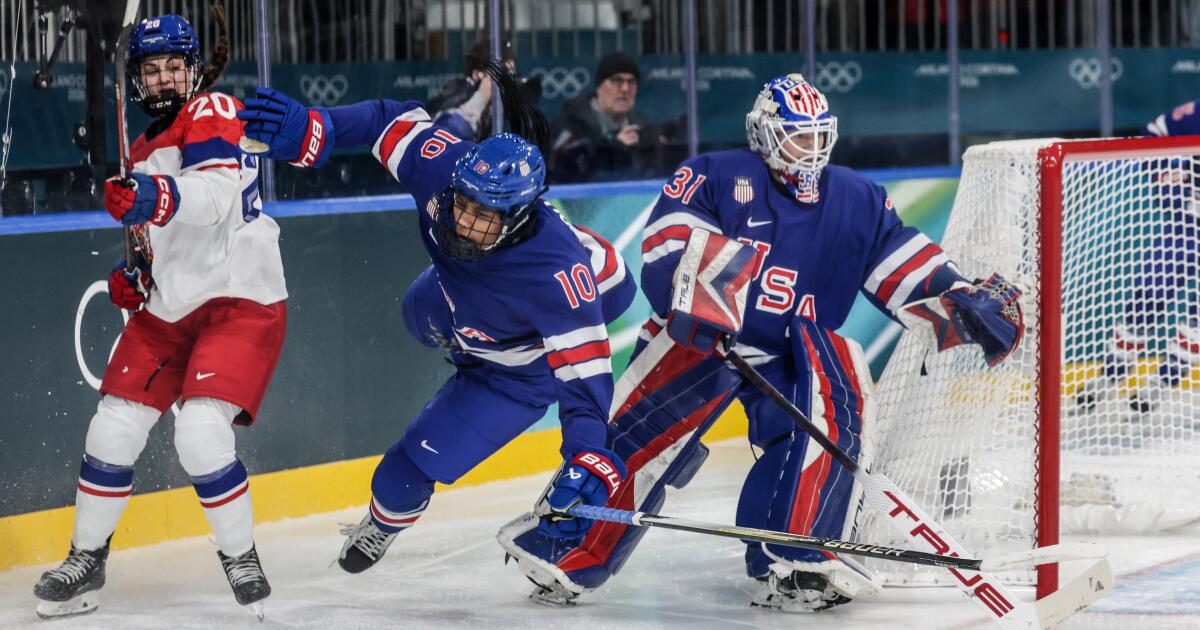
Laila Edwards sparks U.S. women’s hockey to Olympic win over Czechia

Laila Edwards finally got out from under the spotlight and onto the ice for the U.S. women’s hockey team Thursday. It was a simple act, but one that made history.

Yet for Edwards, it was just another day at the office.

“It didn’t feel different at all,” she said. “It’s still hockey at the end of the day. Even though it’s the highest level, it’s still hockey.”

With her first shift in Thursday’s 5-1 win over Czechia, on the first day of hockey at the Milan-Cortina Winter Games, Edwards became the first Black woman to play for the U.S. national team in an Olympic tournament. On a team full of record-breakers, it was a significant milestone, one that has become a storyline for the world’s top-ranked team.

“Cameras constantly in her face. She does a good job of whatever she needs to do,” said teammate Tessa Janecke, who had two second-period assists. “It’s very inspiring for us as her teammates, but as well as the next generation.”

And that, of course, is the point.

“Representation matters,” Edwards said. “There’s been a lot of young kids or parents of young kids who have reached out or I’ve run into that say, ‘You know, my daughter plays sports because of you. And she feels seen and represented,’ and that’s just really motivating.”

Just 22, Edwards is already accustomed to breaking barriers and being the youngest this or the first that.

In 2023, she became the first Black player on the women’s senior national team in any competition; a year later, she became, at 20, the youngest player to win the MVP award in the World Championship.

But if doing that has been easy, talking about it has taken some work.

“I could not do interviews or not talk about it, but then the story doesn’t get out there,” she said. “And maybe a little girl doesn’t see me, who looks like her. So I think that’s what’s more important.”

On Thursday, playing before Vice President JD Vance, Secretary of State Marco Rubio and a packed house at the Milano Rho Ice Hockey Arena, Edwards marked her Olympic debut by helping put the Americans ahead to stay, feeding Megan Keller in the high slot for a slap shot that Alex Carpenter redirected in a first-period power-play goal.

Second-period goals from Joy Dunne and Hayley Scamurra — both on assists from Janecke — and third-period goals from Scamurra and Hilary Knight, sandwiched around one from Czechia’s Barbora Jurickova, accounted for the final score in a game in which the top-ranked Americans outshot the fourth-ranked Czechs 42-14.

Still, the night belonged to Edwards, a player Knight calls “the future of the sport.” But she’s doing pretty well in the present too, having already won two national championships with Wisconsin and two world championship medals with Team USA.

Edwards started skating shortly after she learned to walk, then switched to hockey before starting kindergarten, when her father Robert, who played the game as a child, enrolled her and three siblings in a youth hockey program. By 8, she was so advanced she was playing with boys’ teams and for high school she left her native Cleveland Heights, Ohio, for the elite girls’ hockey program at Bishop Kearney High School in Rochester, N.Y.

Although she was a high-scoring forward in high school and college — she led the nation with 35 goals as a junior at Wisconsin — she’s proven versatile enough to play on the blue line in the Olympics. That’s a little like playing a running back at right guard.

“I couldn’t even imagine that,” forward Abbey Murphy said of Edwards, who skated a team-high 25 shifts Thursday. “She took it and she just kind of ate it up and she made defenseman look easy. She’s magic on the blue line.”

At 6-foot-1 and 185 pounds — making her the biggest and most physical player on the U.S. team — Edwards was well-suited for the move.

“She’s so dynamic, so athletic, you could put her in goal and she would perform,” said Caroline Harvey, a teammate in high school, college and now with the national team. “She’s just adjusted so well. It’s seamless. It doesn’t even seem like she’s switched positions.”

Edwards hasn’t made her journey to the Olympics alone, however, a fact she acknowledged after Thursday’s game. Although her father is responsible for her start in hockey, it looked like he wouldn’t be able to travel to Milan to see his daughter make history. So Edwards’ parents started a crowdfunding campaign to pay for flights and accommodations.

Jason and Travis Kelce, brothers and former Super Bowl players who also grew up in Cleveland Heights, learned of the campaign and quickly kicked in $10,000, allowing 14 members of Edwards’ family to come to Italy — where their cheers were audible every time her name was announced.

“They show support,” Edwards said. “And they’re really cool guys.”

After her Olympic debut Thursday, there are a lot of little girls who can say the same about Edwards.

Source link