Odesa

Why is Russia escalating attacks on Ukraine’s Odesa? | Russia-Ukraine war News

Russian forces have struck Ukraine’s southern Black Sea port of Odesa, damaging port facilities and a ship, the region’s governor says.

The attack late on Monday followed another at the weekend when Moscow carried out a sustained barrage of drones and missile attacks on the wider area around Odesa, which is home to ports crucial to Ukraine’s overseas trade and fuel imports. They followed Russian threats to cut “Ukraine off from the sea”.

Recommended Stories

list of 4 itemsend of list

The escalation in Russia’s assault on Odesa, Ukraine’s biggest port city, has unfolded as Washington steps up diplomatic efforts to bring an end to the war. Ukrainian officials met members of a US delegation on Friday in Florida while US envoys held talks with Russian representatives on Saturday.

“The situation in the Odesa region is harsh due to Russian strikes on port infrastructure and logistics,” Ukrainian President Volodymyr Zelenskyy told reporters in Kyiv on Monday. “Russia is once again trying to restrict Ukraine’s access to the sea and block our coastal regions.”

What happened in the latest Russian attack on Odesa?

On Tuesday, the head of the Odesa Regional Military Administration, Oleh Kiper, said Russian strikes overnight had damaged a civilian cargo vessel and a warehouse in a district of Odesa while the roof of a two-storey residential building had caught fire.

Meanwhile, strikes on Saturday on the port of Pivdennyi near Odesa damaged storage reservoirs, Ukrainian Deputy Prime Minister Oleksii Kuleba said. Those came just one day after a ballistic missile strike, also in Pivdennyi, had killed eight people and wounded at least 30.

These are just the latest strikes in an escalation of hostilities in the area over the past few weeks.

Last week, Russia launched one of its largest aerial assaults of the war on the Black Sea region, damaging energy infrastructure and causing a power outage in Odesa, leaving hundreds of thousands of residents without electricity for several days.

Russia’s Ministry of Defence did not immediately comment on the strikes, but the Kremlin has previously described Ukraine’s economic infrastructure as a “legitimate military objective” during the nearly four-year war.

On the Telegram messaging app, Kuleba said on Friday that Russian forces were targeting power infrastructure and a bridge over the Dniester River near the village of Mayaky, southwest of Pivdennyi, which was struck five times in 24 hours.

That bridge links parts of the region separated by waterways and serves as the primary westbound route to border crossings with Moldova. It is currently out of operation. Kuleba said the route normally carries about 40 percent of Ukraine’s fuel supplies.

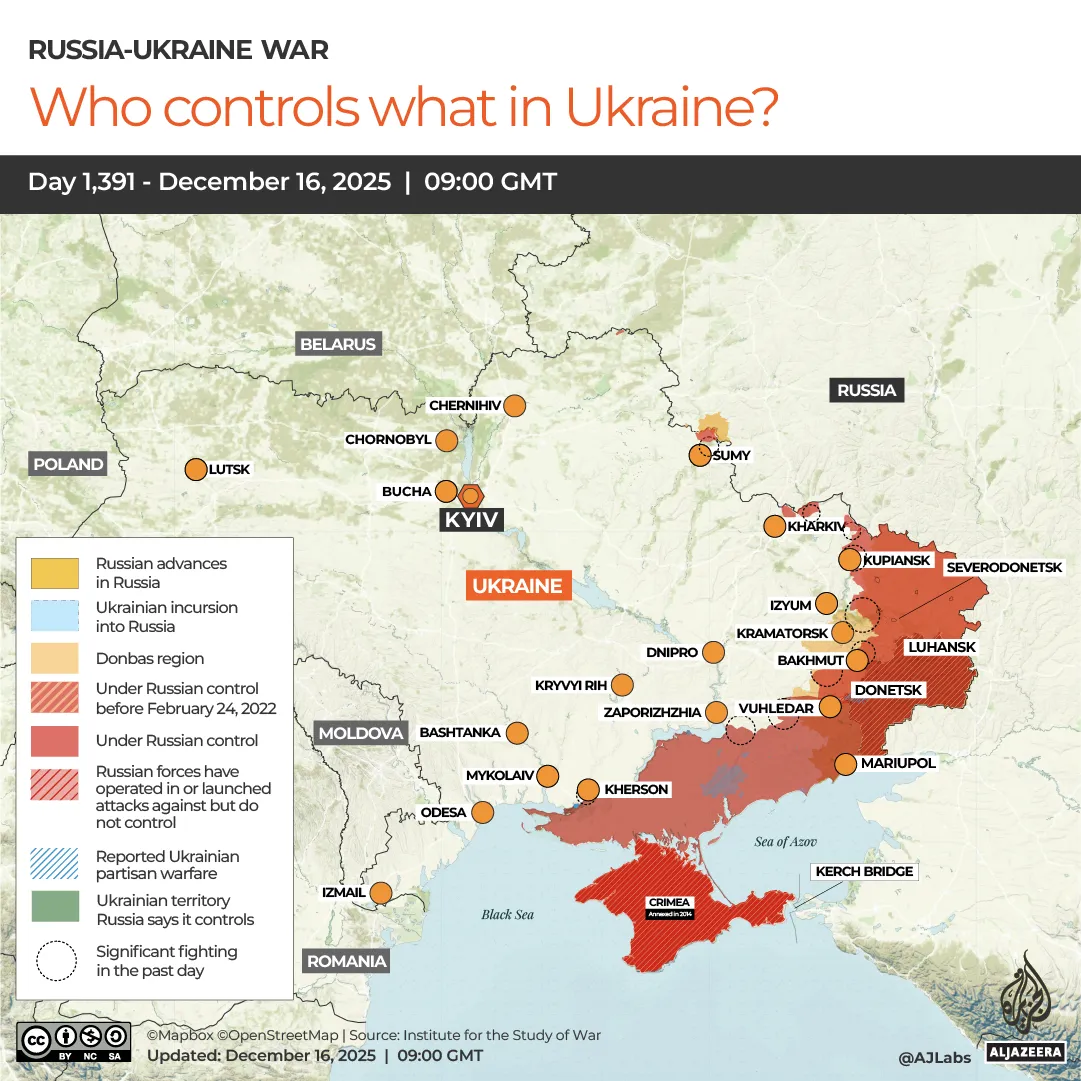
INTERACTIVE-WHO CONTROLS WHAT IN UKRAINE-1765877913
(Al Jazeera)

Why is Russia targeting Odesa?

“The focus of the war may have shifted towards Odesa,” Kuleba said, warning that the “crazy” attacks could intensify as Russia tries to weaken Ukraine’s economy.

Russian President Vladimir Putin has previously said Moscow wants to restrict Ukraine’s Black Sea access in retaliation for Kyiv’s recent drone attacks on Russia’s sanctions-evading “shadow fleet” of vessels, which carry a variety of commodities.

Ukraine said those vessels are used to illegally export sanctioned oil, which provides Russia with its main source of revenue for financing its full-scale invasion of its neighbour.

How important is the port of Odesa to Ukraine?

Odesa’s port has long been central to Ukraine’s economy. Called a “pearl by the sea”, Odesa is Ukraine’s third most populous city after Kyiv and Kharkiv.

Black Sea ports – including Odesa and two others close by, Pivdennyi and Chornomorsk – and Mykolaiv to the east handled more than 70 percent of Ukraine’s exports before the war.

But Odesa’s role as a trading hub has grown in recent years as ports in the Zaporizhia, Kherson and Mykolaiv regions have been occupied by Russia.

Since the war began in February 2022, Ukraine has continued to rank among the world’s top five exporters of wheat and corn – largely through Odesa.

By targeting Odesa’s shipping facilities with missiles and drones, Ukrainian officials said, Putin aims to destroy Ukrainian trade and business infrastructure.

Zelenskyy, who has previously accused Russia of “sowing chaos” on the people of Odesa, said: “Everyone must see that without pressure on Russia, they have no intention of genuinely ending their aggression.”

What would it mean for Ukraine if Odesa were destroyed?

If the port of Odesa were badly damaged, the economic impact for Ukraine would be severe. The city and its surrounding areas would suffer major job losses in the shipping and logistics industries, seriously squeezing local incomes. Meanwhile, port-dependent businesses would falter and investment would fall away.

Nationally, Ukraine’s export capacity would be hit hard. As a key gateway for grain and other commodities, disruptions there would raise transport costs, slow shipments and reduce export volumes, choking foreign currency earnings and piling pressure on the hryvnia, Ukraine’s currency.

Elsewhere, farmers would suffer from lower prices for their produce as well as storage bottlenecks with knock-on effects across rural economies. The government would also lose customs revenue just as reconstruction costs would rise, weakening the country’s overall economic resilience.

What other acts of maritime warfare have Ukraine and Russia engaged in during the war?

Over the past six months, maritime warfare between Ukraine and Russia has intensified. Both sides have targeted naval and commercial assets across the Black Sea and beyond.

Ukrainian forces have increasingly used underwater drones and unmanned surface vessels to strike ships tied to Russia’s shadow fleet.

Several shadow fleet tankers, including the Kairos and Virat, were hit by Ukrainian naval drones in the Black Sea near Turkish waters in late November.

Kyiv has expanded its reach elsewhere, claiming drone strikes in the Mediterranean on December 19 on the Qendil, a Russian-linked tanker, marking an expansion in Kyiv’s maritime operations.

At the same time, Russian forces have ramped up attacks on commercial targets, including a Turkish-flagged ship carrying trucks and other freight near Odesa with drone attacks on December 13.

These actions reflect a shift towards what is referred to as “asymmetric naval warfare”, in which drones and improvised systems play a growing role in disrupting each side’s economic and military support networks at sea, experts said.

Source link

EU pledges $105B loan for Ukraine as Russia targets Odesa

Dec. 20 (UPI) — Officials for the European Union have agreed to loan $105 billon to Ukraine to help it stay financially solvent over the next two years amid Russian attacks in the Odesa region.

The money is in lieu of an allocation to Ukraine from frozen Russian assets equal to nearly $246 billion and being held in Belgium, the BBC reported.

The funds are equal to about two-thirds of the amount that Ukraine will need to pay its bills and give it a stronger bargaining position as peace talks continue with the aim of ending the Ukraine War that started when Russia invaded its neighbor on Feb. 24, 2022, according to The New York Times.

Ukrainian President Volodymyr Zelensky said the loan is interest-free and only would be repaid if Russia were required to pay reparations to Ukraine.

News of the E.U. allocation comes after a Russian missile strike near Odesa that killed eight and injured 27 others on Friday night, CNN reported.

Russian missiles struck a port facility in Pivdenne, and some of those killed and wounded were on a bus that was struck during the attack.

The missile strikes were part of an ongoing aerial campaign against the Odesa region over the past nine days and caused a power outage in Odesa, which is located on the Black Sea and about 300 miles south of Kyiv.

Two bridges in southern and northern Odesa were knocked out in recent strikes and are being repaired.

Russian forces also are targeting the energy infrastructure in Ukraine and have used drones and missiles to damage or destroy many targets in recent months.

President Donald Trump holds a signed executive order reclassifying marijuana from a schedule I to a schedule III controlled substance in the Oval Office of the White House on Thursday. Photo by Aaron Schwartz/UPI | License Photo


Source link

Russian attack on Ukraine’s Odesa kills at least 8 as peace talks lumber on | Russia-Ukraine war News

A Russian ballistic missile strike on port infrastructure in Ukraine’s Odesa port in the south has killed at least eight people and wounded 27, as Moscow intensifies attacks on the strategic Black Sea region and talks to end the war remain in a critical stage.

The attack late on Friday hit critical logistics infrastructure, with some of the wounded trapped on a bus at the strike’s epicentre as trucks caught fire in a car park.

Recommended Stories

list of 2 itemsend of list

Ukrainian officials say the bombardment is part of a sustained Russian campaign against Odesa’s civilian infrastructure that has left more than two million people without electricity, water and heating for days amid freezing temperatures in the war’s fourth punishing winter.

Moscow struck the same port again on Saturday, hitting reservoirs in what Ukrainian Deputy Prime Minister Oleksii Kuleba described as deliberately targeting civilian logistics routes.

The escalation comes as both sides trade blows across multiple fronts, while United States-led negotiations and numerous high-level meetings in Europe to end the war lumber on without a breakthrough.

Russia claimed on Saturday to have seized the villages of Svitle in the eastern Donetsk region and Vysoke in the northeastern Sumy region, though the reports could not be independently verified.

Ukraine has responded with a widening campaign against Russian military and energy assets.

On Friday night, Ukrainian drones struck the Filanovsky oil rig belonging to Russian energy giant Lukoil in the Caspian Sea, along with a military patrol ship patrolling near the platform.

The attack marked the first officially acknowledged Ukrainian strike on Caspian drilling infrastructure, though the rig had been hit at least twice before in December.

Between December 14 and 15, Ukrainian forces used sea drones to strike a Russian Kilo-class submarine at the Novorossiysk Naval Base in the Black Sea, according to a United Kingdom Defence Intelligence assessment.

Miami talks

The attacks unfold as American and European officials gather in Miami for weekend talks aimed at ending the nearly four-year war, with Russian and Ukrainian teams also in attendance.

Russian envoy Kirill Dmitriev said on Saturday he was heading to Miami.

US Secretary of State Marco Rubio said Washington would not force Ukraine into any agreement, though he described the conflict as “not our war”.

Trump envoys Steve Witkoff and Jared Kushner are leading discussions with Ukrainian negotiator Rustem Umerov and officials from the UK, France and Germany. Russian representatives, including Kremlin key negotiator Dmitriev, are meeting separately with American officials.

The key obstacle remains territorial concessions, with reports suggesting Washington is pushing Kyiv to cede parts of the eastern Donetsk region.

Russian President Vladimir Putin showed no signs of compromise at his annual choreographed news conference on Friday, pledging to press ahead with military operations and predicting new successes before the year’s end.

Putin’s remarks were the latest in a drumbeat of often-repeated maximalist Russian positions nearly four years after he ordered troops into the neighbouring country.

The issue of territory gained, lost, to be ceded or not, delves into the heart of the matter on one of the most contentious issues in the talks to end the war so far.

Putin has demanded Ukraine cede all territory in four key regions his forces have captured and occupied, along with Crimea, which Moscow seized and annexed in 2014.

He also wants Ukrainian troops to withdraw from parts of eastern Ukraine that Russian forces have not yet taken in the eastern Donetsk region, where fighting remains attritional – conditions Kyiv has rejected outright.

As talks continue, so does the fighting, with Russia controlling large parts of Ukraine’s eastern and Black Sea coastal regions.

Putin projected confidence on Friday about battlefield progress, saying Russian forces had “fully seized strategic initiative” and would make further gains before the year ends.

However, that narrative is on shaky ground this week, as Moscow’s assertion of inevitable victory flew in the face of facts on the ground.

Ukraine steadily took back control of almost all of its northern city of Kupiansk after isolating Russian forces within it, belying Russian claims to have seized it.

Russian forces were also unable to dislodge Ukrainian defenders from the eastern city of Pokrovsk in the eastern area of Donetsk to back up Moscow’s claims of total control.

Ukraine received a boost on Friday when European leaders agreed to provide a 90 billion euros ($105bn) loan to cover military and economic needs for the next two years.

President Volodymyr Zelenskyy, who met Polish President Karol Nawrocki in Warsaw the same day to reinforce regional unity against Russia, said the funds would go towards defence if the war continues or reconstruction if peace is achieved.

Source link