Christmas celebrations return to Bethlehem as thousands gather in Manger Square for the first time since 2022.
Thousands of people have gathered in Bethlehem on Christmas Eve for the first public celebrations since 2022 after the city cancelled or muted festivities for two years out of respect for the thousands killed during Israel’s genocidal war on Gaza.
Families filled Manger Square in the occupied West Bank city as a giant Christmas tree returned to the plaza, replacing a nativity display used during the war that showed baby Jesus amid rubble and barbed wire, symbolising the devastation in Gaza.
Recommended Stories
list of 3 itemsend of list
The celebrations were led by Cardinal Pierbattista Pizzaballa, the top Catholic leader in the Holy Land, who arrived in Bethlehem from Jerusalem in the traditional Christmas procession and called for “a Christmas full of light”.
Clergymen and alter boys wait ahead of Christmas service in the Manger Square outside the Church of the Nativity (R) in the biblical city of Bethlehem in the occupied West Bank on Christmas eve on December 24, 2025. (AFP)
Scout bands from towns across the West Bank marched through Bethlehem’s streets, their bagpipes draped with tartan and Palestinian flags.
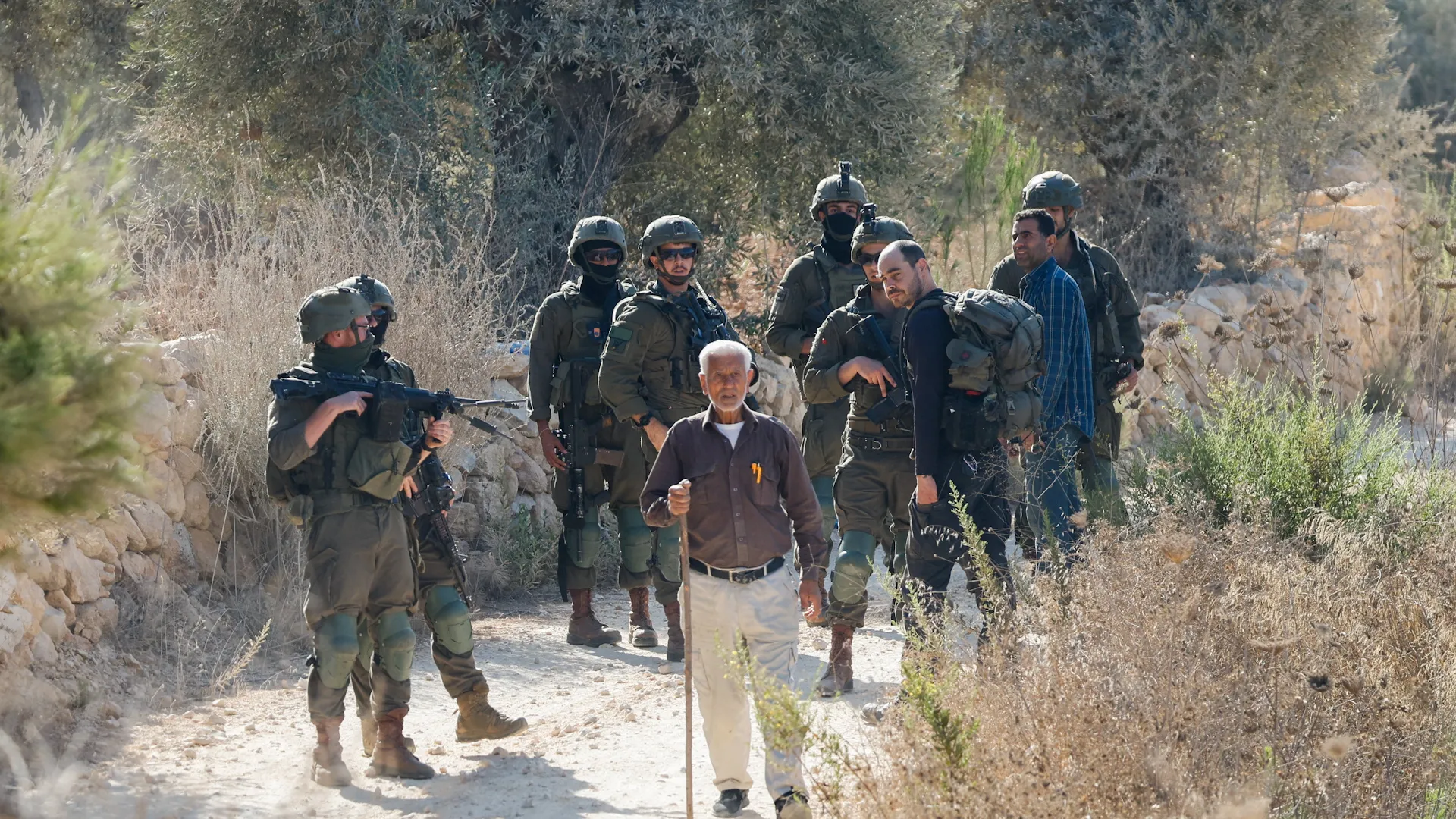
Since the start of Israel’s genocidal war on Gaza, its forces have carried out near-daily raids across the West Bank, arresting thousands of Palestinians and sharply restricting movement between cities.
Palestinians say the intensified military presence, road closures and checkpoint delays have deterred visitors, paralysing the tourism sector on which Bethlehem’s economy depends.
The vast majority of those celebrating were local residents, with only a small number of foreign visitors.
Unemployment in Bethlehem surged from 14 percent to 65 percent during the genocidal war on Gaza, Mayor Maher Nicola Canawati said earlier this month. As economic conditions deteriorated, about 4,000 residents left the city in search of work, he added.
Israeli raids and settler attacks
The return of Christmas celebrations comes despite continued raids and large-scale military incursions across the occupied West Bank, even after a fragile ceasefire in Gaza, which has been repeatedly violated by Israeli forces, took hold in October.
The raids often entail mass arrests of Palestinians, home searches and demolitions, as well as physical assaults that sometimes lead to deaths.
Attacks by Israeli settlers against Palestinians have reached their highest level since the United Nations humanitarian office began recording data in 2006. The attacks have involved killings, beatings and the destruction of property, often under the protection of the Israeli military.
Earlier on Wednesday, more than 570 Israeli settlers entered the Al-Aqsa Mosque compound in occupied East Jerusalem under police protection, the Palestinian news agency Wafa reported.
Palestinians say such incursions violate the longstanding status quo governing Islam’s third-holiest site.
Israel’s security cabinet has also signed off on plans to formalise 19 illegal settlements across the West Bank, in a move Palestinian officials say deepens a decades-long project of land theft and demographic engineering.
The United Kingdom, Canada, Germany and other countries condemned the move on Wednesday.
“We call on Israel to reverse this decision, as well as the expansion of settlements,” said a joint statement released by the UK, Belgium, Denmark, France, Italy, Iceland, Ireland, Japan, Malta, the Netherlands, Norway and Spain.
“We recall that such unilateral actions, as part of a wider intensification of the settlement policies in the West Bank, not only violate international law but also risk fuelling instability.”
Commercial premises among buildings facing demolition as military incursions intensify near Qalandiya and Kafr Aqab.
Israeli forces have begun demolishing shops in the vicinity of the Qalandiya refugee camp, north of occupied East Jerusalem, as part of a wider military incursion across several Palestinian neighbourhoods, witnesses and medical officials say.
The raids, which began early on Tuesday, have extended into the nearby town of Kafr Aqab, where Israeli troops deployed in large numbers, carried out house searches and forcibly evicted residents from their homes, according to local media reports.
Recommended Stories
list of 3 itemsend of list
The Palestine Red Crescent Society said its medical teams treated at least three people injured during the raids in Qalandiya and Kafr Aqab. The injuries included a bullet wound to the thigh, wounds caused by shrapnel from live ammunition, and injuries resulting from physical assault.
The Jerusalem governorate reported that at least three Palestinians were injured by Israeli forces’ gunfire, in addition to dozens of cases of suffocation caused by the firing of tear gas and stun grenades, the Palestinian Wafa news agency reported.
Several Palestinians were detained during the large-scale incursion that was also accompanied by the deployment of military vehicles and bulldozers.
Among those arrested are Anan Mohammed Taha and his father, Mohammed Taha, residents of the Qalandiya refugee camp, Wafa said.
‘Intimidation’ and ‘anxiety’
Residents said Israeli forces ordered several families to evacuate their homes, with at least three houses converted into temporary military outposts in Kafr Aqab. Homeowners were reportedly told the operation would continue until at least Wednesday morning.
Israeli forces also stormed the youth club inside the Qalandiya refugee camp and turned the facility into a military base, according to Al Jazeera Arabic’s correspondent.
Journalists covering the operation were also targeted, including Al Jazeera Arabic reporters, with Israeli forces firing stun grenades and tear gas canisters in their direction during the raid in Kafr Aqab.
According to the Jerusalem governorate authorities, stun grenades were also fired directly towards students in the area as they were returning home from school, while private surveillance cameras were seized.
Al Jazeera’s Nida Ibrahim, reporting from Kafr Aqab, said Israeli forces are continuing to “intimidate” Palestinians.
“They have raided Palestinian stores, Palestinian shops, and they’ve destroyed some of the plaques, some of the advertisement billboards that were here”, in an attempt to further cripple the Palestinian economy, Ibrahim said.
“This is part of the anxiety that Palestinians live through day in and day out as these Israeli raids continue on a daily basis,” she added.
Israeli incursions across the West Bank average “60 raids per day”, Ibrahim said.
In addition to the demolitions, Israeli forces confiscated goods from commercial shops in the Qalandiya refugee camp, Kafr Aqab and parts of northern Jerusalem, citing alleged unpaid municipal taxes.
Most Palestinians living in these areas hold Jerusalem residency identification cards. Residents say they are subject to high municipal taxes while receiving few basic services.
Separately, confrontations were also reported in the town of Beit Furik, east of Nablus in the occupied West Bank, after Israeli forces stormed the area.
The Israeli security cabinet has approved 19 new settlement outposts in the occupied West Bank as the right-wing government headed by Prime Minister Benjamin Netanyahu moves to prevent the formation of a viable Palestinian state.
As Netanyahu’s government has made the annexation of occupied Palestinian territory a priority, the United Nations has said Israeli settlement expansions in 2025 have reached their highest level since 2017.
“These figures represent a sharp increase compared to previous years,” UN Secretary-General Antonio Guterres said, noting an average of 12,815 housing units were added annually from 2017 to 2022.
Under the current far-right government, the number of settlement and outposts in the West Bank and occupied East Jerusalem has risen by nearly 50 percent – from 141 in 2022 to 210 now. An outpost is built without government authorisation while a settlement is authorised by the Israeli government.
Nearly 10 percent of Israel’s Jewish population of 7.7 million people lives in these settlements, which are considered illegal under international law.
Here’s everything you need to know about the newly approved settlements and what they mean for the future of Palestinian statehood.
(Al Jazeera)
Where are the new settlements?
The new settlements are spread across the West Bank – home to more than three million Palestinians – from Jenin in the north to Hebron in the south.
Most of them are close to the densely populated Palestinian villages of Duma, Jalud, Qusra and al-Lubban Asharqiya in the Nablus governorate and Sinjil in the Ramallah and el-Bireh governorate, according to Peace Now, an antisettlement watchdog group based in Israel. Other locations identified by the watchdog for the new settlement areas are in the northwestern West Bank, in the Salfit governorate, near the Palestinian towns of Sa’ir and Beit Sahour, and other areas near Bethlehem and in the Jericho governorate.
Israel’s construction spree is entrenching the occupation and squeezing Palestinians out of their homeland. Settlements dot the West Bank and are often connected by Israeli-only highways while Palestinians face roadblocks and security checks, making their daily commutes harrowing experiences.
Israel has also built Separation Barrier that stretches for more than 700km (435 miles) through the West Bank restricting movement of Palestinians. Israel says the wall is for security purposes.
Under a dual legal system, Palestinians are tried in Israel’s military courts while crimes committed by settlers are referred to a civilian court.
Israel’s latest approval also includes settlements in Ganim and Kadim, two of the four West Bank settlements east of Jenin that were dismantled as part of Israel’s 2005 disengagement plan, a unilateral withdrawal ordered by then-Prime Minister Ariel Sharon.
Five of the 19 settlements already existed but had not previously been granted legal status under Israeli law, according to a statement from the office of Finance Minister Bezalel Smotrich.
Israel controls most of the West Bank and East Jerusalem, territory Palestinians want to be part of a future state along with Gaza. Israel captured East Jerusalem, the West Bank and the Gaza Strip in a 1967 war. It later annexed East Jerusalem, which Palestinians see as their future capital.
Israeli settlements and outposts are Jewish-only communities built on Palestinian land and they can range in size from a single dwelling to a collection of high-rises. About 700,000 settlers live in the West Bank and East Jerusalem, according to Peace Now.
The latest approval comes at a time when the United States has been working with Israel and Arab allies to move the Gaza ceasefire into a second phase. After a meeting on Friday of top officials from the US, Egypt, Turkiye and Qatar in the US city of Miami, Florida, Turkish Foreign Minister Hakan Fidan accused Israel of committing repeated violations of the ceasefire that began in October.
Israel still controls nearly half of Gaza’s territory since a ceasefire was announced on October 10 after more than two years of a genocidal war killed more than 70,000 Palestinians.
Palestinian farmers, left, scuffle with Israeli settlers during the olive harvest in the Palestinian village of Silwad,near Ramallah in the Israeli-occupied West Bank on October 29, 2025 [AFP]
Has settlement construction spiked in recent years?
The new settlements bring the total number approved over the past three years to 69, according to a statement from the office of Smotrich, who is a vocal proponent of settlement expansion and a settler himself.
In May, Israel approved 22 new settlements in the West Bank, the biggest expansion in decades.
The UN chief has condemned what he described as Israel’s “relentless” expansion of settlements in occupied Palestinian territory. It “continues to fuel tensions, impede access by Palestinians to their land and threaten the viability of a fully independent, democratic, contiguous and sovereign Palestinian state”, Guterres said this month.
Palestinians have also been facing increasing settler violence since Israel’s war on Gaza began.
According to data from the UN Office for the Coordination of Humanitarian Affairs (OCHA), settlers have attacked Palestinians nearly 3,000 times over the past two years.
Settler attacks often escalate during the olive harvest from September to November, a vital time of year that provides a key source of income for many Palestinian families.
Settlers are often armed and frequently accompanied or protected by Israeli soldiers. In addition to destroying Palestinian property, they have carried out arson attacks and killed Palestinian residents.
Every West Bank governorate has faced settler attacks over the past two years, data from OCHA shows.
(Al Jazeera)
Are the settlements legal under international law?
No. The UN, the International Court of Justice (ICJ) and the International Committee of the Red Cross all consider Israeli settlements as a violation of the Fourth Geneva Convention, which outlaws settler activity.
In a landmark judgement in July 2024, the ICJ, the UN’s top court, found that Israel’s occupation, settlement activity and annexation measures are illegal. In its nonbinding advisory opinion, the ICJ ruled that Israel’s continued presence in occupied Palestinian territory is unlawful and should come to an end “as rapidly as possible”.
The judges pointed to a wide list of policies – including the building and expansion of Israeli settlements in the West Bank and East Jerusalem, use of the area’s natural resources, the annexation and imposition of permanent control over lands and discriminatory policies against Palestinians – all of which it said violated international law.
Two months later, the UN General Assembly adopted a resolution demanding that Israel end its occupation of Palestinian territory within a year.
But Israel has defied the resolution by the global body backed by its ally – the United States. Washington has extended diplomatic cover to Israel against numerous UN resolutions.
Palestinians harvest olives near the occupied West Bank village of Turmus Aya near Ramallah on October 19, 2025 [Hazem Bader/AFP]
Since returning to power in January, US President Donald Trump has adopted a permissive stance towards Israeli settlement activity, breaking with longstanding US policy.
In 2019, he said Israeli settlements in the West Bank were not inherently illegal under international law. Trump also revoked his predecessor President Joe Biden’s sanctions on several settlers and groups accused of perpetrating violence against Palestinians in the West Bank.
US sanctions on settlers under Biden came under Washington’s long-held policy that settlements are the biggest impediments to the two-state solution to the conflict.
However, Trump and his officials have repeatedly said Israel cannot annex the West Bank. “It won’t happen because I gave my word to the Arab countries,” Trump told Time magazine in October. “Israel would lose all of its support from the United States if that happened.”
Israelis walk past soldiers standing guard during a weekly settlers tour in Hebron in the Israeli-occupied West Bank on December 13, 2025 [Mussa Qawasma/Reuters]
What will the new settlements mean for the future of a Palestinian state?
The growing settlements – together with other projects undertaken by Netanyahu’s government like the E1 settlement plan that will split the West Bank – are further squeezing Palestinians in occupied territory.
Settlement expansions have drawn criticism from the international community, including Israel’s European allies, who said the steps undermine prospects for a two-state solution.
But Netanyahu and his far-right cabinet, including Smotrich and National Security Minister Itamar Ben-Gvir, have doubled down on their rhetoric against a Palestinian state.
“On the ground, we are blocking the establishment of a Palestinian terror state,” Smotrich said in his statement on Sunday.
In June, the United Kingdom, Australia, Canada, New Zealand and Norway slapped sanctions on Smotrich and Ben-Gvir for inciting violence.
Several European nations, including the UK and France, as well as Australia recognised Palestinian statehood in September in a push for the two-state solution.
Israel condemned the move, and Netanyahu said he won’t allow a Palestinian state. He has previously boasted how he scuttled the 1993 and 1995 Oslo peace accords by boosting settlement expansion in occupied territory.
“It’s not going to happen. There will be no Palestinian state to the west of the Jordan River,” Netanyahu said in an address in September. “For years, I have prevented the creation of that terror state against tremendous pressure, both domestic and from abroad.”
Israeli settlers attacked Palestinians who were forced out of their homes in occupied East Jerusalem, as Israeli forces demolished a four-storey residential building displacing around 100 people on Monday. It was the latest in a series of demolitions targeting Palestinian homes in the area.
Palestinian officials condemn the actions as part of a ‘systematic policy of displacement’ in the occupied territory.
Israeli forces have stormed towns in the occupied West Bank and demolished a residential building.
Soldiers fired stun grenades and tear gas on Monday as they carried out the demolition in East Jerusalem. Palestinian officials accused Israel of a campaign of displacement in the city, saying the operation was part of a systematic attempt to ethnically cleanse Palestinians from their land.
Recommended Stories
list of 4 itemsend of list
Scores of Palestinians were displaced as Israeli bulldozers tore through a four-storey residential building. Activists called it the largest such demolition in the area this year.
Three bulldozers destroyed the building with 13 apartments in the Wadi Qaddum neighbourhood of the Silwan district, south of Jerusalem’s Old City, Al Jazeera Arabic correspondents reported.
Israeli forces cordoned off surrounding roads, deployed heavily across the area and positioned security personnel on the rooftops of neighbouring houses. During the operation, a young man and a teenage boy were arrested.
Residents were told the demolition order was issued because the building had been constructed without a permit.
Palestinians face severe obstacles in obtaining building permits due to Israel’s restrictive planning policies, activists say, a policy that they assert is part of a systematic attempt to ethnically cleanse Palestinians from their land.
Israel’s security cabinet has recently approved the recognition of 19 new settlements in the West Bank, expanding the total number approved this year to 69 as the government continues its settlement push.
‘Systematic policy of displacement’
The Jerusalem governorate, affiliated with the Palestinian Authority, condemned the demolition.
“The building’s destruction is part of a systematic policy aimed at forcibly displacing Palestinian residents and emptying the city of its original inhabitants,” the governorate said in a statement.
“Any demolition that expels residents from their homes constitutes a clear occupation plan to replace the land’s owners with settlers.”
The Jerusalem municipality, an Israeli authority whose jurisdiction over East Jerusalem is not recognised under international law, said the demolition was based on a 2014 court order.
Israeli human rights groups Ir Amim and Bimkom said the demolition was carried out without warning despite a scheduled meeting on Monday to discuss steps to legalise the building.
“This is part of an ongoing policy. This year alone, around 100 East Jerusalem families have lost their homes,” the groups said, calling Monday’s demolition the largest of 2025.
Escalated attacks
Elsewhere in the West Bank, Israeli forces damaged agricultural land and uprooted trees in the northern town of Silat al-Harithiya.
In the city of Halhul, north of Hebron, Israeli forces stormed several neighbourhoods with large numbers of military vehicles, deployed sniper teams and took up positions across the city.
Al Jazeera Arabic journalists reported that Israeli vehicles entered Halhul through multiple checkpoints, including Nabi Yunis, while closing the Halhul Bridge checkpoint linking the city to Hebron.
Since Israel launched its war on Gaza in October 2023, Israeli forces and settlers have also sharply escalated attacks across the West Bank.
More than 1,102 Palestinians have been killed in the territory, about 11,000 wounded and more than 21,000 arrested, according to Palestinian figures.
Israeli authorities are engaged in multiple major efforts, including building settlements and pursuing annexation, to ensure there will be no Palestinian state in the future.
Israeli authorities are expected to advance plans to build 9,000 new housing units in an illegal settlement on the site of the abandoned Qalandiya airport in occupied East Jerusalem, in another attempt to cut off Palestinian lands from each other and block any possibility of a contiguous Palestinian state ever emerging.
The so-called Atarot neighbourhood in northern East Jerusalem, reminiscent of the E1 plan to undermine Palestinian statehood, is to be discussed and have its outlines approved on Wednesday by the District Planning and Building Committee, according to Israeli group Peace Now.
Recommended Stories
list of 3 itemsend of list
The advocacy group said the new settlement is envisioned to be built within a densely populated Palestinian urban area, stretching from Ramallah in the occupied West Bank and Kafr Aqab in the north through the Qalandiya refugee camp, ar-Ram, Beit Hanina and Bir Nabala.
It would build an Israeli enclave in an area where hundreds of thousands of Palestinians live in close proximity, with the aim of blocking development in a key area and further damaging the likelihood of a sovereign Palestinian state being established.
“This is a destructive plan that, if implemented, would prevent any possibility of connecting East Jerusalem with the surrounding Palestinian area and would, in practice, prevent the establishment of a Palestinian state alongside Israel,” Peace Now said.
Translation: The massacre government is working to establish a new ultra-Orthodox mega-settlement across the Green Line north of Jerusalem. The new political attack called ‘Atarot’ is planned to be built in the heart of the Palestinian state that will be established alongside Israel. This involves 9,000 housing units that Israel will have to evacuate. Isn’t it a shame?
The organisation said the far-right government of Prime Minister Benjamin Netanyahu is seizing every moment to bury chances for a future of peace and compromise.
“Especially now, when it is clear to everyone that the ideas of ‘managing the conflict’ and ‘decisive victory’ have led to a security disaster for Israel, we must act to resolve the conflict.”
The plan’s advancements date back to early 2020, when Israel’s Housing Ministry sent it to the Jerusalem municipality to prepare it for approval. It completed the bureaucratic preparation process within months, but faced objections from the Environmental Protection and Health ministries, according to Peace Now, which said the administration of United States President Barack Obama had also opposed it.
It would need further government consideration and approval before being given legal effect and moving towards tender processes to select construction contractors.
Most of the plan area is designated as “state land” by Israeli authorities, meaning they would not have to seek permission from Palestinian landowners.
Israel has been quickly advancing with several major projects to build illegal settlements on occupied Palestinian territory and pursuing annexation of the occupied West Bank, alongside its genocidal war on Gaza that started in October 2023 and has now killed more than 70,000 people.
The E1 plan, which would see the construction of thousands of illegal Israeli homes in the occupied West Bank, is hailed by Israeli officials despite international condemnation.
Israel’s security cabinet last week signed off on plans to formalise 19 illegal settlements across the West Bank.
Demolitions and widespread arrests
Israeli forces continue to launch raids across the occupied West Bank and support violent settlers in attacking Palestinian lands while issuing permits to demolish Palestinian homes.
Israeli authorities began carrying out demolition operations Wednesday morning in the town of Biddu, located northwest of occupied East Jerusalem, under the pretext that the Palestinian buildings lacked permits.
In the central part of the West Bank, settlers, who have been rampaging with impunity often backed by the Israeli military, burned Palestinian vehicles and wrote racist slogans in the village of Ein Yabrud in Ramallah on Wednesday.
Several Palestinians were also arrested during raids across the West Bank, including in Nablus.
Rights groups say the demolition order, which will affect 100 Palestinian homes, is an attempt to ‘cage in’ Palestinians.
The Israeli military will demolish 25 residential buildings in the occupied West Bank’s Nur Shams refugee camp this week, according to local authorities.
Abdallah Kamil, the governor of the Tulkarem governorate where Nur Shams is located, told the AFP news agency on Monday that he was informed of the planned demolition by the Israeli Defence Ministry body COGAT.
Recommended Stories
list of 4 itemsend of list
Faisal Salama, the head of the popular committee for the Tulkarem camp, which is near Nur Shams, said the demolition order would affect 100 family homes.
Israel launched Operation Iron Wall in the occupied West Bank in January. It says the campaign is aimed at combating armed groups in refugee camps in the northern West Bank.
Human rights organisations have warned that Israel is using many similar tactics it used in its genocidal war against the Palestinian people in Gaza to seize and control territory across the occupied West Bank.
“This is part of a wider campaign that has persisted for about a year, targeting three refugee camps and demolishing or damaging a total of about 1,500 homes in the past year, and forcibly displacing 32,000 Palestinians,” said Al Jazeera’s Nour Odeh, reporting from the West Bank’s Ramallah.
Palestinians and human rights organisations say such demolitions are an attempt to “cage in” Palestinians and alter the geography in the West Bank, she added.
On Monday, a dozen displaced Nur Shams residents held a demonstration in front of armoured Israeli military vehicles blocking their way back to the camp. They protested against the demolition orders and demanded the right to return to their homes.
The head of the Palestinian National Council, Rouhi Fattouh, said that the Israeli decision is part of “ethnic cleansing and continuous forced displacement”, the Palestinian news agency Wafa reported.
‘Social death’
Omer Bartov, a professor of holocaust and genocide studies at Brown University, told Al Jazeera that Israel was “dehumanising” the Palestinian population in the occupied West Bank.
“[It is creating] a growing situation of social death, which is a term that was used to describe what happened to Jewish populations in Germany in the 1930s. That is, that your population, the Jewish population of Israel, increasingly has no contact with the people on the other side, and it exists as if they don’t exist,” he said.
“It dehumanises the population because you treat it as a population that has to be controlled, and it dehumanises the people doing it because they have to think of that population as being lesser than human.”
Aisha Dama, a camp resident whose four-floor family home, housing about 30 people, is among those to be demolished, told the AFP she felt alone against the military.
“On the day it happened, no one checked on us or asked about us,” she said.
“All my brothers’ houses are to be destroyed, all of them, and my brothers are already on the streets,” said Siham Hamayed, another camp resident.
Nur Shams, along with other refugee camps in the West Bank, was established after the 1948 Nakba, when hundreds of thousands of Palestinians were forcibly displaced from their homes in what is now Israel.
With time, the camps they established inside the West Bank became dense neighbourhoods. Residents pass on their refugee status from one generation to the next.