occupation

Israel extends Gaza occupation beyond ‘yellow line’ in north, bombs south | Israel-Palestine conflict News

The Israeli military has spent the past 24 hours expanding the so-called “yellow line” in eastern Gaza, particularly in eastern Gaza City’s Tuffah, Shujayea, and Zeitoun neighbourhoods, according to Al Jazeera teams on the ground, squeezing Palestinians into ever smaller clusters of the enclave.

The Israeli army’s actions on Monday are also pushing it closer to the key artery of Salah al-Din Street, forcing displaced families sheltering near the area to flee as more of them come under intensive threat, as Israel’s genocidal war on Gaza shows no signs of abating.

Recommended Stories

list of 3 itemsend of list

Israel now physically occupies more than 50 percent of the Gaza Strip.

Since the ceasefire took effect, Israeli attacks have killed at least 414 Palestinians and injured 1,145 in daily truce violations despite the ceasefire deal mediated by the United States on October 10.

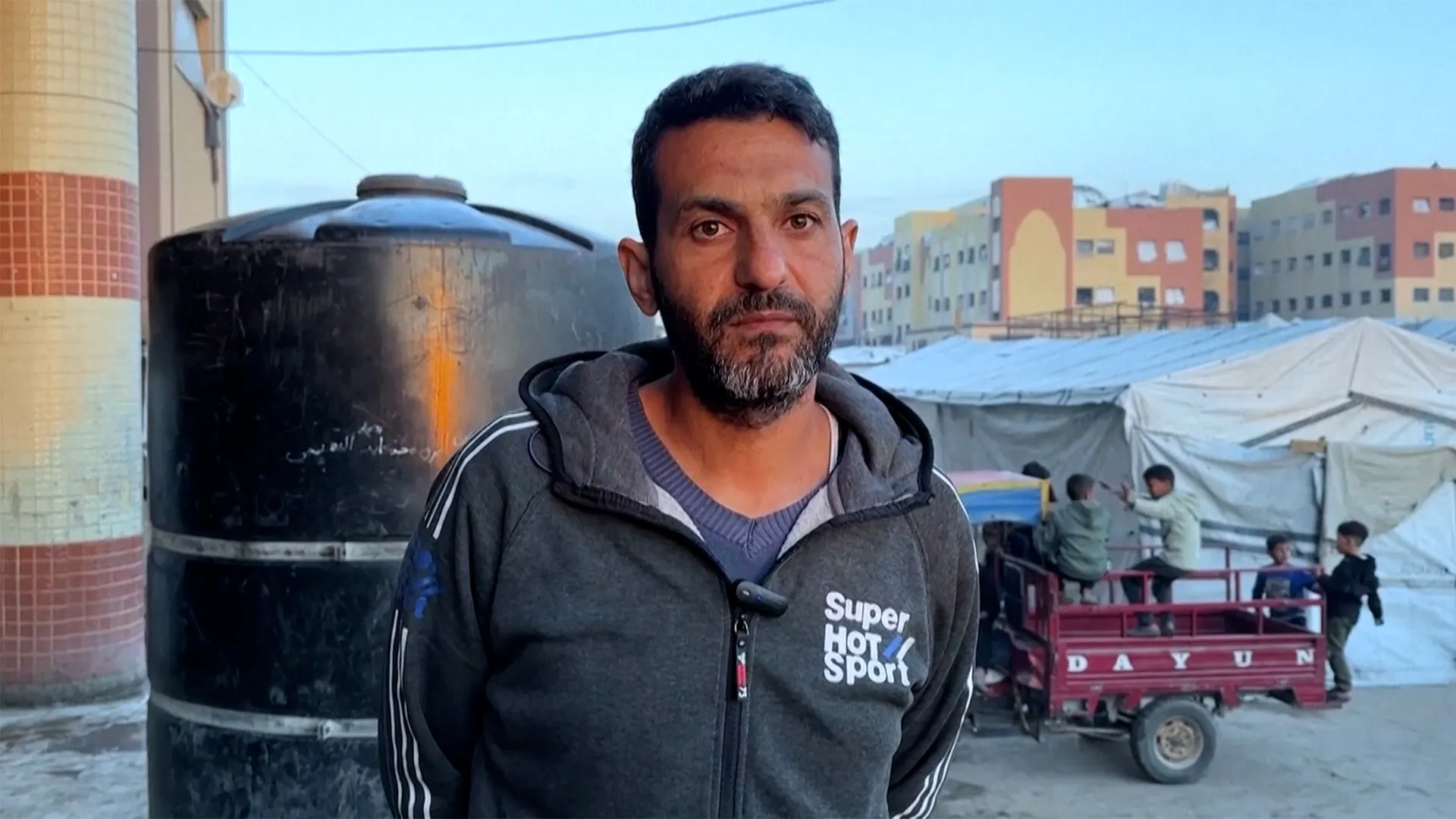
Al Jazeera’s Hani Mahmoud, reporting from Gaza City, said, “The ongoing Israeli attacks on the ground, the expansion of the ‘yellow line’ are meant to eat up more of the territory across the eastern part, really shrinking the total area where people are sheltering.”

“Everyone is cramped here. The population here not just doubled but tripled in many of the neighbourhoods, given the fact that none of these people is able to go back to their neighbourhoods. We’re talking about Zeitoun, Shujayea, as well as Tuffah,” he added.

“It was not until the past few minutes that the sounds of hums, the drones buzzing, faded away, but it had been going on for the past night and all of yesterday. Ongoing explosions that could be heard clearly from here,” Mahmoud said.

Intense artillery bombardment and helicopter fire also resumed on Monday in the areas south of the besieged enclave, north and east of the cities of Rafah and Khan Younis.

On Sunday, Israel launched more attacks into parts of Gaza outside its direct military control. At least three Palestinians were killed in separate Israeli attacks in Khan Younis, medical sources told Al Jazeera.

A five-storey building belonging to the al-Shana family in the Maghazi camp in central Gaza collapsed. It had been subjected to Israeli bombing at the end of 2023.

Civil Defence teams are searching for missing people under the rubble. The Wafa news agency reported that at least five people were injured.

Israeli push to make Rafah crossing ‘one-way exit’

Expectations have heightened around the possible reopening of the Rafah crossing, fuelling both desperate hope and deep fear.

For many in Gaza, there is some hope it could offer a lifeline, allowing the sick and wounded to access medical care, reuniting separated families, and giving some people a rare chance to move in or out of the Strip. Some also see it as a potential sign of easing restrictions.

But fears remain strong. Many worry the opening will be limited and temporary, benefitting only a few. Others fear it could become a one-way exit, raising concerns about permanent expulsion, effectively Israeli ethnic cleansing, and whether those who leave will be allowed to return.

“Until this moment, there’s nothing on the ground other than the headlines we’ve been reading over the past couple of days, the expectation now that within days the Rafah crossing is going to open and allow for movement in and out of Gaza. So far, we know the Israeli military is pushing for Rafah to be just a one-way exit,” Al Jazeera’s Mahmoud reported.

After months of uncertainty, people in Gaza who have suffered unimaginable loss and destruction are cautious. Even the possibility of relief comes with questions and little trust in what will happen next.

At least 71,386 Palestinians have been killed and 171,264 injured since the start of the war in October 2023, according to the latest figures from Gaza’s Ministry of Health. At least 420 people have been killed since the ceasefire was agreed upon three months ago.

The Israeli military continues to block a large amount of international humanitarian aid amassing at the Gaza crossings, while maintaining that there is no shortage of aid despite testimonies by the United Nations and others working on the ground.

Source link

‘We’re Going to Run the Country:’ Preparing an Illegal Occupation in Venezuela

Solidarity movements held an emergency rally in front of the White House. (Archive)

I listened to the January 3 press conference with a knot in my stomach. As a Venezuelan American with family, memories, and a living connection to the country being spoken about as if it were a possession, what I heard was very clear. And that clarity was chilling.

The president said, plainly, that the United States would “run the country” until a transition it deems “safe” and “judicious.” He spoke about capturing Venezuela’s head of state, about transporting him on a U.S. military vessel, about administering Venezuela temporarily, and about bringing in U.S. oil companies to rebuild the industry. He dismissed concerns about international reaction with a phrase that should alarm everyone: “They understand this is our hemisphere.”

For Venezuelans, those words echo a long, painful history.

Let’s be clear about the claims made. The president is asserting that the U.S. can detain a sitting foreign president and his spouse under U.S. criminal law. That the U.S. can administer another sovereign country without an international mandate. That Venezuela’s political future can be decided from Washington. That control over oil and “rebuilding” is a legitimate byproduct of intervention. That all of this can happen without congressional authorization and without evidence of imminent threat.

We have heard this language before. In Iraq, the United States promised a limited intervention and a temporary administration, only to impose years of occupation, seize control of critical infrastructure, and leave behind devastation and instability. What was framed as stewardship became domination. Venezuela is now being spoken about in disturbingly similar terms. “Temporary Administration” ended up being a permanent disaster.

Under international law, nothing described in that press conference is legal. The UN Charter prohibits the threat or use of force against another state and bars interference in a nation’s political independence. Sanctions designed to coerce political outcomes and cause civilian suffering amount to collective punishment. Declaring the right to “run” another country is the language of occupation, regardless of how many times the word is avoided.

Under U.S. law, the claims are just as disturbing. War powers belong to Congress. There has been no authorization, no declaration, no lawful process that allows an executive to seize a foreign head of state or administer a country. Calling this “law enforcement” does not make it so. Venezuela poses no threat to the United States. It has not attacked the U.S. and has issued no threat that could justify the use of force under U.S. or international law. There is no lawful basis, domestic or international, for what is being asserted.

But beyond law and precedent lies the most important reality: the cost of this aggression is paid by ordinary people in Venezuela. War, sanctions, and military escalation do not fall evenly. They fall hardest on women, children, the elderly, and the poor. They mean shortages of medicine and food, disrupted healthcare systems, rising maternal and infant mortality, and the daily stress of survival in a country forced to live under siege. They also mean preventable deaths,  people who die not because of natural disaster or inevitability, but because access to care, electricity, transport, or medicine has been deliberately obstructed. Every escalation compounds existing harm and increases the likelihood of loss of life, civilian deaths that will be written off as collateral, even though they were foreseeable and avoidable.

What makes this even more dangerous is the assumption underlying it all: that Venezuelans will remain passive, compliant, and submissive in the face of humiliation and force. That assumption is wrong. And when it collapses, as it inevitably will, the cost will be measured in unnecessary bloodshed.  This is what is erased when a country is discussed as a “transition” or an “administration problem.” Human beings disappear. Lives are reduced to acceptable losses. And the violence that follows is framed as unfortunate rather than the predictable outcome of arrogance and coercion.

To hear a U.S. president talk about a country as something to be managed, stabilized, and handed over once it behaves properly, it hurts. It humiliates. And it enrages.

And yes, Venezuela is not politically unified. It isn’t. It never has been. There are deep divisions, about the government, about the economy, about leadership, about the future. There are people who identify as Chavista, people who are fiercely anti-Chavista, people who are exhausted and disengaged, and yes, there are some who are celebrating what they believe might finally bring change.

But political division does not invite invasion. 

Latin America has seen this logic before. In Chile, internal political division was used to justify U.S. intervention, framed as a response to “ungovernability,” instability, and threats to regional order, ending not in democracy, but in dictatorship, repression, and decades of trauma.

In fact, many Venezuelans who oppose the government still reject this moment outright. They understand that bombs, sanctions, and “transitions” imposed from abroad do not bring democracy, they destroy the conditions that make it possible. 

This moment demands political maturity, not purity tests. You can oppose Maduro and still oppose U.S. aggression. You can want change and still reject foreign control. You can be angry, desperate, or hopeful, and still say no to being governed by another country.

Venezuela is a country where communal councils, worker organizations, neighborhood collectives, and social movements have been forged under pressure. Political education didn’t come from think tanks; it came from survival. Right now, Venezuelans are not hiding. They are closing ranks because they recognize the pattern. They know what it means when foreign leaders start talking about “transitions” and “temporary control.” They know what usually follows. And they are responding the way they always have: by turning fear into collective action.

This press conference wasn’t just about Venezuela. It was about whether empire can say the quiet part out loud again, whether it can openly claim the right to govern other nations and expect the world to shrug.

If this stands, the lesson is brutal and undeniable: sovereignty is conditional, resources are there to be taken by the U.S., and democracy exists only by imperial consent.

As a Venezuelan American, I refuse that lesson.

I refuse the idea that my tax dollars fund the humiliation of my homeland. I refuse the lie that war and coercion are acts of “care” for the Venezuelan people. And I refuse to stay silent while a country I love is spoken about as raw material for U.S. interests, not a society of human beings deserving respect.

Venezuela’s future is not for U.S. officials, corporate boards, or any president who believes the hemisphere is his to command. It belongs to Venezuelans.

Michelle Ellner is a Latin America campaign coordinator of CODEPINK. She was born in Venezuela and holds a bachelor’s degree in languages and international affairs from the University La Sorbonne Paris IV, in Paris. After graduating, she worked for an international scholarship program out of offices in Caracas and Paris and was sent to Haiti, Cuba, The Gambia, and other countries for the purpose of evaluating and selecting applicants.

The views expressed in this article are the author’s own and do not necessarily reflect those of the Venezuelanalysis editorial staff.

Source link