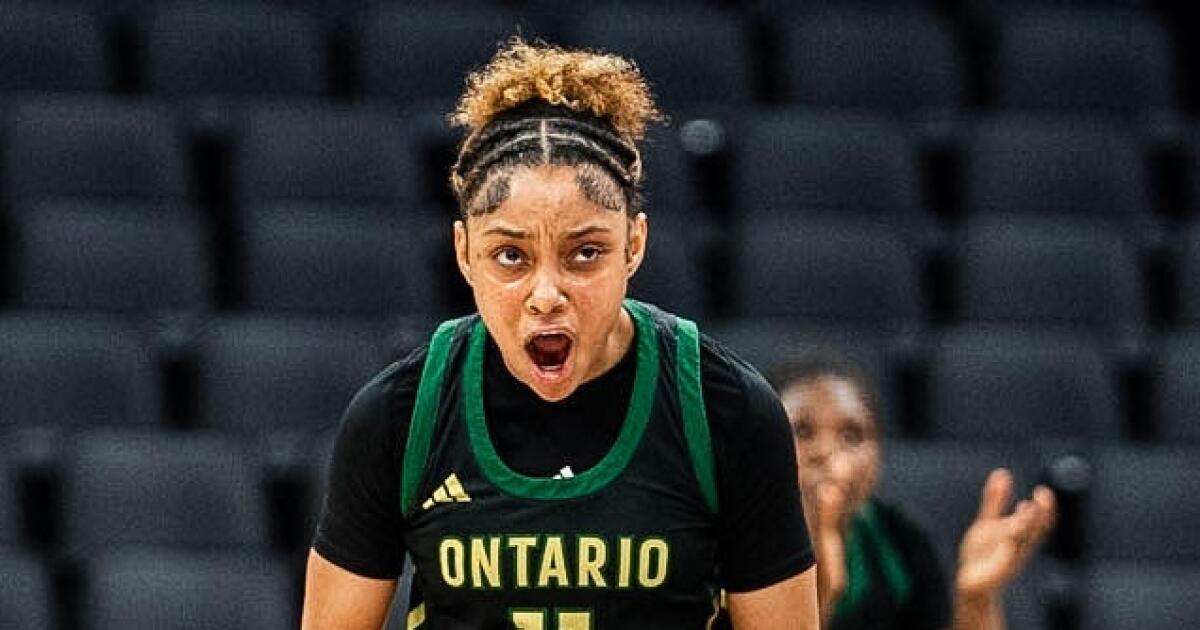
Kaleena Smith averaged 31 points, seven assists and four steals a game this season while playing for the No. 1 program in the Southland, but her expanded leadership role is what earns her the honor of The Times’ girls’ basketball player of the year.
The 5-foot-6 junior point guard marshaled Ontario Christian to the CIF state championships in Sacramento for the first time in the program’s history and along the way her voice spoke almost as loudly as her game — surprising for someone who is not talkative by nature.
“Her numbers speak for themselves but the biggest difference in Kaleena this season has been her leadership,” Knights coach Aundre Cummings, said. “She’s always coming to practice first and leaving last, which teammates respect, but also knowing when to speak up.”
Smith has been nicknamed “Special K” for her talent and charisma, traits that make her one of the top national recruits in the class of 2027. She is garnering attention from multiple college programs. USC women’s coach Lindsay Gottlieb was even on hand to witness Smith score 23 points and contribute six assists in the Southern California regional semifinals against Etiwanda on March 8 and the state championship game against Archbishop Mitty at Golden 1 Center in Sacramento.
“I’m being more vocal, yes, because I’m gonna have to do that in college,” said Smith, who spent countless hours refining her mid-range jumper this winter. “As captain it’s one of my responsibilities.”
One hundred games into her high school career, Smith is living up to the hype thrust upon her when she was named MaxPreps’ national freshman of the Year in 2024. She passed the 2,000-point plateau when she scored 51 points against Esperanza in November.
Smith paced Ontario Christian to the Southern Section Open Division title as a sophomore and although the Knights were denied a repeat (she had 30 points and five assists in a finals defeat to Sierra Canyon) her stats are better in every significant category. Intertwined with her competitive spirit and winning mindset is the maturity and confidence of an upperclassman.
“Her leadership is what stands out,” sophomore teammate Tatianna Griffin said. “She’s a very quiet person. I’m not sure it comes naturally or not but when she says something we listen.”
Griffin’s own game has blossomed because of Smith’s willingness to give her the ball in clutch situations, and Smith has been a mentor to freshman Chloe Jenkins, who led the team in rebounds (11.3 per game).
Adding leadership to her basketball IQ, court vision, defense, quickness, shooting, passing and dribbling has made Smith a complete player, one who is poised for a senior season worth talking about.
For months, the senior U.S. senator from Montana pondered his political future.
Or so he said.
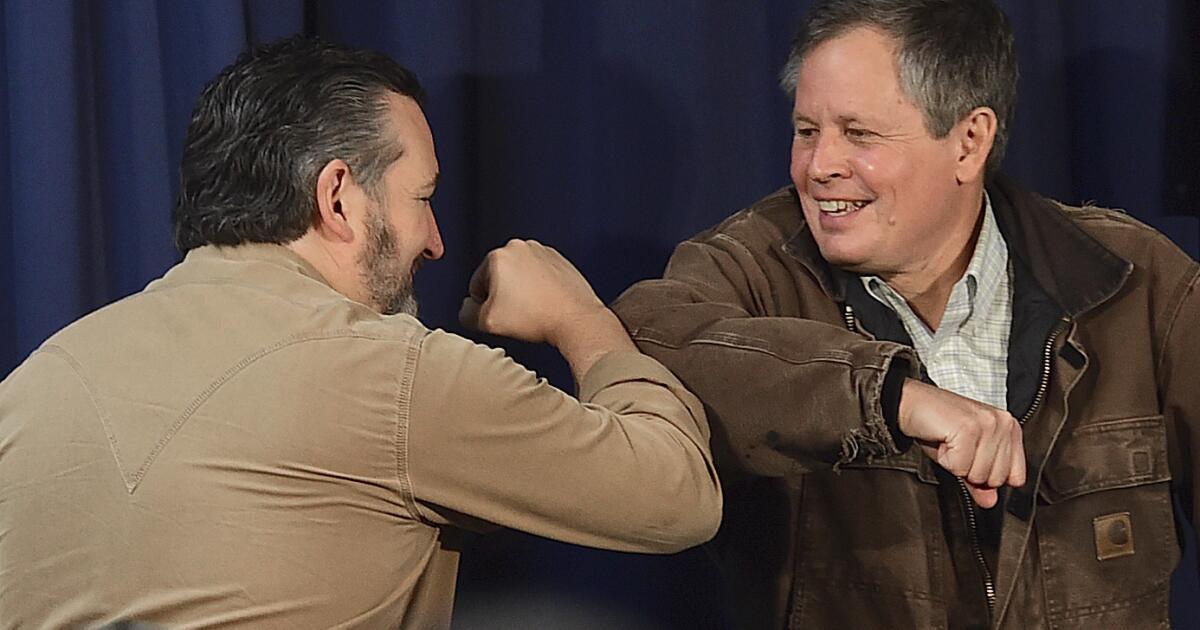
Wrapping up his second term and facing a glide path to a third, Steve Daines unexpectedly opted this month against seeking reelection, saying in an aw-shucksy video he planned to spend more time back home in Montana and enjoy more cherished moments with his seven grandkids.
Notably, after long “wrestling with this decision,” Daines announced his intent a scant two minutes after the deadline passed for candidates to put their names on the ballot. March 4 at 5:02 p.m local time, to be precise.
More notable still, Daines’ preferred successor, Republican former U.S. Atty. Kurt Alme, jumped into the race at 4:52 p.m. that very same day.
There are relay runners who might learn a thing or two from their timing and coordination.
As part of the seamless handoff, Alme was swiftly endorsed by President Trump, Montana’s Republican governor, Greg Gianforte, and its other Republican senator, Tim Sheehy, for all intents settling the GOP contest and, quite likely, choosing the state’s next member of the U.S. Senate.
Never mind what voters might have wished, or other prospective candidates might have had in mind.
“There are a lot of Republicans in the state, folks with political ambitions, who are extremely peeved right now,” said Kal Munis, a Montana native and political science professor at Auburn University, who closely tracks politics in his home state.
Moreover, Munis said, with enough notice a heavy-hitting Democrat might have entered the contest, instead of the lowly bunch now running hopeless campaigns.
Montana, which has a rich Democratic history, has become a solidly Republican state, though the makeover took some time to complete.
Still, while Daines’ seat hardly appeared at great risk for the GOP, a fight for the party’s nomination might have been a costly distraction, diverting money and attention that could go elsewhere as Republican prospects for the midterm election grow increasingly dim. (An unpopular war and shaky economy that’s been knee-capped by a sudden spike in oil prices will do that.)
Of all people, Daines certainly appreciates the bigger political picture, having led Republicans’ Senate campaign committee during the 2024 cycle. So he and his allies short-circuited the election process by laying hands on Alme, who stepped down as U.S. attorney to sidle into the Senate.
Seth Bodnar was among those who quite rightly criticized Daines for, as Bodnar put it, having “so little respect for Montana Republicans that he withdrew at the last minute to coronate his handpicked successor instead of giving them a voice at the ballot box.”
It just goes to show, Bodnar suggested, “the disgusting arrogance of Washington politicians and their party bosses who trade power back and forth like candy.”
Bodnar, the former president of the University of Montana, is running for Senate as an independent, conspicuously steering clear of the toxic Democratic brand. There is speculation the high-handed behavior of Daines, Trump and other Republicans might be enough to give Bodnar’s steep-odds candidacy a decent shot in November.
Munis, for one, is doubtful.
“There are a number of activist types who are deeply angered by this,” he said. “But when it comes to tallying votes in an election, that’s just a drop in the bucket.”
Unfortunately, Daines’ scheming, stick-it-to-the-voters approach isn’t just a Montana Republican thing.
Democratic Rep. Chuy Garcia of Illinois announced in the fall that he would not seek a fifth term this year. The last-second move — which came after Garcia had earlier filed paperwork to run for reelection — made it so his chief of staff and preferred successor, Patty Garcia (no relation), was the only major Democrat to appear on the ballot, virtually guaranteeing her election in November.
His actions were “beneath the dignity of his office and incompatible with the spirit of the Constitution,” said Gluesenkamp Perez, who was jeered and booed by fellow Democrats during the floor debate for having the temerity — heavens to Betsy! — to put principle above knee-jerk partisanship. The measure passed the House, 236 to 183, with only 22 Democrats joining Gluesenkamp Perez in support.
In California, the law prevents incumbents from pulling off the kind of underhanded stunt that Garcia and Daines managed. That’s because the filing deadline is automatically extended for an extra five days whenever a sitting lawmaker opts against seeking another term.
So, for instance, when Rep. Darrell Issa suddenly announced this month he would not run for reelection, he endorsed his favored replacement, San Diego County Supervisor Jim Desmond, but couldn’t grease the process to see to it that Desmond takes his place.
Legislators in other states should pass a law like the one in California to prevent the undemocratic shenanigans that in effect neutered voters in Montana and the Chicago area.
That is, if they truly believe elections matter and voters should have a choice and not stand by powerless as their government representatives are anointed from on high.
A series of proposed changes to the city’s charter — essentially its constitution — could give elected leaders in Los Angeles more oversight of the police department and enable the chief to fire problematic officers, reforms long sought by advocates that are likely to once again face fierce opposition.
Among the recommendations approved last week by the city’s Charter Reform Commission was a proposal that would require any LAPD accountability-related motion or ordinance passed by the City Council to automatically become law if not acted on by the Police Commission within 60 days.
Once the language is finalized, the proposals must clear the City Council and its committees before they can be put to voters on November’s ballot.
Another proposal would give city leaders the ability to override the policy decisions by the Police Commission, a board appointed by the mayor that sets the LAPD policies, oversees its budget and serves as a civilian watchdog.
With the police chief taking criticism for a recent rise in shootings by officers, several proposals sought to strengthen accountability for the use deadly force. One recommendation could require the LAPD to purchase “no less than” $1 million of liability insurance for its roughly 8,700 officers. The insurance would be used to cover legal fees if an officer is found liable for a wrongful injury or death, instead of tapping into the city’s General Fund budget.
Another potential change would “clarify and strengthen” the police chief’s ability to “to initiate and pursue the removal of officers with documented, repeated histories of harm or misconduct.”
Under city rules, the chief of police does not have the authority to fire an officer. Instead, they must send officers whose misconduct they deem severe to disciplinary panels, which occasionally lead to lighter penalties. The new proposal would give the City Council the power to override decisions not to fire, still leaving officers the right to appeal through the courts.
Mayor Karen Bass vetoed a similar bid to rework the disciplinary process in 2024.
The latest proposals drew cautious optimism from activists, many of whom claim the Police Commission is too cozy with the LAPD and have pushed for stronger independent oversight.
Godfrey Plata, deputy director of the nonprofit L.A. Forward, called the proposals a “huge victory” in the fight for police accountability.
“Months ago, police reform wasn’t even on the Charter Commission’s to-do list. Today, because community members came together to force conversations that likely never would have happened on their own, we have multiple reforms headed to City Council,” Plata said.
The Police Commission and LAPD issued nearly identical statements that said they are looking forward to working with the City Council on the charter reform process.
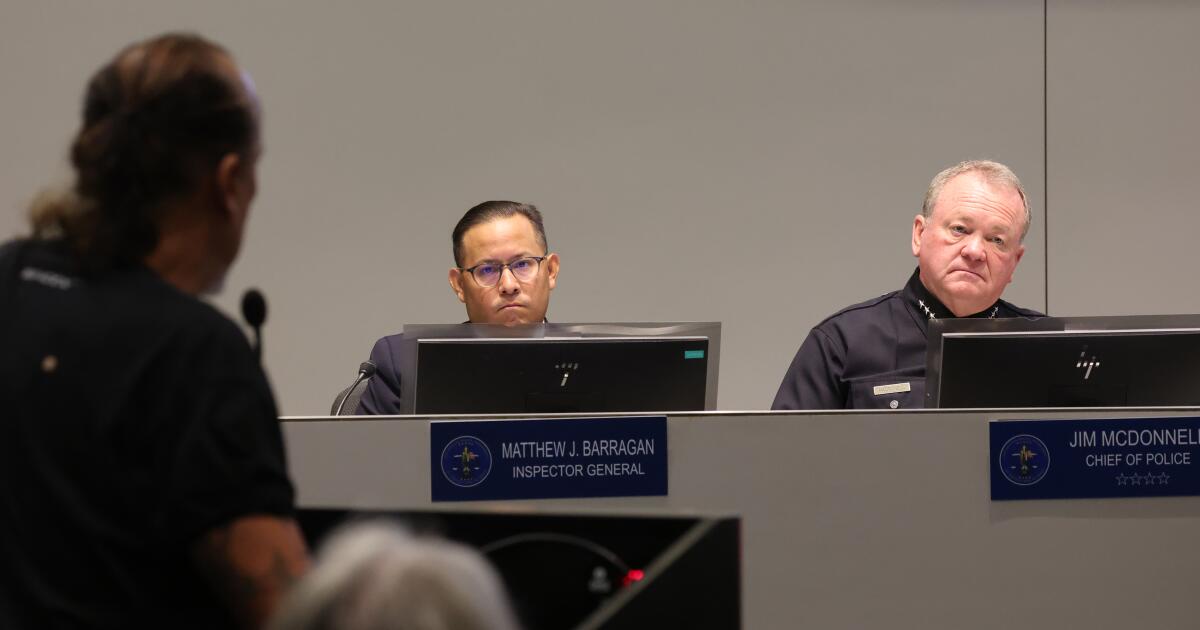
An LAPD spokesman declined to say how Chief Jim McDonnell felt about the proposal, saying it wasn’t “in his interests to give his opinion on something like this as long as it’s still with the full council.”
Samantha Stevens, a Los Angeles political consultant and former legislative staffer, said she is worried the proposed changes are a shortsighted solution to address police abuses that will create another layer of bureaucracy.
“If we don’t like how they’re running things, we should replace the commissioners.” she said. “I don’t know that this will be as effective when you’ve got 15 councilmembers now telling LAPD what to do in their own districts. Is that now too many cooks in the kitchen?”
The charter commission, which has been meeting since last July, must send all its recommended changes to the City Council by April 2.
Two years after Huntington Beach residents voted to effectively ban Pride flags from being displayed on city property, the conservative coastal city could be represented by a gay member of Congress and outspoken critic of President Trump — Rep. Robert Garcia.
That twist of fate came after last year’s unprecedented mid-decade rejiggering of California’s congressional districts.
Voters in November overwhelmingly approved Proposition 50 — Gov. Gavin Newsom’s plan to neutralize Republican gerrymandering in Texas — to help Democrats win control of the House this November and put a meaningful check on the Trump administration.
The political tremors triggered by the ballot measure already have reshaped California’s political landscape.
Veteran Republican Rep. Darrell Issa of northern San Diego County, an incessant thorn in the backside of President Obama, has called it quits. Northern California Rep. Kevin Kiley has shed his GOP label to run as a political independent. And two Republican congressional incumbents find themselves in a political death match in a newly crafted district straddling Orange, Riverside and San Bernardino counties.
The new 42nd District remains anchored in Garcia’s home base of Long Beach. But under the new lines, it has swapped out Southeast L.A. communities such as Downey and Bell Gardens for the more MAGA-friendly cities of Huntington Beach and Newport Beach.
“I say that every time a district crosses the L.A.-Orange County border, a Democrat gets its wings,” said Paul Mitchell, the redistricting expert who drew the new lines for Democrats. “Drawing the Long Beach district to go down to Huntington Beach meant that you’re giving Robert Garcia a community that, in its elected City Council, has been real anathema to who he is as a person, being an out gay member of Congress.”
The change means Garcia’s district shifts rightward with a lot more Republican voters, but still has a Democratic majority. Former Vice President Kamala Harris would have still won the new district in the 2024 presidential race by 13 points, making Democrats confident that it’s still one where Garcia could win.
As the top Democrat on the House Oversight Committee, Garcia is poised to win more power in pushing back against the Trump administration if historical precedent holds and Democrats win back the House majority in November.
Garcia was unavailable for an interview, but many of the new voters he will have to court are represented by Rep. Dave Min (D-Irvine), who won the closely divided Orange County seat in 2024 and now faces a slightly bluer voting base in his newly configured district.
“I have a lot of voters to introduce myself to,” said Min, who described himself as “progressive for Orange County” because he cares about protecting civil rights but often aligns with law enforcement and small-business interests.
“The message [to new voters] is that you may not always agree with me, but that I will try my best to do what I say. I will fight to deliver on the promises I make, I will fight for the values that I represent myself as caring about. And I listen to my constituents,” he said, noting that he recently held his seventh town hall since he was elected.
In a neighboring Orange County district, Republican Reps. Young Kim and Ken Calvert are going to battle for control of the region’s only safe Republican seat post-Proposition 50. That district also crosses county lines — into Corona, Chino Hills and other parts of western Riverside and San Bernardino counties.
Republicans may be dismayed to see the two popular party leaders battling it out in what promises to be a brutal and expensive election.
Republican “primary voters are looking for how to distinguish between two of the same flavor,” said Rob Stutzman, a Republican political strategist. “Republican voters are going to like both of them, so how do you make that judgment?
“Often, it comes down to who their friends are,” he said, noting that endorsements from interest groups and other elected officials are usually more valuable in primaries than general elections.
A handful of Democratic candidates have also declared for the seat, which campaign strategists said could split the liberal vote and allow both Calvert and Kim to advance to the general election ballot.
Issa bids farewell, Kiley drops GOP label
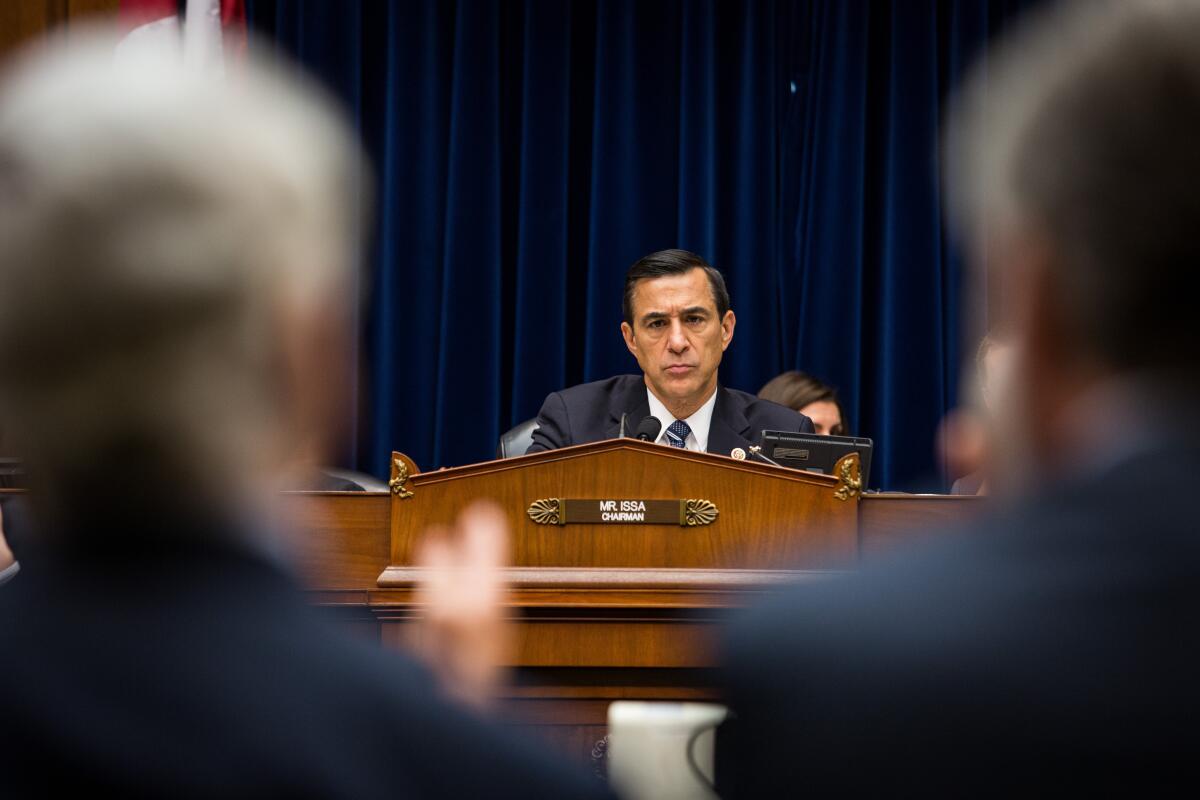
Chairman Darrell Issa (R-Bonsall) listens to testimony from witnesses during a House Oversight Committee hearing entitled “Reviews of the Benghazi Attack and Unanswered Questions,” in the Rayburn House Office Building on Capitol Hill in 2013 in Washington.
(Drew Angerer / Getty Images)
Issa’s decision to forgo a run for reelection came as a surprise Friday, even though speculation has swirled about his future after the newly drawn congressional districts put him in a seat where Democratic voters outnumber Republicans. That was a major downgrade from his current district, which swallows up right-leaning eastern San Diego County and the conservative pockets of Temecula and Murrieta.
“This decision has been on my mind for a while and I didn’t make it lightly,” Issa said in a statement. “But after a quarter-century in Congress — and before that, a quarter-century in business — it’s the right time for a new chapter and new challenges.”
Democrats celebrated the departure of Issa, who helped fund the successful 2003 recall of California Democratic Gov. Gray Davis, and led the congressional investigation of the 2012 attack on the U.S. diplomatic mission in Benghazi during the Obama administration.
“After over two decades of disastrous representation, Darrell Issa is once again running for the exits — and good riddance,” said Anna Elsasser, spokesperson for the Democratic Congressional Campaign Committee.
Several Democrats had already announced plans to challenge Issa, including San Diego City Councilmember Marni Lynn von Wilpert.
Proposition 50 also split the sprawling district held by Kiley, a Republican from Rocklin, into six pieces, leaving the Northern California congressman and frequent Newsom critic with few good options.
Over the following months Kiley posted on social media to announce — like the dating show “The Bachelor” — where he would not run until it came down to two districts: a safe Republican seat that would force Kiley into a primary with longtime Rep. Tom McClintock (R-Elk Grove) or a district with a 9-point Democratic registration advantage.
Kiley chose to avoid challenging McClintock and delivered his final rose to the new 6th District along with a twist: On Friday the congressman announced he would run as an independent candidate rather than a Republican.
Rep. Kevin Kiley (R-Rocklin) in his office in Washington in 2025.
(Richard Pierrin / For The Times)
In a lengthy social media post and accompanying video, Kiley said he has become “frustrated, sometimes disgusted, by the hyper-partisanship in Congress” and that he answers to constituents, “not party leaders.”
But without a political party behind him, Kiley’s campaign is “entirely his burden,” said Republican strategist Matt Rexroad. “He’s not going to get the party endorsement. He’s really on his own.”
Without a letter denoting a political party next to their name on the ballot, independent candidates have historically gotten lost in the mix.
One other candidate, a Christian author named Michael Stansfield, confirmed Friday that he filed to run for the seat as a Republican, giving Kiley automatic competition for conservative votes.
Several Democrats have already announced campaigns for the seat — which lumps conservative suburbs of Sacramento with liberal-leaning ones closer to the capital city — including former state Sen. Richard Pan, Sacramento Dist. Atty. Thien Ho, West Sacramento Mayor Martha Guerrero and Lauren Babb, a public affairs leader for Planned Parenthood clinics in California and Nevada.
For some longtime Democrats such as Rep. Brad Sherman, the addition of new GOP voters could help them fend off challenges from younger progressive candidates.
Half a dozen Democrats, mostly younger progressives, have filed paperwork to challenge Sherman (D-Sherman Oaks), 71, who has represented parts of the San Fernando Valley for nearly 30 years.
The 32nd District remains solidly blue post-Proposition 50, but a nearly seven-point swing to the right “makes it less likely that two Democrats go to the general, which makes it less likely that [Sherman] would get beaten,” said Mitchell.
It’s a similar story for Reps. Doris Matsui (D-Sacramento), Mike Thompson (D-St. Helena) and John Garamendi (D-Walnut Grove), who are all in their 70s and 80s and facing younger, more progressive challengers.
While gaining more conservative voters may help some incumbents avoid facing another Democrat in November, the threat of such a faceoff is pushing them to be more active on the campaign trail, Rexroad said.
“You’re seeing more activity by Doris Matsui and Mike Thompson and John Garamendi as a result of them being challenged, because they like their seats and they’d like to hold on to them,” Rexroad said.
Times staff writer Seema Mehta contributed to this report.
Every time Adriana Molina drives up Lake Avenue to her retro-style women’s clothing shop Sidecca in Altadena, she sees the new outdoor mural she commissioned for the store by muralist and illustrator Annie Bolding. It gives her hope.
“I’m here to stay, and this mural solidified my decision to reopen my business,” said Molina on a recent winter day, sitting next to Bolding inside the boutique. “I grew up in Altadena. The community has motivated me this whole time, and I want them to drive by this mural and smile.”
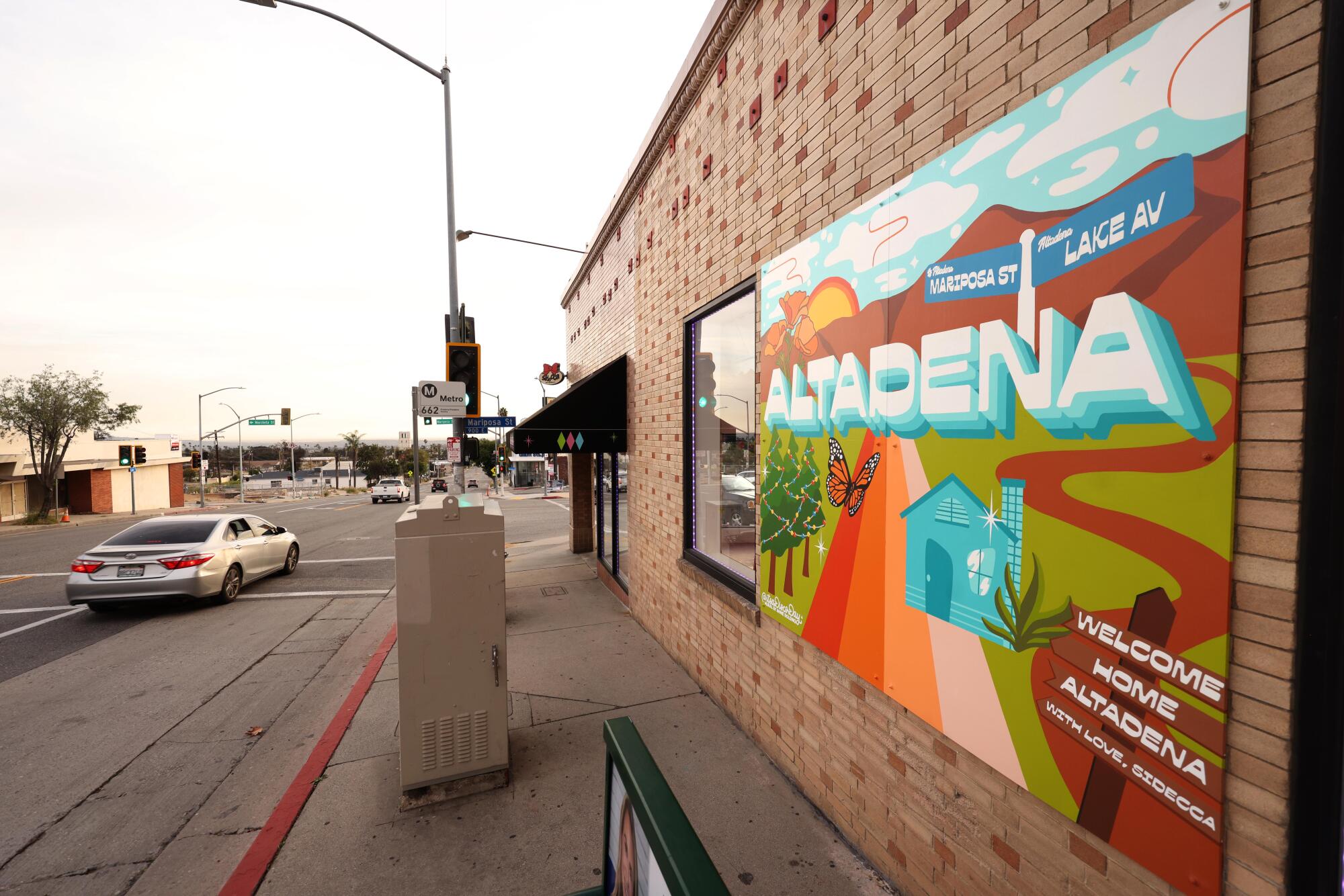
“ALTADENA.” The word — in big white letters, set against layers of blue — appears toward the top of the mural, on the store’s brick wall facing Lake. Above are the San Gabriel Mountains, painted a deep brown, California poppies and Mariposa Street and Lake Avenue street signs. Below are green grass, a monarch butterfly and Altadena’s Christmas Tree Lane. A bright blue house is on a multicolored striped path in the middle of the mural. Next to it, on a hiking trail, a sign says, “Welcome Home Altadena… With Love, Sidecca.”
For Molina and Bolding, the mural is a personal ode to the Eaton fire-ravaged community — art as a message of optimism and healing.
A car passes by the new Altadena mural on the side of Sidecca apparel shop, which commissioned the piece after fire and floods devastated the community.
(Genaro Molina / Los Angeles Times)
When the fire tore through Altadena in January 2025, Sidecca and a few other stores on the north side of Mariposa Street’s bustling Mariposa Junction survived, while the other half-block of businesses burned to the ground. The fire leveled Bolding’s parents’ house off Lake and the home of one of Molina’s close relatives.
Molina staged pop-ups and sold merchandise online during months of remediation, and officially reopened Sidecca’s doors in November as part of Mariposa Junction’s larger comeback. Then the store suffered another blow: flooding and damage during rainstorms in late December. While Molina prepped to temporarily close her store yet again for renovations, Bolding began work on the mural. She started painting on the one-year anniversary of the fire and finished eight days later.
“On the day I started it, it was so cold and windy, and I was scared being up on the ladder,” said Bolding. “But getting to talk to community members while I was painting was very special. People were excited and honking as they drove by. That night, I drove up to the lot where my parents’ place was, and I stood there and all the feelings flooded back.”
The mural’s origin story is that of two creative women bound by strength and a desire to give back.
Molina, who has worked in the fashion industry for more than 30 years, opened Sidecca’s Altadena spot in 2023, after closing its longtime Pasadena location. Voted Pasadena’s best women’s clothing store five times by Pasadena Weekly, Sidecca sells fun vintage-inspired merchandise and clothes, from ‘50s style dresses to snazzy magnets, tote bags and sunglasses. A big rainbow zips across the top of one of the store’s walls.
A display in Sidecca in 2023, two years before the Eaton fire devastated Altadena.
(Alejandro R. Jimenez)
“A few months after Sidecca opened in Altadena, my mom walked in and saw how colorful it was, and said, ‘This reminds me of my daughter,’ ” Bolding said. “With zero hesitation, my mom said to Adriana, ‘Here’s her Instagram. This is my daughter’s stuff.’ ”
Bolding, who goes by Disco Day Designs, calls herself “a joyful creator who loves to intentionally transform spaces.” Known for the bright murals she creates for brands and shops, Bolding gained attention on social media for a trash bin she painted with palm trees and stripes. She brought it to the 2024 Coachella Valley Music and Arts Festival as part of a contest organized by the festival’s sustainability partner, Global Inheritance.
“I fixated on the trash can,” said Molina. “I looked at Annie’s murals and was like, ‘Oh, she has to do something in here for us.’ ”
“Game recognizes game,” added Bolding, smiling.
Molina wanted to rebrand Sidecca with a new logo, bags and art, and connected with Bolding about that and a possible mural inside the store. “I wanted ‘Sidecca’ painted across a wall as an acronym that stands for style, individuality, diversity, expression, community, culture and art,” she said. “That’s who we are.”
Then came Jan. 7, 2025.
The store was closed all day for a holiday lunch. Then the winds picked up and the flames roared. Molina, who lives with her husband and two children on the Altadena-Pasadena, evacuated with her family to Long Beach and came back days later. She knew the store was OK because she’d seen it — intact — on the news.
“As soon as we could come up to the shop, we went,” Molina said. “There were ashes all over.”
Bolding and her husband were in Palm Springs fixing up an AirBnb they cohost when Bolding got a call from her mom about the fire in Altadena. She urged her mom, dad and younger brother to evacuate. After they did, their home burned down. Her parents now live in a Pasadena apartment.
When Molina started selling Altadena-themed merch on Sidecca’s website, Bolding donated three designs, including one with lively retro daisies. In July, she wrote an email to Molina reviving the idea of a mural, but outside versus inside, as an ode to Altadena.
“It felt like anything I could do to bring joy, let’s go,” said Molina. “And I really wanted a little house in there, and for it to say, ‘Welcome home.’ ”
The mural would be Bolding’s first public piece of art on a main street.
“Lake always felt like the road going home,” she said. “That rainbow road in the mural, leading to the mountains, is so symbolic. Very ‘Wizard of Oz.’ The mountains, their silhouette, have always felt majestic, safe, and why it was so heartbreaking anytime to see them burn. To me, they feel like mother.”
Muralist Annie Bolding stands in front of her new Altadena mural on the side of the Sidecca apparel shop. The work is Bolding’s first piece of public art on a main street.
(Genaro Molina / Los Angeles Times)
Bolding’s joyful daisies decorated the Sidecca tote bag given to customers at November’s reopening, just before December’s intense rainstorms. Water gushed through Sidecca’s ceiling. Molina and her employee Manisa Ianakiev were overwhelmed.
“We were like, ‘Is this really happening?’ ” said Molina. “Then people started bringing tools and towels. It was an example of community.”
Bolding planned to start painting the mural Jan. 4, during the Altadena Forever Run, but rain swept through. After Molina’s landlord installed a plywood base, Bolding started on the mural several days later.
Since then, the shop’s ceiling has been replaced, and Molina is working on trying to replace the floor — while continuing to stage pop-ups and sell merchandise online — before fully reopening the bricks-and-mortar boutique this spring.
“People say, ‘Every time I go into your store, I just get happy. I’m in a better mood,’ ” said Molina. “I get that all the time. And what Annie has done, this mural, is beautiful. It makes me happy.”
SACRAMENTO — A proposed initiative to require Californians to show identification every time they vote, and election officials to verify registered voters are U.S. citizens, appears to have enough support to qualify for the November ballot.
Proponents say they have collected more than 1.3 million voter signatures on petitions supporting the ballot measure, far more than required under California law, and plan to submit them to county elections officials Monday for verification.
The Republican-led push for the voter ID initiative comes at a time of growing distrust in the integrity of the electoral process nationwide, a wariness intensified by President Trump’s baseless claims that the 2020 election was stolen from him and false assertions that droves of undocumented immigrants are swaying elections with illegal votes.
Proponents of voter ID contend that such laws prevent election fraud and, along with proof of citizenship mandates, prevent noncitizens from voting. Opponents say ID mandates threaten the fundamental constitutional rights of Americans who do not have the mandated documentation readily available, and that the restrictions are unnecessary given that voting by noncitizens is rare and already outlawed in the U.S.
The partisan divide over whether voters must provide proof of U.S. citizenship when registering to vote, one of Trump’s top priorities, continues to consume Washington. House Republicans passed the mandate in early February but the legislation — known as the SAVE Act — has bogged down in the Senate.
Democrats say that under the SAVE Act, many state driver’s licenses would not be adequate documentation to prove U.S. citizenship, forcing people to produce a passport or birth certificate — which many voters do not have. According to a 2023 survey by the Brennan Center for Justice and others, 9% of U.S. adult citizens do not have proof of their citizenship that’s readily available. The survey found that 11% of adult citizens of color were unable to readily access those documents, compared with 8% for white American adults. They accused Republicans of trying to prevent millions of Americans from voting in the next election in order to keep Congress under GOP control.
UC Berkeley Law School Dean Erwin Chemerinsky said that both the SAVE Act and proposed ballot measure in California are not only unnecessary, but harmful to democracy.
“Both are aimed at solving problems that don’t exist,” Chemerinsky said. “There is no evidence of a problem of non-citizens voting. Nor is there evidence of significant fraud with voters casting votes under false names. But both would limit who can vote. As for the SAVE Act, many people don’t have a birth certificate or passport.”
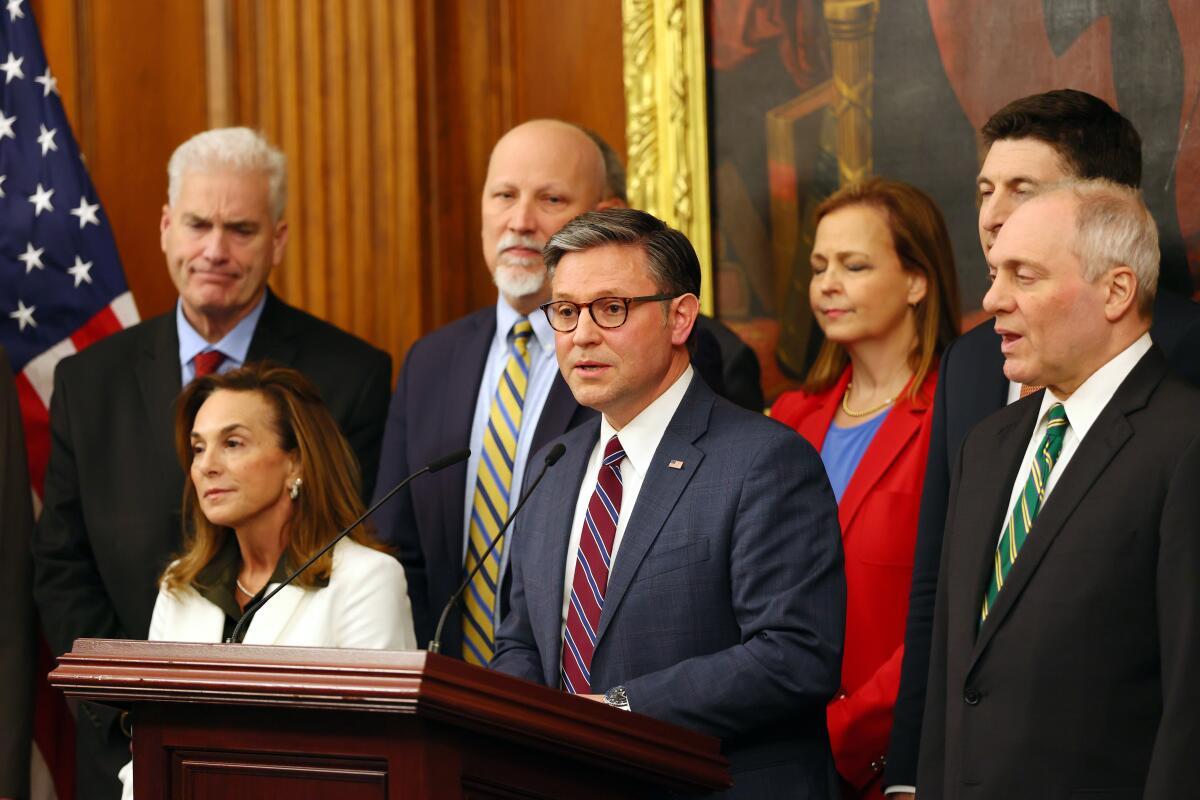
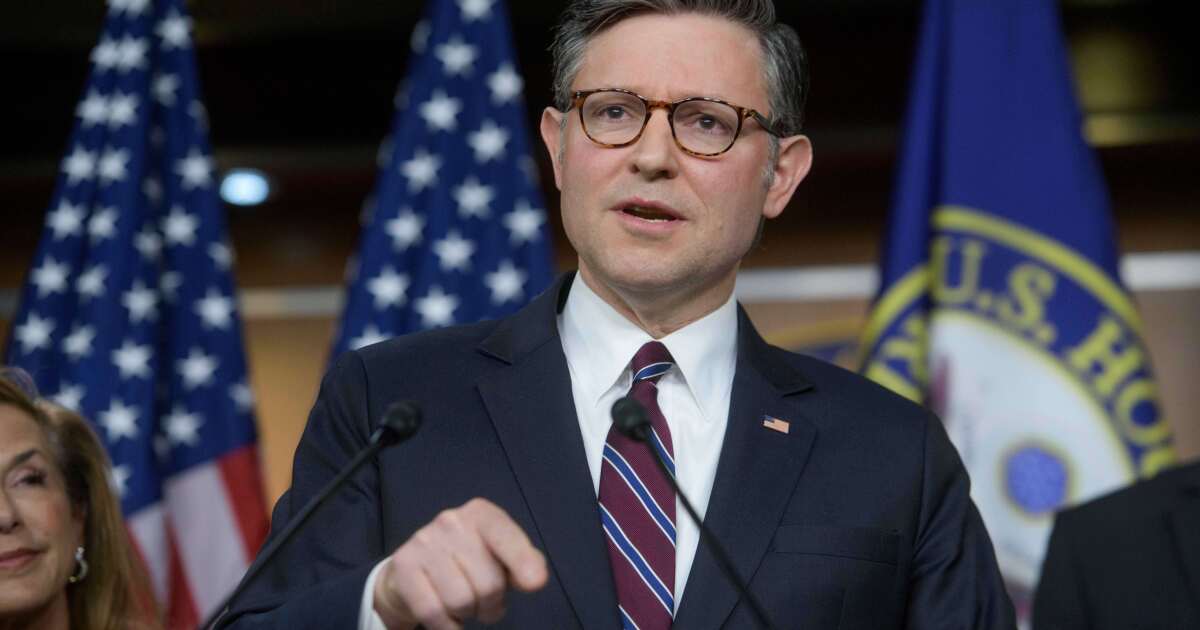
U.S. House Speaker Mike Johnson (R-La.) speaks during a news conference on Feb. 11 at the U.S. Capitol. Johnson was joined by Republicans to speak about the passage of the SAVE America Act, an election bill backed by President Donald Trump that would require proof of citizenship to register to vote and require photo identification at the ballot box.
(Michael M. Santiago / Getty Images)
Rep. Ken Calvert (R-Corona), who supports and voted for the SAVE Act, said it is a simple way to restore voter confidence in elections. But he said the bill’s fate appears grim.
“I don’t think they have the votes,” Calvert said Friday.
Which is why, Calvert says, California must join other states and enact commonsense voter ID and citizenship requirements that can attract bipartisan support. The longtime Republican congressman said he does not believe there has been widespread voter fraud in the U.S., or a that a flood of noncitizens has been voting, but that does not mean those have not happened to some degree and would sway both tightly contested local elections and congressional races.
“I’ve always said it’s probably a small amount, but it’s enough to change an outcome of elections, and could change the numbers we have in Congress,” Calvert said.
The California ballot measure
The petitions being submitted for the California Voter ID Initiative will be reviewed by county election officials, who must verify that the people who signed are registered voters in the state and that the proponents collected at least the 874,641 valid signatures required to qualify for the November ballot.
The ballot measure will make significant changes to how Californians vote, and enact new mandates on county elections officials. Among the top changes being proposed:
Every time a voter casts a ballot in person in any election in California, they must present government-issued identification.
Californians voting by mail will be required to list on the ballot envelope the last four digits of a “unique identifying number from a government issued identification” — essentially a pin number like people use at an ATM — that matches the one the voter designated when they registered to vote.
The California secretary of state and county election officials will be required to verify that registered voters are U.S. citizens by “using government data,” which according to supporters could include information in the federal Social Security Administration database, jury summons information and other government records.
The secretary of state and county election officials must maintain accurate voter registration lists.
If requested, the state would be required to a provide eligible voters with free voter identification cards for use during elections.
“We’re creating the legal obligation that in California, when we do voting, we want our election officers to actually give a damn about whether someone’s a citizen,” said Assemblymember Carl DeMaio (R-San Diego), one of the main forces behind the proposed ballot measure. “That’s what we’re asking. That’s why voters support this, because it’s not a burden on the voter. It really is a burden on the election officers to do their job.”
Republican Assemblymember Carl DeMaio of San Diego speaks at a press conference in July to announce a campaign to require voter identification in California.
(Tran Nguyen / Associated Press)
But Jenny Farrell, executive director of the League of Women Voters of California, called the proposed ballot measure an underhanded attempt by Trump and Republicans to make it even harder for people in the state to vote — which they see as a political advantage. The Californians who will suffer the most are “communities of color, people with disabilities, elderly folks, folks who move around a lot, folks who have recently experienced a name change.”
“California elections are already secure. This initiative isn’t really about election integrity. It’s part of this broader national playbook from President Trump and the current federal administration to make voting harder and to create doubts in the minds of the public and to really sow chaos on election day,” Farrell said. “The measure would create new strict barriers for eligible voters. It could wrongfully flag naturalized citizens, and it will create new ways to challenge results.”
Noncitizens who vote in California risk being charged with a felony and deported, she said.
Farrell’s organization has joined with the ACLU of Northern and Southern California, Common Cause, Disability Rights California and other groups to oppose the proposed measure.
Currently, 36 states require or request that voters provide identification at the time they cast a ballot, and 10 states have strict laws requiring people to produce government-issued photo IDs, according to the National Conference of State Legislatures.
Under current law, Californians are not required to show or provide identification when casting a ballot in person or by mail. They are required to provide identification when registering to vote, and must swear under penalty of perjury, a felony, that they are eligible to vote and a U.S. citizen.
To register to vote, Californians must provide their driver’s license number or state identification card number and the last four digits of their Social Security number, along with other information. The state is required to validate the information using relevant databases, including records at the state Department of Motor Vehicles and Social Security Administration.
Along with a driver’s license, U.S. passport or state identification card, acceptable identification also can include photo identification cards issued by a school, a credit card company, a gym, an insurance company, an employer or a public housing agency. Californians have the option of providing certain other documents, as long as they contain the person’s name and address, including: utility bills, bank statements, government checks, rental statements or government-issued bus passes.
First-time voters who did not present identification when they registered to vote must present ID the first time they cast a ballot in a federal election.
When ballots are sent by mail, election officials are required to verify a voter’s signature on the ballot by comparing it with the signature on the official voter registration records on file.
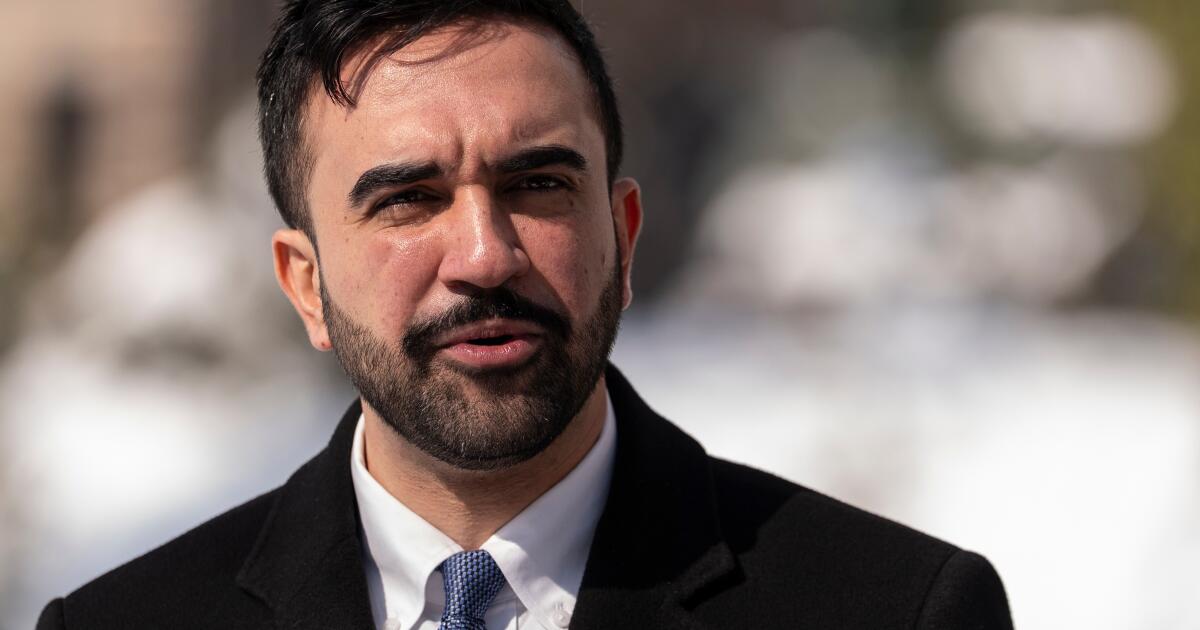
WASHINGTON — New York City Mayor Zohran Mamdani presented President Trump with a mock newspaper front page during a visit to the White House on Thursday to discuss massive new housing investments in the city.
It’s a tactic designed to appeal to Trump, who is keenly aware of his media coverage and, aside from being an avid viewer of cable news, is known to voraciously consume coverage in the local New York City publications. The Republican president and Democratic mayor have maintained a cordial relationship since their first meeting last fall.
Anna Bahr, Mamdani’s communications director, said the mayor’s team created a mock front page and headlines for Trump to look at and demonstrate what kind of reaction new federal housing investments could bring. The mock New York Daily News front page says “Trump to City: Let’s Build” — a riff on the famous 1975 cover that read “Ford to City: Drop Dead,” referring to Gerald Ford’s vow to veto financial assistance to the city.
The mayor posted the photo of their meeting, featuring the front pages, to his social media page.
Mamdani’s office declined to elaborate on the mayor’s housing proposal, but Bahr said Trump was “very enthusiastic” about it. When Trump and Mamdani last met in November, the president encouraged Mamdani to return to him with an idea to build big things together in New York City, Bahr said.
Though Trump repeatedly maligned Mamdani as a “communist” as he ran for New York City mayor, the president appeared charmed by him after their one-on-one meeting at the White House in November.
At the meeting on Thursday – which was previously unannounced and lasted for about an hour – Mamdani also brought up the detainment of Ellie Aghayeva, a Columbia University student from Azerbaijan who was arrested earlier Thursday by federal immigration agents.
The agents had accessed a campus residence by claiming they were searching for a “missing person,” according to Aghayeva’s attorneys and Columbia’s president. As he met with Trump, Mamdani urged Trump to consider releasing her.
In a phone call not long after their White House meeting, Trump told the mayor that Aghayeva would be released. Mamdani also gave White House chief of staff Susie Wiles a list of four other students targeted by federal authorities and asked for the administration’s help with them.
The four students are Mahmoud Khalil, Yunseo Chung, Mohsen Mahdawi and Leqaa Kordia, who were all detained for their roles in pro-Palestinian protests. Of the four, only Kordia remains in custody, although all cases are proceeding through the courts.
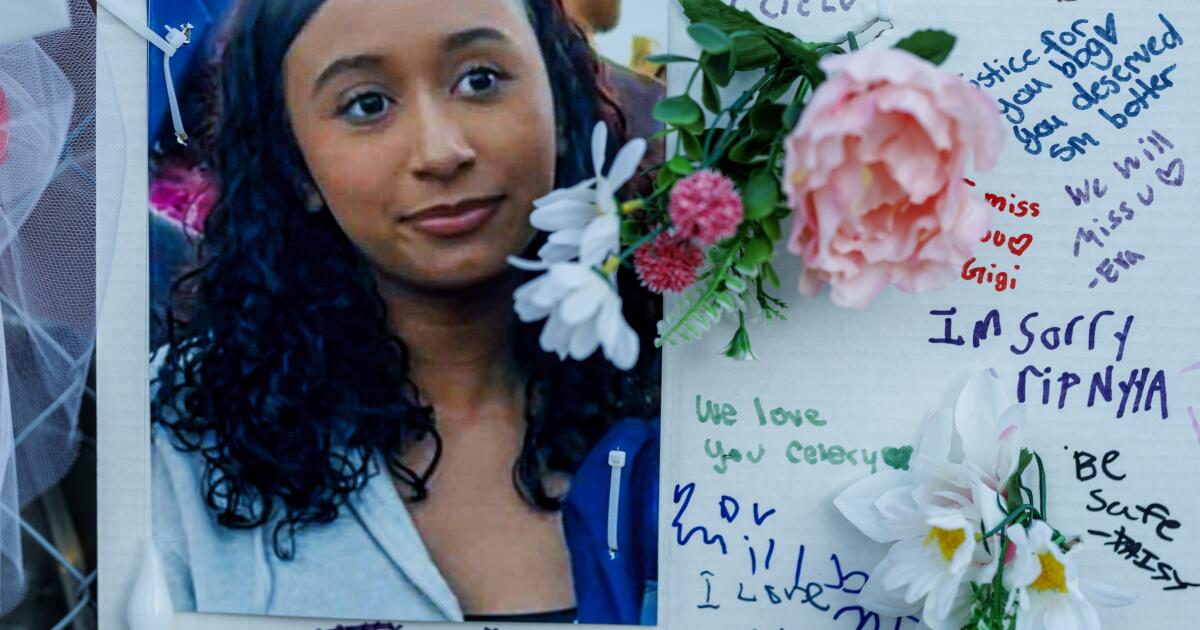
D4vd is the “target” of a Los Angeles County criminal jury investigation into the death of a teenage girl. The singer’s star was on the rise, with a global tour in his future, before the discovery of the girl’s remains in the front trunk of his Tesla.
The singer, whose real name is David Burke, has been the subject of the probe since November, months after the dismembered body of 14-year-old Celeste Rivas Hernandez was found in the car after it was towed off a street in Hollywood.
According to a grand jury subpoena seeking to have Burke’s father, mother and brother testify in L.A., the musician is described as “Target David Burke,” who may have committed a criminal offense in California, “to wit: One count of Murder.”
The document was part of a legal challenge to the subpoenas filed by the singer’s family in Texas. The newly unsealed documents reveal that, when Los Angeles police opened up the Tesla trunk, they found “a black cadaver bag covered with insects and a strong odor of decay” inside. Investigators had been granted a search warrant to look in the vehicle Sept. 8 after a tow yard worker noticed a rotting smell emanating from the vehicle.
According to the document, detectives partially unzipped the bag and found “a decomposed head and torso.”
Criminalists and medical examiners then processed the body.
“Upon removing the cadaver bag from the front storage compartment, it was discovered the arms and legs had been severed from the body,” the subpoenas noted. “A second black bag was discovered underneath the cadaver bag. Upon opening the second bag, the dismembered body parts were discovered.”
Los Angeles County Deputy Dist. Atty. Beth Silverman issued the subpoenas on Jan. 15, with Superior Court judge Craig Richman approving them.
The First Court of Appeals in Texas on Feb. 9 denied petitions from the three Burke family members to ignore the subpoenas.
In November, prosecutors began presenting evidence to a grand jury, described at the time as an investigative grand jury, according to a source who spoke on the condition of anonymity because they were not authorized to discuss the case with the media.
Since then, numerous witnesses have been called in to testify, among those, one of the musician’s managers. A friend of D4vd, Neo Langston, was arrested in Montana after ignoring a subpoena and was recently forced to return to L.A. to testify.
In a Texas appeals court footnote, the court refers specifically to the singer’s true name. The court states that the “underlying case” is “The People of the State of California v. David Burke,” pending in the 506th District Court of Waller County, Texas, with Judge Gary W. Chaney presiding. There is no public case with that name, but grand jury proceedings are confidential.
The singer’s father, Dawud, mother, Colleen, and brother, Caleb, reside in Texas, according to court records. Lawyers for the trio could not be reached for comment.
Detectives have spent months investigating the circumstances surrounding the girl’s death, as well as her relationship with D4vd.
His Tesla sat abandoned on a street in the Hollywood Hills for several weeks — potentially months — before its removal.
L.A. Police Capt. Scot Williams, who leads the Robbery-Homicide Division, said the girl had been “dead for at least several weeks.” Williams said the body had not been decapitated or frozen, as some news outlets have reported.
Detectives determined that the Tesla had been parked on Bluebird Avenue since late July — around the time D4vd began a national tour. The tour was canceled soon after the death investigation drew worldwide media attention.
SAN FRANCISCO — Leaders of the California Democratic Party, along with liberal activists and loyal power brokers, are openly expressing fear that their crowded field of candidates running for governor may splinter the vote and open the door to a surprise Republican victory in November.
Because of those concerns, the Democrats lagging at the bottom of the pack are being urged to drop out of the race to ensure the party’s political dominance in statewide elections survives the 2026 election.
“California Democrats are prepared to do what’s required,” state party chairman Rusty Hicks told reporters at the California Democratic Party’s annual convention on Friday. “We are ready and willing and able to do what’s required … to ensure we have a strong candidate coming out of the primary to do what’s required in November.”
Nine prominent Democrats are running to replace termed-out Gov. Gavin Newsom, compared to two top GOP candidates, and could divide the Democratic electorate enough that the two Republicans could receive the most votes in the June primary and advance to the November election. Under California’s “jungle primary” system, the top two vote-getters advance to the general election, regardless of their party affiliation.
Hicks was deferential to the Democratic candidates who have long-served in public office, and have compelling personal tales and the experience to take the helm of the state. But he said there is the harsh political reality that a viable candidate needs to raise an enormous amount of money to have a winning campaign in a state of 23.1 million registered voters and some of the most expensive media markets in the nation.
The party, its allies and the candidates themselves have a “collective commitment to ensuring we do not see a Republican elected [for governor],” Hicks said.
While Hicks and other party leaders did not publicly name the candidates who ought to leave the race, among the candidates lagging in the polls are state Supt. of Public Instruction Tony Thurmond, former state Controller Betty Yee, former Los Angeles Mayor Antonio Villaraigosa and former Assembly Majority Leader Ian Calderon.
Democratic voters vastly outnumber the number of registered Republicans in the state, and no Republican has been elected to statewide office since 2006.
But given the sprawling field of gubernatorial candidates, the lack of a clear front-runner and the state’s unique primary system, the race appears up for grabs. According to an average of the most recent opinion polls, conservative commentator Steve Hilton and Riverside County Sheriff Chad Bianco — both Republicans — are tied for first place, according to Real Clear Politics. Each received the support of 15.5% of voters. The top Democrat, Rep. Eric Swalwell of Dublin, Calif., was backed by 12.5%.
In 2012, Republicans finished in first and second place in the race for a San Bernardino County congressional district — despite Democrats having a solid edge in voter registration. The four Democrats running for the seat split the vote, opening the door for a victory by GOP Rep. Gary Miller. Pete Aguilar, one of the Democrats who lost in the primary, went on to win that seat in 2014 and has served in Congress ever since.
Former House Speaker Nancy Pelosi (D-San Francisco) on Friday pushed back at the fears that two Republicans will win the top two gubernatorial spots in June.
“That’s not going to happen,” she said in an interview after speaking at a young Democrats’ reception. “And everything that you should know about the Democrats this year is we are unified. As I say, our diversity is our strength, our unity is our power. And everybody knows that there’s too much at stake.”
However, the scenario has prompted a cross section of the typically fractious party to unite behind the belief the field must shrink, whether by candidates’ choice or through pressure.
Jodi Hicks, the leader of Planned Parenthood’s California operations, said that the organization is laser-focused on congressional races, but having two Republican gubernatorial candidates “would be nothing short of devastating.”
“We have not weighed in on the governor’s race but we are paying close attention to whether this comes to play, and whether or not we do decide to weigh in and make sure that doesn’t happen,” she said.
Newsom and legislative Democrats have tried to buffer the massive federal funding cuts to reproductive care. A November election with two Republicans on the gubernatorial ballot would eliminate a key partner in Sacramento, and could impact turnout in down-ballot congressional and legislative races.
“A top-two Republican [race] would certainly have dire consequences for the midterm battle and to the governor’s office,” Jodi Hicks said.
Lorena Gonzalez, the leader of California Federation of Labor Unions, noted that her organization’s endorsement process begins on Tuesday.
“I think we are going to have some pretty honest discussions with candidates about their individual paths and where they are,” she said. “They’re all great candidates, so many of them are really good folks. But it’s starting to get to be that time.”
She expects the field to begin to thin in the coming days and weeks.
The conversation went beyond party leaders, taking place among delegates such as Gregory Hutchins, an academic labor researcher from Riverside.
“My goal at the convention, it’s not necessarily that the party coalesces around one particular candidate, but more, this is a test to see what candidates have a level of support that they can mount a successful campaign,” said the 29-year-old, who said he hopes to see some candidates drop out after the weekend.
“Am I concerned long term that [a top-two Republican runoff] could be a thing? Yes and no,” he said “I’m not concerned that we’re not going to solve this problem before the primary, but I do think we need to start getting serious about, ‘We need to solve this problem soon.’”
Not everyone agreed.
Tim Paulson, a San Francisco Democrat who supports Yee, called efforts to push people out of the race “preemptive disqualification.”
“This is nothing but scare tactics to get people out of the race,” he said. “This is still a vibrant primary. Nobody knows who the front-runner is yet.”
Bob Galemmo, 71, countered that many people did not believe Donald Trump would be elected president in 2016 and fears two Republicans could advance to the general election.
“You should never say never,” he said. “If we could get down to like four or five [candidates], that would be helpful.”
The efforts had already began.
RL Miller, the chair of the state Democratic Party’s environmental caucus, said Yee ought to drop out.
Yee, “who is at the bottom of the polls, needs to be taking a good long look at whether she is serving the party or being selfish by staying in the race,” Miller said.
Yee, a former state party vice chair, pushed back forcefully, saying pressure to drop out of the race “would just be undemocratic.”
“First of all, I’ve served this party for a long time. I don’t do it out of selfishness, by any means,” she said at a Saturday gathering where she provided breakfast burritos to delegates. “But I’ll just say this — the race is wide open.”
Yee‘s campaign manager noted that 40% of voters are undecided, and the candidate said no one has asked her directly to exit the race, but that someone started a rumor a month or two ago that she was going to drop out and run for insurance commissioner instead.
“I’m not dropping out, and I don’t think any candidate should go out,” Yee said.
Calderon said Swalwell had urged him to get out of the race.
Calderon noted the largest group of voters is still undecided and defended staying in the race to try to reach those voters after speaking at a gubernatorial forum at the Commonwealth Club on Friday
“I stay very consistent in that 1 to 3% range,” he joked. “But my challenge is access to resources and visibility, which is something that could change within a day with the right backing and support.”
Swalwell and his campaign did not respond to a request for comment.
While President Trump is busy working through his checklist for sabotaging the midterm elections, Republicans are already concocting the political equivalent of a shady insurance policy — the kind someone takes out the day before the house catches fire.
I’ll save you some time and explain that the drubbing Republicans are about to endure won’t be the result of Trump or his policies. Instead, it will be because the midterm elections were rigged for the Democrats. Or at least these claims are the GOP spin that’s already in progress.
The predicate is being laid. “They want illegals to vote,” House Speaker Mike Johnson recently declared. “That’s why they opened the border wide for four years under Biden and Harris and allowed in all these dangerous people. It was a means to an end. The end is maintaining their own power,” Johnson continued.
To prevent this, Republicans have invented a MacGuffin: the SAVE America Act — a plot device Republicans have introduced primarily to drive the story forward.
That’s not to say the legislation would be meaningless. The SAVE America act would require proof of citizenship to register to vote, eliminate mail-only registrations, mandate photo ID nationwide and force states to send voter lists to the Department of Homeland Security.
Some of these things (like requiring voter ID) are popular and even arguably salutary. But in light of recent events — say, Trump’s attempt to overturn the 2020 presidential election results — any effort by Trump to nationalize or otherwise meddle in our election process should be met with immediate alarm.
Still, it is highly unlikely that any of these new tools would actually stem the tide of the rising blue wave that is poised to devour Republicans this November.
And to the degree there would be impediments to voter registration (there is worry that women who changed their names after getting married would be disenfranchised), the electoral results of making it harder to register to vote would largely affect future elections after this year — and these provisions wouldn’t solely hurt Democratic voters.
Regardless, this is all likely a moot point. Despite passing the House, it’s hard to imagine this bill can garner the 60-vote threshold needed to pass the Senate (and it doesn’t seem likely there’d be enough votes to nuke the filibuster).
This raises an interesting question: Why invest so much time and energy in a bill that seems destined to fail — and that, even if it did pass, would likely not alter even the closest of November’s midterm elections?
Because the bill isn’t really about passing policy. It’s about narrative control.
The SAVE America Act serves three strategic purposes for Republicans:
It’s a comforting but false diagnosis for the midterms. Let’s face it: Trump isn’t going to admit that his policies have backfired or that his approval ratings are in the tank, and Republicans aren’t about to lay that at his feet. As Trump declared in 2020 (before a single vote was cast), “The only way we’re going to lose this election is if the election is rigged.” Trumpism cannot fail; it can only be failed.
Base mobilization through grievance. Just as caravans of migrants always seem to miraculously appear just before an election, threats of election rigging at least give Republicans something to scare Fox News voters about — a way to motivate via fear and outrage in an otherwise moribund midterm electorate.
Blame insurance. Despite being the establishment and controlling the entire federal government, Trump still gets to cast himself as the victim. And it won’t just be Democrats who get blamed for a midterm loss; there will also be a “stabbed in the back” excuse.
Scott Presler, a prominent right-wing activist championing this bill on Fox News, has already declared that unless the SAVE America Act passes, Republicans will lose both chambers of Congress. In a veiled threat to Sen. John Thune (R-S.D.), he recently asked, “Do you want to be remembered as the Senate Majority Leader that was responsible for ushering in the decline of the United States?”
They’re clearly playing a game, but is this game good for Republicans?
While it might seem shrewd to construct a boogeyman, Republicans risk eliminating the feedback loop on which healthy political parties rely.
When losses are blamed on cheating rather than voter sentiment, there’s no incentive to change your behavior, your policies or your candidates. So a party that voters have rejected will keep repeating the same dumb things, all while voters scratch their heads and wonder why they still haven’t gotten to the promised land.
Republicans might well reflect on Trump’s Republican Party as a party that had “learned nothing and forgotten nothing.”
And a party that cannot learn or adapt is a party that shouldn’t count on winning many elections in the future.