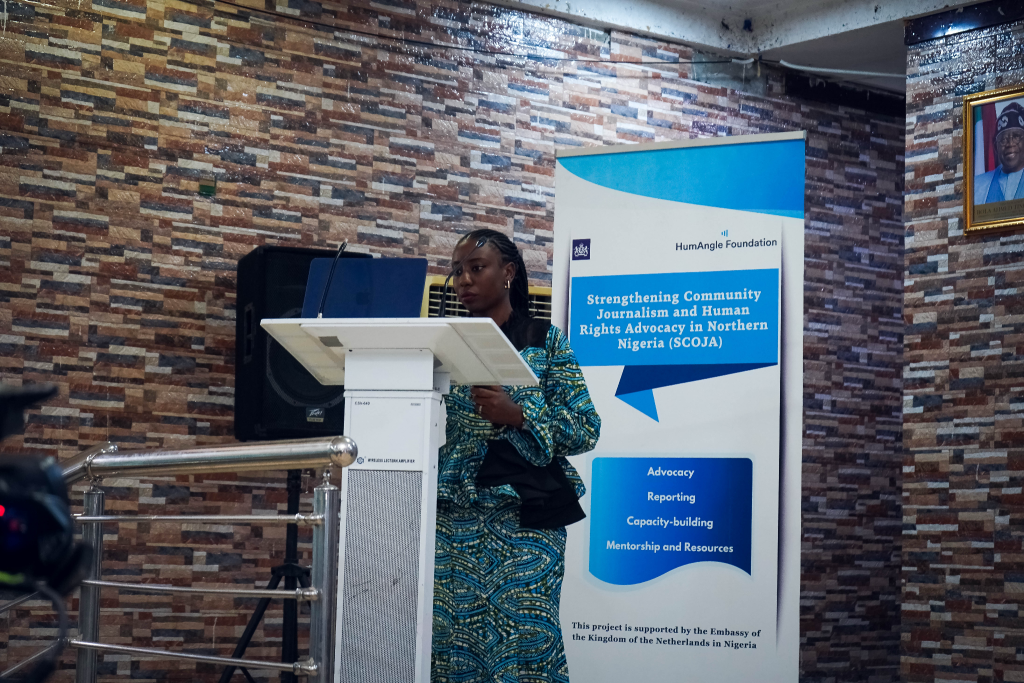
HumAngle Foundation gathered students, professors, and community journalists on Tuesday, June 21, at the University of Maiduguri in northeastern Nigeria to hold timely conversations around ways to strengthen community journalism in Nigeria.
The event, which also featured the launch of a guide to community journalism, is part of the Strengthening Community Journalism and Human Rights Advocacy in Northern Nigeria (SCOJA) project, implemented with support from the Embassy of the Kingdom of the Netherlands in Nigeria. Through a fellowship, the project has trained 90 journalists and human rights defenders in the past year.
During the event, three SCOJA Fellowship alumni reflected on the journey so far and called on relevant organisations to commit to similar projects. The session had Yahuza Bawage, Faiza Jibrin, and Nathaniel Ishaya in attendance.
“There aren’t many trainings that focus on the ethics of journalism in a very practical way,” Yahuza said. “One of the sessions we treated during the three-day workshop in Plateau State was Journalism Ethics and Standards, and that taught me a lot. I was able to learn about minimising harm.”
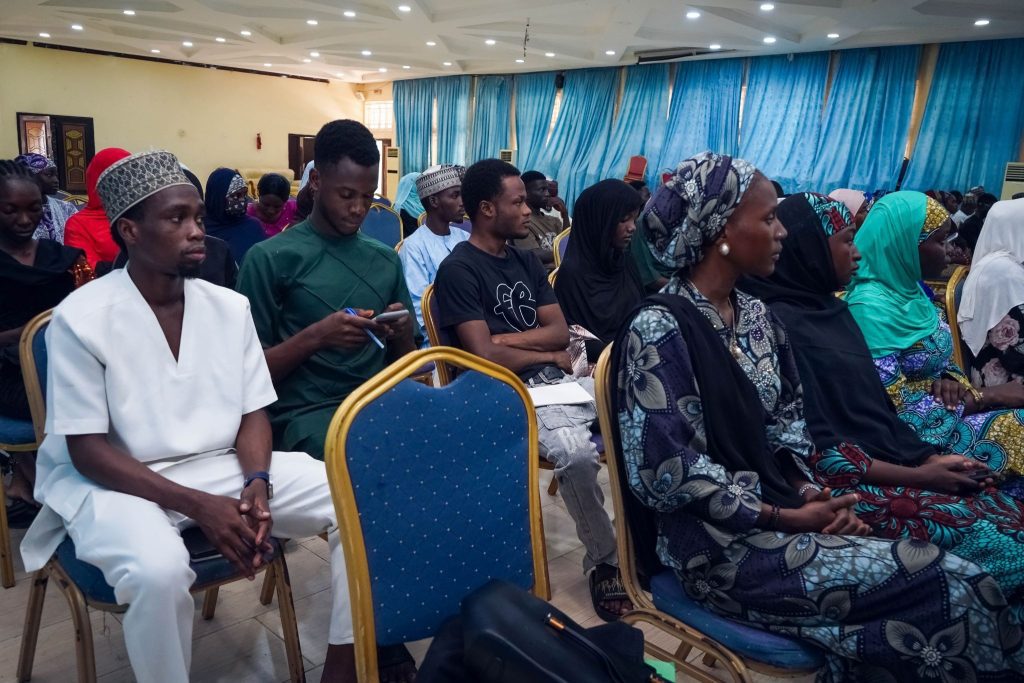
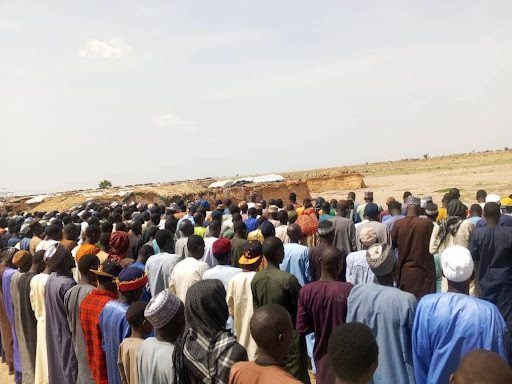
Cross-section of the audience at the event. Photo: Al’amin Umar/HumAngle.
The same sentiment was echoed by the other fellows. They highlighted that interviewing vulnerable people is a delicate skill that not many journalism training programmes cover in depth, and that they were happy to have learned it during the fellowship.
“One skill I sharpened during the fellowship was my interview skills. I learned about building connections with the subjects first, and I practised it. It really works because instead of sticking strictly to my interview guide, I connected first, and the person became eager to share [their] experience with me. I also learned about not re-traumatising my sources through the questions I ask,” said Faiza.
They also offered some advice and encouragement for fellow young journalists trying to find their feet.
“One thing I will tell student-journalists is that they should not allow fear to hold them back. They should try out new opportunities, and with mentorship, they can do so much,” Nathaniel added.
During another session at the event, Hassana Danyerwa, a SCOJA Fellowship alumnus, talked about the elevation she experienced as a result of the fellowship.
“Although I am not a journalist and I joined the SCOJA Fellowship as an advocate, my experiences from the fellowship set me up for a global experience where I was the only Nigerian selected. The mentorship aspect of the fellowship helped me and opened a new professional pathway for me.”
She offered some words of advice on the conditions necessary for journalists to do their work.
“Sometimes, we do not know what we need until we are given it, but one thing community journalists need is mentorship. Also, trust and avoiding micromanagement so journalists can express themselves and explore different topics is important.”
During the six-month fellowship, the fellows produced several investigative reports and carried out advocacy activities on various issues, including human rights, gender-based violence, and climate change. In Kano, northwestern Nigeria, some of the fellows launched the Kano Climate Change Journalists’ Network as a direct result of their fellowship.
Labaran Kaduna says his son, Desire, was unlucky in life. Two months after Desire’s white wedding in Rigange, a small Bachama community in the Lamurde local government area of Adamawa State, northeastern Nigeria, his newly built house was burnt to the ground when the Tshobo and Bachama tribes first clashed in July, 2025. A year later, Desire himself was killed in the same conflict that remains unresolved.
Desire had provided HumAngle with materials and information about the conflict last year, in an effort to bring awareness to the violence, as though he knew that it would one day claim his life too.
Labaran speaks about his late son with a sad smile on his face and pride etched in his voice: “He was a university graduate. Since he was yet to secure a white-collar job, he joined me in farming and soon had his own large farm.”
Desire was 36 years old.
“He had a bad leg which made it difficult for him to walk very fast or run, so when our community was attacked that night, people fled and left him behind,” said Labaran.
HumAngle gathered that a group of armed men stormed the Rigange community on the night of June 27 and opened fire on people. Labaran believes the men were members of an armed militia and that several of them had been storming the area to wreak havoc since the communal crisis began. That night, many fled, leaving Desire limping behind.
“His brother survived the attack, so he ran home to inform us. When we reached the spot, we realised that he had been shot dead, and after shooting him, they took all his belongings, like his phone and wallet. They even took his shoes,” the grieving father said.
A phone displaying the photo of the deceased Desire Labaran, captured on his wedding day in 2025. Photo: Saduwo Banyawa/HumAngle.
A lot can happen in a year
Desire is one of the many who have lost their lives in the Lamurde communal clash. HumAngle has been unable to obtain the total number of casualties, as efforts to reach Suleiman Nguroje, the Adamawa State Police Public Relations Officer, have failed. He has neither responded to phone calls nor replied to text messages sent to his phone.
In 2025, HumAngle extensively documented the violent land dispute that shattered daily life in Lamurde. The clash, which began in July 2025, forced many locals to flee the area, while those who remained lamented being trapped in their communities, unable to move freely. Access to healthcare and other social services became difficult, especially for Tshobo communities, which had long depended on clinics in Lamurde town, a Bachama stronghold. The most affected communities remain Rigange, Waduku, Wammi, Sabon Layi, and Sikori. A total of 53 houses were destroyed that year while 170 homes were partially damaged. Despite several peace talks and reconciliation efforts by the government and stakeholders, both tribes continue to clash.
“Desire was kind and hardworking. He had two little children. Last year, he married their mother in church, but unfortunately, he was not lucky to see them grow,” Labaran said.
The clash, which started in July 2025, caused many locals to flee the area and stay with relatives in other towns, while those who remained lamented being trapped within their communities, unable to move freely. Photo: Morison Napwatemi
Rosaline Danladi, a Tshobo woman from Anguwan Baki, one of the affected communities in Lamurde, bears the scars of the year-long conflict. Her husband, Danladi, was killed when the tribes clashed in December 2025. Danladi was a farmer who left behind his wife and seven children.
“We were in the room that night when we heard gunshots, so my husband stepped out while I ran with the children in another direction. We waited for his return, but he never came back,” Rosaline recalled.
Danladi’s remains were later found, and he was buried. Rosaline explained that she has been struggling to keep up with her children’s needs months after his demise because she was a full-time housewife who had always relied on her husband.
“I am just managing to take care of the children. Two were in a boarding school in Numan while the smaller ones were in a private school here, but they have all recently dropped out,” she said.
Rosaline said 2025 had been an unfortunate year for her and many in the Lamurde area. Sadly, the conflict has persisted into 2026, and new waves continue to rise.
Speaking to HumAngle, Jonah John, a security analyst in Adamawa, stressed that the impact of the crisis can not be overemphasised. Apart from deaths, property losses, and displacement, he noted that the closure of the famous Tingo market in the region has affected businesses, leading to a hike in the cost of foodstuffs across Adamawa.
Fallen classrooms
When both tribes started clashing in June 2025, schools, clinics, and other social services closed temporarily across the affected Lamurde communities. Even though clinics and administrative activities have now resumed, children in communities such as Tingno and Rigange remain out of school.
The Government Day Secondary School in Rigange was burnt down during the communal clash. Photo: Celestine Bafyau
HumAngle spoke to Celestine Bafyau, the principal of the Government Day Secondary School in Rigange. He said the school serves almost 300 students from both Bachama and Tshobo communities.
“We have students from Bashaka, Lamurde, and other Rigange areas,” he stated.
The school was burnt down during the July 2025 clash and has remained deserted to date. To ensure the children don’t miss out on learning, Celestine said, teachers utilised the nearby primary school, but with many students displaced and others who had completely fled town, it became hard to keep up.
According to the principal, students from JSS 3 and SS3 are currently using the primary school block to write their final examinations, and, due to the large number, some are writing theirs under a nearby tree. At the same time, those in JSS1, JSS2, SS1, and SS2 remain out of school.
“I have taken pictures of the school attached to a report and submitted it to the education board in Yola because we need help,” he stated.
The school was burnt down during the clash by armed youths in 2025 and has remained deserted to date. Photo: Celestine Bafyau
Celestine noted that teachers are eager to resume teaching. “Honestly, my staff are ready, and they are disturbed. We do go to school sometimes to check it, but most of the students have relocated to other communities. If there’s peace, we will call them so we can teach them,” he said.
When the crisis began in July, several people were killed, and many were displaced. In December, another bout of violence erupted between the two tribes and eight people were killed in Lamurde town. Despite three peace deals, a fresh wave of terror occurred in January when three women in the area were attacked and killed on their farm. On June 27, the attack that claimed Desire’s life happened.
According to the security analyst, Lamurde’s security architecture is very weak.
“The deployment of the security forces should be treated with a great sense of importance, looking at the fact that it’s the sole responsibility of the government to safeguard and to protect the lives and property of its citizens, but the government has failed totally. That is the only reason why things keep repeating themselves over and over again,” he stressed.
Three women were attacked and killed on their farms in January. Photo: Hyginus Mangu
Locals told HumAngle that security officers deployed to the area had since withdrawn. Youths and local vigilante groups now take turns to patrol the area.
Both parties have accused each other of using armed militias to fight. Jonah, the security analyst, explained that both parties illegally acquired rifles and other unlicensed weapons to intimidate each other.
“If they cannot stand the pressure or tension on the other hand, they will have to employ the service of militia,” he warned.
The cause of the Lamurde clash has been linked to land ownership, with both tribes claiming possession of the same land. HumAngle gathered that both parties were instructed by the state government and members of the peace committee to forfeit the land. Yet, the clashes continued.
There are claims across social media that the land both parties have been clashing over contains mineral resources. While some claim it is gold, others call it ‘mineral’. HumAngle learned that it is clay-like in nature.
“They brought it home as a sample for me to see. So, it’s like clay. Even if I see it, I can just pass. I wouldn’t even know that it’s important or something. So, they say the men have been packing them in large quantities. And then, actually, Tshobo has never been benefiting from it at all,” Hyginus Mangu, the Tshobo community leader, told HumAngle.
The controversial mine
Hyginus said the mine in question lies far away from the town and is in no way affiliated with the land in dispute. “For me, personally, I don’t know where the spot is, but I do know that there are some people who used to do some mining there, and the people are not Tshobo people. I don’t know how they get to that area to mine,” the Tshobo community leader said.
He added that the miners were from Gombe State and had been mining in the area before the crisis began.
Jacob Bawa, the Youth leader of Rigange, a Bachama community in Lamurde, corroborated Hyginus’s claim. According to him, the mine is far away from the main town and is not affiliated with the disputed land. Jacob also claimed that locals from the Bachama community do not benefit from the mine.
Jacob maintained that he had never been to the mine, as it was only recently publicly discovered, even though it had been operating illegally for years.
HumAngle could not access the mine or obtain pictures of the mineral, as access is highly restricted.
On June 30, Adamawa State Governor Ahmadu Fintiri banned illegal mining in Lamurde Local Government Area following speculations that the mining was fueling the crisis between the two tribes. Security agencies were directed to ensure strict compliance. The Governor assured locals of securing sustainable peace and addressing the root causes of the Lamurde conflict.
Jonah, the security analyst, emphasised that allegations that the mine is driving the recurring conflict in Lamurde should be taken seriously by the government and other relevant stakeholders. Although most miners come from Gombe State to extract the minerals, Jonah believes the illegal miners engage Lamurde residents as labourers, who end up clashing over land and resources. He called on locals to shun violence and desist from being used as puppets by the miners who are taking advantage of their home.
Even though access to farmlands and clinics has improved for the Tshobo people, Hyginus said they still don’t have access to administrative and business services in Lamurde town due to fear of being attacked.
In Rigange, Jacob Bawa, the youth leader, says life is hard for Bachama locals who stayed behind because they have nowhere else to go. “We are suffering because most of the people have run to neighbouring communities like Numan and Yola. Also, we don’t have mosquito nets or tents because most of the houses here were burnt down,” he said.
HumAngle gathered that the Lamurde main route is partly closed, and travellers can barely access the area.
According to Jonah, the use of social media by both parties to spread hate speech and misinformation also re-fuels the crisis.
“So if the government can put an order, just like the federal government did, any hate speech from each other should equally be dealt with,” he said.
What lies ahead?
The security analyst calls on the government and stakeholders to secure the people of Lamurde. He also advised the locals to embrace peace and live together as they’ve always done, especially with intermarriages that have occurred between them for centuries.
“All those people that are hiring all these militias or whatever, please, they should stop that. At the end of every crisis, only the women and the children suffer the most. So honestly, they should look at the future of their children, the future of their local government and the future of their tribes,” he said.
While Rosaline and Desire’s father continue to bear the burden of grief, they are uncertain of what lies ahead for other grieving families and displaced locals of Lamurde. Rosaline says she’s struggling to get by each day and is doing her best to make sure her children are provided for. However, she fears another night might come when the clashes will recur as the matter remains unsettled and with her husband gone, she’s not sure if she could cope with another attack.
Labaran (Desire’s father) has a large family. With four wives, 16 children and many grandchildren, he said the family had never been apart. They lived together in their large family home in Rigange. Now, he says, his family is scattered because some of his daughters-in-law had gone to their families for safety. While some of his sons remain in Rigange, guarding what’s left of their household, Labaran has moved with the others to Numan local government, where they are currently staying with a relative.
“My children built a big apartment, and it was all burnt to the ground. My son-in-law then built a new house for me, and it was burned too. Approximately 13 houses were burnt in my extended family,” the man said.
But none of those losses, he said, can be compared to the loss of his son, Desire.
“Just peace. I want peace. We are in a difficult situation at the moment,” he said.
HumAngle Foundation, in collaboration with the Embassy of the Kingdom of the Netherlands, has launched a guide for community journalism, as part of the Strengthening Community Journalism and Human Rights Advocacy in Northern Nigeria (SCOJA) project. The project, which started in 2025, has trained 90 journalists and human rights advocates so far, and their work has recorded some impact in their communities.
The launch was held on Tuesday, July 21, at the University of Maiduguri in Borno State, northeastern Nigeria, and was hosted by the Faculty of Communication and Media Studies. Angela Umoru-David, HumAngle Foundation’s Programme Director, welcomed dignitaries, students, and speakers to the gathering. In her remarks, she noted that partnerships like these were instrumental in ensuring the reach of journalism resources to those who need them the most.
“We developed this manual to serve as a guide for community journalists in Nigeria,” she said.
Angela Umoru-David, Programme Director of HumAngle Foundation. Photo: Al’amin Umar/HumAngle.
HumAngle’s Founder/CEO, Ahmad Salkida, noted in his introduction to the manual that the role of community journalists was crucial to social cohesion. “Community journalists, often the first witnesses to crises and transformation, are the unsung custodians of enduring social realities,” he wrote. “Their proximity to the people and understanding of local realities make them indispensable to the national narrative… We hope that every journalist who engages with this manual will find in it a field companion, a guide, and an inspiration to tell deeper, more authentic stories, to stand firm in truth, and to amplify the voices that matter most.”
Cross-section of the audience. Photo: Al’amin Umar/HumAngle.
Jessica Odudu, Senior Policy Advisor on Human Rights and Public Diplomacy at the Embassy of the Kingdom of the Netherlands in Nigeria, reiterated this point in her welcome remarks.
“While information has become abundant, trust is increasingly scarce. In moments like these, the role of journalists becomes even more important. Community journalists are often the first to report conflict. They understand the realities in their communities in a way outsiders don’t. Yet, many do this work with very few resources. Over the past year, the Embassy of the Kingdom of the Netherlands has had the privilege of strengthening community journalists’ capacity to do their work,” she said.
During the keynote speech, Prof. Mu’azu Abubakar, Dean, Faculty of Communication and Media Studies, University of Maiduguri, emphasised the importance of viewing ‘community’ as an expansive and diverse concept. On his behalf, Mohammed Auwal Umar delivered a paper they co-authored, which sought to understand the fragile conditions in which community journalism must thrive.
Prof. Mu’azu Abubakar, Dean, Faculty of Communication and Media Studies, University of Maiduguri, delivers a keynote speech. Photo: Al’amin Umar/HumAngle.
“Community journalism curates content, generates it, and develops it in a way that is relevant to the community we are serving. It is not meant to serve a classical divide,” he said.
The event also featured a panel discussion with Dr Abdulmutallib Ado Abubakar, Head of the Department of Mass Communication, University of Maiduguri; Abdulhamid Al-Gazali, Editor-in-Chief, Yerwa Express; Hauwa Shaffii Nuhu, Managing Editor, HumAngle Media; and Hassana Danyerwa, Founder, FeelandHeal Initiative and SCOJA Fellowship alumna. The discussion, which focused on strengthening community journalism in Nigeria, was moderated by Abdussamad Ahmad Yusuf, HumAngle Foundation’s Human Security and Policy Analyst.
Speaking during the discussion, Abdulhamid said, “We have to understand that as a people, the most important aspect of our society is the kind of information our people consume. Communities must have media that understand their fundamental issues, curate relevant information, and take responsibility for disseminating the right information. If we do not take control of what we consume, it affects society.”
The panellists discuss strengthening community journalism in Nigeria. Photo: Al’amin Umar/HumAngle.
Hassana, while reflecting on the impact of the SCOJA Fellowship, said, “Although I am not a journalist and I joined the SCOJA Fellowship as an advocate, my experiences from the fellowship set me up for a global experience where I was the only Nigerian selected. The mentorship aspect of the fellowship helped me and opened a new professional pathway for me.”
Abdulkareem Haruna, NUJ President, Borno State chapter, offered some closing remarks at the end of the event. Photo: Al’amin Umar/HumAngle.
Other past SCOJA fellows, including Faiza Jibrin, Yahuza Bawage, and Nathaniel Ishaya, also shared their experiences with attendees.
As the guide was formally launched, Angela Umoru-David announced the donation of copies to the University of Maiduguri. The guide, available in both Hausa and English, can be downloaded here for free.
Chellu Masaram’s shelter stands on a patch of land in Goniri, a community a few kilometres from Bama town in northeastern Nigeria.
At 85, she does not have the strength to build a house. So when she and her grandchildren arrived after the closure of the Government Senior Science Secondary School (GSSS) camp in Bama, one of the largest displacement settlements in Borno State outside Maiduguri, they used the only materials they had.
“We still do not have a room,” Chellu told HumAngle. “We made a room out of the tarpaulin we brought from the camp. The room leaks when it rains.”
For more than a decade, displacement has shaped her life. She fled Sabsabwa, a town in Bama, in 2014 when Boko Haram terrorists attacked the community and killed her son. Since then, she has raised his three children alone: a year at the Bama General Hospital camp, then ten years at GSSS.
Now she is displaced again.
On June 25, Borno State announced the closure of the GSSS camp as part of its broader policy of ending camp-based displacement and resettling people to their communities of origin or nearby settlements. The announcement was made by Dauda Iliya, spokesperson to Governor Babagana Umara Zulum. The exercise was described as the relocation of about 3,000 households to settlements including Abbaram, Darajamal, Mainti, and Goniri, though the actual number of individuals moved remains unclear. Authorities also indicated that the displacement camp in Gwoza could be among the next to close.
The numbers associated with the GSSS camp have varied considerably over the years. In 2023, the camp’s own management estimated it was hosting more than 100,000 people, four times its designed capacity of 25,000. Government statements on the recent closure referenced approximately 3,000 households being relocated to surrounding communities. But that figure came with its own complications. During the closure announcement, Governor Zulum noted that a year earlier the camp had held no more than 400 households, and expressed surprise that the number had risen to 3,000 shortly before closure. “Most of them are residents living within the town,” he said, suggesting that a significant share of those counted at the end were not long-term displaced persons but local residents who had re-entered the camp, most likely to access aid distributions. If that is accurate, the 3,000 figure may overstate the number of people who were genuinely in need of resettlement support, while simultaneously obscuring how many actual long-term IDPs were moved and to where. Humanitarian and official figures detailing the exact number of individuals relocated have not been publicly released.
HumAngle wrote to the Borno State Emergency Management Agency (BOSEMA) seeking clarification on the number of households and individuals relocated, the preparedness of receiving communities, and plans for future camp closures. The agency had not responded by the time of publication.
What is emerging from Goniri and other receiving communities is a more complicated picture than the language of “camp closure” suggests. For some families, displacement may not have ended. It may simply have changed location.
Abubakar Mohammed, 36, lives with his wife and children in a single-room tarpaulin shelter in Goniri after being relocated from the GSSS camp. “The Aja [District Head] said, ‘You may live here pending when you find your own place,’” he recalled. The roof leaks when it rains. Photo: Al’amin Umar/HumAngle.
From Camp Residents to Makeshift Settlers
Chellu and her grandchildren left the camp in the evening, a truck transporting their belongings. “We paid ₦7,000,” she said.
The move brought them to Goniri, one of the communities receiving former camp residents. The grandchildren she cares for are now 17, 15, and 12 years old. None attend formal school. The oldest studies at a Tsangaya school in Bama and returns there to sleep each night. The two girls remain with their grandmother.
The family survives through a combination of small trading and firewood collection. Chellu sells groundnuts when she can. The more demanding work falls to her granddaughters. “The girls go to the bush to gather firewood to sell,” she said. According to her, they spend up to three hours walking into surrounding bush areas before returning with wood that earns around ₦2,000 daily. “This is what we depend on majorly.”
Chellu Masaram at the entrance of her makeshift shelter in Goniri. Since relocating from the GSSS camp, she sells groundnuts outside the structure while her granddaughters venture into surrounding bush areas to gather firewood for sale. Photo: Al’amin Umar/HumAngle.
The arrangement is not unusual. Across displacement settings in Borno and the wider North East, firewood collection has become one of the primary survival strategies available to women and girls. In 2020, HumAngle reported how this burden traps women in a cycle of poverty that limits access to education and economic opportunity while increasing exposure to violence.
For Chellu’s granddaughters, the hours in the bush are not a choice. They are an economic necessity shaped by the inadequacy of humanitarian support and the absence of alternative livelihoods. But in Borno, those hours carry a risk that goes beyond physical exhaustion.
Firewood collection in conflict-affected parts of the northeast has long been documented as a moment of acute danger for women and girls. A 2018 World Food Programme survey found that 85 per cent of women in four local government areas of Borno feared rape, murder, or abduction while collecting firewood. UNHCR protection monitoring reports have recorded incidents of rape during firewood collection, alongside the persistent threat of abduction by terrorists. In March 2024, more than 200 internally displaced women were abducted in Ngala, Gamboru Ngala LGA, while collecting firewood in the bush around Jillam and Wurga villages, approximately 15 kilometres from town. Older women and children under 10 were reportedly released; scores of others remained unaccounted for. In August 2023, at least 42 women were abducted by suspected Boko Haram terrorists while gathering firewood in Mafa. This often forces relatives in camps to crowdsource ransom.
In Goniri, Chellu’s granddaughters are navigating that same risk. They go anyway, because the family has to eat.
Chellu’s granddaughters rest outside their makeshift shelter after returning from a firewood collection trip. HumAngle spoke with their grandmother, Chellu Masaram, while they rested that evening. Photo: Al’amin Umar/HumAngle.
The broader consequences of this dependence extend beyond the households bearing it.
As hundreds of families like Chellu’s converge on Goniri and surrounding communities, demand for firewood is rising sharply in an environment already under significant ecological pressure. The Lake Chad Basin, of which Borno is a part, has experienced accelerating deforestation driven by displacement, conflict, and climate stress. A study examining the impact of internally displaced persons on forest cover in Jere LGA found that displaced populations destroyed approximately 12 square kilometres of forest and vegetation. Research on the Lake Chad Basin has found that competition between displaced populations and host communities for firewood is driving deforestation and natural resource degradation, reducing the resilience of both groups. Governor Babagana Zulum has acknowledged that displacement-linked deforestation in Borno is contributing to soil erosion, reduced water availability, and increased vulnerability to climate change.
“It was not like this at the camp,” Chellu said.
Food worries now dominate her thoughts. She said she recently cried because she did not know how she would provide enough. For water and medical care, she and the children walk to Bama, a journey she estimates at over an hour on foot. “As old as I am, I must trek with the children for at least an hour daily,” she said. The move has also introduced tensions with neighbours. A nearby resident has repeatedly told her family they are not welcome. “He said he does not want us beside him,” she said. She says the man has attempted to physically attack her and her granddaughters on multiple occasions, and that complaints to local leaders have produced no resolution.
“I wish the government would intervene.”
The uncertainty surrounding shelter, water, food, and social acceptance has left her wondering what exactly changed when the camp closed. For a woman who has spent 11 years moving between displacement sites, the answer is not obvious.
The shelter gap in Goniri
The Borno State government has long argued that prolonged camp life is not a sustainable solution. Camp closures form part of a broader strategy aimed at restoring communities, reducing dependency on humanitarian assistance, and facilitating recovery from years of insurgency. But interviews with former camp residents in Goniri suggest the transition has been uneven.
Abubakar Mohammed, 36, arrived in Goniri after years in displacement. He first fled Alagarno in Damboa Local Government Area when insurgent attacks devastated the community, spent three months at the Bama General Hospital camp, and then moved to the GSSS camp, where he remained for several years. Like many residents, he said the relocation came with little explanation. “We were asked to relocate two weeks ago,” he told HumAngle on July 7. “We were not given any reason.”
The token Abubakar Mohammed received at the GSSS camp before relocation. Households holding a token received ₦30,000 along with 25-kilogram bags of rice and maize flour when they left the camp. Those without tokens, including Babagana Ali, received nothing. Photo: Al’amin Umar/HumAngle.
Before departure, he received a token card later exchanged for a document used during aid distribution. The government distributed ₦30,000 to each household that held a token, along with 25-kilogram bags of rice and maize flour. “Only those who had tokens got the money,” he said. Even so, the assistance did not resolve the housing challenge. “The government constructed some shelters before asking us to relocate,” he acknowledged. “But it is not sufficient.” He now lives in a makeshift tarpaulin shelter on land temporarily provided by community heads. “The Aja [District Head] said, ‘You may live here pending when you find your own place,’” he recalled. His wife and children share the structure with him; his mother and three sisters are staying elsewhere in Goniri with a friend. Many other households have improvised similar arrangements, renting accommodation or relying on relatives. Some remain more exposed. “Other people could not even afford to set up shelters,” he said. “They sleep in the open.”
With no shelter of their own, some displaced families sleep in the open in Goniri. “Other people could not even afford to set up shelters,” said Abubakar Mohammed, who was relocated from the GSSS camp. “They sleep in the open.” Photo: Al’amin Umar/HumAngle.
The experience of Babagana Ali, 38, illustrates how unevenly the same process was administered.
His displacement history spans multiple locations. He first fled Warafaya in 2017 and settled in Kumshe, both in Bama; in 2022, violence displaced him again, eventually bringing him to Bama town and the GSSS camp. When officials announced the closure, residents received approximately one week’s notice. “They came on a Thursday and gave us a week’s notice,” he said. Unlike Abubakar, Babagana never received a ration card. He was working on his farm when distributions took place and as a result received none of the food items, zinc sheets, or money given to other households. Without money for a truck, he rented a pushcart for ₦1,500 and made two trips to move his belongings. Today, he shares a single tarpaulin shelter with two wives, six children, and four children belonging to his late brother. When it rains, water enters through the roof.
His experience points to a concern emerging across interviews: the closure of the camp may have reduced the visibility of displacement without resolving the housing deficit it created.
Earlier, humanitarian actors have made appeals for emergency shelter interventions in Goniri and Abbaram following the influx of relocated households. Those appeals suggest that aid agencies themselves recognised accommodation gaps after the movement began. This pattern is not new to Borno’s camp closure process. A 2022 Human Rights Watch report documenting earlier rounds of camp closures found that housing, water, healthcare, schools, and other infrastructure necessary to meet basic needs were lacking in many receiving communities, and that the closures had stripped over 200,000 displaced people of food and shelter without adequate alternatives.
Residents gave varying estimates of how many people have arrived in Goniri since the closure. Chellu believed there could be about 3,000 people in the settlement; Abubakar estimated as many as 6,000, with roughly half lacking adequate shelter. HumAngle could not independently verify these figures, but both accounts point to the same reality: Goniri’s population has grown rapidly, and the question is whether the community has the infrastructure to absorb it.
Life beyond the camp
For government officials, the success of relocation will ultimately depend on what happens after families arrive. Housing is only one part of that equation. Access to livelihoods, water, healthcare, sanitation, education, and social acceptance all determine whether a relocation becomes sustainable. In Goniri, many of those systems remain under pressure.
Water emerged repeatedly during HumAngle’s reporting. Chellu, Abubakar, and Babagana all described the same daily routine: a walk to Bama that can take up to an hour. OCHA’s 2025 Humanitarian Needs and Response Plan identifies overcrowding in camps and receiving settlements, alongside lack of access to clean water and sanitation, as conditions that have worsened as a direct result of IDP movements linked to camp closures in Borno. Healthcare follows the same route as water. Abubakar estimated transportation costs at about ₦300 per trip, a burden that falls hardest on older residents, pregnant women, and households without steady income.
Sanitation presents another strain. Babagana said the communal latrines built for an earlier displaced population are now being shared by hundreds of newly arrived households. “There are insufficient toilets,” he said. “We have to queue. It is also dirty.” He estimated that only five fenced latrines serve the settlement.
A communal latrine in Goniri, now shared by hundreds of newly arrived households relocated from the GSSS camp. “There are insufficient toilets,” said Babagana Ali. “We have to queue. It is also dirty.” He estimated only five fenced latrines serve the settlement. Photo: Al’amin Umar/HumAngle.
Livelihoods present a different challenge. Before the closure, many residents relied on a combination of humanitarian support and informal income. Outside the camp, they face greater pressure to generate income independently. Abubakar is a farmer by training, but insecurity has limited access to agricultural land this season. “I now do menial jobs,” he said, earning around ₦3,000 on a good day. Babagana manages similarly. “Anything that my strength can do,” he said, with income averaging around ₦2,000 daily. Neither considers it sufficient for households of their size.
For children, the transition raises additional concerns. None of Chellu’s grandchildren attends formal school. Their days revolve around religious education and income-generating activities, the girls spending long hours collecting firewood that contributes directly to household survival. They are not alone in this. UNICEF estimates that 56 per cent of displaced children across Borno, Adamawa, and Yobe states do not attend school, with roughly two million children out of school across the three states. The situation in Goniri illustrates how economic hardship reshapes childhood after displacement, turning survival into a full-time occupation.
Social integration remains unresolved. While some host community members have provided land and accommodation, not all relationships appear harmonious. Abubakar said some residents blame the displaced for ongoing insecurity. “They say we caused the ongoing insecurity,” he said. Such perceptions breed friction in communities already stretched by scarce resources and years of conflict.
A state moving toward more closures
The debate over Bama is likely to intensify as the camp in Gwoza is expected to be the next major closure.
Many residents of Borno also want to leave camps behind. After years of displacement, the idea of living in a community rather than a crowded camp carries real emotional weight.
“I expected the government to wait for peace before asking us to relocate,” he said.
That concern reflects a broader uncertainty in Bama and surrounding areas. Several communities continue to experience insecurity, farming restrictions, and periodic displacement linked to insurgent activity and military operations. Earlier in 2024, OCHA conducted area-based assessments of both the GSSS camp in Bama and the camp in Gwoza, both of which document the fragility of receiving communities and the scale of unresolved displacement needs. Sabsabwa, from which Chellu was displaced in 2014, experienced renewed disruptions in late 2022 and 2025. Warafaya, where Babagana once lived, was emptied by violence years ago. Alagarno, Abubakar’s hometown, was devastated by insurgent attacks. For many families, displacement has not been a single event but a series of movements from one place to another.
Without clear data from BOSEMA, several questions remain unanswered. How many people were actually moved from the camp? How many houses were completed before the relocation? How many households are still living under tarpaulins or in the open? What support is planned for communities such as Goniri and Abbaram as their populations grow? Those questions matter not only for Bama but for every future camp closure in Borno.
Chellu Masaram spreads a wrapper soaked by the previous night’s rain, as her granddaughters sit nearby. At 85, she is among the elderly displaced persons for whom daily life in Goniri, with no nearby water, healthcare, or secure shelter, has been the hardest adjustment since the camp closed. Photo: Al’amin Umar/HumAngle.
As evening approaches in Goniri, Chellu’s grandson leaves for the Tsangaya school where he sleeps, her granddaughters prepare for another trip into the bush to gather firewood, and the tarpaulin roof remains patched against the next rain.
Artificial intelligence is steadily changing how the world responds to crises.
Governments use it to analyse satellite imagery after natural disasters, humanitarian agencies are testing AI to anticipate displacement before it overwhelms fragile communities, and researchers are applying machine learning to uncover patterns buried inside millions of records that no human could process alone.
These advances, while useful, expose a problem worthy of scrutiny.
Most AI systems are built on data that tells only part of the world’s story. Since they are trained largely on information from North America, Europe, and parts of Asia, they know relatively little about the realities of conflict in parts of Nigeria like Borno, Zamfara, Katsina, Diffa or the wider Lake Chad Basin. They struggle with Hausa, Kanuri, Fulfulde, Igbo and hundreds of other African languages. In addition, they often miss the informal power structures, survival economies, historical grievances, and social relationships that determine whether a community remains stable or slips into violence.
For example, despite advancements in AI content flagging on social media platforms, HumAngle’s reporting and research have consistently found that moderation systems that perform effectively in English often fail to detect incitement expressed in Hausa, Kanuri, Igbo, and other Nigerian languages. Language models frequently miss local expressions, figurative speech and cultural nuances, allowing harmful content to evade automated moderation. That is not simply a technical limitation. It is a human security challenge.
Africa has long faced a deficit in research, reporting, documentation, and structured knowledge about local realities. That gap is becoming one of the continent’s biggest constraints in the AI era. Large language models (LLMs) can only learn from information that exists. If communities, conflicts, languages, histories or ecosystems remain poorly documented, those blind spots are carried directly into the systems built on them. Building culturally informed and representative AI therefore begins long before model development. It begins with producing more reliable knowledge.
Kunle Adebajo, editor of Code for Africa’s African Academy for Open Source Investigations (AAOSI), has this to say: “Artificial intelligence companies have successfully scraped most of what exists on the Internet to train their models. But a vast amount of data lives outside of the shores of the Internet, especially in Africa. AI systems, for example, will struggle with geolocation because many parts of Nigeria are still not properly mapped. They will struggle with translating languages spoken by minority ethnic groups. Even languages spoken by tens of millions of people, like Amharic, are considered low-resource by AI companies and therefore aren’t prioritised, let alone those spoken by only a few million. There’s, of course, also the lived experiences of conflict victims, which aren’t reported online and which you can only understand through fresh field interviews. Even when all this information is integrated into the AI systems, we still have the risk of hallucinations. In matters of security, we cannot take any of these shortcomings and risks lightly, because lives are at stake. Security actors who are incorporating AI tools into their operations must do their due diligence and maintain strong human oversight over the processes.”
The decline in funding for research and investigative reporting therefore comes at a critical moment. Every research project left unfunded, every environmental change left undocumented, and every local story that never enters the public record represents knowledge that remains unavailable not only to policymakers and researchers today but also to the AI systems increasingly shaping future analysis. The quality of future AI will depend, in part, on the quality and diversity of the knowledge produced today.
If the data is incomplete, the analysis will be incomplete. If the context is missing, the conclusions may be wrong. In fragile environments, inaccurate conclusions can delay humanitarian assistance, distort policy responses and, in the worst cases, cost lives.
Communities see the signals first
Conflict rarely arrives without warning, and the warning signs are rarely dramatic. They are usually ordinary changes that occur over time, not all at once. A weekly market suddenly stops operating, or fishermen abandon parts of Lake Chad. Parents stop sending children to school weeks before an attack while farmlands expand into traditional grazing routes, or herders begin avoiding ancestral migration paths that have remained open for generations. HumAngle’s reporting has repeatedly documented these patterns.
Months before major offensives around the Lake Chad Basin, local communities described unusual restrictions on fishing, increased taxation by armed groups after governments introduced ransom-payment restrictions, shifting movement routes, and growing pressure on traders. These were not isolated observations. They formed part of a broader pattern.
In northwestern Nigeria, our reporting has shown how armed groups shifted from pickup vans to motorcycles when security operations disrupted their mobility. We documented how kidnapping networks increasingly demanded ransom in CFA francs after Nigeria’s cashless policy disrupted access to large amounts of naira. We traced the emergence of new ungoverned forest frontiers, the expansion of illegal mining sites and the growing links between critical minerals, transnational migration and armed violence. These adaptations rarely appear in conventional datasets, yet they are recognised by communities living with insecurity every day.
Researchers increasingly argue that AI systems become more reliable when such verified local observations are analysed alongside conventional datasets, helping analysts identify patterns that would otherwise remain fragmented.
Joshua Olufemi, Founder of Dataphyte, a data and research analytics company, believes that agenda-setting is critical to this. Speaking to HumAngle about some practical pathways, he mentioned “Multistakeholder agenda setting and strategic partnerships on critical infrastructure and local data modelling and innovation. Newsroom Viability and business case initiatives to build and sustain the ecosystem.”
Building AI that understands fragile societies
The proposed HumAngle AI and Human Security Lab is designed to explore how verified field reporting, historical conflict data, humanitarian information, environmental indicators, satellite imagery, where appropriate, and open-source intelligence can be organised to identify areas where risk is changing.
The objective is not to predict the exact time or location of an attack. Conflict is too complex for deterministic prediction, and responsible AI requires transparency about uncertainty. Instead, the approach focuses on identifying shifts in risk while ensuring that assessments remain explainable, transparent, and subject to human review.
For humanitarian organisations, even a few days of additional warning can allow food supplies to be prepositioned before roads become inaccessible, schools to strengthen protection measures before attacks occur, vulnerable communities to relocate before violence escalates or emergency resources to reach areas before displacement intensifies.
Journalism is structured evidence
Journalism is often viewed as a record of past events. Increasingly, it also provides structured evidence that can help explain how crises evolve over time.
For more than six years, HumAngle has reported on insurgency, communal violence, kidnapping, humanitarian crises and governance failures across Nigeria and the Lake Chad region.
Its investigations have exposed mass arbitrary detentions, documented attacks on schools, mapped displacement, tracked ransom economies and examined the evolution of Boko Haram, ISWAP and other armed groups.
Get our in-depth, creative coverage of conflict and development delivered to you every weekend.
Subscribe now to our newsletter!
Reporting on school attacks has gone beyond casualty figures to examine how fear empties classrooms, deepens inequality and reshapes communities. Investigations into kidnapping networks have documented how criminal economies evolve, how ransom systems adapt and how insecurity expands into areas once considered relatively stable. Each story contains verified interviews, timelines, locations, local terminology and community knowledge. They represent one of Africa’s richest public interest records documenting how insecurity has evolved across the Lake Chad Basin and the wider Sahel.
Adebajo argues that this type of journalism becomes even more valuable when its evidence is intentionally structured for computational analysis.
“Credible investigative journalism products and community knowledge can be used to train AI models that provide intelligence for crisis signalling and data-driven predictive research. But it has to be structured. The good thing is that AI tools can help with that structuring, so it doesn’t consume as much time. However, collecting information for AI training and collecting information for Investigative reporting are not the same thing.”
According to the investigative journalist and AI researcher at Code for Africa, “if you set your mind on achieving both objectives, it’ll also inform the kind of data you collect and how you standardise the process and schema across different scenarios. When you have such a big dataset from years of journalism, you can combine it with other security, satellite, and reporting datasets to draw out patterns and outliers. You can determine which areas are more susceptible to attacks and multiple displacements, which seasons, what time of day, etc.”
Beyond the statistics of political violence, you can also draw out patterns in the nature of the attacks and the experiences of victims. All these can help with better allocation of scarce resources in tackling the problem of insecurity, Adebajo argued.
Kofoworola Odozi, a media analyst and AI hobbyist, agrees. She believes deliberate archiving is central to this work. “Newsrooms and CSOs have to build a digital library that has local information and that they completely own and control. What this would do for us is that instead of relying on data that big tech companies gather, we collect more materials like notes from townhalls, local newspapers, budget hearing notes–things like that that you would not typically find in the data that big tech companies have. CSOs and newsrooms can gather that and use open source to document them.”
The media analyst also believes that media and CSOs have to move to a unified digital infrastructure. “Media and CSOs are very individualistic in the ways we work, even though we are all working towards the same thing. We should work towards an industry-wide consortium.”
Adebajo says there are some strategies working at Code for Africa.
“One thing we’re doing at Code for Africa in our fight against information disorder is to go beyond fact-checking to train people who edit Wikipedia articles and train AI models, so that we can put the fact-checks into a pipeline that feeds into quality AI data, because we understand that more and more people are getting their information directly from these models,” he said. “That’s another thing to consider when reporting on conflict, especially in the fight against misinformation and conspiracy theories. How do we get these dozens and hundreds of reports to be assimilated reliably into AI systems, which are not only disseminating information directly to people but are also feeding indirectly into other knowledge production mechanisms?”
Context matters more than computing power
Much of the AI conversation focuses on larger models, faster processors, and bigger datasets. Yet model performance ultimately depends on the quality and relevance of the information used to train it.
A global AI system may recognise the word “flood.” It may identify references to drought, migration or armed conflict. Yet it may completely miss why a cash policy disrupted kidnapping networks, why changes in seasonal border patrols altered irregular migration routes or why the discovery of lithium, gold, and other strategic minerals reshaped local security dynamics.
It may recognise extremist vocabulary without understanding how concepts such as hijrah, bay’ah or takfir carry different meanings depending on who is using them, where they are used, and the historical context in which they are invoked.
It may classify a dispute as ethnic when local communities understand it primarily as competition over grazing routes, irrigation access, taxation or political representation.
Without local knowledge, AI systems risk misunderstanding complex societies despite increasing computational power.
The next battlefield is information
Conflict no longer unfolds only on the ground. It also unfolds across phones, messaging platforms, and social media.
False rumours spread within minutes as old videos are recycled as evidence of new attacks. AI-generated images and synthetic audio are becoming increasingly difficult to distinguish from authentic documentation, and armed groups continue adapting their propaganda while misinformation and disinformation deepen mistrust between communities and weaken confidence in legitimate institutions.
HumAngle has documented how Boko Haram and ISWAP compete not only through violence but also through narratives that seek legitimacy, exploit grievances and shape public perceptions of governance, justice and religion.
Understanding these information ecosystems is becoming increasingly important for humanitarian response and conflict analysis.
The proposed HumAngle AI and Human Security Lab also explores how publicly available information can be analysed to better understand AI-enabled misinformation, extremist narratives, and digital conflict across African contexts, while respecting privacy, freedom of expression, and the principles of independent journalism.
Human judgement must remain at the centre
The growing use of AI in humanitarian and security settings has been accompanied by claims that algorithms will predict wars or replace analysts. Current evidence suggests a more limited role.
AI can support human decision-making by organising large volumes of information, identifying patterns and highlighting anomalies. Human judgement remains essential for interpreting those findings, questioning assumptions, and understanding context. Transparency about uncertainty, limitations, and data quality remains fundamental in fragile environments where analytical errors can carry significant consequences.
Africa and the future of humanitarian AI
The debate over AI in Africa has increasingly shifted from digital access to questions of data, governance, and representation.
Africa possesses extensive community knowledge, linguistic diversity, and historical experience that remain underrepresented in many AI systems. As governments, humanitarian organisations and researchers expand the use of AI in crisis response, these forms of knowledge are becoming increasingly important sources of evidence.
The proposed HumAngle AI and Human Security Lab’s focus is not AI for its own sake. It is the development of analytical tools that help humanitarian organisations act earlier, journalists identify emerging patterns, researchers organise complex evidence and policymakers make better-informed decisions.
If these approaches prove effective, AI may contribute to more timely humanitarian action, stronger evidence-based policymaking and improved protection for vulnerable communities.
For nearly two decades, Nigeria fought Boko Haram and its offshoots, the Islamic State West Africa Province (ISWAP) and Ansaru, largely with bombs, bullets, and casualties announced in press briefings. However, the slow process of delivering justice through prosecution was the part of the counterterrorism machine that never quite got built properly.
Thousands of suspects, many of them innocent, disappeared into the barracks and detention facilities of Giwa, Wawa, and the Borno Maximum Security Prison, some for a decade or more, without ever seeing a judge. HumAngle has reported extensively on that. Now, that is visibly changing.
At least 865 convictions were secured between January and July 2026 alone, according to Nigeria’s Office of the National Security Adviser (ONSA). The convictions are part of the country’s Mass Trial Programme, a series of tribunal sittings. That figure represents more than half of all terrorism-related convictions the programme has produced since its inception, according to Zakari Mijinyawa, the ONSA’s Director of Legal Services.
However, ONSA has not released comprehensive data on acquittals, dismissals, plea agreements, or pending cases within this period, making it difficult to assess the programme’s overall prosecutorial performance or conviction rate.
In April, a federal court in Abuja convicted 386 people in a single sitting after four days of hearings before a panel of 10 judges, with sentences ranging from five years to life. In June, 12 more defendants were sentenced to death by hanging in cases spanning terrorism financing, kidnapping, and the 2022 massacre at St. Francis Catholic Church in Owo, Ondo State, where terrorists killed more than 40 worshippers.
The charges themselves read like a mirror of how an insurgency actually sustains itself: not only fighters but financiers, couriers, and suppliers. One man was sentenced to 20 years for selling cattle and goats to Boko Haram; the presiding judge, Justice Binta Nyako, called the offence “so gruesome” and rejected pleas for leniency. Another received ten years for exchanging roughly ₦750,000 with the group. A woman was convicted for ferrying hundreds of rounds of ammunition to a terror leader in the country’s northwestern region.
This is prosecutorial attention to the economic scaffolding of terrorism – financing, logistics, and information-withholding; rather than a fixation on the terrorist with the gun, which has historically been the easiest and least useful person to punish.
Justice delayed – now being served
Just as significant, though less publicised, is what has been happening on the other side of the ledger. The Department of State Services, under its current Director-General, Oluwatosin Adeola Ajayi, has spent the past year and a half reopening what officials describe as “inherited” detention files, including cases dating back to 2021 and 2022 involving people held for years on suspicion of terrorism before internal review panels ultimately found the allegations baseless.
A Kaduna farmer and herder, Nura Idris, arrested in 2024 over alleged Boko Haram links, was cleared and paid ₦3 million. A Yobe State resident, Ya’u Mohammed, received a similar package after two years in custody. Perhaps the starkest case is that of Sunday Ifedi, arrested with his wife, Calista, in 2021 over alleged links to the separatist group IPOB; Calista died in detention before either of them was ever tried. Sunday was released in December 2025 and paid ₦10 million, and the DSS says it now intends to rebuild the restaurant Calista once ran, in her name. Agency sources say more than 30 such cases have been reviewed and over ₦300 million has been paid out in total.
None of this restores what was lost. Years of a life lost, families destroyed, or a wife who did not come home. But as a matter of institutional behaviour, it is a genuine departure. Public compensation for wrongful terrorism detention remains unusual among West African security services.
Even though it comes after years of pressure from human rights groups and media organisations, the reviews suggest a shift in institutional practice under the current DSS leadership, in which “we got this wrong” is no longer an unspeakable sentence inside Nigeria’s intelligence services. However, it is too early to know whether the approach will endure.
For a country whose counterterrorism record has been shadowed for years by allegations of arbitrary detention, torture, and enforced disappearance in military custody, allegations HumAngle and other outlets have documented extensively, that is not a small shift.
Communities in the North East, particularly in Borno and Yobe, where terrorism has been ravaging lives, have long complained that indiscriminate sweeps net far more innocent men than actual insurgents. In 2014, for instance, 42 men from Gallari, a community in Borno State, were arbitrarily arrested and detained by the Nigerian Army. By 2025, more than a decade later, only five were still alive. Of those five, only three were eventually released.
Each acquittal or compensation payout, in theory, is a data point against that particular grievance, and a small deposit into public trust that has been overdrawn for a generation.
Still, an important puzzle remains why this shift is happening, and if there are measures in place to prevent further arbitrary or illegal arrests and detention of innocent citizens. An official with the DSS, who pleaded anonymity because they were not authorised to speak to the media, offered some insight into this.
“The Director-General, on assuming office, directed that no arrest is made until all reasonable evidence is gathered about the offence being committed or believed to be about to be committed and the evidence is substantial enough to secure conviction in court,” they said.
The halt of Operation Safe Corridor?
It is against this backdrop that the Senate’s intervention on July 8 lands. Meeting to discuss a wave of attacks on military personnel, prompted by the abduction and death in captivity of retired Major General Rabe Abubakar, the Senate adopted a resolution urging the federal government to halt Operation Safe Corridor (OPSC), the decade-old programme that screens, deradicalises, and reintegrates former Boko Haram terrorists who surrender rather than fight to the end.
In July, Senator Joseph Ikpea, who represents Edo Central Senatorial District, made an additional prayer, seconded by former labour leader and Edo North Senator Adams Oshiomhole, arguing that pardoning and rehabilitating people responsible for atrocities makes no sense while their victims and the families of fallen soldiers receive comparatively little. The Senate wants surrendering fighters prosecuted instead, and “made to face the full wrath of the law”.
Get our in-depth, creative coverage of conflict and development delivered to you every weekend.
Subscribe now to our newsletter!
The instinct is neither irrational nor new. Communities that watched OPSC graduates return home with vocational grants while widows of soldiers got condolence visits have voiced exactly this complaint for years. HumAngle’s own reporting from Borno has documented residents’ fury, alongside cases of the programme’s supposed “clients” turning out to be non-combatants swept up in raids and warehoused there simply because army cells were overcrowded.
HumAngle understands that not everyone who goes through a deradicalisation programme was once a terrorist. Some of them can, in fact, be described as victims. Sources confirmed to HumAngle that whenever Boko Haram or ISWAP terrorists storm a village, they often prevent anyone from leaving and force residents to choose between joining the insurgents or being killed. For some people, the instinct to survive leaves them with little choice but to go along with the terrorists, hoping they will eventually find an opportunity to escape and surrender to the military.
Even after surrendering, such individuals are usually required to undergo the deradicalisation process because of the time they spent under the control of the insurgents and the possibility that their beliefs or worldview may have been influenced.
There are also people who are made to undergo deradicalisation because they spent long periods in military detention facilities or prisons alongside high-profile terrorist suspects. The concern is that prolonged exposure to extremist inmates could have affected their thinking, even if they are later cleared and released. That was the case for Abubakar, a man who was once accused of belonging to Boko Haram but was later freed after authorities established that he was innocent. He told HumAngle that because of the years he spent in detention, he was still required to pass through the deradicalisation programme at Mallam Sidi, a facility in Gombe State that serves as the OPSC rehabilitation centre.
However, civil society groups such as the Civil Society Legislative Advocacy Centre (CISLAC) and the CREAP Africa Initiative, in response to the Senate’s move, called for something more surgical: an evidence-based review of the programme’s screening and transparency, not its abolition.
“CISLAC commends the Senate for responding to earlier calls drawing national attention to the worsening security situation and reiterates that protecting the lives of Nigerians, upholding justice, and restoring public confidence in national security institutions must remain central to all government responses to terrorism and violent extremism,” stated its director, Auwal Rafsanjani.
But the Senate’s prescription runs into an operational reality that the mass trials should make obvious: Operation Safe Corridor and the tribunal system are not rivals competing for the same defendants. They were designed, from the start, to sort two different populations: hardened commanders and financiers who should be prosecuted, and conscripted or coerced low-level members whom the military itself has long argued should not be, because there would be nowhere to put tens of thousand of them, and because the promise of a “safe corridor” home is one of the few incentives that reliably pulls terrorists out of the bush faster than bullets do.
Babayo Sule, a security analyst, put it this way in response to the resolution: the programme exists precisely because years of a purely kinetic strategy failed to end the insurgency on its own; scrapping it removes one of the few levers that can shrink Boko Haram’s manpower without a single shot being fired.
“The Nigerian government will not have opted for the choice of deradicalisation except that Nigeria’s security architecture is overwhelmed by the multi-pronged and multidimensional challenges of insecurity across the country,” he said.
There is also a due-process irony the Senate seems not to have registered. The same week lawmakers called for suspending rehabilitation in favour of prosecution, courts were demonstrating, at unprecedented volume, that prosecution is now genuinely available and increasingly being used.
The danger of the Senate’s resolution, then, is less that it is emotionally wrong (grief for a murdered general and for civilians killed for a generation is entirely legitimate) than that it collapses two distinct instruments into one, at the exact moment when both are showing, separately, signs of working.
That distinction has, in fact, just been reinforced by the federal government itself. On Monday, July 13, the ONSA, through the National Counter Terrorism Centre (NCTC), unveiled a comprehensive set of Standard Operating Procedures (SOPs) for Nigeria’s Disarmament, Demobilisation and Reintegration (DDR) programme. Rather than expanding eligibility for rehabilitation, the framework seeks to formalise a process that has often been criticised as opaque by defining institutional responsibilities, referral pathways, case management procedures, human rights safeguards, and mechanisms for inter-agency coordination.
Perhaps more importantly, officials were explicit that DDR is not intended to replace criminal accountability. Abimbola Wońosikou, the NCTC’s Director of Preventing and Countering Violent Extremism, stressed during the validation workshop that individuals accused of serious crimes would continue to face prosecution through the appropriate legal processes, while only those who meet established eligibility criteria would proceed through rehabilitation and reintegration.
In effect, the SOPs are intended to codify the distinction between those who should stand trial and those whose circumstances warrant disengagement and rehabilitation, an area critics have long argued lacked sufficient clarity and transparency.
“What needs to be done is to look at what is wrong, how to amend it and how to make it better. It is even better to expand the programme rather than discard it,” Babayo said.
This, HumAngle gathered, could include reforming screening, introducing tighter oversight of who qualifies as a “low-risk” defector, and ensuring faster referral of the genuinely culpable into the tribunal system. The newly adopted DDR SOPs appear designed to achieve many of these objectives by clarifying institutional mandates, strengthening oversight, and embedding human rights safeguards throughout the process. Such measures would address almost every grievance the Senate raised without discarding the one mechanism that has, for a decade, given terrorists still in Sambisa and the Lake Chad Basin forests a reason to walk out instead of dig in.
Whether these safeguards restore public confidence will depend less on the existence of the SOPs than on how consistently they are applied, particularly in deciding who qualifies for rehabilitation and who is referred for prosecution.
On Tuesday, June 9, a disturbing incident left many locals mourning in the rural areas of Zamfara State, in northwestern Nigeria. An improvised explosive device (IED) detonated along the Anka-Bagega road. When the news reached Sadiq Sulaiman, he anxiously waited for hours to learn the fate of his brother, Yusuf Sulaiman, who had travelled by road in a commercial vehicle that same day.
Family members began frantically calling one another to search for their relatives. As photos from the scene started to emerge on social media, security agents and health workers rushed to rescue the victims. At first, only one man, Sama’ila Muhammad, was identified and his body brought before the grieving crowd. Sadiq clung to the slightest thread of hope, praying that his brother was not involved. A few hours later, his worst fear came to pass, as he learned that Yusuf died in the incident.
“My heart is heavy,” Sadiq, who was in Abuja when the incident happened, told HumAngle. “I cried for hours because the loss cannot be imagined. I’ve lost more than a sibling.”
Since Yusuf’s death was confirmed, Sadiq has repeatedly checked his last conversation – a WhatsApp chat – with his brother. The messages were short and “unserious”, a brother checking on his brother. In an earlier message, Yusuf had told Sadiq that terrorists had stolen his phone when they attacked the Bagega community of Zamfara on Saturday, May 3. He said in the message that he had since gotten a new phone and would stay in touch with him.
With his brother’s body found and buried, Sadiq felt a little relieved that he wouldn’t be trapped in the uncertainty of not knowing what happened to his brother. He says he feels double pain: losing his brother to the terrorists and not being able to pay his last respects by participating in burying him.
That morning, Yusuf boarded one of the two Golf saloon vehicles that were headed to Anka town from Bagega community when it struck the buried IEDs. Ten people died in the resulting explosion, including a three-year-old girl travelling with her uncle. Four people survived but were seriously injured.
The Anka–Bagega Road has become a recurring site of tragedy; IED explosions on the route have turned it into one of the deadliest routes in the region. On the afternoon of June 15, three police officers attached to the Zamfara State Command’s Explosive Ordnance Disposal Unit died in an IED blast on the same road when their armoured vehicle struck an explosive device during a routine clearance operation. The officers were Abdulrazak Musa Hassan, Auwal Ahmad, and Murtala Musa Abdurazak, a superintendent of police who was the officer in charge of the unit.
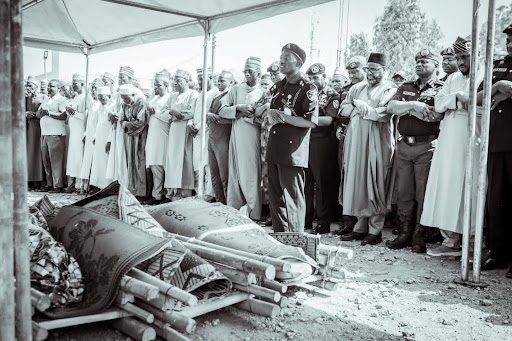
Funeral prayers for three policemen killed in an IED incident on Anka – Bagega road. Photo: Zamfara Police Command.
Earlier on May 7, seven residents of Bagega were killed in an IED explosion on the Anka-Bagega road. Eight persons were also seriously injured. The incidents have cast the community into mourning and fear.
Buried bombs
Armed violence has persisted for over a decade across northwestern Nigeria, with thousands of people killed and displaced. As the government struggled to protect civilians and their communities, the terrorists grew stronger, accumulating illicit wealth through their kidnapping-for-ransom operations, collection of so-called “farming and protection taxes”, and illegal gold mining. In the past months, however, terrorists have increased the deployment of IEDs to target civilians and security personnel, specifically in Zamfara and Sokoto states.
Since the beginning of May, at least six IED explosions have been recorded in the two states, while the seventh attack was averted when police officers found and destroyed the buried devices.
The proliferation of IEDs by terrorists in the region can be traced to 2024 when civilians fell victim to the buried explosives in Zamfara’s Maru Local Government Area (LGA) on two different occasions. The first IED incident occurred on Yar Galadima Road, followed by another on the Dansadau-Magami Road. Before then, IED attacks by terrorists had been relatively rare in the region.
By late 2025, that shift had become more pronounced. In December of that year, an IED blast unsettled civilians in Maru. According to sources familiar with the operations of the armed groups in the area, the attack was masterminded by Abubakar Abdullahi, also known as Dogo Gide, a terror group leader with strong influence in the region. That same month, another terror group loyal to Ado Aleru, an infamous criminal mastermind, also planted an IED on the Funtua-Tsafe Highway in an attempt to target soldiers at several military checkpoints.
The tactic persisted into the following year. In February 2026, 11 terrorists were killed while attempting to plant an IED in the Babbar Doka community of Maru. These incidents threw locals of the areas into panic, but more IED explosions would follow, especially in May and June, the same period when Sadiq’s brother and the three police officers were killed.
The buried explosive devices have become some of the terrorists’ most dangerous weapons against locals and security agents in the northwestern region. On June 20, a military armoured personnel carrier was also hit by an IED on the Isa-Bargaja road in Sokoto State. The explosion killed three soldiers who were in the armoured vehicle, while several soldiers got injured.
Barely eight days later, on June 28, thunderous explosions shook Kurawa, an area in Sabon Birni in Sokoto State. A commercial vehicle travelling along the Sabon Birni-Hurawa road accidentally stepped on a buried IED planted by terrorists. Although nobody died, the passengers were badly injured.
“We believe the terrorists planted the IED to stop soldiers from repelling their attack,” Lauwali Rabiu, a resident of Kurawa, told HumAngle. He said the terrorists attacked the community in the night and killed a civilian simply identified as Sabiu. “We suspected that the terrorists planted the IED before they went into the community so that soldiers coming to fight them would step on it.”
Just two days later, on June 30, terrorists planted another IED on the Tidibale–Tagirke road in the Isa area of Sokoto, and two soldiers were killed in the resulting blast.
These IED incidents represent a shift in the operational capacity of terrorists in the northwestern region; they also pose an expanding threat in a region that has been witnessing violence since at least 2013.
Historically, the use of IEDs in Nigeria has been associated primarily with extremist groups operating in the North East. Security experts believe there is a disturbing collaboration between extremist groups from northeastern Nigeria who have been moving into North Central and North West regions, and the terrorists operating in Sokoto and Zamfara.
James Barnett, a Nigerian-based conflict researcher, told HumAngle that the jihadists, especially Ansaru and Jama’atul Ahlis Sunnah Lidda’awati wal-Jihad (JAS), have sought alliances with local terrorists in the northwestern region. Despite the alliances, the insurgents tried to maintain the upper hand in those relationships, James said.
Get our in-depth, creative coverage of conflict and development delivered to you every weekend.
Subscribe now to our newsletter!
“To that end, jihadists have typically tried to maintain a monopoly on IED manufacturing and supply so as to maintain a comparative advantage over the more numerous bandits (terrorists). This has involved supplying limited numbers of IEDs or employing IEDs in joint operations as a means of winning [terrorists’] favour while keeping them dependent on the jihadists’ technical know-how and supplies,” James noted, adding that it is now harder for the northeast-bound terrorists to control the manufacturing and supplying of the IEDs in the northwestern region.
Yusuf Sulaiman, one of the victims of an IED explosion on Anka-Bagega road in Zamfara State. Photo: Sadiq Sulaiman.
“A number of [terrorists] have developed those skills within their gangs, sometimes by luring explosives specialists from jihadist groups. Banditry has become a lucrative enterprise, and some gangs therefore have the capital to invest in these deadly technical skills,” he added.
IEDs on the prowl
The unholy alliances between the extremists and northwestern terrorists have fuelled the proliferation of IEDs, turning public roads into death traps for unsuspecting civilians.
On the day of the June 9 explosion in Bagega, Hassan Ibrahim sat outside his house with friends and neighbours. He had gone to the motor park to buy fuel for his power generator, but he was the only black-market vendor who had run out of stock. He wanted to ask someone travelling to Anka town to buy fuel for him, but was told that vehicles were not available.
“A few minutes later, the news came in that a bomb (IEDs) planted on the road by terrorists had gone off. Someone said two cars from here (Bagega) had left and were possibly caught in it,” he told HumAngle.
Hassan and his friends immediately headed to the scene, where they saw the vehicles, including two military trucks almost reduced to dust. Residents from neighbouring communities trooped out to confirm the story. Hassan said he felt he knew some of the victims. He would later realise that his father-in-law, Salisu Minyama, was there, as was his nephew, Sama’ila Muhammad.
A military officer searching for IEDs. Photo: AFP
“It dawned on me that yes, this is real. How do you start to explain to their families? I was with Alhaji (Salisu) in the morning, and he told me he would be travelling. I saw his children, and then my nephew, Sama’ila; I spoke with him. How would you feel if you spoke with someone, and minutes later they tell you he is dead?” he wondered.
The victims of the IED, according to residents, were Alhaji Salisu Minyama, Abba Salisu Minyama, Abdurashid Salisu Minyama, Yusuf Sulaiman, Babangida Mika Sunke, Sama’ila Muhammad, Sabiu Mallamawa, Ashiru Mallamawa, and Nana Mallamawa.
Disturbing pattern
Although the infiltration of terrorists into the North West from the North East is blamed for the proliferation of IEDs, some locals and security experts believe several homegrown terrorists now produce IEDs on their own. Abubakar Dan-iya, a conflict researcher in Zamfara, told HumAngle that IEDs are now being produced by the terrorists mostly under the guidance of Dogo Gide, the terror group leader with known ties to jihadists from the northeastern region.
Abba Salisu, a fresh graduate of Federal University Gusau, also died in the Bagega IED explosion alongside his father, Alhaji Salisu Minyama and brother, Abdurashid Salisu. Photo: Hassan Ibrahim
“The resurgence of Dogo Gide in the criminal circle ignites recent IED incidents recorded in the areas of Bagega, Gwashi, and Dansadau axis. He remains the only merchant and supplier of explosive devices, dynamites, and coil detonators in Zamfara. Dogo Gide has recently been touring areas in Tureta, Shagari, Gummi, Anka, and Bukkuyum both in Zamfara and Sokoto states,” Abubakar said, adding that some of the raw materials needed for making IEDs are found in Zamfara.
Abubakar noted that some public transport parks are now being used by terrorists’ collaborators to source the raw materials and move them to areas where terrorists use them to assemble IEDs. Local markets like Polo Club, Old Market, Garejin Mailena, all in Gusau, are points where coil detonators, wire cables, dynamites, and other IED-related accessories are loaded onto the vehicles for movement to Bindin, Bagega, Dansadau, Magami, Faikai, and other communities across Anka, Maru, Shinkafi and Bukuyum LGAs, as well as the Tsafe axis.
While some of those sourcing the raw materials may not know how they will ultimately be used, Abubakar alleged that some of the drivers transporting them are collaborators. HumAngle could not independently verify these claims.
Scene of an IED explosion outside Kurawa in Sokoto State. Photo: Basharu Altine Guyawa on Facebook.
Avoidable tragedy
Describing the IED blast that killed his brother as an “avoidable tragedy”, Sadiq says the security situation in Zamfara has gone way too bad. “This is on the government,” he lamented. “We know that it’s the government that should protect citizens, so why are we not being protected? The road from Anka to Bagega has always been in terrible shape; the situation would improve with a good road and enough security.”
Isa, another resident of Zamfara who asked to be identified only by his first name, told HumAngle how he lost his bosom friend to the recent IED attack. He was listening to the radio in his room when his wife broke the news about the explosion. His friend, Abba Salisu, had informed him that he would be going to Anka with his father and brother. They wanted an early trip so they could return to Bagega in time. That morning, Isa’s wife heard a neighbour crying. When she went to find out what had happened, she was told about the explosion.
“I didn’t want to believe it at first, so I put on my shirt and went out,” Isa said. On his way, he called Abba’s number, but it was unreachable; he convinced himself that the network was poor.
He wanted to know whether his friend was really involved. As he moved from one person to another, his heart rate increased. That was when someone told him they had seen Abba and his father in one of the cars. “In the end, you can do nothing since it’s their time; it’s what God decided; we can only pray for them to be accepted as martyrs,” he said in a broken voice.
Residents who spoke to HumAngle said the recent explosion has not only killed 10 persons they have known for years; it has also instilled fear in their minds. The community’s economy has broken down as more people avoid the weekly market for fear of attacks.
“It goes beyond this particular incident,” Bilyaminu Abubakar, a resident of Bagega, told HumAngle. “For over two months, the people of Bagega have been completely abandoned. We are facing a severe security crisis, yet those in power behave as though we don’t exist. These explosions have taken the lives of our beloved ones, shattered families, and trapped us in constant fear.”
When contacted by HumAngle, both the Zamfara and Sokoto States Police spokespersons, Yazid Abubakar and Ahmad Rufai, did not respond to messages and calls placed on their lines for reactions over the trend of IED deployment by terrorists. HumAngle also contacted Sulaiman Bala Idris, the spokesperson for the Zamfara State Governor, but he did not respond to our messages. Sambo Bello Danchadi, the Sokoto State Commissioner for Information, also did not respond to queries about measures being taken to address the growing IED threats.
There is almost no landscape across the West African Sahel that cannot be accessed from the back of a motorcycle. That is why terrorists operating in the region prize them so highly. In various terror operations, motorcycles are used not only as vehicles, but as weapons, and even as a form of currency.
In April, terrorists abducted five residents from their farms in Anka, Zamfara State, in Nigeria’s North West, and demanded a ₦3.8 million ransom. After the affected families managed to raise the money and paid it, the abductors issued another demand: they were to return with motorcycles before the hostages would be released.
“They told the families that they would kill the victims if they did not bring a motorcycle,” Ciroma Ade* said. He was tasked with travelling to parts of Sokoto, or somewhere else, to buy the motorcycles and deliver them to a location that would be communicated to him later, in his experience, usually around Gurusu Forest between Anka and Gusau.
It was not the first time he had made the run. Over time, he unintentionally became a ‘middleman’ in the motorcycle ransom economy. He was also one of its victims. In 2024, he bought motorcycles to secure the release of many of his relatives. Buying a ransom vehicle is never straightforward because the region is now more conscious of its purchase, and many vendors will no longer sell the vehicle in that part of the country.
Sometimes the terrorists arrange for an anonymous ‘middleman’ to travel far, often to the trading hubs in Kano, to source motorcycles on their behalf. Ciroma has his own networks. He knows which traders to approach in Sokoto or Zuru, in Kebbi State, despite the growing difficulty of buying the machines.
Over the years, he has repeatedly relied on those contacts to secure abducted villagers, including many of his relatives. Once the motorcycles were purchased, the terrorists would arrange a meeting point for delivery. He did the same this time. Most of the time, the hostages returned alive. The terrorists appeared to understand the continuing value of keeping captives alive; they were useful leverage for future negotiations.
This time was different. The victims were killed anyway.
An emerging trend has taken hold across parts of northern Nigeria. Terrorists have created a self-sustaining system in which motorcycles have become a form of ransom. Each abduction helps replenish the very machines used to carry out the next one. The motorcycle has become both the means of violence and its reward.
HumAngle learned that terrorists in the region frequently use commercially available motorcycles, especially Honda models, for their durability, availability, and suitability for rough terrain. They ride them into battle, use them to swarm a target, and conduct large-scale operations like mass abductions.
Ciroma, for one, knows this too. As one of the reluctant middlemen who helped bring ransom motorcycles into the system, he believes his community has become both a source of motorcycles for terrorists and one of the least safe places in the country.
While researching how motorcycles have become inseparable from conflict in the Sahel, I could not find many stories that told the tales of war from the motorcycle’s perspective. Almost every day brings reports of non-state armed groups using motorcycles to attack villages, ambush troops, abduct civilians, or simply move from one place to another. Yet the motorcycle itself rarely occupies the centre of those stories.
Conflict reporting understandably focuses on bloodshed, casualties, military operations, and the growing sophistication of insurgents’ weaponry. Compared with assault rifles, rocket launchers, or improvised explosive devices, motorcycles appear almost mundane. But this overlooks one of the constants of modern insurgency.
Across Nigeria’s conflict theatres, and much of the wider Sahel, the motorcycle is present regardless of the group, geography, or operation. It functions simultaneously as a transport, a logistics platform, an escape vehicle, and a weapon. There should be a literature that treats it as the protagonist rather than merely part of the scenery.
This is what we are attempting to do.
A motorcycle recovered by the Nigerian army after a raid in the Matazu Forest in Katsina State.
Ciroma had just returned from the cemetery, where he and other villagers buried five people killed by the terrorists, when he heard that a journalist wanted to know about the motorcycle ransom economy. He spoke passionately about the suffering of his community.
During his final assignment, he deliberately delayed delivering the motorcycles until every option had been exhausted. After the victims were killed, he sold the motorcycles and distributed the proceeds back to their families.
As he told members of his community, he wanted nothing more to do with the “thieves”, including playing a part in the supply chain that sustained them.
If soldiers were willing to follow the motorcycle tracks into the forests, he said, he would guide them himself. He knew the routes. He knew the delivery points. Together with the local vigilantes, they could reach the camps where he had previously delivered motorcycles. “They could clear the thieves out,” he said.
The rider
Back in Abuja, I needed more perspective if I was going to write this story.
I left my estate and approached a commercial motorcyclist waiting by the roadside. He eyed me suspiciously. He wanted no association with terrorists, even if it meant nothing more than answering a journalist’s questions.
Get our in-depth, creative coverage of conflict and development delivered to you every weekend.
Subscribe now to our newsletter!
Standing nearby was another rider, Musa Abba. He waved me over, introduced himself, and agreed to speak, but only off camera. I asked him what it felt like to ride his bike every day.
“There is no place I cannot reach with this machine,” he said.
Musa trusts his motorcycle more than anything else. He kicked the engine to life and gestured for me to climb on. He had decided the interview would be better conducted while we were moving.
As I settled in behind him, my thoughts drifted, not to motorcycles, but to horses. I found myself thinking about how civilisations across the ancient world discovered the extraordinary power of a mounted rider. Horses became indispensable: first for farming and transport, then, most significantly, for war. They were the all-important multipurpose machines of their age.
They could hardly have imagined that one day a two-wheeled machine would replicate the power of a cavalry many times over. Perhaps they wondered about it. Back then, even with other machines of war, such as the horse-drawn cart, the camel caravan, and eventually some mechanised infantry, the role of the rider in battle remained central.
Motorcycles have inherited that role.
Some recent research has begun to recognise this. Analysts have documented the emergence of a ransom economy in which insurgents increasingly demanded motorcycles instead of cash. Communities are taxed to replace bikes lost during military operations. The most in-depth literature was compiled by the Global Initiative, an international think tank that interviewed people across the West African Sahel and found that motorcycles were stolen and trafficked over the years to sustain transnational criminal operations in Mali, Niger, Burkina Faso, and the Republic of Benin.
Not much was said about Nigeria in the report. However, the Nigerian Army has, in press statements, documented the seizure of thousands of motorcycles in counterinsurgency operations in Nigeria. Beyond those records, evidence also lies along the routes connecting illicit smuggling and trafficking hubs, with networks tracing back to the organised trans-Saharan trade from the 8th to the 16th centuries. Today, those same corridors still carry motorcycles used for smuggling and for slipping along clandestine routes that let riders avoid conventional roads and border checkpoints.
The motorcycle is now so woven into life across West Africa, the Sahel, and the Lake Chad Basin that the mobility it provides sustains entire communities, and many people in the lower and middle classes cannot imagine life without it.
As we continued the ride, Abba said, “When it is time to work, the only road I cannot enter is a place I am not allowed to work.”
File: Civilians across the country, especially in rural areas, also depend on motorcycles for mobility through rough terrain. Photo provided by Huzaifa Shehu, a resident of Magami in Zamfara State,
The war machine
How does a bike measure up to the cavalry? Scottish engineer James Watt coined the term ‘horsepower’ in the late 18th century, defining one horsepower as the daily output of a strong working horse. In reality, a horse sustains only about half that output over the course of a day.
I wondered whether the rider ever feels limited by terrain, and what it must feel like to have such command of the road.
“Surely you cannot climb rocks with it,” I said in Hausa, pointing at a hill we were riding past. “There is no place I cannot reach with this machine,” he repeated over the soft rush of wind. “Wannan karfe ne,” he continued. This is metal.
His Hausa made the argument sound more emphatic.
“It is not like rubber-rubber,” he went on, referring to the flashier plastic-bodied motorcycles. “A bike like this,” he said, gesturing at his motorcycle, “is the most durable of them all. You don’t need to maintain it much, and it doesn’t consume as much fuel as most other brands. You can change the oil just once in a while if you like. It can go anywhere, enter almost anywhere, and its second-hand value is even better than rubber-rubber [brands].”
Abba went on and on about what makes a motorcycle valuable in everyday life, and in doing so, he laid out exactly what makes it valuable to a terrorist across the conflict zones of Nigeria.
Measured by sustained power output, a Honda CG125 delivers roughly the equivalent of about 16 working horses. By that measure, a single terrorist on a motorcycle is riding with the power of about 16 horses at a time.
What we found
Over months of work, we built a database by measuring hundreds of military operations conducted over the past decade, logging every reported incident of motorcycle seizure and the count attached to it. Between February 2015 and November 2025, the Nigerian Army reportedly seized at least 2,607 motorcycles across 300 separate encounters. Taken together, this aggregated press data describes the logistical philosophy of the terror groups that the troops fight.
The seizure records also reveal distinct phases. At various points, different armed groups appear to have dominated motorcycle use, and there were periods when almost every operation reported by the military involved recovering bikes. Yet the headline figure of 2,607 motorcycles over ten years tells only part of the story.
In the early years of military engagement in the insurgency, the totals were driven by a handful of major discoveries, followed by long runs of tens of operations, each yielding only a single vehicle. These recoveries were not sustained by patrol pressure; they came when a campaign stumbled on a cache.
Over time, however, the army evolved its tactics. It pushed deeper into the terror enclaves in the forests, adopting specialised strategies, including the so-called strangulation strategy of the late 2010s, which was designed to starve the groups of the fuel and resources that kept their motorcycles running, and in many ways they set up the clearance operations that produced the few thousand vehicles in the record.
The earliest phase of this campaign against the motorcycle is unclear in the data. In late 2015 and 2016, at the peak of the Boko Haram insurgency, motorcycles were still being treated as secondary characters in the war. At the time, Boko Haram could field a 15-gun-truck convoy against a Forward Operating Base in Borno, sustain multi-wave assaults with machine guns and specialised Type-36 hand grenades in a single engagement, and then publish videos of the attack to showcase its strength and firepower.
Counterinsurgency reports from the period mention motorcycles only in passing. The focus was on weapons recovered, fighters neutralised, and territories retaken. But the bikes grew more prominent as larger caches began to appear in the record around 2017. Most seizure events still involved a single motorcycle, but occasionally the numbers jumped to a few or to a large cache, almost always the product of a one-off encounter or an ambush on a terrorist base.
As the military expanded its operations deeper into the forest to dislodge the groups, recoveries increased, especially in the northeastern region. I designate this as the first of two eras of riders, as the aggregated data reveal the core role of motorcycles in the wars.
The era of riders
On Feb. 17, 2016, soldiers of the 7 Division Garrison, on a clearance mission, entered Gulumba in Bama Local Government Area in Borno State. They found what they described as a small city where they had expected a makeshift camp. Inside were medical supplies stored in a field hospital, a sizable market, two logistics trucks, a grinding machine, and an industrial 100KVA Mikano generator. The most important find, though, was the transport garage of 180 motorcycles and 750 bicycles. In a single operation, at least 930 potential combatants were denied transport that day.
The period between 2016 and 2017 belonged to Boko Haram’s riders. Operation Lafiya Dole, a counterinsurgency operation of the Nigerian government, alone accounts for 57 per cent of all seizures in the dataset, with 1,792 motorcycles across 96 records, almost all recovered during camp-clearance operations in Borno. That works out to an average of 19.7 motorcycles per recorded operation.
Viewed over the full 2015–2025 period, the distribution of motorcycle seizures tells the story of two distinct conflicts. The first peaks in 2016; the second begins to emerge after 2022.
The defining year is 2016. Alone, it accounts for almost half of all motorcycles recorded in the dataset: roughly 1,300 bikes recovered across just 86 records, an average of 17 per record, far above any other year. This was the peak of Operation Lafiya Dole’s deepest push into Boko Haram’s territorial strongholds in Borno, where large-scale camp clearances dismantled the insurgency’s mobile logistics in bulk.
The pattern continued into 2017. Although the database contains only 10 records for that year, it accounts for 331 bikes, carried almost entirely by a single cache of 301 bikes recovered at Njibulwa, an insurgent enclave in Borno State.
After that, the numbers collapsed. Between 2018 and 2022, annual recoveries averaged just 49 motorcycles.
The second era of riders
Then there was another uptick in 2023, but it is a different case from 2016. This time, the centre of gravity shifted westwards. Kaduna led the increase, accounting for 88 recovered motorcycles, mostly linked in military reports to “terrorists”. The change reflected the growing prominence of motorcycle-riding armed groups in north-western Nigeria from around 2020 onwards.
Unlike the Boko Haram years, recoveries were no longer dominated by massive camp clearances. Instead, the database settles into a consistent pattern of around five to eight motorcycles per record, with a steady climb. The groups they were recovered from were labelled by the security forces as “bandits”, not Boko Haram.
After 2022, the number of seizure records rose sharply, even as the number of motorcycles recovered in each operation remained relatively low. Instead of discovering large transport depots, security forces were finding motorcycles in small clusters during repeated engagements. Operation Shaaran Daji became the leading source of recoveries in the northwestern region, signalling that the motorcycle had become embedded not in large insurgent camps but in dispersed, highly mobile armed networks.
The informal motorcycle networks through the Sahel
There are dirt roads in the desert that cross international borders and run through the Sahel’s sands, following routes that have connected communities for centuries. Many trace the arteries of the trans-Saharan trade, linking illicit hubs of smuggling and trafficking through networks first established hundreds of years ago. These pathways did not disappear as modern states emerged across the Sahel. Instead, they evolved alongside them. Most still exist today, at least as part of a broader web of formal and informal routes connecting contemporary roads to historical trading corridors that continue to facilitate cross-border movement.
Consider the recent ruins of Metele, which is comparatively recent than the historical networks, a Borno town brought down to rubble by the Boko Haram insurgency and abandoned for years, and crumbling into building blocks. After a decade of silence, the one thing that has only grown more visible is the roads, and in particular the ones made by motorcycle tracks. These have deepened with continued use, suggesting activities likely by insurgents operating in the area.
Metele and hundreds of villages in northern Borno around it have been abandoned, leaving only insurgent camps and military bases that occasionally clash in the parts where these routes link them. Yet the old roads have only grown deeper, and new paths have opened across the empty ground, as seen in the satellite imagery below.
Satellite imagery showing motorcycle track junctions 2km from the ruins of Metele. At least two of these networks lead through the abandoned community. Imagery: Google Earth Pro.
Let’s follow the Metele tracks eastward and see where it leads. It runs for about eight kilometres of the bike route, crossing onto the shore of an island in Lake Chad, and continuing from there across the flat terrain of the island, with many sub-tracks splitting off toward different corners, while the main track presses on east, along the shore and onto a much larger island with road networks also branching off on every side and onto other islands. We stop here because this island matters for a particular reason. Among its thousands of tracks sits a largely isolated compound in the island’s north.
In May 2026, US forces, working with Nigerian Army intelligence, carried out an airstrike on that compound and killed a senior ISWAP commander, Abu Bilal Al-Minuki. The site was geolocated using video of the strike released by United States Africa Command (AFRICOM).
Al-Minuki served as a liaison between ISWAP’s various commands across the Lake Chad Basin and the wider Islamic State organisation. Different factions of the group operate on multiple fronts, with administrative functions carried out in locations such as this island. Senior commanders often gathered in secluded places like these, whether in forest compounds in Sambisa or in camps scattered across the islands of Lake Chad.
When fighters enter Nigeria, they may arrive by boat from neighbouring islands, or blend in with ordinary travellers using the road network. Once inside the theatre of conflict, however, the motorcycle becomes the preferred means of movement. It allows commanders to visit training camps, inspect fighters on different fronts, and travel rapidly between operational bases.
Imagery: Google Earth Pro.
The compound and the road network on the island were not present in the previously available satellite imagery of the area, which was taken about five years ago. The tracks show significant activity. Imagery: Google Earth Pro
These tracks travel far and wide, meeting at certain points across the Sahel. They run north into Lake Chad, or northwest toward the Niger Republic. Cross-border routes make neighbouring communities, places like Diffa in Niger, feel as close as the other side of the street. The motorcycle gives its riders command at border crossings, and they hardly worry about checkpoints on official roads unless they intend to attack the location and run into state forces on either side.
Here, the border itself counts for far less. This indistinguishable, landlocked frontier has been reshaped by centuries of informal movement, by daily life that transcends the very idea of nationality. These places have long borne the brunt of regional security forces unable to fully command the area, and in a geography this vast, with so many options and pathways, smuggling and trafficking are barely a challenge.
The network of informal motorcycle routes is still more intricate. Some lead into the ruins of the hundreds of villages, like Metele, abandoned across the area. The ruins of Metele is within 50 kilometres of the nearest fringe of communities where people still live. The tracks also connect to minor and major roads leading to inhabited areas, giving the motorcycles access for incursions.
Eventually, these routes connect to every community in the region. Across the flatlands of Metele and Lake Chad through the desert of the border country, the motorcycle is highly effective, and this is why it is such a powerful weapon in the typical insurgent arsenal, despite the secondary attention it tends to receive next to the AK-47s and rocket launchers recovered alongside it in a raid.
The forest route
You will rarely hear about motorcycle–riding terrorists being caught at a military checkpoint, on their way to an operation or simply travelling. For anyone who knows the terrain, there is often no need to cross a major road on most journeys in the region.
The forests of Sambisa, Kyumbana, Mando, and the Mandara Mountains welcome the tyres of the war machine. HumAngle has previously reported on fighters travelling, moving, even migrating to another state through the interconnected, ungoverned forest reserves of the region, which give them multi-state reach and the ability to turn up in almost any part of the country.
Lines illustrating the generic route linkage through ungoverned forest hotspots that motorcycle-riding terrorists use to move across northern Nigeria. Map illustrated by Mansir Muhammed/HumAngle
Once through the forests and the mountain wilderness of the northeastern region, riders reach the other end of the country, though not necessarily in one go. They drop down now and then onto the main road, sometimes to refuel; there are reports of the military intercepting them and warning filling stations not to serve them. They settle for a while in certain towns, or in camps near towns, using the towns as supply bases before picking up the trail back into the wilderness and on toward their destination.
The machines are useful throughout the journey, should they wish to travel from the northeast to the northwest. In 2022, HumAngle reported how fighters from the forests of the northwestern region, such as the Birnin Gwari and Kamuku forests, often travel through towns, stopping at communities where they are repeatedly reported to assault local residents, particularly women, often sexually, before continuing toward an operation elsewhere. The very sight of them on their bikes has already terrified those communities into compliance with whatever they demand. It has become a kind of tradition in Kaduna, in Niger, and even in Kwara State when these riders come into town.
From this end, too, groups like the Lakurawa have been reported riding into Nigeria. Locals often describe them as Arab-looking non-Nigerians entering through the porous borders in the northwest, and a similar pattern is evident along the Lake Chad Basin on the other side of the north. Recent reporting has confirmed the group as a faction of the Islamic State operating in West Africa, and in Nigeria in particular.
They move through the Sahara along a network of ancient routes and illicit hubs where trafficking and underground resources are available to anyone on the road. This underworld of hubs and crossings is what lets riders pass between countries.
The Sahel underworld
When the collapse of Muammar Gaddafi’s regime released Libya’s vast weapons stockpiles into the region, it was this same illicit Sahelian underworld that carried many of those weapons into West Africa, including Nigeria.
Before he was killed, the terrorist kingpin Halilu Sububu was reported to ride with his gang across this terrain, loaded with gold sourced from the artisanal mining pits they controlled, and to return to Nigeria with weapons traded for that gold. Those weapons became the lifeblood of banditry in the country’s northwestern region and made Sububu the chief arms supplier to the various groups there.
His advantage was not simply access to weapons, but access to the routes. He reportedly knew how to travel to the Sahel and return with arms without significant interference. His command of the motorcycle corridors enabled his network to move across borders with relative ease. The same routes connected him to weapons originating from the post-2011 Libyan arms outflow, and even allowed combat vehicles acquired by his organisation to be delivered through the network.
Smuggling routes link arms trafficking networks through illicit hubs and border crossings at the West African end of the trans-Saharan network. Map by Mansir Muhammed/HumAngle
Critical transit and logistics networks span multiple border regions across the Sahel and West Africa, including the Burkina Faso–Côte d’Ivoire border, the Côte d’Ivoire–Mali–Burkina Faso tri-border area, and the Ghana–Burkina Faso frontier, where Hamile, Tumu, and Bawku serve as key crossing points. Further north, Ansongo in Mali, Arlit and Agadez in Niger, and numerous settlements across the Mali–Niger–Burkina Faso tri-border region function as centres for acquiring, consolidating, and redistributing illicit resources.
Perhaps the most famous network that leads into northern Nigeria is the one from Libya. It crosses through illicit hubs and artisanal mining sites, most of which are controlled by armed groups. The network of arms smuggling runs from Libya, usually from the desert oasis of Sabha; the journey flows through Fazzan in southern Libya and crosses the infamous Salvador Pass into the Republic of Niger, where illicit hubs and mining networks link to Sokoto, Borno and Zamfara states, connecting through Niger Republic routes from Agadez, Maradi, Tahoua, following ancient trade routes that continue to shape movement today.
These hubs share a profile of remote geography, thin state presence, weak governance, and established illicit trade networks that move goods and people across borders.
Motorcycles rule in this terrain.
The same network used to bring weapons into West African Sahel states is also used to move gold to Dubai. Map by Mansir Muhammed, based on the following sources: Illicit hub mapping in West Africa 2025 byLyes Tagziria and Lucia Bird, and The West Africa–Sahel Connection by Mangan and Matthias Nowak.
Of middlemen and motorcycle bans
We met another middleman, Abu Dogara*. Unlike Ciroma, he was not interested in sharing his experience, as his job still leaves a bad taste in his mouth. He answered mostly with short replies, with the occasional long clarification about the details of his involvement in the motorcycle ransom economy.
Earlier, we talked about the middlemen: the mostly anonymous intermediaries who know how to secure the motorcycle for victims’ families when all other options are lost. Abu was a middleman, at least until terrorists abducted his sister-in-law. He wanted me to understand that the last time he was on the job, he had not dealt with the terrorists himself. They had taken his younger brother’s wife, so it was his brother who spoke to them. He had played the same role as always, travelling to buy the motorcycles.
As awareness of the terrorists’ reliance on motorcycles has grown, buying one anywhere near the axis has become increasingly difficult. Most of the people we spoke to about sourcing a ransom vehicle named far-off places like Kano, Kebbi, and even Lagos. This is part of what has driven the rise of the anonymous middleman, sometimes known to the kidnappers, and sometimes hired by the victim’s family.
Abu travelled to Sokoto to buy the bikes. He searched and found nothing. An issue he hadn’t faced before. But finally, he met a vendor with a single one in stock, a Honda, exactly the kind the kidnappers wanted. The vendor let him have his last one, but warned that they were getting harder and harder to find in the area.
Across northern Nigeria, state governments have introduced strict motorcycle bans and usage restrictions to counter-terrorism and “banditry”. Niger State went so far as to ban motorcycle sales outright, specifically targeting high-capacity models such as Hondas, which are frequently demanded as ransom. Elsewhere, the measures range from outright commercial bans to localised movement restrictions, all intended to disrupt terrorist logistics. Katsina and Zamfara states have also introduced night-time curfews and complete movement bans in forested areas.
Abu does not like to dwell on the last job. He remembers only that the motorcycle cost more than ₦2 million, and that finding it was painfully difficult. At one point, he even asked his brother to persuade the kidnappers to accept cash instead. They refused. In the end, the Honda he bought in Sokoto secured his sister-in-law’s freedom.
In Kano and Kebbi, the approach moved away from banning sales altogether, focusing instead on restricting how the bikes can be ridden to stop criminals from using them for quick getaways and remote logistics. Many sources we spoke with named Kano, Kebbi (Zuru), and Sokoto as sources for the machines, with Kano and Kebbi most consistently described as the last resort.
The Motorcycle Regulatory Framework in Northern Nigeria.
The machine they cannot beat
To replace the motorcycles seized by the troops, terrorist groups tax the very communities near where those seizures take place. In one incident, terrorists taxed a community that had narrowly escaped a planned terror attack, saved only because soldiers happened to be in the village at the time. In another, one kingpin abducted a district head and party chieftain in a village in Zamfara, saying that his confiscated motorcycles were the reason for his actions, and he must be compensated.
Across much of Nigeria’s North, attacks launched from the back of a motorcycle are becoming more common. The country is still dealing with motorcycle-facilitated crises at both extremes. It is the one insurgent tactic the Nigerian security forces have not been able to beat. Not with trenches on the battle fronts of the northeastern region, nor in the communities across the country where these raids have become a regular part of recent reporting.
The Nigerian Army has itself adopted motorcycles for parts of the same war. Boko Haram deserters recruited to support counterinsurgency operations ride ahead of advancing troops on motorcycles, scouting for ambushes, improvised explosive devices, and landmines. The machine has become indispensable to both sides.
For many survivors, the sound of a motorcycle engine will always bring up the worst of their memories.
The names of the middlemen have been changed to protect their identities.
Joy Oga, a pregnant woman in her second trimester, was harvesting yams on her farm in Kwanta/Dooshima area when armed men attacked. The 31-year-old farmer had gone out with three others from her community on June 16 to harvest the farm she had been unable to reach since her village was invaded in September 2025. She never finished the harvest.
“I went to the farm to pack yams when I was attacked,” Joy told HumAngle.
Joy had farmed in her village in Chanchanji, Takum Local Government Area, in Taraba State, northeastern Nigeria, for five years, and farming is her only means of livelihood. After enduring months of hardship in a displacement camp in Chanchanji town, she was eager to resume farming as soon as she and other residents were asked to return home. On the day of the recent attack, she was there to also clear the land for a new planting season.
Joy said the attackers, whom she claimed were herders, confronted her and the other people that were with her, and immediately started hacking them with the machete. She ran back to the community with a cut on her face, wrist, and legs.
Joy was pregnant in her second trimester when she was attacked on June 16. Photo: Felix Ashe
The attack came barely two months after a peace deal was struck between the Fulani and Tiv communities of southern Taraba, and has raised questions about the restoration of peace and the fate of residents who rely on farming for survival in the area.
In April, a peace dialogue organised by the Taraba State government, northeastern Nigeria, brought together leaders of the Fulani and Tiv ethnic groups to put an end to the series of clashes that claimed lives and properties in communities within southern Taraba. The Fulani in the area are predominantly nomadic herders, while the Tiv are mostly farmers. During the dialogue in Jalingo, the state capital, both parties agreed never to raise arms against one another.
The government also instructed displaced residents across the affected areas to return home. Weeks later, some residents began to exit the displacement camps in Chanchanji and Amadu for their hometowns after months of facing terror attacks, mass displacement, and food shortages. Three committees were set up by the government to manage the displaced persons’ return, inter-boundary and migration control, and boundary assessment and settlement.
A multitude of motives
Southern Taraba has witnessed recurring violence involving farming and pastoralist communities for more than two decades. The area comprises five Local Government Areas (LGAs): Donga, Ibi, Takum, Ussa, and Wukari. Researchers say the conflict is driven by a complex mix of competition over land and water, population growth, the proliferation of small arms, weak law enforcement, and criminality. While these clashes are often described as “farmer-herder conflicts”, several studies caution that they increasingly involve organised armed groups whose activities go beyond disputes over grazing routes. Indigenous Tiv communities in Taraba and neighbouring Benue State also say the attacks are a strategic move to take over their lands and resources.
A security expert, who has also worked as a police officer in the area, told HumAngle that the crisis goes beyond ethnicity. “This is terrorism, because the attackers come into town, destroy property, and run back. They do not have a settlement around that area, and whenever they come to Chanchanji, it does not only affect one tribe — it affects other tribes living in Chanchanji too,” the source, who pleaded anonymity, noted.
Locals in Chanchanji said the Sept. 2025 attacks were the worst they have experienced in the area. Photo: Moses Uko
He argued that terrorists are exploiting the unresolved ethnic clash between both parties to infiltrate the area, particularly in ungoverned spaces, adding that if it were purely an ethnic conflict, only the Tiv and Fulani would be affected; since every tribe in the area suffers during the attacks, he believes it is more accurate to describe the situation as terrorism.
Other claims about the motive of the attacks have been circulating; one of them originated from the deceased leader of a criminal gang that operated along the border between Benue and Taraba. Before his death in the hands of the Nigerian Military in September 2020, Terwase Akwaza, known popularly as Gana, a notorious criminal gang leader in Benue, claimed during an interview that armed groups posing as herders had approached him and asked him to carry out attacks in “about three states they want to [capture], being Plateau, Taraba, and Benue.” Joy, like many other residents, believes that the attacks were carried out by these armed groups.
After Gana’s death, his allies fractured into rival factions, with the most prominent ones being led by Fullfire and Chen. Despite attempts by community leaders urging these groups to cease fire, they have continued to operate violently in the region.
On the allegations from both parties about the hiring of militias, the security expert acknowledged that “in an environment where there is crisis, there are people who try to bring up some things to justify their actions”, adding that parties might exaggerate casualties or incidents.
A blow on both sides?
Benjamin Kwazza, who also survived the June 16 attack, told HumAngle that the attackers were tactical, targeting their heads and necks with the intention of causing instant death. “They pursued us, and along the line when they got us, they started to cut my neck,” he said, adding that he sustained a deep neck wound.
When Joy, Benjamin, and the others returned to the village, residents organised a search party, but the attackers had already fled.
The following day, June 17, two other farmers were attacked on their farmland in the same community. While the other farmer managed to escape untouched, Terkura Mathew was brutalised and left in his pool of blood. Locals found him and brought him back to the village. His condition remains critical.
HumAngle reviewed videos and photographs of the June attacks, which showed visible wounds sustained by survivors, including deep cuts and injuries consistent with machete assaults.
Bello Mbela, the Taraba State chairperson of Tabital Pulaaku International, an organisation that serves as a unified voice for Fulani communities across the continent, explained that the southern Taraba crisis is a blow to both sides. Tabital Pulaaku represented the Fulani community during the signing of the peace deal in Jalingo.
According to him, Fulani people who live around Southern Taraba communities like Kofai Amadu, Tor Damisa, Kurmi and other areas are always caught up in the violence, which has led to loss of lives, cattle, and properties, with many who are currently displaced.
Illustration: Akila Jibrin/HumAngle
Bello said the most recent incident occurred in February. “In Kofai Amadu under Takum Local Government Area (LGA), several women and children. The children were grazing when they were attacked, and their necks were snapped,” he stated.
Get our in-depth, creative coverage of conflict and development delivered to you every weekend.
Subscribe now to our newsletter!
The Tabital Pulaaku leader also stressed that the herder communities in the region were set ablaze by aggrieved locals multiple times. “Also, around Kurmi LGA, there were rape cases. When a young woman sets out, she’s captured, threatened with a knife and raped. Especially those who go to hawk Fura da Nono,” Bello claimed.
Although he did not provide visual evidence of the alleged violence, he said attacks against herders and their families often go unreported and undocumented. “We do not record their deaths. We bury them instantly and keep moving. Most of the deaths are common among the elderly, disabled, pregnant women, and children,” he told HumAngle.
Bello added that the affected herder communities are afraid of seeking shelter in temporary displacement camps in the towns due to fear of being profiled. Hence, they retreat farther into the bush for safety when their homes are razed. “Some of them come to Jalingo where they are sheltered by the Muslim council,” he said.
Similarly, farming communities report a similar pattern of targeted abuse. Uzaki Peter, a local leader in Bachula, a community in southern Taraba that was displaced by attacks, told HumAngle that farmers have been experiencing a series of fresh attacks since they resumed farming in June. According to him, locals were adamant about returning home despite the hardships in the camp, but the peace meeting in April gave many hope.
HumAngle learnt that locals and herders lived together in the region for years until clashes started recurring in 2025. “We always meet with the herders. They were telling us there is no problem. We should invite our people to come back. So, we started feeling like there was a solution, so our people started going back,” he said. However, Bachula is currently experiencing the same pattern of attack that occurred last year, according to Uzaki. “They will come and attack you. If you have a phone, they will collect it, and if you have money, they will collect it. They were sleeping with our women who were going to the farm,” the community leader said.
Despite the peace dialogue
Bello, who was present during the peace dialogue, told HumAngle that both parties have been trying to abide by their agreement that no party must attack the order. However, new cases are coming up. “In May, two women went to the Chanchanji area and did not return. They were killed.”
He explained that the incident sparked outrage and nearly led to fresh clashes. Since there was a peace dialogue, the issue was reported to the police station, and an investigation began. To date, none of the perpetrators has been caught.
“If someone goes to the bush to graze alone, he does not return,” Bello gave another instance, stating that they are probably killed because such incidents took place in the past.
When HumAngle reached out to James Lashen, the Taraba State Police Command’s Public Relations Officer, regarding the recent attacks in the region, he said that Kwanta/Dooshima and other areas in Chanchanji that are constantly under attack fall under “ungoverned spaces”.
“Taraba is the third largest in landmass in this country after Borno and Niger,” he stated, explaining that the landmass affects security response and patrol. “But for now, Chanchanji, Amadu and other areas, there is peace. There is a sustained patrol. We would like to embark on a convoy patrol due to the length of the road. You know, from Takum to Wukari, it is a long distance. And that is where they normally perpetrate. But for now, we have already taken charge of that area. For now, no incidents are taking place there,” he asserted.
When asked about the recent incidents in the area, despite his assurance of peace, Lashen said it is quite common during the farming season and that it is the responsibility of the Divisional Police Officers to report to the command. However, he noted that he had yet to receive a report of the incident in Kwanta/Doorshima or Bachula at the time of our communication.
The PPRO stressed that the Taraba State Police Command has ensured displaced communities returned home. “Everybody has been back. Policemen are stationed there. We have posted tactical teams there in that area. Everybody has gone back to his house,” the officer said.
However, some residents disagree. Uko Moses, a farmer and resident of Peva, another affected area in the region, told HumAngle that the Peva community remains deserted to date, and locals are still in displacement camps in Amadu and Chanchanji town due to recurring attacks and unresolved tension. He also noted that areas such as New Gboko, Demavaa, and other southern Taraba communities remained abandoned.
“Those who try to access their farmlands are being hurt on a daily basis,” Moses said.
According to him, food, clothing, and healthcare are the basic challenges faced by displaced people still in camps due to fear of returning home. Also, children have been out of school for over nine months. “We depend on the government, humanitarian organisations, and philanthropists. The insecurity has made us become beggars,” he stated.
To cushion the suffering of displaced persons in the displacement camps, HumAngle learned that Kefas Agbu, the Taraba State Governor, donated bags of rice and other relief items across the camps in March. Also, Benue State Governor Hyacinth Alia visited the displaced and assured those living along the Benue border that they would soon be able to return home.
“His words were full of hope. According to him, it will not take long for the people to return to their communities and continue with their daily business.” Moses spoke of the Benue State Governor’s promise.
However, locals remained in the displacement camps, and despite the hardship, Moses said they prefer to stay in the camps rather than come home where their safety is not guaranteed.
“The security architecture there is very poor. In some of the villages, there are no checkpoints close by or police stations built there,” he said.
Uzaki, the Bachula caretaker, echoes Moses’s security concerns in the area. “Yesterday [June 16], I reported a case of three people. They were admitted to the hospital, and the day before yesterday [June 15], I reported a case involving two people. They are also here. And today [June 17] two have been brought out that have been matcheted,” he said.
Lashen, the police spokesperson, said officers in the region cannot be everywhere. “So that is why we always engage with the stakeholders within the community to talk to their people. Because the police cannot be everywhere. Because of this landmass,” he said.
Several displaced residents are seeking refuge in overcrowded camps in safer communities within southern Taraba. Photo: Uko Moses
Herder communities are also grappling with another crisis. According to the Tabital Pulaaku leader, herders are often segregated in local healthcare facilities when it comes to receiving treatment for injuries sustained during clashes. “Some of them are even arrested on the spot. This has made some of them stop accessing healthcare centres and rely on home treatment, which leaves them dead,” he said.
What now?
During a summit in 2025, the Federal government described Taraba state as “a cornerstone of Nigeria’s agricultural and industrial future”, owing to its agricultural potential. The state was also hailed as a major producer of export-grade tea, coffee, and livestock for the meat industry.
A recent study by socio-political science researchers in the country’s northeastern region found that the majority of the population in IDPs camps and those killed, injured and displaced due to the conflict are farmers. While the rate of the clashes is said to be high, the impact on food insecurity in the region is also high due to the magnitude of the attacks on farming communities.
Felix Ashe, a farmer from Chanchanji, told HumAngle that the most recent attacks in the area occurred on farmland, prompting locals to abandon their farms. He says hunger now shapes the lives of many who usually depend on farming for survival.
“We planted yams, groundnuts, benniseed and so on. The yam that was planted last year was not able to be harvested, and those who tried to harvest them are being attacked,” he said.
In the Peva and Amadu communities, which are known as agrarian areas, Moses said locals are facing food scarcity. “Seriously, we are living at the mercy of God, because predominantly, we are farmers and we started receiving these unprovoked attacks since last September, and till today, we are still receiving attacks. We don’t have access to farms, and farm produce has been destroyed. We are facing the challenge of hunger,” Moses said.
Several farmlands and barns were set ablaze in the 2025 attack. Photo: Monday Vincent
If the attacks persist, local farmers in the region say they fear for their future.
“The most important thing we need now is peace. That is the restoration of peace in the area. If we’re able to get peace, everything will come back gradually,” Moses said.
While peace efforts are being made, the Tabithal Pulaaku leader said most of the herders around the affected Southern Taraba communities are still displaced, while some remain missing. Through stakeholder engagements and awareness-raising campaigns, Bello said leaders of the Fulani community are sensitising locals to shun violence and embrace peace to resolve the crisis.
To permanently break the cycle, the security expert calls on the government to move beyond temporary peace declarations and to continue engaging local leaders and stakeholders from both ethnic groups, formally entrusting them with responsibility for maintaining peace among their people. He strongly advocates for the establishment of modern ranches and clearly designated grazing routes for herding communities.
“They don’t have a route to follow with their cattle, so they follow people’s farmlands, and that causes a lot of issues. There should be a dedicated path for them,” he said. “The herders should maintain their particular axis and also, people should be notified not to go there and farm.”
He also emphasised the need for a visible security presence in those areas and for constant patrols. “The security agencies should be well equipped and motivated to be very active at work,” the expert added.
On a hot Tuesday afternoon in Yola, Adamawa State, in northeastern Nigeria, 32-year-old Fidelis Mbai walked to a point-of-sale (POS) stand to withdraw ₦35,000. The POS operator, Abu Sani, collected his Automated Teller Machine (ATM) card and inserted it into a POS terminal. Fidelis entered his Personal Identification Number (PIN). Within seconds, he received a debit alert. The money had left Fidelis’ account, but Abu’s terminal showed that the transaction had not been completed successfully.
The two men stared at their screens. One had seen ₦35,000 withdrawn from his account; the other had received nothing. For nearly 30 minutes, they kept refreshing their mobile bank apps. “I was angry because the money had left my account immediately,” Fidelis said. “As far as I was concerned, the transaction was successful.”
Abu understood the frustration, but he had a problem of his own. “The customer was debited, but I didn’t receive the money,” he said. “If I gave him cash and the transaction eventually failed completely, the loss would be mine.”
Eventually, Fidelis left without cash. His money would later be reversed. But for several hours, ₦35,000 simply disappeared into Nigeria’s digital payment infrastructure.
This experience has become familiar to many Nigerian residents. As digital payments increasingly replace cash, it is ordinary citizens, not institutions, who bear the cost of failed transactions. The consequences often extend beyond the value of the failed transaction itself. Delayed payments can prevent traders from restocking goods, force customers to borrow money while waiting for reversals, disrupt access to healthcare, transport, or other essential services, and erode trust in digital financial systems. For small businesses and low-income households that depend on immediate access to funds, even a short delay can translate into lost income, missed opportunities, and significant financial stress.
Nigeria’s digital payment revolution
Nigeria’s digital payment ecosystem has expanded rapidly over the past decade. According to data from the Nigeria Inter-Bank Settlement System (NIBSS) – which operates the core infrastructure that processes and settles electronic payments and fund transfers between banks, discount houses, and card companies in Nigeria, and is jointly owned by the Central Bank of Nigeria and all licensed banks – the value of instant digital payments reached ₦1.07 quadrillion in 2024, up from ₦600.36 trillion in 2023. The data also showed that Nigerians conducted 1.38 billion POS transactions worth ₦18.32 trillion during the same period.
These numbers reflect one of the most successful examples of digital public infrastructure (DPI) in Africa. At its core, DPI refers to the digital rails that allow citizens to identify themselves, make payments, and access services. In Nigeria, these rails include bank transfer systems, mobile money platforms, POS networks, identity systems such as BVN and NIN, and shared payment infrastructure.
Photo: Andrew Eseibo/Rest of World.
Together, these systems enable millions of transactions every day. For most users, the process appears simple: send money, receive money, and move on. But when something goes wrong, the burden often shifts away from the infrastructure and onto the people who rely on it.
While there is no official national estimate of the total amount Nigerians lose annually to failed digital payment transactions, the scale is substantial. During the 2023 cashless transition, industry reports indicated that as many as 40 per cent of failed e-payment complaints remained unresolved for extended periods, with affected transactions running into millions of naira.
Given that Nigerians processed over ₦1.07 quadrillion in instant payments in 2024 alone, experts say that even a failure rate of less than one per cent could leave billions of naira temporarily trapped in failed, delayed, or disputed transactions each year.
The last mile bankers of Nigeria
Every morning, Abu begins work with a few simple calculations. How much cash does he have? How much electronic value is in his account? And how much of that money is trapped in pending transactions?
“Almost every week, we experience failed transactions,” he said. “Sometimes two or three times. During network problems, it can happen many times in one day.”
Officially, Abu’s role is to provide financial services. Unofficially, he has become something else: a lender, a mediator, and a shock absorber. He is one of an estimated 1,600 POS operators per square kilometre in Nigeria, according to the International Monetary Fund (IMF). As banks have reduced their physical footprint in some communities, these agents have become the last-mile providers of financial services, connecting millions of Nigerian residents to the formal financial system.
One afternoon, a regular customer named Musa Ibrahim arrived to withdraw ₦50,000. The debit alert arrived immediately, but Abu’s account was not credited. Musa needed the money urgently for a hospital bill, and Abu had to choose between trusting the system and trusting the customer. “I knew him very well,” Abu said. “So I gave him the money from my own cash.”
The confirmation took two days to arrive. For 48 hours, Abu had effectively given Musa an interest-free loan. Nobody paid him for the risk. Nobody compensated him for the anxiety. Yet this informal lending happens every day across Nigeria. Thousands of POS operators use their own money to bridge gaps created by delayed transactions.
At Jimeta Modern Market in Yola, 38-year-old Aisha Mohammed sells food items. More than half of her customers now pay by bank transfer. Like many traders, she has adapted to Nigeria’s cash-light economy, but that adaptation comes at a cost. Several months ago, a customer purchased a bag of rice worth ₦80,000. He presented a transfer receipt. The money did not arrive.
File: A grocery store attendant operating a POS terminal. Photo: Opay
“The customer looked genuine,” Aisha said. “He showed me everything on his phone.”
She released the goods. The payment did not arrive until the following day. That night, she barely slept. “You start asking yourself whether you have been scammed,” she said.
Delayed transactions create a dilemma for traders like Aisha. If they reject digital payments, they risk losing customers; if they accept them, they risk losing money. Many solve the problem through selective trust. “If I know the customer, I may release the goods,” she explained. “If I don’t know them, I wait until I see the money myself.”
This has created a parallel trust economy operating beneath Nigeria’s digital economy. In theory, transactions are guaranteed by technology; in practice, they are often guaranteed by relationships.
Get our in-depth, creative coverage of conflict and development delivered to you every weekend.
Subscribe now to our newsletter!
Dr Ibrahim Sule, a financial inclusion expert at the Adamawa State Ministry of Finance described it as a hidden feature of Nigeria’s digital economy. “It shows that people are finding ways to compensate for weaknesses in the system. Personal trust often fills the gaps where technology falls short,” he said.
Borrowing money while waiting
For Ibrahim Yusuf, a resident of Damilu, a community in Jimeta, the consequences were far more serious. In October 2025, he transferred ₦43,000 to a shop owner as payment for foodstuffs he had purchased. The money left his account instantly, but the shop owner never received it.
One day passed, then two, three, four, five, and six. During that period, Ibrahim had no extra money with him. “The money was meant for foodstuffs, but I couldn’t leave the market with what I bought because the shop owner didn’t receive an alert,” Ibrahim said.
By the third day, Ibrahim borrowed ₦20,000 from a friend. The irony was difficult to ignore. His own money existed somewhere inside the banking system, yet he needed someone else’s money to survive. “It wasn’t even the financial loss that hurt the most,” he said. “It was the uncertainty. Nobody could tell me exactly where the money was.”
His experience illustrates a hidden cost rarely captured in transaction statistics. When payments fail, people do not simply lose access to money. They lose opportunities, business deals collapse, and relationships become strained.
The financial system eventually restores the funds. But it rarely restores the time, trust, or opportunities lost along the way.
How the money moves
While a bank transfer feels like a simple process for customers, financial experts say that transactions often travel through multiple systems. According to Hakeem Abdulkareem, a tech expert at NIBSS, “When you initiate a transfer on your bank app or through your bank, your bank first authenticates the transaction and verifies the beneficiary’s account details. The payment instruction is then routed through the NIBSS Instant Payment (NIP) platform to the receiving bank, which validates the request before crediting the beneficiary’s account. For the transfer to succeed, each of these systems – the sending institution, the NIP switch, and the receiving institution – must exchange information correctly and in real time,” he explained. “Each stage must communicate properly for the transaction to be completed.”
Any disruption along that chain can create problems. Not every failed transfer originates from NIBSS. Payment experts note that delays can occur at the sending bank, the receiving bank, a fintech platform, telecommunications networks, or the central payment switch. One way to determine where a transaction stalled is through the unique ‘Session ID’ generated for every transfer, which allows institutions to trace the payment through the system.
“Delays often occur when there are network issues, system outages, or communication problems between institutions involved in the transaction,” Hakeem added, noting that NIBSS continues to work with banks and fintech companies to improve transaction monitoring, automate reconciliation processes, and strengthen the resilience of the NIBSS Instant Payment (NIP) platform as transaction volumes continue to grow.
In the first quarter of 2025, electronic payment transactions reached ₦284.99 trillion, a 17.7 percent increase from ₦234.49 trillion recorded during the same period in 2024. POS transactions alone rose to ₦10.45 trillion during the same period, more than double the ₦3.62 trillion recorded in the first quarter of 2024.
While these figures highlight growth, Hakeem noted that “as transaction volumes increase, maintaining system efficiency becomes even more important.”
The institutions behind Nigeria’s digital payment system agree on one point: public confidence depends on reliability. As transaction volumes continue to grow, banks, fintech companies, and regulators say they are investing in infrastructure, monitoring systems, and consumer protection to reduce delays and strengthen trust.
Adi Dansanda, Customer Protection Officer at the Central Bank of Nigeria, Yola branch, told HumAngle that “Consumer confidence is critical to the success of Nigeria’s digital payment ecosystem. We continue to work with financial institutions and payment service providers to strengthen compliance, improve service quality, and ensure that customer complaints are resolved within established timelines.”
CBN Yola Branch Office. Photo: Obidah Habila Albert/HumAngle.
Despite these commitments, the experiences of everyday Nigerian residents suggest that the gap between policy and practice remains significant. For them, confidence is built every time a transfer arrives on time, every time a complaint is resolved quickly, and every time money moves when it is needed most.
Lessons from elsewhere
Building a reliable real-time payment system is not unique to Nigeria. Countries with some of the world’s most advanced digital payment platforms have also experienced outages and technical failures as transaction volumes increased.
In India, the Unified Payments Interface (UPI), which processes more than 18 billion transactions each month, experienced several nationwide outages in 2025. An investigation by the National Payments Corporation of India (NPCI) traced one of the largest disruptions to excessive transaction-status requests from participating banks that overwhelmed the system. In response, the regulator tightened technical protocols, limited repeated status checks, and strengthened monitoring to reduce the risk of similar failures.
Brazil’s Pix platform has also experienced periodic service disruptions linked to participating financial institutions and network issues. Rather than eliminating failures entirely, authorities have continued to improve interoperability, operational resilience, and incident response as usage has expanded.
Nigeria has already built one of Africa’s largest real-time payment systems through the NIBSS Instant Payment platform. Experts who spoke to HumAngle say the lesson from other countries is not that payment systems can avoid failures altogether, but that maintaining public trust depends on continuously strengthening infrastructure, improving coordination among participants, and responding quickly and transparently to disruptions.
This report is produced under the DPI Africa Journalism Fellowship Programme of the Media Foundation for West Africa and Co-Develop.
When Kaka Ali said those words over the phone on June 8, I nearly asked him to repeat himself. I had been speaking to him about farming and survival in northern Borno for nearly two years. Kumalia was where he was born, but it was also a place that most people had long stopped calling home.
The community is located within Monguno Local Government Area (LGA) in Borno State, northeastern Nigeria. The Boko Haram insurgency had emptied it in 2016, forcing residents to flee to Monguno town and Maiduguri, the state capital. The government never formally reopened the community. In the years that followed, its name surfaced mostly in conversations about what the insurgency had taken.
“Why would you go back there?” I asked.
“The negotiations did not go through,” Kaka replied.
I did not fully understand what he meant until weeks later.
On June 21, I reached him again. I learnt that he had returned to Monguno to attend the funerals of four friends who were killed the previous day by suspected Islamic State West Africa Province (ISWAP) terrorists while working on a farm near Kartari, a remote settlement close to Cross Kauwa town in Kukawa LGA, on the shores of Lake Chad. Twelve other farmers were also killed in the incident.
The men had travelled to Kartari from different parts of northern Borno, drawn by the search for land to cultivate after farming had been disrupted closer to home. That same day, in Zabarmari, a farming community in Jere LGA, another 11 farmers were reportedly killed. By then, Kaka’s explanation about Kumalia finally made sense.
The warning had come months earlier at the onset of cultivation in February, when farmers across parts of northern Borno began receiving warnings from ISWAP terrorists not to farm this season. The message spread among returning farmers and community leaders through word of mouth.
“They approached farmers who had gone to Kartari and told them we must not cultivate this year,” said Musa Abubakar, a farmer from Cross Kauwa. “They also informed community leaders in villages close to them, and those leaders passed the message to us in other towns,” he said.
According to Musa, farmers who wished to cultivate were instructed to relocate with their families to terror-controlled territories, locally known as Daula, and farm there instead. Many initially assumed it was another extortion attempt because for years, cultivating in parts of northern Borno had meant paying terror groups for access to land. In 2024, HumAngle documented how farmers in the region paid millions of naira in levies and so-called farming permits to ISWAP. This season, farmers pooled their money together, some contributing at least ₦50,000 each, hoping to negotiate their way back to their fields. However, the effort failed, and the warning held.
So they began looking elsewhere. Some moved toward the Lake Chad region. Others returned to abandoned communities. More than 100 farmers from Monguno, according to Kaka, relocated to Kumalia, where they erected makeshift shelters from sticks and dry grass to plant their crops. They plan to stay until the harvest season in November or December.
The women were not left behind either.
“My sister is there,” Kaka, the 30-year-old father of two, said. “Many women went with their children. The older ones trekked with their parents. The younger ones are carried on their backs or transported in push carts.”
Kaka’s older sister, Yabusam Ali, travelled with one of her children and left the others with their grandmother in Monguno. Other women made similar calculations, weighing which children could endure the walk and which would be safer left behind. Yabusam said conditions remain basic but manageable.
“There is drinkable water there,” she told HumAngle.
For now, that is enough. Kumalia has no schools, no health facilities, and no visible state presence. It is a settlement held together by necessity. Over the coming months, the community will once again have residents, not because it is safe, but because it has become the least dangerous option left.
File: A family riding to their farm on a motorcycle in rural Gombe in 2024. Photo: Al’amin Umar/HumAngle.
Across Borno, the farming ban, enforced through violence and the threat of it, is reshaping how rural families survive. Some have abandoned cultivation entirely. Others have confined themselves to plots within sight of military positions. A growing number are returning to communities the state had given up on, betting that the promise of a harvest is worth living beyond its protection. Together, these choices are accumulating into something larger than disrupted planting seasons: a food security crisis taking shape incrementally, in the daily calculations of people who can no longer be certain what the harvest will bring, or whether there will be one at all.
The consequences extend far beyond the communities where cultivation has been disrupted. Agriculture remains one of Nigeria’s largest employers and a critical source of food for millions of households. The World Bank estimates that nearly four in every five rural households in Nigeria depend on farming, while livestock rearing is especially common across the country’s northern regions. When insecurity forces farmers off their land, harvests decline, market supplies tighten, and food prices rise.
The Famine Early Warning Systems Network (FEWS NET), a food security monitoring and forecasting initiative, estimates that between 21 and 22 million people across northern Nigeria will require humanitarian assistance during the June-to-August lean season, driven by escalating conflict, lower-than-expected household food production, and constrained access to food. The Integrated Food Security Phase Classification (IPC) similarly projects that more than six million children across northern Nigeria will experience acute malnutrition this year, with conflict, displacement, and reduced access to food among the principal drivers.
Get our in-depth, creative coverage of conflict and development delivered to you every weekend.
Subscribe now to our newsletter!
Kaka had already made these calculations. “Are you not afraid of attack from the terrorists, or of being mistaken for one by troops?” I asked him. “We will die even if we don’t go,” he replied. “So, it is all the same.”
Flags on the farm
Just as Kaka mentioned, several farmers in northern and central Borno say the people who first heard the warnings were often those who had gone ahead of the rains to clear their fields.
In Monguno, Koso Abubakar said farmers preparing their land were approached and warned against cultivation. They returned to town carrying the news, and from there, the message spread from household to household. In Cross Kauwa, a farming and fishing community on the shores of Lake Chad, the warning reached those working near Kartari, a remote settlement under Kukawa LGA. Community leaders received it and relayed it to surrounding towns.
In Lassa, a farming community in Askira-Uba LGA in southern Borno, it arrived with violence. Andrew Adamu, a farmer there, said suspected terrorists attacked and flogged women they found working on their fields at the beginning of the season. “They said nobody should farm there,” he said. “They [the women] said they had mounted their flags on those lands.”
The flags, a territorial marker used by terror groups across the region to signal control, were understood immediately. Few people in Lassa are now willing to venture beyond the land immediately surrounding the town.
Musa, a farmer in Cross Kauwa, said the warning came with an additional condition in the northern Borno community. He said that farmers willing to cultivate were instructed to relocate permanently with their families to terror-controlled territories and continue to farm there while paying levies instead. The requirement to relocate permanently was new. The levies were not. But this time around, levy negotiations failed in some places.
Farmers handing over money to armed and masked terrorists in a rural setting. Illustration: Akila Jibrin/HumAngle.
However, in parts of southern Monguno, some farmers were reportedly permitted to cultivate after paying ₦50,000 each. The inconsistency stirred speculation that the restrictions reflected internal disagreements among ISWAP commanders rather than a unified policy.
“It was said that two Amirs controlling two farming villages had a dispute over farming fees,” Kaka explained. “The Amir controlling where we farm said he would not allow anyone to farm this season. The other Amir said farmers were welcome to cultivate in his territory after paying this year’s levy.”
HumAngle could not independently verify the claim.
When negotiations collapsed, the consequences began to accumulate. In Lassa, Andrew said, women were beaten while working on their farms. In Auno, Konduga LGA, a 55-year-old farmer was attacked and killed while working on his land earlier in February, according to residents. News of his death, Aja Bukar, another farmer, said, spread quickly through surrounding communities, confirming what many had hoped was merely a threat.
Then, on June 20, 15 farmers were killed near Kartari while working on their fields. Bashir Suleiman, a farmer from Doron Baga, said the victims included four farmers from Monguno, six from Kukawa town, three from Baga, and two from Cross Kauwa.
In Cross Kauwa, Musa said most farmers have stayed away from their fields since. The few still cultivating have been permitted by the military to plant low-growing crops, such as beans and groundnuts, within a fixed distance of the community’s defensive trench. Beyond that line, he said, most no longer believe the harvest is worth the risk.
The return to Kumalia
For the first time in nearly a decade, Kumalia has residents again. Not many, and not enough to resemble the farming community it once was before the insurgency emptied it in 2016, but enough to bring movement back to a place which has long given up — children’s voices have returned. Smoke rises from cooking fires in the morning. The fields are being planted. And temporary shelters made from sticks, ropes, and dry grass stand across parts of the settlement.
Getting there, however, is not easy. According to Modu Baluye, a farmer who also relocated to Kumalia, reaching the settlement takes five hours of walking over terrain most vehicles cannot cross. “We travel by foot,” he said. “There is no means of transportation except push carts.” The shelters, he said, are simple: stick frames with dry grass roofing, which offers little protection from rain or wind, but they are enough to house families for the months between planting and harvest.
A family working together in their field. Illustration: Akila Jibrin/HumAngle.
For years, displacement pushed families out of places like Kumalia and into towns where security forces could better protect them. Now, insecurity around farming is pushing some of those same families back, not into safety but into a different kind of exposure: too far from the state to be protected, yet close enough to armed groups to be noticed.
Communities across northeastern Nigeria have learned, often through grief, that living or farming in remote and ungoverned territories can attract a different kind of violence during military operations. Aerial surveillance, in vast terrains where terror groups move through civilian spaces, collect levies, and use local markets, must be able to distinguish between farmers and fighters. In places like Kumalia, unrecognised by the government, absent from any official resettlement record, populated by people living in makeshift shelters on cultivated open land, that distinction is not guaranteed.
In April 2026, reports showed that more than 30 civilians were killed when a Nigerian Air Force strike hit a village market in Jilli, a remote settlement between Gubio LGA in Borno State and Geidam LGA in Yobe State. Military authorities described it as an active terrorist enclave. Borno State Governor Babagana Zulum later acknowledged that the area’s market had been officially closed due to terrorist activity, yet civilians were among the dead. It was not the first such incident. In 2017, a military aircraft bombed a displaced persons camp in Rann, Kala-Balge LGA, killing more than 100 people including aid workers. And in 2024, HumAngle documented cases in which fishermen around Lake Chad were reportedly misidentified during military operations.
Farmers in Kumalia are aware of this history. It sits alongside the warnings from ISWAP, the distance from town, and the inadequacy of their shelters. It is part of what they weighed before they went.
The price of survival
Every morning before sunrise, Esther Danjuma sets up her stall on the roadside outside the Divisional Council Church (DCC) Internally Displaced Persons’ camp in Shuwari, Maiduguri. She heats cooking oil, prepares her bean paste, and waits for the first customers. By the time most people in Maiduguri are awake, she is already working.
Esther Danjuma fries kosai every morning outside her settlement in Maiduguri. The farming restrictions this season led her to switch professions. Photo: Al’amin Umar/HumAngle.
The 26-year-old was displaced from Amuda in Gwoza LGA years ago. Until recently, she measured time by farming seasons, not calendar months. Before the warning reached Chabbal, a farming community in Magumeri LGA where she and thousands of others from the DCC displacement camp cultivate each season, she grew sorghum, sesame, and groundnuts. Last year, she harvested five bags each of sorghum and sesame and three bags of groundnuts. This year, she planted nothing.
“I never thought I would sell kosai,” she told HumAngle. She earns at least ₦3,000 daily. This helps her care for herself and her elderly grandmother at the camp, she said.
A few shelters away from Esther lives Andrawus Yakubu. While Esther replaced farming with a small business, Andrawus has replaced it with whatever work presents itself each day. On some days, he works at construction sites. On other days, he digs pits, cuts logs, or takes on manual labour wherever opportunities arise. The work is irregular and physically demanding, but Andrawus says he cannot afford to be selective. “I will do whatever legal thing that my strength can do,” the father of nine told HumAngle.
For years, Andrawus supplemented his household income through farming in Limanti, a rural community in Konduga LGA. Like many displaced residents of the DCC Shuwari camp, he relied on the farming season to feed his family and reduce their dependence on the market. Last season, he cultivated four hectares of land, harvesting five bags of millet, 12 bags of groundnuts, and eight bags of beans. This season, however, the farming restrictions have forced him to abandon farming.
Andrawus has replaced farming with whatever work presents itself each day. Photo: Al’amin Umar/HumAngle.
Others have chosen to leave Borno altogether. In Auno, Aja Bukar said the killing of a farmer earlier this year convinced many residents that remaining in the area was no longer worth the risk. Some households, including his, have since relocated to Damaturu in neighbouring Yobe State, hoping to find safer opportunities elsewhere.
These different responses – the roadside stall, the day labour, and relocation to another state – all lead back to the same question: what can replace a harvest, if anything?
Agriculture remains the backbone of rural livelihoods across Borno and the wider North East. In Borno, farming is not only an occupation but also a source of sustenance for families; it is how they feed themselves, pay school fees, buy medicine, and prepare for the long dry season. Yet years of conflict have steadily eroded that foundation, limiting access to farmland, disrupting markets, and deepening food insecurity.
When farmers abandon their fields, the consequences ripple far beyond the households directly affected: Harvests decline, local markets receive fewer supplies, and children and other vulnerable groups bear the greatest nutritional burden. The effects are felt not only in the villages where cultivation stops, but across communities that rely on those harvests for food and trade.
A boy sits, selling grain at the Baga Road grain market in Maiduguri. Humanitarian organisations project that food prices may skyrocket, driving food insecurity across Borno and the wider northern region due to increasing restrictions on farming and attacks on farmers. Photo: Al’amin Umar/HumAngle.
The region has been here before. In 2023, HumAngle documented how repeated attacks on farming communities forced many residents to abandon cultivated fields, leaving crops worth millions of naira to wither or be destroyed. A year later, the trend persisted, contributing to worsening food insecurity and malnutrition among vulnerable households, particularly children.
What is unfolding this season is not unique to Borno. Across the North West and North Central, terror groups have used similar tactics to control access to rural farmland, taxing farmers, threatening communities, and displacing those who resist. In Zamfara, HumAngle reported in June that farmers were displaced despite paying millions in levies. Another report the same month showed that 17 farmers were killed in Maradun while working their fields. In 2024, Reuters reported from Katsina that attacks on farmers were driving up food prices. According to SBM Intelligence, a Lagos-based consultancy, 1,356 farmers have been killed across Nigeria since 2020.
The scale of what is at stake is significant. UNICEF estimates that around three million children may require treatment for severe wasting in 2026, with conflict-affected northeastern states carrying a disproportionate share.
Across Borno, people are making decisions whose consequences they cannot yet fully see.
Students at Government Day Secondary School in Lassa, Askira-Uba Local Government Area of Borno State, northeastern Nigeria, were preparing to sit for their National Examinations Council (NECO) Biology paper on the morning of Monday, June 29, when terrorists stormed the school, killing at least one teacher, abducting staff and students, and forcing another disruption to education in a community still reeling from a school abduction barely a month ago.
The attackers struck shortly before 9 a.m., according to school officials and residents, arriving on more than 40 motorcycles, many dressed in military camouflage and armed with AK-47 rifles. Witnesses said the assault lasted about 20 minutes before security personnel pursued the attackers into nearby bushland.
The exact number of abducted students remains unclear as authorities and school officials continue compiling names.
Imperiju Mamza, the school’s examinations officer, told HumAngle that the senior students had assembled for their Biology paper, scheduled to begin at 10 a.m., when the attackers arrived. “They invaded the school some minutes to 9 a.m.,” he said.
“Only one student who is sitting for the exams was abducted. She came very early and was, unfortunately, abducted alongside the other students who were from other classes. The others are safe and are currently writing their paper,” he said.
The ongoing NECO examinations began on June 23. According to Mamza, 243 candidates registered for the examination. “Apart from the one abducted, 242 are currently writing their exams,” he said. “I am trying to compile names of those abducted and cannot yet confirm how many were taken.”
Following the attack, candidates were relocated under armed protection to Government Girls Secondary School, Lassa, where the Biology examination continued.
The Hakimi Girema Ptil Madu Shopping Complex at the Lassa Central Market. The Government Day Secondary School, where the abduction happened, sits a few kilometres away. Photo: James Lucky.
Teachers killed, others abducted
Residents who witnessed the aftermath said the attackers appeared to target the school directly rather than the wider community.
Timothy Apagu, whose shop is located near the school, said the community had received reports as early as 7 a.m. that armed men had been sighted around Muthalavu village on the outskirts of Lassa. Community vigilantes were deployed towards the Dille axis after residents raised the alarm, believing the gunmen were approaching from that direction.
“Unfortunately, another team of terrorists followed a different route and attacked the community,” he said.
Apagu said the attackers went straight into the school. “They did not enter the community. I suspect it was a targeted attack.”
He said more than 40 motorcycles participated in the raid. “Most were wearing military camouflage. Others were wearing black trousers. Some wore boots while others wore bathroom slippers. From afar, you would know they were terrorists.”
According to Apagu, one teacher died at the scene while another, who sustained gunshot injuries, later died at the Lassa General Hospital.
He said two teachers, a male Vice Principal identified as Mr Paul and a female teacher popularly known as Madam Angelina, were initially abducted alongside students. The Vice Principal was later rescued after security personnel pursued the attackers, while the female teacher remained in captivity at the time of reporting.
The corpse of the teacher killed at the scene is covered in leaves. Photo: James Lucky.
Another resident, Andrew Adamu, gave a similar account, saying security personnel rescued one teacher and five students during the pursuit and recovered six motorcycles abandoned by the fleeing gunmen.
He added that one female student escaped with gunshot injuries. HumAngle could not independently verify these rescue figures.
Security response
The military and local vigilantes immediately pursued the attackers into nearby bushland, residents said. Adamu said one soldier and one vigilante were killed during the pursuit.
Residents said the military and local vigilantes immediately pursued the attackers into nearby bushland, rescuing the vice principal and six students. Photo: James Lucky.
“There is a military base here, but the soldiers are few. They are not more than 50,” he said. “The school and the military base are less than a kilometre apart.”
The Borno State Police Command confirmed the attack but said the number of abducted students remained unverified. Nahum Kenneth Daso, the Police Public Relations Officer, said the Area Commander for Askira-Uba had deployed to the scene alongside other officers.
Asked what security measures had been introduced after last month’s abduction of more than 40 schoolchildren in nearby Mussa, Daso said police deployments around schools in the area had been increased.
Get our in-depth, creative coverage of conflict and development delivered to you every weekend.
Subscribe now to our newsletter!
“The challenge we had in Lassa is that the school does not have a fence,” he said. “When the invasion happened, they took advantage of that.”
The school vice principal, Mr Paul, and six students who were rescued by security operatives.
Mamza said school authorities had repeatedly raised concerns about the absence of perimeter fencing following the Mussa attack. “The Government Day Secondary School has no fence, and we have complained to the government following the Mussa incident,” he said. He explained that the school is located about a kilometre from the town centre and shares a boundary with the Lassa Vocational Training Centre.
When contacted, Mada Saidu, the Chairperson of Askira-Uba LGA, declined to discuss the attack, saying he was channelling his time and efforts into coordinating the emergency response, which he felt was more important than speaking to journalists.
The latest attack comes barely a month after dozens of schoolchildren were abducted in neighbouring Mussa, also in Askira-Uba LGA, renewing fears over the security of schools across southern Borno despite assurances that protective measures had been strengthened.
Terrorists attacked the Government Day Secondary School in Lassa, northeastern Nigeria, killing at least one teacher and abducting others, causing a significant disruption to the students who were preparing for their NECO Biology exams.
The assault involved approximately 40 armed men on motorcycles and targeted the school specifically, leading to the abduction of students and staff, including the Vice Principal, who was later rescued.
In response, security forces, including the military and local vigilantes, pursued the attackers, with some casualties on both sides. Authorities could not confirm the exact number of abducted students, but following the attack, surviving students continued their exams under increased security at a different location. Residents and officials have raised concerns about the lack of perimeter fencing at the school, an issue highlighted in previous incidents, as local security efforts have been increased following similar abductions in the nearby area.
When the first three people fell sick on Thursday, June 11, residents of Doron Baga were unsure what was happening. The symptoms – vomiting, diarrhoea, and weakness – were familiar enough in a rural community where access to healthcare is limited, and illnesses are often treated at home or by local patent medicine vendors. However, as more people began showing the same signs, and deaths followed within days, concern spread across the community.
Ahmadu Haruna watched the disease move rapidly through his household. He is the community leader of Randa, an area within Doron Baga, a fishing and farming community on the shores of Lake Chad, less than three kilometres from Baga town in Kukawa Local Government Area (LGA) of Borno State, northeastern Nigeria.
He lives in a large compound that houses nearly 150 people, including his four brothers, their wives, children, and grandchildren. Within seven days, he said, at least 20 people living in his compound became ill. Seven died. “It started with three people,” Ahmadu recalled. “One of my brother’s children and another brother’s wife were the first to be infected.”
As cases multiplied, residents began drawing connections to reports they had been hearing from Maiduguri, the state capital, where a cholera outbreak had already overwhelmed health facilities and infected thousands. “We knew it was cholera because the symptoms matched what we heard on [the radio] about the outbreak in Maiduguri,” said Bashir Suleiman, a resident. “The people there were vomiting and having diarrhoea, and that was exactly what we were seeing here.”
The outbreak has unsettled Doron Baga, a community that has spent the last six years rebuilding after it was displaced by the Boko Haram insurgency. Residents were officially resettled in September 2020 by the state government. Many residents say that returning home symbolised the beginning of recovery. Families rebuilt their houses, fishermen returned to the lake, and farmers reclaimed their fields. Gradually, life appeared to be returning to normal. The cholera outbreak, however, has revealed how incomplete that recovery remains.
Cholera, according to the World Health Organisation (WHO), is “an acute diarrhoeal infection caused by consuming food or water contaminated with the bacterium Vibrio cholerae”.WHO), is “an acute diarrhoeal infection caused by consuming food or water contaminated with the bacterium Vibrio cholerae”.
A cholera patient is being carried into a waiting ambulance at an MSF facility by health workers in Maiduguri on Monday, June 8. Photo: Jude Mike/AP.
The disease is not new to communities along the Lake Chad shoreline. In 2018, the Borno State Ministry of Health recorded 502 cases and one death across Baga, Doro, and Kukawa wards. Doro accounted for the highest burden, with 254 reported cases. Response efforts at the time involved the Ministry of Health, WHO, and the Alliance for International Medical Action (ALIMA). Six years later, residents of Doron Baga say many of the conditions that enable cholera transmission remain unresolved.
Access to healthcare remains limited, many households depend on self-built water sources, and sanitation challenges persist in parts of the community.
Unlike many urban households, Ahmadu’s home is a large family compound that functions almost like a small settlement. At its centre is a manually operated hand pump, and near the entrance sits an open well. Built by the family years ago, the two sources continue to supply most of the household’s water needs. “Our main source of drinking water is the hand pump and the open well,” Ahmadu told HumAngle.
The compound also relies on pit latrines. Each household maintains its own facility, while another serves as a communal latrine for residents and visitors.
The source of the infection has not been established. But in a compound where dozens of people share water sources and common spaces, many residents may have been exposed to the same source of contamination. The outbreak also comes during the rainy season, a period when cholera cases often increase as flooding and runoff can contaminate drinking-water sources.
From Maiduguri to Lake Chad
The outbreak that has now reached Doron Baga began hundreds of kilometres away in Maiduguri, where it was first detected in early May. Health authorities had reported more than 2,700 suspected cases and 39 deaths across eight LGAs by mid-May, with Maiduguri Metropolitan Council recording the highest burden.
The spread, according to the international medical humanitarian organisation Médecins Sans Frontières (MSF), overwhelmed treatment facilities, prompting an emergency response from the state government and humanitarian organisations.
As the days went by, the numbers continued to climb. By June 7, Borno had recorded 7,850 suspected cases and 74 deaths across 14 local government areas, according to figures cited by MSF and state health authorities. MSF alone said it had treated 7,439 patients between May 1 and June 7.
To contain the outbreak, the Borno State Ministry of Health and Human Services said it is implementing emergency health measures, improving sanitation, and increasing public awareness. In addition, humanitarian organisations such as MSF and Save the Children have activated emergency responses that include cholera treatment centres, oral rehydration points, surveillance, hygiene promotion campaigns, and water, sanitation, and hygiene interventions. MSF expanded treatment capacity in Maiduguri and opened additional cholera treatment units as admissions surged.
At the height of the outbreak, between June 5 and 7, MSF reported treating as many as 500 patients in a single day. Another organisation, Save the Children, said it was responding to more than 7,000 suspected cases reported across the state. The Nigerian Red Cross also supported awareness campaigns, case management, community sensitisation, and emergency response activities.
For weeks, the outbreak appeared largely concentrated in and around Maiduguri and other major population centres. Then it reached Doron Baga.
An MSF nurse carrying a patient with suspected cholera out of a facility in Maiduguri. Photo: Merel van de Geyn/MSF.
The unfinished work of recovery
As cases spread through Doron Baga, residents and health workers say longstanding challenges in healthcare, water access, sanitation, and public infrastructure have complicated efforts to contain it.
Many residents did not consider the local health facility a realistic option. When HumAngle asked why his family did not immediately seek treatment at the hospital, Ahmadu laughed. “Hospital?” he asked. “Do you expect us to take our sick relatives to a hospital without doctors and drugs?”
Residents say the Doron Baga Primary Healthcare Centre suffers from chronic shortages of personnel and medicines. “There are no staff, too,” Bashir said. “Those coming from Baga don’t spend more than an hour.” As a result, many families depend on patent medicine stores as their first source of treatment.
Get our in-depth, creative coverage of conflict and development delivered to you every weekend.
Subscribe now to our newsletter!
The nearest alternative is Baga town, but the cost of transportation, combined with the expense of purchasing prescribed medicines, often places formal healthcare beyond the reach of many households. “We usually take sick relatives to Baga,” Ahmadu said. “However, we did not take these ones there because it is expensive.”
Residents’ complaints come despite years of government investments aimed at improving healthcare services in the area. During a visit to Baga in July 2023, Borno State Governor Babagana Zulum ordered the rehabilitation of the Baga General Hospital and Doro Primary Healthcare Centre. Residents confirmed that the rehabilitation was carried out.
More recently, in May, Kukawa Local Government Chairperson, Mustapha Kukawa, distributed drugs to healthcare facilities across the LGA and warned against the diversion or mismanagement of medical supplies. At the state level, the Executive Secretary of the Borno State Contributory Healthcare Management Agency (BOSCHMA), Saleh Abba, said on June 4 that the agency had disbursed more than ₦400 million to 171 primary healthcare centres and nine secondary health facilities providing free treatment to vulnerable persons across Borno.
Yet residents of Doron Baga say shortages of staff and medicines persist, raising questions about the extent to which investments in infrastructure, medical supplies, and healthcare financing are translating into accessible services in some resettled communities.
Their concerns reflect a broader pattern documented across conflict-affected communities in Borno. In 2023, HumAngle reported that residents of Kirawa, a resettled border town in Gwoza LGA, frequently crossed into neighbouring Cameroon to access healthcare services. In 2024, residents of Baga and Dalori, another resettled community in the Konduga LGA, similarly complained about inadequate drug supplies and limited healthcare services. That same year, a Premium Times investigation found that despite significant investments in rehabilitating primary healthcare facilities across rural Borno, many communities continued to struggle with staffing shortages and inadequate medicines.
Together, these accounts suggest that while reconstruction has improved physical infrastructure in many communities, ensuring consistent access to healthcare workers, medicines, and essential services remains a challenge in parts of the state.
The primary healthcare centre in Doro was reconstructed two years ago, but the residents say the facility lacks adequate medicine and staff. Photo: Umar Ahmad.
Faced with these realities, many residents turn to informal healthcare providers. One of them is Kasim Muhammad Auwal, a patent medicine vendor and community health worker who has operated in Doron Baga since the community was resettled.
“I have recorded 40 cases so far,” Kasim said. “Most have recovered. Four have died.”
Kasim holds a diploma in community health from the College of Health Technology in Maiduguri and believes that sanitation may also be contributing to the outbreak. “One major thing I have observed is increasing open defecation in the community,” he said. “This, I suspect, is the leading cause.”
According to him, the practice is particularly common among children, residents living on the outskirts of the settlement, and visiting fishermen from neighbouring communities.
Public health research supports concerns about the relationship between water, sanitation, and cholera transmission. The WHO identifies contaminated drinking water and inadequate sanitation as major drivers of cholera outbreaks, while studies have linked unprotected wells and poor sanitation practices to increased infection risks.
Like Ahmadu’s household, many residents rely on self-built infrastructure, including open wells and manually operated pumps, to meet their daily water needs. Although these sources may serve communities for years, they can become significant public health risks during disease outbreaks. Studies consistently show that communities dependent on untreated water and limited sanitation infrastructure face a higher risk of waterborne diseases.
Children fetch water at a manually operated pump in the Randa area of Doron Baga. Photo: Umar Ahmad.
As cases spread through the community, humanitarian organisations also began carrying out preventive measures. Residents said volunteers from the Nigerian Red Cross and other organisations had conducted sensitisation campaigns, educating households about cholera symptoms, hygiene practices, and ways to reduce transmission.
A Red Cross volunteer in Kukawa confirmed that awareness activities were ongoing in the community but declined to comment officially, saying he was not authorised to speak on behalf of the organisation.
As of June 23, residents said new suspected cases were still being recorded in the community and that additional deaths had occurred in recent days, indicating that the outbreak had not yet been fully contained. They also said at least 11 patients were receiving treatment at the Doro Primary Healthcare Centre. HumAngle could not independently verify a community-wide death toll.
Residents say most of the staff at Doro Primary Healthcare Centre come from Baga, a town three kilometres away. They leave by 3 p.m. and the burden of catering for the sick falls on volunteers and patent medicine vendors. Photo: Umar Ahmad.
For many residents, the persistence of new cases points to challenges that extend beyond emergency response efforts. Community leaders like Ahmadu say the conditions facing Doron Baga are rooted in a longer history of conflict, displacement, and uneven recovery.
The community was among several settlements around Lake Chad that were emptied by years of insurgency before residents gradually returned under the state’s resettlement programme. Yet rebuilding communities after conflict involves more than restoring security. Across Borno State, reconstruction projects have frequently been disrupted by insecurity, while healthcare, water, and sanitation infrastructure have not recovered at the same pace as population returns.
Studies of recurrent cholera outbreaks in northeastern Nigeria have identified weak water infrastructure, sanitation gaps, poverty, displacement, and fragile health systems as recurring risk factors. Researchers argue that outbreaks often reveal deficiencies that remain hidden until disease transmission occurs.
In Doron Baga, the current outbreak has done exactly that.
Jadon John keeps a diary in which he records reference numbers for government-mandated registrations. Based in Jimeta, a commercial district in Adamawa State, northeastern Nigeria, one page of Jadon’s diary contains his voter registration details and another lists his Bank Verification Number (BVN). The 34-year-old has also noted down his National Identification Number (NIN), records for Subscriber Identification Module (SIM) registration, and information for his driver’s licence renewal.
All of these are national digital identifiers that Nigerians require for most official documentation. For him, these entries feel like variations of the same repetitive process.
“It has been stressful from the beginning,” he said, sitting outside a phone repair shop near the Jimeta Modern Market in Adamawa. “I first registered for my voter’s card, then later did BVN at the bank, and after that, I spent almost two days trying to get my NIN. Every place asked for almost the same information and biometric capture.”
The queues were always long, he said, and sometimes the network would fail after hours of waiting. His experience has become a normal routine for many people in Nigeria, a country that has devoted years to developing digital identity systems aimed at modernising governance, enhancing financial inclusion, and minimising fraud.
Experts have described the government’s efforts as Digital Public Infrastructure (DPI), which encompasses the collective digital frameworks that facilitate effective online interactions between governments and citizens. Despite the government’s investments in identity infrastructure, many citizens experience cycles of repeated registrations, record mismatches, and fragmented databases. At the heart of the problem is a simple contradiction: Nigeria now has multiple powerful identity systems, but they do not fully connect with one another.
One person, many registrations
Jadon, for instance, says he struggles to remember how many times he has submitted his fingerprints for similar digital identity registrations. “Every agency takes my fingerprints, passport photo, phone number, and address again, as if I have never registered anywhere before,” he complained, especially about how repetitive and tedious these processes can be.
Nigeria has multiple agencies managing different biometric databases for identity verification, banking security, voting, and driver licensing. The National Identity Management Commission (NIMC) manages the NIN database to build Nigeria’s foundational identity system. The Central Bank of Nigeria (CBN) introduced the BVN in 2014 to secure the banking sector and combat fraud. The Independent National Electoral Commission (INEC) maintains its own voter register for elections, while the Federal Road Safety Corps (FRSC) operates another biometric database for driver licensing. Each system has its own valid purpose, but when combined, they frequently function in isolation. Experts say this lack of coordination can sometimes lead to significant problems.
Jadon said that on many occasions, he has suffered service disruptions due to identity mismatches. His bank account was once restricted because his NIN details did not exactly match the BVN record. One system had his middle name fully written, while another used only initials. A similar incident occurred in 2020, when his SIM was blocked amid the government’s NIN-SIM linkage policy.
“When my SIM was blocked because of the NIN-SIM linkage issue, I lost customers because people could not reach me,” he recalled. “I could not receive calls, bank alerts, or access mobile banking for days simply because my records did not match properly across the systems.”
As with the NIN-SIM linkage policy, people also face difficulties linking their BVN to their NIN records. The BVN was introduced in 2014, when Nigeria’s national identity system was not yet fully developed for seamless nationwide interoperability. Abubakar Nuhu Buba, the Deputy Manager of the Currency Operations and Branch Management Department at the CBN in Yola, said the BVN emerged during a period when Nigerian banks urgently needed stronger identity verification systems.
“The original goal of the BVN system was to address the absence of a unique identifier across the Nigerian banking industry,” Abubakar noted. “The banking industry faced an urgent security crisis that the national identity system was not yet equipped to handle.”
The CBN official revealed that the current BVN-NIN integration presents a complex dual effect on financial inclusion. While it builds a more secure foundation for credit and digital banking, he said, it also creates significant friction that risks pushing vulnerable rural populations back into the informal sector. That friction is often felt most sharply in rural communities where internet access is weak, enrolment centres are scarce, and transport costs are high.
CBN Yola Branch Office. Photo: Obidah Habila Albert/HumAngle.
The unified identity dream
Nunaya David, a senior enrolment officer with NIMC in Adamawa, said the NIN is intended to serve as Nigeria’s official foundational identity number. Its primary goal is to establish a unique identity for every Nigerian and legal resident, serving as a central reference point across various platforms and services.
“The long-term goal is one person, one identity across all sectors,” he noted.
In theory, that would mean a citizen registers biometrics once, and authorised institutions securely verify identity digitally, rather than repeatedly capturing fingerprints and photographs. But in practice, the systems continue to function as separate databases.
Nigeria’s broader digital interoperability efforts are also coordinated by the National Information Technology Development Agency (NITDA), which has developed frameworks to improve secure data exchange and interoperability across government institutions. Through initiatives such as the Nigerian e-Government Interoperability Framework (Ne-GIF) and the Nigeria Data Exchange framework, NITDA seeks to enable Ministries, Departments, and Agencies (MDAs) to securely share and verify data across platforms rather than operate disconnected databases. The agency has repeatedly stressed that interoperability is essential to achieving Nigeria’s “One Citizen, One Identity” vision.
“The main reason citizens still repeat biometric registration is that most agencies still maintain independent databases and legal mandates,” Nunaya said. He identified several challenges affecting Nigeria’s digital identity systems, including varying database architectures, inconsistent data formats, outdated legacy infrastructure, network disruptions, and issues regarding data ownership.
“Many citizens have different names, dates of birth, or phone numbers across BVN, voter registration, passport, and NIN records,” he added, noting that minor spelling differences can prevent systems from recognising the same person.
Registration for a voter’s card through the Independent National Electoral Commission (INEC) also presents similar interoperability challenges. INEC officials in Yola told HumAngle that their biometric registration process serves a different purpose from the NIN database. Grace Akpan, an electoral officer in the state, said the electoral body is mandated to conduct its own biometric registration because the voter register is legally separate from the NIN and BVN databases. The commission also captures biometrics specifically for the Bimodal Voter Accreditation System (BVAS) used during elections.
“INEC currently does not use NIN as a mandatory verification requirement during voter registration,” Grace said.
Get our in-depth, creative coverage of conflict and development delivered to you every weekend.
Subscribe now to our newsletter!
Citizens can still register to vote without a NIN because the law allows other forms of identification, including passports, birth certificates, and driver’s licences. The official said that while discussions on collaboration exist between INEC and NIMC, real-time nationwide interoperability has not yet been achieved.
It is the same challenge of duplicated effort for Nigeria’s road safety administration. Samuel Danladi, an Assistant Corps Commander of the FRSC in Adamawa, said biometrics are collected during driver’s licence registration to prevent fraud and maintain unique driver records. Although most applicants already possess NIN or BVN records, the FRSC still performs separate biometric capture.
“Nigeria’s identity systems were developed independently by different agencies with separate mandates,” Danladi argued. “Systems are not fully interoperable, biometric standards differ, and agencies lack full real-time access to one another’s databases.”
Since December 2020, FRSC has made the NIN compulsory for driver’s licence applications and renewals, but citizens still submit fingerprints and photographs during the licensing process. “What exists now is mostly verification-based connectivity, not full data-sharing interoperability,” Danladi said.
FRSC Head Office, Yola, Adamawa State. Photo: Obidah Habila Albert/HumAngle.
The human cost
For ordinary Nigerians, however, the consequences go beyond inconvenience. The burden often falls hardest on people who depend on daily income and cannot afford to spend days correcting identity records. Mercy Barka, a caterer in Yola, encountered an issue while attempting to transfer money to a supplier via her bank’s mobile app. The transaction repeatedly failed despite sufficient funds in her account.
When she visited her bank branch, she was told that her account name did not exactly match the name attached to her BVN records. One database contained her full middle name, while another used an abbreviated version. “The bank told me I needed to correct the information with NIMC first or obtain an affidavit before they could update the records,” she said.
What appeared to be a minor discrepancy eventually took five days to resolve. The resolution required Mercy to shuffle between the bank, a court registry, and the NIMC enrolment centre. “I spent money on transport, affidavit fees, and photocopies,” she said. “The amount I spent trying to correct the problem was painful because I was only trying to access my own money.”
Identity mismatches do not merely create administrative inconvenience; they can interrupt business activities, delay transactions, and impose additional costs on already strained incomes. “It affects everything,” Jadon said quietly. “I lose workdays anytime I have to visit these offices. I spend money on transport, passport photographs, and photocopies.”
Throughout Nigeria, individuals frequently undertake long journeys to resolve discrepancies in records between various databases. This can occur due to a missing middle name, an incorrect birth date, or issues with fingerprint synchronisation during verification. Sometimes, entire systems may just go offline.
“Sometimes one office tells you their server is down after waiting for long hours,” Jadon said. “Other times, they say your information does not match another system. You keep moving from one office to another, trying to correct problems you do not even understand.”
For Charles Anthony, a student who secured a scholarship under the Adamawa State Government, the frustration came during the renewal of his passport. Although immigration authorities already possessed biometric records linked to his previous passport, he was required to submit fresh fingerprints and another facial photograph during the renewal process.
“I thought renewal meant they would simply verify the information they already had,” Charles said. “Instead, it felt like starting the registration process from the beginning.”
The repeated capture was not unique to passport services. Charles noted that he had previously submitted similar biometric information during NIN registration, voter registration, and banking enrolment. “Sometimes it feels like the offices do not know that they are dealing with the same person,” he said.
The privacy question
Beyond the interoperability problem facing Nigeria’s digital identity systems, a growing concern over data protection has also emerged among citizens and digital governance experts. Different government agencies now hold enormous amounts of biometric and demographic information about citizens, including fingerprints, facial scans, phone numbers, home addresses, and financial records. Yet many Nigerians remain uncertain about how securely that information is managed.
“I worry about it sometimes,” Jadon said. “Different agencies already have my fingerprints, face, phone number, and personal details, but nobody explains clearly how the data is protected or who can access it.”
Data protection experts say the concern is legitimate. Vincent Olatunji, the National Commissioner of the Nigeria Data Protection Commission (NDPC), believes that effective identity management requires “harmonised policies, secure technologies, and inclusive systems.” Vincent warned that identity systems must align closely with privacy and data protection frameworks to build public trust. He also said that disconnected databases can increase security vulnerabilities because agencies often duplicate sensitive information rather than securely verify identity through shared infrastructure. He noted that the risks include inconsistent records, unauthorised access, identity theft, and data breaches across multiple systems.
Mohammed Bello Buhari, a digital governance and democracy expert, noted that as Nigeria develops its Digital Public Infrastructure, the primary challenge is ensuring efficient information exchange across systems without repeatedly collecting the same personal data. Mohammed argued that the purpose of modern digital identity systems is not to create more databases but to enable trusted verification across institutions.
“The goal is not to collect more data about people, but to create trusted ways of verifying identity while minimising unnecessary data sharing,” he said, warning that when agencies continue collecting the same information independently, citizens are exposed to greater privacy and security risks because sensitive personal data is duplicated across multiple databases rather than verified through interoperable systems.
Alan Gelb, a senior fellow at the Centre for Global Development and a long-time researcher on identification systems, also argued that global digital identity systems create the greatest value when they are interoperable and trusted across sectors rather than operating as isolated databases. According to him, fragmented systems often increase costs for both governments and citizens while reducing the efficiency that digital identity programmes are meant to achieve.
The World Bank’s Identification for Development (ID4D) programme advocates that trusted digital identity systems should be accompanied by strong safeguards for privacy and data protection. The World Bank noted that digital identity reaches its full potential when combined with secure data-sharing frameworks that allow institutions to verify information without repeatedly collecting it from citizens.
For Jadon, however, those debates remain far from everyday reality. His concern is that several government agencies already possess the same fingerprints, photographs, and personal records, yet he is still asked to provide them.
Learning from other countries
Countries around the world have faced similar identity challenges, but several have moved further towards interoperability. In India, the Aadhaar system allows citizens to authenticate identity across banking, telecoms, and public services through a shared digital identity infrastructure. In Estonia, a European country in the Baltic region, the digital identity ecosystem enables citizens to access healthcare, taxes, voting, and banking through interoperable platforms connected by secure data-sharing systems. The ID4D programme also encourages countries to build interoperable identity ecosystems as part of Digital Public Infrastructure.
As of early 2026, Nigeria had already issued more than 127 million NINs, according to figures released by NIMC, which shows the massive scale of the country’s digital identity expansion. Meanwhile, Nigeria aims to issue up to 180 million NINs by December 2026 and has begun upgrading its identity infrastructure under the NIMS 2.0 platform, which is supported by the World Bank.
Despite the current frustrations, officials across agencies agree on one thing: the future lies in interoperability.
“The key reform needed in Nigeria’s identity system is establishing the NIN as the single foundational identity across government services,” Samuel of the FRSC said, calling for stronger interoperability standards, reduced repeated biometric capture, improved digital infrastructure, and stronger cybersecurity protections.
The CBN official also told HumAngle that Nigeria would soon achieve interoperable digital systems. “There are major plans to move towards a single, unified identity system by December 2026,” the official claimed.
For citizens like Jadon, however, reforms cannot come soon enough. He says he is tired of standing in endless queues to repeatedly provide the same fingerprints. “If the government already has my information, why should I still start from the beginning every single time?” he asked.
This report is produced under the DPI Africa Journalism Fellowship Programme of the Media Foundation for West Africa and Co-Develop.
It was midnight on April 12 when Modu Baluye woke to the sound of gunfire.
He was asleep with his family inside a classroom at Government Girls’ Secondary School (GGSS), in Monguno, Borno’s north, in northeastern Nigeria, which now serves as a temporary displacement camp, when the first shots rang out. Then came another burst, and another, cutting through the night in rapid succession.
“These people are attacking again,” he remembered saying.
He whispered a prayer and stayed awake. Around him, other displaced families were stirring as well. In the darkness, people listened without speaking, measuring the distance of the violence by the sound of the guns. The attack went on for hours.
By Modu’s account, the gunshots lasted about four hours. He later learned it was a gun battle between terrorists and military officers at the nearby Sector 3 base. As the troops pursued the terrorists along the exit route between Gana Ali, another displacement shelter, and the GGSS, they drove over buried explosives, which detonated and killed the commanding officer and six other soldiers.
By morning, fear had settled over the communities.
The military, residents said, became suspicious of the settlements around the base. The attackers had entered on foot under the cover of darkness, and the communities were not far from the military formation.
“They suspected we were hiding some of them,” Modu said. In the days that followed, soldiers raided Gana Ali and the GGSS camp. Residents told HumAngle that five suspected informants in the communities were arrested, and weapons were recovered. Then came an order for the communities to leave.
“They told us: leave or we will kill you all and burn down your houses,” Modu recounted. Within two days, families began dismantling their makeshift shelters. They packed what they could carry and left. Some were moved to a government settlement on the outskirts of Monguno, along the Monguno-Gajiram road, which is about a 30-minute walk from town.
“It is two weeks today,” Modu said when he spoke to HumAngle on May 10. “The place was torched after we left. I am not sure who torched the buildings.”
For Modu, displacement is not new. He fled Ala, his village in the Marte Local Government Area (LGA) of the state, in 2016 as insurgent violence spread across northern Borno. At the time, he was unmarried and found refuge with his parents at the ‘Water Board’ displacement camp in Monguno, where they lived for about six months. He later moved to the GGSS settlement after securing his own shelter and spent nearly a decade there. In 2024, he got married. By the time soldiers ordered residents to leave the community in April, he had begun building a mud house on a piece of land he purchased the previous year. It was there, in the unfinished house, that he and his family began rebuilding their lives after years of displacement.
A war returning to the bases
The Monguno attack came during a renewed wave of terror assaults on military formations and rural settlements across Borno.
File: A military patrol vehicle with personnel parked outside a Civilian Joint Task Force office in Maiduguri. Photo: Kunle Adebajo/HumAngle.
In recent months, terrorists from Jama’atu Ahlis Sunna Lidda’awati wal-Jihad (JAS), commonly known as Boko Haram, and the Islamic State West Africa (ISWAP) have repeatedly targeted troops, bases, weapons, and supply routes. The attacks have killed soldiers, including senior military officers, and Civilian Joint Task Force (CJTF) members.
In Nov. 2025, terrorists ambushed a military convoy along the Damboa-Biu road. Two soldiers and two CJTF members were killed. Brigadier-General M. Uba, commander of the 25 Task Force Brigade, was abducted and later killed.
On Jan. 26, terrorists attacked a military base in Damasak, killing seven soldiers and capturing 13 others, including the commanding officer. Eleven later escaped. Five days later, on Jan. 31, another terror attack on an army base in Sabon Gari killed nine soldiers and two CJTF members; about 16 injured security personnel were evacuated for treatment.
On March 10, a military base in Kukawa came under attack; the commanding officer, Lt. Col. Umar Farouq, and several of his soldiers were killed.
On April 9, three days before the Monguno attack, terrorists launched a joint assault on the headquarters of the 29 Task Force Brigade in Benisheikh, killing its brigade commander, Brigadier-General Oseni Braimah.
The attacks have already weakened the military formations in rural areas. In some places, troops have withdrawn or consolidated around larger garrison towns, leaving smaller settlements more exposed. But when soldiers are killed, residents say the anger does not end on the battlefield. It returns with the troops.
The Nigerian Police officers at the scene of an explosion at the Maiduguri Monday Market in March. Photo: Al’amin Umar/HumAngle.
The trails of suspicion
In rural Borno, civilians are often trapped between two armed powers. Terrorists demand information about troop movements, military positions, and security operations. Soldiers, in turn, demand information about insurgent hideouts, movements, and informants. Refusing either side can be deadly.
Those suspected of helping the military may be abducted or killed by the terrorists. Those suspected of helping terrorists may be arrested, detained, displaced, or punished by security forces. As a result, civilians often face impossible choices, with serious consequences regardless of whom they cooperate with.
Get our in-depth, creative coverage of conflict and development delivered to you every weekend.
Subscribe now to our newsletter!
Despite these risks, communities have at times provided intelligence to the military. In March, for example, residents of Doro, a rural community in Kukawa LGA on the shores of Lake Chad, reportedly alerted troops after observing suspicious insurgent movements, helping security forces prepare for an attack.
The consequences of such actions can be severe. In March 2022, ISWAP executed four civilians in communities within the same local government area after accusing them of spying for government troops. Residents said the killings were intended to deter others from sharing information with security forces. For many civilians, the message was clear: speaking to the military could carry a death sentence.
The Chief of Defence Staff (CDS), Gen. Olufemi Oluyede, recently argued that residents in Borno and Yobe knew some of those behind the attacks during an operational visit to Maiduguri in March, reflecting a long-held security assumption that residents in affected communities often know more than they admit. The CDS said communities must take ownership of the crisis, citing Kukawa, where he claimed two of the attackers were from within the village.
But for many civilians, knowing does not mean consenting. They say in places where terrorists move freely, buy food, collect supplies, and threaten residents, silence is often a currency for survival.
Professor Abubakar Mu’azu, former director of the Centre for Peace, Development, and Diplomatic Studies at the University of Maiduguri, said this suspicion has existed since the early years of the insurgency.
“Right from the start, there was suspicion by the security agencies that the people who are living in areas where these terrorist activities were happening are also supporting the terrorists,” he said. “They never considered the fact that there is a majority of people who disagree with these terrorists’ activities.”
Mu’azu said the reactionary nature of security operations has prevented the military from building a reliable system of trust with local communities.
“They assume that the locals are giving information to the terrorists willingly,” he said. “But they keep saying they want the people to give them information about the terrorists.”
For him, this contradiction is at the heart of the crisis.
The military needs civilian intelligence to fight terrorism, but if civilians fear that any contact with terrorists, even under duress, will be treated as collaboration, they may stop speaking altogether.
File: Men seated, playing a game on a smartphone in an IDP camp in Maiduguri. Photo: Usman Abba Zanna/HumAngle.
Life under duress
In Monguno, residents say terrorists still move in and out of town despite the presence of security forces.
Koso Abubakar, a displaced farmer, said the terrorists often enter on motorcycles, buy food items, and leave.
“They come and leave at will,” he said. “Sometimes, they come to kidnap people. They don’t attack the military, and the military does not confront them. But on other days, they attack the military. That is when the military retaliates.”
According to Koso, most residents live with the knowledge that they can be accused by either side at any time.
“People are living in fear because everyone is a potential target,” he said.
In many rural communities, even work has become dangerous. A farmer going to his field, a fisher heading towards the water, or a trader moving goods through bush paths may first have to pay those who control the routes. The payments are called taxes, levies, or sometimes simply “settlement”, but residents understand what they are: money paid under fear. To refuse is to risk punishment, in lighter cases, or killing and abduction, in extreme cases, from terrorists. To pay is to risk being seen by soldiers as someone sustaining the insurgency. In this way, even the small acts people perform to feed their families can become evidence against them.
Farmers handing over money to armed and masked terrorists in a rural setting. Illustration: Akila Jibrin/HumAngle.
Professor Mu’azu said this fear terrorists use violence to discipline communities.
“They are very good at setting a very deadly example by killing or eliminating people, with or without evidence,” he said. “If they are attacked by security agencies and they did not hear anything from people living in these settlements, they would assume the people gave information about their positions.”
This was what many residents believe happened in Ngoshe in March, when terrorists attacked the community, killed many residents, and abducted others, including women and children. The attack was suspected to be retaliation for a previous military operation in the Mandara Mountains that killed some terrorist commanders. The terrorists reportedly believed residents had given up their location.
For civilians, the lesson is brutal: giving information can kill you. Not giving information can also kill you.
When protection becomes punishment
The military has long accused some civilians of aiding terrorists. In the early years of the war, many young men were arbitrarily detained. Some disappeared. Some were killed. In April 2014, soldiers arrested 42 adult men from Gallari, a village in the Konduga LGA of Borno, on suspicion of links to the insurgency. They were taken to the Giwa Barracks detention facility in Maiduguri. Twelve years later, only three have regained their freedom after years in detention and alleged torture. Through months of on-the-ground investigation and analysis of satellite imagery, HumAngle has also previously reported on disappearances and mass graves linked to military operations, while the wives of detained and disappeared men later formed the Knifar Women movement to demand justice.
Terrorists and suspected civilian collaborators arrested by the military. Illustration: Akila Jibrin/HumAngle.
For communities already carrying the memory of those years, new raids and forced evacuations reopen old wounds.
Mu’azu said security forces should approach communities with more care, especially when allegations of collaboration arise.
“One would assume that when security forces are dealing with situations like this, they would not come with the mindset that the people are sympathetic to the terrorists, or that all the people are giving information to the terrorists,” he said.
He added that soldiers have a difficult job and deserve sympathy for the burden they carry. But he argued that this does not justify indiscriminate punishment.
“They are the ones who are supposed to protect the civilians,” he said. “If there are people they suspect, they should arrest them and hand them over to the police for proper investigation, without compromising the little support they have in the community.”
When communities are burned or displaced after attacks, the consequences go beyond the immediate loss of shelter. Food stocks disappear. Children are pulled out of school. Families scatter. People who had already fled violence once are forced to flee again.
In resettled or displaced communities, where people have spent years coping, another displacement can mean the collapse of everything they had slowly rebuilt.
A dangerous silence
After the Monguno raid, Koso said some residents became so afraid of the military that they fled into the bush.
“Many people, about 30, also left for the bush,” he said. “Most of them fear the military. The military does not trust them.”
Mu’azu warned that this kind of fear can damage counterterrorism efforts.
“They will lose trust, respect, and block chances of receiving information,” he said. “This could also push them to be recruited by the terrorists.”
For Mu’azu, the solution is not to abandon intelligence work, but to make it safer and more systematic. He said the military should cultivate trusted informants within communities, create secure channels of communication, and protect residents when terrorists retaliate.
“This is the gap,” he said. “Oftentimes, communities are attacked after successful military operations. The patterns should be studied. They should do a statistical analysis. They should be mindful of the time and be prepared against such actions.”
He also called for stronger collaboration among the military, DSS, police, civil defence, and intelligence agencies in neighbouring countries such as Cameroon, Chad, and Niger, because terrorists move across borders.
But for Modu and others displaced from Gana Ali and the GGSS, these policy questions remain distant. What they know is simpler: they fled one danger and met another. They were told to leave the place they had made into a home. Then they watched, or heard, that what remained had been burned.
In Borno’s war, civilians are often asked to prove their loyalty to the state while surviving under the shadow of terrorists, and in that narrow space between fear and suspicion, many are losing everything.
Nigerian troops say they have rescued 360 people abducted during a deadly terrorist attack on Ngoshe, a resettled community in Gwoza Local Government Area of Borno State, northeastern Nigeria, more than three months after terrorists overran the town, killing residents and forcing thousands to flee.
Solomon Ali Talake, a primary school teacher and survivor of the March 3 attack, said community members had received information about the rescue.
“I was told they have been rescued,” Solomon told HumAngle on Sunday. “Families have been informed, but they have not allowed us to see them yet. They said they are assessing them and will release them to their families afterwards.”
The March 3 attack on Ngoshe was one of the deadliest assaults on a resettled community in southern Borno in recent months. Residents said the attackers first struck a military formation in the town before moving into the community. Homes were set ablaze, civilians were killed, and hundreds of residents were reportedly abducted.
Solomon survived by hiding in a tree throughout the night while the attack unfolded beneath him. From his hiding place, he watched as gunmen moved through the community, burning houses and pursuing fleeing residents.
The attack displaced thousands of people, many of whom fled to Pulka, a neighbouring community about 12 kilometres away. Others sought refuge in Maiduguri, Cameroon, and other locations. The exact number of people killed or abducted remains disputed. While some media reports estimated that about 100 people were killed and more than 300 abducted, residents told HumAngle that the scale of the attack made precise figures difficult to establish. Victims were later buried in a mass grave, according to survivors.
Among those abducted were two of Solomon’s nephews, aged 14 and 11. On Sunday, he said he had not yet been able to confirm whether they were among those rescued.
Asabe Ali Talake, Solomon’s sister and the children’s mother, also said she had received reports of the rescue but remained uncertain about the fate of her children.
Asabe said she was still waiting for confirmation from authorities. Relatives of the freed victims say communication with them remains restricted while security agencies conduct assessments.
Military authorities typically screen and profile people freed from insurgent-controlled territories before reuniting them with their families. The process is intended to establish identities, assess physical and psychological conditions, and determine whether further investigation or rehabilitation may be required.
This comes amid a broader wave of insecurity affecting communities across Borno State. In recent months, terrorists have launched repeated attacks on military formations, reconstruction projects, and resettled communities, raising concerns about the sustainability of government resettlement efforts in conflict-affected areas.
Part of a broader rescue effort
A politician from Gwoza, who spoke to HumAngle on the condition of anonymity because he was not authorised to discuss the matter publicly and who was involved in advocacy efforts for the victims’ release, claimed a ransom was demanded for the release of the victims. HumAngle could not independently verify the claim, and the military has not publicly indicated that any negotiations took place.
This development is the latest in a series of operations by troops of Operation Hadin Kai targeting terrorist enclaves in the Mandara Mountains and surrounding areas.
Three days earlier, troops rescued a woman and her infant child after killing several terrorists. On May 1, troops rescued six abductees during an operation around the Mandara Mountains. Six more victims were rescued on May 14. In April, 12 victims, including men, women, and children, escaped during a military operation targeting a terrorist camp.
The latest operation, however, represents the largest reported release linked to the March 3 attack on Ngoshe, offering renewed hope to families who have spent months waiting for news of their relatives.
While military authorities described the operation as a rescue, questions remain about how the victims regained their freedom.
Nigerian troops have rescued 360 people abducted during a terrorist attack on the resettled community of Ngoshe in Gwoza, Borno State, over three months after the attack.
The March 3 assault was one of the deadliest, with homes destroyed, civilians killed, and hundreds taken hostage, displacing thousands to nearby areas.
Survivors like Solomon Ali Talake reported receiving news of the rescue, though they have yet to reunite with the freed individuals, including his nephews. Authorities are evaluating the rescued individuals before reuniting them with their families to ensure proper identification and assess any need for rehabilitation.
The rescue is part of broader operations by Operation Hadin Kai aimed at dismantling terrorist strongholds in the region.
Get our in-depth, creative coverage of conflict and development delivered to you every weekend.
Subscribe now to our newsletter!
A local politician suggested a ransom was involved, though this remains unverified. This largest reported rescue related to the Ngoshe attack provides hope to families anxiously awaiting news of their loved ones.
In the previous episode of Vestiges of Violence, we told the story of Bintu Suleiman, whose daughters and grandchildren were abducted during the attack on Ngoshe, northeastern Nigeria, on March 3, 2026. She was still waiting for news, still hoping for their return.
Now, we have some updates.
In this episode, her 16-year-old daughter, Aisha Muhammad Shuaibu, has escaped captivity after spending a period of two months and two weeks with the terrorists. She returned home carrying her four-year-old nephew on her back.
She shared with HumAngle what happened to her in captivity and how she escaped.
Reported by Sabiqah Bello
Voice acting by Rukayya Saeed and Khadijat Isah Baka
Multimedia editor is Anthony Asemota
Executive producer is Ahmad Salkida
In a recent update on the Vestiges of Violence series, Aisha Muhammad Shuaibu, aged 16, managed to escape after being held captive for over two months during a terrorist attack in Ngoshe, northeastern Nigeria. Aisha returned with her young nephew, offering insights into her experiences and escape strategy. The episode is reported by Sabiqah Bello, with voice acting by Rukayya Saeed and Khadijat Isah Baka, multimedia editing by Anthony Asemota, and executive production by Ahmad Salkida.
Across northeastern Nigeria, former Boko Haram insurgents now move with Nigerian troops into forests they once controlled. They identify footpaths that insurgents use after attacks, point out where improvised explosive devices are most likely buried beneath soft sand roads, and decode habits, voices, and movement patterns invisible to the average soldier. They explain how camps are structured during the rainy season and identify commanders at a distance. Some of these ex-insurgents die in combat fighting the same insurgency they once served.
One of the first such defectors was Abubakar Umar from Bama in Borno State. Soldiers called him Small and say he was presumably in his mid-20s when he died in 2023. Before then, he had fought on the frontlines of multiple operations across Sambisa, Timbuktu, and the Lake Chad basin.
Before surrendering, Small spent years in the insurgency as a Naqeeb, a low-ranking fighter, enabling him to know the terrain intimately. By the time he defected to the Nigerian Army, he already knew which routes disappeared under floodwater during the rains, where insurgents buried weapons before abandoning camps, and how insurgents escaped after raids. He understood the logic behind ambushes because he had once planned and carried out attacks against the same army he would later fight beside.
Others followed a similar path. Among them was Zakariyya from Pulka in Gwoza, another ex-insurgent who later supported military operations across Borno and Yobe. He died in late 2025.
At first, many soldiers distrusted them, especially as some of them had lost close friends and colleagues to Boko Haram attacks. For them, accepting a former insurgent carrying a rifle beside them was never easy. Operation after operation changed the relationship, however. According to military sources familiar with the missions, Small and Zakariyya repeatedly identified patterns that helped troops avoid deadly traps and ambushes. With time, commanders began listening whenever they spoke.
Then came a particular operation deep inside Sambisa in 2023. Small moved ahead of the troops in a way one soldier later described to HumAngle as “fearless, almost reckless,” as though death no longer frightened him, having already crossed too many moral boundaries to fear its arrival. He never returned.
Ex-surgents who defected and were actively engaged in combat against Boko Haram. Late Abubakar Umar “Small” is seen in the middle in this file photo.
The soldiers who survived that operation spoke about him afterwards with the kind of tone usually reserved for men buried in decorated military uniforms.
There are many stories like this now scattered across the northeastern region–former insurgents fighting alongside the state.
From the islands and marshes of Lake Chad to the forests of Zamfara, Sokoto, Kaduna, Niger, Kebbi, and the roads stretching toward Kwara, Nigeria is confronting a conflict system that has changed shape. In response, security forces are increasingly turning toward defectors.
The unseen war
For years, the Nigerian state has made progress against the Boko Haram war. When villages like Bama and Gwoza fell to the terror group, the military reclaimed them very quickly. They have also killed commanders over time, while still exploring non-kinetic approaches that made it possible for insurgents to surrender. Through this approach, defections occurred at an unprecedented rate.
Boko Haram fractured internally as ISWAP consolidated its presence in parts of the Lake Chad Basin. Many did not want to remain in the Lake Chad theatre, but they also did not trust a formal surrender to Nigerian authorities, so some of them moved to other parts of Nigeria.
HumAngle has tracked the movement of former Boko Haram elements to the North West region and parts of central Nigeria as far back as 2020. Some joined criminal armed groups, others became trainers, bomb makers, couriers, informants, guards, or logistics brokers. Others disappeared into cities following the death of Abubakar Shekau and clashes between factions within the group.
In Kano and several urban areas, defectors and affiliates blended into urban life. Some became labourers, mechanics, phone repairers, commercial drivers, or petty traders. Some drifted into robbery and informal criminal economies, while others married and completely concealed their past.
This creates a difficult security dilemma for many reasons. How does a state track men who have left the insurgency but not entered any formal process? How does it distinguish between a deserter seeking anonymity and one rebuilding operational networks elsewhere? How does it protect communities without criminalising everyone who once lived under insurgent rule?
Nigeria has not answered those questions through a coherent national framework. Instead, it improvises.
The intelligence war nobody sees
When HumAngle spoke with soldiers and intelligence officers who served in the North East, their language was different. They do not romanticise former Boko Haram insurgents nor do they describe them as heroes, but they call them assets.
Before defectors became operationally useful, troops often entered unfamiliar terrain with insufficient intelligence from local hunters, the civilian joint task force, and satellite imagery. Equipment like drones and maps was useful but had limitations, as it could not predict movement patterns or likely landmines. Former insurgents helped dismantle part of that advantage. According to several defectors interviewed for this report, many military successes now depend partly on information provided by them.
“Whenever soldiers go for operations,” one explained, “some of us move ahead because we know the roads, the bushes, and where bombs are planted. We tell them which road not to use.”
Another former insurgent described how they identified hidden weapon caches and camp positions.
“Some of us know where weapons were kept. So when operations happen, we guide soldiers directly to those places.”
Get our in-depth, creative coverage of conflict and development delivered to you every weekend.
Subscribe now to our newsletter!
They also described helping troops understand insurgent movement patterns after attacks.
“When fighters escape,” one said, “we know the routes they use because we ourselves used those routes before.” The source added, “We advised soldiers to evacuate the women and children left behind by fighters to Maiduguri, which encouraged a lot of the fighters to defect from the group easily at a later date.”
The moral fracture
For victims, however, these battlefield contributions rarely erase memory. A widow whose husband was executed does not easily accept that the man who once terrorised her community now works alongside soldiers. A farmer whose village was burned does not find emotional comfort in hearing that a former insurgent helped identify buried bombs. A displaced family living with hunger in an abandoned resettled community does not easily understand why former insurgents appear to receive rehabilitation support while survivors struggle alone.
That anger has become one of the deepest unresolved tensions inside Nigeria’s reintegration strategy. Many affected communities perceive former insurgents as receiving privileges unavailable to victims. Some surrendered members received food support, accommodation, vocational training, phones, stipends, or reintegration assistance. Meanwhile, many survivors still live with displacement, trauma, hunger, unemployment, grief, and insecurity.
Infographics: Akila Jibrin/HumAngle.
One former insurgent described how resentment intensified after communities observed rehabilitated insurgents riding motorcycles, carrying weapons alongside soldiers, wearing jeans and clean clothes, and moving relatively freely.
“What happened was mostly hatred and resentment,” he said. “People saw the boys looking comfortable and became angry.”
Kabiru Adamu, the Managing Director of Beacon Consulting, comments on this imbalance. “When we look at this from a transitional justice perspective,” he said, “the current imbalance is a significant vulnerability.”
According to him, communities may interpret reintegration programmes as rewarding violence while neglecting victims.
“If the state appears to reward insurgency while neglecting victims, it breeds a deep sense of injustice. Unaddressed grievances are the primary fuel for cyclical violence.”
Former insurgents speak
The former insurgents interviewed by HumAngle described themselves not as forgiven men, but as useful men. “There are those who go to war,” one former fighter said, “And there are informants.” He explained that some maintain communication with active insurgents and relay intelligence to security agencies.
“If attacks are being planned, information is passed quickly to intelligence officers so security can be strengthened.”
Others described identifying civilians secretly supplying insurgents with food, fuel, or information. “There are people in town transporting petrol, food, and information,” one explained. “Those who surrendered know many of them because they worked together before.”
According to the former insurgents, these intelligence networks disrupted insurgent logistics and prevented attacks. Some defectors also described participating directly in combat operations.
“They gave some of us motorcycles and guns,” one said. “Sometimes, operations happen without soldiers even accompanying us.”
Another described units led by surrendered insurgents moving independently through forests to intercept attacks or recover weapons.
“Some commanders are given twenty or thirty motorcycles and sent to carry out patrols,” he said. “They stop attacks and return with captured weapons… Nearly 40 per cent of ground troops’ successes achieved in the past three years in this war come from the contribution of surrendered fighters.”
HumAngle cannot independently verify this claim. Still, several military and intelligence sources who spoke to HumAngle on the condition of anonymity admit that defectors remain useful in operations. What is less clear is whether relying on them will be safe or sustainable in the long run.
Security expert Kabiru Adamu described former insurgents as “force multipliers” rather than the decisive force behind military gains. According to him, conventional military operations, air power, and the Civilian Joint Task Force remain central to weakening insurgent networks.
“Ex-fighters provide precision,” he explained. However, he warned that the strategic dangers remain severe. “The risks include infiltration, double agents, human rights concerns, institutional degradation, and loss of civilian trust.”
The risk of dependence also concerns some analysts and security officials. If military units become too reliant on defectors for intelligence, what happens when defectors lie, or when personal grudges shape accusations, or when former insurgents return to active criminal networks or, as in some cases, return to Boko Haram carrying sensitive operational knowledge? What happens when military institutions fail to build independent intelligence systems because surrendered insurgents appear easier to use?
The northwestern region is quite different from the North East. Boko Haram and ISWAP emerged through ideological insurgency structures combining theology, coercion, governance, taxation, and violence. In contrast, the armed groups in the northwestern region emerged differently, engaging in criminal activities such as cattle rustling, communal conflict, illegal mining, vigilante reprisals, extortion, kidnapping, and governance collapse.
Yet over time, the distinction blurred. Armed groups across Zamfara, Sokoto, Katsina, Kaduna, Niger, and Kebbi increasingly adopted tactics associated with insurgent warfare: IEDs, ambushes, and rural territories being subject to armed taxation systems.
Abubakar Abdullahi, a journalist who has reported extensively from Zamfara, said Boko Haram-linked elements have become increasingly visible inside parts of the northwestern region.
“In areas such as Dutsin Maiqardaji mountain,” he said, “Boko Haram members have a heavy presence. Both Lakurawa and Boko Haram terrorists preach to residents they keep under siege in ungoverned spaces. Ongoing armed operations in the North East pave the way for fighters to find Zamfara as a haven,” he explained.
Therefore, the state’s decision to use surrendered insurgents in counterinsurgency operations across parts of the northwest follows a grim internal logic.
Trauma beneath the surface
The psychological burden of the insurgency now stretches across an entire generation. In Maiduguri, Monguno, Bama, Dikwa, Gwoza, Damboa, Pulka, Banki, and dozens of smaller communities scattered across Borno and the wider Lake Chad region, trauma shows up in ordinary routines. Some people report waking suddenly at night whenever motorcycles pass too quickly outside their compounds. Parents instinctively gather children indoors whenever rumours of attacks on nearby roads spread. Men who once farmed freely now calculate distance from military formations before deciding whether land is safe enough to cultivate.
For many survivors, peace itself feels temporary.
Kauna Malgwi, a clinical psychologist directly affected by the insurgency during its early years, described northeastern Nigeria as a society living in a prolonged psychological survival mode.
“Prolonged violence keeps societies in chronic hypervigilance,” she explained. “People shift from acute stress into collective survival mode. Nervous systems remain activated for years. Unresolved trauma normalises fear, weakens communities, and erodes cohesion. Ongoing violence keeps trauma active and prevents healing.”
The effects appear everywhere: overcrowded displacement settlements, classrooms where children struggle to concentrate because conflict has interrupted the normal architecture of childhood, families where fathers withdraw emotionally after years of violence, and young men who have grown up around guns, funerals, military convoys, and uncertainty.
“Children in chronic conflict develop emotional, learning, and behavioural problems that, if unaddressed, persist into adulthood and become the generational norm,” Malgwi warned
She listed the consequences as cycles of violence, emotional detachment, chronic anxiety, educational disruption, social mistrust, difficulty forming secure relationships, and increased vulnerability to recruitment by armed groups.
“If trauma among children is ignored,” she warned, “national stability itself is at risk. Peacebuilding that ignores collective healing produces fragile and temporary peace. When victims feel forgotten as ex-fighters are supported, trauma deepens and trust in institutions erodes. Forgiveness must not be forced. Communities require safety and acknowledgement before reconciliation.”
According to her, communities need public acknowledgement of suffering before reintegration can become emotionally sustainable.
“Victim-centred support systems are essential. Communities need visible justice, visible care, and transparent communication before trust can begin to recover.”
She also warned about the development of emotional desensitisation among conflict-affected populations.
“Without support, grief becomes anger or despair,” she explained. “Violence itself can become normalised.”
Many young people in northeastern Nigeria have never experienced sustained normalcy. They grew up hearing stories about massacres the way previous generations heard folktales. They learned directions through checkpoints and geography through displacement.
Kauna Malgwi believes recovery in such environments cannot depend solely on psychiatrists or formal hospitals because the scale of trauma is too large.
“Community healing includes training community health workers in psychosocial support, group therapy, trauma-informed schools, faith-based healing spaces, and safe storytelling forums,” she explained, stressing the importance of collectively restoring dignity. “The goal is not only treatment. The goal is restoring function, trust, and resilience across society.”
For many survivors, however, the war never became a discussion about tactical adaptation. It remained personal. A missing daughter. A burned house. A father was executed beside a road. A child was buried after an explosion and nights of screaming.
A life divided permanently into before and after.
The state’s impossible calculation
For Kabiru Adamu, the question is not whether the state should use former insurgents operationally. The deeper issue is whether Nigeria can do so without weakening its own legitimacy. He described the current approach as a fragile balancing act between military necessity, transitional justice, and social stability.
“The Nigerian military faces a highly asymmetric threat,” he said. “Using former fighters offers distinct immediate operational advantages because these individuals possess granular, real-time intelligence. They know Sambisa Forest, the Mandara Mountains, the Lake Chad islands, and the internal communication structures of factions like JAS and ISWAP.”
Still, he repeatedly returned to the dangers. “The strategic risks are severe and multifaceted.” The operational usefulness of former insurgents can serve as an excuse to abandon accountability. “There must be transparent triage,” he argued. “Low-level associates and coerced participants cannot be treated the same way as high-level perpetrators. Most residents of Borno, Adamawa, and Yobe reject blanket amnesty for commanders associated with mass atrocities.”
For Adamu, reintegration without visible justice creates long-term instability.
“If communities feel abandoned by the state in favour of their attackers, it erodes the social contract. It opens the possibility of vigilantism or future militant mobilisation driven by resentment. Demobilisation is not simply a military process,” he said. “Reintegration is generational and should remain civilian-led.”
He pointed to global examples from Iraq, Afghanistan, and Colombia as warnings.
“When stipends dry up without sustainable livelihoods, ex-combatants often return to criminal economies.”
According to him, Nigeria risks repeating similar mistakes unless rehabilitation becomes economically viable. “Cash support alone is not enough. Long-term reintegration requires market-driven livelihoods and ongoing monitoring.”
He also warned against grouping defectors into separate armed formations.
“Never create isolated paramilitary monopolies from ex-combatants,” he said. “If they are used operationally, strict oversight and accountability systems are essential.”
Perhaps most importantly, he insisted that reintegration cannot survive politically unless victims see equal investment in their own recovery.
A group of former Boko Haram insurgents who were rehabilitated by Nigeria’s Operation Safe Corridor programme in northeastern Nigeria.
“For every dollar spent on DDR,” he argued, “an equal or greater amount should be visibly invested in victims and receiving communities.”
Without that balance, he believes the state risks winning short-term tactical gains while deepening long-term social fractures.
The soldiers and the boys
One of the strangest transformations inside this war is the relationship between soldiers and former insurgents. Many soldiers lost friends to insurgent attacks, some carry visible scars, and others carry memories they rarely discuss. Meanwhile, former insurgents themselves live in a state of permanent ambiguity. They are neither fully accepted civilians nor recognised soldiers. They exist inside a grey zone.
According to the former insurgents HumAngle spoke to, several surrendered members deployed to Zamfara and other northwestern states were killed during operations against armed groups.
“In this war,” one said, “many of those helping the government have lost their lives. Some died fighting people they once called brothers.”
A Nigerian soldier told HumAngle he never imagined he would one day fight alongside former Boko Haram members.
“I thought the only relationship I would ever have with these bastards was to kill them or be killed,” he said, speaking on condition of anonymity because he’s not permitted to speak to journalists on this matter
Now deployed with some of the defectors against their former comrades, the soldier said the experience has reshaped parts of his perception over time. Some of the former insurgents have proven useful in combat operations, particularly because of their familiarity with insurgent tactics and terrain.
“They have been very helpful since we started working with them. They are constantly watched and supervised, but the contributions of some of them have been priceless,” said the staff sergeant.
What a serious framework would require
Nigeria does not need to pretend former insurgents are useless. Evidence from the field suggests they have helped disrupt attacks, expose explosives, identify camps, trace logistics, and support military operations. At the same time, experts say the state cannot continue to manage reintegration through improvisation and silence. A credible framework would require clear categories that separate coerced associates from high-level perpetrators. It would require transparent accountability systems. Victims would receive compensation, trauma support, livelihood recovery, education, and public acknowledgement.
The northwest would be treated as its own conflict system requiring tailored responses rather than simple transplantation of northeastern models.
Repentant volunteers
The former insurgents interviewed for this report did not seem to want public sympathy. Most acknowledged that many Nigerians would always see them as part of the violence they once took part in. Yet, beneath their answers was a recurring theme. They insisted they no longer recognised the movement they had joined years earlier.
Abu Muhsin, now 38, said he entered Boko Haram as a teenager after preachers repeatedly visited his village.
“I joined them when I was around 16 years old,” he said. “They used to come and preach in our village, near Damasak. I got convinced, and I joined them.”
Over time, he rose within the movement and eventually became a Naqeeb, a field commander operating around the Lake Chad region. But years inside the insurgency changed his view of the organisation.
“We saw that the group was not following the rules of Islam,” he said. “They kill people and loot their properties. We started communicating with those who surrendered before us. They directed us and later escaped from the bush with some of our families.”
After surrendering, Abu Muhsin said he volunteered to support military operations because former insurgents understood terrain and insurgent movement patterns better than most troops.
“No one forced us to volunteer,” he said. “We just felt we should assist the military since we know the bush better than they do.”
For that assistance, he said, volunteers receive irregular payments. “They give us some allowance. They pay us ₦100,000, sometimes ₦50,000 or ₦30,000.”
Another former insurgent, Ibn Mus’ab, traced his recruitment to family influence. “My cousins were already members and used to visit us,” said the 35-year-old former fighter from Wulgo in Gamboru Ngala. “They used to preach their doctrines to us. Later, they convinced me, and I followed them to the bush.” That was in 2014.
Inside the insurgency, Ibn Mus’ab became Amirul’Uddah, responsible for weapons management. Like several defectors interviewed for this report, he framed his disillusionment in religious terms.
“I left them because some of their activities are becoming un-Islamic,” he said. “They kill people unnecessarily. They kill someone for taking drugs, which is not so in Sharia.”
His departure from Boko Haram was shaped partly by internal persecution. He said he was accused of an offence and that members of the group declared him wanted. “I escaped to Giedam, not even knowing that the military was accepting people who surrendered,” he recalled. “I was later told I could submit myself, and I surrendered to them.”
He escaped alone, and his family joined him later. Asked why he now assists the military against former comrades, he answered without hesitation.
“I decided to assist because those people are no longer following the Sharia accordingly. There are many of us who are ready to assist, and a lot are doing well.”
Like others, he described financial incentives as modest and inconsistent.
“The usual pay is ₦100,000, sometimes ₦50,000,” he said. “If they can pay more than this, many more would be willing to volunteer.”
Abu Faruq’s story begins differently. Unlike some defectors who joined as adults through ideological persuasion, he said he was absorbed into the movement as a child during Boko Haram’s expansion across Gwoza.
“They took me when I was a kid,” the 35-year-old said. “It was in Gwoza when they were preaching. I grew up in their place and got married.”
He said he became part of the Rijaal, the fighting cadre within the insurgency structure.
Years later, he concluded that the movement no longer reflected the religious principles it claimed to defend. “I left them because they were not practising what the Qur’an and Hadith say about Sharia,” he explained. “They kill innocent people, they loot and destroy people’s properties.”
According to him, communication with earlier defectors again played a critical role in encouraging surrender. “Some of our friends have earlier surrendered, and they told us how they were received warmly,” he said. “They directed us on the phone on how we could come out and meet the military.”
After leaving the bush, Abu Faruq eventually joined operations supporting Nigerian troops, including deployments far beyond the northeast. “Yes, I did,” he said when asked whether he travelled with soldiers to the northwest. “They selected some of us to assist them in Zamfara and Sokoto.”
According to him, defectors participated in operations across multiple villages affected by armed groups. “They first took us to Sokoto, and from there we went to many villages in both Sokoto and Zamfara for operations.”
He said he remained there for about two months. For that deployment, he received what he described as ranger allowances. ‘They pay us ₦100,000 per month as rangers.”
These stories show men trying to find a new place for themselves in a war that has already taken over much of their lives. But none of their reasons answers the deeper moral question about Nigeria’s use of former insurgents.
Muhammed Kaumi had just stepped out of the mosque when his phone rang on the evening of Friday, May 29. He had recently returned from Dikwa, a town in Borno State, northeastern Nigeria, and assumed the call was from a relative checking on his journey home. Instead, the voice on the other end delivered news that left him numb.
“Bulama has been killed,” the caller said. “They have killed Bulama.” Muhammed felt his chest tighten. “I instantly felt a sharp pain in my heart,” he recalled.
Bulama Ali was his cousin, a farmer, a father of five, and one of thousands, like him, who have been displaced by the Boko Haram insurgency that has scarred the region for more than a decade.
Within minutes, Muhammed was on his way to the Custom House Internally Displaced Persons’ Camp in Muna, on the outskirts of Maiduguri, where Bulama had lived with his family for nearly a decade.
As he rushed there, questions flooded his mind: “What had happened? Who had killed him? Why?”
When he arrived, residents told him that Bulama had allegedly been beaten by men they identified as “repentant Boko Haram fighters”, locally known as “Hybrids”.
For many residents of Maiduguri, the allegation struck a painful nerve.
For years, former insurgents who surrendered to authorities have passed through government rehabilitation and reintegration programmes such as Operation Safe Corridor and the Borno Model, before returning to civilian communities. However, some have bypassed both interventions completely.
The Nigerian authorities have involved some of these deserters in security operations, where they help troops with intelligence gathering, their knowledge of terrorist-held terrain, and even operational activities. The arrangement has remained controversial among many survivors of the conflict and among security analysts.
Now, residents in these communities say their fears have been justified.
They brought him back dead
Bulama’s final hours began shortly before the Friday Muslim congregational prayers.
Muhammed was told by relatives and eyewitnesses that “[Bulama] was on his way to the mosque on his bicycle when he received a phone call. He stopped by the roadside [close to Muna, on the Maiduguri-Gamboru highway] to answer it.” Behind him was a vehicle carrying armed men dressed in black uniforms. “They honked at him to move,” Muhammed said. “But he was speaking on the phone and did not hear them.”
Abbas Shettima, who witnessed the incident, said the confrontation, which occurred between 1:15 p.m. and 1:30 p.m., quickly escalated.
“We were all heading to the mosque when we saw them beating him,” Abbas recounted. According to him, the group consisted of about ten men carrying guns and sticks. “They said he was blocking their way,” he said.
Bulama tried to explain. He apologised repeatedly, but his pleas fell on deaf ears.
“He kept begging them to spare him,” Abbas said. “He crouched down and covered his head with his hands while they beat him.” When bystanders attempted to intervene, the armed men threatened them. Residents watched helplessly. Eventually, the men forced Bulama into their vehicle and drove away.
No one knew where he had been taken.
At the time, witnesses said they believed the group were members of the Civilian Joint Task Force (CJTF) because of their uniforms.
Hours later, shortly after 3 p.m., the vehicle returned. “They brought him back severely wounded,” Abbas recounted. “He could barely move.”
Residents rushed toward him to help, but within ten minutes, he died.
Get our in-depth, creative coverage of conflict and development delivered to you every weekend.
Subscribe now to our newsletter!
The incident was immediately reported to the soldiers stationed at the camp’s entrance. According to Muhammed, the soldiers said they had seen the vehicle dropping Bulama but did not know what had transpired. “They were the ones who told us the men were Hybrids and that they had come from the Maiwa axis,” he said.
Residents later learned that Bulama had allegedly been taken to Maiwa Kura, a remote village in Mafa Local Government Area, Borno State, where the group was reportedly stationed.
Although “Hybrids” are often perceived as operating independently, they are typically attached to military formations and work alongside security forces, according to a member of a local volunteer security outfit involved in counterterrorism operations who spoke to HumAngle.
“The commanding officer of the military base gives instructions to the ‘Hybrid’ commander attached to that formation, who then relays orders to his men,” the source explained. “During broader operations involving multiple locations, they also have a state commander from whom they receive directives.”
However, this does not necessarily imply military involvement in the attack that claimed Bulama’s life, as Hybrid patrols sometimes operate independently.
Bulama’s family subsequently reported the matter to the police.
Muhammed said that soldiers, police officers, and members of the CJTF later travelled to Maiwa, where they arrested three suspects, including a commander. “They told us the others had travelled to Mafa for an operation,” he said.
The suspects were taken into custody and transferred to the Borno State Criminal Investigation Department for further investigation.
According to family members, the suspects claimed Bulama died after jumping from the back of a moving Hilux vehicle. But the relatives remain unconvinced. “The doctors told us he had been severely beaten,” Muhammed said. “His hands were tied, and he had internal bleeding.”
The family retrieved the body on Saturday morning and buried him later that afternoon. When the body was prepared for burial, he said, blood continued to seep from his eyes, ears, and nose. “It stained the white shroud.”
Mourners at Bulama’s interment at the Custom House IDP camp. Photo: Abbas Shettima.
When HumAngle contacted the Borno State Police Public Relations Officer, Nahum Kenneth Daso, he said he was not aware of the case and would make inquiries. As of publication, no official update had been provided.
The men known as ‘Hybrids’
In many communities across Borno State, the word “Hybrid” carries different meanings depending on who defines it.
To security officials, they are a practical asset in a war that has stretched for more than 15 years. For many residents, they are former terrorists trying to rebuild their lives. To others, especially those who lost relatives, homes, farms, and livelihoods during the conflict, they are a constant reminder of wounds that have never fully healed.
The term is commonly used to describe some former Boko Haram members who surrendered and passed through official rehabilitation and deradicalisation programmes, and later became attached to security operations in various capacities.
Since they possess intimate knowledge of terrorist operations and hierarchy, security agencies have increasingly relied on some of them to help in identifying former colleagues, navigating difficult terrain, and providing information that security forces may otherwise struggle to obtain.
For authorities, the arrangement is often viewed as a necessary component of the counterterrorism campaign. However, many civilians find it deeply unsettling.
File: A group of former Boko Haram terrorists who were rehabilitated by Nigeria’s Operation Safe Corridor programme in northeastern Nigeria.
That is why, for some residents, the sight of former terrorists carrying weapons or working alongside security forces can be difficult to accept.
Bulama’s death has reopened those anxieties. Yet, the resentment many residents express today did not begin with his killing. It has been building for years.
In August 2021, as thousands of terrorist deserters began surrendering from the Sambisa Forest and the Lake Chad region, the Borno State Government convened a high-level stakeholders’ meeting at the Government House in Maiduguri. Government officials, security agencies, traditional rulers, religious leaders, civil society organisations, journalists, and community representatives gathered to discuss the reintegration of former insurgents into society.
At the end of the meeting, participants agreed in principle to forgive and accept these deserters back into their communities. Their acceptance, however, was not unconditional. The stakeholders insisted that surrendered terrorists must be thoroughly screened before reintegration. They also warned against the release of hardened extremists into the communities. They further called for meaningful reconciliation between victims and former terrorists.
The gathering was widely presented as a collective endorsement of reconciliation.
Many residents who had survived the violence felt they had not been part of that conversation. Some had lost parents, spouses, siblings, and/or children. Others had spent years moving between displacement camps, uncertain whether they would ever return home. For them, forgiveness was not a policy decision that could be reached through consensus among stakeholders. It was an intensely personal choice shaped by trauma, memory, and loss.
“The people making these decisions are not always the people who suffered directly,” Abba Gana told HumAngle.
Over the years, some residents have complained of harassment and intimidation by former terrorists and their families. Others say they simply feel the reintegration process has moved faster than community healing.
The debate became even more sensitive as some former terrorists began assisting security operations. To many survivors, the transformation can be difficult to reconcile: people who once arrived as attackers returning as neighbours and protectors, and in some cases, as men carrying authority.
Some government officials have repeatedly defended the reintegration policy. Recently, General Olufemi Oluyede, the Chief of Defence Staff and chairperson of the Operation Safe Corridor National Steering Committee, likened terrorist deserters to the biblical Prodigal Son, arguing that they deserve rehabilitation because they remain Nigerian citizens.
Those concerns were further amplified by reports that not all former terrorists were passing through official rehabilitation channels. In 2025, a HumAngle investigation documented allegations that some defectors were quietly leaving the forest and reintegrating into communities without participating in formal deradicalisation programmes, raising questions about screening, accountability, and oversight.
Over the years, several incidents involving terrorist deserters have also contributed to public unease. In April, a former Boko Haram member allegedly shot and killed a CJTF member during an argument in the Mafa LGA. According to reports, the victim was rushed to the hospital but was confirmed dead on arrival, while the suspect was later arrested and handed over to the police.
File: Police officers at the scene of an explosion at the Maiduguri Monday Market in March 2026. Photo: Al’amin Umar/HumAngle.
Two years earlier, some deserters reportedly stormed a police station in Maiduguri in an attempt to secure the release of their colleagues arrested over alleged drug-related offences. In another case that generated public outrage in 2023, a deserter was accused of killing his wife at the outskirts of Maiduguri.
Concerns about the reintegration programme are not new. As far back as 2020, Ali Ndume, the senator representing Borno South Senatorial District, publicly criticised aspects of the government’s amnesty efforts, recounting the case of a deserter whom he alleged killed his father and later absconded with his property. The senator argued that the victims and survivors’ concerns were not receiving the same level of attention as the rehabilitation of the deserters.
Taken individually, the circumstances surrounding these incidents differ significantly from Bulama’s case. Collectively, however, they have helped shape public perceptions of the reintegration programmes and deepened anxieties among some residents about the monitoring, supervision, and accountability of deserters, particularly those involved in security-related activities.
For many survivors of the conflict, such incidents reinforce a lingering fear that rehabilitation alone may not be enough. Bulama’s death has now brought those long-simmering concerns into sharper focus.
“The community is deciding on an action,” Abbas said.
Residents gathered after Bulama’s burial to discuss possible legal steps. Some suggested pooling money to hire a lawyer. Others proposed approaching human rights organisations.
“We are thinking of contributing money and hiring a lawyer,” Abbas said.
Justice and unfinished wounds
For Muhammed, grief and anger now coexist. His cousin survived displacement and years of uncertainty. He, however, did not survive a short journey to the mosque.
When asked what justice would look like for his family and the displaced community, Muhammed replied, “The law does not play by sentiments; it follows laid-down rules. I hope they will do what is right. If it is by my sentiments, I would not want them to be free. I would want them imprisoned for life.”
He paused.
“I don’t care about compensation. I don’t care about apologies. Justice for me is their imprisonment.”
A family left devastated
Bulama was only 30 years old. He left behind two wives and five children.
He earned a living as a farmer. And before displacement forced the family from Boboshe in 2016, his father was killed. His elderly mother remains alive and still lives with them at the displacement camp.
The survival of his family, which was Bulama’s responsibility as the breadwinner, hangs uncertainly over relatives, who are also struggling to survive. “We are not rich people,” Muhammed said. “Caring for five children in addition to our own children will be difficult.”
Around the camp where he lived for over a decade, residents gather beneath makeshift shelters to rest, but the conversations about Bulama’s death remain on their lips.
What remains immediate is his nuclear family, and the space left by a man who left home for Friday prayers and never returned.
The death of Abakar Minuki, one of the most influential leaders of the Islamic State West Africa Province (ISWAP), in a joint United States and Nigerian military operation, marks one of the most consequential blows to the insurgent group in recent years. Yet, analysts and insiders familiar with the terror group warn that history offers little reason to assume the killing will significantly diminish the long-term threat posed by the group.
Multiple sources familiar with ISWAP’s internal structure told HumAngle that Minuki’s most likely successor was Baba Shuwa, commonly known as Ba Shuwa. However, indications emerging from the aftermath of the operation suggest he may also have been killed. If confirmed, the simultaneous removal of both men would trigger the most significant leadership transition in the organisation since its emergence from Boko Haram’s internal schism nearly a decade ago.
For the first time, leadership could pass not to the insurgency’s founding generation, but to a second generation of fighters raised entirely within the movement’s war ecosystem. Two names have emerged as the strongest contenders: Abu Salem and Bana Chingori.
“This would represent a generational shift unlike anything the movement has experienced before,” a source familiar with ISWAP’s internal dynamics told HumAngle.
From village barber to insurgent leader
Known variously as Abu Bakr ibn Muhammad ibn Ali al Mainoki, Abor Mainoki, Abubakar Mainoki, and Abakar Minuki, the slain commander was himself a product of the insurgency’s evolution.
Born in 1982 in the village of Mainok, a settlement along the Maiduguri-Benisheikh corridor in Borno State, he adopted his nom de guerre from his hometown. Long before becoming one of the most feared figures in the Lake Chad Basin insurgency, Minuki was known as a young barber operating a modest salon in the village.
Those who encountered him during the rise of Mohammed Yusuf’s movement recall a quiet young man who blended into daily life. That anonymity would eventually disappear. By the time Boko Haram transformed from a fringe religious movement into a powerful insurgent force, Minuki had become part of its military structure.
Abu Mus’ab, Abu Fatima, and other Boko Haram leaders had to secure Minuki’s approval before finalising their escape from Abubakar Shekau in the Sambisa forest to the islands of the Lake Chad Basin, shortly before ISWAP split from Boko Haram. Minuki not only provided refuge for members of the newly formed ISWAP fleeing Shekau’s crackdown, but also protected them and facilitated their settlement in his territory, where he ruled as one of Shekau’s most formidable Amirul Fiya.
He belonged to the first generation of fighters who entered the organisation before the 2009 uprising that transformed the movement forever.
The last men of Yusuf’s generation
To understand what Minuki represented, one must return to Boko Haram’s earliest years. According to sources familiar with the group’s formative history, Mohammed Yusuf’s original armed contingent consisted of fewer than 100 members. These men were responsible not only for security but also for recruitment.
As the organisation expanded, Yusuf reorganised fighters into military formations named after prominent figures from Islamic history. Among them were the Zubair Ibn Awwam Battalion, Umar Farouk Battalion, Salmanu Farisu Battalion, Khalid Ibn Walid Battalion, and Salaudeen Ayubi Battalion.
Several battalions survived years of expansion, state crackdowns, factional disputes, and battlefield losses. Over time, however, only two retained their original lineage and remain operational: the Timbuktu formation, associated with Faruk, and the Buhairiya structure, which absorbed the remnants of several earlier battalions.
Multiple sources have identified this undated photograph as depicting the corpse of Abakar Minuki. The image is currently being circulated widely across the Lake Chad region by both active and ex-insurgents.
Minuki was already a Naqeeb, a junior commander, during the pre-2009 period. Ba Shuwa, by contrast, was merely a foot soldier. While Abu Salem, who is now touted as the likely successor of ISWAP, was still a child. That generational distinction highlights that few survivors remain from the movement’s founding era.
The rise of the second generation
If Minuki and Ba Shuwa are both dead, the succession process could elevate men who never knew the insurgency before it became a regional war. Among them, Abu Salem stands out. Sources describe him as both a military commander and a religious authority within the insurgency. He currently serves as Amirul Fiya, based in Krinua, a battlefield commander with influence extending beyond purely military affairs.
His biography mirrors the insurgency’s own evolution. The son of a respected first-generation Boko Haram member, Abu Salem benefited from mentorship by senior leaders from an early age. His pedigree gave him access to influential networks that many younger fighters lacked.
He also carries the scars of combat. During one battle with members of Nigeria’s armed forces, he sustained serious gunshot wounds to the lower abdomen. The injuries required long-term medical management involving a Foley catheter. According to sources familiar with his condition, he continued participating in military operations despite the injury for years.
Within ISWAP, Abu Salem has cultivated a reputation for bravery, clerical authority, and charisma. Several sources compared his influence to that once exercised by Abu Musab al-Barnawi and Minuki himself.
Another contender is Bana Chingori, regarded as Ba Shuwa’s closest deputy. Unlike Abu Salem, however, Bana faces a structural challenge: He does not originate from the Faruk battalion network, which sources estimate supplies approximately 70 per cent of ISWAP’s current fighters and leadership, including Minuki.
In an organisation where battlefield alliances and battalion loyalties remain deeply influential, that may prove decisive.
The ethnic question behind ISWAP leadership
Leadership succession inside ISWAP is not determined solely by military competence. HumAngle understands that ethnicity, lineage, dialect, and social hierarchy continue to shape power within the organisation.
Get our in-depth, creative coverage of conflict and development delivered to you every weekend.
Subscribe now to our newsletter!
Public portrayals often reduce Boko Haram and ISWAP to ideological movements driven exclusively by extremist interpretations of Islam. The reality is considerably more complex. The overwhelming majority of ISWAP’s estimated fighting force originates from the Kanuri ethnic nationality, which has historically been dominant across the Lake Chad Basin. Yet, the Kanuris are far from homogeneous.
They are divided into numerous dialect communities, clan networks, and social categories that carry significant political weight, all of which the insurgents take very seriously. These divisions influence recruitment, promotions, alliances, and leadership legitimacy.
Mohammed Yusuf, for example, belonged to the Manga dialect group, one of the most prestigious Kanuri communities. His lineage strengthened his standing within the movement’s formative years. Abubakar Shekau came from the Kaama-speaking Ngala’a community, often viewed as socially marginal within traditional Kanuri hierarchies.
Several researchers and former members argue that Shekau’s relationship with the broader movement was shaped partly by this outsider status. Minuki himself emerged from Borno Central, where multiple Kanuri dialect groups intersect. Ba Shuwa’s ancestry has also been the subject of internal scrutiny.
Sources say rivals occasionally questioned the purity of his Kanuri lineage, reflecting how deeply social stratification continues to influence perceptions of authority within insurgency networks in the Lake Chad basin.
For this reason, sources told HumAngle, the emergence of a non-Kanuri leader remains highly unlikely. Even if such a figure were elevated, sustaining authority would be extraordinarily difficult. “The movement talks about Islam and the caliphate,” one source familiar with internal deliberations said, “But when leadership questions arise, ethnicity still matters.”
The foreign fighters effect
The leadership transition unfolding inside ISWAP is taking place within an organisation that has undergone profound internal transformation in recent years. Sources familiar with the group’s operations told HumAngle that the growing presence of foreign fighters from across the Sahel and beyond has reshaped not only the movement’s military tactics but also its internal security culture.
As foreign fighters increasingly settled in the Lake Chad region, ISWAP imposed some of its strictest operational security measures to date. Members were ordered to delete existing photographs and cease documenting activities through images. The use of smartphones was largely prohibited, reflecting mounting concerns about surveillance, geolocation tracking, and intelligence penetration.
The restrictions marked a sharp departure from earlier years when both Boko Haram and ISWAP routinely photographed preaching sessions, training exercises, weapon displays, and daily life in territories under their control. Such imagery formed a central component of the group’s propaganda and recruitment machinery.
According to sources, the new rules were enforced ruthlessly. Several fighters accused of taking photographs or retaining images on their devices were reportedly executed. The killings served as both punishment and deterrence, reinforcing a culture of secrecy that now permeates much of the organisation.
“The message was simple,” one source familiar with the group’s internal directives said. “Any digital trace that could expose fighters, commanders, or locations became a security threat.” The arrival of experienced foreign fighters appears to have accelerated this shift. Many brought with them lessons learned from conflicts across the Sahel, where drone surveillance, signals intelligence, and electronic tracking have increasingly shaped the battlefield.
The influence of foreign fighters introduced a greater emphasis on counter-intelligence, operational discipline, compartmentalisation, and the elimination of digital footprints that could expose personnel, camps, supply routes, or command structures. The result is an insurgent organisation that has become considerably more cautious than its predecessors. While leadership losses continue to disrupt, ISWAP’s evolving security architecture suggests a movement increasingly focused on institutional survival rather than on dependence on individual commanders.
Fractured, not defeated
The killing of Minuki undoubtedly represents a serious disruption, and the elimination of Ba Shuwa, if confirmed, would considerably deepen that disruption. Yet, military and intelligence officials caution against interpreting the development as a strategic defeat for ISWAP.
“The organisation has experienced similar moments before with the deaths of Mohammed Yusuf, Mamman Nur, Abu Musab al Barnawi, Ba Idrissa, and several other senior commanders, each of which generated predictions of organisational collapse,” said Kyari Mustafa, a conflict researcher in Maiduguri.
Those predictions never materialised. Instead, the group adapted. The pattern has become familiar across the Lake Chad Basin.
HumAngle has documented a pattern where successful military campaigns weaken the insurgency. Communities experience a period of relative calm. The group regroups, reassesses, and eventually resumes attacks. This cycle has repeated itself for more than 15 years. What makes the current moment significant is the possibility that an entire generation of commanders may be disappearing simultaneously. If Minuki and Ba Shuwa are indeed gone, the future of ISWAP may soon be shaped by men who were toddlers when Mohammed Yusuf built the movement.
Whether that transition produces fragmentation, renewal, or further violence remains uncertain. What is clear is that the Lake Chad Basin has witnessed enough leadership decapitations to know that the death of a commander, however important, does not automatically mean the end of the war.