US President Donald Trump says no Americans, but some soldiers ‘on the other side’ were killed in the ‘complex’ military operation that abducted Venezuelan leader Nicolas Maduro.
Denmark and Mexico, also threatened by US President Donald Trump, warn that the US violated international law.
Members of the United Nations Security Council (UNSC), including key US allies, have warned that the abduction of Venezuelan President Nicolas Maduro and his wife by US special forces could be a precedent-setting event for international law.
The 15-member bloc met for an emergency meeting on Monday in New York City, where the Venezuelan pair were also due to face drug trafficking charges in a US federal court.
Recommended Stories
list of 4 itemsend of list
Venezuela’s ambassador to the UN, Samuel Moncada, condemned the US operation as “an illegitimate armed attack lacking any legal justification”, in remarks echoed by Cuba, Colombia and permanent UNSC members Russia and China.
“[The US] imposes the application of its laws outside its own territory and far from its coasts, where it has no jurisdiction, using assaults and the appropriation of assets,” Cuba’s ambassador, Ernesto Soberon Guzman, said, adding that such measures negatively affected Cuba.
Russia’s ambassador, Vassily Nebenzia, said the US cannot “proclaim itself as some kind of a supreme judge, which alone bears the right to invade any country, to label culprits, to hand down and to enforce punishments irrespective of notions of international law, sovereignty and non-intervention”.
Notable critics at the emergency session included traditional US allies, Mexico and Denmark, both of whom Trump has separately threatened with military action over the past year.
Mexico’s ambassador, Hector Vasconcelos, said that the council had an “obligation to act decisively and without double standards” towards the US, and it was for “sovereign peoples to decide their destinies,” according to a UN readout.
His remarks come just days after Trump told reporters that “something will have to be done about Mexico” and its drug cartels, following Maduro’s abduction.
Denmark, a longstanding US security ally, said that “no state should seek to influence political outcomes in Venezuela through the use of threat of force or through other means inconsistent with international law.”
“The inviolability of borders is not up for negotiation,” Denmark’s ambassador, Christina Markus Lassen, told the council in an oblique reference to Trump’s threat that the US would annex Greenland, a self-governed Danish territory.
France, another permanent member of the UNSC, also criticised the US, marking a shift in tone from French President Emmanuel Macron’s initial remarks that Venezuelans “can only rejoice” following Maduro’s abduction.
“The military operation that has led to the capture of Maduro runs counter to the principle of peaceful dispute resolution and runs counter to the principle of non-use of force,” said the French deputy ambassador, Jay Dharmadhikari.
Representatives from Latvia and the United Kingdom, another permanent UNSC member, focused on the conditions in Venezuela created by Maduro’s government.
Latvia’s ambassador, Sanita Pavļuta-Deslandes, said that Maduro’s conditions in Venezuela posed “a grave threat to the security of the region and the world”, citing mass repression, corruption, organised crime and drug trafficking.
The UK ambassador, James Kariuki, said that “Maduro’s claim to power was fraudulent”.
The US ambassador, Mike Waltz, characterised the abduction of Maduro and his wife as a “surgical law enforcement operation facilitated by the US military against two indicted fugitives of American justice”.
The White House defended its wave of air strikes on Venezuela, and in the waters near it, and Maduro’s abduction as necessary to protect US national security, amid unproven claims that Maduro backed “narcoterrorist” drug cartels.
The administration of United States President Donald Trump is planning to meet with executives from US oil companies later this week to discuss boosting Venezuelan oil production after US forces abducted its leader, Nicolas Maduro, the Reuters news agency has reported, citing unnamed sources.
The meetings are crucial to the administration’s hopes of getting top US oil companies back into the South American nation after its government, nearly two decades ago, took control of US-led energy operations there, the Reuters news agency report said on Monday.
Recommended Stories
list of 4 itemsend of list
The three biggest US oil companies – Exxon Mobil, ConocoPhillips and Chevron – have not yet had any conversations with the Trump administration about Maduro’s ouster, according to four oil industry executives familiar with the matter, contradicting Trump’s statements over the weekend that he had already held meetings with “all” the US oil companies, both before and since Maduro was abducted.
“Nobody in those three companies has had conversations with the White House about operating in Venezuela, pre-removal or post-removal, to this point,” one of the sources said on Monday.
The upcoming meetings will be crucial to the administration’s hopes to boost crude oil production and exports from Venezuela, a former OPEC nation that sits atop the world’s largest reserves, and whose crude oil can be refined by specially designed US refineries. Achieving that goal will require years of work and billions of dollars of investment, analysts say.
It is unclear what executives will be attending the upcoming meetings, and whether oil companies will be attending individually or collectively.
The White House did not comment on the meetings, but said it believed the US oil industry was ready to flood into Venezuela.
“All of our oil companies are ready and willing to make big investments in Venezuela that will rebuild their oil infrastructure, which was destroyed by the illegitimate Maduro regime,” said White House spokesperson Taylor Rogers.
Exxon, Chevron and ConocoPhillips did not immediately respond to requests for comment from Reuters.
One oil industry executive told Reuters the companies would be reluctant to talk about potential Venezuela operations in group settings with the White House, citing antitrust concerns that limit collective discussions among competitors about investment plans, timing and production levels.
Political risks, low oil prices
US forces on Saturday conducted a raid on Venezuela’s capital, arresting Maduro in the dead of night and sending him back to the US to face narcoterrorism charges.
Hours after Maduro’s abduction, Trump said he expects the biggest US oil companies to spend billions of dollars boosting Venezuela’s oil production, after it dropped to about a third of its peak over the past two decades due to underinvestment and sanctions.
But those plans will be hindered by a lack of infrastructure, along with deep uncertainty over the country’s political future, legal framework and long-term US policy, according to industry analysts.
“While the Trump administration has suggested large US oil companies will go into Venezuela and spend billions to fix infrastructure, we believe political and other risks, along with current relatively low oil prices, could prevent this from happening anytime soon,” wrote Neal Dingmann of William Blair in a note.
Material change to Venezuelan production will take a lot of time and millions of dollars of infrastructure improvement, he said.
And any investment in Venezuelan infrastructure right now would take place in a weakened global energy market. Crude prices in the US are down by 20 percent compared with last year. The price for a barrel of benchmark US crude has not been above $70 since June, and has not touched $80 per barrel since June of 2024.
A barrel of oil cost more than $130 in the leadup to the US housing crisis in 2008.
Chevron is the only US major currently operating in Venezuela’s oil fields.
Exxon and ConocoPhillips, meanwhile, had storied histories in the country before their projects were nationalised nearly two decades ago by former Venezuelan President Hugo Chavez.
Conoco has been seeking billions of dollars in restitution for the takeover of three oil projects in Venezuela under Chavez. Exxon was involved in lengthy arbitration cases against Venezuela after it exited the country in 2007.
Chevron, which exports about 150,000 barrels per day of crude from Venezuela to the US Gulf Coast, meanwhile, has had to carefully manoeuvre with the Trump administration in an effort to maintain its presence in the country in recent years.
A US embargo on Venezuelan oil remained in full effect, Trump has said.
The S&P 500 energy index rose to its highest since March 2025, with heavyweights Exxon Mobil rising by 2.2 percent and Chevron jumping by 5.1 percent.
Maduro and his wife, Cilia Flores, were brought before US District Judge Alvin K Hellerstein at 12pm (17:00 GMT) on Monday for a brief legal proceeding that kicks off a long legal battle over whether they can face trial in the United States.
Recommended Stories
list of 4 itemsend of list
Handcuffed and wearing blue jail uniforms, Maduro and his wife were led into the court by officers, and both put on headsets to hear the English-language proceeding as it was translated into Spanish.
Maduro pleaded not guilty in the US court, telling the judge: “I was captured. I am innocent and a decent man, the president of my country.”
Across the street from the courthouse, the police separated a small but growing group of protesters from about a dozen pro-intervention demonstrators, including one man who pulled a Venezuelan flag away from those protesting the US abduction.
The left-wing leader, his wife, son and three others could face life in prison if convicted of allegedly working with drug cartels to facilitate the shipment of thousands of tons of cocaine into the country. Some observers say there is no evidence linking him to cartels.
Maduro’s lawyers said they’ll contest the legality of his arrest, arguing he is immune from prosecution as a sovereign head of a foreign state, though he is not recognised as Venezuela’s legitimate leader by the US and other nations around the world.
Flores also pleaded not guilty to US charges against her during the arraignment. Hellerstein ordered the Venezuelan leader to next appear in court for a hearing on March 17.
‘Attacks’ against US people
Near the end of the hearing, Maduro’s attorney Barry J Pollack said his client “is head of a sovereign state and entitled to the privilege” that the status ensures.
Pollack said there were “questions about the legality of his military abduction”, and there will be “voluminous” pretrial filings to address those legal challenges.
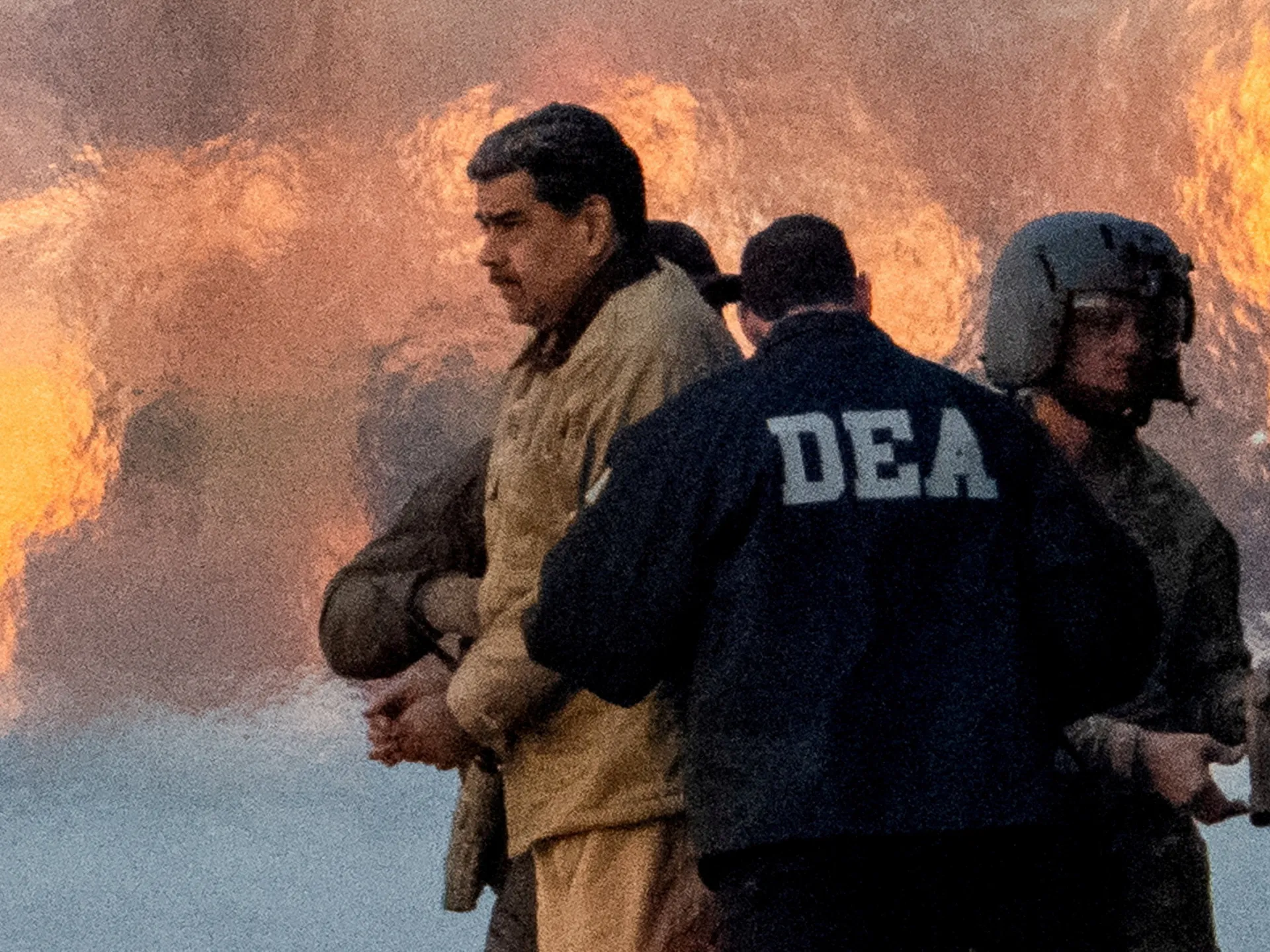
Earlier, images showed the pair being led handcuffed and under heavy guard from a helicopter en route from a detention facility to the courthouse, two days after they were forcibly removed from Caracas in a brazen US special forces operation.
“The United States arrested a narco-trafficker who is now going to stand trial in the United States,” US Ambassador to the United Nations Mike Waltz told an emergency UN Security Council meeting about the US attack on Venezuela on Saturday.
Waltz accused Maduro of being “responsible for attacks against the people of the United States, for destabilising the Western Hemisphere, and illegitimately repressing the people of Venezuela”.
Samuel Moncada, Venezuela’s ambassador to the UN, accused the US of carrying out an illegal armed attack against his country.
Venezuela was subjected to bombing, the destruction of civilian infrastructure, the loss of civilian and military lives, and the “kidnapping” of Maduro and his wife, Moncada said.
The abduction of a sitting head of state breached a core norm of international law, the personal immunity of leaders in office, he added, warning that such actions set a dangerous precedent for all countries.
Vast oil wealth
All eyes are on Venezuela’s response to the swiftly moving events after US President Donald Trump said late on Sunday that the US is “in charge” of the South American nation, which has the world’s largest proven oil reserves.
Interim President Delcy Rodriguez, who took the place of her ally Maduro, initially took a defiant stand against the seizure of the president in what some observers labelled a return to “US gunboat diplomacy”. But she has now offered “to collaborate” with Washington.
Venezuela’s opposition appreciates US intervention to remove Maduro from power, but is alarmed by Trump’s comments about US plans to “run” Venezuela, apparently with members of his government, one analyst said.
“Trump doesn’t recognise the decision of the Venezuelan people. We are not a colony of the US. We are an independent country,” Jose Manuel Puente, a professor at the Instituto de Estudios Superiores de Administracion, a private university in Caracas, told Al Jazeera.
“We want to initiate a transition to democracy, to rebuild the institutions, to rebuild the economy, to rebuild the oil sector. And we don’t see that from Trump until now.”
Rodriguez has served as Maduro’s vice president since 2018, overseeing much of Venezuela’s oil-dependent economy and its feared intelligence service, and was next in the presidential line of succession.
She’s part of a band of senior officials in Maduro’s administration who now appear to control Venezuela, even as Trump and other US officials say they’ll pressure the government to fall in line with their vision for the oil-rich nation.
On Sunday, some 2,000 Maduro supporters, including rifle-wielding men on motorcycles, rallied in Caracas with crowds shouting and waving Venezuelan flags. The Venezuelan military, loyal to Maduro, announced it recognised Rodriguez and urged calm.
The White House indicated on Sunday that it does not want regime change, only Maduro’s removal and a pliant new government that will enable US companies to exploit the country’s vast oil reserves – even if the government is filled with his former associates.
There are legal concerns about the abduction of Maduro, but little Western criticism.
The United States’ abduction of Venezuela’s President Nicolas Maduro has been sharply criticised by his allies – but not by Western nations, despite questions about its legality.
So, does the operation signal a new aggressive US strategy? And what might the global impact be?
Presenter: Adrian Finighan
Guests:
Charles Shapiro – Former US ambassador to Venezuela under President George W Bush
Stefan Wolff – Professor of International Security at the University of Birmingham in the United Kingdom
Ernesto Castaneda – Director of the Center for Latin American and Latino Studies at the American University in Washington, DC
In less than 24 hours, the US bombed Venezuela, brazenly abducted President Nicolas Maduro and his wife from their compound in Caracas and whisked them to a detention centre in New York. Here’s how regime change unfolded overnight.
Weekly insights and analysis on the latest developments in military technology, strategy, and foreign policy.
Videos and images are emerging on social media showing what appears to be a large U.S. military operation now underway around the Venezuelan capital of Caracas, which includes multiple large explosions and the presence of American special operations helicopters. While there has been no official announcement of such an operation kicking off, this comes after months of U.S. military buildup in the region aimed at pressuring cartels and Venezuelan dictator Nicolas Maduro.
See all the latest updates at the bottom of the post.
We have reached out to the White House, Pentagon, and U.S. Southern Command for comment and will update this story with any pertinent information provided.
Videos show explosions and the resulting clouds of smoke across the skyline.
Other videos show 160th Special Operations Aviation Regiment (SOAR) MH-47 Chinook helicopters (and what appear to likely be MH-60s) flying over Caracas as several explosions erupt in the background.
Full-scale military operations appear to be underway against Venezuela, with dozens of helicopters with the U.S. Army spotted over the capital of Caracas. pic.twitter.com/kIqfbGjOK4
Based on what we are seeing, which still has not been confirmed by the U.S. government at this time, it seems that large-scale kinetic actions inside Venezuela have begun as a new phase of Operation Southern Spear.
We will be updating this post with additional analysis and information. Stand by.
Update: 2:45AM EST—
The Pentagon and SOUTHCOM responded to our inquiry about what was going on and they told us to contact the White House without further comment. We haven’t gotten a response yet.
CBS News reports that Trump ordered the strikes, including on military facilities.
🚨BREAKING via @CBSNews: President Trump ordered strikes on sites inside Venezuela including military facilities, U.S. officials said, as the administration early Saturday ratcheted up its campaign against the regime of President Nicolás Maduro. via @JimLaPorta and me
Some thoughts on the timing of this operation. Flying special operations helicopter missions deep inside contested territory during nearly a full moon is far from ideal. It isn’t clear if something may have pushed-up a timeline for such an operation. Venezuela’s air defenses are not advanced, but they do pose a threat, which you can read all about here. Beyond larger SAM systems, the country also has many man-portable air defense systems (MANPADS) that are especially problematic for helicopters, as well as anti-aircraft artillery. Regardless, either the threat was deemed low enough to move forward with helicopter operations or the risk was worth the potential reward of whatever target or targets they were after.
It’s also worth noting that air strikes likely wiped out known air defenses that could put the helicopters at risk, but Venezuela’s MANPADS (if they were widely deployed) and road-mobile SAMs are far harder, and in many cases impossible, to mitigate with pre-planned strikes. We would also expect that either the U.S. had assurances that Venezuela’s fighter force would not fly, and contingencies in place to make sure they didn’t, or they were (more likely) preemptively destroyed on the ground. Beyond a fighter suppression of enemy air defenses and counter-air package, electronic and cyber warfare would have played a major role in this operation in regard to blunting Venezuela’s air defenses, as well.
Timing is interesting here. Moon is nearly full, far from optimal for this kind of thing, especially using SOF helicopters deep into a metro area like this. Strikes likely helped clear air defenses for them, but that is unclear at this time. Target may have dictated the timeline…
A video showing a helicopter firing rockets at targets on the ground is said to have come from tonight’s operation, although we cannot confirm it. This looks like a common MH-60 Direct Action Penetrator or MH-6 Little Bird rocket attack run.
One strike appeared to have hit a harbor warehouse:
Update: 3:20 AM EST—
Venezuela’s government has put out a statement decrying the attacks and saying that they are about seizing the country’s oil and mineral resources.
With what appears to be a very large contingent of 160th SOAR helicopters spearheading this operation, it seems likely that the USS Iwo Jima would be used to support them, especially as much of this ship’s air wing has been moved ashore. The special operations mothership M/V Ocean Trader is also a critical part of this effort as it has been in the region for months and sailing with the Iwo Jima, but its ability to support many helicopters is much more limited than an amphibious assault ship.
Would imagine that USS Iwo Jima is also acting as special operations mothership for this. Much of its air wing has been redeployed ashore. Ocean Trader of course is in the mix as well.
The @USNavy (🇺🇸) Iwo Jima ARG is conducting fleet maneuvers in the Caribbean Sea, notably with a special guest, the MV Ocean Trader Special Warfare Support vessel.
Here is another video showing what appears to be an MH-60 Direct Action Penetrator doing another run:
Footage of a US helicopter (possible USMC AH-1Z Viper) engaging ground targets with gun and rocket fire in Caracas, Venezuela. pic.twitter.com/mT5h1lnFkl
Early reports said Fort Tiuna was a major focus of the action. This military installation is a center of gravity for the Venezuelan military and it has some very unique features, including bunkers/tunnels built into the side of the mountain it butts up against.
Man… there is some very ‘interesting’ features at this base pertaining to what is built into the hillside.
There have been reports that the presidential palace was targeted in some way this evening, although we cannot confirm that. There are armored vehicles now in position protecting the roads nearby:
A V-150 “Commando” Armored Wheeled-Gun with the Venezuelan Army spotted near Miraflores Presidential Palace in the capital of Caracas. pic.twitter.com/ToYWjTRlMn
Airfields were extensively targeted, with some major secondary explosions:
It looks like there were some flight diversions heading to Puerto Rico:
Major diversions of civil flights away from San Juan in Puerto Rico, as U.S. forces likely use the island to stage strikes on Venezuela. pic.twitter.com/rBWwkbMYjC
It’s also worth noting that all this went down within hours of China’s envoy arriving in Caracas, in part to show support for the Maduro regime during the crisis with the United States. The diplomatic party may still be in the capital.
Just a few hours ago, Maduro held a three-hour meeting in Caracas with Xi’s Special Envoy from China, underscoring how Beijing is quietly deepening its role in the escalating U.S.–Venezuela crisis. pic.twitter.com/LWEBygUtNg
The U.S. government has issued a shelter-in-place order for any Americans who remain in Venezuela:
Update: 4:31 am EST—
President Trump has put out a statement saying the U.S. has captured Maduro and his wife and has flown them out of the country. This matches exactly with our suspicion that this operation was peculiar in its timing and how odd it was pushing the 160th SOAR over Caracas so early in the operation during nearly a full moon. Now this makes total sense. As our editor stated earlier in the evening when this began:
“Timing is interesting here. Moon is nearly full, far from optimal for this kind of thing, especially using SOF helicopters deep into a metro area like this. Strikes likely helped clear air defenses for them, but that is unclear at this time. Target may have dictated the timeline here. Use your imagination with that one.”
Timing is interesting here. Moon is nearly full, far from optimal for this kind of thing, especially using SOF helicopters deep into a metro area like this. Strikes likely helped clear air defenses for them, but that is unclear at this time. Target may have dictated the timeline…
Trump’s post on Truth Social also said there would be a presser at 11am.
Update: 5:24 am EST—
Was Maduro in on his own ‘exit’ or was this a true snatch and grab? Weird indicators point to both possibilities. This is a glaring question that we will hopefully get an answer to in the coming hours.
Venezuela’s defense minister is alive and is putting up a defiant front:
Venezuelan Defense Minister is alive and speaks:
We will not negotiate, we will not surrender, and we will ultimately triumph.
CBS News reports that the U.S. Army’s Delta Force captured Maduro. They were very likely at the center of the operation, but it’s possible, if not probable, that other elements, including those from the FBI, were also directly present during the operation.
🚨SCOOP from @CBSNews: Venezuela’s Maduro was captured by Delta Force, the US military’s elite special mission unit, sources tell me.
“Nicolas Maduro and his wife, Cilia Flores, have been indicted in the Southern District of New York,” U.S. Attorney General Pamela Bondi has now written in a post on X. “Nicolas Maduro has been charged with Narco-Terrorism Conspiracy, Cocaine Importation Conspiracy, Possession of Machineguns and Destructive Devices, and Conspiracy to Possess Machineguns and Destructive Devices against the United States.”
Nicolas Maduro and his wife, Cilia Flores, have been indicted in the Southern District of New York. Nicolas Maduro has been charged with Narco-Terrorism Conspiracy, Cocaine Importation Conspiracy, Possession of Machineguns and Destructive Devices, and Conspiracy to Possess…
— Attorney General Pamela Bondi (@AGPamBondi) January 3, 2026
Senator Mike Lee, a Utah Republican, says he has spoken with Secretary of State and acting National Security Advisor Marco Rubio about the overnight operation, confirming that Maduro is now in U.S. custody.
“This action likely falls within the president’s inherent authority under Article II of the Constitution to protect U.S. personnel from an actual or imminent attack,” Lee wrote in a post on X. “He [Rubio] anticipates no further action in Venezuela now that Maduro is in U.S. custody.”
He anticipates no further action in Venezuela now that Maduro is in U.S. custody
Pictures and videos have now emerged showing at least one of Venezuela’s Russian-made Buk-M2E surface-to-air missile systems that was destroyed by U.S. strikes. The Buk-M2E is among the Venezuelan military’s most modern air defense capabilities, as you can read more about here.
A firefighter walks past a destroyed anti-aircraft unit at La Carlota military air base, after U.S. President Donald Trump said the U.S. has struck Venezuela and captured its President Nicolas Maduro, in Caracas, Venezuela, January 3, 2026. REUTERS/Leonardo Fernandez Viloria pic.twitter.com/dFE3aOY4L3
Venezuela’s Minister of Interior Diosdado Cabello Rondon, another key figure in Maduro’s regime, has also now made a public appearance following the U.S. operation in Venezuela. Cabello, as well as Defense Minister Vladimir Padrino López, are also under indictment in the United States on charges related to drug trafficking.
Venezuelan Minister of Interior Diosdado Cabello:
Trust the leadership and remain calm. Do not fall into despair or aid the enemy.
This is not our first struggle—we have faced attacks before and endured.
The image of abducted Venezuelan President Nicolas Maduro bound and blindfolded aboard the USS Iwo Jima posted by Donald Trump prompted shock and condemnation.
A brief power vacuum had emerged in Venezuela in the sudden chaos and confusion after the abduction of President Nicolas Maduro by the United States.
But shortly after the US military rained strikes down on Caracas and other areas on Saturday, US President Donald Trump – in a surprise snub against Venezuelan opposition leader Maria Corina Machado, who was awarded last year’s Nobel Peace Prize – noted that Vice President Delcy Rodriguez, 56, had been sworn in as interim president.
Recommended Stories
list of 4 itemsend of list
The right-wing Machado – who had cosied up to Trump, especially after her October Nobel win, an honour that he himself coveted and she dedicated to him – was described by the US president as not having enough support or “respect” to be Venezuela’s leader.
Trump said Rodriguez had talked to US Secretary of State Marco Rubio and was “essentially willing to do what we think is necessary to make Venezuela great again”.
“I think she was quite gracious,” Trump added. “We can’t take a chance that somebody else takes over Venezuela that doesn’t have the good of the Venezuelan people in mind.”
However, Rodriguez’s remarks soon after the strikes and abduction were diametrical: She criticised the US military action as “brutal aggression” and called for Maduro’s immediate release.
“There is only one president in this country, and his name is Nicolas Maduro,” Rodriguez said defiantly on state television as she was flanked by top civilian officials and military commanders.
Who, then, is the current acting president of Venezuela?
Revolutionary roots
A Caracas native, Rodriguez was born on May 18, 1969. She is the daughter of left-wing rebel fighter Jorge Antonio Rodriguez, who founded the Socialist League party in the 1970s. Her father was killed while tortured in police custody in 1976, a crime that shook many activists of the era, including a young Maduro.
Rodriguez’s brother, also named Jorge, also holds a key role in government as the head of the National Assembly.
She is an attorney who graduated from the Central University of Venezuela and rose rapidly through the political ranks in the past decade. Rodriguez has a long history of representing on the world stage what late President Hugo Chavez called his socialist “revolution” with those carrying on his legacy referred to as Chavistas.
She served as communication and information minister from 2013 to 2014, foreign minister from 2014 to 2017 and as the head of a pro-government Constituent Assembly, which expanded Maduro’s powers, in 2017.
Economic prowess
Rodriguez is sometimes perceived as more moderate than many soldiers who took up arms with Chavez in the 1990s.
Rodriguez’s roles as finance and oil minister, held simultaneously with her vice presidential post, have made her a key figure in the management of Venezuela’s economy and gained her major influence with the country’s withered private sector. She has applied orthodox economic policies in a bid to fight hyperinflation.
Maduro added the oil ministry to Rodriguez’s portfolio in August 2024, tasking her with managing escalating US sanctions on Venezuela’s most important industry.
Rodriguez developed strong ties with Republicans in the US oil industry and on Wall Street who balked at the notion of a US-led change in Venezuela’s government.
Among her past interlocutors were Blackwater security company founder Erik Prince and, more recently, Richard Grenell, a Trump special envoy who tried to negotiate a deal with Maduro for greater US influence in Venezuela.
Venezuelan Vice President Delcy Rodriguez speaks during the Antifascist Global Parliamentary Forum in Caracas [File: AFP]
A ‘tiger’
Despite being perceived as more moderate, Maduro has called Rodriguez a “tiger” for her die-hard defence of his socialist government.
When she was named vice president in June 2018, Maduro described her as “a young woman, brave, seasoned, daughter of a martyr, revolutionary and tested in a thousand battles”.
After Maduro’s abduction on Saturday, Rodriguez demanded the US government provide proof of life for Maduro and his wife, Cilia Flores, and minced no words in denouncing the US actions.
“We call on the peoples of the great homeland to remain united because what was done to Venezuela can be done to anyone. That brutal use of force to bend the will of the people can be carried out against any country,” she said in an address broadcast by the state television channel VTV.
The Constitutional Chamber of Venezuela’s Supreme Court later on Saturday ordered Rodriguez to serve as acting president.
The court ruled that Rodriguez will assume “the office of President of the Bolivarian Republic of Venezuela, in order to guarantee administrative continuity and the comprehensive defence of the Nation”.
The United States intervention in Venezuela to abduct President Nicolás Maduro is not law enforcement extended beyond its borders. It is international vandalism, plain and unadorned.
Power has displaced law, preference has replaced principle and force has been presented as virtue. This is not the defence of the international order. It is its quiet execution. When a state kidnaps the law to justify kidnapping a leader, it does not uphold order. It advertises contempt for it.
The forcible seizure of a sitting head of state by the US has no foothold in international law. None. It is not self-defence under Article 51 of the United Nations Charter. It was not authorised by the UN Security Council. International law is many things, but it is not a roving moral warrant for great powers to perform regime change by abduction.
The claim that alleged human rights violations or trafficking in narcotics justifies the removal of a foreign head of state is particularly corrosive. There is no such rule. Not in treaty law. Not in custom law. Not in any serious jurisprudence.
Human rights law binds states to standards of conduct. It does not license unilateral military seizures by self-appointed global sheriffs. If that were the rule, the world would be in a permanent state of sanctioned chaos.
Indeed, if the US were serious about this purported principle, consistency would compel action far closer to home. By the logic now advanced, there would be a far stronger legal and moral case to seize Israeli Prime Minister Benjamin Netanyahu, given the extensive documentation of mass civilian harm and credible allegations of genocide arising from Israel’s conduct in Gaza.
Yet no such logic is entertained. The reason is obvious. This is not law. It is power selecting its targets.
Regime change is not an aberration in American foreign policy. It is a habit with a long paper trail, from Iran in 1953 to Guatemala in 1954, Chile in 1973 and Iraq in 2003.
But the kidnapping of a sitting president marks a new low. This is precisely the conduct the post-1945 legal order was designed to prohibit. The ban on the use of force is not a technicality. It is the central nervous system of international law. To violate it without authorisation is to announce that rules bind only the weak.
The US understands this perfectly. It is acting anyway and in doing so is conducting the autopsy of the UN Charter system itself.
The rot does not stop there. Washington has repeatedly violated its obligations under the UN Charter and the UN Headquarters Agreement. It has denied entry to officials it disfavours. Preventing the Palestinian president from addressing the UN General Assembly in person last year was not a diplomatic faux pas. It was a treaty breach by the host state of the world’s principal multilateral institution.
The message was unmistakable. Access to the international system and adherence to the UN Charter is conditional on American approval.
The UN was designed to constrain power, not flatter it. Today, it increasingly fails to constrain serious international law violations. Paralysed by vetoes, bullied by its host and ignored by those most capable of violating its charter, the UN has drifted from the supposed guardian of legality to a stage prop for its erosion.
At some point, denial becomes self-deception. The system has failed in its core promise. Not because international law is naive but because its most powerful beneficiary has decided it is optional.
It is, therefore, time to say the unsayable: The UN should be permanently relocated away from a host state that treats treaty obligations as inconveniences. And the international community must begin a serious, sober conversation about an alternative global structure whose authority is not hostage to one capital, one veto or one currency – or a system whose powers supersede the UN precisely because the UN has been hollowed out from within.
Law cannot survive as a slogan. Either it restrains those who wield the most force, or it is merely rhetoric deployed against those who do not. What the US has done in Venezuela is not a defence of order. It is a confirmation that international order has been replaced by preference. And preferences, unlike law, recognise no limits.
The views expressed in this article are the author’s own and do not necessarily reflect Al Jazeera’s editorial stance.
China has called on the United States to immediately release Venezuelan President Nicolas Maduro after Washington carried out massive military strikes on the capital, Caracas, as well as other regions, and abducted the leader.
Beijing on Sunday insisted the safety of Maduro and his wife Cilia Flores be a priority, and called on the US to “stop toppling the government of Venezuela”, calling the attack a “clear violation of international law“.
Recommended Stories
list of 4 itemsend of list
It was the second statement issued by China since Saturday, after US President Donald Trump said Washington had taken Maduro and his wife and flown them out of the country.
On Saturday, Beijing slammed the US for “hegemonic acts” and “blatant use of force” against Venezuela and its president, urging Washington to abide by the United Nations charter.
China is closely watching developments in Venezuela, according to Andy Mok, a senior research fellow at the Center for China and Globalisation.
Mok told Al Jazeera that a Chinese delegation had met Venezuelan officials just hours before the US action, adding that Beijing was not surprised by Washington’s move, given the scale of US strategic and economic interests in the region.
What did stand out, he said, was how the operation was carried out, as it may “represent the long-term US strategy in the region”.
China is Venezuela’s largest buyer of oil, Mok added, although the country accounts for only 4-5 percent of its total oil imports. Beyond energy, he said, China has growing trade and investment interests across Latin America, meaning Beijing is paying close attention to political shifts in the region.
Mok warned that if a future US administration were to revive a Monroe Doctrine-style policy, it could increase tensions with China, as Latin America is a “pillar of China’s Global South strategy”.
Still, China is likely to limit its response to the events in Venezuela to diplomatic protest rather than hard power, according to China-based analyst Shaun Rein.
“I think China has issued a very strong condemnation of the United States, and they’re working with other Latin American and Caribbean countries to say this isn’t right,” Rein, founder of the China Market Research Group, told Al Jazeera.
Rein said Beijing is deeply alarmed but constrained, and its options are limited.
“There’s not a lot of things that China can do. Frankly, it doesn’t have the military power. It only has two military bases outside of China, while America has 800,” Rein noted, stressing that, “historically, China is not warlike”.
“China is just going to make proclamations criticising the United States’ actions, but they’re not going to push back with military action, and they’re probably not going to push back with economic sanctions.”
Global condemnations, celebrations
World reaction has poured in since the US military action in Venezuela, with opinion firmly split over the intervention.
Left-leaning regional leaders, including those of Brazil, Colombia, Chile and Mexico, have largely denounced Maduro’s ouster, while countries with right-wing governments, from Argentina to Ecuador, have largely welcomed it.
Australian Prime Minister Anthony Albanese on Sunday said he backed a “peaceful, democratic transition” of power in Venezuela, but urged that international law be respected.
His government was “monitoring developments”, he said in a statement.
South Korea also responded on Sunday, calling for a de-escalation of tensions.
“Our government urges all involved parties to make utmost efforts toward easing regional tensions. We hope for a quick stabilisation of the situation via dialogue, ensuring democracy is restored, and the will of the Venezuelan people is honoured,” its Ministry of Foreign Affairs said.
Venezuela has been increasingly isolated, particularly after Maduro’s contested election in 2024.
China and Russia, however, continue to maintain strong economic and strategic ties, and alliances have grown with Iran over their shared opposition to US policy.
Within hours of a massive operation of regime change in Venezuela, United States President Donald Trump revelled in his “success”. He posted a photo of Venezuelan President Nicolas Maduro in handcuffs and then addressed the American public.
He praised the military for launching “one of the most stunning, effective and powerful displays of American military might” in US history, allegedly rendering Venezuelan forces “powerless”. He announced that Maduro and his wife would be indicted in New York for “narcoterrorism” and claimed – without evidence – that US operations have reduced maritime drug trafficking by 97 percent.
Trump went further, declaring that the US would “run the country” until an unspecified transition could be arranged, while openly threatening a “second and much larger attack”. Crucially, he framed these claims within a broader assertion of US “domination over the Western Hemisphere”, explicitly invoking the 1823 Monroe Doctrine.
The US military intervention in Venezuela represents something far more dangerous than a single act of aggression. It is the latest manifestation of a centuries-old pattern of US interference that has left Latin America scarred. The regime change operation in Caracas is a clear sign the Trump administration is embracing this old policy of interventionism with renewed fervour. And that bodes ill for the region.
That this attack targeted Maduro’s repressive and corrupt government, which was responsible for the immense suffering of many Venezuelans, makes the situation no less catastrophic. Washington’s long history of supporting brutal dictatorships across the region strips away any pretence of moral authority. Trump himself can hardly claim any moral high ground given that he is himself embroiled in a major political scandal due to his close ties with convicted paedophile Jeffrey Epstein and has maintained unconditional support for Israel’s genocide in Gaza.
The Trump administration’s attack on Venezuela solidifies a catastrophic pattern of violations of international law. If the US can unilaterally launch military strikes against sovereign nations at a whim, then the entire framework of international law becomes meaningless. This tells every nation that might and power trump legality and sovereignty.
For Latin America specifically, the implications are chilling. To understand why this attack reverberates so painfully across the region, one must take a quick look at its history. The US has orchestrated or supported coups and military dictatorships throughout the region with disturbing regularity.
In Guatemala in 1954, the CIA overthrew the democratically elected government of Jacobo Arbenz. In Chile in 1973, the US backed the coup that brought Augusto Pinochet to power and ushered in an era of unchecked political violence. In 1983, the US invaded and occupied the island of Grenada to overthrow its socialist government. In Argentina, Brazil, Uruguay, and throughout Central America, Washington provided training, funding and political cover for military regimes that tortured dissidents and murdered civilians.
The new question now is, if the US carried out regime change in Venezuela so easily, who is next? Colombia’s President Gustavo Petro, who has been at odds with the Trump administration, was quick to react – and is right to be concerned, as in December, Trump threatened an intervention, saying “he’ll be next“. Others in the region are also nervous.
Beyond the looming threat of US intervention, Latin America now also faces the potential regional instability that a regime change in Caracas is likely to create. The political crisis under Maduro had already spilled beyond its borders into neighbouring Colombia and Brazil, where Venezuelans fled poverty and repression. One can only imagine the ripple effect the US-enacted regime change will have.
There are probably many Venezuelans who are celebrating Maduro’s ouster. However, the US intervention directly undermines the political opposition in Venezuela. It would allow the regime, which appears to retain power, to paint all opposition as foreign agents, eroding its legitimacy.
The Venezuelan people deserve democracy, but they have to achieve it themselves with international support, not to have it imposed at gunpoint by a foreign power with a documented history of caring more about resources and geopolitical dominance than human rights.
Latin Americans deserve better than to choose between homegrown authoritarianism and imported violence. What they need is not American bombs but genuine respect for self-determination.
The US has no moral authority to attack Venezuela, regardless of Maduro’s authoritarian nature. Both can be true: Maduro is a dictator who caused immense harm to his people, and US military intervention is an illegal act of aggression that will not resolve the crisis of democracy in Venezuela.
The region’s future must be determined by people themselves, free from the shadow of empire.
The views expressed in this article are the author’s own and do not necessarily reflect Al Jazeera’s editorial stance.
United States President Donald Trump has said that Washington will “run” Venezuela until a political transition can take place, hours after US forces bombed the South American country and “captured” its president, Nicolas Maduro.
Speaking during a news conference on Saturday, Trump said the US would “run the country until such time as we can do a safe, proper and judicious transition”.
Recommended Stories
list of 3 itemsend of list
“We don’t want to be involved with having somebody else get in, and we have the same situation that we had for the last long period of years,” he said.
The Trump administration launched attacks on Venezuela’s capital, Caracas, and seized Maduro and his wife in the early hours of Saturday.
A plane carrying the Venezuelan leader landed in New York state on Saturday evening, according to US media.
Footage broadcast by CNN, Fox News and MS Now showed US officials escorting a person they identified as Maduro off a plane at the Stewart international airport, about 97 kilometres (60 miles) northwest of New York City.
Maduro’s capture took place after a months-long US pressure campaign against his government, which included US seizures of oil tankers off the Venezuelan coast, as well as deadly attacks on alleged drug-smuggling boats in the Caribbean. The attacks were widely denounced as extrajudicial killings.
Washington had accused the Venezuelan leader, who has been in power since 2013, of having ties to drug cartels. Maduro had rejected the claim, saying the US was working to depose him and take control of Venezuela’s vast oil reserves.
During Saturday’s news conference, Trump said that “very large United States oil companies” would move into Venezuela to “fix the badly broken… oil infrastructure and start making money for the country”.
He added that his administration’s actions “will make the people of Venezuela rich, independent and safe”.
The Trump administration has defended Maduro’s “capture, saying the left-wing leader faced drug-related charges in the US.
These charges include “narco-terrorism conspiracy, cocaine importation conspiracy, possession of machine guns and destructive devices, and conspiracy to possess machine guns and destructive devices against the United States”, US Attorney General Pam Bondi said.
“They will soon face the full wrath of American justice on American soil in American courts,” she added in a post on X.
A Justice Department official told the Reuters news agency that Maduro is expected to make an initial appearance in Manhattan federal court on Monday.
‘Illegal abduction’
But legal experts, world leaders and Democratic Party lawmakers in the US have condemned the administration’s actions as a violation of international law.
“Attacking countries, in flagrant violation of international law, is the first step towards a world of violence, chaos, and instability, where the law of the strongest prevails over multilateralism,” Brazilian President Luiz Inacio Lula da Silva wrote on X.
Ben Saul, the United Nations special rapporteur on human rights and counterterrorism, slammed what he called Washington’s “illegal abduction” of Maduro. “I condemn the US’ illegal aggression against Venezuela,” Saul wrote on social media.
A spokesperson for UN chief Antonio Guterres said he was “deeply alarmed” by the situation, describing the US’s actions as setting “a dangerous precedent”.
“The Secretary-General continues to emphasize the importance of full respect – by all – of international law, including the UN Charter. He’s deeply concerned that the rules of international law have not been respected,” Guterres’s office said in a statement.
Earlier on Saturday, Venezuela’s defence minister released a defiant statement in response to the US attacks, urging people to remain united.
“We will not negotiate; we will not give up,” Vladimir Padrino Lopez said, stressing that Venezuela’s independence is not up for negotiation. “We must maintain calm and [be] united in order to prevail in these dire moments.”
Uncertainty prevails
It remains unclear how exactly the US plans to “run” Venezuela, and how long the purported transitional period will last.
During Saturday’s news conference, Trump said that US Secretary of State Marco Rubio had spoken with Venezuelan Vice President Delcy Rodriguez.
“She was sworn in as president just a little while ago,” Trump told reporters. “She had a long conversation with [Rubio], and she said, ‘We’ll do whatever you need’. I think she was quite gracious, but she really doesn’t have a choice.”
Rodriguez appeared to contradict that in a news conference in Caracas later in the day.
“We demand the immediate release of President Nicolas Maduro and his wife. The only president of Venezuela is President Nicolas Maduro,” she said.
“We are ready to defend Venezuela. We are ready to defend our natural resources, which should be for national development,” she added.
Al Jazeera’s Latin America editor Lucia Newman, reporting from Chile, said that, if Rodriguez is “on board” with the US plan for Venezuela, as Trump and Rubio have suggested, “she certainly didn’t sound like it” during her address.
“She sounded like her typical, fiery self, very much on the side of… Maduro, demanding that he be released and saying that Venezuela would not be a colony of the United States,” Newman said.
The events of the day have brought “a rollercoaster of emotions” to “Venezuelans both inside and outside of the country”, said Caracas-based journalist Sissi de Flaviis.
“When we first heard that Maduro was taken out of the country, there was a mix of reactions,” she said. “A lot of people couldn’t believe it. Other people were pretty much celebrating. Other people were kind of on standby, waiting.”
After Trump’s news conference announcing US plans to run Venezuela, “there’s been a shock”, de Flaviis added.
“People are a bit concerned about what this will actually mean for us, what this will mean for the government and who is going to lead us in the next few days, months and years.”
Meanwhile, Harlan Ullman, a former US naval officer, told Al Jazeera that “the notion of America taking over Venezuela is going to explode in our faces”.
“When Trump says, ‘We’re going to run the country’: We’re not capable of running America, how are we going to be able to run Venezuela?” Ullman said.
“I do not believe that we have a plan for dealing with Venezuela,” he added. “A country is extraordinarily complex. We lack the knowledge, understanding and all the logistics to do this.”
Leaders around the world have responded with a mix of condemnation and support to the US capture of Venezuela’s President Nicolás Maduro.
Following a large-scale strike on Venezuela on Saturday, Maduro and his wife were captured by US forces and removed from the country. The pair have been indicted on drug charges in New York.
In an initial response, UK Prime Minister Keir Starmer said his government would “shed no tears” for the end of Maduro’s regime.
Neighbouring Latin American countries condemned the actions, as did Venezuela’s long-term allies, Russia and China. China said it was “deeply shocked and strongly condemns” the use of force against a sovereign country and its president.
Russia accused the US of committing “an act of armed aggression”.
Iran, which is locked in its own dispute with Trump over his promise of intervention in its country, called the strikes a “flagrant violation of the country’s national sovereignty”.
Trump said the US will “run” Venezuela “until we can do a safe, proper and judicious transition”.
Many Latin American leaders condemned the US actions.
President Luiz Inacio Lula Da Silva in Brazil wrote on X that the actions “cross an unacceptable line”, adding “attacking countries in flagrant violation of international law is the first step toward a world of violence, chaos, and instability”.
Colombian President Gustavo Petro called the strikes an “assault on the sovereignty” of Latin America, while Cuba’s President Miguel Diaz-Canel described it as a “criminal attack”.
Chile’s President Gabriel Boric expressed “concern and condemnation” on X and called for “a peaceful solution to the serious crisis affecting the country”.
Cuban President Miguel Diaz-Cane accused the US of a “criminal attack”, while Uruguay said in an official statement it was monitoring developments “with attention and serious concern” and “rejects, as it always has, military intervention”.
Trump has indicated that Cuba could become part of a broader US policy in the region, calling it a failing nation. Secretary of State Marco Rubio said Cuba was a disaster run by incompetent leaders who supported Maduro’s administration. He said the government in Havana should be concerned
The Venezuelan Interior Minister Diosdado Cabello urged citizens to remain calm and to trust the country’s leadership and military, saying, “The world needs to speak out about this attack,” according to the Reuters news agency.
Meanwhile UK Prime Minister Sir Keir Starmer refused to be drawn into whether or not the military action may have broken international law.
In an interview with the BBC’s Sunday with Laura Kuenssberg programme on Saturday morning, the prime minister did not condemn the US strikes.
He said he was waiting to establish all the facts but would not “shy away from this”, adding he was a “lifelong advocate of international law”.
The UK was not involved in the strikes and Sir Keir said he had not spoken to Trump about the operation.
Later on Saturday, Sir Keir posted on X that the UK “regarded Maduro as an illegitimate president and we shed no tears about the end of his regime”.
“The UK government will discuss the evolving situation with US counterparts in the days ahead as we seek a safe and peaceful transition to a legitimate government that reflects the will of the Venezuelan people,” he added.
The EU’s top diplomat Kaja Kallas reiterated the bloc’s position that Maduro lacks legitimacy, that there should be a peaceful transition of power, and that the principles of international law must be respected.
French President Emmanuel Macron said the transition of power “must be peaceful, democratic, and respectful of the will of the Venezuelan people” in a post on X.
He added he hoped González – the opposition’s 2024 presidential candidate – could ensure the transition.
German Chancellor Friedrich Merz said the legality of the US operation was “complex” and international law in general must apply.
He warned that “political instability must not be allowed to arise in Venezuela”.
UN Secretary General Antonio Guterres said he was “deeply concerned that the rules of international law have not been respected”, his spokesperson said. He was “deeply alarmed” by the strikes, which set a “dangerous precedent”.
He called on all actors in Venezuela to engage in inclusive dialogue, in full respect of human rights and the rule of law”.
In the US, Senate Minority Leader Chuck Schumer, a Democrat, said, “Let me be clear, Maduro is an illegitimate dictator, but launching military action without congressional authorization, without a federal plan for what comes next, is reckless”
US President Donald Trump says the US “successfully captured” Venezuela President Nicolas Maduro and his wife “in the dead of night” and they will “face American justice” for alleged narcoterrorism. Trump said the US will run Venezuela until there is a “safe… and judicious” transition of power.
The United States early Saturday morning staged a mission to apprehend Venezuelan President Nicolás Maduro, pictured in November, and his wife, both of whom have been indicated in the United States for narco-terrorism. File Photo by Venezuelan President Office/UPI | License Photo
Jan. 3 (UPI) — The United States early Saturday morning staged a daring “large strike against Venezuela,” during which the country’s president, Nicolas Maduro, was captured and flown out of the country.
President Donald Trump announced on Truth Social that Maduro and Maduro’s wife had been captured, with the New York Times reporting that they were flown by helicopter to the USS Iwo Jima and that both will eventually face charges in the Southern District of New York.
“The United States of America has successfully carried out a large scale strike against Venezuela and its leader, President Nicolas Maduro, who h as been, along with his wife, captured and flown out of the country,” Trump said in the Truth Social post. “This operation was done in conjunction with U.S law enforcement.”
Trump said that a news conference will be held at 11 a.m. EST from Mar-a-Lago, his golf club in Florida.
This is a developing story. Please check back for updates.
President Donald Trump holds a signed executive order reclassifying marijuana from a schedule I to a schedule III controlled substance in the Oval Office of the White House on Thursday. Photo by Aaron Schwartz/UPI | License Photo
Medellin, Colombia – The shock removal of Venezuelan leader Nicolas Maduro by the United States military has triggered alarm in bordering Colombia, where analysts warn of the possibility of far-reaching repercussions.
The Colombian government condemned Washington’s early Saturday morning attacks on Venezuela – which included strikes on military targets and Maduro’s capture – and announced plans to fortify its 2,219-kilometre (1,378-mile) eastern land border, a historic hotbed of rebellion and cocaine production.
Recommended Stories
list of 3 itemsend of list
Security analysts also say Maduro’s deposition could aggravate an already deteriorating security situation in Colombia, while refugee advocacy groups warn the country would bear the brunt of possible migration waves triggered by the fallout from the intervention.
The Colombian government held an emergency national security meeting at 3am (09:00GMT), according to President Gustavo Petro.
“The Colombian government condemns the attack on the sovereignty of Venezuela and Latin America,” wrote the president in an X post, announcing the mobilisation of state forces to secure the border.
The ELN factor
The National Liberation Army (ELN), a left-wing group and the largest remaining rebel force in the country, have been vocal as recently as December in its preparations to defend the country against “imperialist intervention”.
Security analysts say the primary national security risk to Colombia following the attacks stems from ELN, which controls nearly the entire border with Venezuela.
“I think there is a high risk now that the ELN will consider retaliation, including here in Colombia, against Western targets,” said Elizabeth Dickinson, deputy director for Latin America at Crisis Group International.
The rebel group is heavily involved in cocaine trafficking and operates on both sides of the border; it has benefited from ties with the Maduro government, and US intervention threatens the group’s transnational operations, according to analysts.
The ELN, which positions itself as a bastion against US imperialism in the region, had already stepped up violence in response to the White House’s threats against Colombia and Venezuela. In December, it ordered Colombians to stay home and bombed state installations across the country, an action it described as a response to US aggression.
The Colombian government has ramped up security measures in anticipation of possible retaliatory action by the ELN following Maduro’s removal.
“All capabilities of the security forces have been activated to protect the population, strategic assets, embassies, military and police units, among others, as well as to prevent any attempted terrorist action by transnational criminal organisations, such as the ELN cartel,” read a statement on Saturday morning issued by Colombia’s Ministry of Defence.
‘Mass influx of refugees’
In addition to fears of increased violence, Colombia also stands to bear the brunt of any migration crisis initiated by a conflict in Venezuela.
In an X post on Saturday morning, Petro said the government had bolstered humanitarian provisions on its eastern border, writing, “all the assistance resources at our disposal have been deployed in case of a mass influx of refugees.”
To date, Colombia has received the highest number of Venezuelan refugees worldwide, with nearly 3 million of the approximately 8 million people who have left the country settling in Colombia.
The previous wave of mass migration in 2019 – which followed opposition leader Juan Guaido’s failed attempt to overthrow Maduro – required a massive humanitarian operation to house, feed, and provide medical attention to refugees.
Such an operation is likely to prove even more challenging now, with Colombia losing roughly 70 percent of all humanitarian funds after the Trump administration shuttered its USAID programmes in the country last year.
“There is a real possibility of short-term population movement, both precautionary and forced, especially if instability, reprisals, or power vacuums emerge,” said Juan Carlos Viloria, a leader of the Venezuelan diaspora in Colombia.
“Colombia must prepare proactively by activating protection mechanisms, humanitarian corridors, and asylum systems, not only to respond to potential arrivals, but to prevent chaos and human rights violations at the border,” added Viloria.
A further collapse in US-Colombia relations
Analysts say Maduro’s removal raises difficult questions for Petro, who has been engaged in a war of words with Trump since the US president assumed office last year.
The Colombian leader drew Trump’s ire in recent months when he condemned Washington’s military buildup in the Caribbean and alleged a Colombian fisherman had been killed in territorial waters. In response, the White House sanctioned Petro, with Trump calling him a “thug” and “an illegal drug dealer”.
“Petro is irascible at the moment because he sees Trump and his threats no longer as empty, but as real possibilities,” said Sergio Guzman, Director at Colombia Risk Analysis, a Bogota-based security consultancy.
Indeed, Trump has on multiple occasions floated military strikes against drug production sites in Colombia. However, experts say it is unlikely the White House would take unilateral action given their historic cooperation with Colombian security forces.
Despite Petro condemning Washington’s intervention in Venezuela, he previously called Maduro a “dictator” and joined the US and other nations in refusing to recognise the strongman’s fraudulent re-election as president in 2024.
Rather than supporting Maduro, the Colombian leader has positioned himself as a defender of national sovereignty and international law.
On Saturday, Petro called for an emergency meeting of the United Nations Security Council, which Colombia joined as a temporary member just days ago.
“Colombia reaffirms its unconditional commitment to the principles enshrined in the Charter of the United Nations,” wrote the president in an X post.
This story has been published in conjunction with Latin America Reports.
United States President Donald Trump announced on Saturday morning that his country’s forces had bombed Venezuela and captured the South American nation’s president, Nicolas Maduro, and First Lady Cilia Flores in a dramatic overnight military attack that followed months of rising tensions.
Venezuela’s government said that the US had struck three states apart from the capital, Caracas, while neighbouring Colombia’s President Gustavo Petro released a longer list of places that he said had been hit.
The operation has few, if any, parallels in modern history. The US has previously captured foreign leaders, including Iraq’s Saddam Hussein and Panama’s Manuel Noriega, but after invading those countries in declared wars.
Here is what we know about the US attacks and the lead-up to this escalation:
Pedestrians run after explosions and low-flying aircraft were heard in Caracas, Venezuela, on Saturday, January 3, 2026 [Matias Delacroix/ AP Photo]
How did the attack unfold?
At least seven explosions were reported from Caracas, a city of more than three million people, at about 2am local time (06:00 GMT), as residents said they heard low-flying aircraft. Lucia Newman, Al Jazeera’s Latin America editor, reported that at least one of the explosions appeared to come from near Fort Tiuna, the main military base in the Venezuelan capital.
Earlier, the US Federal Aviation Administration had issued instructions to American commercial airlines to stay clear of Venezuelan airspace.
Within minutes of the explosions, Maduro declared a state of emergency, as his government named the US as responsible for the attacks, saying that it had struck Caracas as well as the neighbouring states of Miranda, Aragua and La Guaira.
The US embassy in Bogota, Colombia, referred to the reports of the explosions and asked American citizens to stay out of Venezuela, in a statement. But the diplomatic mission did not confirm US involvement in the attacks. That came more than three hours after the bombings, from Trump.
Supporters of Venezuelan President Nicolas Maduro embrace in downtown Caracas, Venezuela, on Saturday, January 3, 2026, after US President Donald Trump announced that Maduro had been captured and flown out of the country [Cristian Hernandez/ AP Photo]
What did Trump say?
In a post on his Truth Social platform, Trump said, a little after 09:00 GMT that the US had “successfully carried out a large scale strike against Venezuela and its leader, President Nicolas Maduro, who has been, along with his wife, captured and flown out of the Country”.
Venezuela has not yet confirmed that Maduro was taken by US troops — but it also has not denied the claim.
Trump said that the attack had been carried out in conjunction with US law enforcement, but did not specify who led the operation.
Trump announced that there would be a news conference at his Mar-a-Lago resort in Florida at 11am local time (16:00 GMT) on Friday, where more details would be revealed.
Where did the US attack in Venezuela?
While neither the US nor Venezuelan authorities have pinpointed locations that were struck, Colombia’s Petro, in a social media post, listed a series of places in Venezuela that he said had been hit.
They include:
La Carlota airbase was disabled and bombed.
Cuartel de la Montana in Catia was disabled and bombed.
The Federal Legislative Palace in Caracas was bombed.
Fuerte Tiuna, Venezuela’s main military complex, was bombed.
An airport in El Hatillo was attacked.
F-16 Base No 3 in Barquisimeto was bombed.
A private airport in Charallave, near Caracas, was bombed and disabled.
Miraflores, the presidential palace in Caracas, was attacked.
Large parts of Caracas, including Santa Monica, Fuerte Tiuna, Los Teques, 23 de Enero and the southern areas of the capital, were left without electricity.
Attacks were reported in central Caracas.
A military helicopter base in Higuerote was disabled and bombed.
The US Navy’s Gerald R Ford Carrier Strike Group, including the flagship USS Gerald R Ford, USS Winston S Churchill, USS Mahan and USS Bainbridge, sail towards the Caribbean Sea, in the Atlantic Ocean, on November 13, 2025 [US Navy/Petty Officer 3rd Class Tajh Payne/Handout via Reuters]
What led to these US attacks on Venezuela?
Trump has, in recent months, accused Maduro of driving narcotics smuggling into the US, and has claimed that the Venezuelan president is behind the Tren de Aragua gang that Washington has proscribed as a foreign terrorist organisation.
But his own intelligence agencies have said that there is no evidence that Maduro is linked to Tren de Aragua, and US data shows that Venezuela is not a major source of contraband narcotics entering the country.
Starting in September, the US military launched a series of strikes on boats in the Caribbean Sea that it claimed were carrying narcotics. More than 100 people have been killed in at least 30 such boat bombings, but the Trump administration is yet to present any public evidence that there were drugs on board, that the vessels were travelling to the US, or that the people on the boats belonged to banned organisations, as the US has claimed.
Meanwhile, the US began its largest military deployment in the Caribbean Sea in at least several decades, spearheaded by the USS Gerald Ford, the world’s largest aircraft carrier.
In December, the US hijacked two ships carrying Venezuelan oil, and has since imposed sanctions on multiple companies and their tankers, accusing them of trying to circumvent already stringent American sanctions against Venezuela’s oil industry.
Then, last week, the US struck what Trump described as a “dock” in Venezuela where he claimed drugs were loaded onto boats.
Could all this be about oil?
Trump has so far framed his pressure and military action against Venezuela and in the Caribbean Sea as driven by a desire to stop the flow of dangerous drugs into the US.
But he has increasingly also sought Maduro’s departure from power, despite a phone call in early December that the Venezuelan president described as “cordial”.
And in recent weeks, some senior aides of the US president have been more open about Venezuela’s oil: the country’s vast reserves of crude, unmatched in the world, amounted to an estimated 303 billion barrels (Bbbl) as of 2023.
On December 17, Trump’s top adviser Stephen Miller claimed that the US had “created the oil industry in Venezuela” and that the South American country’s oil should therefore belong to the US.
But though US companies were the earliest to drill for oil in Venezuela in the early 1900s, international law is clear: sovereign states — in this case Venezuela — own the natural resources within their territories under the principle of Permanent Sovereignty over Natural Resources (PSNR).
Venezuela nationalised its oil industry in 1976. Since 1999, when socialist President Hugo Chavez, Maduro’s mentor and predecessor, came to power, Venezuela has been locked in a tense relationship with the US.
Still, one major US oil company, Chevron, continues to operate in the country.
The Venezuelan opposition, led by Nobel Peace Prize laureate Maria Corina Machado, has publicly called for the US to intervene against Maduro, and has pointed to the oil reserves that American firms could tap more easily with a new dispensation in power in Caracas.
Oil has long been Venezuela’s biggest export, but US sanctions since 2008 have crippled formal sales and the country today earns only a fraction of what it once did.
Venezuelan Vice President Delcy Rodriguez speaks to the media at the Foreign Office in Caracas, Venezuela, on August 11, 2025 [Ariana Cubillos/AP Photo]
How has Venezuela’s government reacted?
While Venezuela has not confirmed Maduro’s capture, Vice President Delcy Rodrigues told state-owned VTV that the government had lost contact with Maduro and First Lady Flores and did not have clarity on their whereabouts.
She demanded that the US provide “proof of life” of Maduro and Flores, and added that Venezuela’s defences were activated.
Earlier, in a statement, the Venezuelan government said that it “rejects, repudiates and denounces” the attacks.
It said that the aggression threatens the stability of Latin America and the Caribbean, and places the lives of millions of people at risk. It accused the US of trying to impose a colonial war, and force a regime change — and said that these attempts would fail.
This combination of pictures created on August 7, 2025 shows US President Donald Trump in Washington, DC, on July 9, 2025, and Venezuelan President Nicolas Maduro, right, in Caracas on July 31, 2024 [Jim Watson and Federico Parra/AFP]
What happens to Maduro next?
In a statement posted on X, Trump’s Attorney General Pam Bondi announced that Maduro and his wife have been indicted in the Southern District of New York.
Maduro has been charged with “Narco-Terrorism Conspiracy, Cocaine Importation Conspiracy” among other charges, Bondi said. It was unclear if his wife is facing the same charges, but she referred to the Maduro couple as “alleged international narco traffickers.”
“They will soon face the full wrath of American justice on American soil in American courts,” she added.
Mike Lee, a Republican senator from Utah, earlier posted on X that he had spoken to US Secretary of State Marco Rubio, who had told him that Maduro had been “arrested by US personnel to stand trial on criminal charges in the United States, and that the kinetic action we saw tonight was deployed to protect and defend those executing the arrest warrant.”
In 2020, US prosecutors had charged Maduro with running a cocaine-trafficking network.
But US officials remain silent on the illegality of Maduro’s capture and the attacks on Venezuela, which violate UN charter principles of sovereignty and territorial integrity of nations.
Russia and Cuba, close Maduro allies, condemned the attack. Colombia, which neighbours Venezuela and has itself been in Trump’s crosshairs, said that it “rejects the aggression against the sovereignty of Venezuela and of Latin America” – even though Bogota itself does not recognise Maduro’s government.
Most other nations have been relatively muted in their response to the US aggression so far.
Venezuela’s Interior Minister Diosdado Cabello, left, Defence Minister Vladimir Padrino Lopez, second from left, and Vice President Delcy Rodriguez, centre, seen here at a ceremony commemorating the 80th anniversary of the Soviet Union’s victory over Nazi Germany in World War II in Caracas, Venezuela, on Tuesday, May 13, 2025. Rodriguez, Cabello and Lopez are among the leaders widely seen as Maduro’s closest aides [Cristian Hernandez/AP Photo]
What’s next for Venezuela?
Constitutionally, Rodriguez, the vice president, is next in line to take charge if Maduro indeed has been plucked out of Venezuela by the US.
Other senior leaders seen as close to Maduro and influential within the Venezuelan hierarchy include Interior Minister Diosdado Cabello, National Assembly President — and Delcy’s brother — Jorge Rodriguez, and military chief General Vladimir Padrino López.
But it is unclear whether the state apparatus that Chavez and Maduro carefully built over a quarter century will last without them.
“Maduro’s capture is a devastating moral blow for the political movement started by Hugo Chavez in 1999, which has devolved into a dictatorship since Nicolas Maduro took power,” Carlos Pina, a Venezuelan analyst based in Mexico, told Al Jazeera.
If the US does engineer — or has already engineered — a regime change, the opposition’s Machado could be a front-line candidate to take Venezuela’s top job, though it is unclear how popular that might be. In a November poll in Venezuela, 55 percent of participants were opposed to military intervention in their country, and an equal number were opposed to economic sanctions against Venezuela.
Trump might be mistaken if he thinks the US can stay out of the chaos that’s likely to follow in a post-Maduro Venezuela, suggests Christopher Sabatini, a senior research fellow for Latin America, the US and North America programme at Chatham House.
“Assuming even if there is regime change – of some sort, and it’s by no means clear even if it does happen that it will be democratic – the US’s military action will likely require sustained US engagement of some sort,” he said.
“Will the Trump White House have the stomach for that?”
Jan. 2 (UPI) — Venezuelan President Nicolás Maduro said claims that his government engages in drug trafficking are lies, and he is willing to meet with President Donald Trump amid rising tensions.
Maduro on Thursday accused the Trump administration of knowingly making false claims of drug trafficking, including recent comments by Trump saying Venezuela’s alleged drug trafficking is akin to using weapons of mass destruction
“Since they cannot accuse me, since they cannot accuse Venezuela of having weapons of mass destruction, since they cannot accuse us of having nuclear rockets, of preparing a nuclear weapon, of having chemical weapons, they invented an accusation that the United States knows is as false as that accusation of weapons of mass destruction, which led them to an eternal war,” Maduro said while referencing the Iraq War.
The Venezuelan president offered to work with U.S. officials to oppose drug trafficking and repeated his prior offers to meet with Trump to discuss the U.S. military targeting alleged drug vessels, seizing oil tankers and blockading Venezuelan ports.
“The U.S. government knows, because we’ve told many of their spokespeople that, if they want to seriously discuss an agreement to combat drug trafficking, we’re ready,” he said in a taped interview on Venezuela’s state-owned channel teleSUR.
The Venezuelan president also suggested his country and the United States could work together to enable U.S. firms to invest in Venezuela’s oil industry “whenever they want it, wherever they want it and however they want it.”
Maduro refused to comment on a recently reported U.S. strike on an alleged drug-processing facility located among docks on Venezuela’s Caribbean coastline.
The CIA also has refused to comment on the strike, which Trump announced on Monday and said “knocked out” a drug facility on Saturday night.
The president in October announced he authorized the CIA to undertake operations in Venezuela but did not say what kind.
The Defense Department also sent a carrier strike group to the Caribbean to stop alleged drug-trafficking fast boats from transporting drugs intended for the United States and Europe and more recently to blockade Venezuelan ports amid seizures of sanctioned vessels.
The White House has said the strikes on the alleged drug boats are intended to stop South American drug cartels from sending drugs to the United States, which has some U.S. officials questioning the legality of such strikes.
The U.S. Southern Command announced two more boat strikes that killed five in international waters on New Year’s Eve.
The United States began striking the alleged drug boats in September and has sunk at least 36 and killed at least 115.
Most of the drug boat strikes, 23, have occurred in the eastern Pacific Ocean and away from Venezuela, while 11 others occurred in the Caribbean Sea, with another two in undisclosed locations.
The United States also has placed a $50 million bounty on Maduro and recently sanctioned some of his family members for their alleged roles in drug trafficking.
Trump also has accused Maduro of intentionally sending criminals and others to the United States during the Biden administration, including members of the Venezuela-based Tren de Aragua gang that he has designated as a foreign terrorist organization.
US President Donald Trump warned Nicolas Maduro to ‘not play tough’ and to step down on Monday, while the Venezuelan leader said Trump should focus on the issues in his own country. Trump told reporters the US will keep 1.9 million barrels of oil that were seized near Venezuela in December.
Mario Lubetkin on Washington’s revived sphere-of-influence doctrine, Venezuela, and China’s growing footprint.
The United States is reviving a policy first set out in the 1800s that treats Latin America as its strategic sphere of influence. As Washington expands maritime operations in the Caribbean and eastern Pacific, critics warn of legal violations and rising regional instability.
Uruguay’s Foreign Minister Mario Lubetkin joins Talk to Al Jazeera to discuss US strikes, Venezuela, migration pressures, and China’s growing role in the region — and whether diplomacy can still prevent escalation in a hemisphere shaped once again by power politics.