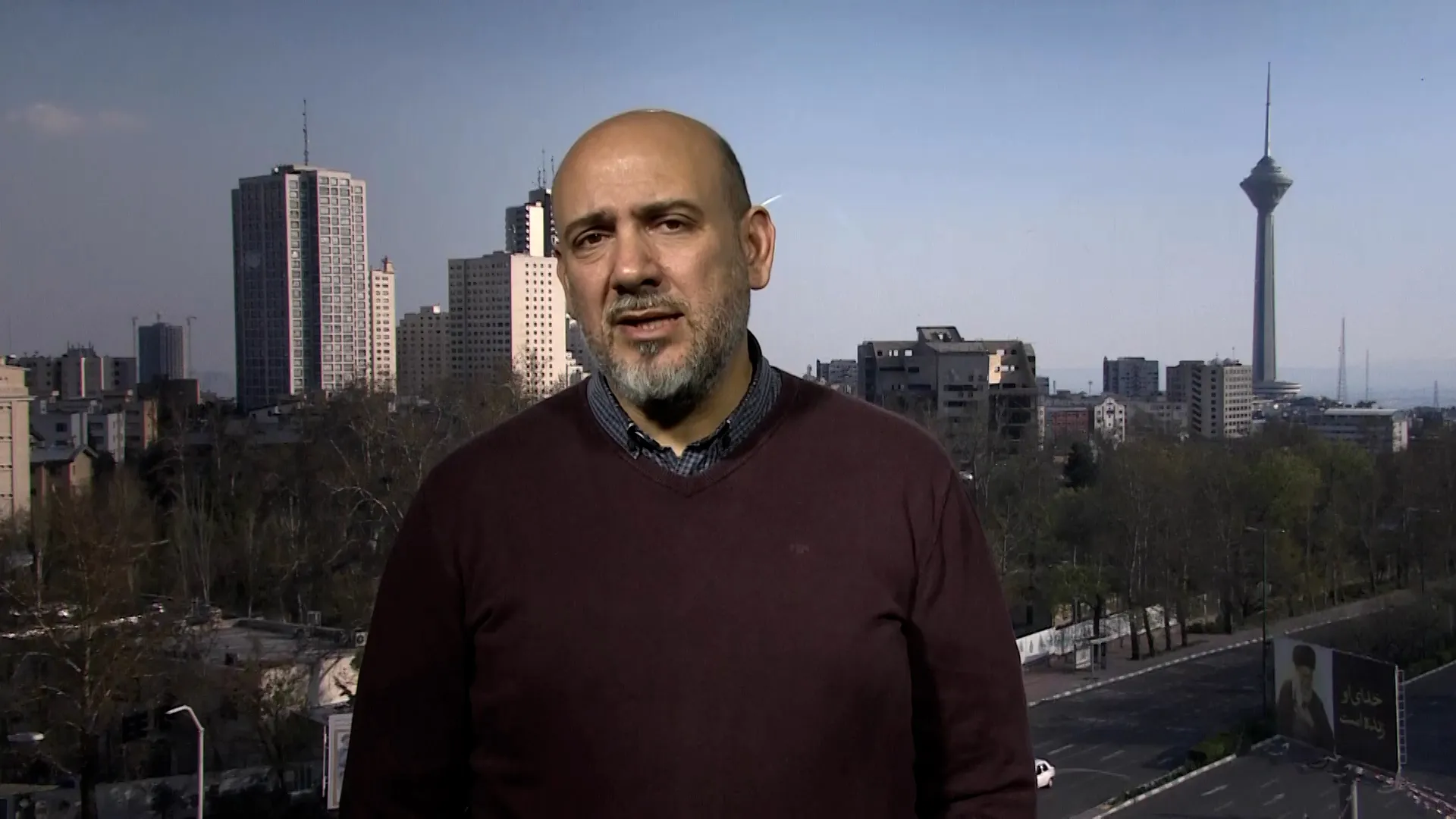
A senior Iranian official has laughed in response to US President Donald Trump’s claim that Iran’s president has asked for a ceasefire, Al Jazeera’s Ali Hashem says Trump’s comments come a day after Iran’s foreign minister said his country was not looking for a ceasefire.
A Lahore court has ruled in favour of Pakistani singer Ali Zafar in his defamation case against fellow singer Meesha Shafi. On Tuesday, the court ordered Shafi to pay Zafar 5 million rupees ($17,900) in damages.
Zafar sued Shafi for defamation in 2018 after she accused him of sexual harassment in Pakistan’s highest-profile #MeToo case.
What has the court ruled?
The court’s ruling, which has not been released to the public but has been seen by several Pakistani media outlets, states that a 2018 social media post by Shafi and an interview she gave to a lifestyle magazine contained “false, defamatory and injurious imputations” against the plaintiff, Zafar.
The court found that her allegations of sexual harassment of a physical nature had not been proved to be true or shown to be made for the public good, and therefore constituted actionable defamation, according to Pakistan’s leading daily newspaper, Dawn.
The court added that Shafi was to be “permanently restrained from repeating, publishing, or causing to be published, directly or indirectly, the aforesaid defamatory allegations of sexual harassment of a physical nature against the plaintiff, in any form of media”.
This order will be appealed to the High Court, Nighat Dad, the lawyer who represented Shafi in court, told Al Jazeera.
As well as a member of Shafi’s legal team, Dad is the executive director of a nongovernmental, research-based advocacy organisation, the Digital Rights Foundation.
She said: “The appeal is likely to challenge the judgement on several grounds: that the trial court misread and selectively interpreted the evidence, failed to properly consider material evidence presented by Meesha, and overlooked the legal context, particularly that her sexual harassment complaint against Ali Zafar is still pending before the Supreme Court.”
What was the #MeToo case involving Shafi and Zafar?
In April 2018, Shafi, now 44, posted a statement through a series of posts on X, then called Twitter, accusing Zafar of sexually harassing her on multiple occasions.
Shafi wrote: “I have been subjected, on more than one occasion, to sexual harassment of a physical nature at the hands of a colleague from my industry: Ali Zafar.”
Shafi added that she was speaking up as an “empowered, accomplished woman who is known for speaking her mind!”
In her posts, Shafi referred to the global “#MeToo” movement by women and girls against sexual harassment and assault.
The hashtag gained worldwide prominence in 2017 when women in Hollywood and beyond began speaking out in the wake of allegations against the former American film producer and now convicted sex offender, Harvey Weinstein.
Within hours of Shafi’s post, Zafar, now 45, responded on X: “I categorically deny any and all claims of harassment lodged against me by Ms Shafi.”
He added that he intended to take the allegation to “the courts of law” and to address them legally rather than “contesting personal vendettas on social media and in turn disrespecting the movement”.
Shafi and Zafar were once known to be friends and are both prominent figures in Pakistan’s entertainment industry. Both have also made appearances in films outside Pakistan. Shafi even performed a small cameo role in 2003 in a music video for Zafar’s first album.
In April 2018, Shafi spoke about her allegations against Zafar during an interview with fashion and lifestyle magazine Instep Pakistan.
She told the magazine that she had not publicly spoken about the harassment at the time it happened because “I’m a public figure and so is he (Ali Zafar). My thought process was who I am and who he is and what that’s going to lead to. Being ready to talk was far off because it had just happened. I buried it.”
Have other women accused Zafar of inappropriate behaviour?
Yes. Several Pakistani celebrities and public figures posted in support of Shafi online after her 2018 X posts.
Additionally, other women came forward to accuse Zafar of sexual harassment.
They included makeup artist and painter Leena Ghani, who wrote in a statement on X in April 2018 that Zafar had on “several occasions” crossed the boundaries of what is considered appropriate behaviour between friends.
“Inappropriate contact, groping, sexual comments should not fall in the grey area between humour and indecency,” Ghani said.
Maham Javaid, a journalist who now works for The Washington Post, alleged in April 2018 that Zafar had tried to kiss her cousin and pull her inside a restroom in a now-deleted X post.
How has the dispute between Shafi and Zafar unfolded?
The pair have filed a slew of complaints against each other.
In June 2018, Zafar filed his one‑billion‑rupee defamation suit against Shafi. At the time, that was equivalent to more than $8m. It is now equivalent to $3.5m, due to the devaluation of the Pakistani rupee.
Shafi then filed a complaint about the alleged harassment before the Ombudsperson Punjab for Protection Against Harassment of Women at the Workplace, later in 2018.
Her complaint was rejected on the technical grounds that she and Zafar did not have an employer-employee relationship. An appeal is pending in the Supreme Court.
Zafar also filed a separate cybercrime complaint with the Federal Investigation Agency (FIA) in November 2018, alleging that Shafi and others were running a coordinated smear campaign against him on social media.
Based on this report, the FIA filed a First Information Report (FIR) against Shafi and eight others in September 2020 under Pakistan’s Prevention of Electronic Crimes Act (PECA).
Those named in the complaint included Ghani, Javaid, comedian Ali Gul Pir and actor Iffat Omar, who had publicly supported Shafi and posted critical comments about Zafar online. The PECA offences they were charged under – criminal defamation provisions covering “offences against dignity” – carried a maximum penalty of three years in prison.
It is not known publicly whether the FIA cybercrime case has reached a verdict.
In September 2019, Shafi filed her own two-billion-rupee civil defamation suit against Zafar in a Lahore court, accusing him of making false allegations about her in the media. Two billion rupees was worth roughly $13m when Shafi filed the suit in 2019; due to the rupee’s steep depreciation, the same amount is now worth about $7m. That case is ongoing.
What has been the response to this week’s defamation ruling?
Actor and television host Iffat Omar, who was also named in the FIA cybercrime case and was also a witness for Shafi in Zafar’s defamation case against her, criticised the court ruling in an X post on Tuesday.
Omar wrote: “People were silenced, pressured, bought, and scared. The entire support system was broken. On top of that, we were accused of running a foreign agenda, of being paid huge amounts in dollars. I said it then, and I say it again – prove it in court. I am ready to open all my bank accounts, everything.”
Last week, Saqib Jilani, another of Shafi’s lawyers, asked the Lahore court to dismiss the defamation lawsuit, arguing that Zafar had not produced any concrete evidence to support his defamation claims.
Also last week, Shafi’s mother, the Pakistani actor Saba Hameed, who has been attending court proceedings in Pakistan while her daughter lives in Canada, told reporters: “We have been fighting this for eight years, and we are not accepting defeat in this matter.”
What happens next?
Shafi’s legal team intends to appeal the defamation ruling in favour of Zafar to the High Court. “This is far from the end of the road,” Dad told Al Jazeera.
She added that other legal actions relating to this are ongoing.
“Meesha Shafi’s original complaint of sexual harassment against Ali Zafar has been pending before the Supreme Court for several years now,” Dad explained, referring to the 2018 complaint dismissed on technical grounds by the Office of the Ombudsperson Punjab for Protection Against Harassment of Women, but which Shafi has appealed.
“Separately, Ali Zafar initiated a criminal case alleging cyber-defamation against Meesha and her witnesses, which also reached the Supreme Court and is currently stayed.”
Dad said that Shafi’s civil defamation suit against Zafar is also still pending.
Why is this significant?
“This ruling risks setting a deeply troubling precedent,” Dad said.
Currently, she said, survivors of sexual harassment face major legal, social and reputational barriers. Decisions like the Lahore court’s recent order are likely to discourage victims of sexual harassment “from speaking out at all”.
“If defamation law is interpreted in a way that punishes speech before underlying harassment claims are even adjudicated, it shifts the burden unfairly onto survivors and reinforces silence over accountability,” Dad added.
From Thuc Nhi Nguyen:Luka Doncic, with the eyes of five defenders fixed on him in the paint, faked a lob pass. He threatened to wrap a pass around Cleveland center Thomas Bryant’s back. Instead, the Lakers superstar pulled up straight over the top of Bryant’s outstretched arm, dropping a fadeaway jumper softly through the net.
Doncic smiled toward the Lakers’ bench as he backpedaled. He shrugged at himself.
Doncic brought back all his old tricks after serving a one-game suspension and capped his torrid March with 42 points, 12 assists, five rebounds and no turnovers in the Lakers’ 127-113 rout of the Cavaliers (47-29) on Tuesday night at Crypto.com Arena.
Go beyond the scoreboard
Get the latest on L.A.’s teams in the daily Sports Report newsletter.
By continuing, you agree to our Terms of Service, which include arbitration and a class action waiver. You agree that we and our third-party vendors may collect and use your information, including through cookies, pixels and similar technologies, for the purposes set forth in our Privacy Policy such as personalizing your experience and ads.
Doncic, who was suspended for Monday’s game against the Washington Wizards because of technical foul accumulation, joined Michael Jordan as the only players in NBA history to score 600 points in the month of March. He is one of just 10 players to score 600 points in a month.
“You can see he’s the MVP,” forward Rui Hachimura said.
Doncic, in the NBA most valuable player conversation with Oklahoma City’s Shai Gilgeous-Alexander, San Antonio’s Victor Wembanyama and Denver’s Nikola Jokic, scoffed at the suggestion that he state his case for the coveted award.
He’ll let his numbers speak: A league-best 33.8 points per game, the only player averaging 30 points a game with more than 100 steals this season and the third-youngest player to reach 15,000 career points.
Dodgers pitcher Shohei Ohtani delivers during the third inning of a 4-1 win over the Cleveland Guardians at Dodger Stadium on Tuesday night.
(Ronaldo Bolanos / Los Angeles Times)
From Maddie Lee: The sprinkling of rain over Dodger Stadium on Tuesday night added a new element to what’s already a familiar sight: Shohei Ohtani walking off the mound and immediately strapping on the various guards and batting gloves he wears to hit.
In the Dodgers’ 4-1 win — as Ohtani held the Guardians to one hit through six scoreless innings in his 2026 pitching debut — it happened twice.
The first inning was guaranteed. But after throwing a scoreless fifth, Ohtani again was due up to lead off the bottom half of the inning.
He appeared to realize just that as he reached the far end of the dugout. Ohtani pivoted and jogged to the opposite entrance, where he handed off his hat and glove to start the well-practiced routine.
UCLA guard Gabriela Jaquez, left, drives to the basket past Duke center Arianna Roberson during the Bruins’ Elite Eight win in the NCAA women’s basketball tournament on Sunday.
(Eric Thayer / Los Angeles Times)
From Anthony Solorzano: With Kendrick Lamar’s “tv off” blaring outside the Mo Ostin Basketball Center, a crowd of cheering fans gave the UCLA women’s basketball team a fitting sendoff Tuesday as they left Westwood for Phoenix.
The Bruins are back in the Final Four, where they’ll play Texas — the only team that has beaten them this season — and begin a final push to win what they hope will be their first national championship since 1978.
Last year, UCLA fell to Connecticut in the Final Four, a loss that has made the Bruins hungrier for a title.
“Experience is such an important teacher, for me, as well as for [the team],” said UCLA coach Cori Close. “I just think there’s been a clarity of focus.”
Portland’s Brandon Ingram, left, controls the ball in front of the Clippers’ Derrick Jones Jr. during the first half of the Clippers’ 114-104 loss Tuesday night at Intuit Dome.
The Clippers (39-37) are eighth in the Western Conference, a half-game in front of the ninth-place Blazers (39-38). The loss locked the Clippers into the NBA play-in tournament. They lead the season series against the Blazers 2-1, with the teams playing again on April 10 in Portland.
Toumani Camara scored 17 points and Scoot Henderson added 15 for the Trail Blazers.
Logan O’Hoppe hit a two-run single with two outs in the sixth against reliever Phil Maton (0-1), and that was all Soriano (2-0) needed on a cold and windy night at Wrigley Field.
The 27-year-old right-hander threw 90 pitches, striking out four and walking two. He was coming off a terrific performance in the Angels’ 3-0 win at Houston on opening day.
Chase Silseth pitched around a single by Nico Hoerner and walk to Moisés Ballesteros in the seventh. Drew Pomeranz worked 1⅓ innings against his former team, and Jordan Romano got two outs for his second save.
Detroit Lions coach Dan Campbell, left, speaks with referees during a game against the Rams at SoFi Stadium in December.
(Harry How / Getty Images)
From Sam Farmer: With the NFL and referees union at a negotiating impasse, the league has put in place a safety net in case replacement game officials are required for the upcoming season.
Team owners approved a rule Tuesday allowing the league to intervene from its New York headquarters and correct officiating errors in real time using replay technology. The rule would be in effect for one year only and would be triggered if the NFL and NFL Referees Assn. cannot agree on the fundamental issues of accountability, compensation and working conditions.
“There is frustration among ownership about the state of the negotiations,” said NFL executive Jeff Miller, responsible for overseeing the league’s communications and public affairs. “What we’ve been crystal clear on is that this is an opportunity for us to improve the state of our officiating.”
Golfer Tiger Woods stands by his overturned vehicle in Jupiter Island, Fla., March 27.
(Jason Oteri / Associated Press)
From Steve Henson:Tiger Woods failed field sobriety tests after crashing into another vehicle last week, and had bloodshot eyes and two hydrocodone pills in his pants pocket, according to a probable cause arrest affidavit released Tuesday.
Woods, 50, told investigators he did not notice the vehicle in front of him had slowed because he was looking at his cellphone and changing the radio station, the affidavit said. His Land Rover rolled onto its side after hitting a Ford-F150 pickup truck pulling a small trailer.
The prescription opioid pills were found during a search after his arrest on suspicion of driving under the influence, causing property damage and refusal to submit to a lawful test. Woods told deputies he had taken prescription medications earlier that day.
Just consider the evidence: In his 10 years with LAFC, Thorrington has hired three coaches and each one has been better than the last. How many other executives have a track record like that?
Then again, maybe it’s not luck. Maybe Thorrington simply has been the best general manager in the league over the past decade.
“Either one. Doesn’t really matter,” Thorrington said when asked for the secret to his success. “The results are what matter.”
Jaden Ivey waived by Bulls for ‘conduct detrimental’
Chicago Bulls guard Jaden Ivey is defended by Denver Nuggets forward Spencer Jones on Feb. 7.
(Erin Hooley / Associated Press)
From Chuck Schilken: The Chicago Bulls announced Monday that they have waived guard Jaden Ivey for “conduct detrimental to the team,” soon after the former first-round draft pick made anti-LGBTQ+ comments on Instagram Live.
The move came less than two months after Chicago acquired Ivey from the Detroit Pistons. In recent days, the fourth-year player has posted several videos on Instagram in which he speaks at length about his religious beliefs.
Ivey recorded another such video Monday soon after learning of his release by Chicago. In it, he held firm to his convictions and predicted he would have trouble landing another NBA job because of them.
1930 — American golfer Bobby Jones starts his Grand Slam season by winning the Southeastern Open.
1938 — Joe Louis knocks out Harry Thomas in the fifth round in Chicago to retain his world heavyweight title.
1940 — Governor Herbert Lehman of New York signs the Dunnigal bill, which legalizes pari-mutuel wagering and outlaws bookmakers at the state’s racetracks.
1954 — Detroit Red Wings right wing Gordie Howe scores 2 goals and an assist, and sets a Stanley Cup playoff record for fastest goal from the start of a game (:09).
1972 — The first collective player’s strike in major league history begins at 12:01 a.m. The strike lasts 12 days and cancels 86 games.
1973 — Boston’s John Havlicek connects on 24 field goals and finishes with 54 points the Celtics defeat Atlanta, 134-109, in Game 1 of the Eastern Conference semifinals.
1978 — NY Islanders RW Mike Bossy becomes first NHL rookie to score 50 goals in a season.
1981 — Edmonton C Wayne Gretzky has an assist (his 103rd) to break Bobby Orr’s 10-year mark for most assists in a single NHL season.
1984 — Southern Cal beats Tennessee 72-61 for the NCAA women’s basketball title.
1985 — Villanova shocks Georgetown with a 66-64 victory to win the NCAA basketball title. The Wildcats, led by Dwayne McClain’s 17 points, shot 79 percent from the field, making 22 of 28 shots, and added 22 of 27 free throws.
1989 — Jim McAllister of Glassboro State hits four home runs and drives in nine runs in four at-bats in a 21-5 five-inning rout of Delaware State.
1990 — Betsy King holds on for a two-stroke victory over Kathy Postlewait to win the LPGA Dinah Shore tournament.
1991 — Duke ends years of frustration with a 72-65 victory over Kansas for its first national title in five championship game appearances and nine trips to the Final Four.
1992 — A week before the Stanley Cup playoffs are set to begin, the NHL players strike for the first time in the league’s 75-year history. The strike lasts 10 days.
1996 — Kentucky wins its first national title in 18 years with a 76-67 victory over Syracuse.
1999 — Detroit Pistons G Joe Dumars becomes 10th player in NBA history to play 1,000 games with the same team.
1999 — Philadelphia 76ers head coach Larry Brown wins his 900th pro game.
2000 — Michelle Kwan wins her third World Figure Skating title by pushing through all seven triple jumps. The triple toe-triple toe lifts Kwan above Russians Irina Slutskaya and last year’s champion, Maria Butyrskaya.
2002 — With Juan Dixon and Lonny Baxter leading the way, Maryland wins its first national championship with a 64-52 victory over Indiana.
2007 — Morgan Pressel becomes the youngest major champion in LPGA Tour history with a game well beyond her 18 years, closing with a 3-under 69 at the Kraft Nabisco Championship. Pressel plays her final 25 holes over Mission Hills without a bogey as Suzann Pettersen blew a four-shot lead with four holes to play.
2007 — American super swimmer Michael Phelps smashes his own world record in the 400m individual medley (4:06.22) to win his record 7th gold medal at the World Championships.
2011 — Jarome Iginla scores his second goal of the game with 5:03 left to reach 1,000 points and help Calgary rally to beat St. Louis 3-2.
2016 — Golden State Warriors consecutive home winning streak ends at 54 games.
2018 — Arike Ogunbowale hits a 3-pointer with a tenth of a second left to give Notre Dame a 61-58 win over Mississippi State and its first women’s national championship since 2001. Notre Dame, trailing 30-17 at halftime, pulls off the biggest comeback in title game history, rallying from a 15-point deficit in the third quarter and a five-point deficit in the final 1:58.
2020 — All England Lawn Tennis Club cancels Wimbledon for the first time since World War II because of the COVID-19 pandemic; entire grass-court season abandoned.
Compiled by the Associated Press
Until next time…
That concludes today’s newsletter. If you have any feedback, ideas for improvement or things you’d like to see, email me at houston.mitchell@latimes.com. To get this newsletter in your inbox, click here.
A general strike swept the occupied West Bank after Israel passed a death penalty law that only targets Palestinians, sparking international condemnation and protests.
A breakdown of the teams and groups of the FIFA World Cup in Canada, Mexico and the US after the final playoffs.
Published On 1 Apr 20261 Apr 2026
Iraq’s qualification for the FIFA World Cup 2026 has completed the lineup of 48 nations for the tournament hosted by Canada, Mexico and the United States.
The Lions of Mesopotamia edged Bolivia 2-1 on Tuesday to win the second final of the FIFA Playoff tournament in Mexico. In the first final earlier, Democratic Republic of the Congo beat Jamaica 1-0.
Recommended Stories
list of 4 itemsend of list
In the other games, Turkiye, Bosnia and Herzegovina, Sweden and Czechia were the final four teams to complete the European quota of World Cup qualification.
Widely considered the most famous sporting event in the world, the 2026 FIFA World Cup will be its biggest ever. Forty-eight nations will play instead of the usual 32, with 104 matches in 16 venues across the three host nations.
Argentina will look to defend the trophy lifted by iconic captain, Lionel Messi at Qatar 2022. Cape Verde, Curacao, Jordan and Uzbekistan will make their debut.
The World Cup’s first game will be a throwback to 2010 when Mexico take on South Africa on June 11 in Mexico City in a replay of the tournament opener then. Football fans will hope the opening goal this year matches the screamer scored by Lawrence Tshabalala from the South African hosts then.
Mexico in group A – which includes South Korea and Czechia – will be one of the toughest of the 12 groups.
Team USA are alongside Australia, Paraguay and Turkiye.
Canada, too, face the challenging task of making it out of a group comprising Switzerland, Qatar and Bosnia.
Here’s a breakdown of the 48 teams in the 12 groups:
Former US Senior State Department official Jennifer Gavito argues why US attacking Iran’s nuclear facilities may be a sign that the war is coming to an end.
Turkiye secure a return to football’s biggest tournament for the first time since 2002, when they finished third.
When Turkiye finished third at the 2002 World Cup, few Turkish fans thought it would be almost a quarter of a century before their side’s next appearance at football’s showcase event.
So Turkiye’s qualification for World Cup 2026 on Tuesday was greeted with joy and a fair amount of relief, with a tense 1-0 playoff win at Kosovo prompting wild celebrations among the players and the 700-strong travelling support.
Recommended Stories
list of 4 itemsend of list
Back in Turkiye, people took to the streets in celebration, with many hanging out of honking cars and waving flags.
Turkiye rode their luck at times during the game at the Fadil Vokrri Stadium in Pristina, but emerged victorious thanks to a 53rd-minute goal from Kerem Akturkoglu, who poked the ball home from close range after Kenan Yildiz’s cross was turned into his path by Orkun Kokcu.
“Thank God. It has been 24 years. Some of us were not even born the last time we qualified, and some were too young to remember. We always dreamed of moments like this,” Akturkoglu told the Turkish media.
“We talked about 2002 and the success there; we always dreamed of it. Most of us don’t even remember 2002. Now we will give the next generation something to dream about at the 2026 World Cup. We want to make our country proud,” he added.
Translation: We can’t find the words to describe the beauty of this video! The one thing we’ll say is that we deserved it, and we are in the World Cup!
Turkiye have only appeared at the FIFA World Cup on two occasions. In 1954, they exited in the group stage, while in 2002 they beat cohosts Japan en route to a narrow 1-0 semifinal defeat to eventual champions Brazil.
Hakan Sukur scored just 11 seconds into the third-place playoff to score the fastest World Cup goal in history as Turkiye went on to beat the other cohosts, South Korea, to win the bronze medal.
Since then, Turkiye, currently 22nd in FIFA’s world rankings, have endured a series of near World Cup qualification misses and playoff losses.
Hopes were high among Turkish fans for this campaign as coach Vincenzo Montella had a particularly talented squad at his disposal, featuring a blend of emerging young stars such as Real Madrid’s Arda Guler and the Juventus forward Kenan Yildiz, alongside more seasoned players such as captain Hakan Calhanoglu.
“I am incredibly proud,” Montella told Turkish state news agency Anadolu.
“I wouldn’t change my players for a thing. Anyone who does this job dreams of the World Cup. I am incredibly grateful to my players. We have achieved our dream.
“It is an incredible feeling, I cannot describe it in words. The World Cup is the pinnacle.”
Australia, Paraguay and cohosts the United States await Turkiye in Group D of the World Cup, which is also being hosted by Canada and Mexico.
While Turkiye have appeared in several European Championships over the last two decades – including a run to the semifinals at Euro 2008 – those tournaments pale in significance to the World Cup.
Turkish Football Federation President Ibrahim Haciosmanoglu had even said Montella would be granted Turkish citizenship if his side qualified for the 2026 edition, which the Italian coach mentioned during his post-match media conference.
“I feel like a Turk, I think like a Turk in every step I take. The passport is just a formality for me, I am always like a Turk,” he said.
It is clear that Montella is beloved by his players, who mobbed him in celebration and drenched him in water during the media conference.
Montella also had some kind words for Kosovo and congratulated them on a fierce performance that pushed Turkiye to their limits.
“We are two friendly countries,” he said. “I wish we could have gone to the World Cup together, but they put up an incredible fight.”
Shrapnel from an Iranian drone interception kills a Bangladeshi national in the UAE’s Fujairah city.
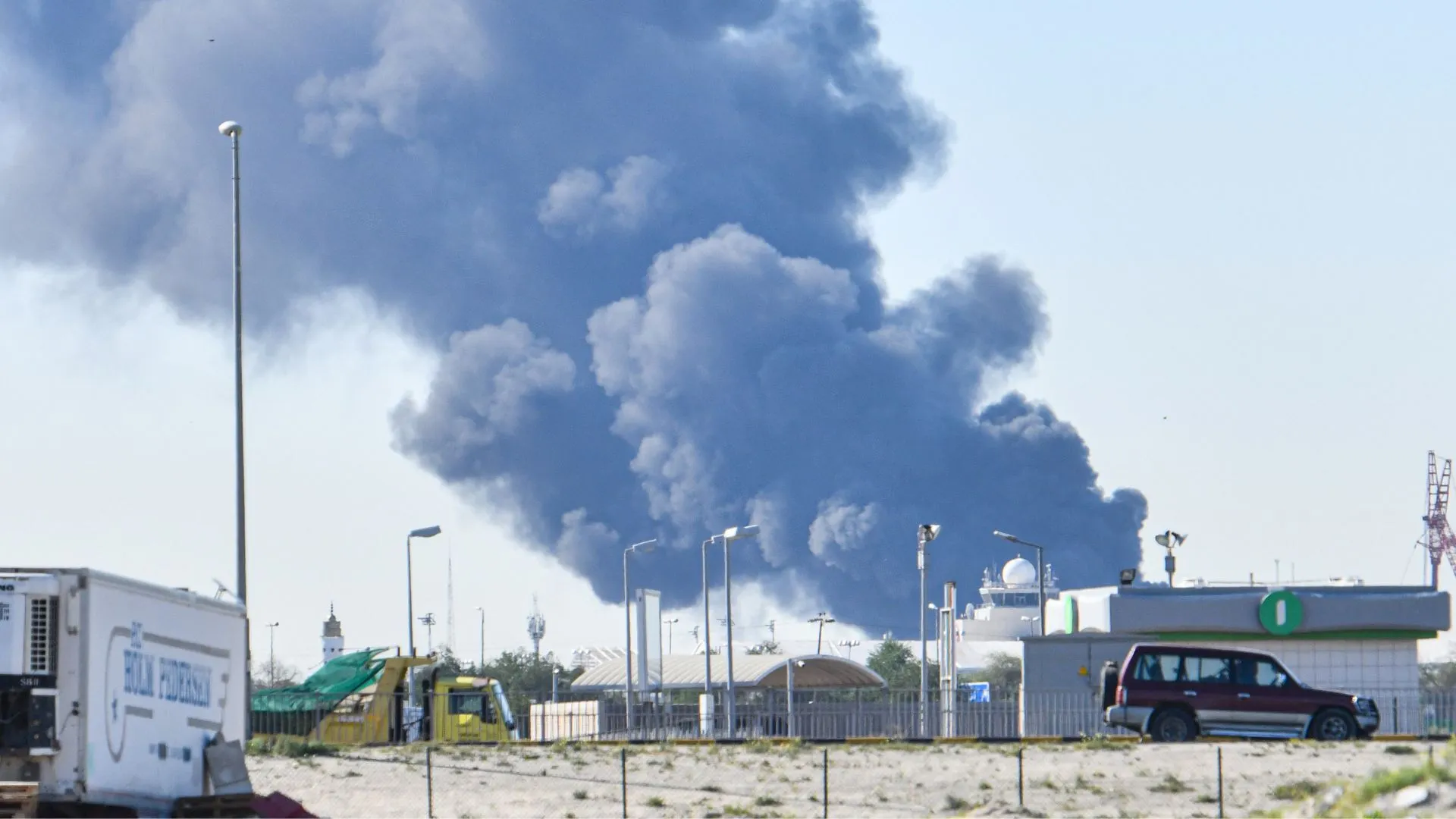
Iran’s drones have hit fuel tanks at Kuwait’s international airport, causing a large blaze, and authorities in Bahrain have reported a fire at an undisclosed company facility, as the United States-Israel war on Iran continues for a fifth week.
Abdullah al-Rajhi, a spokesman for the General Directorate of Civil Aviation in Kuwait, on Wednesday said the airport had been subjected to “brazen attacks by drones from Iran and the armed factions it supports”.
Recommended Stories
list of 3 itemsend of list
The raids targeted fuel tanks at the airport, “leading to a large fire breaking out at the site”, al-Rajhi was quoted as saying by the official Kuwait News Agency (KUNA).
Emergency teams were on site, and “the damage is material with no human injuries,” he said.
Bahrain’s Ministry of Interior said civil defence crews were “extinguishing a fire in a facility of a company as a result of the Iranian aggression”.
“Relevant authorities are taking their measures at the site,” it added, without naming the company.
Vessel hit
A tanker was hit by an unknown projectile near the Qatari capital Doha, causing damage to the hull at the waterline, the United Kingdom Maritime Trade Operations said, adding the crew were safe.
The vessel was struck about 17 nautical miles (equivalent to about 32km) north of Qatar’s Ras Laffan industrial hub, the country’s main gas production facility, which was hit by Iranian missiles last month, causing significant damage.
Confirming the incident, Qatar’s Ministry of Defence said the country was targeted by three cruise missiles launched from Iran, one of which struck an oil tanker.
In a post on X, the ministry said it intercepted two of the missiles, while the third hit a tanker leased to QatarEnergy. The tanker’s 21-person crew was evacuated, the ministry said. No injuries were reported.
In the United Arab Emirates (UAE), the official WAM news agency said shrapnel from a drone interception fell on a farm in the al-Rifaa area of Fujairah city and killed a Bangladeshi national. It said authorities were dealing with the incident.
Saudi Arabia’s Ministry of Defense said several drones were “intercepted and destroyed”, without reporting any injuries.
The oil-rich Gulf has borne the brunt of Iran’s attacks in response to the US-Israeli air strikes on the country.
Iran has claimed to be attacking US assets in the region, but Gulf nations say Tehran has targeted civilian infrastructure.
On Tuesday, a United Nations Development Programme (UNDP) report said gross domestic product (GDP) in the Arab world was estimated to decline by approximately 3.7 to 6 percent after a month of war, equivalent to a contraction of $120bn to $194bn.
Meanwhile, US President Donald Trump and his administration have sent contradictory statements about how and when the war might end.
“We’ll be leaving very soon,” Trump told reporters at the White House on Tuesday, saying the exit could take place “within two weeks, maybe two weeks, maybe three”.
Washington had previously threatened to intensify operations if Tehran did not accept a 15-point US ceasefire framework that had, among its core demands, commitments by Iran not to pursue nuclear weapons, halt all uranium enrichment and fully reopen the Strait of Hormuz.
Tehran dismissed the proposal as “maximalist” and “unreasonable”, stressing it is not seeking war and wants a permanent end to the conflict. It also demanded compensation for the destruction caused by US-Israeli attacks against the country.
Police inspect a strike site in Tel Aviv after a missile hit the city, causing injuries as the US-Israeli war on Iran enters its fifth week. Meanwhile, Washington signals the conflict could soon wind down, even as timelines remain unclear.
Weekly insights and analysis on the latest developments in military technology, strategy, and foreign policy.
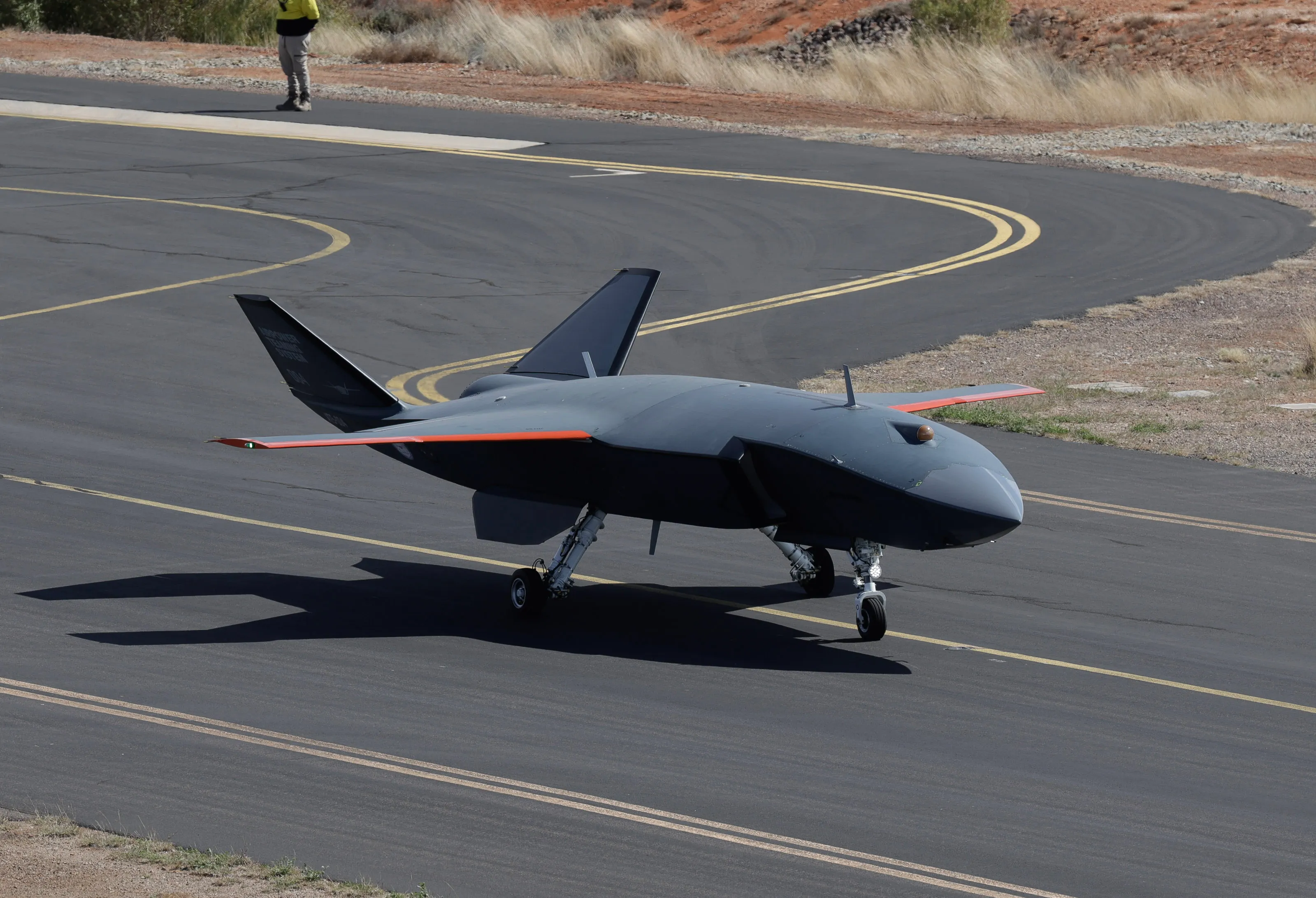
Boeing Australia has teamed up with Rheinmetall, the largest arms manufacturer in Germany, to offer the MQ-28 Ghost Bat drone to the German military. The Ghost Bat collaborative combat aircraft (CCA) is the latest contender for a German requirement, and is likely to face competition from the XQ-58A Valkyrie drone and potentially the homegrown Airbus Wingman.
In a statement today, Rheinmetall said that the plan was to pitch the MQ-28 as “a mature solution for the Bundeswehr’s procurement of collaborative combat aircraft (CCA) into Germany by 2029.” Describing the Ghost Bat as “a world-leading, proven CCA,” Rheinmetall noted that the drone “can be modified to meet Germany’s sovereign requirements” — as we have discussed before, the highly modular nature of the MQ-28 is a key part of its design.
An MQ-28A Ghost Bat taxis prior to flight at Woomera, South Australia, in September 2025. Australian Department of Defense
Should Germany select the MQ-28 for its CCA requirement, Rheinmetall would serve as the system manager for the aircraft in Germany, overseeing system integration into the country’s existing and future command and weapon systems, and adaptation to national requirements. The company would also provide operational, maintenance, and logistical support. A major benefit of the platform is the fact that much of the development has already been paid for by Australia, and the resulting drone is more mature than anything else in Europe.
“With Boeing Defense Australia as a partner, we are laying the groundwork to optimally tailor the MQ-28 to the Bundeswehr’s requirements,” said Armin Papperger, CEO of Rheinmetall AG. “As a system integrator, we ensure that integration, operation, and further development come from a single source while simultaneously strengthening industrial value creation in the form of an industrial hub in Germany and Europe. We see revenue potential for Rheinmetall in the range of three-digit millions of euros.”
Australia has also contracted for the development of the enhanced Block 3 MQ-28, which will include an internal weapons bay. This will be scaled to accommodate one AMRAAM or two GBU-39/B Small Diameter Bombs (SDB) or equivalents, in terms of size. A pair of SDB IIs, also known as the GBU-53/B StormBreaker glide bomb, would be another option.
An AIM-120 AMRAAM loaded on an MQ-28A Ghost Bat. Australian Department of Defense
The next big milestones for the Royal Australian Air Force should come in 2028, with the planned service introduction of the Block 2 aircraft and the initial production of the Block 3 aircraft.
Interestingly, the Rheinmetall press release describes the MQ-28 being “ready to deliver air-to-ground capability to Germany by 2029.” It’s unclear at this point if this reflects Berlin’s requirement for an exclusive air-to-ground CCA platform, or if an air-to-air capability will be added at a later point.
A quartet of MQ-28s, the two in the middle having IRST sensors on top of their noses. Boeing
For Block 3, Boeing is working on three or four alternative sensor payloads, too. Integration of these would be facilitated by the fact that the entire nose can be swapped out to accommodate different payloads.
Speaking earlier this year to journalists, including from TWZ, Glen Ferguson, MQ-28 program director at Boeing, said he was unable to talk about any potential future customers other than Japan, but noted that the company was pursuing sales elsewhere in the Indo-Pacific region, specifically.
Meanwhile, in 2022, the Pentagon confirmed that it had acquired at least one MQ-28 to be used to support the U.S. Air Force’s advanced uncrewed aircraft and autonomy efforts. Meanwhile, the U.S. Navy has deployed a test and evaluation squadron to Australia to work on the aircraft, and an MQ-28 has also been operating out of Naval Air Station Point Mugu, California.
As we have discussed in the past, the MQ-28 seems uniquely suited for a cooperative production and operation program across multiple allied nations, and it’s perhaps not a coincidence that the Bundeswehr is increasingly looking at future operations in the Indo-Pacific region, something that has seen recent deployments of Luftwaffe Eurofighters, for example.
A Luftwaffe Eurofighter flies alongside an F/A-18F from the Royal Australian Air Force over Darwin, Australia, during the Pitch Black 2022 exercise. Bundeswehr/Christian Timmig
The Luftwaffe has long been seen as a candidate for a CCA-type drone. In the medium term, this would involve an uncrewed companion to work alongside the Eurofighter, which would be especially relevant for its forthcoming Eurofighter EK electronic warfare jets.
A rendering of a Typhoon EK for the German Air Force. Airbus
A drone of this kind could also be harnessed by other German Eurofighters, which undertake a range of air defense and air-to-ground missions, as well as the F-35A stealth fighters it also has on order. The F-35 is designed very much with CCAs in mind, with the combination of the stealth jet and complementary drones being a key part of the planned future U.S. Air Force force posture.
A CCA could be even more important for Germany depending on the fate of the pan-European Future Combat Air System (FCAS) program, at the heart of which will be the crewed New Generation Fighter (NGF). Both are expected to be in service by 2035, although that target is looking increasingly unlikely.
Concept artwork of the NGF fighter that is the centerpiece of the pan-European FCAS. Dassault Aviation
In fact, there is a good chance that rifts between France and Germany on the course that FCAS should take, especially when it comes to workshare, could see Germany walk away from the program entirely.
That would leave a significant gap in combat air ‘mass’ that a CCA could help mitigate.
With Germany in the market for a drone in this class, another partnership, announced last year, sees Airbus Defense and Space team up with Kratos Defense and Security Solutions to provide the stealthy XQ-58A to the German Luftwaffe.
Kratos says the new version of the Valkyrie would be “tuned” for the European mission, suggesting that it will feature specific modifications for operators in the region. New versions of the XQ-58 will be capable of runway launch, and the platform can be scaled to a degree, too.
A U.S. Marine Corps XQ-58A Valkyrie conducts a test flight with a U.S. Air Force F-16. U.S. Air Force photo
The same would likely apply to the MQ-28, which Rheinmetall could potentially offer to a range of other European nations, alongside Germany, potentially filling an emerging niche for ‘loyal wingman’-type drones, along with other roles, with several air forces. Again, depending on the fate of FCAS, that requirement could become even greater, and the new partnership gives the MQ-28 an anchor in Europe and an increasingly lucrative market.
Last year also saw the emergence of another possible contender for the Luftwaffe CCA, when German defense startup Helsing unveiled its CA-1 Europa. The company is targeting a first flight in 2027 for the drone, which looks very similar to the MQ-28.
CA-1 Europa: Autonomous Air Dominance
Meanwhile, in 2024, Airbus unveiled a stealthy CCA-like concept of its own, known as Wingman. At the time, the company said that the Luftwaffe had “expressed a clear need” for a drone that would be able to operate in conjunction with crewed fighters before the arrival in service of the FCAS. Airbus says the Wingman should provide a unit cost that’s equivalent to one-third that of a modern crewed fighter.
The Airbus Wingman concept aircraft at the Berlin Airshow in 2024. Thomas Newdick
Somewhat larger than the XQ-58A, the Wingman currently exists only as a concept aircraft, and its future is less certain now that Airbus is collaborating with Kratos on the Valkyrie.
Drones of the kind that are now referred to as CCAs are not entirely new territory for Germany.
Before the Wingman concept, Airbus worked on other advanced uncrewed aircraft programs, including the Barracuda, work on which began in 2003, initially as a ‘black program.’ The Barracuda was retired after six test campaigns. Experience and data from the drone have been fed into FCAS, which is also planned to include interaction of crewed and uncrewed aircraft, with “remote carrier” drones of different sizes being among the latter.
Ground crew working on the Barracuda technology demonstrator. Airbus
Whether Germany opts for the MQ-28 Ghost Bat or another rival solution, if current plans materialize, the Luftwaffe looks set to be operating some kind of advanced collaborative combat aircraft before the end of the decade.
Weekly insights and analysis on the latest developments in military technology, strategy, and foreign policy.
As Epic Fury grinds into a second month, the Air Force continues to rely heavily on its fleet of aerial refueling tankers, the majority of which are over 60 years old, to gas up aircraft attacking Iran and those still pouring into the Middle East. The strain on the force has been exacerbated by the loss of a KC-135 Stratotanker and damage to another after a collision over Iraq and several more tankers being destroyed and damaged on the ground by Iranian long-range weapons. Meanwhile, given this large commitment of aircraft and personnel, there are questions about how the U.S. tanker fleet can respond to a fight in the Pacific should one break out tonight. To get a better sense of that, we spoke to retired Air Force Col. Troy Pananon, who flew tankers and commanded a tanker wing.
In the second installment of our two-hour, wide-ranging exclusive interview – the first centering on Epic Fury’s strain on the force – Pananon offers insights into whether there are enough tankers and crews to sustain combat in two theaters more than 4,000 miles apart, the challenges of flying long distance over contested airspace and what, if any, countermeasures tankers should be given to survive.
Some of the questions and answers have been lightly edited for clarity.
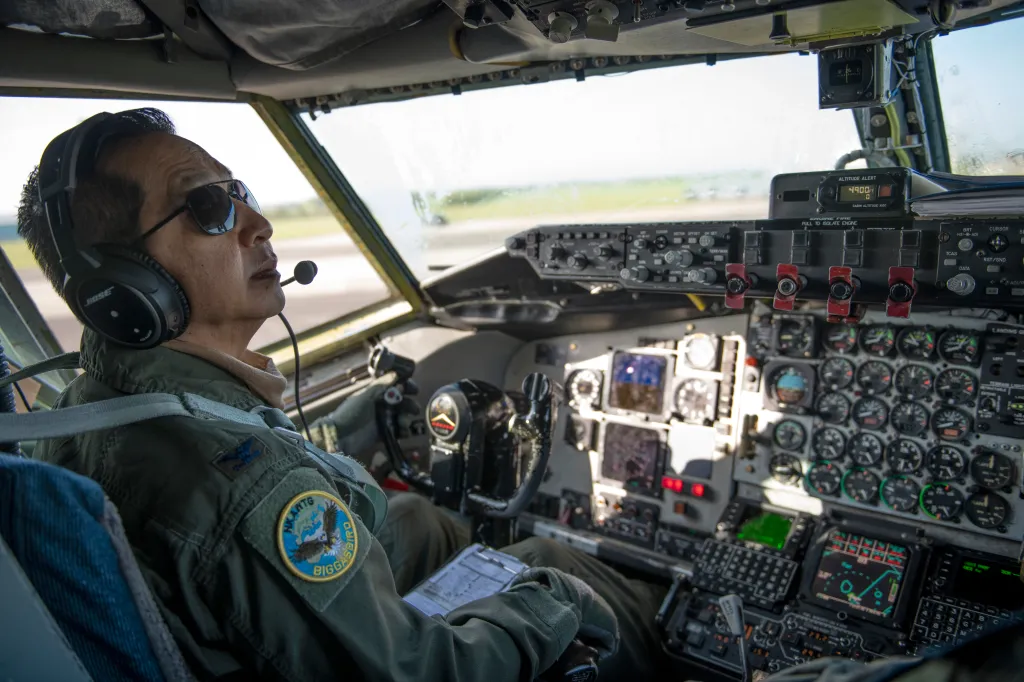
Col. Troy Pananon, 100th Air Refueling Wing commander, prepares for take-off aboard a KC-135 Stratotanker at RAF Mildenhall, England, April 23, 2020. (U.S. Air Force photo by Tech. Sgt. Emerson Nuñez) Tech. Sgt. Emerson Nunez
Q: Given the heavy use of aerial refueling for Epic Fury, how concerned are you about the ability to fuel a fight in the Pacific, if one should break out tonight or in the near term?
A: There is a high demand on the tanker community. We retired the KC-10s, so that is a void that can’t be filled as quickly as we would like. But the tanker force is robust, and even though we have a contingency of aircraft in the Middle East region and parts of Europe, we still have tankers that are all over the world, to include the Pacific. Kadena has its own wing of tankers there. And so the ability for our tanker fleet to pivot or to surge and scale to another region – there is not another military out there that can do it – but it puts that demand on the total force.
I think that we could do it, sure, but it would put a significant strain if we were trying to operate in two different parts of the globe, especially if it was involving major combat operations. And not to mention, there’s an element of protecting the homeland as well. Tankers are required to do that too. So you can’t just say, ‘Oh well, we’ll deplete the entire force and focus abroad.’ There’s an element required to support homeland operations as well.
A KC-10 Extender assigned to the 908th Air Refueling Squadron lands after conducting the airframe’s final combat sortie before inactivation at Prince Sultan Air Base, Kingdom of Saudi Arabia, Oct. 3, 2023. The flight served as a capstone for the KC-10 after over 30 years of service within the U.S. Air Forces Central (AFCENT) Area of Responsibility. By September 2024, the U.S. Air Force’s fleet of KC-10s will be decommissioned and gradually replaced by the KC-46 aircraft. (U.S. Air Force photo by Tech. Sgt. Alexander Frank) A KC-10 Extender assigned to the 908th Air Refueling Squadron touches down at Prince Sultan Air Base, Oct. 3, 2023. U.S. Air Force photo by Tech. Sgt. Alexander Frank
Q: Does the need to do all those missions at once worry you?
A: At my level, when I was at the tactical level or the operational level, I always felt that we were adequately supported. There was certainly a stressor involved with trying to manage all that. But whenever there was a concern, you always would go up to your higher headquarters, and say, ‘Hey, here’s the current situation. We don’t need help now, or we do need help, and this is how you can help.’
It was their ability to resource those needs that really made my job easier and made the jobs of those who worked with me easier, knowing that they had support from above. But it’s not an unlimited resource. It’d be hard for me to say what would be required if we needed to pivot, or if we needed to support two operations in different parts of the world. But I would say that we were certainly capable of doing it.
I just don’t know the duration of that, and unfortunately we always tend to think of these things in short-term snippets. But there are long-lasting impacts to things where high operations tempo means higher strain on the resources, higher strain on the aircraft.
Looking at the long view, if you have to increase your operational tempo on a particular platform versus what you had planned for that, it is going to put a strain on the acquisition process. It’s going to put a strain on the supply system. All these things, they do have an impact, not only in the short, but in the long-view as well.
Tech. Sgt. Jessica Dear, a 507th Aircraft Maintenance Squadron crew chief, tracks the amount of fuel being loaded into a KC-135 Stratotanker aircraft. (U.S. Air Force photo by Senior Airman Katriel Coffee) Airman 1st Class Katriel Coffee
Q: Considering how long it took to build up forces in the Middle East, how concerned are you about being able to fly long distances to protect Taiwan from attack by China? Can the current fleet sustain a major conflict with China, where fighters will need to fly thousands of miles on each sortie just to get to the effective fighting range?
A: I can’t completely comment on this for various reasons. There are certainly war plans in place. There have been studies that have taken place that are certainly higher classification levels, and we can’t discuss in this session or in public, right? It’s been looked at. I would say that there are plans in place that would prove that we could support operations in the Pacific region.
Is it complex? Yes. Does it require certain things to be successful? Yes, There are certain dominoes that need to fall into place in support of an operation like that.
Maintainers from the 718th Aircraft Maintenance Squadron attach a drogue to a KC-135 Stratotanker at Kadena Air Base, Japan, Aug. 25, 2023. (U.S. Air Force photo by Airman 1st Class Tylir Meyer) Staff Sgt. Tylir Meyer
Q: But from a tanker pilot and wing commander perspective, what are the challenges of flying over these long distances through a very robust Chinese anti-aircraft, area denial environment?
A: I like to use the term, it’s a young man’s or woman’s game. It’s fatigue that is the enemy here, because when you have to operate at these distances and for the duration that is involved, it is certainly a physical stressor. Often, we’re operating in multiple time zones, and we’re not probably getting adequate rest, and that’s a cumulative effect, as you are asked to operate for these long durations.
I’ve been on a cruise where we operated for 24 hours straight, and to do that over a sustained length of time – I don’t know that you can do it. In order to do that, it means you need more personnel. And so where an operation might be successful with – and I’ll just use easy numbers here – with 100 personnel that don’t have to range like you would in the Pacific or in Europe or even in the Middle East, depending on basing. Well, you’re probably going to need maybe twice as many to operate in the Pacific, because of the human element. You don’t want personnel to be fatigued to the point where they are not operating in a safe manner, and so you need to give them the appropriate rest.
It goes all the way down the line, from air traffic control to ground personnel to maintenance to logistics. You need more personnel to support that effort at the distances and the range that you’re talking about. And the Pacific is a challenge, and it would require more personnel to just operate the aircraft, let alone the logistics tail required to support those aircraft. It is a significant challenge. And I’ve certainly endured operations where you bring in multiple energy drinks or keep the coffee brewing for long periods of time.
Aircraft propulsion technicians with the 6th Aircraft Maintenance Squadron install an engine on a KC-135 Stratotanker at MacDill Air Force Base, Florida, March 28, 2023. Replacing this engine was a 72-hour task that required a team of highly trained maintainers with a keen sense of attention to detail. (U.S. Air Force photo by Senior Airman Lauren Cobin) Staff Sgt. Lauren Diaz
Q: What about the addition of robust Chinese air defenses into that equation? How much additional concern does that raise?
A: Tanker aircraft are not inherently survivable from enemy aircraft or missiles. There are upgrades or updates that could help in certain ways. The [AN/AAQ-24(V)N Large Aircraft Infrared Countermeasure] LAIRCM is one of those technologies that would certainly help some of those aircraft. But, again, that means that we’ve got to stay out of harm’s way. Typically, we’ve got to set our tanker orbits up further away from the enemy’s reach and their engagement zone.
It is a team effort, right. The role of our strike aircraft and joint partners to eliminate that threat is probably more important than our ability to add protection to these aircraft. I think they go hand in hand. It would be nice for tankers to have protective measures in place to make sure that they are survivable if we need them to operate in a contested environment, but in their current state, I would be definitely worried about pushing tankers closer to that engagement zone, because they don’t have the survivability or protections that maybe even aircraft like the F-22 or F-35 might have.
We don’t have chaff or flares. We don’t have other measures that would protect our fleet, and so I think it’s the role of the warfighting commander to protect those assets and to ensure that they’re operating in a safe zone. And if they’re moved closer to that Weapon Engagement Zone, then they have the ability to retrograde or the connectivity and communication ability to ensure that those tankers can move back or retrograde away from the threat. There are some technology solutions out there, but I don’t know if that’s the sole solution. It is a comprehensive solution that is required to kind of go after that challenge.
U.S. Air Force Capt. Nick ‘Laz’ Le Tourneau, F-22 Raptor Demonstration Team commander and pilot, releases flares during an aerial demonstration at the 2025 Marine Corps Air Station Miramar Air Show in San Diego, Sept. 28, 2025. (U.S. Air Force photo by Staff Sgt. Lauren Cobin) Staff Sgt. Lauren Diaz
Q: How difficult is to get, say, an F-35 into effective combat range and to fuel them up outside of the Chinese Weapons Engagement Zone?
A: It’s layers, right? In order for those aircraft to move into those high threat areas, it will probably require preparation of that environment. I think there are other elements of our military that would go to great lengths to create lanes or passageways to allow those aircraft to move closer to wherever they’re trying to get to their objective.
The preparation of the environment that’s required probably is not the F-35 – the shorter range aircraft. There are other elements that would be used to prepare certain areas to allow our aircraft to move closer. There are other aircraft that would probably be capable of penetrating those air defenses and eliminating some of those threats.
Q: Which aircraft?
A: You have highly capable B-2A Spirit bombers and maybe in the future, B-21 Raider aircraft. There’s other non-manned platforms that I would assume could be used to help eliminate some of the threat, but not all of it.
The Chinese have a very, very robust air defense environment and system of systems in place. But I think that we as a military certainly have capabilities that could give us moments of opportunity. And I think once we find an opportunity, our trained airmen and joint force can leverage that. I don’t think that we want to go toe-to-toe right now. I don’t think we ever want to go toe-to-toe with an adversary like China. I hope that we don’t have to do that, but I know that our joint force is preparing for that if it ever happens.
A U.S. Air Force B-21 Raider stealth bomber undergoing a test flight. (USAF)
A: Prevention is the best cure here. Not putting them in harm’s way would be the best way for them to survive. But I think it would be certainly comforting to know that they have onboard systems or bolt-on systems that would help them at least have a chance against some of these threats. There are certainly a lot of opportunities out there. I’ve heard of efforts where you would outfit certain aircraft with certain defensive measures.
If you got into a situation and we needed to do it, I think the KC-46 Pegasus is a great platform to utilize for this, because it has so much advanced avionics architecture already on board. Trying to do it on the KC-135? That is because you’re trying to answer a scale problem. We don’t have enough KC-46s and we need more. And I know that they’re trying to procure more and and they’re coming, but they’re not to the scale that we have with the KC-135. And so the problem with trying to work with that is that now we’ve got an older airframe, and we’re trying to bolt on new technology that may or may not be compatible, and so we’re gonna have to upgrade other elements on board the aircraft, just to make sure that it can work.
We have an old aircraft. We have some things that have been updated, like the avionics have been updated. But is it the same technological advancement as what is going to be required to bolt on to protect that particular aircraft? Well, no, because it probably – from a data infrastructure set – is not going to operate at the same speed. It’s not going to operate in a similar fashion. There’s some latency that gets introduced if you’re trying to onboard new technology with older technology.
KC-46 Pegasus aerial refueling tankers. (USAF)
Q: What about adding electronic warfare pods, CCAs or mini interceptors?
A: I think nothing is off the table. I think those are fantastic ideas, and I know that there are people that have probably experimented or modeled to and then probably proven that it’s a successful option. But you have to resource it. We have a lot of mouths to feed here – it’s not a limitless pot, and there’s the research and development and then product production of that.
It doesn’t happen overnight and with every new technology that is offered to the warfighter, it is a challenge to make sure that all the personnel are trained and learn how to leverage these resources, not just individually, but collectively, as a team, as an organization, to really harness that and make sure that anything that’s introduced is successful.
You can’t just say, ‘Oh, well, look, I got this bright, shiny object. I’m just going to bolt it onto this aircraft, and everything is going to be working beautifully.’ No, there’s a whole host of problems that creates because you don’t have personnel that are all collectively trained, that have all operated with it, that have all that is integrated with it, that ensures that when you add this to that platform, that it is operating the way it was designed or intended to be operated. You can’t just snap your fingers and think that it’s gonna work right away.
A view of one of the repurposed Multipoint Refueling System (MPRS) pods under the wing of a Utah Air National Guard KC-135. (MSgt Nicholas Perez/Utah Air National Guard)
Q: As a flight commander, would you like to have been able to have air-to-air interceptors under the wings of your tanker?
A: The one thing about airmen, and I would say Air Force in general, is that we tend to like new technologies. We’re not afraid of technology in general. We embrace it. The people that we attract into our service are people that embrace technology, that are innovative themselves. So, yeah, sure if I could roll back time, and that technology was introduced to me, I’d be first in awe. And two, I’d say, ‘Okay, well, how can we make this work? How can I integrate? How can I be able to leverage that and exceed expectations, and ensure that we meet the potential for that new technology?’
A graphic from 2019 describing “tech enablers” for various AFRL projects, including the MSDM’s seeker. (USAF)
Q: There’s been a great deal of discussion about the importance of improving communications connectivity on the tanker fleet. We’ve already talked a little about it. Why is connectivity an issue? And what’s your advice to improve it?
A: Connectivity provides us situational awareness, and that situational awareness improves our ability to operate. It’s a team effort, and in order to do things collectively as a team, we have to be connected. And then the challenge is deciding, well, how should we connect? What sole-source platform should we be all collectively using because it does us no good to be connected as an Air Force, but not be able to talk to a Marine Corps or Navy, or Army or a coalition partner.
And so the challenge is not only do we need to find the right technological solution, we have to ensure that it is able to integrate and communicate harmoniously with all our other partners, because it is not just an Air Force by itself, game. It is a joint force coalition game in terms of what we’re doing right now and what we’ll do in the future.
I know that it’s a huge discussion about, okay, what platform do we use? How do we get it to our airmen right away? How do we make sure that it can integrate with the joint force? And then, ok, now we’ve got the solution. Where’s the money, right? There are so many elements to ensure that we can do this at scale and at speed. I trust that our leadership has been advocating with Congress and with other elements of the administration to get this in place. I don’t know how long it’ll take, but it certainly will help from a situational awareness perspective.
The Roll-On Beyond Line-of-Sight Enhancement (ROBE) package seen here is among the add-on communications and data-sharing capabilities that has been available for use on the KC-135, as well as other aircraft, for years now already. USAF
Q: Is there any particular system that you think would help improve situational awareness?
A: I think there are some age-old systems that have been in place. Link 16 architecture comes to mind. There are probably other modern solutions out there, but I don’t want to say that ‘this is the right system,’ because I’m not in the position to really argue for that. There are some systems out there that help, that are already in place, that would help us immensely, if we were to have that particular system across all platforms, right where the AOC [air operations center] can talk directly to the tanker element, who is also receiving data from other elements in the air, whether it be fighter aircraft, bomber aircraft, reconnaissance aircraft, and then, feeding that through our platform – maybe a KC-46 – back to the AOC, instantaneously. I know there are efforts out there to enhance that pipeline, but it’s not my place to say one system’s better than the other.
I just know that’s the panacea. That’s where you have to get to. You have to get to where the shooter is, all the way back to where the decisions are being made, and harness that data and then allow that data to help inform a decision, so that now you can give that decision over to the activity that’s operating. And so this constant cycle, and they use the term OODA loop, right? This constant cycle of observe, orient, decide, act – it’s got to happen faster than the enemy cycle for us to be successful. Connecting those points with technology can help us do that faster.
A stock picture of a KC-46A refueling an F-15E Strike Eagle. USAF
Q: You’re in the aircraft, you’ve got a receiver coming up. You don’t necessarily know where everything is. How does it help a pilot and the crew to have better connectivity?
A: Let me just put a hypothesis out there as an example. Say we have a receiver that was coming up, and they’ve got a really good understanding of where the threat rings are, what enemy positions are, where our friendly forces are, and that’s all in a data packet on board their aircraft. And if you don’t have a secure connection over the air, but you do have a secure connection once you’re connected with the boom, that data packet can then be uploaded to our aircraft and then displayed for our airmen to see, right? Because now, it’s like that whole moving map idea, like you may have a navigation system in your car that says, ‘hey, where’s the nearest gas station?’ and then it pops up and it tells you where the nearest gas stations are.
Same thing can be said if you’re operating a tanker aircraft, and now you get a data packet that gives you the full display of what the battlefield looks like in front of you. You now know, okay, here’s where I want to go, and here’s where I don’t want to go. So, if the technologies in place or are available now, it’s just a matter of connecting the dots. And this is a huge situational awareness improvement, if we can get to the point where the tanker crew on board has the ability to see exactly what is taking place, where the threats are, where the green zones are, where it’s safe to operate. And if they can do this in a secure manner that’s impenetrable by enemy forces, that is where we need to get to.
In our next installment, Pananon talks about drone incursions, the challenges of creating a new tanker fleet and whether single-pilot operations are a good idea.
“Trump’s taunt exposes a PM without a plan” says the Daily Mail. The paper says MPs have accused Sir Keir Starmer of not having a clear plan after it emerged that the UK’s last known shipment of jet fuel from the Middle East is due to arrive within two days. Elsewhere, the paper continues its coverage on the BBC’s sacking of radio presenter Scott Mills. The broadcaster sacked Mills on Monday over allegations related to his personal conduct. The BBC has not given any further details over the allegations and it is not clear what, if any, role a police investigation into sexual offences played in his sacking. The investigation, which began in 2016, was closed in 2019 after the Crown Prosecution Service (CPS) deemed there was insufficient evidence to bring charges. Mills has been approached for comment.
Weekly insights and analysis on the latest developments in military technology, strategy, and foreign policy.
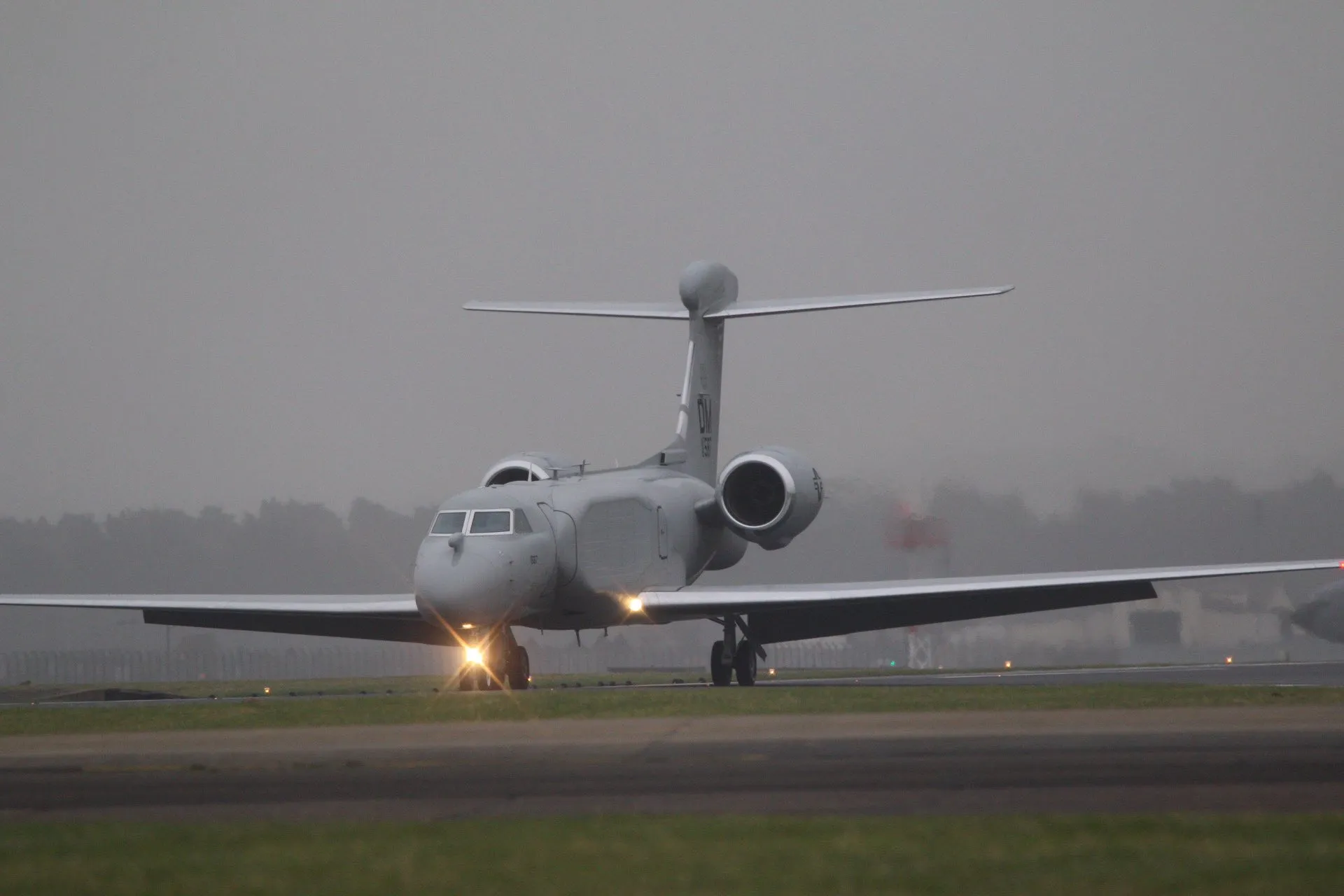
A pair of the U.S. Air Force’s new EA-37B Compass Call electronic warfare jets have touched down at RAF Mildenhall in England, from where they could move forward and join America’s growing aerial armada in the Middle East.
Last night, open-source flight trackers began to track the progress of the two jets — tail numbers 19-1587 and 17-5579 — that were flying with the callsigns AXIS41 and AXIS43. Photos of the aircraft arriving at Mildenhall were provided to TWZ by g.lockaviation.
One of the two EA-37B Compass Call jets after landing at RAF Mildenhall yesterday evening. g.lockaviation
A pair of U.S. Air Force EA-37B Compass Call electronic warfare aircraft arrived today at RAF Mildenhall in the UK, likely in preparation for a deployment to the Middle East.
This could become the EA-37B’s first operational deployment, but we cannot say that for certain at this time. One of the EA-37Bs was in Europe earlier this year to introduce airmen to the platform, but it was not yet operational. You can read more about that here.
It is worth bearing in mind that, during Operation Desert Storm in 1991, a pair of E-8 Joint STARS surveillance aircraft were also deployed, but were operated by civilian crews. The same could be the case here, or at least mixed crews.
The 55th Wing at Offutt Air Force Base, which operates the Compass Calls, declined to provide TWZ with a comment, deferring us to CENTCOM, which could not immediately comment.
g.lockaviation
The Air Force plans to acquire 10 EA-37Bs to replace its aging and steadily shrinking fleet of turboprop-powered EC-130H Compass Call planes, of which only four are still in service. Two are deployed to the Middle East for Operation Epic Fury. There have been some unconfirmed reports that these aircraft may have been damaged in the attack on Prince Sultan Air Base that saw an E-3 destroyed. Losing EC-130H capability in the region could have very well prompted an emergency deployment of EA-37Bs, even ahead of their planned entry into full operational availability. But we cannot confirm that is the case at this time.
Electromagnetic warfare, evolved
The new aircraft are designed to provide critical standoff jamming support against enemy communications systems, including hostile air defense systems.
At the same time, while air defenses are certainly part of the equation, simply keeping the Iranian military from communicating and (further) disrupting their already fractured command-and-control infrastructure is a highly significant capability to bring to bear.
The EA-37B also has an important intelligence, surveillance, and reconnaissance (ISR) function, given its ability to spot, track, and geolocate various types of emitters.
This aircraft, which represents the cutting edge in U.S. electronic warfare capabilities, would be highly important for any ground operation, helping to protect troops put in harms way, should this come to pass.
We will have to wait and see if the EA-37Bs make the leap to the CENTCOM area of responsibility. If they do, it will be something of a baptism by fire for America’s new Compass Call.
A full deep-dive into the various capabilities of the EA-37B can be found in this interview with top executives from the two co-primes that are working on the electronic attack aircraft program.
UPDATES:
Our coverage for the day has concluded.
UPDATE: 5:38 PM EST –
CENTCOM spokesman Capt. Tim Hawkins provided us with the latest casualty figures for Epic Fury.
There have been 348 troops wounded, six seriously and 315 have returned to duty. There have been 13 troops killed.
Trump told reporters at the White House that the U.S. military will soon depart from the Strait of Hormuz.
“We’ll be leaving very soon,” he proclaimed. “What happens [there] we’ll have nothing to do with.
Trump: “We’ll be leaving very soon… what happens in [Hormuz] we’ll have nothing to do with”
Other countries can “fend for themselves” if they want gas or oil from the Persian Gulf. pic.twitter.com/mZbaQNLCjA
CNN said top administration officials acknowledge that the U.S. cannot swiftly end the war within the Trump-imposed four to six week timeline and keep the Strait of Hormuz.
As the White House stares down Trump’s self-imposed four- to six-week deadline for ending the war, top administration officials have privately acknowledged that they can’t both achieve their military objectives swiftly and vow to reopen the strait within the same timeline,…
Secretary of State Marco Rubio reiterated the Trump administration’s rationale for going to war with Iran, stating “we were on the verge of having an Iran that had so many missiles and so many drones that nobody could do anything about their nuclear weapons program…”
From Day One, the mission was crystal clear: This was the final, best chance to wipe out Iran’s threat for good – so they can never have a nuclear weapon.@SecRubio breaks it down ⬇️ pic.twitter.com/eChlkRPzyb
It appears that USS Tulsa and USS Santa Barbara, a pair of U.S. Navy Independence class Littoral Combat Ships (LCS) configured for minesweeping, remain in the Pacific.
According to open-source researcher MT Anderson, satellite imagery shows vessels moored alongside each other at Sembawang Shipyard in Singapore. As we have previously noted, ships remain thousands of miles away from their primary assigned operating area in the Middle East, where the conflict with Iran grinds on. That despite concerns that the Strait of Hormuz could be mined.
🇺🇸LCS WATCH: The Sembawang Sit-In Mar 30 imagery confirms 2x Independence-class Littoral Combat Ships remain moored alongside at Sembawang Shipyard in Singapore.
➡️The distinct trimaran hulls are clearly visible taking up pier space in this false-color capture. ➡️Given the… pic.twitter.com/HL4UjJ2qaX
Iran released new video of its Eagle 44 underground airbase showing it still has some aircraft. As TWZ editor-in-chief Tyler Rogoway notes in a post on X, low-resolution satellite imagery from March 16 shows relatively little damage at the site. However, things may have changed since then and the site may have been it. Regardless, it doesn’t matter if Eagle 44 only has jets, which wouldn’t last very long even if they got off the ground. However, if the facility were stuffed with missiles, that would be a concern. You can read more about Eagle 44 here.
He’s talking about the Eagle 44 installation. Low res imagery up to 16th doesn’t show signs of major destruction, but it really doesn’t matter at this point as far as the aircraft go. If it has missiles stuffed in there still then yes. More on Eagle 44: https://t.co/cA9hYI8RzXhttps://t.co/UX01AwvGUL
In a brief exchange during an interview with NBC News Tuesday afternoon, Trump hinted that Epic Fury might be drawing to a close.
“We’re doing great,” Trump told the network. “And it’s coming to an end.”
He offered no further details.
The U.K. is sending more troops and Sky Sabre air defense systems to the Middle East to defend against Iranian attacks. This will bring the total number of UK personnel in the Gulf and Cyprus to around 1,000, the BBC noted.
“On a trip to the Gulf nations, Defense Secretary John Healey said extra air defence teams and systems would be deployed to Saudi Arabia, Bahrain and Kuwait while the use of Typhoon jets in Qatar will be extended,” the outlet added. “My message to Gulf partners is: Britain’s best will help you defend your skies.”
Iran’s foreign minister Abbas Araghchi told Al Jazeerathat his country is exchanging messages with the U.S. either directly or through friends in the region.
But that doesn’t mean there are peace talks with Washington, Araghchi posited.
“I receive messages from [U.S. envoy Steve] Witkoff directly, as before, and this does not mean that we are in negotiations,” he told the news outlet.
Araghchi added that Iran has no “faith that negotiations with the U.S. will yield any results. The Trust level is zero.”
Netanyahu said that as a result of constant Israeli attacks on Iran, “sooner or later, it will end up falling.”
The Israeli leader also said “we are working on transforming Israel into a super nation in the region and globally.”
The IRGC confirmed the killing of another Iranian leader, this time Jamshid Eshaghi, head of budget and financial affairs for the Iranian Armed Forces General Staff. He was killed in a missile strike in Tehran on an unspecified date, according to the IRGC.
Eshaghi played a key role in evading oil sanctions and financing the group’s missile projects, according to Ariel Oseran, senior Middle East correspondent for Israel’sI24 News in a post on X.
The IRGC confirms the elimination of Jamshid Eshaghi, head of budget and financial affairs for the Iranian Armed Forces General Staff, in an Israeli airstrike in Tehran, without specifying the date. Eshaghi played a key role in evading oil sanctions and financing the IRGC’s… pic.twitter.com/hs2npoQTt5
— Ariel Oseran أريئل أوسيران (@ariel_oseran) March 31, 2026
The State Department said it is “tracking reports of threats against locations where American citizens gather” in Saudi Arabia. ”We advise U.S. citizens that hotels and other gathering points including U.S. businesses and U.S. educational institutions may be potential targets.”
Saudi Arabia: We are tracking reports of threats against locations where American citizens gather. We advise U.S. citizens that hotels and other gathering points including U.S. businesses and U.S. educational institutions may be potential targets. On March 22, the Department of… pic.twitter.com/9Xm2oLzxzr
📍NORFOLK, Va. – The Nimitz-class aircraft carrier USS George H.W. Bush (CVN 77), the flagship of the George H.W. Bush Carrier Strike Group, departs Naval Station Norfolk to begin operations in support of its scheduled deployment, March 31, 2026. pic.twitter.com/ePDTv4IcPE
Israeli Prime Minister Benjamin Netanyahu hinted at something on Tuesday that at one time was unthinkable – a military alliance with Saudi Arabia and other Arab nations.
According to Israeli media, “Netanyahu told ministers at a cabinet meeting that new alliances are being formed with leaders of Arab countries who ‘are talking about fighting together on our side,’” The Times of Israel reported.
“In the past, I had secret conversations with Arab leaders,” Netanyahu reportedly said. “I told them, ‘As soon as Iran can, it will conquer you and overthrow your kingdoms.’ Back then, they didn’t really internalize things. Today they understand.”
BREAKING 🇮🇱🇦🇪🇸🇦: Israeli PM Netanyahu says talks underway to form alliance with Arab countries to fight alongside Israel. pic.twitter.com/BOmDeCr8H9
Lebanon has informed the United Nations in a letter that it has outlawed Hezbollah’s military wing. Beirut’s letter, dated a few weeks ago but made public today, also mentioned the Lebanese government’s March 2 decision to ban all military activity by the group.
Lebanon has informed the United Nations in a letter that it has outlawed Hezbollah’s military wing. Beirut’s letter, dated a few weeks ago but made public today, also mentioned the Lebanese government’s March 2 decision to ban all military activity by the group. pic.twitter.com/2npN5Fckpa
— Ariel Oseran أريئل أوسيران (@ariel_oseran) March 31, 2026
Hegseth not only validated Trump’s idea to move forward with plans to attack Iran, he also downplayed the inherent risks of the conflict spiraling out of control, according to CNN.
In the immediate lead-up to Iran war, Hegseth not only validated the Trump’s idea to move forward, he also downplayed the inherent risks of the conflict spiraling out of control, three sources tell me & @KristenhCNN.
Nobody in the room during that critical meeting emphasized…
Poland has no intention of shipping any Patriot batteries to the Middle East despite a request from the U.S. to do so, says Polish Defense Minister Władysław Kosiniak-Kamysz.
“Our Patriot batteries and their armament are used to protect Polish skies and NATO’s eastern flank,” he stated on X. “Nothing is changing in this regard, and we are not planning to relocate them anywhere! Our allies know full well and understand how important the tasks we have here are. Poland’s security is an absolute priority.”
Nasze baterie Patriot i ich uzbrojenie służą do ochrony polskiego nieba i wschodniej flanki NATO. Nic w tej kwestii się nie zmienia i nigdzie nie planujemy ich przemieszczać! Nasi sojusznicy dobrze wiedzą i rozumieją jak ważne mamy tu zadania. Bezpieczeństwo Polski jest…
— Władysław Kosiniak-Kamysz (@KosiniakKamysz) March 31, 2026
The Islamic Revolutionary Guard Corps (IRGC) has threatened to strike 18 U.S. technology and defense-related companies operating in the Middle East, Israel’s I24 News reported. The IRGC warned the action could begin as early as tomorrow night if Iran’s senior commanders are targeted.
“In a statement, the IRGC urged employees of the listed firms to evacuate immediately, and advised nearby residents to leave surrounding areas, describing the companies as ‘terrorist’ entities allegedly supporting US and Israeli operations against Iran,” the publication added.
The IRGC threatens to attack 18 U.S. tech companies’ sites in the Middle East, including Apple, Google and Tesla, in response to any future targeted eliminations of its senior commanders as of tomorrow night.
“We advise employees of these companies to leave their workplaces…
— Ariel Oseran أريئل أوسيران (@ariel_oseran) March 31, 2026
U.S. President Donald Trump said today that countries should be prepared to go to the Strait of Hormuz and “take” fuel themselves, urging them to show greater resolve. Writing on Truth Social, he argued that nations would need to “learn how to fight for yourselves,” adding that the United States would no longer step in to assist, particularly after what he described as their refusal to support efforts to topple Iran’s leadership.
Trump suggested that countries facing shortages could instead purchase jet fuel from the United States, where supplies are abundant. He added that Iran had effectively been “decimated” and concluded by telling nations to secure their own oil.
“All of those countries that can’t get jet fuel because of the Strait of Hormuz, like the United Kingdom, which refused to get involved in the decapitation of Iran, I have a suggestion for you…” – President Donald J. Trump pic.twitter.com/aPYmL0qspa
NEWS 🧵: I called President Trump for some clarity on this post. He says the U.S. is not pulling assets in and around the Strait of Hormuz yet: “At some point I will, not quite yet, but countries have to come in and take care of it. Iran has been decimated, but they’re going to… pic.twitter.com/67BRdrOkRV
In a press conference today, U.S. Secretary of War Pete Hegseth stressed that Operation Epic Fury would conclude “on our terms” and that the United States remains committed to shaping the outcome of the conflict according to its own objectives.
The next days of the Iran war will be “decisive,” Pentagon chief Hegseth said at his first news conference in nearly two weeks. He adds: “We have more and more options, and they have less… in only one month, we set the terms, the upcoming days will be decisive. Iran knows that, and there’s almost nothing they can militarily do about it.”
The war secretary reaffirmed that the option of some kind of ground campaign has not been ruled out. Hegseth said that “maybe negotiations will work,” but he was unwilling to commit one way or the other when asked about the potential for American boots on the ground.
Hegseth continued:
“You can’t fight and win a war if you tell your adversary what you are willing to do or what you are not willing to do, to include boots on the ground. Our adversary right now thinks there are 15 different ways we could come at them with boots on the ground, and guess what? There are. And so if we needed to, we could execute those options on behalf of the president of the United States and this department.”
“Or maybe we don’t have to use them at all. Maybe negotiations work, or maybe there’s a different approach. But the point is to be unpredictable in that you certainly do not let anybody know what you’re willing to do or not do.”
More here. Hegseth, speaking to concerns about the war in Iran from some of Trump’s political base:
“As far as President Trump and boots on the ground, I don’t understand why the base, which they have already, they understand wouldn’t have faith in his ability to execute on… https://t.co/7wBzUlntGI
Hegseth went on to argue that recent events have exposed the level of support the United States can expect from its allies, suggesting that their responses have fallen short. According to Hegseth, while the missiles in question do not threaten the United States directly but rather its allies, requests for assistance — or even basic overflight access — have often been met with hesitation or obstacles.
Hegseth also confirmed that he had briefly visited the U.S. Central Command region recently.
Press conference at Pentagon just began. Hegseth says he was in the Centcom region for half a day recently — something not previously disclosed.
He has a notably different tone in his opener today, sharing details about what he saw and gratefulness to the service members in the…
He concluded by warning that an alliance loses its meaning if member countries are unwilling to stand together when it matters most.
When it comes to overflight access, France has apparently joined Spain in denying U.S. military access to their airspace for taking part in attacks on Iran. In a statement, Trump slammed France for refusing to let U.S. military aircraft carrying military supplies operate in its airspace.
Trump:
The Country of France wouldn’t let planes headed to Israel, loaded up with military supplies, fly over French territory.
France has been VERY UNHELPFUL with respect to the “Butcher of Iran,” who has been successfully eliminated! The U.S.A. will REMEMBER!!! pic.twitter.com/uu7hezFJUq
In other France-related news, Israel has apparently stopped defense exports to the European country, citing “hostile attitude,” sources told The Jerusalem Post.
Meanwhile, Italy confirmed that it denied permission for U.S. military aircraft to land at Sigonella Air Base in Sicily last week, before heading to the Middle East; this was due to Washington having not sought prior authorization from the government in Rome, Reutersreports. A source at the Italian defense ministry toldThe Guardian that “some US bombers” had been due to land at Sigonella en route to the Middle East. Otherwise, U.S. military aircraft continue to operate from Italian airbases as a matter of course, the defense ministry confirmed.
Italian MOD just released this:
Someone is trying to push the narrative that Italy has decided to suspend the use of its bases by U.S. assets.
That is simply false, because the bases are active, in use, and nothing has changed.
Gen. Dan Caine, the Chairman of the Joint Chiefs of Staff, has said the U.S. military is delivering precision strikes against manufacturing nodes “deep within Iran.”
He says around 11,000 targets have been hit in the past 30 days. The U.S. military “continues to assert dominance over the Iranian Navy,” he added.
Caine added that more than 150 ships have been “taken out.”
An underground missile storage facility in Sofeh, in Isfahan province, appears to be among the hardened facilities targeted in recent strikes. Earlier accounts suggested that the target was an Iranian underground missile base, but that seems to be refuted by the geolocation of the imagery available.
Videos purporting to show the aftermath of the strikes include multiple secondary explosions, suggesting that bunker-busting munitions managed to penetrate the vaults and then detonate the missiles stored there. As we have described in the past, a key vulnerability of Iranian subterranean installations is the risk that even a single weapon penetrating their hardened exterior by any means could have absolutely catastrophic results.
Last night, President Trump published footage on his Truth Social account showing massive explosions and secondary detonations in Iran. Reports indicated that the strike took place in the Safeh–Havanirooz area, south Esfahan.@NASA Fire monitoring maps indeed detected active… https://t.co/69f3khsLiwpic.twitter.com/6ffTI0xZIk
Officials familiar with U.S. and Western intelligence assessments say the U.S.-Israeli war on Iran has fractured the Iranian government, making it harder for the country to make decisions or coordinate large-scale retaliatory attacks, TheNew York Timesreports.
Since the conflict began four weeks ago, several dozen Iranian leaders and their deputies have been killed. Survivors face significant communication challenges and are unable to meet in person, fearing that their calls could be intercepted by the United States or Israel and lead to airstrikes.
Although Iran’s security and military agencies remain operational, the government’s capacity to develop new strategies or policies has been significantly weakened.
The U.S.-Israeli war against Iran has fractured the Iranian government, complicating its ability to make decisions and coordinate larger retaliatory attacks.
Several dozen Iranian leaders and their deputies have been killed since the war began four weeks ago. Those who survive…
Iranian state media reported yesterday that a parliamentary committee has approved a plan to impose tolls on ships passing through the Strait of Hormuz.
According to a Telegram post by the FarsNews Agency, the strait would remain closed to vessels from the United States, Israel, and countries involved in sanctions against Iran. The report added that Iran would play a “sovereign” role in enforcing the new system.
The proposal, which has been backed by Iran’s parliament security committee, would still require agreement from other countries bordering the strait. Details on the level of the proposed tolls have not been disclosed.
Meanwhile, as you can read about in our previous coverage, President Trump warned that if no agreement is reached with Iran — including reopening the Strait of Hormuz shipping route — the U.S. military forces would destroy “all of their Electric Generating Plants, Oil Wells and Kharg Island (and possibly all desalinization plants!).”
More information on the proposed toll arrangement emerged today, including the surprising suggestion that Oman is slated to help shape the legal framework. This was reported by Fars and later picked up by Bloomberg, but has yet to be independently verified. Oman has strong relations with the United States, including extensive security cooperation. Oman also plays a key role as a regional mediator, particularly between the United States and Iran.
A pair of container ships operated by the Chinese shipping giant Cosco have successfully transited the Strait of Hormuz and exited the Gulf, according to ship-tracking data.
The vessels, CSCL Indian Ocean and CSCL Arctic Ocean, sailed near the Iranian-controlled island of Larak and are now heading toward Port Klang in Malaysia.
While Iran has largely restricted traffic through the key waterway, it appears to be permitting limited passage for ships from countries it considers “non-hostile,” including Thailand, China, Pakistan, and India.
Two COSCO Container Ships Make First Major Commercial Crossing of Strait of Hormuz Since War Began
After turning back on an initial attempt, the CSCL Indian Ocean and CSCL Arctic Ocean sailed through the strategic waterway on Monday toward Malaysia, a rare transit for major… pic.twitter.com/kBwscFC7qU
Iran struck a fully laden crude oil tanker anchored in the port of Dubai, setting it on fire and damaging its hull in what marks the latest attack on commercial shipping in the Gulf and the Strait of Hormuz during the conflict.
Authorities in Dubai said the drone strike on the Al Salmi tanker sparked a blaze that was brought under control early Tuesday, several hours after the incident was first reported. They later confirmed that no oil spill had occurred.
Dubai authorities confirm that response teams have successfully contained the incident involving the Kuwaiti oil tanker in Dubai waters, with no oil leakage and no injuries reported.
Iran is reportedly pushing the Houthis to prepare for a renewed campaign against Red Sea shipping, contingent upon any further escalation by the United States in the conflict with Iran. This was reported by Bloomberg, citing European officials familiar with the matter.
An Israeli military spokesperson has said the country is ready to continue its offensive against Iran for an extended period. According to Reuters, Lt. Col. Nadav Shoshani told reporters that Israel is prepared for “weeks” more of fighting in the conflict, which began on February 28 when joint U.S.-Israeli airstrikes killed Iran’s supreme leader, Ali Khamenei. He emphasized that while the final decision rests with political leaders, “we are prepared to keep operating for weeks to come. We have the targets for that, the munitions for that, the manpower for that, and it’s up to the leadership to decide”.
His remarks follow comments from Israeli Prime Minister Benjamin Netanyahu, who said the campaign was “definitely beyond the halfway point,” later clarifying that he was referring to progress in terms of “missions” rather than “not necessarily in terms of time.”
A photo released by the Israeli Air Force today shows an F-16D Barak armed with 2,000-pound-class Joint Direct Attack Munitions (JDAMs), apparently heading out to attack infrastructure belonging to Hezbollah in Beirut. IAF
In a televised interview, Netanyahu has claimed that Iran has tried to kill President Trump twice, although he did not provide a timeline for when these attempts were made or how. “They’re still trying to kill him,” the Israeli leader added.
The Israeli military claimed today that all of its critical and essential pre-war targets in Iran will have been destroyed by Wednesday.
This represents the complete elimination of the top two priority categories of pre-war targets and is part of the broader campaign in which the IDF has destroyed roughly 60 to 70 percent of all designated targets within the Islamic Republic.
The Israeli Air Force carried out over 230 strikes in Iran in the past day, the military says, publishing footage showing attacks on Iranian air defense systems in Tehran.
The IDF says other targets hit in the past day included primed ballistic missile launchers and weapon… pic.twitter.com/sLuUZFqYV8
— Emanuel (Mannie) Fabian (@manniefabian) March 31, 2026
“Critical” targets include those posing an immediate threat to Israel, such as ballistic missile facilities, as well as key sites central to the objectives of the campaign, including the few remaining nuclear-related installations.
The IDF announced that all of its critical and essential pre-war Iran targets, including ballistic missile industry targets and nuclear-related targets, will have been destroyed by Wednesday.
On the topic of nuclear-related targets, President Trump disclosed today that he considers that Iran’s nuclear facilities are buried so deeply that it would be difficult to raid them to secure their enriched uranium stockpiles.
“I don’t even think about it. I just know that, you know, that’s so deeply buried it’s gonna be very hard for anybody,” Trump told CBS News.
TWZ has previously explored the possibility of U.S. and/or Israeli authorities launching a special operations ground raid to extract or otherwise neutralize Iran’s stockpile of enriched uranium. While noting that it is far from easy to achieve this objective from the air alone, it is also true that Israel has demonstrated its ability and willingness to carry out complex raids on subterranean facilities in the past. Nevertheless, any such operation would still face immense risks and uncertainties.
Four Israeli soldiers have been killed during fighting in southern Lebanon, the Israeli military said on Tuesday, as its forces continue to clash with the Iran-backed Hezbollah.
In a statement, the military identified three soldiers from the same battalion who “fell during combat,” while a separate statement said a fourth soldier, whose name has not yet been released, was also killed in the same incident, according to Agence France-Presse.
The military added that another soldier was seriously injured, while a reservist sustained moderate wounds.
All 3 soldiers, a team commander and 2 soldiers, from the Nahal Reconnaissance Battalion (934th), Nahal Brigade, fell during combat in southern Lebanon.
Saudi Arabia’s defence ministry has said it intercepted and destroyed 10 drones in recent hours, along with eight missiles targeting the Riyadh area and the country’s eastern region.
The United Arab Emirates says its air defenses engaged eight ballistic missiles, four cruise missiles, and 36 drones launched from Iran earlier today.
UAE air defences engaged 8 Ballistic missiles and 4 Cruise missiles and 36 UAV’s.
The UAE air defences on 31th March 2026 engaged 8 Ballistic missiles, 4 Cruise missiles and 36 UAV’s launched from Iran.
Furthermore, Kuwait reported that its air defences were responding to hostile missile and drone attacks. Neither country specified the origin of the projectiles.
Gulf partners of the United States, especially Saudi Arabia and the United Arab Emirates, are pressing President Trump to keep up military operations against Iran, asserting that Tehran has not been sufficiently weakened by the month‑long U.S.‑led bombing campaign, according to U.S., Gulf, and Israeli officials, APreports.
“Officials from Saudi Arabia, United Arab Emirates, Kuwait and Bahrain have conveyed in private conversations that they do not want the military operation to end until there are significant changes in the Iranian leadership…” https://t.co/WRh4iTIwx5
A recent video released by U.S. Central Command includes footage of attacks on pickup trucks configured to launch drones, including Shahed-136 one-way attack drones.
🇮🇷🇺🇸 This is, to my knowledge, the first indication that Iran is launching Shahed-136 strike drones, among other designs, from pickup trucks (without the use of a rocket booster/RATO) during this war. This is a low-signature approach that is well-suited for use in surprise… https://t.co/R1AJdAoG4hpic.twitter.com/cGUoAOqE2b
NPR has reported that the Iranian strike on Saudi Arabia’s Prince Sultan Air Base last week damaged two U.S. Air Force E-3G Sentry AWACS aircraft. Previously, we had gotten confirmation that one aircraft was entirely destroyed. The extent of the damage to the other is unclear.
NPR now reports that Iranian strike on Saudi Arabia’s Prince Sultan Air Base damaged two U.S. E-3 Sentry AWACS aircraft.
Ukraine’s president, Volodymyr Zelensky, has claimed that Ukrainian intelligence had information that a Russian spy satellite had photographed the base three times before the attack, with targeting data provided to Iran. While that may be true, commercially available satellite imagery over the same period also revealed the likely position of the E-3s at the base.
Comparative images in planet labs of Prince Sultan Air Base from two weeks ago (delayed) and days before tell you everything you need to know about how Iran could have targeted certain aircraft on that airfield even without real time intel.
A video circulating on social media appears to show an Iranian ballistic missile maneuvering to evade an Israeli interceptor. If verified, this would not be the first occasion that we have seen evidence of more advanced types of Iranian missiles still being fired at Israel and eluding air defenses. We have seen multiple occasions where Iranian maneuverable reentry vehicles (MaRVs) have been able to pierce interceptor barrages during the terminal stage.
At least some of the aircrews of the three U.S. Air Force F-15E Strike Eagles that were shot down in a friendly-fire incident by Kuwaiti air defenses are still flying missions in Epic Fury, Secretary of War Pete Hegseth has confirmed. “Admiral Cooper noted this morning that the three Air Force captains who were shot down by Kuwaiti friendly fire early in the fight never left the theater. All dropped bombs over Tehran last night.”
.@SECWAR “Admiral Cooper noted this morning that the three Air Force captains who were shot down by Kuwaiti friendly fire early in the fight never left the theater.
’14 years of war is enough for Syria’: Syrian President Ahmed al-Sharaa says Syria will remain outside the US-Israeli war on Iran unless it is directly targeted. His comments come as fighting continues across the region for a 31st day.
District Judge Richard Leon says construction has to stop until Congress provides statutory authorisation.
Published On 1 Apr 20261 Apr 2026
A judge has ruled that US President Donald Trump cannot proceed with his planned $400m ballroom on the site of the White House’s demolished East Wing without approval from Congress.
District Judge Richard Leon on Tuesday granted a request for a preliminary injunction filed by the National Trust for Historic Preservation, which sued after alleging Trump had exceeded his authority by razing the historic East Wing and launching construction on the new building.
Recommended Stories
list of 2 itemsend of list
“I have concluded that the National Trust is likely to succeed on the merits because no statute comes close to giving the President the authority he claims to have,” Leon, an appointee of former Republican President George W Bush, wrote in the ruling.
“The President of the United States is the steward of the White House for future generations of First Families. He is not, however, the owner!” he said. “Unless and until Congress blesses this project through statutory authorization, construction has to stop!”
Leon said the order does not affect “construction necessary to ensure the safety and security of the White House”.
His ruling keeps the 90,000 square-foot (8,360 square-metre) ballroom project on hold while the lawsuit continues.
The judge said he was pausing his order for 14 days to allow the Trump administration to appeal. Hours later, the Justice Department filed an appeal at the Washington, DC-based US Court of Appeals for the District of Columbia Circuit.
Artist renderings of the new White House East Wing and Ballroom [Jon Elswick/AP]
Carol Quillen, president and CEO of the National Trust, welcomed Leon’s ruling.
“This is a win for the American people on a project that forever impacts one of the most beloved and iconic places in our nation,” Quillen said in a statement.
In a social media post, Trump called the National Trust a group of left-wing “lunatics” and said his ballroom is “under budget, ahead of schedule, being built at no cost to the Taxpayer, and will be the finest Building of its kind anywhere in the World”.
The Republican has championed the ballroom as a defining addition to the White House and a lasting symbol of his presidency.
Weekly insights and analysis on the latest developments in military technology, strategy, and foreign policy.
An F-35 crashed in the Nevada Test and Training Range in Southern Nevada. The pilot ejected and is reportedly safe after sustaining only minor injuries.
According to KSNV News 3, “The U.S. military is searching for a pilot who had to eject from an aircraft over Southern Nevada on Tuesday, sources tell News 3… The aircraft reported trouble maneuvering around noon, according to sources.” The outlet subsequently reported that the pilot was found in good condition.
UPDATE: Nellis Air Force Base tells News 3 the pilot is safe, having reported minor injuries. An F-35 from Nellis AFB crashed north of Las Vegas, and emergency responders are on scene.https://t.co/KNlxePnBRm
An F-35 from Nellis AFB crashed north of Las Vegas today. The incident occurred approximately 25 miles northeast of Indian Springs, Nevada, within the controlled airspace and restricted federal property of the Nevada Test & Training Range.
Emergency responders are on-scene and there is no impact to populated areas. The pilot is safe and being treated for minor injuries. The safety of our personnel and the community remain our top priority.
We will provide additional information as it becomes available.
In her small shop on Merritt Island, racks of orange, blue and black T-shirts depict hand drawn rockets, mission patches and moonscapes, ready for the crowds who arrive on regular launch days. But this launch is different, she tells us. “We’ve wanted to go back to the Moon since the ’70s. People are excited. People are beyond excited,” she said.
Plea comes hours after sheriff’s report said the golfer showed signs of impairment at the scene of last week’s crash.
Published On 31 Mar 202631 Mar 2026
Golfer Tiger Woods pleaded not guilty in his driving under the influence case in Florida on Tuesday, hours after a sheriff’s report said he had pain pills and showed signs of impairment at the scene of the crash last week.
The online court docket for Martin County, Florida, showed that Woods entered a written plea of not guilty and planned to waive his appearance during an arraignment hearing next month.
Recommended Stories
list of 4 itemsend of list
Woods’s eyes were bloodshot and glassy, his pupils were dilated, and he had opioid pills in his pocket when interviewed at the scene of the crash, according to the arrest report released by the Martin County Sheriff’s Office.
The golfer’s movements were slow and lethargic, and he was sweating as he talked to deputies and told them he had taken prescription medication earlier in the morning, according to the report. Woods told deputies he had been looking at his phone and fiddling with the radio before he clipped a truck in front of him, the report said.
Deputies found two white pills, which were identified as the opioid hydrocodone, used to treat pain, in his pocket, the report said.
When asked by a deputy if he took any prescription medications, Woods said, “I take a few.”
Woods’s agent at Excel Sports, Mark Steinberg, has not responded to multiple messages seeking comment.
The golfer was travelling at high speeds on a beachside, residential road on Jupiter Island when his Land Rover clipped the truck and rolled onto its side, according to the sheriff’s office, which noted that Woods had shown signs of impairment.
The truck had $5,000 in damage, according to the report.
The truck driver and another person helped Woods out of his vehicle, with the golfer needing to climb out from the passenger side. Neither Woods nor the truck driver was injured.
During a field sobriety test, deputies noticed Woods limping and that he had a compression sock over his right knee. The golfer explained he had undergone seven back surgeries and more than 20 leg operations, and that his ankle seizes up while walking. Woods, who was hiccupping during the questioning, continuously moved his head during one of the sobriety tests, and deputies had to instruct him several times to keep his head straight, the report said.
“Based on my observations of Woods, how he performed the exercises and based on my training, knowledge, and experience, I believed that Woods’ normal faculties were impaired, and he was unable to safely operate the motor vehicle,” the deputy wrote after the tests.
Woods, 50, is the most influential figure in golf and has become as recognisable as any athlete in the world. The first person of Black heritage to win the Masters in 1997, he has captivated golf fans with records likely never to be broken.
But his injuries kept him from accomplishing more, including those suffered in a 2021 car crash that damaged his right leg so badly he said doctors considered amputation.
At this latest crash, Woods agreed to a breathalyser test, which showed no signs of alcohol, but he refused a urine test, authorities said. He was arrested and released on bail eight hours later.
No one from Woods’s camp or the PGA Tour – he is on the board and is the chairman of the committee reshaping the competition model – has commented since his arrest.
Woods, who has been involved in many crashes over the years, is charged with driving under the influence, with property damage and refusal to submit to a lawful test. He is scheduled for arraignment on April 23. Online court records do not list a lawyer for him.
Under a change to Florida law last year, refusing a law enforcement officer’s request to take a breath, blood or urine test has become a misdemeanour, even for a first offence.
A Russian tanker has delivered enough fuel to meet Cuba’s energy needs for up to 10 days, following a three-month blockade.
Published On 31 Mar 202631 Mar 2026
A Russia-flagged tanker carrying 730,000 barrels of oil has docked in Cuba, marking the first time in three months that an oil tanker has reached the island nation.
The administration of United States President Donald Trump allowed the Anatoly Kolodkin to proceed despite an ongoing US energy blockade. The Aframax tanker entered the Bay of Matanzas – the country’s largest supertanker and fuel storage port – on Tuesday at daybreak.
Recommended Stories
list of 4 itemsend of list
The vessel, under US sanctions, entered Cuban territorial waters late on Sunday, not far from the US Navy base at Guantanamo Bay. The United States said it was allowing the tanker to deliver fuel for humanitarian reasons.
The Anatoly Kolodkin entered the Bay of Matanzas under clear skies and light winds at sunrise. Much of the nearby city – and the majority of Cuba – was without power when the tanker arrived at the port area.
Cuba has not received an oil tanker in three months, according to President Miguel Diaz-Canel, exacerbating an energy crisis that has led to seemingly endless blackouts across the country of 10 million people and brought hospitals, public transportation, and farm production to the brink of collapse.
Cubans, including Energy and Mines Minister Vicente de la O Levy, cheered the ship’s arrival. A shortage of petroleum has exacerbated a deep economic crisis, leaving the population mired in long blackouts and facing severe shortages of food and medicine.
“Our gratitude to the Government and People of Russia for all the support we are receiving. A valuable shipment that arrives amidst the complex energy situation we are facing,” de la O Levy wrote on X.
The fuel, if delivered, would give Cuba’s communist-run government breathing room amid growing pressure from the Trump administration, which has promised change in Cuba.
It will take days before the crude on board the Anatoly Kolodkin can be processed domestically and turned into motor fuel and refined products, such as diesel and fuel oil for power generation.
The ship is carrying Russian Urals, a medium sour crude, which is a good fit for Cuba’s ageing refineries.
Cuba produces barely 40 percent of its required fuel and relies on imports to sustain its energy grid. Experts say the anticipated shipment could produce about 180,000 barrels of diesel, enough to feed Cuba’s daily demand for nine or 10 days.
Cuba used to receive most of its oil from Venezuela, but those shipments have been halted ever since the US attacked the South American country and abducted its leader, Nicolas Maduro, in early January.