new york premiere

Method dressing: Timothée Chalamet, Zendaya, ‘Wicked’ fashions explained

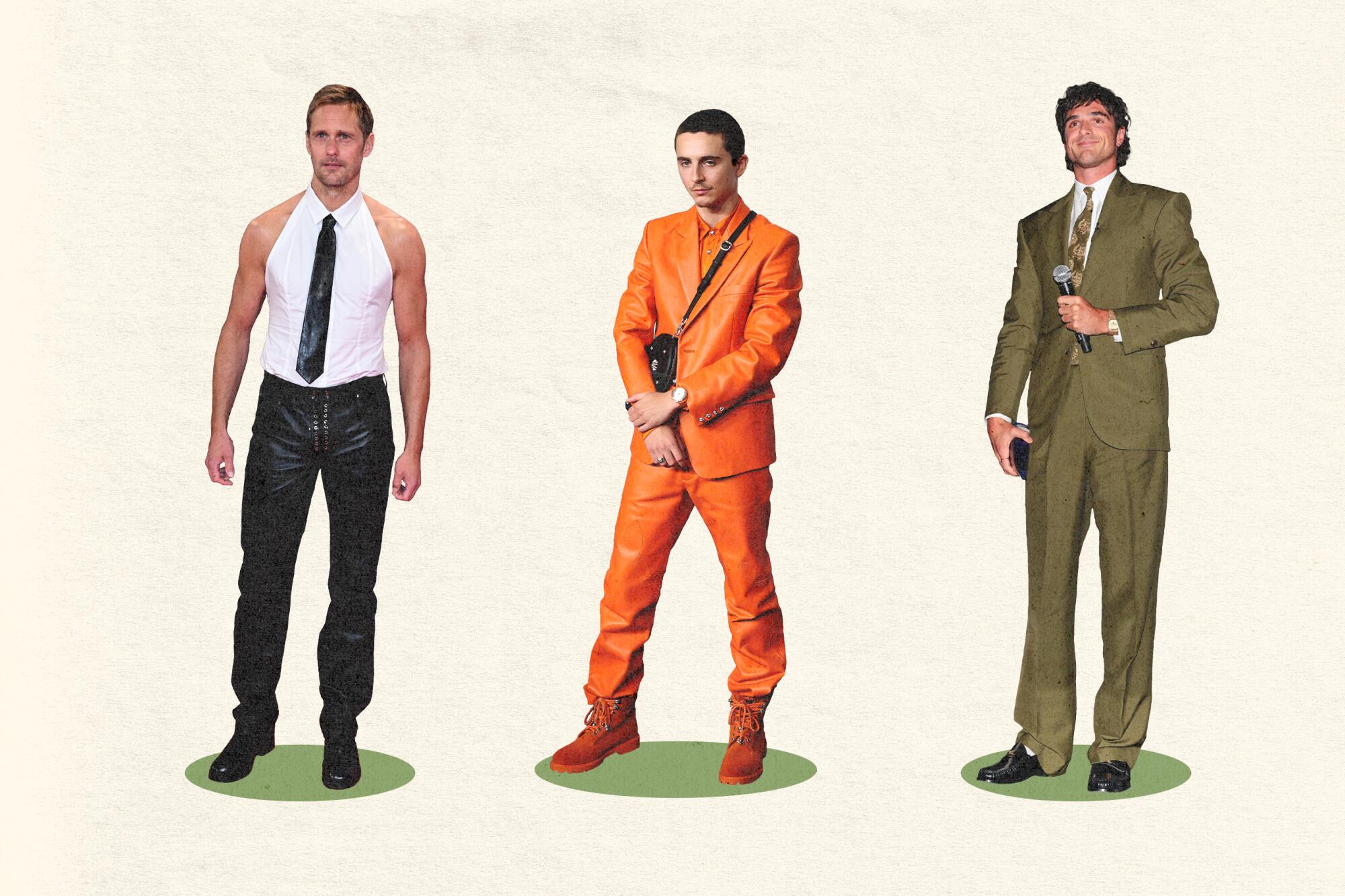
Cynthia Erivo’s aggressively feathered Balenciaga at the “Wicked: For Good” New York premiere. Alexander Skarsgård’s Ludovic de Saint Sernin halter top and snug leather pants at the London premiere of the BDSM dramedy “Pillion.” Jacob Elordi’s Celine suit — in monster green, no less — at the Newport Beach Film Festival as the actor promoted “Frankenstein.”

If these recent outings haven’t convinced you that Hollywood is in its method dressing era, well, where in the Law Roach have you been?

From left: "Pillion's" Alexander Skarsgård, "Marty Supreme's" Timothée Chalamet and "Frankenstein's" Jacob Elordi.

From left: “Pillion’s” Alexander Skarsgård, “Marty Supreme’s” Timothée Chalamet and “Frankenstein’s” Jacob Elordi.

(Photos by Getty Images)

For those not familiar, method dressing is when stars wear looks on a press tour inspired by the movie they’re promoting. The practice has been around since the days of Old Hollywood, when actors like Audrey Hepburn, in “Breakfast at Tiffany’s” and “Sabrina,” melded their star personas with their characters. More recently, Geena Davis and Gwyneth Paltrow channeled their projects with their premiere fits in the 1990s, and the casts of 2015’s “Cinderella” and 2018’s “Black Panther” did the same.

But experts say the current method dressing trend — exemplified by Margot Robbie’s Andrew Mukamal-styled candy-colored juggernaut for “Barbie,” Zendaya’s dystopian desert and tennis chic in her Law Roach-styled appearances for “Dune 2” and “Challengers,” and the relentless, two-year press tour for the “Wicked” movies — is a different animal.

“Method dressing often becomes prologue to the film itself — it sets the tone and the context of the film and makes you curious about it,” says Ross Martin, president of marketing agency Known. “[But it’s also] a signal that the actor you like really is deeply invested in this film. They’re not just showing up, they’re actually embodying the character in the world of the film.”

'Wicked' stars Cynthia Erivo and Ariana Grande.

‘Wicked’ stars Cynthia Erivo and Ariana Grande.

(Photos by Getty Images)

Martin cites Timothée Chalamet’s orange-hued campaign for “Marty Supreme” as a particularly skillful deployment of the trend. “If your favorite actor keeps showing up in the same way over and over again, that used to be rewarded,” he says. “Now there’s this pressure on Hollywood stars to define and then redefine themselves … [you] don’t want to see the same Chalamet that [you] just saw playing Bob Dylan. What you’re seeing is really modern marketing tools applied in very strategic ways to the traditional medium of films. It’s really necessary because 90% of the movies that are released don’t get the marketing dollars they need to launch. So this is innovation by necessity.”

Savvy stylists are also driving the red carpet cosplay. “Previously, stylists were responsible for making sure that stars appeared on trend,” says Raissa Bretaña, fashion historian and lecturer at New York’s Fashion Institute of Technology. “As they gained more prominence in the movie industry, it was less about making sure the stars were on trend and more about making sure the stars were setting the trends.”

Setting trends and creating meme-worthy, TikTok- and Instagram-friendly moments that often reach more eyeballs than the films themselves. An image of “a star wearing a beautiful gown isn’t enough anymore,” says Bretaña. “It is meant to engage with the algorithm. How do we get people talking more about this movie? How do we get more eyes on it by having a different manifestation of it in our real life?”

Indeed, during the “Challengers” press tour, online chatter peaked each time Zendaya stepped out in a new tennis-centric look. “I’m a storyteller, and the clothes are my words,” Zendaya’s stylist Law Roach recently said to Variety. As for his work with the actor on “Dune: Part Two” — including Thierry Mugler’s sartorial mic drop — Roach told Vogue the “looks served as an extension of the wardrobe from the movie; it was intentional and purposeful.”

Zendaya in outfits inspired by her movie "Challengers"

Zendaya in outfits inspired by her movie “Challengers”

(Photos by Getty Images)

Pop culture commentator Blakely Thornton has been following method dressing closely, posting frequently on press tour fashions. “Maybe [Zendaya] walked so Cynthia and Ariana could run,” he says. “The stars are taking it upon themselves to be like, ‘I have to invest in myself in this capacity to get what I need out of it.’” It’s an important distinction, he notes, as film execs aren’t always footing the bill for stylists. “The studios are pretending that it’s not something they have to pay for when it’s something in the internet era you must require. Because if these people came out wearing a turtleneck to every premiere, you wouldn’t be happy.”

Enrique Melendez, the stylist behind Jenna Ortega’s viral red carpet looks for the “Beetlejuice Beetlejuice” press tour, believes his work was key in boosting interest for new demographics. “Jenna being of a newer generation, wearing pieces and looks celebrating the original film had a whole new wave of young people researching the references and Easter eggs with their parents who understood exactly what they meant.”

Still, you can’t guarantee virality: There’s a fine line between a “Spider-Man” triumph and a “Madame Web” tragedy. Some of it can be attributed to an actor’s commitment, says Martin, contrasting Chalamet’s enthusiastic campaign with Dakota Johnson’s reluctant “Madame Web” tour. It also depends on the film itself. Bretaña says method dressing tends to work best with sci-fi or fantasy projects because of the inherent drama in their costuming.

She’s excited by an upcoming period film, Emerald Fennell’s adaptation of “Wuthering Heights,” starring on-theme veterans Margot Robbie and Jacob Elordi. “I think ‘Wuthering Heights’ will be our litmus test to see if method dressing will spill over into historically inspired garments,” says Bretaña. “In the past, whenever actors promoted period films, they try to look as contemporary as possible in order to distance themselves.”

Actors actually looking like themselves on the red carpet? Groundbreaking.


Source link

‘Stereophonic’ at the Pantages falls flat: Review

“Stereophonic,” David Adjmi’s heralded drama that won five Tony Awards including best play, is ready for its Los Angeles close-up.

The first national tour production, which opened Wednesday at the Hollywood Pantages Theatre, seems right at home in the music capital of the world. The play about a 1970s rock band on the brink of superstardom takes place in recording studios in Sausalito and L.A., where the Laurel Canyon vibe is never out of sight.

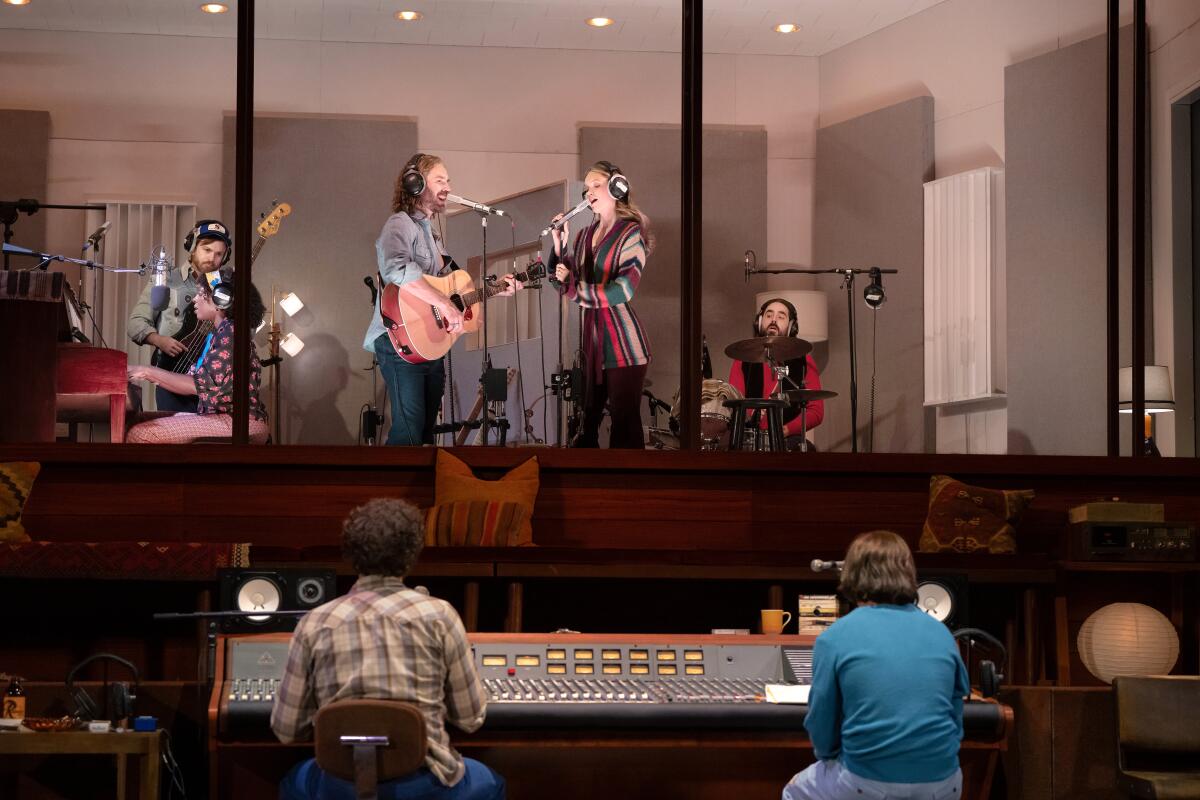
The visual crispness of this L.A. premiere goes a long way toward dispelling doubts that the Pantages is the wrong venue for this ensemble drama. If there’s a problem, it isn’t the cavernousness of the theater. The production, gleaming with period details on a set by David Zinn that gives us clear views into both the sound and control rooms, comfortably inhabits the performance space, at least from the perspective of a decent orchestra seat.

The play, which includes original music from Will Butler, the Grammy-winning artist formerly of Arcade Fire, has a sound every bit as robust as one of the blockbuster musicals that regularly passes through the Pantages. The songs, crushed by the actors at top volume, are Butler’s indie rock re-creation of cuts for a part-British, part-American band that bears such a striking resemblance to Fleetwood Mac that a lawsuit brought by a former sound engineer and producer of the group was eventually settled.

Adjmi, like Shakespeare, takes his inspiration where he finds it. And like the Bard, he makes his sources his own, alchemizing the material for novel ends.

Musicians record music in a sound room as engineers watch outside in "Stereophonic."

The touring production of “Stereophonic” makes clear just how integral the original cast was to the success of the play.

(Julieta Cervantes)

Unfolding in 1976 and 1977, “Stereophonic” offers a fly-on-the-wall perspective of a band at a crossroads. While recording a new album top-heavy with expectations, the group falls prey to romantic conflicts and self-destructive spirals, to toxic jealousies and seething insecurities. The prospect of fame magnifies pathologies that have been intensifying over time.

Diana (Claire DeJean) is the Stevie Nicks of the band. Beautiful, achingly vulnerable and awash in lyrical talent, she is entangled in a relationship with Peter (Denver Milord), the Lindsey Buckingham of the group, who strives for musical perfection no matter the cost.

Their connection is as professionally enriching as it is personally destructive. Diana’s ambition is matched by her self-doubt. She’s susceptible to a Svengali yet doesn’t want anyone to tell her how to write her songs.

Peter, angrily competitive, can’t help resenting the natural ease of Diana’s talent, even as it’s her song from their first album that has put the band back in the spotlight. His genius is ferociously exacting while hers seems to spring naturally from her soul.

Artistically they depend on each other, but the tension between them is unsustainable. And as the play makes clear, there’s no way to keep their personal lives out of the studio.

DeJean and Milord are the most captivating performers in the ensemble. The other actors are solid but this touring production makes clear just how integral the original cast was to the success of the play.

Daniel Aukin’s production, which had its New York premiere at Playwrights Horizons in 2023 before moving to Broadway the following year, hasn’t lost its confident flow. The storytelling is lucidly laid out. But the tantalizing peculiarities of the characters have been whittled down.

The British band members suffer the worst of it. Emilie Kouatchou’s Holly moves the character away from the obvious Christine McVie reference, but her role has become vaguer and less central. Cornelius McMoyler’s Simon, the drummer and weary manager, fills the bill in every respect but gravitas, which must be in place if the character’s ultimate confrontation with Peter is to have the necessary payoff.

No one could compete with Will Brill, who won a Tony for his strung-out portrayal of Reg, a deranged innocent whose addictions and dysfunctions create farcical havoc for the band. Christopher Mowod can’t quite endow this “sad man in a blanket,” as Simon dubs his bundled-up bandmate, with the same level of fey madness that Brill was able to entertainingly supply.

These casting differences wouldn’t be worth noting if it weren’t for their impact on a play that distinguishes itself by its observational detail. Everything is just a little more obvious, including the two American sound guys bearing the brunt of the artistic temperaments running riot in the studio.

Jack Barrett’s Grover, the sound engineer who lied about his background to get the job, sands off some of the character’s rough edges in a more straightforwardly appealing version of the character than Eli Gelb’s bracing portrayal in New York. Steven Lee Johnson’s Charlie, the dorky assistant sound engineer, is an amiable weirdo, though I missed the way Andrew R. Butler played him almost like a space alien in New York.

The play has been edited, but it’s still a bit of an endurance test. Art isn’t easy for the characters or for us. But the effort isn’t in vain.

Adjmi’s overlapping dialogue and gaping silences, orchestrated in a neo-Chekhovian style, renders the invisible artistic process visible. By the end of the play, the tumultuous human drama behind creative brilliance emerges in poignant, transcendent glory.

‘Stereophonic’

Where: Hollywood Pantages Theatre, 6233 Hollywood Blvd., L.A.

When: 7:30 p.m. Tuesdays-Thursdays; 8 p.m. Fridays; 2 and 8 p.m. Saturdays; 1 and 6:30 p.m. Sundays. (Check schedule for exceptions.) Ends Jan. 2.

Tickets: Start at $57 (subject to change)

Contact: BroadwayInHollywood.com or Ticketmaster.com

Running time: 2 hours, 55 minutes (including one intermission)

Source link