new contract

Why contract fights like YouTube TV versus Disney could be the new norm

After 14 days, two “College GameDays,” two “Monday Night Footballs” and one election night, the protracted contract dispute between YouTube TV and Walt Disney Co. is finally over.

As my colleague Meg James reported last week, the two sides settled Friday after agreeing on a multi-year distribution deal for YouTube to carry Disney-owned programming.

Financial terms of the deal were not disclosed.

Both sides touted the agreement as a win for consumers. Disney Entertainment Co-Chairs Alan Bergman and Dana Walden and ESPN chief Jimmy Pitaro said in a joint statement that the deal “recognizes the tremendous value of Disney’s programming and provides YouTube TV subscribers with more flexibility and choice.”

For its part, YouTube also noted that the settlement “preserves the value of our service for our subscribers” and “future flexibility in our offers.” The Google-owned platform also apologized to consumers for the “disruption,” saying it appreciated people’s patience during the dispute.

Of course, reaching an agreement is good for customers who had lost access to ESPN, ABC News election coverage and other programming during the two-week blackout.

But this is far from the last impasse that sports fans and other viewers will see — if history is any guide.

In fact, the number of blackouts related to carriage and contract disputes has been increasing over the last decade, particularly as the health of the television business has declined, raising the economic stakes for all sides.

Back in the day, contracts between content providers and distributors would last for five years or more because the industry was more stable and little would change over the course of an agreement.

That’s obviously all different now, with most deals today lasting about two to three years, reflecting rapid changes in a TV business that has been upended by streaming platforms.

In today’s TV landscape — with cable cord-cutters aplenty and many more options to watch your favorite shows and sports teams — negotiations are more fraught.

Traditional pay TV providers like DirecTV and Charter Communications are scrambling to retain their subscribers, while legacy media companies like Disney are trying to support their networks — particularly channels such as ESPN that have invested huge sums for those all-important sports rights that keep viewers engaged.

And in the midst of it all is the growing power of live TV streaming distributors, especially YouTube TV, which has become a much bigger force in the TV business.

The platform’s subscriber base has been quickly growing.

YouTube is approaching 10 million subscribers, making it the third-largest pay-TV distributor, behind Charter Communications and Comcast. Back in February, when it reached a deal with Paramount Global to avert a CBS blackout, that number was reported at 8 million.

Such growth is giving YouTube TV — with the financial backing of tech giant Google — more clout in contract negotiations, making them more willing to push back against fee increases demanded by legacy Hollywood media companies.

Disney sought rates similar to those paid by major distributors, including around $10 a subscriber per month for ESPN, CNBC reported.

“They realize their power,” said Brent Penter, associate analyst at Raymond James. “And they’re trying to use it.”

But Disney is no wilting flower, either. Last week, Disney’s Chief Financial Officer Hugh Johnston struck a tough tone on CNBC when talking about the negotiations, saying, “We’re ready to go as long as they want to.”

The Burbank entertainment giant has some of the most popular programming around, meaning it can command the biggest fees from providers. It also owns a competitor to YouTube TV in Hulu + Live TV and its new ESPN Unlimited direct-to-customer streaming service.

But in this dispute, Disney temporarily lost the distribution fees and potentially advertising dollars for any of its programs that a YouTube TV subscriber didn’t watch, making it a costly standoff.

No one wins in a blackout situation. But if you had to pick a winner, analysts say it might be the alternatives to YouTube TV — services like Fubo, Sling TV, DirecTV Stream and Hulu + Live TV.

If you’re a diehard Eagles fan who also happens to be a YouTube TV subscriber, and you refused to miss the game against the Packers last Monday, you might have signed up for temporary passes through one of these services. And if you liked it, well, you might choose to keep that subscription instead.

That also goes back to the complicated web of options consumers must wade through to find their favorite teams and shows.

“There is friction out there,” said Ric Prentiss, managing director at Raymond James. “Blackouts raise it to a head, where people say, ‘Wait, I don’t know how to navigate this,’ and they start looking at other alternatives.”

You’re reading the Wide Shot

Samantha Masunaga delivers the latest news, analysis and insights on everything from streaming wars to production — and what it all means for the future.

By continuing, you agree to our Terms of Service and our Privacy Policy.

Stuff We Wrote

Film shoots

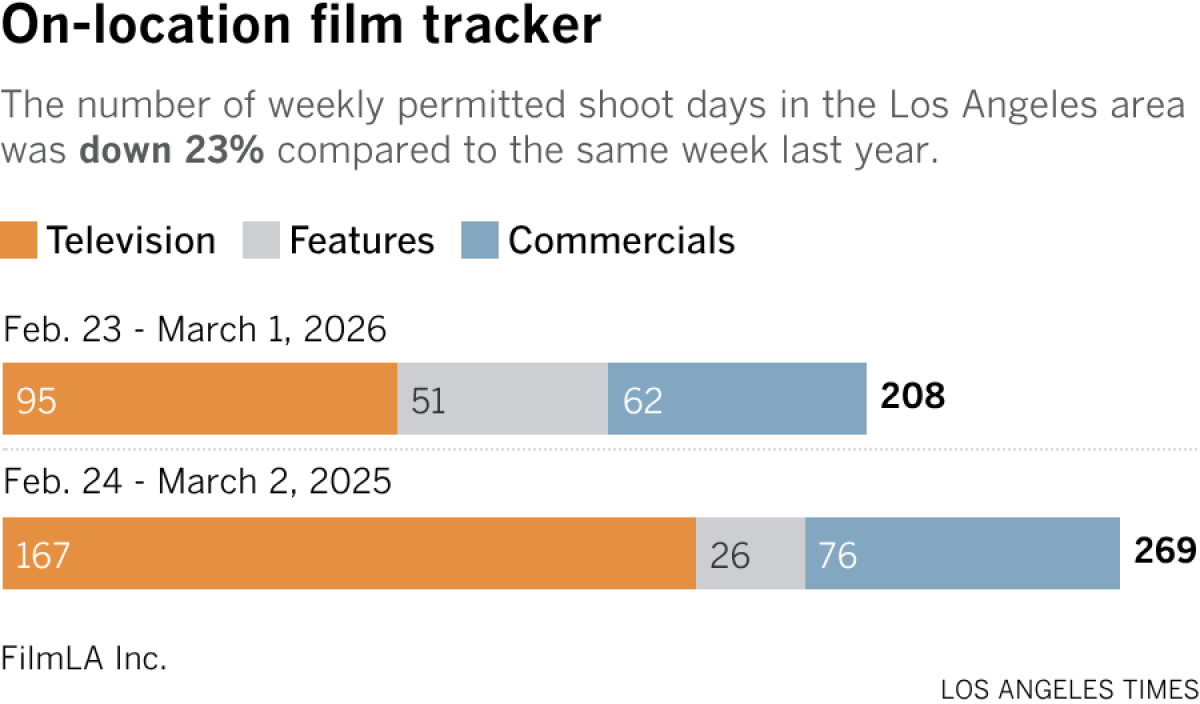
Stacked bar chart shows the number of weekly permitted shoot days in the Los Angeles area. The number of weekly permitted shoot days in the area was down 30% compared to the same week last year. This year, there were a total of 209 permitted shoot days during the week of November 10 - November 16. During the same week last year (November 11-17, 2024), there were 300.

Number of the week

eight percent

TV station owner Sinclair Inc. has an eye toward dominating the TV market. The Baltimore-based company, which is known for its conservative bent, has acquired about 8% of rival broadcaster E.W. Scripps, according to a recent filing with the U.S. Securities and Exchange Commission.

Sinclair also said in the filing that it has had “constructive discussions” with Scripps about potentially combining, though no deal has been reached. Scripps, however, has suggested that it is not interested in a merger.

Finally …

It might be a sign of the economy. My colleague, Suhauna Hussain, wrote about how McDonald’s is seeing lower traffic from one of its core customer bases, low-income households.

Source link

Why movies like “The Hunger Games” are going on stage

This week, Lionsgate is betting that the odds will be in their favor when “The Hunger Games: On Stage” opens at London’s Troubadour Canary Wharf Theatre.

The play, which is based on the young adult novel by Suzanne Collins and 2012 film that catapulted actor Jennifer Lawrence into the mainstream, is just the latest film-to-stage adaptation from Hollywood.

This isn’t a new playbook. After all, Disney revolutionized the space by adapting its animated films like “The Lion King,” “Beauty and the Beast” and “Aladdin” into Broadway musical hits. But it is one that studios are turning to again, particularly as they look to connect more deeply with audiences and expand the fan base of their franchises.

You’re reading the Wide Shot

Samantha Masunaga delivers the latest news, analysis and insights on everything from streaming wars to production — and what it all means for the future.

By continuing, you agree to our Terms of Service and our Privacy Policy.

Last year, Universal Theatrical Group debuted a musical stage adaptation of the 1992 film “Death Becomes Her” on Broadway.

In addition to “The Hunger Games,” Lionsgate has several other theatrical shows in the works, including a stage adaptation of the 2017 film “Wonder” opening in Boston in December, as well as “Now You See Me Live” opening that same month at the Sydney Opera House.

Next year, there will be a stage version of “La La Land,” as well as a new production of the iconic classic “Dirty Dancing.” (Of course, the opposite is also happening, with “Wicked” as the most recent example of a book-to-stage-to-film pipeline.)

“When you look at the way that fans are engaging with entertainment, there are so many different mediums that are important now, and experiential is a big one,” Jenefer Brown, Lionsgate’s president of global products and experiences, said an interview. “With all of us spending so much time online and in digital mediums, the idea of that shared live experience in a theater is something that’s highly appealing.”

But getting “The Hunger Games” to the stage wasn’t easy — the process took almost seven years from the inception of the idea to first previews. As part of the show’s development, the producers also built a custom theater in London. Brown spoke with The Times about why the dystopian franchise was a good candidate for live theater and why communal experiences are so important.

This interview has been edited for clarity and length.

What made “The Hunger Games” ripe for the stage?

It’s an enduring story that has so much relevance to occurrences that happen in the world today. I think that there’s just a ton of cultural significance.

And what we know about “The Hunger Games” is that there’s always a new wave of fans that discover it. Now we’re seeing Gen Alpha reading the books and watching the movies, and of course, we have Gen Z fans and millennial fans, and parents from other generations who have been on the journey with their children. It’s a way to bring aspects of the book to life, maybe in a different interpretation, or to let fans be able to explore certain things in a greater depth than we were able to do on a movie screen.

What does a stage play do for audiences that, say, a series or ride does not?

When you’re seeing something live, we don’t have the tricks that we have behind a camera in a movie.

You have to really find ways to bring the audience on a journey, and you can’t hide anything. That’s part of the magic of the experience, and for fans to be there and be mesmerized by some of the things that we’re executing in real time on a stage with special effects and illusions and real people doing the stunt choreography and the stunt work right in front of you, I think that there’s a lot of value in that type of experience.

Does this allow you to reach different audiences than those who already saw the films?

Obviously, a lot of fans are interested, but I think theatergoers in general, who maybe haven’t been as exposed to “The Hunger Games” or aren’t super fans, are going to be interested from the theater side of it. There’s been a lot of buzz and excitement in London, in the theater world, knowing that we had a new theater being built.

In general, lots of of people want to engage with experiences. We’re seeing just a huge sort of upward trend in interest, particularly amongst Gen Z and Gen Alpha audiences. Someone who maybe has read the books but hasn’t seen the movie yet will come see the stage show and then watch the movie. And I think this idea of all of it feeding each other, depending on which entry point you choose, is a really interesting thing for us as a studio to think about.

Did the pandemic turbocharge interest in live entertainment?

It’s an interest in live stage and live entertainment, and the idea of getting out again, supporting the arts and supporting shared experiences. We’ve definitely seen, thankfully, a recovery and an upswing in that area.

How big of a business is the stage aspect of Lionsgate global products and experiences?

We have three shows opening before the end of this year, and about that number slated for next year. So it really is a very busy and active space for us, and I think more in the pipeline. We probably are spending about a third of our time in this space, and I don’t see that changing.

Stuff We Wrote

Film shoots

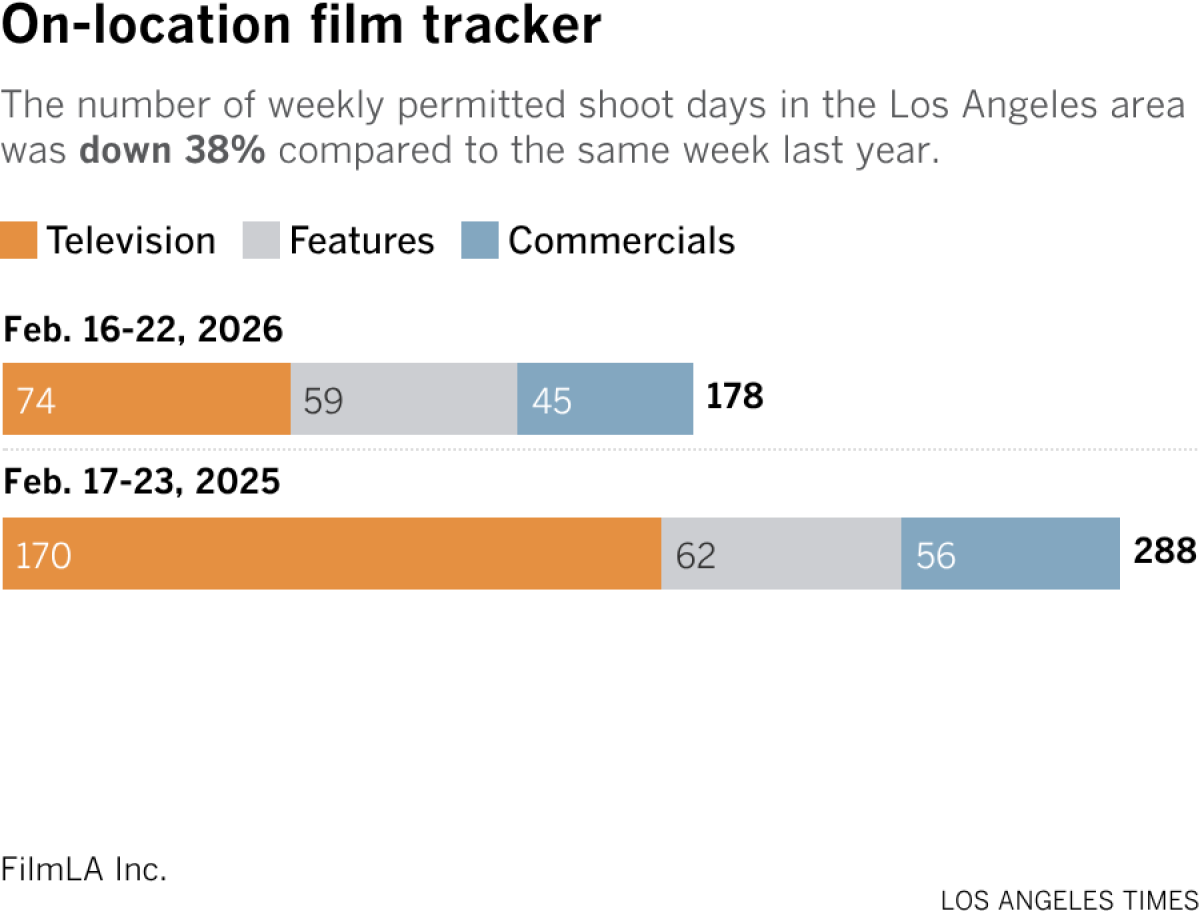
Stacked bar chart shows the number of weekly permitted shoot days in the Los Angeles area. The number of weekly permitted shoot days in the area was down 16% compared to the same week last year. This year, there were a total of 222 permitted shoot days during the week of November 03 - November 09. During the same week last year (November 04-10, 2024), there were 263.

Number of the week

$80 million

After a sleepy October, Walt Disney Co. and 20th Century Studios’ “Predator: Badlands” conquered the box office this past weekend, grossing $40 million in the U.S. and Canada for a total of nearly $80 million worldwide.

The haul is the highest global opening for any film in “Predator” franchise history, surpassing 2018’s “The Predator,” which notched $73.5 million.

The strong start for the Elle Fanning-led “Predator: Badlands” provides a hopeful start for November’s theatrical fortunes. So far this year, domestic box office revenue is about $7.2 billion, up 3.1% compared with the previous year, according to Comscore. But when compared with pre-pandemic 2019, that number is still down 24.7%.

Finally …

My colleague, Malia Mendez, wrote about a TV writer who found a second career in ceramics after the slowdown in Hollywood left him out of work. His most popular workshop — Tattoo a Mug.

Source link

What the steady drumbeat of layoffs means for Hollywood workers

The cuts in Hollywood just keep coming, following a sadly familiar script.

Last week it was Paramount, which laid off about 1,000 workers in the first wave of a deep staff reduction planned since tech scion David Ellison’s Skydance Media took over the storied media and entertainment company.

The cuts affected a wide swath of the company, from CBS and CBS News to Comedy Central, MTV and the historic Melrose Avenue film studio, my colleague Meg James and I reported. Another 1,000 layoffs are expected in the coming weeks.

You’re reading the Wide Shot

Samantha Masunaga delivers the latest news, analysis and insights on everything from streaming wars to production — and what it all means for the future.

By continuing, you agree to our Terms of Service and our Privacy Policy.

But Paramount isn’t the only one in the media business that’s shedding jobs and payrolls.

Earlier, cable giant Charter Communications said it would lay off 1,200 people nationwide, as the company faces increased competition for its broadband internet packages. NBC News, too, laid off 150 employees last month amid declining TV ratings and lessening ad revenue.

Other recent media-adjacent layoffs included 100 cuts to Disneyland Resort’s Anaheim-based workforce and the massive 14,000 worker reduction at Amazon, including at the company’s gaming and film and TV studios.

And that doesn’t even include widespread job losses that happened earlier this year at companies such as Walt Disney Co., Warner Bros. Discovery, NBCUniversal and Six Flags Entertainment Corp.

It all adds up to a grim picture for Hollywood’s workers, who have faced a near endless marathon of economic hurdles for the last five years.

First it was the pandemic, followed by the dual writers’ and actors’ strikes in 2023, cutbacks in spending after studios splurged on streaming productions, and the outflow of production to the U.K. and other countries with lower costs than California.

Then, in January, nature struck a blow, with the fires in Altadena and the Pacific Palisades destroying many industry workers’ homes.

Topping it off, Saturday marked the first day that millions of low-income Americans lost federal food assistance due to the government shutdown that began Oct. 1. That has affected some 5.5 million Californians and probably some who work in the entertainment industry.

“It’s been one crisis after another, without enough time in between,” said Keith McNutt, western regional executive director of the Entertainment Community Fund, which provides social services for arts and entertainment professionals. “People are concerned and very worried and really trying very hard to figure out where they go from here.”

McNutt reports that the nonprofit group has already heard from some people who were recently laid off, and has experienced a sharp increase in demand for its services, particularly from those in the film and TV industry. The fund offers healthcare and financial counseling and operates a career center. It also provides emergency grants for those who qualify.

Clients include not only low-income people who are always hit hardest in downturns, but also veteran entertainment industry professionals who’ve worked in the business for 20 to 30 years.

Those who were lucky enough to have savings saw those wiped out by the pandemic, and then were unable to replenish their rainy-day funds after the strikes and industry contraction, said David Rambo, chair of the fund’s western council.

“It has been snowballing very slowly for about five years,” Rambo said.

Many in the industry are hopeful that California’s newly expanded film and television tax credit program will bring some production — and jobs — back to the Golden State. That’s what backers campaigned on when they lobbied Sacramento legislators to bolster the program. Dozens of TV shows and films have received credits so far under the revamped program, but it’ll take some time to see the results in filming data and employment numbers.

And that doesn’t help the workers who were just laid off last month. For those folks, McNutt suggests calling the fund’s health insurance team to make sure they understand their options and also to spend some time with career counselors to understand how Hollywood skills can be transferable to other employers, whether that’s on a short- or long-term basis. Most importantly, don’t isolate yourself.

“You’re not alone,” he said. “Nobody’s alone in this situation that the industry is finding itself in right now, and so reach out to your friends, reach out to your colleagues. If you’re not comfortable with that, reach out to the Entertainment Community Fund.”

Stuff We Wrote

Film shoots

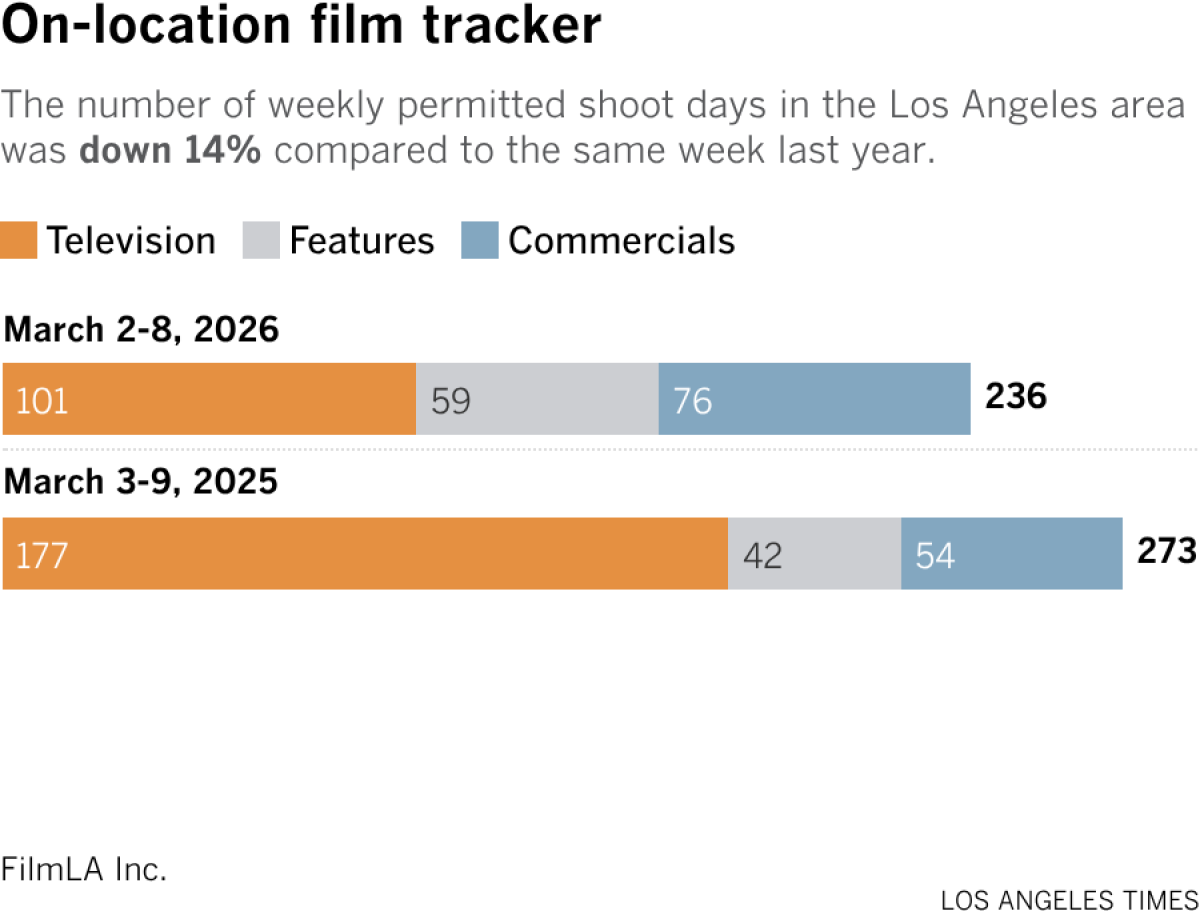
Stacked bar chart shows the number of weekly permitted shoot days in the Los Angeles area. The number of weekly permitted shoot days in the area was down 23% compared to the same week last year. This year, there were a total of 197 permitted shoot days during the week of October 27 - November 02. During the same week last year (October 28 - November 03, 2024), there were 256.

Number of the week

twenty-six million

The Los Angeles Dodgers’ wild 11-inning win on Saturday over the Toronto Blue Jays notched nearly 26 million viewers, making it the most-watched World Series game since 2017, according to Nielsen data.

The 2017 Game 7 win by the Houston Astros over the Dodgers had an audience of 28.3 million.

The Dodgers are now the first Major League Baseball team to win back-to-back championships in 25 years. On Monday, thousands of Dodgers faithful turned out for the team’s victory parade through downtown L.A.

Finally …

You’ve no doubt heard of L.A.’s famous star tours. But what about a tour of a historic cemetery?

My colleague, Cerys Davies, wrote about local historian and guide Shmuel Gonzales — or as he calls himself, “Barrio Boychik” — and his walking tour of Boyle Heights’ Evergreen Cemetery.

The cemetery is the final resting place for many of L.A.’s early movers and shakers, including the Lankershims and the Hollenbecks, and it’s also a prime example of L.A.’s multicultural history.

Source link