nba

NBA star Irving pledges to pay Al-Shaair’s NFL fine over Hind Rajab message | American Football

Basketball superstar Kyrie Irving has offered to pay a fine for American football player Azeez Al-Shaair, who was penalised for wearing the name of Hind Rajab, a Palestinian girl killed by Israeli forces in Gaza.

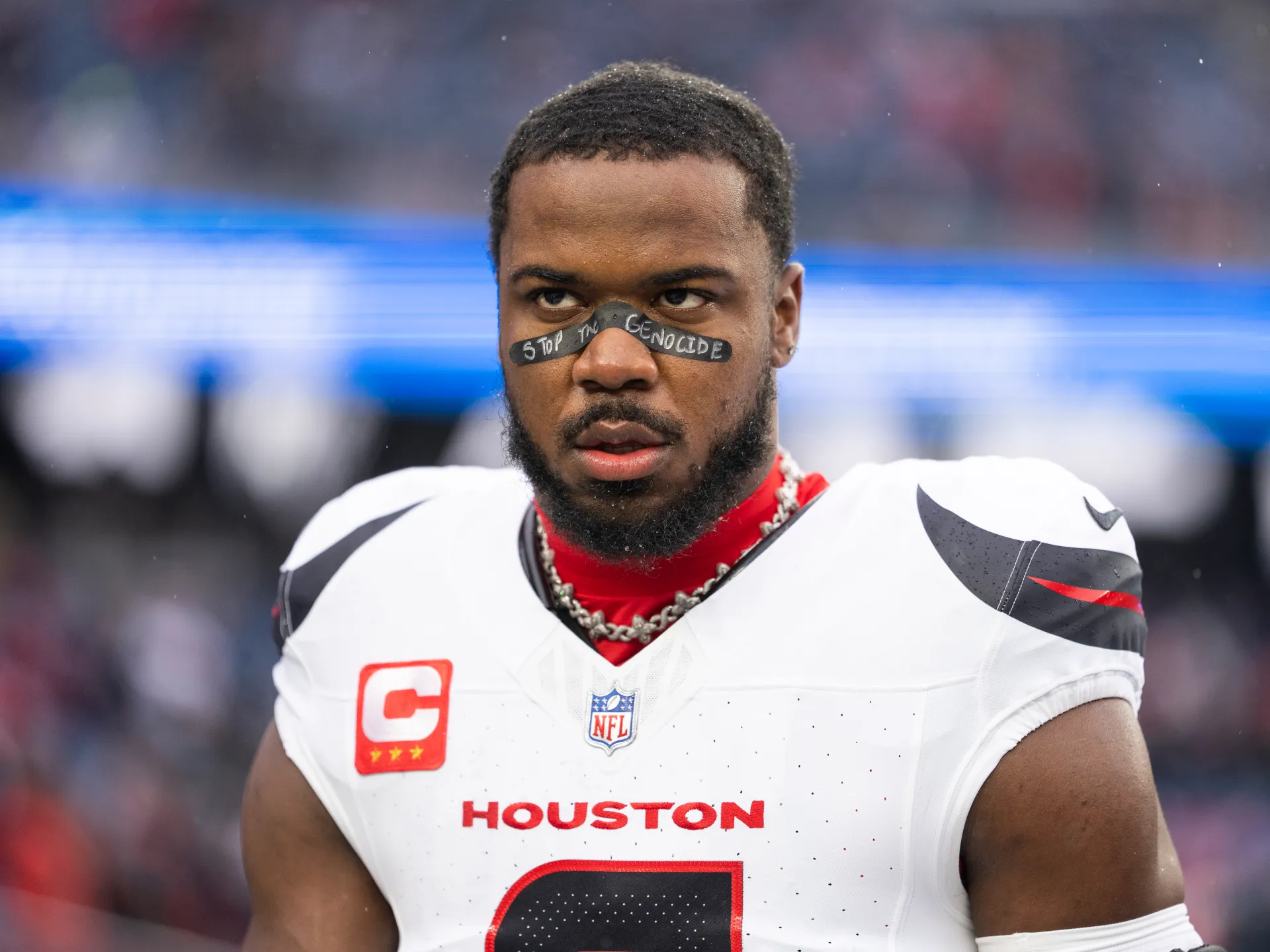
Al-Shaair was handed a fine of $11,941 by the National Football League (NFL) on Wednesday as he was found to be in breach of the NFL’s rules on players’ equipment and clothing during his team Houston Texans’ game against the Buffalo Bills last weekend.

Recommended Stories

list of 3 itemsend of list

Shortly after the fine was announced by an NFL reporter on X, the pro-Palestine basketball player responded to the tweet by saying he would “take care” of it.

Al-Shaair, 29, is a linebacker for the Houston-based NFL team and a vocal advocate for Palestinian rights.

During his team’s last NFL game, Al-Shaair wrote Rajab’s name on his eye black, a sticker or paint frequently used by NFL players to reduce glare.

Five-year-old Rajab was killed in Gaza after Israeli soldiers opened fire on her family’s stranded car. A phone call by the Palestinian Red Crescent documented her final moments and was the subject of an Oscar-nominated docudrama.

Al-Shaair, a Black American Muslim player, has frequently spoken about the plight of Palestinians and has paid the price for it.

He was also fined in January, during the NFL’s last season, when he displayed the message “Stop The Genocide” on his nose tape. While it did not specifically refer to a particular conflict, it was widely understood to be about Gaza and Sudan.

NFL criticised for ‘inhumane’ fine on Al-Shaair

The NFL’s fine on Al-Shaair comes at a time when Robert Kraft, the owner of the Boston-based team New England Patriots, confirmed that he pressured pop star Ed Sheeran to drop rapper Macklemore from his tour of the United States.

The billionaire is the owner of Gillette Stadium in Foxborough, Massachusetts, one of the venues where Macklemore was due to appear on stage as the opening act for Sheeran’s US tour in late September.

Letting Macklemore perform in Gillette Stadium would, Kraft said, cross a line, as he described the rapper’s recent performances as including a “broader history of anti-Semitic rhetoric and imagery”.

Kraft is known for launching a so-called “anti-Semitic campaign” during Israel’s genocide in Gaza in 2023, when players, coaches and executives from his Patriots team wore blue pins.

On October 15, 2023, the NFL observed a moment of silence for Israel during a game between the Baltimore Ravens and the Tennessee Titans in London, United Kingdom, while the league has sanctioned its player for raising awareness for Palestinians.

The NFL was criticised on social media for slapping a fine on Al-Shaair, with one user calling the move “inhumane”.

“He is advocating for the murder of this innocent child Hind Rajab in Palestine and they fine him?! Nah, that is so inhumane. You should be ashamed of yourself,” the user wrote.

Prominent American Muslim scholar Omar Suleiman questioned whether Al-Shaair would have faced a similar punishment if his tape carried the name of Holocaust victim Anne Frank instead.

“Why is honoring murdered Palestinian children ‘an unauthorized message’?” he asked in a post on X.

Meanwhile, the Texas chapter of the Council on American-Islamic Relations backed Al-Shaair over his continued advocacy for Palestinians.

“We commend Al-Shaair for using his platform to highlight the memory of Hind Rajab, one of the many children murdered by the Israeli government during its genocide in Gaza,” the rights group said in a statement on its website.

“The NFL has no problem with coaches wearing pins developed for genocide supporter Robert Kraft’s “Stand Up to Jewish Hate” campaign, and it should have no problem with an NFL player mentioning the name of a girl killed in that genocide,” the statement went on to add.

“Al-Shaair’s message was rooted in basic human decency and concern for innocent lives. That should not be controversial, much less subject to a fine.”

Irving’s pro-Palestine stance

Meanwhile, nine-time National Basketball Association (NBA) All-Star Irving has previously made his pro-Palestine stance on Israel’s genocidal war on Gaza clear.

In February, Irving wore a shirt reading “PRESS” at the NBA All-Star Game to honour journalists who had been killed in Gaza while covering the war.

According to reports, the tag on his shirt read: “Dedicated to our beloved journalists in Gaza showing the world the truth.”

In April, Irving changed his display picture on Instagram to an image of a Palestinian child blocked from attending school by Israeli soldiers in the occupied West Bank.

During a pre-game interview in 2024, he was seen wearing a chain with the Palestine flag in the shape of Israel’s landmass.

In 2023, the basketball player wore a keffiyeh, a cotton headdress with a distinctive checkered pattern worn in many parts of the Arab world that represents Palestinian identity, during a post-match news conference.
Source link

Steve Ballmer says Clippers will comply with NBA sanctions

Clippers owner Steve Ballmer released a lengthy statement Sunday night apologizing to fans and accepting the findings of an NBA investigation of salary cap violations.

“This has been a very difficult time for everybody associated with the Clippers, and for that, I have sincere regrets,” Ballmer said in the statement released 11 days after the NBA first sanctioned the owner and his team. “I want to apologize to our fans, employees, and my fellow NBA team owners for the distraction and distress this matter has caused, for which I accept responsibility as principal owner.”

The NBA handed down stiff penalties to Ballmer and the Clippers after the law firm of Wachtell, Lipton, Rosen & Katz found “a pattern of misconduct and multiple significant rules violations” that benefited Clippers star Kawhi Leonard.

The investigation found Leonard received $66 million in cash and equity from four companies facilitated by Ballmer and Clippers executives at the behest of Dennis Robertson, Leonard’s uncle and then-agent. Ballmer invested $60 million in Aspiration Partners, while Boingo Wireless, Daktronics and Lockton Insurance received $22 million from the Clippers in consulting fees.

The Clippers initially protested and vowed to use all means available to contest sanctions that included banning Ballmer from all league activities for a year, fining the team $30 million and taking away five first-round draft picks in the 2029, 2030, 2031, 2032 and 2033 drafts.

Leonard previously agreed to pay a $700,000 fine and did not contest the sanctions, removing the possibility of the case going to arbitration because the mechanism only exists for players and not teams.

“We are committing to put this chapter behind us,” Ballmer’s statement read. “We have communicated to the NBA that we are complying with the penalties assessed by the league, have paid the fine and are moving forward. While there are still disagreements concerning the findings in the report, this is not where I want to focus. Team owners should support, not distract.”

Two of Ballmer’s top executives were also sanctioned, altering the way the team will have to operate moving forward.

Clippers president of business operations Gillian Zucker was suspended without pay for one year for “being primarily and directly culpable for the impermissible endorsement arrangements and for providing false and misleading statements to investigators.”

Clippers president of basketball operations Lawrence Frank was suspended without pay for six months for “his involvement with the impermissible endorsement arrangements and for approving impermissible expenses incurred by Mr. Leonard and his family.”

Ballmer, however, has assembled a deep front office staff, giving the Clippers a number of options to offset the loss of those who are suspended.

“The challenges ahead of us are significant, but so is our resolve,” Ballmer wrote. “We will continue to build our team and invest in our community. The confidence of our fans is our priority. With our talented roster, outstanding staff and clear vision, I am certain that we will compete at the highest level and be an organization our fans can be proud of.”

The decision to comply with the sanctions rather than attempting to contest them in the court could help resolve one of the biggest outstanding offseason items the Clippers face.

Leonard’s trade to the Toronto Raptors in exchange for forward Brandon Ingram, shooting guard Gradey Dick, two first-round draft picks, a pick swap and two second-round picks was put on hold while both teams awaited investigation results.

With the NBA stripping the Clippers of five future first-round picks, the package they are expected to receive when the Leonard trade is completed would have a substantial impact on their future roster-building options.

Source link

Hiltzik: Inside the NBA’s nuclear bomb on the Clippers

Question about the Clippers’ attempt to evade the NBA salary cap: Did they really think they could get away with it?

One rule I’ve developed in years of writing about financial scandals is that, as bad as a scheme appears at first, it’s more likely than not that the facts will turn out to be nastier than they appeared at first.

Case in point: The scandal swirling around the Los Angeles Clippers of the National Basketball Assn. and their billionaire owner, former Microsoft Chief Executive Steve Ballmer.

The story was initially broken one year ago by sports podcaster Pablo Torre, who reported on a suspect endorsement deal between a sustainability company named Aspiration and All-Star forward Kawhi Leonard that smelled like an attempt to circumvent the NBA’s strict salary cap. (Torre won a Pulitzer Prize for his reporting.)

I have no idea why we’d do this.

— Aspiration executive questioning its “endorsement” deal with Kawhi Leonard

By Sept. 2, when the NBA issued a series of nuclear sanctions against the team and Ballmer, it had become much bigger. The team, according to an investigative report the league released, actually orchestrated endorsement deals for Leonard with four companies that had been angling for business arrangements with the team, not just one, and took steps to hide the deals from public view.

Because of the extent to which these deals violated league rules and perhaps because the Clippers are repeat offenders (they were fined $250,000 in 2015 for a similar endorsement scheme involving then-free agent DeAndre Jordan), the league hit the team with its maximum penalties.

Get the latest from Michael Hiltzik

Commentary on economics and more from a Pulitzer Prize winner.

It fined the team $30 million and took away its first-round draft picks for five years, 2029-2033 (the team already had ceded its first-round picks for the next two years in trade deals). It suspended Ballmer from any league or team activities for one year and imposed a one-year suspension on Gillian Zucker, the team’s president of business operations, and a six-month ban on Lawrence Frank, its president of basketball operations.

The Clippers said they “vehemently reject” the accusations and called them the product of a “heavily biased investigation.” They said they would appeal the sanctions, though it’s unclear how they could do that.

Leonard, who appears to be on his way back to the Toronto Raptors, from whence he came to the Clippers in 2019, issued a statement accepting “full responsibility for lapses in judgment by people within my inner circle.” That’s an apparent reference to Dennis Robertson, his business manager and uncle, who the investigators said was a key figure pushing the Clippers to find “off-court income” for Leonard.

The report released by the NBA’s investigators at the law firm of Wachtell, Lipton, Rosen & Katz portrays Ballmer and the team as treating the league’s salary cap rules not as strict mandates, but as obstacles to be evaded, like traffic cones. And it describes efforts at subterfuge that seemed to reach a Gilbert & Sullivan-esque level of absurdity.

Ballmer is called out to an extent that one almost never sees when applied to the millionaires and billionaires who own most professional sports teams. That’s even more remarkable given his status in the NBA: With a reported net worth of more than $150 billion, he is the richest team owner by an enormous margin, outranking the next-place owners, the Adelson family, owners of the Dallas Mavericks, by about $115 billion.

The other NBA owners were reportedly stunned by the sheer arrogance of the Clippers’ behavior. That’s saying something, since one would expect that those in the billionaire class have had plenty of rannygazoo paraded past their eyes in the course of their business careers. Ballmer, who can often be seen bouncing around like a hyper-caffeinated party animal in the Clippers’ home arena, Intuit Dome, is no shrinking violet — he was known as a ferociously hard-charging, hands-on leader at Microsoft. The NBA faults him for being “knowingly” engaged in the team’s dealings with Leonard and creating its anything-goes culture.

The NBA values its salary cap as a key to a competitive balance, enabling even mid-market teams to reach the Finals — over the last 10 seasons, eight teams have reigned as champs. Its rules bar teams from initiating endorsement deals or other such arrangements for players by interpreting them as an underhanded breach of the cap; if teams are approached by a potential endorsement partner for a player, they can refer the partner to a player’s representatives but can’t participate in the dealmaking. They’re also required to report any such overtures to the league. The Clippers violated those rules, the investigators say.

The investigators say the team tried to circumvent the initiation clause via emails Zucker sent to three companies in 2020, implying that she was responding to their requests for introductions to Leonard.

The investigators found “no documentary evidence” that the companies genuinely initiated the requests. They viewed the emails merely as efforts to “create the appearance” that the Clippers were complying with the rules. The companies were Boingo, a wi-fi company at which Zucker’s husband was then chairman; Daktronics, a maker of scoreboards and video displays; and Lockton, an insurance brokerage.

All three were seeking to launch business relationships with the Clippers. The investigators asserted that the team implied to them that participating in its scheme to make illicit payments to Leonard by signing him to endorsement deals would help them win the contracts. They also found that the Clippers essentially assured the companies that it would cover their payments for the endorsement deals via their other contracts.

The investigators called these multi-year, multimillion-dollar endorsement deals, totaling $18 million, “peculiar.” None of the companies had ever signed an endorsement deal “of remotely the same financial magnitude” as these, nor have they done so since.

None of the deals was publicly announced, even though the whole point of signing a pro player to represent your company is to shout it from the rooftops. In any case, Leonard was nothing like a big, popular star—the investigators charitably referred to his “relatively insubstantial endorsement profile.” That hardly mattered, since the deals didn’t require Leonard to actually do anything for the money.

The key deal was with Aspiration, which was guided by the Clippers into paying Leonard $48 million over four years. When Joseph Sanberg, Aspiration’s co-founder and a board member, presented the deal to top executives, they were dumbfounded. “I have no idea why we’d do this,” one wrote in an email, according to the investigators.

But Sanberg assured them that the Clippers would adjust their contract with Aspire to cover the expense. Seeing that the deal was “cashflow neutral,” as an executive observed, they agreed.

Inside the Clippers’ front office, the contract for Aspiration to provide environmental services was seen as “super shady,” according to a text from one executive to another cited in the report.

Ballmer maintained in at least one interview that the endorsement deal was initiated by Aspiration: “They were off to the races on their own,” he told a television interviewer. “We weren’t involved.”

In fact, the investigators say, the Clippers initiated the contact with Aspiration, put the firm in touch with a business agent who was already a team contractor, and provided the agent with proposed deal terms. The investigators found that the endorsement deal was such a departure for Aspiration that Sanberg needed to be educated about what it should require from Leonard in return for his fees. Sanberg “doesn’t really know what to ask for,” the agent told his associates.

Ballmer maintains that he was the victim in this arrangement. He points the finger at Sanberg, who he says enticed him into investing $60 million in his failing firm, thereby causing him “reputational harm.” But Sanberg might be viewed as a target of convenience, given that he pleaded guilty last year to federal fraud charges associated with the collapse of Aspiration and has been sentenced to 14 years in prison. (The NBA investigators told the court in a pre-sentence letter that Sanberg “substantially assisted our investigation”—though in the investigative report they said they “remained cautious in relying on Mr. Sanberg’s information” unless it was “corroborated by other evidence.”)

Where does this leave the Clippers? Nowhere good. Ballmer’s acquisition of the team in 2014 was seen as a major step toward ending its years-long record of futility, dating to its origin as the Buffalo Braves in 1970. The team still has never played in the NBA Finals. Leonard hasn’t lived up to expectations — injuries have kept him off the court for nearly half of his games as a Clipper, as my colleague Mirjam Swanson notes.

Basketball mavens see the NBA sanctions as condemning the Clippers to as long as 10 more years in John Bunyan’s Slough of Despond. For a brief moment, Ballmer got Southern California fans excited about the team. Ten years from now, will anyone even remember they exist?

Source link

NBA drops hammer on The Cheatin’ Clippers, and they can’t shed stink

Boom, goes the Clippers.

Steve Ballmer has been tattered. Lawrence Frank has been shredded. Their team future has been flattened.

Boom, goes those damn Clippers.

They had transformed themselves from the ridiculed Clip Joint to a top-shelf NBA organization, with the billionaire owner, the beautiful arena, the best coach and the most devoted fans … but they apparently got greedy, seemingly played dirty, and now have been affixed with a scarlet eight letters that will follow them forever.

Cheaters.

The NBA has ruled that the Clippers are cheaters.

Ballmer, cheater. Frank, cheater. Even president of business operations Gillian Zucker, cheater.

The NBA suspended Ballmer and Zucker for one year and Frank for six months Wednesday for violating salary cap rules when they signed Kawhi Leonard in 2019.

In arguably the harshest punishment in sports since SMU was given college football’s death penalty in 1987 — this is even worse than the USC sucker punch of 2010 — the league added injury to insult by stripping the team of five consecutive draft picks from 2029 to 2033.

The league also fined the team $30 million and Leonard $700,000 but the issue here is not money.

The issue is trust.

How can any of the Clippers partners or sponsors or fans trust this team with their dollars or their time or their affection after they were apparently caught knowingly breaking one of the NBA’s cardinal rules?

You don’t mess with the salary cap. Period. It’s the one thing that keeps these disparate teams and markets competing on a level field. Period.

Yet according to the findings of a lengthy investigation by the NBA, the Clippers’ top three executives — Ballmer, Frank and Zucker — helped arrange rich endorsement deals for Leonard that allowed him to make considerably more money than his contract states. Leonard did little if any endorsing, collected the extra checks, and essentially was paid above and beyond the salary cap.

The circumvention was first revealed a year ago by the podcast “Pablo Torre Finds Out,” which cited a $28-million endorsement deal with the now-bankrupt Aspiration, a sustainability services company. The subsequent NBA investigation discovered three more endorsement deals that amounted to similar salary cap circumvention, a charge which drew the particular ire of the league because the Clippers had been warned about salary cap circumvention with Leonard before.

The Clippers' Kawhi Leonard looks down during a game against the Golden State Warriors at Intuit Dome on Jan. 05, 2026.

Kawhi Leonard, above during a game against the Golden State Warriors at Intuit Dome in January, signed with the Clippers in 2019.

(Sean M. Haffey / Getty Images)

Bottom line, the Clippers seemingly flouted the rules, got burned, got punished, and now you have to wonder, how on earth do they move forward from this?

They started the recovery process immediately Wednesday by issuing a statement that accused the NBA of not playing fair.

“We vehemently reject the NBA’s findings, which are the result of a heavily biased investigation seeking to justify a predetermined narrative rather than facts and evidence,” the statement began.

They can let out one of those trademark Ballmer screams and it still won’t matter. There is no arbitration or appeals process available. The NBA’s ruling is final.

All of which leaves the Clippers facing serious questions about their future.

First, will Ballmer still have the local support to own the team? His absence from his traditional seat under the basket will serve as a nightly reminder that he commanded a dirty ship. Their most vocal cheerleader is now their biggest scoundrel, and how do you come back from that?

Although he made great strides in dragging the Clippers back into relevance since buying the team from the shamed Donald Sterling in 2014 — even building that cool arena in Inglewood — Ballmer has lost much credibility with this decision.

He may need to sell to help the organization shed its stink. There’s been so much peddling of billion-dollar franchises around town lately, surely some rich group is in a position to take the Clippers off his hands.

Stan Kroenke? Too late. Bob Iger and Josh Kushner? Too late. Mark Walter? Um, no. How about those Buss kids, or are they too busy making nice with Manny Machado?

Then there’s the matter of Frank, who was struggling to build sustained success before this scandal. It would be a surprise to see him return, just as it would be a surprise to see Zucker return. For the Clippers to come out of this mess, they’re going to need to retool at the top.

Which brings this story to one Clipper leader who was not indicted in the investigation. How much longer will Ty Lue, one of the league’s very best coaches, want to stick around this mess? He has three years left on his contract. That could be three long years.

Finally, what of Kawhi Leonard? The Clippers thankfully traded him back to Toronto this summer, and hopefully that is where he’ll stay if the trade gets taken off hold with the investigation complete.

In all, just when you thought the Clippers reputation in this town had long since moved past all those years of losing and insults and embarrassments and Sterling scandals, just when you thought it couldn’t get any worse…

It just got worse.

Source link

NBA hammers Clippers, Steve Ballmer and Kawhi Leonard after probe

The NBA handed down sweeping penalties to Clippers owner Steve Ballmer, team executives, the team and star Kawhi Leonard following an investigation into allegations the group circumvented the league’s Collective Bargaining Agreement.

The Clippers said in a statement that they “vehemently reject the NBA’s findings” and vowed to challenge them. Leonard issued a statement saying he had no direct knowledge of the rule violations.

The findings announced Wednesday, the result of a nearly yearlong investigation conducted by Wachtell Lipton Rosen & Katz, a high-powered New York law firm, determined the Clippers broke NBA rules by initiating off-court income opportunities between Leonard and four companies doing business with the team: Aspiration Partners, Boingo Wireless, Daktronics and Lockton Insurance.

The firm’s report stated that the Clippers facilitated endorsement agreements between the companies and Leonard, induced the companies to enter into the agreements by offering them business from the team, paid personal expenses on behalf of Leonard and his representatives and failed to report improper solicitations for off-court income made on Leonard’s behalf by Dennis Robertson, his then-business manager.

The investigation found Leonard received $66 million in endorsement pay from four companies facilitated by Ballmer and Clippers executives at the behest of the star’s then-manager. Ballmer invested $60 million in Aspiration and three other companies received $22 million from the Clippers in consulting fees.

As a result, the NBA issued the following sanctions:

  • The Clippers are forfeiting first-round draft picks, one apiece in the 2029, 2030, 2031, 2032 and 2033 NBA drafts.
  • The Clippers are fined $30 million.
  • Ballmer is suspended from all league and team activities for one year for “knowingly seeking to help Leonard obtain off-court income opportunities, for approving a business deal that he knew was a precondition for Aspiration to enter into an endorsement agreement with Mr. Leonard, and for his failure to create conditions under which his organization abided by the NBA’s circumvention rules.”
  • Clippers president of business operations Gillian Zucker is suspended without pay for one year for “being primarily and directly culpable for the impermissible endorsement arrangements and for providing false and misleading statements to investigators.”
  • Clippers president of basketball operations Lawrence Frank is suspended without pay for six months for “his involvement with the impermissible endorsement arrangements and for approving impermissible expenses incurred by Mr. Leonard and his family.”
  • The Clippers organization and personnel are subject to a compliance and monitoring program overseen by the league office for five years.
  • Leonard is required to pay the league $700,000.
  • Dennis Robertson, Leonard’s uncle and previous business manager, is banned from conducting business or otherwise engaging with NBA teams and their affiliates on behalf of or with respect to any player, employee or other league or team personnel for a period of five years.

The Clippers said in a statement they cooperated fully with the investigation and will fight “to demonstrate our innocence.”

“The NBA’s findings … are the result of a heavily biased investigation seeking to justify a predetermined narrative rather than facts and evidence,” the team statement read. “What the league told us privately differs from what it announced today publicly, and they have not held themselves close to the standard Commissioner [Adam] Silver set at the start of this investigation to ensure it’s fairness and accuracy.”

”… We intend to vigorously challenge these findings and penalties through every avenue available to us and look forward to an ethical and impartial arbitration process.”

The Clippers most likely will have to take their claims to court. A league source not authorized to discuss the sanctions publicly said there is not an arbitration or appeal process available for the team to pursue. Arbitration is reserved for players and the National Basketball Players Association declined to pursue use of it in this case.

The Clippers released a letter sent to Silver arguing Ballmer spent nearly $50 million funding the investigation and cooperated in every way possible.

“Mr. Ballmer’s reputation has been irreparably damaged as he now finds himself embroiled not only in this heavily biased investigation, but in civil litigation, the Aspiration bankruptcy proceeding, and more,” the letter stated. “It seems increasingly likely that Mr. Ballmer will spend years defending himself and the team against a podcaster’s baseless claims.”

Leonard issued a statement denying knowledge of the salary cap violations without contesting the league’s findings.

“I accept full responsibility for lapses in judgment by people within my inner circle and regret the distraction this situation has caused the fans and my family,” Leonard’s statement read. “I entered into my contract with the Clippers as well as the agreements in question in good faith, fully committed to fulfilling my obligations and with no knowledge of any intent on anyone’s part to circumvent the salary cap.

“For 15 years, my priority has been giving everything to my family, the game, and those I share the court with. As I return to Toronto, I am focused on what I can control, closing this chapter, and moving forward with a clean slate.”

It remains unclear whether Leonard’s trade to Toronto, which was put on hold until the NBA investigation was completed, will be finalized.

The probe was triggered when the “Pablo Torre Finds Out” podcast aired an episode Sept. 3, 2025, detailing the contract Leonard received from Aspiration, a self-described “socially-conscious and sustainable banking services and investment products” firm.

The deal with Leonard came to light in Aspiration’s bankruptcy documents. Joseph Sanberg, co-founder of the company, pleaded guilty in October to federal charges of conspiring to bilk investors out of $248 million and on June 1 was sentenced to 14 years in federal prison.

One of the primary investors in Aspiration was Ballmer, the former longtime CEO of Microsoft whose estimated net worth is $139 billion. He has owned the Clippers since 2014.

Ballmer invested $50 million in Aspiration in September 2021. A month later, the Clippers announced a $300-million sponsorship deal with the company. Ballmer nearly granted Aspiration naming rights to the team’s new $2-billion arena, but instead chose financial services firm Intuit.

Two years later when Aspiration was experiencing severe financial difficulties, Ballmer invested an additional $10 million and Clippers co-owner Dennis Wong — Ballmer’s former college roommate — invested $1.99 million in Aspiration nine days before Leonard received a $1.75 million payment from the company. Leonard was paid $21 million of the $28 million agreed upon in his contract with Aspiration.

Leonard was traded to the Toronto Raptors on June 30 for Brandon Ingram, Gradey Dick and a slew of draft picks, but the deal was put on hold pending the outcome of the investigation. Leonard led the Raptors to the NBA championship in 2019.

Leonard would not talk about the allegations during the 2025-26 NBA season because the investigation was ongoing and brushed it off during media day in September 2025.

“None of us did … wrongdoing and, yeah, that’s it,” he said. “We invite the investigation.”

Asked if he performed any endorsement work for Aspiration, Leonard said, “I understand the full contract and services that I had to do. Like I said, I don’t deal with conspiracies or the click-bait analysts or journalism that’s going on.”

Players are allowed to have endorsement and business deals, but at issue was whether the Clippers participated in arranging the side deal beyond simply introducing Aspiration executives to Leonard. Doing so would be a violation of Article 13 of the NBA collective bargaining agreement.

ESPN reported Aug. 17 that NBA investigators had met with Ballmer and other Clippers officials in an attempt to agree to findings before the case went to arbitration. Although ESPN wrote that three sources told reporters the NBA found no evidence showing Ballmer funneled money through team sponsors to pay Leonard to circumvent the salary cap, the NBA immediately pushed back, releasing a statement that read “ESPN’s article regarding the L.A. Clippers investigation — for which the NBA declined to cooperate — contains numerous and significant inaccuracies. The results in this matter will be made clear once the investigation is concluded.”

In his only public comments since the salary cap circumvention accusations first surfaced, Ballmer told ESPN in September 2025 that he was “conned” by Sanberg and Aspiration. He also said he knew nothing of the endorsement deal between the company and Leonard.

“We were done with Kawhi, we were done with Aspiration,” Ballmer said. “The deals were all locked and loaded. Then, they did request to be introduced to Kawhi, and under the rules, we can introduce our sponsors to our athletes. We just can’t be involved.”

Ballmer cannot wipe his hands clean of Aspiration yet. He was added as a defendant in a civil lawsuit against Sanberg and others associated with Aspiration — renamed Catona Climate in 2025 just before the bankruptcy filing — brought by 11 investors in the company. Ballmer and other defendants are accused of fraud and aiding and abetting fraud, with the plaintiffs seeking at least $50 million in damages.

Source link

Read the NBA’s scathing investigation of L.A. Clippers, Steve Ballmer,

Here is the NBA’s investigation into allegations the Los Angeles Clippers circumvented the league’s Collective Bargaining Agreement.

The NBA handed down sweeping penalties to Clippers owner Steve Ballmer, team executives, the team and Kawhi Leonard following an
investigation. The Clippers said in a statement that they “vehemently reject the NBA’s findings” and vowed to challenge them.

Read the full report here:

Source link

NBA: Los Angeles clippers fined $30m over Kawhi Leonard deal

The LA Clippers have been fined $30m (£22.2m) by the National Basketball Association (NBA) for violating salary rules over the acquisition of star player Kawhi Leonard.

The Clippers will also have to forfeit five first-round draft picks between 2029 and 2033, while owner Steve Ballmer has been suspended from all league and team activities for 12 months for “knowingly seeking to help Mr Leonard obtain off-court income opportunities”.

Two-time NBA champion Leonard has been fined $700,000 (£518,997) by the league.

The team’s president of business operations, Gillian Zucker, has been suspended for one year without pay for providing “misleading statements to investigators”.

The punishments come after the NBA said its month-long investigation “found a pattern of misconduct and multiple significant rules violations by the Clippers organisation, a prior offender of the salary-cap circumvention rules”.

Following the ruling, Leonard, 35, said he “accepts full responsibility” for his actions and “regrets the distraction this situation has caused the fans and my family”.

“I entered into my contract with the Clippers as well as the agreements in question in good faith, fully committed to fulfilling my obligations and with no knowledge of any intent on anyone’s part to circumvent the salary cap,” he wrote on Instagram.

The two-time NBA Finals MVP joined the Clippers in 2019, spending seven years with the franchise before joining the Toronto Raptors.

The NBA said both the “organisation and personnel” of the Clippers will be subject to a compliance and monitoring programme, overseen by the league for five years.

More to follow.

More to follow.

Source link

Shaky future of Spectrum’s Lakers channel adds more drama to the team’s sale

For more than a decade, Los Angeles’ premier sports teams — the Lakers and the Dodgers — have relied on big-ticket TV rights deals to boost their operations and player payrolls.

But major changes are looming.

The prospective new Lakers owners — investor Joshua Kushner and former Walt Disney Co. chief executive Bob Iger — will inherit an uncertain long-term television picture for the team when they assume control of the storied franchise.

Charter Communications’ Spectrum service broadcasts Lakers games on its SportsNet cable channel. The Lakers are set this fall to enter the 15th year of their long-term, $3-billion agreement with the cable company to bring regular season action to local viewers.

But Charter executives have discussed exiting that relationship, which guarantees the team about $200 million a year in revenue, according to people familiar with the company’s plans who were not authorized to comment.

Charter months ago retained investment bankers to find a buyer for El Segundo-based Spectrum SportsNet, which the company runs in tandem with the Dodgers-owned channel, SportsNet LA.

Charter’s interest in jettisoning the channel as fewer consumers watch cable TV has sparked fears within the Lakers organization about the stability of the critical revenue stream, according to a person familiar with the situation who was not authorized to speak publicly.

The Lakers and Kushner’s investment firm, Thrive Capital, declined to comment.

Stamford, Conn.-based Charter on Thursday finalized its $34.5-billion purchase of Cox Communications, making Spectrum the dominant internet and television provider in Southern California, covering Santa Barbara to the Mexican border.

In response to questions from The Times, Charter Chief Executive Chris Winfrey acknowledged the turmoil surrounding sports channels.

“The regional sports network business is significantly challenged,” Winfrey said during a Thursday conference call with reporters to highlight the Cox merger. “Most of the regional sports networks have gone bankrupt [but] Spectrum has so far remained committed.”

The company is seeking a new arrangement, but Winfrey declined to discuss ongoing conversations with the Lakers or the team’s potential proprietors after Lakers owner Mark Walter, who is facing a federal criminal investigation, abruptly decided to sell the team in a deal valued at $12.5 billion. A spokesperson for Walter and his holding company has stated that they are cooperating with authorities and expect the matter to be resolved “favorably.”

Spectrum, Winfrey said, “would love to find solutions” to make its relationship with the Dodgers and Lakers more acceptable. Over the years, the company has bled hundreds of millions of dollars providing the L.A. sports channels.

“We believe in the local teams, the Lakers and the Dodgers,” Winfrey said. “It’s very important to us. It’s very important to our customers — but that doesn’t mean that it’s a great economic agreement with us.”

The Lakers’ TV contract runs through 2032. The Dodgers’ arrangement with Spectrum extends to 2038, but clouds have been gathering for years as consumers find new ways to watch sports.

Millions of consumers over the last decade have migrated from pricey packages offered by Spectrum and other cable companies to lower-cost streaming options. Spiraling monthly cable bills — largely driven by increases in sports rights fees — have made cable TV less attractive to ordinary subscribers.

A pedestrian walks past Spectrum SportsNet

A pedestrian walks past Spectrum SportsNet in El Segundo on Aug. 13.

(Genaro Molina / Los Angeles Times)

Cable TV audiences are shrinking and major sports leagues, including the NBA, recognize the younger viewers they desperately want to reach primarily get their entertainment on apps. Broken TV economics have prompted the NBA to begin making plans to build a centralized streaming platform for fans to watch basketball.

“It’s mostly the result of cord-cutting and just fewer homes receiving these networks,” said Scott Robson, a principal analyst with S&P Global Market Intelligence. “The league [would like] to create a centralized streaming hub and bring all 29 domestic clubs under one umbrella, whether that be through YouTube or some other streaming partner.”

But such plans could mean sharing revenue among the various teams, which could mean less money for large-market clubs such as the Lakers and world-champion New York Knicks, which benefit from their lucrative local TV contracts.

Earlier this year, Main Street Sports Group alerted the NBA, National Hockey League and Major League Baseball that it would cease operations, leaving teams scrambling to cobble together TV coverage for their games.

The group operated FanDuel-branded channels (previously Bally Sports) following the 2023 Chapter 11 bankruptcy reorganization of Diamond Sports Group. Those channels have long featured Clippers and Kings games.

Pressure was lifted off the NBA when the league struck its latest round of national TV contracts — $77 billion worth of deals that, beginning last fall, spread basketball games across ESPN, ABC, Amazon Prime Video, NBC and NBCUniversal’s Peacock streaming service.

The current NBA contracts “provided more money than the previous deal, and as a result, the teams rely less on the local rights payments than they have in the past,” Robson said.

Headwinds for the local sports channels, including those operated by Spectrum, pose the latest rocky chapter for Los Angeles sports fans.

It’s a reversal of fortune from a quarter-century ago, when media giants, including Rupert Murdoch’s Fox, recognized there were huge profits to be made by launching regional sports networks.

Murdoch even owned the Dodgers for a stretch to corner the market on what was then a Wild West shoot-out among TV programmers to launch cable channels.

Charter’s predecessor, Time Warner Cable, wanted in on the action. In 2011, former Time Warner Cable executives hammered out the 20-year agreement with the Lakers, then owned by the late Jerry Buss. Two years later, Time Warner doled out an even richer $8.3-billion deal to the Dodgers, which at the time were under new ownership — Walter and his partners with Guggenheim Baseball Management.

The fees were so steep that other pay-TV providers, including Cox, Dish Network and, for many years, DirecTV, refused to carry the Dodgers channel — leading to one of the longest blackouts in sports TV.

Charter took over the two channels in 2016, when the company absorbed Time Warner Cable. Winfrey, on Thursday, made it clear he was not a fan of those deals, calling them “something that we inherited … not something we did on our own.”

Over the years, the company has lost hundreds of millions of dollars. Last year, Spectrum began offering a streaming-only option to expand the audience for Dodgers’ games. Spectrum subscribers can also watch Lakers’ games on a streaming app.

Last fall, Charter retained boutique bank the Raine Group to find a buyer for the Lakers channel. It’s not clear whether Charter would like to shed its deal with the Dodgers organization, which owns SportsNet LA.

Iger is well familiar with the fragmented sports landscape and economics after years overseeing ESPN and ABC.

Spectrum is seeking “innovative ways … to find a better long-term solution,” Winfrey said. “We’re trying to be constructive and respectful on all fronts.”

Source link