Myanmars

Myanmar’s military holds second phase of elections amid civil war | Elections News

Polls have opened in 100 townships across the country, with the military claiming 52 percent turnout in the first round.

Myanmar has resumed voting in the second phase of the three-part general elections amid a raging civil war and allegations the polls are designed to legitimise military rule.

Polling stations opened at 6am local time on Sunday (23:30 GMT on Saturday) across 100 townships in parts of Sagaing, Magway, Mandalay, Bago and Tanintharyi regions, as well as Mon, Shan, Kachin, Kayah and Kayin states.

Recommended Stories

list of 4 itemsend of list

Many of those areas have seen clashes in recent months or remain under heightened security.

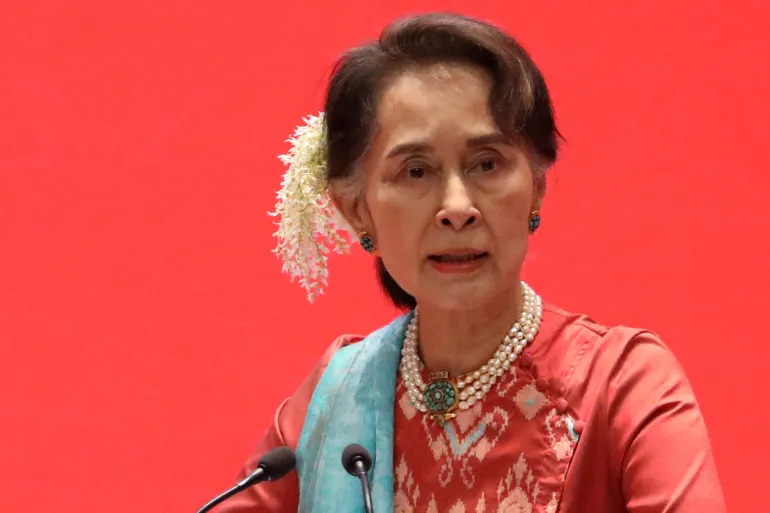
Myanmar has been ravaged by conflict since the military ousted ⁠a civilian government in a 2021 coup and arrested its leader, Nobel Peace Prize winner Aung San Suu Kyi, leading to ​a civil war that has engulfed large parts of the impoverished nation of 51 million people.

Aung San Suu Kyi’s ‍National League for Democracy party, which swept the last election in 2020, has been dissolved along with dozens of other antimilitary parties for failing to register for the latest polls.

The election is taking place in three phases because of the ongoing conflict. The first phase unfolded on December 28 in 102 of the country’s 330 townships, while a third round is scheduled for January 25.

Some 65 townships will not participate due to ongoing clashes.

The military claimed a 52 percent voter turnout after the December 28 vote, while the pro-military Union Solidarity and Development Party (USDP), which analysts say is a civilian proxy for the military, said it won more than 80 percent of seats contested in the lower house of the legislature.

Voters line up to cast their ballots at a polling station during the second phase of general election in Mandalay, central Myanmar, Sunday, Jan. 11, 2026. (AP Photo/Aung Shine Oo)
Voters line up to cast their ballots at a polling station during the second phase of the general elections in Mandalay, central Myanmar, January 11, 2026 [Aung Shine Oo/AP Photo]

“The USDP is on track for a landslide victory, which is hardly a surprise given the extent to which the playing field was tilted in ​its favour. This included the removal of any serious rivals and a set of ‌laws designed to stifle opposition to the polls,” said Richard Horsey, senior Myanmar adviser for Crisis Group.

Myanmar has a two-house national legislature, totalling 664 seats. The party with a combined parliamentary majority can select the new president, who can pick a cabinet and form a new government. The military automatically receives 25 percent of seats in each house under the constitution.

On Sunday morning, people in Yangon, the country’s largest city, cast their ballots at schools, government offices and religious buildings, including in Aung San Suu Kyi’s former constituency of Kawhmu, located roughly 25km (16 miles) south of the city.

As she exited her polling station, 54-year-old farmer Than Than Sint told the AFP news agency she voted because she wants peace in Myanmar, even though she knows it will come slowly given the fractured country’s “problems”.

Still, “I think things will be better after the election”, she said.

Others were less enthusiastic. A 50-year-old resident of Yangon, who asked to remain anonymous for safety reasons, said, “The results lie only in the mouth of the military.”

“People have very little interest in this election,” the person added. “This election has absolutely nothing to do with escaping this suffering.”

The United Nations and human rights groups have called the elections a “sham” that attempt to sanitise the military’s image.

Tom Andrews, the UN special rapporteur on the situation of human rights in Myanmar, said earlier this week that the election was “not a free, fair, nor legitimate election” by “all measures”.

“It is a theatrical performance that has exerted enormous pressure on the people of Myanmar to participate in what has been designed to dupe the international community,” Andrews said.

Laws enacted by the military ahead of the vote have made protest or criticism of the elections punishable by up to 10 years in prison. More than 200 people currently face charges under the measure, the UN said, citing state media.

Separately, at least 22,000 people are currently being detained in Myanmar for political offences, according to the Assistance Association for Political Prisoners.

Source link

Video: What do Rohingya refugees think about Myanmar’s election? | Elections

NewsFeed

Myanmar’s election is unlikely to change the reality for more than 1M Rohingya refugees in Bangladesh who fled what the UN called ‘genocidal violence’ in Myanmar. Efforts to repatriate the Muslim minority have stalled since the junta seized power in 2021. Al Jazeera’s Tanvir Chowdhury reports from Cox’s Bazar.

Source link

What’s happening in Myanmar’s civil war as military holds elections? | Military News

Yangon, Myanmar – Voters in parts of Myanmar are heading to the polls on Sunday for an election that critics view as a bid by the country’s generals to legitimise military rule, nearly five years after they overthrew the government of Nobel Laureate Aung San Suu Kyi.

The multi-phased election is unfolding amid a raging civil war, with ethnic armed groups and opposition militias fighting the military for control of vast stretches of territory, stretching from the borderlands with Bangladesh and India in the west, across the central plains, to the frontiers with China and Thailand in the north and east.

Recommended Stories

list of 4 itemsend of list

In central Sagaing, voting will take place in only a third of the region’s townships on Sunday. Another third will be covered during a second and third phase in January, while voting has been cancelled altogether in the remainder.

Fighting, including air raids and arson, has intensified in several areas.

“The military is deploying troops and burning villages under the guise of ‘territorial dominance’,” said Esther J, a journalist based there. “People here are saying this is being done for the election.”

In most of the region, “we haven’t seen a single activity related to the election,” she said. “No one is campaigning, organising or telling people to vote.”

Across Myanmar, voting has been cancelled in 56 of the country’s 330 townships, with more cancellations expected. The conflict, triggered by the 2021 coup, has killed an estimated 90,000 people and displaced more than 3.5 million, according to monitoring groups and the United Nations. It has left nearly half of the country’s population of 55 million in need of humanitarian assistance.

“People [in Sagaing] say they have no interest in the election,” said Esther J. “They do not want the military. They want the revolutionary forces to win.”

Shifting battlefield

For much of last year, the Myanmar military appeared to be losing ground.

A coordinated offensive launched in late 2023 by the Three Brotherhood Alliance – a coalition of ethnic armed groups and opposition militias – seized vast areas, nearly pushing the military out of western Rakhine state and capturing a major regional military headquarters in the northeastern city of Lashio, about 120km (75 miles) from the Chinese border. Armed with commercial drones modified to carry bombs, the rebels were soon threatening the country’s second-largest city of Mandalay.

The operation – dubbed 1027 – marked the most significant threat to the military since the 2021 coup.

But the momentum has stalled this year, largely because of China’s intervention.

In April, Beijing brokered a deal in which the Myanmar National Democratic Alliance Army agreed to surrender the city of Lashio, without a single shot being fired. The military subsequently reclaimed key towns in north and central Myanmar, including Nawnghkio, Thabeikkyin, Kyaukme and Hsipaw. In late October, China brokered another agreement for the Ta’ang National Liberation Army to withdraw from the gold mining towns of Mogok and Momeik.

“The Myanmar military is definitely resurgent,” said Morgan Michaels, a research fellow at the International Institute for Strategic Studies (IISS). “If this current trend continues, the Myanmar military could be back in a relatively dominant position in a year or so, maybe two.”

The military turned the tide by launching a conscription drive, expanding its drone fleet and putting more combat credible soldiers in charge. Since announcing mandatory military service in February 2024, it has recruited between 70,000 to 80,000 people, researchers say.

“The conscription drive has been unexpectedly effective,” said Min Zaw Oo, executive director at the Myanmar Institute for Peace and Security. “Economic hardship and political polarisation pushed many young men into the ranks,” he said, with many of the recruits technically adept and serving as snipers and drone operators. “The military’s drone units now outmatch those of the opposition,” he added.

According to the Armed Conflict Location & Event Data Project (ACLED), a monitoring group, air and drone attacks by the military have increased by roughly 30 percent this year. The group recorded 2,602 air attacks that it said killed 1,971 people – the highest toll since the coup. It said Myanmar now ranks third in the world for drone operations, behind only Ukraine and Russia.

China, meanwhile, has applied pressure beyond brokering ceasefires.

According to analysts, Beijing pressed one of the strongest armed ethnic groups, the United Wa State Army, to cut off weapons supplies to other rebels, resulting in ammunition shortages across the country. The opposition forces have also suffered from disunity. “They are as fragmented as ever,” said Michaels of the IISS. “Relationships between these groups are deteriorating, and the ethnic armed organisations are abandoning the People’s Defence Forces,” he said, referring to the opposition militias that mobilised after the coup.

China’s calculations

China, observers say, acted for fear of a state collapse in Myanmar.

“The situation in Myanmar is a ‘hot mess’, and it’s on China’s border,” said Einar Tangen, a Beijing-based analyst at the Centre for International Governance Innovation. Beijing, he said, wants to see peace in Myanmar to protect key trade routes, including the China-Myanmar Economic Corridor that, when completed, will link its landlocked Yunnan province to the Indian Ocean and a deep seaport there.

Tangen said Beijing harbours no love for the military, but sees few alternatives.

Indeed, after the coup, Beijing refrained from normalising relations with Myanmar or recognising coup leader Min Aung Hlaing. But in a sign of shifting policy, Chinese President Xi Jinping met Min Aung Hlaing twice this year. During talks in China’s Tianjin in August, Xi told Min Aung Hlaing that Beijing supports Myanmar in safeguarding its sovereignty, as well as “in unifying all domestic political forces” and “restoring stability and development”.

Tangen said China sees the election as a path to more predictable governance. Russia and India, too, have backed the process, though the UN and several Western nations have called it a “sham”. But Tangen noted that while Western nations denounce the military, they have done little to engage with the rebels. The United States has dealt further blows by cutting off foreign aid and ending visa protections for Myanmar citizens.

“The West is paying lip service to the humanitarian crisis. China’s trying to do something but doesn’t know how to solve it,” Tangen said.

Limited gains, lasting war

The military’s territorial gains, meanwhile, remain modest.

In northern Shan state, Myanmar’s largest, the military has recaptured only 11.3 percent of the territory it had lost, according to the Institute for Strategy and Policy – Myanmar, a think tank. But it is western Rakhine State that remains the “larger and more intense theatre of war”, said Khin Zaw Win, a Yangon-based analyst.

There, the Arakan Army is pushing beyond the borders of the state, overrunning multiple bases, and pushing east in a move that threatens the military’s defence industries. In northern Kachin state, the battle for Bhamo, a gateway to the north, is approaching its first anniversary, while in the southeast, armed groups have taken a “number of important positions along the border with Thailand”, he said.

So the military’s recent gains in other parts were “not that significant”, he added.

ACLED, the war monitor, also described the military’s successes as “limited in the context of the overall conflict”. In a briefing this month, Su Mon, a senior analyst at ACLED, wrote that the military remains in a “weakened position compared to before the 2021 coup and Operation 1027 and is unable to assert effective control over the areas it has recently retaken”.

Still, the gains give the military “more confidence to proceed with the elections”, said Khin Zaw Win.

The military-backed Union Solidarity and Development Party, which has fielded the most candidates, is expected to form the next government. Aung San Suu Kyi’s National League for Democracy has been dissolved, and she remains held incommunicado, while other smaller opposition parties have been barred from participating.

Khin Zaw Win said he does not expect the election to “affect the war to any appreciable extent” and that the military might even be “deluded to go for a complete military victory”.

But on the other hand, China could help de-escalate, he said.

“China’s mediation efforts are geared toward a negotiated settlement,” he noted. “It expects a ‘payoff’ and does not want a protracted war that will harm its larger interests.”

Zaheena Rasheed wrote and reported from Kuala Lumpur, Malaysia, and Cape Diamond reported from Yangon, Myanmar.

Source link