MV75

Army Eyes Drone Tankers To Refuel Its New MV-75 Cheyenne II Tiltrotors

  • Army considers drone tankers for MV-75A refueling. The U.S. Army is exploring the use of drone tankers like the MQ-25 Stingray to refuel its new MV-75A Cheyenne II tiltrotors mid-flight.
  • MV-75A to replace Black Hawk helicopters. The Army plans to replace a significant portion of its H-60 Black Hawk fleet with the MV-75A, enhancing range and speed capabilities.
  • 160th SOAR to receive refueling-capable MV-75s. The elite Night Stalkers regiment will get a special operations version of the MV-75 with in-flight refueling capabilities.
  • MQ-25 could operate from land bases. Although designed for carriers, the MQ-25’s long endurance makes it suitable for land-based operations, potentially aiding Army refueling needs.
  • Army lacks organic tanker capacity. The Army currently has no in-house tanker capability, making drone tankers a viable solution for its expeditionary operations.

Bottom line: The U.S. Army is exploring the integration of drone tankers like the MQ-25 Stingray to refuel its new MV-75A Cheyenne II tiltrotors, aiming to enhance operational range and flexibility. This move could address the Army’s lack of organic tanker capacity and support its future air assault strategies.

The U.S. Army is considering configuring at least a portion of its new MV-75A Cheyenne II tiltrotors to be able to refuel in flight using the probe-and-drogue method. This, in turn, has raised the question of how the service will ensure there is adequate tanker capacity to support that capability. Army officials and the MV-75A’s prime contractor, Bell, have both now pointed to a future where tanker drones like the U.S. Navy’s forthcoming MQ-25 Stingray could help extend the Cheyenne II’s reach.

Army Maj. Gen. Clair Gill discussed aerial refueling capability for the MV-75A, as well as other aspects of the Cheyenne II, during a talk yesterday at the Army Aviation Association of America’s (AAAA) 2026 Warfighting Summit, at which TWZ is in attendance. Gill is currently the service’s Program Acquisition Executive for Maneuver Air. The Army plans to replace a substantial portion of its H-60 Black Hawk helicopters with the MV-75A in the coming years.

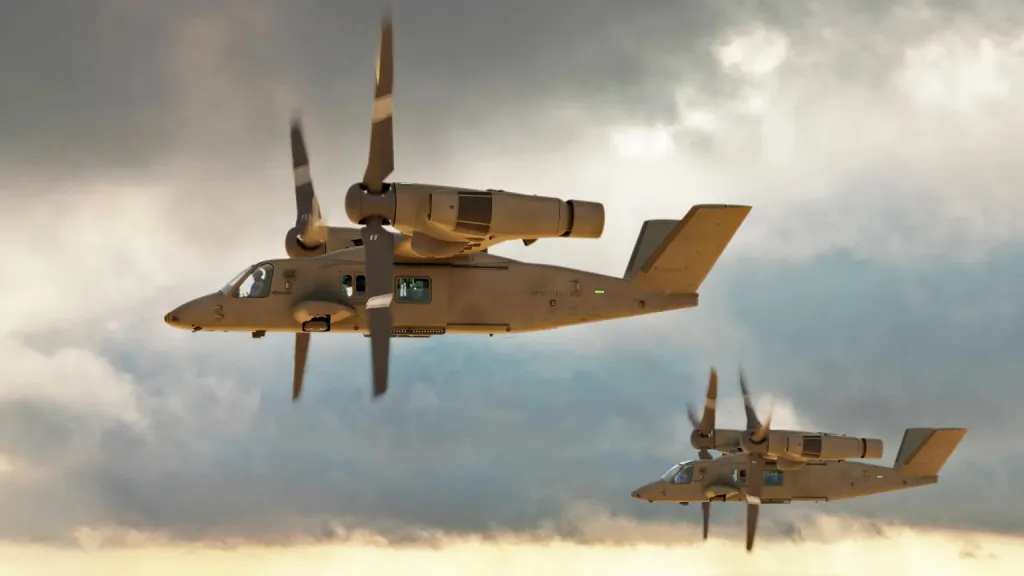
A rendering of a pair of MV-75As without in-flight refueling capability. Bell

“Our last chief used to talk to me all the time about aerial refueling. We think that’s something. Maybe we don’t get all of them [the MV-75As] configured for that, but they’ll have the capability,” the Army’s top aviation acquisition officer added. “For industry, I want you to think about how are we going to refuel ourselves, right? One of the challenges, even the Regiment will tell you, and make it top priority – their challenge isn’t you know how good they are on par, their challenge is getting somebody to give them the gas.”

The “Regiment” that Gill refers to here is the Army’s elite 160th Special Operations Aviation Regiment (SOAR), also commonly known as the Night Stalkers. The 160th is expecting to eventually receive a special operations-specific configuration of the MV-75, which will include in-flight refueling capability by default, as you can read more about here. Existing Night Stalker MH-60M Black Hawk and MH-47G Chinook special operations helicopters also have the ability to refuel in flight via probe-and-drogue. However, Army Black Hawks and Chinooks assigned to conventional units do not have this capability.

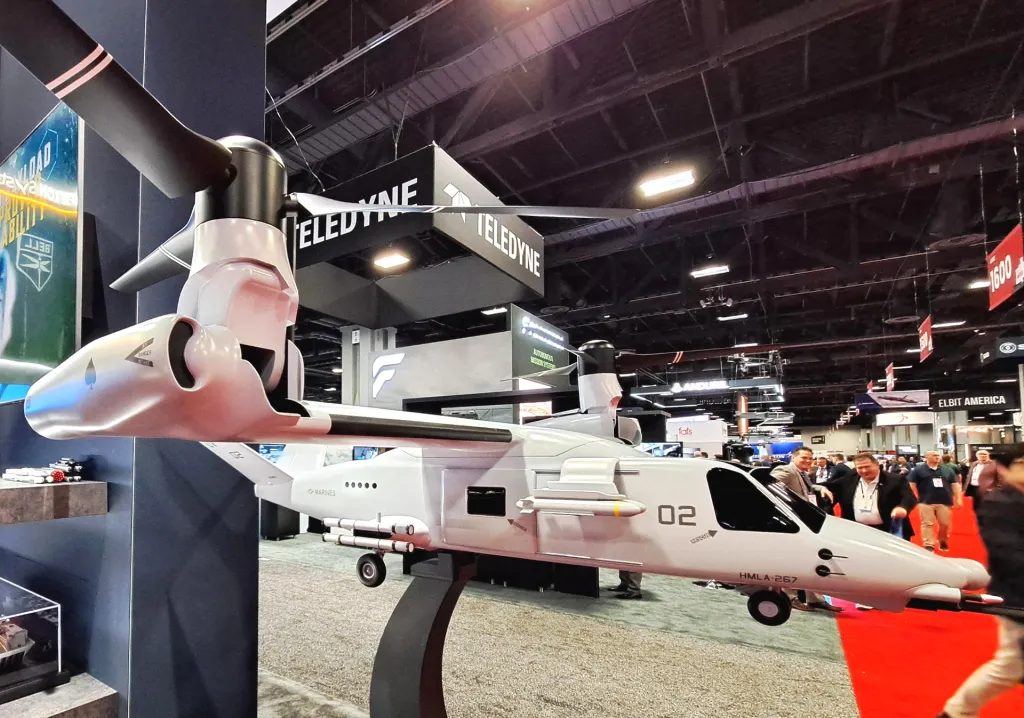
A rendering of a special operations configured MV-75 that the Army showed at this week’s AAAA conference. Jamie Hunter

“The Navy’s got some pretty good unmanned ideas there if you want to kind of follow where we’re going,” Gill noted yesterday.

Gill did not specifically name Boeing’s MQ-25, but this is the only uncrewed tanker the Navy is currently pursuing, at least that we know about. Furthermore, Bell released a new computer-generated MV-75 promotional video yesterday around the AAAA conference, seen below, wherein a Cheyenne II is clearly depicted linking up with a Stingray, or an extremely similar-looking variant or derivative thereof.

Meet the Cheyenne II thumbnail

Meet the Cheyenne II


A screen capture from the video above showing an in-flight refueling-capable MV-75A linking up with an MQ-25, or a variant or derivative thereof. Bell capture

The MQ-25 is in development now primarily as a carrier-based platform, but there is no reason why it could not also operate from bases on land. Boeing has itself previously presented a concept for an enlarged, land-based derivative of the design that could help meet future U.S. Air Force tanking needs.

A rendering of an enlarged, land-based derivative of the MQ-25 refueling from a KC-46 Pegasus tanker. MQ-28 Ghost Bat drones are also shown flying alongside. Boeing

The MQ-25 by itself promised to offer very long endurance and extreme range, which could make it attractive in the land-based role, as well as when operating from carriers. TWZ has previously explored how those capabilities open the door to the Stingray being utilized as much more than a tanker, as well.

A demonstrator drone, known as the T1, used in the development of the MQ-25 refuels an F-35C Joint Strike Fighter during a test. USN

Currently, the U.S. Air Force provides probe-and-drogue aerial refueling capacity using KC-135 and KC-46 tankers, as well as HC-130J Combat King II combat search and rescue aircraft and MC-130J Commando II special operations tanker/transports. The U.S. Marine Corps and Navy also have C-130 variants that can be employed as tankers, as well as transports. Navy carrier air wings currently rely on F/A-18F Super Hornet fighters carrying buddy refueling stores and drop tanks to provide organic aerial refueling support.

A US Marine Corps KC-130J tanker/transport prefers to refuel an MV-22 Osprey tiltrotor. USMC

Shortfalls in aerial refueling capacity, even to meet peacetime demands, have been an increasingly concerning issue for years now. The Air Force just recently developed a system that allows A-10 Warthog attack jets to refuel via probe-and-drogue to create new operational flexibility for those aircraft, as you can read more about here. The A-10 was originally designed to refuel in flight using the boom method, which the Air Force prefers for fixed-wing aircraft.

On top of all this, the Army has no organic tanker capacity at present, at all. Furthermore, the formal division of roles and missions with the Air Force means that the service does not operate fleets of larger fixed-wing aircraft like the C-130 that could be readily adapted to this role. All of this would point to an uncrewed platform like MQ-25 as the most viable path to establishing an Army tanker force, which could also align better with its expeditionary air assault concepts of operations.

Army MV-75As could still make use of other tankers during joint operations, as well. There could be other organic air refueling options available to the service, too, including the possibility of adapting MV-75 itself to act as a buddy tanker.

The Army is separately advancing plans to acquire fleets of uncrewed aircraft capable of performing a variety of missions in close collaboration with the MV-75A and its existing fleets of crewed helicopters.

For the Army, demands for greater range and ability that cover those distances faster were key factors in the decision to acquire the MV-75A in the first place. The service sees these capabilities as particularly critical in the context of any future fight against China across the sprawling expanses of the Pacific.

“MV-75, as I mentioned, that’s our signature system,” Gen. Gill said yesterday. “Unmatched range, unmatched speed, unmatched mission flexibility.”

Another rendering of a pair of MV-75A Cheyenne IIs. Bell

During a separate talk at the AAAA conference yesterday, Army Maj. Gen. David Gardner, head of the 101st Airborne Division, the service’s premier air assault formation, also highlighted a recent training exercise that included Marine Corps MV-22 Osprey tiltrotors. He said that was done specifically “to help our Division understand the operational reach that it will possess with the MV-75 Cheyenne.”

Units within the 101st are set to be the first to receive operational MV-75As, with or without aerial refueling capability. The Army had previously said that fielding would begin next year as part of a major acceleration of the program. However, it has now stepped back from any fixed timeline for the first flight of the Cheyenne, let alone when Bell will begin delivering production examples.

“It’s going to happen when it’s going to happen. So we are moving as fast as we can,” Gen. Gill told TWZ and other outlets ahead of the AAAA conference this week. “If I was king, and I had all the money in the world and all the engineers, and there were no limits, we probably would be able to do it in a matter of months.”

As an aside, integrating aerial refueling capability onto the MV-75A, and working to pair it with tanker drones like MQ-25, could make the Cheyenne II, or variants thereof, attractive to other potential operators. The Marine Corps is now early in the process of refining requirements for a successor to the MV-22. The Navy has also said it is leveraging work the Army has done on the MV-75A to inform its plans for a Future Vertical Lift-Maritime Strike (FVL-MS) family of systems to succeed its MH-60R and MH-60S Seahawks, as well as the MQ-8C Fire Scout drone helicopter. Bell has presented concepts for variations of its V-280 Valor tiltrotor, on which the MV-75A is based, optimized for supporting amphibious assault and other naval missions in the past.

A rendering of Bell previously released showing a navalized V-280 variant. A V-247 Vigilant tiltrotor drone is also seen in the background. Bell

As it stands now, the Army does not appear to have made a final decision on the extent to which it expects to integrate in-flight refueling capability in its future MV-75A fleet. That will have a direct impact on any pursuit of an organic tanker capability.

Still, the Army and Bell are already pointing to the MQ-25 as an example of what could be on the horizon to help further extend the reach of the Cheyenne II.

UPDATE: 5:08 PM EDT –

Maj. Gen. Clair Gill has now offered some additional comments on aerial refueling support for the MV-75A to TWZ and other outlets at a roundtable today on the sidelines of the AAAA conference.

“We’re also thinking creatively about if we put aerial refueling – which you’re gonna see on the SOCOM [U.S. Special Operations Command] variants – if we put that on a conventional variant, then how do we refuel it?” he explained. “So we’re thinking through, do we need to develop a requirement for aerial refueling for ourselves now that we have really enhanced our capability?”

“One of the things that our special operations aviators – one of their most challenging tasks is helicopter aerial refueling. A lot of times people say, you’re telling me the challenge is the training of that, because it’s a pretty hard task,” he added later on in response to a direct follow-up question on this topic from our Jamie Hunter, who also called attention to what was seen in Bell’s video. “And I would say yes, but it’s actually the asset, the availability [of the] asset, to do the training. And we don’t have those organic to the Army. So I think we need to solve our own problems, and think about how do we do our own, let’s call it logistical resupply in the air, of an MV-75. So that’s where that concept photo or video was pointing.”

“We don’t have a requirement written right now, but I’ve talked with Army leaders,” Gill also noted.

Contact the author: joe@twz.com

Joseph has been a member of The War Zone team since early 2017. Prior to that, he was an Associate Editor at War Is Boring, and his byline has appeared in other publications, including Small Arms Review, Small Arms Defense Journal, Reuters, We Are the Mighty, and Task & Purpose.


Source link

First Look At What A Night Stalker MV-75 Cheyenne Will Look Like

The U.S. Army has given us our first glimpse at what the new MV-75A Cheyenne II tiltrotor will look like in its special operations configuration. The baseline MV-75A already has features specifically intended to simplify the process of converting it to meet the needs of the Army’s elite 160th Special Operations Aviation Regiment, better known as the Night Stalkers.

Army Col. Roger Waleski, commander of the 160th, shared the rendering of the special operations-specific MV-75 during a presentation today at the Army Aviation Association of America’s (AAAA) 2026 Warfighting Summit, at which TWZ is in attendance. Earlier in the day, the Army had announced that Cheyenne II would be the tiltrotor’s official nickname. Service officials had also provided an update on the program to TWZ and other outlets ahead of the show, as you can read more about in our separate reporting here.

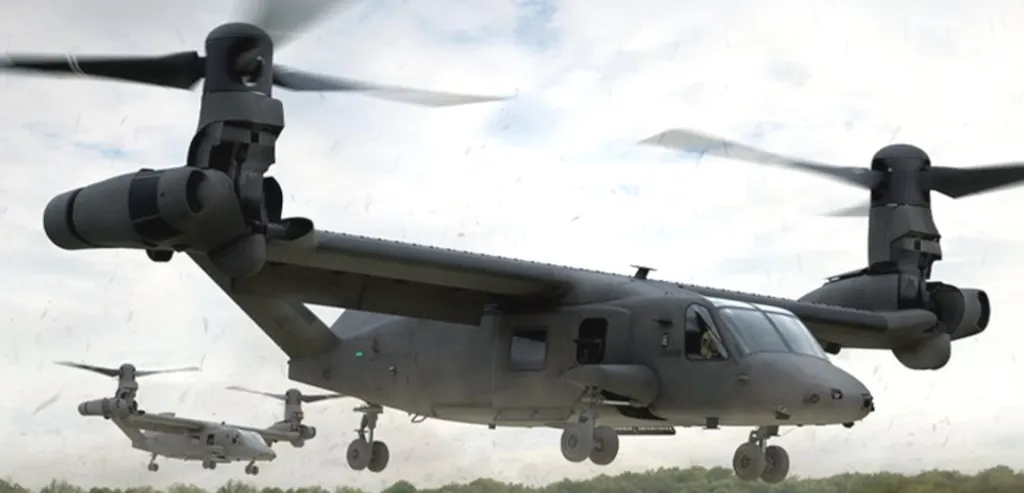
A rendering of a pair of MV-75As in the baseline configuration for the US Army. Bell

The baseline MV-75A is still in development, and it is unclear when it might fly for the first time. The Army has said in the past that it plans to replace roughly half of the 160th’s special operations MH-60M Black Hawk helicopters with MV-75s, but it is not clear if that is still the case.

From what is seen in the rendering that Col. Waleski showed at AAAA, the special operations variant of Cheyenne II will differ from the baseline type most in the configuration of its nose end. Like the 160th’s Black Hawks, its version of the MV-75A will feature a nose-mounted radar and sensor turret underneath, as well as an in-flight refueling probe that extends out from the right side.

A side-by-side comparison of the nose configurations seen in a recent rendering of a baseline version of the MV-75A, at left, and the special operations configuration, at right. Bell/Jamie Hunter

The radar is likely to be the AN/APQ-187 Silent Knight, or SKR, a terrain-following/terrain avoidance (TF/TA) type. SKR is increasingly the default for U.S. special operations aircraft, including Army MH-60M and MH-47G Chinook helicopters, as well as Air Force CV-22 Osprey tiltrotors and MC-130J Commando II special operations tanker/transports.

A past US Special Operations Command briefing slide showing AN/APQ-187 Silent Knight radar installations on the MH-47G and MH-60M. SOCOM A U.S. Special Operations Command (SOCOM) briefing slide showing Silent Knight Radars installed on Army MH-60M Black Hawk and MH-47G Chinook helicopters. SOCOM

The rendering of the special operations MV-75 also shows what looks to be a fixed, forward-facing aperture on the nose to the left of the radar. This most likely reflects the inclusion of a Degraded Visual Environment Pilotage System (DVEPS) or a similar capability, as is found on the 160th’s MH-60s and MH-47s today. DVEPS uses cameras and LIDAR, together with a terrain database, to help crew navigate through ‘degraded’ environments. full of dust, sand, snow, fog, and other obscurants.

Head-on views of 160th MH-60M (left) and MH-47G (right) helicopters with their DVEPSs, as well as other features, prominently visible. US Army/Jamie Hunter

TF/TA radar and DVEPS, together with other sensors and in-flight refueling capability, will enable long-range operations along extremely low altitude nap-of-the-earth flight profiles, even in poor weather and at night. Challenging long-duration flights in unforgiving environments is at the very core of the Night Stalkers’ repertoire.

The rendering shows the special operations version of the Cheyenne II is festooned with an array of other antennas, as well as additional ‘bits and bumps,’ just like the 160th’s helicopters are today. A similarly extensive suite of countermeasures and other defensive systems as is found on MH-60M is not visible in the rendering. It is very possible these features were deliberately omitted for operational security reasons. We can still expect the Night Stalker’s MV-75 to be crammed with special operation-specific self-protection systems, communications gear, and more.

Past Bell renderings have also given hints as to armament, sensors, countermeasures, and communication capabilities that will be found on the baseline variant, as can be seen below. It is possible that some non-special operations versions could be capable of refueling in flight, as well.

Beyond any special operations-specific capabilities, the MV-75 will also offer the 160th a major boost in range and speed compared to the MH-60M.

“I’ve said this before, I’m exceptionally excited about this platform,” Col. Waleski said today. “Yes, I’m excited about the speed. Yes, I’m excited about the payload, and I’m excited about the range.”

“But, really, the things that I find very interesting about this aircraft is [sic] the fact that we’ve gone to a completely modular open system architecture, maintaining the data rights on the aircraft,” he added. “For the warfighters in the room, what that means is your ability to adapt in the warfighting environment, it’s going to be cheaper, it’s going to be quicker.”

Modular open-architecture systems approaches focus heavily on the ability to more rapidly integrate new and improved capabilities and functionality down the line, often with minimal changes to existing hardware. As noted, the Army has taken steps already to ease the process of converting baseline MV-75As into the special operations configuration, which Waleski also highlighted today.

“There is a tremendous amount of growth potential for the warfighter as this aircraft becomes fielded here in the near future,” Waleski said.

Another rendering of baseline MV-75As. Bell

When the Army will begin fielding the baseline version of the MV-75A is now murky. In January, the service told TWZ that it was working to accelerate the program dramatically, with a goal of the first examples reaching operational units next year. The original timeline had expected to reach that milestone in 2031.

However, speaking to TWZ and other outlets last year, Army officials declined to commit to a firm timeline for a first flight for the MV-75A, let alone reaching the start of fielding.

“It’s going to happen when it’s going to happen. So we are moving as fast as we can,” Army Maj. Gen. Clair Gill, the Program Acquisition Executive for Maneuver Air, had said. “If I was king, and I had all the money in the world and all the engineers, and there were no limits, we probably would be able to do it in a matter of months.” 

The Army does remain committed to the MV-75A, which the service sees as offering essential new capabilities, especially in the context of a future high-end fight against China across the sprawling expanses of the Pacific. Waleski’s comments today make clear that the Army special operations aviation community is still very eager to get its version of the Cheyenne II, as well.

In the meantime, we have now finally gotten a look at what is set to be the next major addition, at least publicly, to the Night Stalker’s fleets.

Jamie Hunter contributed to this story.

Contact the author: joe@twz.com
Joseph has been a member of The War Zone team since early 2017. Prior to that, he was an Associate Editor at War Is Boring, and his byline has appeared in other publications, including Small Arms Review, Small Arms Defense Journal, Reuters, We Are the Mighty, and Task & Purpose.


Source link

Army Names Its New MV-75 Tiltrotor Cheyenne II

The Cold War-era Lockheed AH-56 Cheyenne might have been plagued with issues, but there’s no doubt it was among the world’s most advanced helicopters of its day. The AH-56 was so fast, and its features so ahead of their time, that the U.S. Army has decided to port over its name for its highly anticipated MV-75 tiltrotor, now officially named the Cheyenne II. The name also continues the Army’s tradition of naming its helicopters after great Native American tribes, and will find its place among icons like the Apache, Chinook, and Lakota.

A rendering shows a pair of MV-75s, now named Cheyenne II. Bell

In 2022, the Army picked a design from Bell, based on that company’s V-280 Valor tiltrotor, as the winner of its Future Long-Range Assault Aircraft (FLRAA) competition. In January of this year, the Army confirmed to TWZ that it planned to accelerate its timeline for the MV-75 by multiple years, fielding the first examples in 2027 versus 2031.

The Bell V-280 Valor was developed for the Army’s Joint Multi-Role Technical Demonstrator program as a precursor to the Future Long Range Assault Aircraft (FLRAA). Bell/Matthew Ryan

The rollout took place today at the Army Aviation Association of America’s Army Aviation Warfighting Summit in Nashville, Tennessee. Speaking to journalists, including TWZ, before that event, Maj. Gen. Clair A. Gill, the commanding general of the Army Aviation Center and Portfolio Acquisition Executive — Expanded Maneuver Air, announced the MV-75’s rollout as “a pivotal moment for Army Aviation, for our soldiers.”

In keeping with other Army rotorcraft, the MV-75’s name also honors a Native American tribe (more accurately, two tribes), the Cheyenne.

As Maj. Gen. Gill explained: This name reflects more than heritage. It reflects identity. The Cheyenne people inhabited the Great Plains for 400 years, adapting to a harsh and unforgiving environment as highly proficient hunters and gatherers. Their way of life required constant mobility, organized around nomadic buffalo hunting, enabling them to assemble, disassemble, and move quickly to meet the demands of their environment. In many aspects, that same ability to rapidly organize, reposition, and operate with precision is reflected in the MV-75 platform.”

“Life in that environment demanded resilience and strength,” Gill continued. “Tribes navigated rivalries, dirt, conflict, and adapted as Westward expansion reshaped the landscape around them. Today, the Cheyenne are represented by the Northern Cheyenne tribe in Montana, in the Cheyenne and Arapaho tribes in Oklahoma, whose legacy reflects the proud and enduring warrior tradition, ground and protection, provision and leadership. Those values demand capability, and in today’s fight, that capability comes in the form of speed, range, lethality, and adaptability. That spirit of mobility, resilience, and disciplined strength is what the name Cheyenne II represents.”

As for the other, historical Cheyenne, the AH-56, this was a first-generation attack helicopter drafted during the Vietnam War. Most impressively for the time, the helicopter could hit a 224-mile-per-hour cruise speed and dash at speeds up to 240 miles per hour, driven by a nearly 4,000-horsepower turbine engine and a pusher propeller on the tail boom.

F 03873 US Army Lockheed AH-56 Cheyenne multi weapon attack Helicopter thumbnail

F 03873 US Army Lockheed AH-56 Cheyenne multi weapon attack Helicopter


While it boasted incredible performance and was packed full of advanced features, the AH-56 was destined for failure. A combination of technical issues, program management shortfalls, changing procurement priorities, high cost, and a fatal crash in 1969 saw the program terminated. But despite never entering service, the Cheyenne left a profound impact on the concept of close air support and attack helicopter design and today holds a special place in military aviation history.

On the other hand, there are plenty of obvious differences between the AH-56 and the MV-75, not least their missions. They also had different prime contractors, and, the Army must hope, will have very different outcomes.

Maj. Gen. Gill continued: “What the [AH-56] Cheyenne was when it was initially conceived in the 1960s was a transformational leap ahead in technology. It was a rotorcraft when we were still learning how helicopters flew and how we could get the maximum utility, speed, and range out of them. And the Cheyenne, at the time that it was developed, was completely different. It had a pusher prop on it that allowed it to achieve speeds that we hadn’t seen before. You could draw a lot of parallels between going from the current fleet of rotorcraft that we fly, that is really 1960s, 1970s-era technology … to what we’re doing with the tiltrotor technology. Twice as far, twice as fast, vertical takeoff and landing, but flying at airplane speeds. You can certainly draw the metaphor there if you want, between the AH-56 back in the late 1960s and the MV-75 today.”

AH-56 Cheyenne firing rockets. U.S. Army

Continuing on the transformational theme, Brent G. Ingraham, the Assistant Secretary of the Army for Acquisition, Logistics, and Technology, provided his assessment of the MV-75, describing it as “a generational capability for the Army,” and one that “truly fundamentally changes how commanders think about distance, time, and maneuver on the battlefield.”

Ingraham continued: “It combines the vertical lift of a helicopter with the speed and range of an airplane, allowing us to project combat power from safer distances, penetrate deeper into contested environments, and deliver soldiers where they are needed most, faster than we ever have before.”

For the soldier, this means “restoring full-squad insertion at extended range, expanding medevac reach well beyond today’s Golden Hour, enabling large-scale, long-range air assault operations that can reshape the battlefield,” Ingraham added. Just as critically, the Cheyenne II will be able to self-deploy globally, reducing cost, complexity, and response time in a crisis. This is also especially relevant for future operations in the Indo-Pacific region, where operating locations and objectives are likely to be dispersed across large areas with limited options for making intermediate stops.

A rendering of an MV-75 launching drones. Bell

Ingraham also noted another key aspect of the program, namely the incredibly aggressive schedule to get it into service. Claiming the program as an “acquisition success story,” he described the team moving “with urgency while maintaining discipline.”

The MV-75 is designed around a modular, open-systems approach, with a digital backbone that should make it easier to adapt and upgrade as the program evolves.

“That means we can rapidly integrate new technologies, adapt to emerging threats, and avoid the costly redesigns of the past,” Ingraham said.

Soldiers are gaining hands-on experience with the future MV-75 through an immersive Virtual Prototype at Redstone Arsenal. U.S. Army/Matthew Ryan

Ingraham confirmed that the fielding timeline is being accelerated, which means the first Cheyenne II unit should be equipped in Fiscal Year 2030. Exactly how realistic that ambition is is something that we will discuss in a follow-on story.

As Ingraham said, speed matters, not just in the air, but in acquisition as well.

“We did it through strong partnerships across industry, the requirements community, and our operational units like the 101st [The 101st Airborne Division, the Army’s premier air assault unit, and the first unit set to get MV-75s], ensuring this platform is not just technologically advanced, but operationally relevant from day one. Simply put, the MV-75 Cheyenne II is how we deliver capability at the speed of relevance.”

For a rotary-wing program that puts a lot of emphasis on speed, its new Cheyenne II name is especially appropriate. Let’s just hope its warp-speed development doesn’t end the same way as its partial namesake.

Contact the author: thomas@thewarzone.com

Thomas is a defense writer and editor with over 20 years of experience covering military aerospace topics and conflicts. He’s written a number of books, edited many more, and has contributed to many of the world’s leading aviation publications. Before joining The War Zone in 2020, he was the editor of AirForces Monthly.


Source link

MV-75 Tiltrotor Already Part Of Army Officer Training, General Says

With fielding of the Army’s highly anticipated MV-75 Future Long Range Assault tiltrotor aircraft not set to begin until next year under an incredibly aggressive schedule, the service is already building plans for the aircraft into training for mid-grade officers and putting soldiers through recently installed full-size simulators, officials said Tuesday.

Speaking to reporters at the Association of the United States Army’s Global Force Symposium in Huntsville, Alabama, Gen. David Hodne, head of U.S. Army Transformation and Training Command, said that while some soldiers with special operations backgrounds had already experienced V-22 Osprey operations through work with other services, the Army Aviation Center of Excellence (AVCOE) was working to further socialize what the service is promoting as a radically different capability.

“[AVCOE Commander Maj. Gen. Claire Gill is] already introducing MV-75 planning factors into the Captains Career Course,” Hodne said, referring to a 21-week professional training program designed for officers with between four and seven years of service and split between general leadership principles and technical proficiency. “[You have] twice the range, twice the speed. So getting officers talking about that capability is the start.”

A rendering of an MV-75 launching drones. (Bell)

Army officials took delivery of two MV-75 FLRAA “virtual prototypes (VPs)” in June and July of last year at Redstone Arsenal and Fort Rucker, Alabama. Based on digital twins of the aircraft, the simulators highlight “the transformational power of digital engineering,” Brig. Gen. David Phillips, Program Executive Officer for Army Aviation, said last year.

“The VP replicates the cockpit design, mission software, and flight dynamics models of the MV-75; it allows RTC XPs to continue developing tiltrotor experience to prepare for future flight test activities,” Army officials said in a February release. “Additionally, the RTC team actively uses the VP to expose aviators to tiltrotor unique considerations, whether in the context of training and tactics development, Special User Evaluations (SUEs) or VIP demonstrations.”

With Gill at the helm for MV-75 integration, Mohan said the simulators will be a valuable familiarization tool.

“In terms of developing the right instructor base that can integrate this capability, he already has the capability to start that, with one of the simulators that’s already at Fort Rucker,” Mohan said.

Brent Ingraham, assistant secretary of the Army, described these early-delivery digital prototypes as critical to the service’s modernized fielding approach.

“That allows soldiers to get in, start the training, do a lot of the stuff up front, figure out all of the procedures and how they will execute the mission, right?” he said. “A lot of the stuff is being done now ahead of the first flight even occurring.”

Soldiers gaining hands-on experience with the future of Army aviation, learning to operate the MV-75 through an immersive Virtual Prototype at Redstone Arsenal.
Soldiers gaining hands-on experience with the future of Army aviation, learning to operate the MV-75 through an immersive Virtual Prototype at Redstone Arsenal. (US Army) Matthew Ryan

Additional training on advanced composites is also beginning, according to Lt. Gen. Chris Mohan, head of U.S. Army Materiel Command, so soldiers can become proficient at skin and structural repair, “as well as all the digital engineering that goes into the integration end of a truly digitally engineered platform.”

During the roundtable, Army Under Secretary Mike Obadal pushed back on a reporter’s question about the service having to contend with the reputation of tiltrotor aircraft for “catching fire and falling out of the sky” as it sought to make its new tiltrotor a keystone for future Army aviation operations. The question referred to the V-22 Osprey, which entered service in 2007 and has sustained multiple deadly mishaps unique to its design, such as the ability of the prop-rotors to churn up brownout conditions during landing; “vortex ring state,” a condition in which the Osprey faces rapid descent into its own downwash; and most recently, a gearbox issue linked to a fatal 2022 crash that led to widespread flight restrictions.

An Osprey landing on an Amphibious Assault Ship. (USN)

But the Army has maintained that MV-75 is entirely a different aircraft and that the “1980s technology” that bedeviled the Osprey is nowhere to be found in the new Valor.

“I think we have to be very careful about making sweeping statements about tiltrotor technology, and especially when you look at what [manufacturers] Bell-Textron and the Army are doing, because it is the most advanced manufacturing and digital backbone that exists,” Obadal said. “So General Electric creates the digital backbone for all of the intercontinental airliners that Boeing makes, the 777 [and] 787, and they’re applying that experience and technology to our MV-75.”

The MV-75 design has the rotors rotate between forward and vertical flight modes independent of the engine nacelles, rather than the entire nacelles rotating, which occurs on the V-22, “dramatically reduces the technical complexity” of the plane, he said, while the digital systems and controls give it cutting-edge reliability.

“From a technical perspective, it’s far more advanced than anything that exists in the military inventory, because of its fly-by-wire systems and its digital backbone,” Obadal said.

Pictured is the Bell V-280 Valor developed for the Army's Joint Multi-Role Technical Demonstrator program as a pre-cursor to the Future Long Range Assault Aircraft. On 5 December 2022, Bell was chosen to develop the MV-75 FLRAA (Photos courtesy of Bell)
Pictured is the Bell V-280 Valor developed for the Army’s Joint Multi-Role Technical Demonstrator program as a pre-cursor to the Future Long Range Assault Aircraft. On 5 December 2022, Bell was chosen to develop the MV-75 FLRAA (Photos courtesy of Bell) Matthew Ryan

Regarding cultural comfort-building with a tiltrotor aircraft given the V-22’s mixed reputation, Obadal said it was a nonissue.

“When I talk to [soldiers] about it, they say they want to fly it, and so do I,” he said.

In January, the Army confirmed to The War Zone that it planned to accelerate its timeline for the MV-75 by multiple years, fielding the first planes in 2027 versus 2031. The impetus came from Army Chief of Staff Gen. Randy George, who emphasized that the service needed the MV-75’s speed and range “very quickly,” especially due to the operational demands of the vast Pacific, and couldn’t wait until the next decade to integrate it.

Contact the editor: Tyler@twz.com

Source link