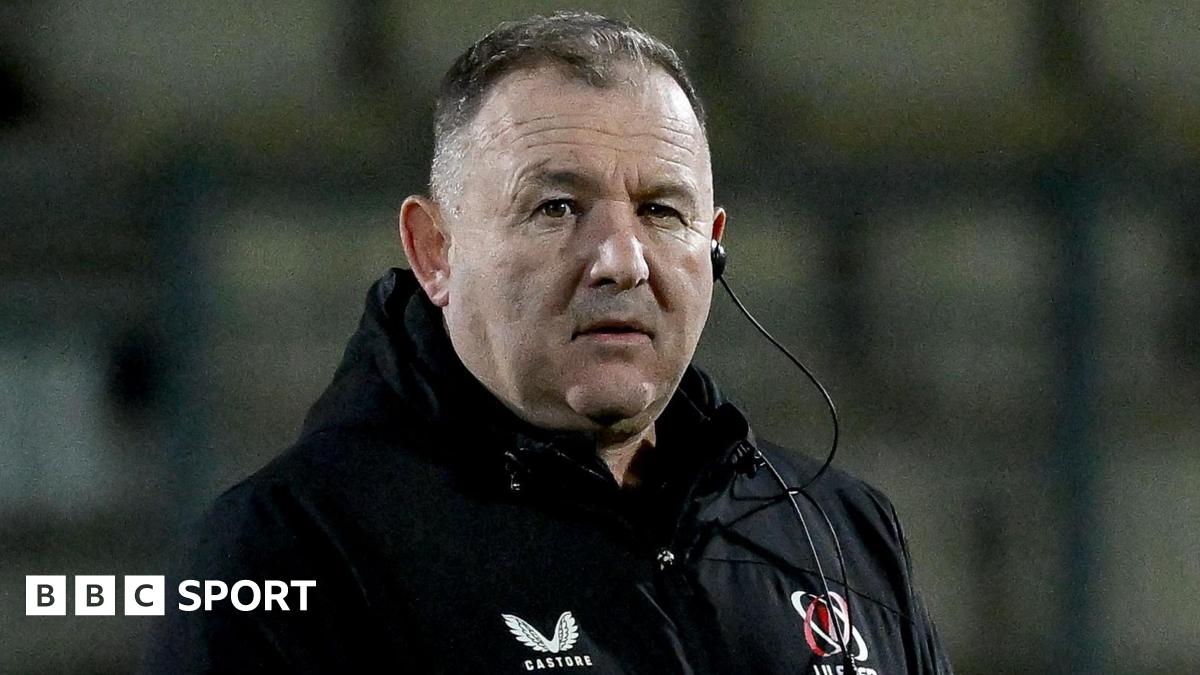
Ulster head coach Richie Murphy said his side “were a bit wasteful at times” during their 28-12 United Rugby Championship victory over Zebre in Parma.
Despite the home side being reduced to 14 men after Simone Gesi’s straight red card just before the half-hour mark, it was a tight and tense match.
The bonus-point win moves Murphy’s side up to third position in the URC table as they return to winning ways ahead of their Challenge Cup fixture against Ospreys at the Affidea Stadium.
“We expected it to be really physical over here and that is what we got,” Murphy said.
“I suppose the red card early in the game gave us a bit more of an advantage and I thought from our point of view, we have to look after the ball better as we were a bit wasteful at times.
“But very happy to get four tries. Coming over here is always very difficult.”
Player of the Match Werner Kok, who scored the bonus-point try, believed that the turning point in the game was the start of the second half.
Ulster scored three tries after the restart with Rob Herring, Zac Ward and Kok all able to cross the line.
“We stopped playing when they went down to 14 and we tried to regroup again and the boys stuck together and played as a team,” Kok said.
“I think the energy from the kick-off [in the second half] was the turning point. The boys stuck in there and that was the turning point for me.”
Two future high major-league draft picks, Anthony Murphy of Corona and Striker Pence of Corona Santiago, showed off their talents Tuesday. Corona rallied for a 9-7 victory.
Pence, who touched 99 mph, struck out Murphy for one of his six strikeouts in 3 2/3 innings. He left the game with a 3-2 lead. Then Murphy hit a home run off Pence’s replacement, Thomas Padilla, to tie the score. Murphy was on the mound in the seventh to strike out Pence and get the save. Pence finished with two RBI singles.
“Those are two amazing baseball players and what a treat for them to get after it,” Corona coach Andy Wise said.
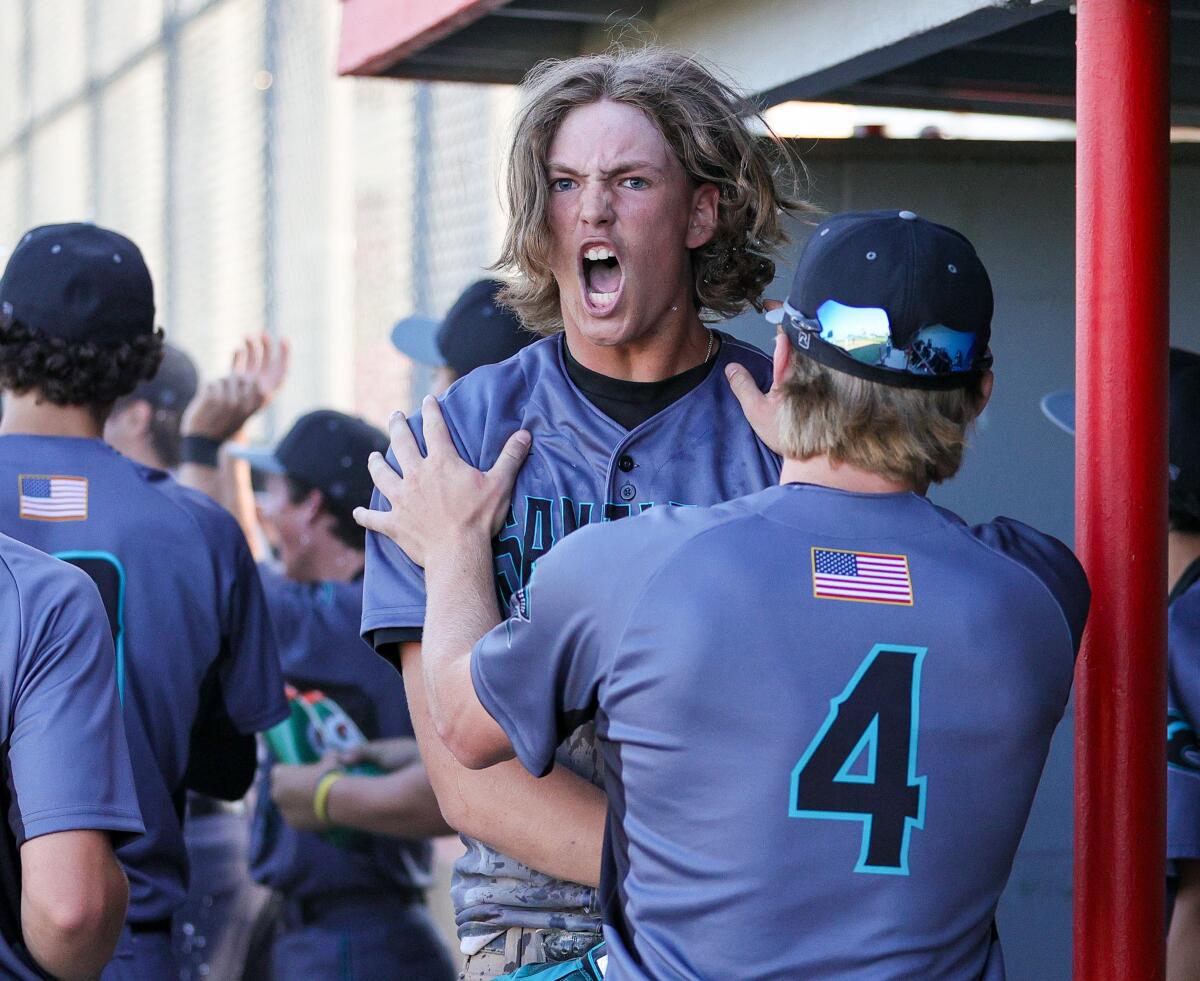
Striker Pence of Corona Santiago gets excited against Corona.
(Craig Weston)
The two went to middle school together. Murphy, a senior center fielder, is shaping up as a potential first-round pick. Pence, a sophomore, might reclassify to be eligible for the 2027 draft.
Errors played a big part in the game. Corona committed three errors, making it 20 errors in its last three games. An error by Santiago opened the door for a six-run sixth by the Panthers. Danny De La Torre had the big hit, a two-run double.
Corona’s defense is expected to get a lot better come Friday when infielders Joseph Flores and Kobee Finnikin become eligible after the sit-out transfer period ends.
Southern California teams got their first chance to show how good Southern California baseball is during Wednesday’s opening games of the National High School Invitational in Cary, N.C. Three came away with dominant wins.
Orange Lutheran received 16 strikeouts from Gary Morse, tying a tournament record, in a 3-0 win over Colorado Regis.
Unbeaten St. John Bosco (8-0) got two hits and two RBIs from Jack Champlin in a 14-1 win over Tennessee Nolensville.
Harvard-Westlake took care of North Carolina Wakefield 16-0 in five innings. Justin Kirchner struck out 10 and Ethan Price had three hits.
In the quarterfinals on Thursday, Harvard-Westlake will play Florida Venice, Orange Lutheran will face Florida Trinity Christian Academy and St. John Bosco will take on Arizona Casteel.
Servite 11, Santa Margarita 2: Eli Rubel had a triple, double and three RBIs for the Friars.
Tesoro 2, Aliso Niguel 1: Corwin Allard threw a complete game with six strikeouts and one walk for Tesoro.
Newport Harbor 8, Edison 2: Keaton Anderson struck out four in six innings. Grant Horsley had two hits.
Huntington Beach 8, Edison 4: Dane Cunningham, Ely Mason and Jaxon Greer hit home runs for Huntington Beach. Cunningham had three hits.
Villa Park 13, Foothill 0: Aiden Young went four for four with five RBIs and Logan Hoppie threw the shutout.
Sherman Oaks Notre Dame 11, Crespi 1: AJ LaSota struck out five, walked none and gave up two hits in five scoreless innings. Troy Trejo and Benett Pace each had two hits and two RBIs. Freshman Anthony Daniel had three hits.
Bishop Alemany 5, St. Francis 1: Matthew Serrano gave up two hits in six innings and Alex Noble contributed three hits for the Warriors.
Sierra Canyon 11, Chaminade 2: Brayden Goldstein went three for three with three RBIs.
Hart 3, Ventura 2: Jaiden Chan had the walk-off hit for Hart. Malachi Wobrock threw a complete game.
West Ranch 11, Canyon 1: Blake Johnson hit a three-run home run for West Ranch. Josh Price had two hits and four RBIs.
Saugus 11, Valencia 2: Joey Nuttall finished with three hits for Saugus. Logan Feldman added four RBIs.
Simi Valley 11, Camarillo 1: Ryan Whitson and Kai Stones each had three RBIs for Simi Valley.
Rancho Christian 3, Valley View 2: Jake Brande struck out 10 in a complete game.
Movsar Evloev rallies after a point deduction against the unbeaten Lerone Murphy to win the contest in London.
Published On 22 Mar 202622 Mar 2026
Russia’s Movsar Evloev overcame a point deduction for a foul to edge a majority decision win over Lerone Murphy at Saturday’s UFC Fight Night 270 at the O2 Arena, likely punching his ticket to a title fight against featherweight champion Alexander Volkanovski in his next bout.
With the two fighters putting their undefeated records on the line to decide who will face the 37-year-old Australian Volkanovski for the belt, the bout turned into an intriguing clash of styles.
Recommended Stories
list of 3 itemsend of list
Evloev, who is known for his wrestling, tried to showcase his striking, while Murphy displayed some superb defensive work on the ground.
Murphy evaded the fearsome grappling attack of his Russian opponent for the first two rounds of the five-round bout, using a selection of stiff right hands to keep him at bay. Evloev took the chance to exhibit some of the dangerous spinning strikes he has added to his repertoire since his last fight in December 2024.
Evloev finally managed to take the fight to the mat early in the third round, but Murphy was quickly back to his feet, uncorking a spinning back kick of his own shortly afterwards.
However, it was his opponent who finished the frame strongest with a big overhand right, followed up by a flurry of strikes.
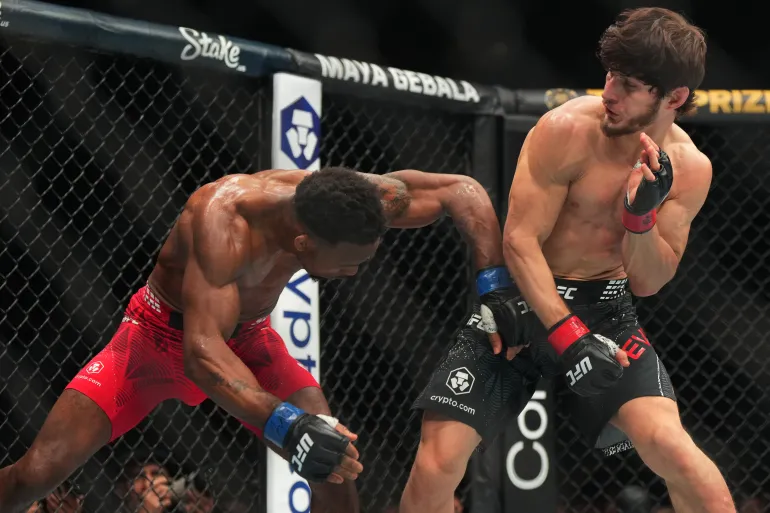
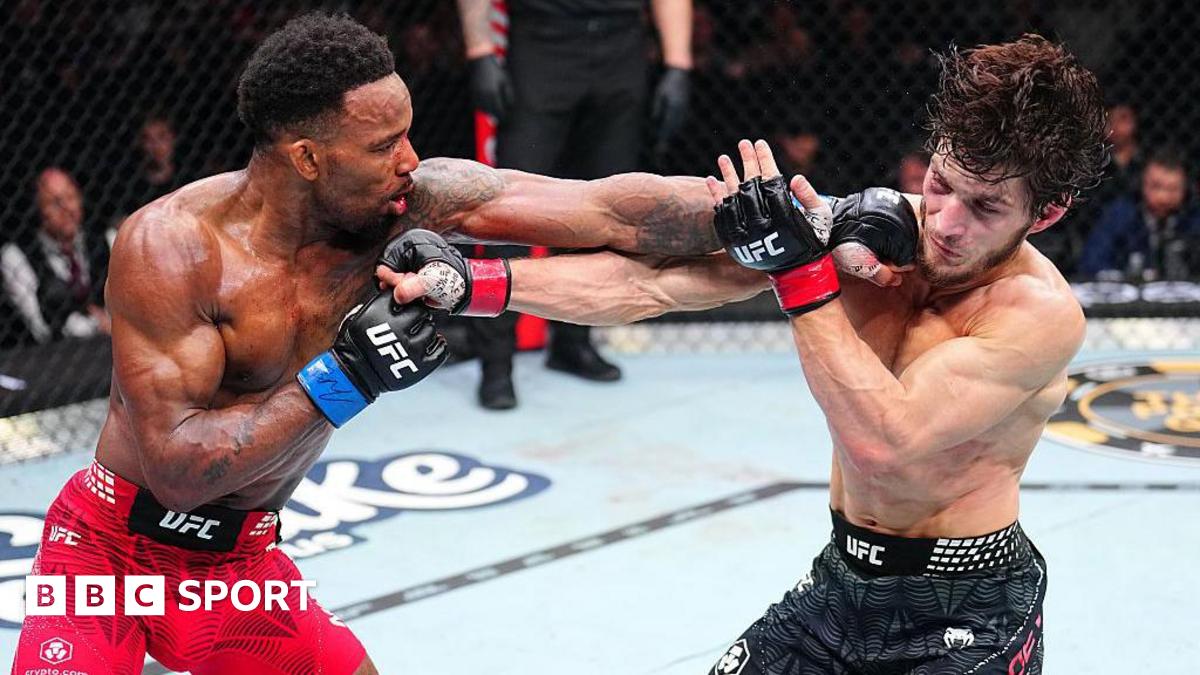
Evloev, right, lands a punch against Murphy during the UFC Fight Night 270 main event at the O2 Arena [Peter van den Berg/Imagn Images via Reuters]
His momentum was derailed somewhat when he landed a second kick to Murphy’s groin early in the fourth round, and referee Marc Goddard deducted a point from Evloev for the foul.
Knowing that the deduction could be decisive if the fight went to the judges’ scorecards, Evloev turned up his energy-sapping grappling attack in the fifth and final frame as he chased a finish, but again Murphy was able to get back to his feet with relative ease.
Despite not really threatening to submit his opponent on the ground, it proved to be enough for the 32-year-old Evloev, with two of the judges scoring the fight 48-46 in his favour and the third scoring it a draw 47-47 after the point deduction was taken into account.
Murphy reacts following his first career defeat in UFC [Jasper Wax/Getty Images]
Murphy came into the contest after missing out on a title fight against champion Alexander Volkanovski in January, with Diego Lopes being given the opportunity instead.
Murphy did not get the rousing reception from the home fans like Aspinall or Pimblett have in the past as he made a business-like walkout, but he was cheered as he stepped into the octagon.
Evloev was booed heavily but embraced his reception as he smiled and made a heart-shaped gesture with his fingers towards the crowd.
Encouraged by chants of “Oh Miracle Murphy”, some of the Mancunian’s best work was done with his back to the cage, as he landed a one-two uppercut combination and tried to keep Evloev at bay with leg kicks.
Evloev was predicted to grapple with Murphy but it was not until the third round, with the Briton gaining the upper hand in the striking, that he attempted his first takedown.
Murphy got to his feet quickly and drew roars from the crowd with a counter right hook, but Evloev would end the round on top as a flurry of strikes opened a cut above the Mancunian’s left eye.
The contest was delayed in the fourth round as Murphy took time to recover from an accidental groin strike in a move for which the Russian was docked a point.
But after telling his corner he had hurt his hip, Murphy struggled to defend takedowns like he had before and Evloev gained the upper hand in the closing stages.
Murphy was roared on by the crowd as he continued to get back to his feet, but Evloev’s nine takedowns by the end of the bout told a telling story.
“I told you I was a better striker than him – joking!” said Evloev.
“Me and my coach were preparing more fakes, takedowns and punches. I think my punches are hard, I can hurt the opponent. Look at his face, he is damaged. I don’t have to use my wrestling to get the win.”