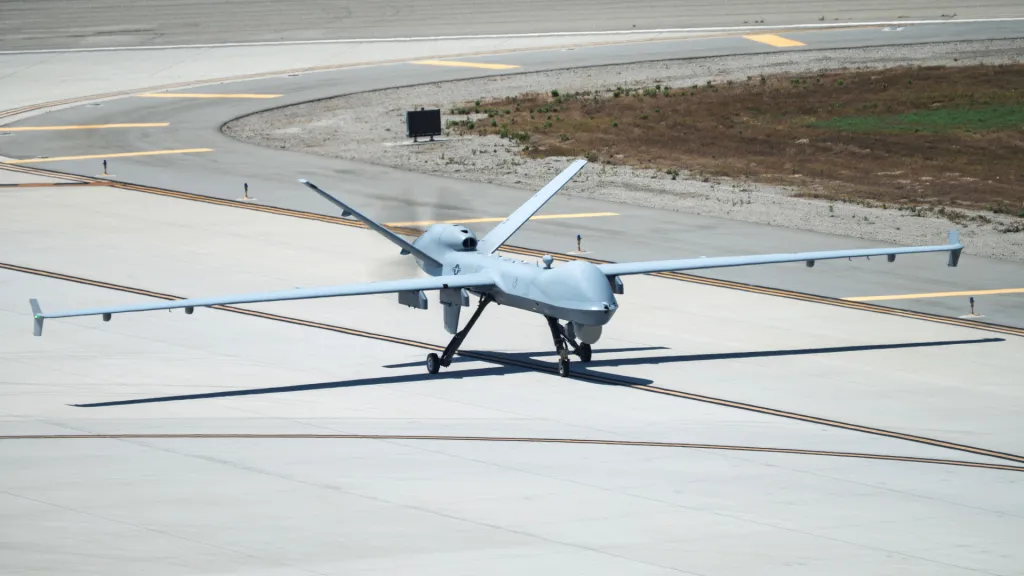
MQ9

MQ-9 Getting Airborne Early Warning Radar Is A Huge Deal

The MQ-9 Reaper and its associated Predator-B family of drones are in an interesting spot these days. On one hand, they are receiving new, highly relevant capabilities and missions at an accelerating pace. They also just proved to be an absolutely star asset for hunting and killing key targets, such as missile launchers and air defenses, deep inside Iran. On the other hand, their vulnerability to air defenses, not even modern ones, is glaring, with major losses in Iran and Yemen. Yet the USAF’s chronic lack of commitment to replace the MQ-9 has left it with dwindling stocks and nothing better to do the job.

Within this jumbled and often misunderstood narrative, one new capability stands out from the rest that would give the MQ-9 extreme value today and for years to come. This is turning the MQ-9 into a radar-toting airborne early warning (AEW) platform for detecting and tracking aircraft, drones, and missiles. A Reaper in this exact configuration just flew for the first time recently.

MQ-9 outfitted with a STOL kit and AEW pods for shipboard fleet defense. (General Atomics)

The MQ-9 sortie in question was the product of a partnership between General Atomics and Saab, with Saab, already a leader in AEW systems, providing the podded radar system named LoyalEye. This initial test flight took place on May 19th, and a full demonstration of the pairing’s capabilities is planned for next year.

GA-ASI President David R. Alexander stated the following about the MQ-9 AEW capability:

“AEW for MQ-9B will offer critical aloft sensing to defend against tactical air munitions, guided missiles, drones, fighter and bomber aircraft, and other threats. Operational availability for a medium-altitude, long-endurance UAS is the highest of any military aircraft, and as an unmanned platform, its aircrews are not put into harm’s way.”

General Atomics is giving the MQ-9 reaper airborne early radar capability, which could have a big impact on the market.
MQ-9 AEW configured aircraft taking to the air for the first time. (General Atomics) General Atomics

For many years now, I have discussed how the most glaring new mission set for a medium altitude, long-endurance drone is AEW. The idea is relatively simple in concept. Take a cost-effective drone that can fly at medium altitudes for long periods and bolt on some radar pods capable of air moving-target indicator (AMTI) functionality. Then configure the datalinks (both line-of-sight and beyond line-of-sight) aboard the aircraft to send the information the pods collect back to controllers, who also remotely operate the drone and the pods from the ground. Such an unmanned aircraft could fly its missions at relatively low cost, and operate in a distributed manner, near where its surveillance capabilities are needed most. Above all else, it would be able to persist for very long periods of time — think of loitering over its launch location for the better part of a day or more — providing persistent long-range look-down radar surveillance, which has never been more important than it is today.

One-way attack munitions, also known as long-range kamikaze drones, are a massive threat to confront on many levels. These unmanned aerial systems blur the definition between cruise missiles and drones. In this case, cruise missiles are also part of the same problem set. While the question of how to shoot down relatively cheap one-way attack drones cost-effectively gets a lot of attention, just spotting them in order to engage them at all, especially at a distance, is also a challenge. Their small signatures and low-altitude flight profiles, as well as their slow speed, can make it so ground-based sensors don’t detect them until it’s almost too late, and aging airborne sensors also have limitations in doing so.

This is where an advanced look-down airborne radar is critical. It can spot these objects from above at long distances and separate them from the ground clutter. The problem is that airborne early warning and control (AEW&C) manned platforms are hugely expensive, resource intensive, and are the very definition of high-value, low-density assets. Many of them can only operate from longer runways, meaning they can only be based far away from where the threats are. Even then, they are top targets, as we saw earlier this year in Saudi Arabia, and their airfields are prime targets too, which can leave them trapped or destroyed on the ground.

The USAF has a dwindling number of geriatric E-3 Sentry Airborne Warning and Control System (AWACS) aircraft, which, despite upgrades, are not the best at spotting low-flying drones. The USAF is now moving begrudgingly forward with stalled E-7 procurement, but these aircraft are also very complex, expensive, and labor-intensive platforms that need long runways to operate from. The Navy has the E-2D Hawkeye, which is more modern and capable in some regards, and less in others, but is also not available in vast numbers as they have other critical taskings, especially to support carrier air wings. These aircraft are better suited to operate from remote forward airfields, and having a smaller logistical and crew footprint, but still require far more support than an MQ-9. Overall, these crewed aircraft are also increasingly vulnerable to long-range air defenses, and, while their sensor range is generous, it is still limited, making their utility questionable in a peer state conflict.

E-7 is seen as a partial, interim replacement for the aging E-3 fleet. (USAF)

For higher-end missions, where command and control is a major part of what AEW&C platforms will be called upon to do, directing air wars and coordinating defenses, while also supplying networking support, a pod-equipped MQ-9 cannot replace an E-7 or E-2. For providing critical surveillance, especially in areas where there are gaps in crewed AEW&C coverage, or in places that just don’t require that level of support, the AEW-capable MQ-9 is a very attractive solution. Even pushing these uncrewed sensor nodes forward, into higher-threat areas, under certain circumstances, to provide high-fidelity radar coverage where no crewed platform would ever be risked, is a real use case. An MQ-9 is far more expendable than a manned AEW&C asset from human life, cost, and recovery operation requirements (combat search and rescue) perspectives.

The truth of the matter is that even if the E-7 replaces all 15 remaining E-3s, and even if the Navy adds E-2 Hawkeyes, in a future distributed conflict, there is no way these aircraft can give all the coverage needed, persistently, day and night, while providing surveillance for all threatened locales. Not even close. This is especially true as relatively cheap one-way attack drones, such as the Shahed-136, can travel over a thousand miles, drastically expanding potential threat areas at a very low cost to the enemy.

This is where the podded MQ-9 can shine, with a detachment of a few of these aircraft providing persistent coverage (“orbits”) over key areas 24/7 while retaining a small logistical footprint. This would also directly support the USAF’s Agile Combat Employment (ACE) combat doctrine, where small groups of tactical aircraft will move quickly from one forward location to another in hopes of staying ahead of an enemy’s targeting cycle. While that may be the goal, these traveling road-shows of airpower will still need persistent look-down coverage, especially if they are positioned deeply within the enemy’s striking range. AEW&C aircraft will not be able to provide this coverage persistently (if at all). AEW MQ-9s could, and they could drastically increase the situational awareness, range, and overall effectiveness of other key defensive capabilities, such as surface-to-air missile systems and fighter aircraft, with the targeting data they provide.

General Atomics is also turning the MQ-9 family into drone killers themselves with the addition of laser-guided rockets. This could result in ‘hunter-killer’ teaming, where the AEW MQ-9 spots the threat and the laser-guided rocket-equipped MQ-9 intercepts and destroys it. Just the AEW MQ-9 on its own can also use its powerful MTS electro-optical sensor turret to visually identify potential enemy aircraft once they get close enough, allowing for a non-cooperative friend or foe identification capability.

Mojave STOL: Real. Rugged. Ready Today. thumbnail

Mojave STOL: Real. Rugged. Ready Today.


You can even look to the recent fighting in the Middle East, which saw Iran barrage allied bases on the Arabian Peninsula with one-way attack munitions and low-end cruise missiles. Reapers with LoyalEye pods could have provided persistent look-down radar coverage over threatened areas, especially as the USAF’s dwindling and rickety AEW&C fleet was overtasked. They could have also created a radar picket line across the Persian Gulf, Gulf of Oman, and eastern Iraq, providing high-fidelity look-down radar coverage and a true early warning screen for Iranian weapons heading towards their target areas, all without putting a crew at risk.

Now, it’s worth noting that the USAF envisions a future where AEW and general AMTI sensing is largely migrated to an orbital layer of satellites, and they are actively working to realize this capability, which would be absolutely revolutionary if fully realized. Yet, as of now, it’s still an if, and it will take years to fully come to fruition. Even then, relying on a space layer alone for this absolutely critical capability would be a huge vulnerability. Backing it up with a lower-end, flexible airborne solution will likely remain critical for a long time to come. AEW MQ-9s can help efficiently fill out a high-low AEW/airborne moving target indicator mix. This is especially true as the platform itself, the MQ-9, can be reconfigured for a huge range of other missions when AEW capabilities are not in high demand, so the USAF isn’t left with a single mission asset.

An MQ-9 seen operating out of Puerto Rico on a counter-narcotics maritime interdiction mission equipped for multi-int collection and kinetic strikes. (Miguel J. Rodriguez Carrillo / AFP via Getty Images)

The AEW MQ-9s can also provide their capabilities here at home. America is dealing with a tough future when it comes to defending the homeland, and providing look-down radar capabilities is a major part of adapting to this reality. Outside of tethered aerostats, which have not proven to be a large-scale workable solution yet, AEW MQ-9s would provide flexible, efficient and persistent capabilities in areas where it may be needed, especially in times of heightened defense, like major public events and during a crisis.

The AEW MQ-9s can also provide their services during large force employment training exercises, including going some way to emulate more capable crewed AEW&C platforms, at least with target track generation, when those manned AEW&C assets are not available. They could also be very valuable in an opposition forces ‘red air’ role, which has historically been sorely lacking in AEW, especially as AEW capabilities proliferate around the globe, particularly with America’s primary pacing threat, China.

China has invested very heavily in modern AEW platforms. (Chinese Military via Chinesemilitaryreview.com)

The naval side of this is a big deal too. The fact that General Atomics is modifying the MQ-9 family to operate from large deck amphibious assault ships and carriers presents another huge opportunity. It could provide LHA/LHDs with a truly organic fixed-wing AEW asset for the first time — one that doesn’t require large flight crews and that can loiter above the amphibious strike group for very long periods of time. This is becoming more important as enemy missile and drone technology evolves. Having to rely on surface combatants and a small contingent of fighter aircraft, if any at all, for air defense is limiting and can impart extra risk at inopportune times, especially in littoral environments. During a major conflict, these ships could operate too far out to sea to make land-based AEW support plausible and those assets will be over-tasked as it is. AEW MQ-9 seems like a relatively glaring off-the-shelf solution to this problem. It’s also worth noting that the USMC already operates the MQ-9 and integrating it into the shipboard Air Combat Element (ACE) of a Marine Air-Ground Task Force should be relatively straightforward.

Introducing MQ-9B STOL thumbnail

Introducing MQ-9B STOL


AEW configured examples could also be extremely useful for the Marines’ Expeditionary Advanced Base Operations (EABO) concept, which mirrors elements of the USAF’s ACE doctrine, but goes beyond just the aerial fight. Marines deployed forward in the enemy’s ring of fire under EABO will need look down protection more than pretty much anyone else, which the AEW MQ-9 could provide at low risk. The MQ-9 family is already capable of short field operations and that is only being enhanced with new STOL (short-takeoff-and-landing) members of the MQ-9 family, meaning they can fly from small, austere airstrips and could maintain sortie rates even if those airstrips receive partial damage.

For supercarriers, the AEW MQ-9 could augment the E-2D, providing constant look down radar coverage for the entire carrier strike group when E-2s are not up. This would deeply benefit the CSG’s entire air warfare mission, providing critical sensor data to Aegis warships, fighters, and the carrier. They could also augment E-2D coverage during high-threat periods of vulnerability, including putting additional sensor coverage farther away from the CSG over high-risk vectors of attack. We discussed in detail how an AEW capable version of the Navy’s MQ-25 Stingray could also serve in this general capacity.

Rendering of an AEW MQ-9 equipped with a STOL wing kit landing on an amphibious assault ship. (General Atomics)

All of this is from a very American point of view, but the AEW MQ-9 concept may be most attractive to foreign air arms that currently have no dedicated AEW capabilities at all, or are looking to augment the limited capacity they do have. Fielding a traditional AEW&C force is very expensive, even for a small cadre of crewed platforms, limiting the realistic application of such a force even if the country can afford it to begin with. AEW MQ-9 could help ‘democratize’ AEW and allow many allies to field such a capability, which a coalition force during multi-national operations could also benefit from, including the U.S. In this way, AEW MQ-9 could be a huge win not just for countries in need of this kind of capability at a lower price point, but also for the U.S., as this kind of sensor information will become far more widespread, putting less pressure on its own organic AEW force. This could be leveraged both in peacetime for surveillance and monitoring, but especially in a crisis.

Just look at what’s happening with the drone threat to Europe for instance. MQ-9s with the radar pods could provide sustainable airborne surveillance for NATO countries. Think of the AEW MQ-9 as the F-5 Freedom Fighter of AEW capabilities. And once again, these allies would be able to use the MQ-9s in many different ways when not configured for the AEW mission, including peacetime monitoring and patrols not related to airborne moving target tracking.

As it sits now, Japan has already expressed interest in the AEW MQ-9 and many other nations are sure to follow.

Finally, it’s worth noting that the idea of AEW functionality on an uncrewed platform isn’t exactly new. It has been experimented with before and China is thought to have added some of this functionality to its far more advanced high-altitude, long-endurance drones. But providing a robust, off-the-shelf solution for the more accessible and flexible medium-altitude, long-endurance drone class, and especially the most proven of all types in this class on the planet, the MQ-9 family, makes glaring sense for an extremely wide set of potential users, including the United States.

Contact the author: Tyler@twz.com

Tyler’s passion is the study of military technology, strategy, as well as foreign policy, and he has fostered a dominant voice on those topics in the defense and national security space. Tyler was the creator of the hugely popular defense site Foxtrot Alpha before developing TWZ, which he continues to lead as the Editor-In-Chief to this day.


Source link

USAF Scrambling To Buy What Few MQ-9 Reapers It Can Find After Epic Fury Losses

After reportedly losing dozens of MQ-9 Reaper drones while battling Iran, the Air Force on Friday confirmed to TWZ that it is planning to purchase an undisclosed number of unused ones from General Atomics, who made the aircraft. The company, however, said it has less than 10 of these drones to offer, and it remains unclear where else the Air Force can find more.

All of this continues to raise serious questions about the Air Force’s near-term ability to plug gaps left by the losses fighting against Iran and in other recent operations in and around the Middle East. The downed Reapers have a reported combined value of about $1 billion.

The Air Force has reportedly lost dozens of MQ-9 Reaper drones. (USAF)

Furthermore, despite the top Air Force officer recently praising Reaper as “perhaps the most valuable player” in the air war against Iran, the aircraft have been in the crosshairs of service officials. They have openly questioned the drone’s survivability and, by extension, general value in future operations. The Air Force has made several half-hearted efforts, without success, to find a successor. It is now in the early stages of a new attempt at acquiring an “MQ-9 Next.” You can read more about that effort in our story here.

An MQ-9 Reaper. (USAF)

It will be years, if ever, before “MQ-9 Next” comes online. Meanwhile, the search is on for existing replacements.

“The USAF intends to purchase several unused MQ-9A Block 5 from GA-ASI [General Atomics Aeronautical Systems, Inc.],” a spokesperson for the service told TWZ today. “A number of MQ-9A Block 5 aircraft were manufactured based on forecasted purchases for other customers but are no longer needed. The available aircraft are currently GA-ASI owned aircraft.”

“The USAF has received funds to begin the acquisition process,” they added.

A U.S. Air Force service member assigned to the 46th Expeditionary Attack Squadron, conducts pre-flight checks on an MQ-9 aircraft in preparation for an Operation Agile Spartan mission departing from Ali Al Salem Air Base, Kuwait, August 21, 2023. This MQ-9 and three others conducted the 386 AEW's first full air tasking order (ATO) cycle using satellite launch and recovery (SLR), providing crucial time-sensitive intelligence, surveillance and reconnaissance to leaders throughout the CENTCOM area of responsibility. (U.S. Air Force photo by Tech. Sgt. Isaac Garden)
A U.S. Air Force service member assigned to the 46th Expeditionary Attack Squadron, conducts pre-flight checks on an MQ-9 aircraft in preparation for an Operation Agile Spartan mission departing from Ali Al Salem Air Base, Kuwait, August 21, 2023. (U.S. Air Force photo by Tech. Sgt. Isaac Garden) Tech. Sgt. Isaac Garden

The Air Force was responding to our questions about congressional testimony from a top officer highlighting the service’s plans to backfill the combat losses. 

“We’re looking at options to buy back as many of the MQ-9As as we possibly can right now,” Air Force Lt. Gen. David Tabor, Deputy Chief of Staff for Plans and Programs, had told members of Congress at a hearing back on May 13. “So there’s a bit of a short-term effort to buy back things immediately, in this fiscal year.”

Tabor also said at that time that the Air Force’s total MQ-9A fleet had shrunk to 135 aircraft. Official budget documents say the Air Force had 165 Reapers in inventory as of the start of Fiscal Year 2026, which began on October 1 of last year. This had already marked a significant year-over-year decrease, down from 231 MQ-9As at the beginning of Fiscal Year 2025.

Despite Air Force needs, General Atomics told us the number of available Reapers is in short supply.

“Between parts in stock for new builds, and company-owned Reapers with some number of flight hours on them, there are less than 10 total ‘new’ MQ-9As available to any customers anywhere in the world,” General Atomics spokesperson C. Mark Brinkley told TWZ earlier this week. “There are some number of decommissioned Reapers out there, and some number of those could potentially be brought back into service.”

MQ-9A Reaper in flight. (General Atomics)

One place the Air Force won’t be able to find any Reapers is in storage. 

The 309th Aerospace Maintenance and Regeneration Group (The Boneyard) has zero MQ-9s in storage nor have they ever regenerated a MQ-9 back into service,” the spokesperson told us.

The MQ-9A is out of production. General Atomics has moved on to the MQ-9B, and currently offers those drones in multiple configurations. Though an evolution of the original Reaper, the core B model design differs in significant ways from its predecessor. Any new Air Force purchases of drones in this broader family would have to be of the B model and worked into the existing production schedule.

How many MQ-9As the Air Force has lost in operations in and around the Middle East since January 2025 is unclear, but is understood to be substantial. As of May, “nearly 30 MQ-9 Reapers have been lost in the course” of Operation Epic Fury against Iran, Air & Space Forces Magazine reported, citing “people familiar with the matter.” This is on top of dozens of Reapers reportedly downed while conducting operations targeting Iranian-backed Houthi militants in Yemen in the past year or so.

At the hearing last month, Tabor did not provide any official accounting of Reaper losses, but did acknowledge that “we are concerned about how they’ve attrited.”

In another effort to bolster the supply of operational Reapers, the Air Force told us that while it never regenerated MQ-1 Predator drones back into service, it was repurposing parts from these aircraft that the service stopped using in 2020. There were dozens on hand after they were retired.

More than 50 were sent to the 309th Aerospace Maintenance and Regeneration Group (AMARG) “and heavily cannibalized for spare parts for the MQ-9 aircraft,” the spokesperson told us.

An MQ-1 Predator flies above the flight line during launch and recovery training at Creech Air Force Base, Nev. Aircrew will fly the MQ-1 for the final time at Creech on March 9, 2018 before it is officially retired from the Air Force inventory. (U.S. Air Force photo by Senior Master Sgt. Cecilio Ricardo)
An MQ-1 Predator flies above the flightline during launch and recovery training at Creech Air Force Base, Nev. Aircrew will fly the MQ-1 for the final time at Creech on March 9, 2018, before it is officially retired from the Air Force inventory. (U.S. Air Force photo by Senior Master Sgt. Cecilio Ricardo) Senior Master Sgt. Cecilio Ricardo

Questions about the status of the MQ-1 fleet arose last week after U.S. Central Command (CENTCOM) acknowledged the loss of an “MQ-1” drone to Iranian fire. This has led many to question whether American forces are flying the venerable Predator again as a result of the Reaper losses.

At the time, the Air Force declined to say if it lost any of theirs and referred us to CENTCOM, which declined comment. However, on Friday, the Air Force told us that in addition to the Predators being used for parts, 20 had been transferred to the Navy. We reached out to them for comment. 

As we previously noted, it is also very possible, if not likely, that the uncrewed aircraft in question was an MQ-1C Gray Eagle, a related but different design still in active U.S. Army service. You can read more about this event in our original story here.

A U.S. Army MQ-1C seen being prepared for a mission somewhere in the Middle East on April 18, 2026. The official caption for this picture erroneously says the drone is an MQ-1 Predator. USAF/Master Sgt. James Cason

At the time of the incident, CENTCOM declined to tell us which variant of the MQ-1 was lost.

Regardless, the Air Force’s mad scramble to find additional Reapers highlights the value of having a high-flying, long-loitering drone that can gather intelligence and fire off munitions, no matter how slow it flies.

Contact the author: howard@twz.com

Howard is a Senior Staff Writer for The War Zone, and a former Senior Managing Editor for Military Times. Prior to this, he covered military affairs for the Tampa Bay Times as a Senior Writer. Howard’s work has appeared in various publications including Yahoo News, RealClearDefense, and Air Force Times.


Joseph has been a member of The War Zone team since early 2017. Prior to that, he was an Associate Editor at War Is Boring, and his byline has appeared in other publications, including Small Arms Review, Small Arms Defense Journal, Reuters, We Are the Mighty, and Task & Purpose.


Source link

MQ-9 Reaper Fires Laser-Guided Rockets In Tests

The MQ-9 Reaper has become the latest platform to test-fire laser-guided 70mm Advanced Precision Kill Weapon System (APKWS) rockets. The trials, conducted with the U.S. Air Force, involved an MQ-9 employing the APKWS in its original air-to-ground capacity, as well as against aerial targets. While giving MQ-9’s standard APKWS capability against ground targets seems relatively straight forward, putting the air-to-air optimized variant of the rocket on the MQ-9 would open up another option for the counter-uncrewed air system (C-UAS) mission, which has only gained in importance since the war with Iran.

General Atomics Aeronautical Systems, Inc. (GA-ASI), the manufacturer of the MQ-9, confirmed today that it had conducted recent flight tests of an Air Force MQ-9A armed with APKWS at the Nevada Test and Training Range (NTTR).

The MQ-9 Reaper flies a training mission over the Nevada Test and Training Range, Jan. 14, 2020. The 432nd Wing/432nd Air Expeditionary Wing flies local sorties at Creech Air Force Base, Nevada to prepare aircrew for launch and recovery roles overseas. (U.S. Air Force photo by Airman 1st Class William Rio Rosado)
An Air Force MQ-9 Reaper flies a training mission over the Nevada Test and Training Range, January 14, 2020. U.S. Air Force photo by Airman 1st Class William Rio Rosado Staff Sgt. William Rosado

According to the company, “the demonstration featured multiple types and variations of shot profiles, including aerial targets. All shots were executed flawlessly by the MQ-9A crews using laser-guided rockets and a specialized launcher.”

The utility of APKWS against ground targets for the MQ-9 family of drones is abundantly clear. It provides an extremely precise, relatively low-collateral option that can also drastically expand the drone’s magazine depth. Standard APKWS can be used against a large number of ground and surface targets, from lightly armored vehicles to troops under shallow cover.

Redefining Precision with the APKWS® Laser-Guided Rocket thumbnail

Redefining Precision with the APKWS® Laser-Guided Rocket


Then there is the air-to-air application. In U.S. military service, the laser-guided air-to-air rocket is known as AGR-20F, a variant of the APKWS II, specifically, also known as the Fixed Wing, Air Launched, Counter-Unmanned Aircraft Systems Ordnance (FALCO). In its press release, GA-ASI refers to the rocket simply as APKWS. FALCO includes the modified laser-guidance and control section and a proximity fuze that is ideal for taking down smaller aerial targets. FALCO-equipped rockets can also be used against soft ground targets, like standard vehicles and fast boats.

A U.S. Army Soldier assigned to the 12th Combat Aviation Brigade load an Advanced Precision Kill Weapon System (APKWS) training round for a live-fire exercise, Sept. 23, 2021, Grafenwoehr Training Area, Germany. The APKWS is the newest laser-guided rocket system utilized by the 12th CAB stationed throughout Europe. (U.S. Army photo by Pfc. Jesus Menchaca)
A U.S. Army soldier loads an Advanced Precision Kill Weapon System (APKWS) training round for a live-fire exercise at the Grafenwoehr Training Area, Germany, on September 23, 2021. U.S. Army photo by Pfc. Jesus Menchaca Cpl. Jesus Menchaca

The test campaign was, in part, a response to “real-time technological adaptation requirements,” GA-ASI explained. The urgent need for C-UAS capabilities saw the trials accelerated, reducing the time between planning, integration, and flight test.

“We recognize the value that a system like APKWS brings to the MQ-9 aircraft as a tool to counter one-way attack drones,” said GA-ASI President David R. Alexander. “APKWS can increase the number of weapons the MQ-9A is able to carry, as well as being able to carry new, lower-cost weapons. More than anything, this integration effort underscores how government and industry can collaborate to rapidly test and make new capabilities available to warfighters.”

Exactly how many APKWS a single MQ-9 can carry is unclear, but the standard pods used for these weapons are loaded with seven rounds, as seen loaded on the MQ-9A involved in the live-fire trials. Nineteen-round rocket pods are also a possibility. The MQ-9 in its standard configuration has seven hardpoints, with six main underwing pylons usually utilized for weapons.

A Mojave STOL drone depicted carrying a load of laser-guided rockets in 19-round pods. General Atomics capture

The potential of the MQ-9, or MQ-9 variants, to carry APKWS for the C-UAS role is something that GA-ASI brought up last month.

In particular, the Mojave short takeoff and landing (STOL) drone was earmarked for C-UAS, as part of a broader mission scope for the aircraft.

“We’ve shown APKWS mounted to Mojave in a static display at some of the recent U.S. Army shows where Mojave STOL was present,” General Atomics spokesperson C. Mark Brinkley told TWZ in April. “Integrating new weapons is a multi-part process. Fit tests, weight considerations, captive carry for airworthiness, software, [and] actual live-fire.”

“For Mojave STOL and other GA-ASI aircraft, we’re inside that process now with APKWS,” he added. “It’s flying and firing soon, [in] weeks, not months.”

Meanwhile, GA-ASI presented a CGI video showing the Mojave STOL undertaking the rocket-armed drone-hunter mission “somewhere in the Western Pacific.” In this scenario, the Mojave STOL used an EagleEye multi-mode radar, as well as its infrared sensor in the turret under its nose, to spot and track a pair of kamikaze drones clearly modeled on the Iranian-designed Shahed-136 pattern.

Mojave STOL: Real. Rugged. Ready Today. thumbnail

Mojave STOL: Real. Rugged. Ready Today.


The drone is then depicted warning a forward U.S. outpost about incoming uncrewed aerial threats through a satellite link. From a ruggedized laptop on the ground, an operator directs that the kamikaze drones be neutralized. A Mojave equipped with two 19-shot rocket pods then moves in and destroys them. The aircraft is later shown being rearmed at a very austere jungle airstrip.

The incoming Shahed-136-like kamikaze drones seen in the recent Mojave STOL video. General Atomics capture

It is noteworthy that, prior to APKWS, MQ-9s and related drones have demonstrated, during testing, their ability to destroy airborne targets using various other weapons, including AIM-9X and Hellfire missiles.

Meanwhile, APKWS has emerged as an increasingly popular choice in the air-to-air C-UAS role since U.S. Air Force F-16s began employing the rockets this way in combat against Houthi drones in 2024. TWZ was first to report on this development. The total number of U.S. military and foreign aircraft platforms cleared to use a variant of the rocket specifically optimized for air-to-air use continues to grow.

There are advantages and disadvantages to using a drone like the MQ-9 or Mojave STOL as a drone-hunter.

Drones of this kind have questionable survivability in high-end operations. The latest conflict with Iran has underscored the vulnerability of the Reaper, in particular.

On the other hand, TWZ has previously highlighted how a drone like the Mojave could be used to provide more localized force protection, including against uncrewed aerial threats, at forward outposts and rear areas in the context of a larger conflict.

The attributes of the Mojave STOL — including its short- and rough-field capabilities — make it especially relevant for a future conflict in the Pacific. Here, it would be able to push its C-UAS and other capabilities far forward, including to island outposts. As for the MQ-9, as used in the live-fire trials, this aircraft is not rough-field-optimized like the Mojave STOL, but can still operate from forward areas with semi-prepared airstrips.

A Mojave STOL drone arrives at a jungle airstrip with cargo in pods under its wings. General Atomics capture

At the same time, the capabilities inherent in the Mojave STOL mean it can also operate from aircraft carriers and big-deck assault ships, opening up the possibility of rocket-armed examples setting up counter-drone screens in maritime scenarios.

When it comes to the air-to-air APKWS, this weapon is well-suited to slower-flying and less dynamic targets. Compared to traditional air-to-air missiles, it comes with a much lower cost-per-engagement and offers greater magazine depth, as you can read about here.

In terms of finding targets, drones like the MQ-9 and Mojave STOL have limited situational awareness compared to traditional air-to-air platforms. They can be fitted with onboard radar with air-to-air modes, which could serve as a primary detection sensor. So, too, could infrared search and track (IRST) sensors, which have been tested extensively on other GA-ASI drones. Thereafter, the MQ-9’s MTS electro-optical/infrared (EO/IR) turret would provide target ID and engagement functions. Taking advantage of tactical networks could also provide the drone with critical initial telemetry to aid in the IR/EO sensor’s lock-up.

A General Atomics Avenger drone carrying a Lockheed Martin Legion IRST pod during a flight test. GA-ASI

It’s also worth noting that drones like the MQ-9 or Mojave STOL are not anywhere near as quick to respond to incoming drone threats, and especially run down multiple incoming hostiles in a short period of time, as fighters. On the other hand, they are able to loiter for far longer at a fraction of the cost, providing resilient combat air patrols. They could also perform strike and intelligence, surveillance, and reconnaissance (ISR) support while on station.

For its part, the MQ-9 offers these capabilities coupled with a higher performance and a more extreme endurance over the Mojave STOL. With hundreds of MQ-9s available, many could be armed with APKWS and tasked to provide anti-drone screening against lower-volume raids across large areas.

The Mojave STOL demonstrator was seen previously with Minigun pods and other stores under its wings. General Atomics

Indeed, it could be well imagined how APKWS-armed MQ-9s could have played a valuable role in this context during the conflict with Iran earlier this year, protecting allied Arab gulf states and U.S. installations from incoming one-way attack munitions. An MQ-9 picket line of sorts could have been set up over the Gulf, for instance, thinning incoming drones waves. Or these aircraft could have been perched to the east of major bases, providing a final airborne layer counter-drone defense.

With the MQ-9 and the related MQ-1C Gray Eagle being widely operated by the U.S. military and a number of export customers, the ability to transform these aircraft into rocket-armed drone hunters could be of high interest indeed.

Contact the author: thomas@thewarzone.com

Thomas is a defense writer and editor with over 20 years of experience covering military aerospace topics and conflicts. He’s written a number of books, edited many more, and has contributed to many of the world’s leading aviation publications. Before joining The War Zone in 2020, he was the editor of AirForces Monthly.


Tyler’s passion is the study of military technology, strategy, and foreign policy and he has fostered a dominant voice on those topics in the defense media space. He was the creator of the hugely popular defense site Foxtrot Alpha before developing The War Zone.


Source link

MQ-9 Reaper Replacement Requirements Stress A Drone Cheap Enough To Risk Losing

The U.S. Air Force has confirmed it has come up with a new set of requirements as it continues to look for a successor to its hard-working MQ-9 Reaper fleet. In contrast to the Reaper, the replacement aircraft is likely to be more flexible in terms of mission spectrum. At the same time, the service wants to use new manufacturing technologies to ensure that it can be built at scale and at a lower price point than the MQ-9. This would allow it to be bought in larger numbers and risked more freely in contested environments.

All this reflects the continued high utility placed on the MQ-9 fleet, as well as its considerable loss rates sustained against mid-tier and lower-tier adversaries. It also points away from filling the MQ-9’s role with a far more exquisite, costly, but more survivable asset, which seemed to have been the direction the Air Force was heading, at least in part, for many years now. With this in mind, this new direction appears to accept that many losses will occur in future combat scenarios and embraces that reality to leverage quantity over quality for whatever eventually takes over from the MQ-9.

Testifying before a Senate Armed Services Committee hearing yesterday, Maj. Gen. Christopher Niemi, the acting head of Air Force Futures, said that a new requirements document for an MQ-9 replacement had been approved. Aviation Week was first to report the development.

U.S. Air Force Maj. Gen. Christopher J. Niemi, U.S. Air Force Warfare Center commander, delivers opening remarks at the Nevada Test and Training Range (NTTR) change of command ceremony at Nellis Air Force Base, Nevada, June 9, 2025. The ceremony marks the transition of leadership, ensuring continuity in the NTTR’s mission to provide a dynamic, multidimensional battlespace for advanced training, testing and tactics development. (U.S. Air Force photo by Airman 1st Class Jennifer Nesbitt)
U.S. Air Force Maj. Gen. Christopher J. Niemi, seen in June 2025, when he was the U.S. Air Force Warfare Center commander. U.S. Air Force photo by Airman 1st Class Jennifer Nesbitt Airman 1st Class Jennifer Nesbitt

The approval clears the path for the Air Force to begin a new acquisition process for an uncrewed aircraft system (UAS) that will assume the MQ-9’s role. A medium-altitude, long-endurance (MALE) system, the Reaper is primarily used for intelligence, surveillance, and reconnaissance (ISR) and strike missions.

Niemi told the Senate Armed Services Committee that improvements in technology since the MQ-9 was developed mean the service now considers it possible for a new drone to be “more flexible,” leaning upon open architectures.

At the same time, modern production methods mean the new drone will be easier and cheaper to produce “in mass numbers,” Niemi said. The result should be a drone that the Air Force can “use in a more attritable way.”

A U.S. Air Force MQ-9 Reaper remotely piloted aircraft, assigned to the 432nd Wing, sits on the flightline while being prepared for takeoff at Creech Air Force Base, Nevada, June 2, 2025. The Reaper is an unmanned aircraft used to accomplish the 432nd Wing/432nd Air Expeditionary Wing’s mission in multiple areas of responsibility around the world. (U.S. Air Force photo by Senior Airman Renee Blundon)
A U.S. Air Force MQ-9 Reaper, assigned to the 432nd Wing, sits on the flightline while being prepared for takeoff at Creech Air Force Base, Nevada, June 2, 2025. U.S. Air Force photo by Senior Airman Renee Blundon

Interestingly, within the Air Force, there has in recent years been a shift away from the term attritable — meaning inexpensive enough to be willing to lose on high-risk missions while being capable enough to be relevant for those missions — to “affordable mass.” This is something TWZ previously highlighted was already happening back in 2021.

This change came about as a way of helping define the kinds of advanced drones that the Air Force is planning to acquire in the coming years, reflecting that their capabilities will necessarily come at a cost that will make them less than “attritable.”

Last month, the Air Force published a market survey notice, requesting information from industry on a new attritable ISR drone.

This notice included some key performance parameters for the drone, including a range of up to 932 miles and a 20-hour endurance. The attritable nature of the drone was reflected in a requirement for it to fly 100 missions with a “low-to-medium acquisition” cost.

The basic Reaper can fly for more than 20 hours unarmed, or more than 12 hours with weapons. In the case of the MQ-9B version, with an extended wingspan, flight endurance can be increased to more than 40 hours.

U.S. Air Force Tech. Sgt. Mark Oberacker, an aerospace ground equipment specialist assigned to the 174th Attack Wing, New York Air National Guard, checks data on the MQ-9 Reaper aircraft during exercise Sentry South 26-2 in Gulfport, Mississippi, March 3, 2026. Sentry South 26-2 is a large force employment exercise focused on major combat operations and joint maritime opportunities in a contested or degraded operational environment. Sentry South 26-2 applies joint and combined warfighting doctrine against realistic and robust enemy integrated threat systems, all while under safe and controlled conditions. (U.S. Air National Guard photo by Staff Sgt. Dylan McCrink)
An aerospace ground equipment specialist assigned to the 174th Attack Wing, New York Air National Guard, checks data on an MQ-9 Reaper, armed with Hellfire missiles, during Exercise Sentry South 26-2 in Gulfport, Mississippi, March 3, 2026. U.S. Air National Guard photo by Staff Sgt. Dylan McCrink

“Operators desire low-cost, fast-to-field, fast-to-deploy airborne ISR mass to increase mission flexibility and mission surging,” the market survey notice added.

The process of figuring out what to replace the Reaper with has been ongoing for many years now. However, the latest effort is noteworthy for its emphasis on a lower-cost, more attritable platform.

Back in 2020, the Air Force published a request for information for a program dubbed MQ-Next, also seeking an MQ-9 successor. This was focused on ISR and strike capabilities, but also stated a desire for reduced operating costs and greater persistence, survivability, and range.

By 2021, the Air Force was concentrating more on a family of systems — the so-called Next-Generation Multi-Role Unmanned Aerial System Family of Systems (Next-Gen Multi-Role UAS FoS) — including a growing emphasis on low-observable (stealth) technologies. The same year, the service said it was seeking a replacement for the MQ-9 that could possibly include defensive counter-air capabilities to protect high-value manned aircraft, such as tankers, as well as potentially fly red air aggressor missions. Fast forward to today, and it’s clear that these higher-performance air-to-air focused missions could be taken over, at least in part, by the current Collaborative Combat Aircraft program. As a result, whatever replaces the MQ-9 is unlikely to have such broad requirements.

The Next-Gen Multi-Role UAS FoS included scope for platforms that could be survivable and reusable, or ones that would be attritable or expendable. This was not a single platform solution, either. It would likely need to include a mix of systems.

A Northrop Grumman concept for a possible stealthy MQ-Next. Northrop Grumman

The 2021 document also stipulated that the MQ-9’s successor should be tailored for Great Power Competition, pointing to a drone ecosystem suitable for the kinds of highly contested environments that would be encountered during a conflict with a peer rival such as China or Russia. At the same time, the solution was also intended to fly missions in more permissive environments, like the MQ-9.

Around this same time, the Air Force also said it wanted to leverage advances in development and manufacturing, meaning that smaller numbers of manned aircraft could be produced quickly to meet dynamically evolving threats. This reflected the Air Force’s “Digital Century Series” that was in vogue at that time, and which led to talk about “throwaway” technology and essentially “disposable” aircraft. Some of this appears to have made it into these new requirements, which stipulate that the aircraft needs to be able to fly just 100 missions.

Meanwhile, the latest statements from the service describe a drone with increased flexibility achieved through open architecture, rather than building bespoke batches of drones for particular requirements. Previous statements from the service outlined an aspiration to have its new drone capable of accommodating rapidly reconfigurable payloads, something that open architecture would expedite.

A MQ-9 Reaper assigned to the 174th Attack Wing flies over Hancock Field Air National Guard Base, Syracuse, NY, following a routine training flight, Oct. 31, 2024. The 108th Attack Squadron conducts these flights to instruct pilots and sensor operators on proper flight operations of the aircraft. (U.S. Air National Guard photo by Senior Airman Dylan McCrink)
An MQ-9 Reaper assigned to the 174th Attack Wing flies over Hancock Field Air National Guard Base, Syracuse, New York, following a routine training flight, October 31, 2024. U.S. Air National Guard photo by Senior Airman Dylan McCrink Staff Sgt. Dylan McCrink

Above all else, the MQ-9 successor will still have to operate in contested environments.

In his testimony yesterday, Niemi presented a vision of a new drone, the design of which would stress being attritable, rather than survivable.

The Pentagon has long worked on the basis that a future conflict with a peer rival, and especially with China in the Pacific, would see it facing highly robust anti-access/area-denial (A2/AD) scenarios. With that in mind, previous Reaper replacement studies had suggested that low observability would need to be incorporated into the design.

An MQ-9 armed with an AIM-9X Sidewinder air-to-air missile. U.S. Navy

The latest thinking seems to reject that, or at least reorient the program toward a lower-cost platform of the kind that the Air Force would be able to field in mass, as well as to absorb the anticipated attrition in a high-end conflict. This does not preclude this airframe from featuring low-observable elements. In fact, it most likely will. But those would be more aggressively balanced against cost.

Concerns over the MQ-9’s vulnerability to air defenses have been ongoing for years now, although usually the nuances of this issue are not portrayed accurately in the media. Regardless, many MQ-9s were lost over Yemen, against a bottom-tier force. The war with Iran earlier this year underlined both the great utility and vulnerabilities of the platform. At least 24 Air Force Reapers were destroyed during the war, but these aircraft were pushed deep into Iran, loitered there for hours on end, and did some of the most important air-to-ground strike and surveillance work during the air campaign. While the Air Force says it plans to “buy back” some of the losses from that conflict, that will come with a hefty price tag, something that the service will want to avoid with its next ISR/strike drone. Furthermore, production of the MQ-9A model has now ended in favor of the MQ-9B.

The assumption that the MQ-9 replacement will be acquired in significant numbers is also noteworthy in terms of the current Air Force Reaper fleet, which includes more than 130 MQ-9As, according to Aviation Week.

MQ-9 Reapers assigned to the 49th Aircraft Maintenance Squadron parked on the flightline for display during the Legacy of Liberty Air Show at Holloman, Air Force Base, New Mexico, April 18, 2026. The air show had more than 15,000 attendees across the two-day event. (U.S. Air Force photo by Airman Jose Veras)
MQ-9 Reapers assigned to the 49th Aircraft Maintenance Squadron parked on the flightline for display during the Legacy of Liberty Air Show at Holloman Air Force Base, New Mexico, April 18, 2026. U.S. Air Force photo by Airman Jose Veras

What appears to be missing at this stage, or at least obscured, is an acquisition strategy for the new drones. As well as the aerial platforms, the MQ-9 successor will require suitable new ground control systems, sensors, and data exploitation technologies, all of which are compatible with open-architecture standards. These systems will also have to leverage the latest technologies to allow the drones to be more effective and more survivable over the battlefield.

Since MQ-Next, the U.S. drone landscape has changed considerably in terms of manufacturers. A few years ago, Northrop Grumman, Lockheed Martin, and General Atomics would have been seen as the front-runners for the MQ-9 replacement. Now, there are more contenders, often with a founding focus on rapidly scaling up production at low cost. Still, these firms have much to prove, especially considering the risk in replacing an aircraft as important as the MQ-9. At the same time, in the more advanced drone space, the legacy defense “prime” contractors are also making major progress in leveraging new technologies to reduce production costs and migrating away from exquisite, very expensive drones as their default offerings.

A rendering General Atomics released in 2021 of a concept for MQ-Next. General Atomics

Back in 2021, the Air Force was promoting a “Speed to Ramp” initiative for its MQ-Next, which would see the first iterations of this capability fielded before “the 2026/2027 timeframe.” Other solutions under the same effort would begin to be fielded “in the 2030 timeframe,” the Air Force said.

While the latter timeline might still be somewhat achievable, it will require a considerable effort and investment and, not least, the firming up of the requirements for exactly what the Air Force wants its MQ-9 replacement to look like.

What we do know is that, while the Reaper’s replacement might not be as survivable as once envisioned, it will certainly be tailored to the increasingly harsh realities of a conflict against an advanced peer-state adversary. 

Contact the author: thomas@thewarzone.com

Thomas is a defense writer and editor with over 20 years of experience covering military aerospace topics and conflicts. He’s written a number of books, edited many more, and has contributed to many of the world’s leading aviation publications. Before joining The War Zone in 2020, he was the editor of AirForces Monthly.


Tyler’s passion is the study of military technology, strategy, and foreign policy and he has fostered a dominant voice on those topics in the defense media space. He was the creator of the hugely popular defense site Foxtrot Alpha before developing The War Zone.


Source link