mozart

Megan Stalter and Paul W. Downs on ‘Hacks’ duo, pay parity and more

In 2021, when HBO Max’s “Hacks” first introduced us to fading Vegas comic Deborah Vance (Jean Smart), we briefly met Vance’s hyper-devoted young talent manager Jimmy LuSaque Jr. (Paul W. Downs) and Kayla Schaeffer (Megan Stalter), the braying, inept assistant foisted upon him. Over the years this turbulent pairing found its groove, opening their own agency while Kayla discovered boundaries (sort of). By “Hacks’” fifth and final season, which concluded this spring, a growing Jimmy-Kayla fan base was clamoring for a spinoff. “We’re not doing it, but I wish,” says Stalter as she sits beside Downs during a video call from Hudson Yards in Midtown Manhattan. “I think it would work.”

These days, Stalter, who is nominated for supporting actress in a comedy, is making her Broadway debut as the campily reimagined Mary Todd Lincoln in Cole Escola’s “Oh, Mary!” Meanwhile, Downs, who is also co-creator, co-showrunner, writer and director on “Hacks,” is nominated for supporting actor, writing and comedy series (as executive producer). Is there a dream of a future project in which he wears just one hat? “I love doing all the jobs,” says Downs, who started out as a writer-performer. “But I’d love to do a superhero so that I could just work on my nutrition, my fitness and my lines.”

Paul, one early Megan sighting was her stand-up act at Echo Park’s Little Joy. What about her made you think you’d found your Kayla?

Downs: She’s so singular and funny. It’s like stream of consciousness and yet also material. We’d written the part before we’d seen Meg, but [after seeing] her in person, I came back to my co-creator, Jen Statsky, and I said, “It’s hers to lose.” There’s something about her that’s fearless, uninhibited.

  • Share via

Meg, correct me if I’m wrong, but your first “Hacks” audition involved a dark, blurry self-tape.

Stalter: It wasn’t that well shot. My brother was filming, and he does a good job, but his apartment in New York was really slanted and there’s lots of dogs running around. I was in a weird outfit. And that’s where I did my self-tape.

Was submitting a bad self-tape part of a strategy to land the role?

Stalter: I didn’t know [the tape] was bad until years later when I watched it. [Laughs] I was a really experienced performer — I’d done stand-up and improv for nine, eight years. But I wasn’t experienced with auditioning. This part was the first thing I ever read where I was like, “I can see myself in this.” I really, really wanted it. I really tried hard to prepare for the audition.

When did it become clear that a Kayla/Jimmy scene has its own oscillating frequency?

Downs: Even before we started, there was just inherent chemistry. I think we just really tickled each other. But, not, I mean, physically.

Stalter and Downs with Earl Brown, right, in "Hacks."

Stalter and Downs with Earl Brown, right, in “Hacks.”

When Jimmy is passionately advocating for something and Kayla is in the same frame, she’s often gesticulating, scrunching up her face or emitting noises like “pffffft.” But it never comes off as scene-stealing. How? Why?

Stalter: I can’t help but do it. Kayla’s so expressive. Even if I’m not talking, my face is doing a lot. Kayla can’t hide her feelings.

Downs: To know when not to derail something is a very hard thing to do. But Meg is a true comedian in that she understands not only how to improvise within the lane of the scene, but also the give and take.

Stalter: You’re going to make me cry.

Downs: She gets the comedy, the music of it. It’s like Mozart.

Stalter: [sob-choked voice] Stop. I’m not Mozart. You’re Mozart. And if I’m Mozart, then you’re Beethoven. And I don’t know why I’m crying.

Megan Stalter.
Megan Stalter of "Hacks" in New York City, NY on Monday, August 3, 2026.

Megan Stalter. (David Urbanke / For The Times)

In comedies, personal reps are always outrageous hustlers. Why take on the challenge of finding laughs in a manager who instead is sensitive, kindhearted?

Downs: We wanted to subvert what you’ve seen on TV before in terms of a manager. There’s also so many big personalities on the show. You need a counterbalance to that. One of the reasons we started to lean more and more into Jimmy working hard, being earnest, doing the right thing, is because he was in some moments the voice of the audience, the person that was grounded [amid] the chaos around him.

Was there a specific moment when it dawned on the “Hacks” team that Jimmy and Kayla deserved more airtime?

Downs: It was certainly something we felt. There was so much feedback. At a certain point, we were seeing people online saying, “Where are Jimmy and Kayla in this episode?” “Hacks” is about duos, but it was this particular duo that people really responded to. And then executives started to come and visit on days we were shooting. There were those kinds of little signals that happened.

True or false? When Meg graduated to series regular in Season 3, Paul insisted she be paid the same amount of money as him.

Stalter: [Surprised] Who told you that? Who told you that? [leans over and puts her head on Downs’ shoulder] That’s so nice. Thank you!

Downs: I’ve never said this before, but it was important to me that Meg and I had parity. So I said, “I don’t want to be paid more than her.” You can’t have Jimmy without Kayla. Or you can. But it won’t be as funny.

Stalter: Well, the first season I was paying to be on the show. [Laughs]

Downs: Yeah, we charged. So I felt bad.

New York City, NY - August 3, 2026: Paul W. Downs of "Hacks" in New York City, NY on Monday, August 3, 2026. Both are nominated for Emmys. (David Urbanke / For The Times)
Paul W. Downs of "Hacks" in New York City, NY

Paul W. Downs. (David Urbanke / For The Times)

Who came up with the idea of using your red carpet appearances to send up celebrity culture? The costumes alone!

Downs: I’ll speak for myself, but [near the end of our final season] I started to get scared about not performing with Meg. And it was thrilling and exciting. It’s like doing improv and sketch when you first started. It’s so fun.

A highlight: Striking poses in orange leather ensembles identical to the matching attire worn by Timothée Chalamet and Kylie Jenner at the “Marty Supreme” premiere.

Stalter: It’s my favorite idea, but it wasn’t mine.

Downs: [“Hacks” producer] Genevieve Aniello said, “You guys should do something ‘Marty Supreme.’ Look at these outfits.’” And Meg was bold enough to be like, “We should do it at the Critics Choice Awards.” And I was like, “That’s in six days. That’s insane.” And Meg was like, “We’re going to get it done.”

Was there any blowback?

Stalter: We were at the SAG Awards and we walked past Timothée and I said, [singsongy voice] “Hey, it’s us…” And he goes, “Oh, should we get a picture?” He was so nice. But I then realized that he thought we came up for a picture.

Downs: But we weren’t, we were just walking to our seats. [Laughs] That night his publicist came over and showed us her phone. She’d sent him a photograph of us and he’d written back “incredible.”

Stalter: It was in lowercase.

Downs: It wasn’t screaming “INCREDIBLE,” just “incredible.” I said, “Oh good, he’s not upset.” And she was like, “No, he loves it.”

Stalter: I think he probably never does all caps.

Downs: That’s real star power.

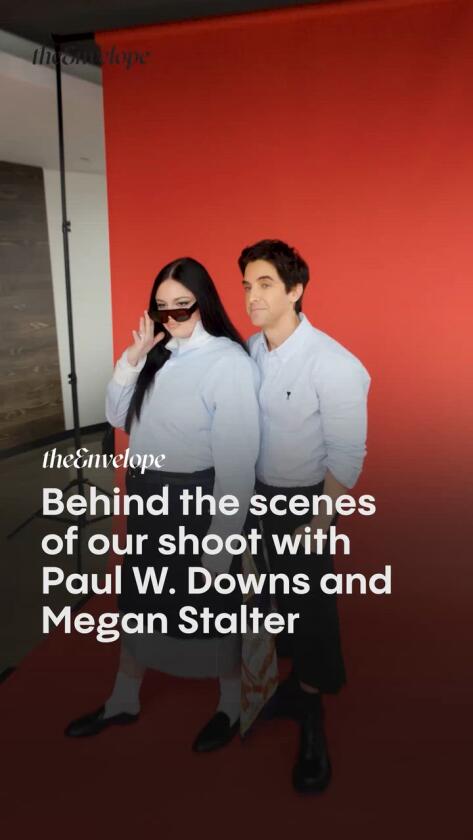
The Envelope digital cover featuring Megan Stalter and Paul W. Downs

(David Urbanke / For The Times)

Source link

Matthias Pintscher to become new music director of LACO

With the Los Angeles Philharmonic and Gustavo Dudamel heading off on a brief tour to London and Edinburgh, the Los Angeles Chamber Orchestra steps in Tuesday night at the Hollywood Bowl with an all-Mozart program. Mozart has long been a specialty of LACO.

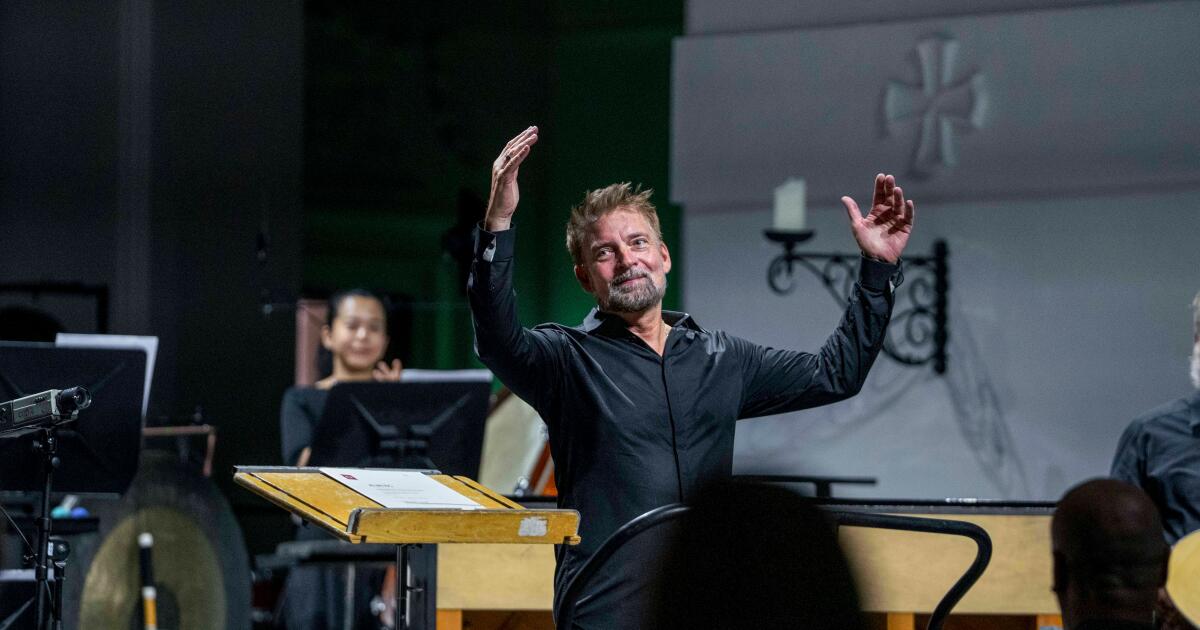
And it so happens that the orchestra is using the Mozartean occasion to announce that its next music director will be German composer and conductor Matthias Pintscher, who has been busy conducting in Mozart’s birthplace, Salzburg, where I caught up with him.

Pintscher, who will succeed current music director Jaime Martín beginning in 2027-28 season, augurs a new era for LACO. The orchestra will have a part-time residence when the Colburn Center opens next fall. The innovative 1,000-seat hall for concert, opera and dance looks to be Frank Gehry’s last music-meant masterpiece certain to usher in a new era for the Grand Avenue cultural district.

It also means a sort of homecoming for LACO, which gave its first concert in 1969 in the then-new Mark Taper Forum, the last of the Music Center’s initial three venues. The orchestra had been founded as an outlet to Hollywood studio musicians, and its first music director was the lively Mozartean, Neville Marriner. LACO’s first nine seasons included a Monday night series when the theater, originally meant to be a chamber music hall, was otherwise dark.

A little odd, perhaps, but the Taper remains until now the most intriguing venue of the peripatetic ensemble that has roamed through the years from Santa Monica to Pasadena, and that helped give the ensemble a distinctive image.

That is still the case. Once the Colburn Center opens, LACO will continue its series at the Wallis as well as at various chamber music programs around town.

Pintscher made his LACO debut in 2016 and already there was talk about him succeeding Jeffry Kahane, at two decades, who was the longest-running and most admired music director. Pintscher then served as its artist-in-residence, during which he oversaw a stab at the avant-garde. Not all LACO patrons were pleased.

It was out of the modernism, if not exactly avant-garde (but close), that Pintscher emerged first as a composer of colorfully complex orchestral and vocal scores that reflect a dizzying technical command and often a deep philosophical concept, sometimes taken from ancient Judaic tradition. His first big break as a conductor was as music director of France’s premiere new music Ensemble Intercontemporain that was founded by Pierre Boulez. But Pintscher also expanded in other directions. At the same time, he guest conducted orchestras in Europe and America with programs, while heavily weighed on the 20th century, that went back to Mozart and Haydn. He developed a surprising reputation as an interpreter of Rachmaninoff and other romantics disliked by modernists.

In 2008, he moved to New York, where he has remained, teaching composition at the Juilliard School and guest conducting widely (including the Los Angeles Philharmonic). Two years ago, he became the unlikely music director of the Kansas City Symphony. It was, he said over coffee at Salzburg hotel terrace, love at first rehearsal. His programming is a kind of wish-list of the new and recent with newly-buffed chestnuts, and it’s worked. His contract has been extended to 2034.

Pintscher, who is 55, says he is not ready to make any grand statements about LACO other than being eager to explore West Coast music and that he loves combining old with everything else. There is always room for Mozart and Haydn, to say nothing for his recent infatuation with Aaron Copland. He also described a mission for collaborative and theatrical projects, noting eager discussions with the Los Angeles Master Chorale (expect a Haydn “Creation” sooner rather than later) and director Peter Sellars.

When asked whether he saw himself as a composer who conducts or a conductor who composes, he simply laughed. But Pintscher did say he had no intention, at least for the present, of conducting his own works, feeling that to be a kind of self-promotion. But his mind can be changed. After two years Kansas City talked him into doing a piece, even if a small one.

Meanwhile, a new opera by Pintscher, “Das Kalte Herz” (The Cold Heart), which had its premiere in Berlin earlier this year, happened to be directed by the Long Beach Opera artistic director and chief creative officer, James Darrah Black. Watch this space.

Pintscher was enticed to the Salzburg Festival as part of this summer’s homage to the ageless Hungarian composer György Kurtág, who turned 100 this year. Pintscher conducted two programs with Vienna’s new music ensemble Klangforum Wien. In one, noting Kurtág’s affinity to Samuel Beckett, Pintscher led a transfixing performance of Morton Feldman’s “For Samuel Beckett” holding an audience prisoner for 50 minutes within a chord that won’t go away.

A mystical aura filled the heat-wave-sweaty Kollegienkirche, a voluminous central Salzburg church. Written on his deathbed in 1988, Feldman‘s piece reflects a final harmonic vision combining mismatched patterning of Turkish rugs and Hebraic chant. It remains super soft throughout and nothing seems to happen. But under the surface, little bits of notes fall precisely in and out of place in a rhythmic structure almost too hard to count.

The world’s complexity and emptiness simultaneously filled the church. Afterward, I walked past the home where Mozart was born. It was late at night. The tourists had turned in. My hotel was nearby, just across the river. But I made a lost, wrong turn.

Pintscher had put a peaceful, Feldman-esque, Twilight Zone spell on Mozart.

Source link

Review: James Conlon turns to Mozart and magic for his L.A. Opera farewell

A site of big changes, the Music Center has become farewell central. Alongside the Gustavo Dudamel hullabaloo at Walt Disney Concert Hall, James Conlon has begun his final appearances in the Dorothy Chandler Pavilion as music director for two decades of Los Angeles Opera, with his own signature form of enchantment in Mozart’s “Magic Flute.”

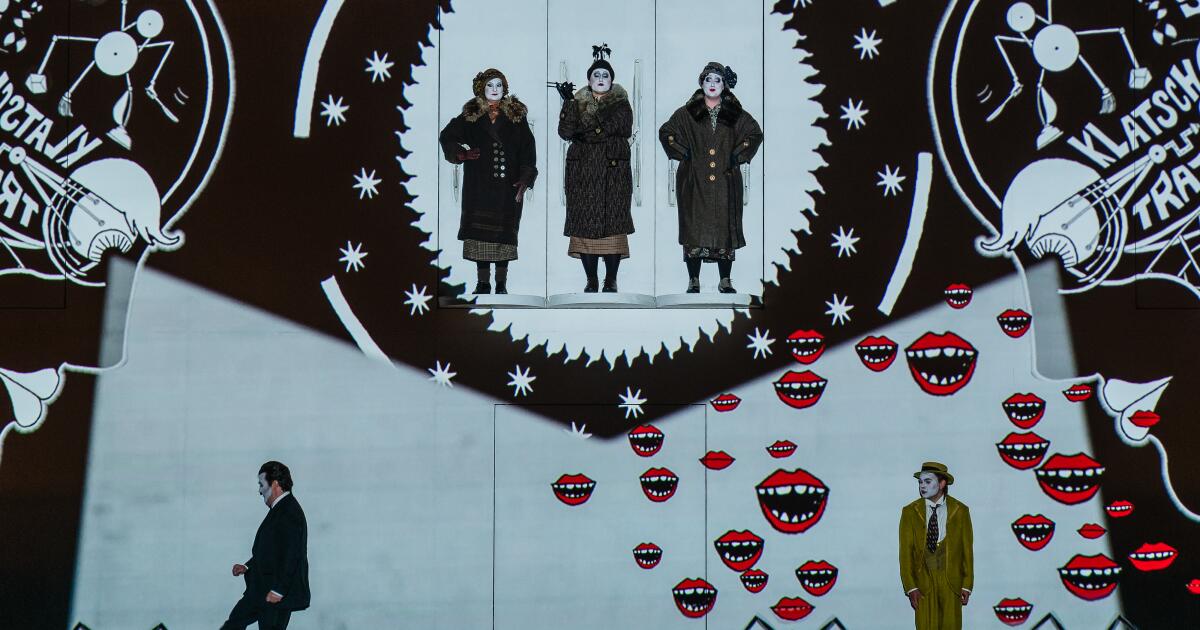
The silent-movie panache of Barrie Kosky’s production, which opened Saturday night at the Dorothy Chandler Pavilion and runs through June 21, is on its way to becoming a perennial. This is the third revival since L.A. Opera first staged it in 2013 — all four times with Conlon in the pit. The production operates like an operatic graphic novel and live animated film charmingly all in one. The scene is a giant movie screen broken up in sections and upon which is projected witty, fantastical background animation, while the characters are the live singers, dressed as though silent film stars.

The orchestra plays Mozart’s score as though it were, as orchestras did in the old days, accompanying a silent movie but to radically different effect. Fulgurous cinematic spectacle may immerse your attention, but the opera’s essence is transferred from the stage to the pit. The singers, meanwhile, function to an unusual degree as choreographed characters in a cartoon, leaving little opportunity for body language, allowing, instead, individual expression almost exclusively to their voices.

In Mozart’s opera, Tamino, a prince in a fairyland of mystic temples and mystifying gods, relies on his supernatural flute that turn sorrow into joy to get him out of jams. The genius of Kosky’s singularly musical production is that it magically makes the orchestra itself a compendious magic flute. It more than ever becomes an agent of delight.

That is where Conlon comes in. He has, while leading L.A. Opera for 20 seasons (half the company’s existence), served as an advocate for the core operatic repertory — notably Mozart, Verdi and Wagner — much of it little heard in our late-blooming former operatic desert. He has also been an international champion of his “recovered voices” project, salvaging the neglected operas of composers in the first half of the 20th century who were silenced by Nazi Germany.

“The Magic Flute,” one of the world’s two or three most popular operas, needs no such patronage. Written at the end of Mozart’s life as a popular entertainment, its a singspiel, or sung play. As a proto-Broadway musical operatic genre of spoken word and musical numbers, it appeals on all levels. The fairy-tale libretto is child-friendly. Mozart’s score is tune heaven.

The troublesome Queen of the Night dazzles with high notes that shoot out like daggers. The main lovers, Tamino and Pamina, are lyrical wonders. The comical bird-catcher, Papageno, is everyone’s darling. The domineering Sarastro, an all-powerful priest, bellows spiritual profundities. But if you start digging under the surface, deeper than the symbolic Freemasonry and all, you may never find bottom.

The opera begins with three ceremonial chords in the orchestra that signal a brief, sober introduction quickly undercut by an exhilarating fast-forwarding overture. Those three chords can be made to mean many things. Often, they come across as commands by an orchestra to sit up straight and pay attention. They may be dignified or downright quirky and playfully no big deal, just a here-we-go.

Conlon handles them as a sweet, perfectly tuned, almost amorous invitation to pleasure, implying this will be a genial, gracious, laid-back “Flute.” Among his accomplishments in L.A. has been to make the opera’s orchestra capable of producing just such velvety, flowing Mozart, as well as terse, tight theater.

Here, Conlon offers a lesson in the kind of leadership generally lacking in modern society, by simultaneously staying out of the way yet being at the essential center of things. Depth here is not announced, but the care of phrasing implies that there is more to everything Mozart is saying than first meets the ear, that, under it all, the “Magic Flute” is not fantasy but a spiritual lesson in morality.

Many in the cast, this revival, are young singers, not yet well known and new to the company. Sydney Mancasola and Miles Mykkanen, as Pamina and Tamino, are likable, lyric lovers. Kyle Miller catches Papageno’s vulnerable charm. Aigul Khismatullina, Queen of the Night, impresses with the silvery pricks of her high notes, while Kwangchul Youn’s Sarastro, unsteady in middle register, takes on weight at the bottom of his bass. Zhengyi Bai’s lustful Monostatos, disguised in the production as a hammy vampire, almost steals the show a time or two. The Three Ladies and Three Spirits provide vocal allure.

One of the evening’s most theatrical moments, though, came after the music stopped when what sounded like a gun interrupted curtain calls. But as if rescued by a magic flute, an instant of fear turned to joy, glittery gold graffiti filling the Chandler and celebrating Conlon.

‘The Magic Flute’

Where: Dorothy Chandler Pavilion, 135 N. Grand Ave., L.A.

When: Through June 21

Tickets: $49-$440

Running time: About 2 hours, 50 minutes, with one intermission.

Info: (213) 972-8001, laopera.org

Source link