Hyundai Motor, Kia post record U.S. hybrid sales amid No. 2 race

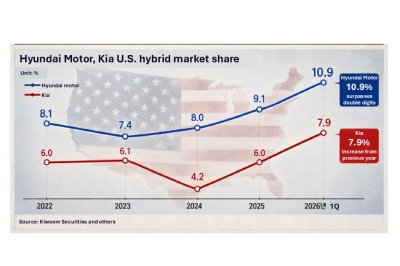
A chart shows Hyundai Motor and Kia’s growing share of the U.S. hybrid vehicle market from 2022 through the first quarter of 2026, with Hyundai reaching 10.9% and Kia 7.9%. Data from Kiwoom Securities. Graphic generate by Asia Today and translated by UPI
May 26 (Asia Today) — Hyundai Motor Company and Kia are accelerating efforts to secure the No. 2 position in the U.S. hybrid vehicle market as demand for gasoline-electric models continues to rise.
The South Korean automakers are expanding local hybrid production in the United States to reduce tariff costs and increase utilization at Hyundai Motor Group Metaplant America, or HMGMA, in Georgia.
The U.S. auto market has seen growing consumer demand for hybrids since the expiration of federal electric vehicle tax credits in September 2025.
Hybrid vehicle penetration in the United States rose from 10.1% in 2024 to 13.7% in the first quarter of this year, while electric vehicle penetration fell from 7.9% to 5.6%, according to industry data.
Data from Kiwoom Securities and EV-Volumes showed Hyundai Motor’s share of the U.S. hybrid market reached 10.9% in the January-March period, up from 8.0% in 2024.
Kia’s share rose to 7.9% from 4.2% two years earlier.
Combined hybrid sales by the two companies totaled 97,627 vehicles in the first quarter, a 53.2% increase from a year earlier.
Industry analysts said demand for hybrids could continue to grow in the second half of the year if high fuel prices persist.
Unlike the increasingly crowded electric vehicle market, where companies including Tesla, Toyota Motor Corporation, General Motors, Rivian and Ford Motor Company compete aggressively, the hybrid segment remains dominated by Toyota, Honda Motor Co. and Hyundai Motor Group, which together account for about 85% of sales.
Hyundai Motor Group plans to further increase U.S. production of hybrid models.
Kia is expected to begin producing the Sportage hybrid at HMGMA later this year, while Hyundai Motor is expected to manufacture the Palisade hybrid and Tucson hybrid at the plant beginning next year.
The strategy is aimed at reducing tariff burdens estimated at about 15% while boosting production efficiency at the Georgia facility.
Analysts said the compact SUV segment will be a key battleground.
Honda’s CR-V led the segment in the United States with about 56,000 units sold in the first quarter, followed by Toyota’s RAV4 with about 37,000 units. Hyundai Tucson and Kia Sportage each sold about 17,000 units during the period.
“The current CR-V model was introduced in 2023 and is beginning to age,” Kiwoom Securities analyst Shin Yoon-cheol said. “Hyundai Motor Group’s new hybrid product cycle could create pressure for Honda.”
Shin added that if Hyundai and Kia capture 10% of CR-V hybrid sales in the United States, the companies’ combined market share could improve by 0.1 percentage points.
— Reported by Asia Today; translated by UPI
© Asia Today. Unauthorized reproduction or redistribution prohibited.
Original Korean report: https://www.asiatoday.co.kr/kn/view.php?key=20260526010007582