China’s High-Flying Swarm Mothership Drone Has Flown
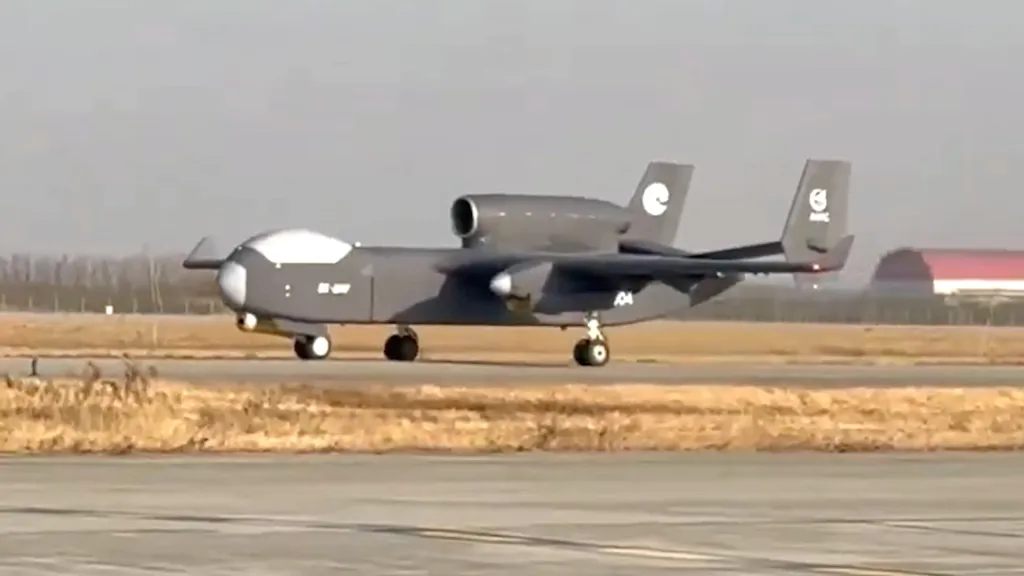
China’s heavyweight jet-powered Jiutian drone, said to have a maximum takeoff weight of around 17.6 tons (16 metric tons), has flown. A key mission for the design is expected to be acting as a mothership for swarms of smaller uncrewed aerial systems, as TWZ has explored in the past. It has also been shown previously armed with various air-to-surface and air-to-air munitions, and could perform a variety of other missions, including airborne signal relay and logistics.
The Jiutian’s manufacturer, the state-run Aviation Industry Corporation of China (AVIC), announced the drone’s first flight, which took place earlier today in Pucheng County in China’s central Shaanxi Province. The drone was first shown publicly at the 2024 Zhuhai Airshow, and it has also been referred to as the SS-UAV. What the “SS” stands for in that acronym remains unclear. The name Jiutian (also sometimes written Jiu Tian), or “The Ninth Heaven,” refers to the highest level of the heavens in traditional Chinese mythology, but is also commonly translated simply as “High Sky.”

Jiutian is some 53.6 feet (16.35 meters) long and has a wingspan of around 82 feet (25 meters), per AVIC. In addition to its maximum takeoff weight, the company says it has a maximum payload capacity of nearly 13,228 pounds (6,000 kilograms), a ferry range of approximately 4,349.5 miles (7,000 kilometers), and can stay aloft for up to 12 hours. The drone’s stated maximum operational ceiling is 49,212.5 feet (15,000 meters), and it can fly at speeds up to 378 knots and as low as 108 knots.
In terms of its general configuration, Jiutian has a high-mounted wing with a very minimal sweep and small winglets at the tips, as well as an H-shaped tail. It has a single jet engine mounted in a nacelle on top of the rear fuselage. Its tricycle landing gear includes main units that retract into sponsons under the wings. As TWZ has noted in the past, these features together give the drone the outward appearance of something of a mashup of the A-10 Warthog and OV-10 Bronco attack aircraft. There is also a resemblance to rugged De Havilland aircraft, with its landing gear looking especially tough, which could point to being able to operate out of rougher fields.

Jiutian is notably large compared to many other armed uncrewed aircraft designs currently on the market globally. For instance, the jet-powered Wing Loong-10 drone (also known as the WZ-10) in Chinese service now, produced by AVIC’s Chengdu Aircraft Industry Group (CAIG) subsidiary, has a maximum takeoff weight of around 3.5 tons (3,200 kilograms). CAIG’s Wing Loong 3 pusher-propeller-driven armed drone, the largest member of that design family to date, has a maximum takeoff weight of around six tons. As another point of comparison, the stated maximum takeoff weight of newer extended-range versions of the U.S. MQ-9 Reaper, which are also notably smaller overall, is just under six tons.
AVIC has described the Jiutian as a “general purpose” design capable of performing a wide range of missions, and its modular payload section has drawn particular attention since it was first unveiled. At the 2024 Zhuhai Airshow, that section had a Chinese phrase printed on the side reading “ascension of the beehive mission module,” according to a machine translation. It also said “Isomerism Hive Module” in English, which appeared to be a mistranslation. A term typically used in chemistry, isomerism refers to the potential existence of isomers, which are molecules or ions with identical molecular formula, but that differ in the physical and chemical arrangements of their atoms. AVIC subsequently confirmed that the intent was to communicate a drone swarm launch capability, according to Chinese state media.

“China’s interest in swarming capabilities and the ability to launch them from various platforms, including high-altitude balloons, is not new. For military purposes, swarms have a number of inherent benefits, including the ability to rapidly fan out across a broad area to carry out various missions depending on how they are configured, including intelligence, surveillance, and reconnaissance (ISR), electronic warfare, and kinetic strike. Individual drones in a swarm can also be equipped with different payloads to give the entire grouping a multi-mission capability. Large numbers of uncrewed aerial systems operating closely together also present significant challenges for defenders who could easily find themselves overwhelmed or otherwise confused about how to best respond to the incoming threats.”
“The War Zone previously laid out a case for giving exactly this kind of drone swarm launch capability to reconfigured P-8 Poseidon maritime patrol planes, which you can read more about here. Drones launching other drones offers a way to push these capabilities further forward while reducing the risk to crewed platforms.”
Having a platform capable of delivering a swarm of drones within hundreds of miles of a particular area would offer huge advantages, especially for attacking ships at sea, island outposts, and other distributed or dispersed target sets. Even the most modern warships in service in the United States and elsewhere today notably lack any real ability to defend against a high-volume attack of this kind. This is something TWZ previously highlighted in a detailed case for arming U.S. Navy warships with their own swarms of drones to bolster their defensive and offensive capabilities, which you can find here.
As mentioned, Jiutian has been displayed in the past with four pylons under each wing loaded with various munitions, as well. This has included PL-12 radar-guided air-to-air missiles, TL-17 land-attack cruise missiles (an export variant of the KD-88), and precision-guided bombs.
Jiutian has a sensor turret under its nose of the kind typically fitted with a mix of electro-optical and infrared cameras. It could also contain a laser designator for employing munitions using that type of guidance.
The drone also has a dome on top of the nose in line with a beyond-line-of-sight communications array and a nose radome. The latter has pointed to at least provisions for the installation of a radar. That could be used to help spot and target aerial threats using weapons like the PL-12, as well as for other targeting purposes, and just to assist with navigation and provide additional situational awareness. Jiutian could use air-to-air weapons for self-defense or to actively hunt flying targets.
The modular payload section is large enough to serve a host of other potential purposes, as well. It could accommodate additional sensors, such as a side-looking airborne radar (SLAR), as well as electronic warfare suites and communication arrays. Jiutian’s ability to fly high and for extended periods at relatively low speeds could make it a particularly ideal platform for more general surveillance and reconnaissance, as well as acting as an airborne communications node. China’s People’s Liberation Army (PLA) had already been expanding its fleet of high-altitude, long-endurance drones and increasingly employing them on routine surveillance and reconnaissance missions, over land or water, around its borders. Many of those existing designs can also carry air-to-surface munitions, but with nowhere near the same capacity as the Jiutian.

AVIC itself has highlighted how Jiutian’s internal space could be utilized for carrying cargo, and it could be a relevant addition for providing logistics support to far-flung locales. The PLA has pronounced needs in this regard with an ever-growing array of remote and austere operating locations, such as its highly strategic island outposts in the South China Sea and its bases spread across the Himalayan Plateau along its disputed border with India. As mentioned earlier, the Jiutian’s landing gear could point to its ability to perform any of its missions while forward-deployed at sites with more limited infrastructure to perform.
Uncrewed platforms could also offer cost benefits compared to traditional crewed cargo aircraft for conducting routine resupply operations to those areas, where the latter may not even be able to operate at all. At the same time, this all seems likely to be at most a secondary mission set for the Jiutian. AVIC and other Chinese aviation firms have already been developing a growing array of larger drones expressly designed primarily for logistics roles.
AVIC and the PLA have also been heavily touting Jiutian’s potential to perform various non-military missions. “Its modular payload system enables roles ranging from precise deliveries of heavy cargo to remote regions, to emergency communication and disaster relief, to geographic surveying and resource mapping,” according to a post today from the China Military Bugle account on X, an official mouthpiece for China’s armed forces.
More broadly, Jiutian is reflective of China’s increasingly dominant position in the uncrewed aviation space globally. AVIC and other firms in China have been steadily unveiling new designs, large and small, in recent years, and getting many of them at least to first flight. Just this year, TWZ has been the first to report on the emergence of multiple new Chinese uncrewed aircraft with flying wing-type designs, an area of development that has become particularly pronounced in the country. Just last month, the PLA announced that it had put its first flying wing uncrewed combat air vehicle (UCAV), the GJ-11, into operational service, as you can read more about here. There has been a notable surge in Chinese military aviation developments, in general, since last year, which also includes the emergence of significant new crewed types, such as the J-36 and J-XDS stealth fighters.
It’s worth pointing out that AVIC’s heavy focus on non-military missions for Jiutian underscores the significant overlap between the military and commercial ends of China’s aerospace industry, as well as the role that ostensibly civilian research institutions often play. This is something TWZ routinely highlights. These kinds of dual-purpose relationships are also prevalent in the country outside of the aviation realm.
When it comes to the Jiutian design, specifically, more insights into its capabilities and expected roles may now begin to emerge as the drone is now in flight testing.
Contact the author: joe@twz.com