Unification white paper pivots to peaceful ‘two-state’ coexistence with N. Korea

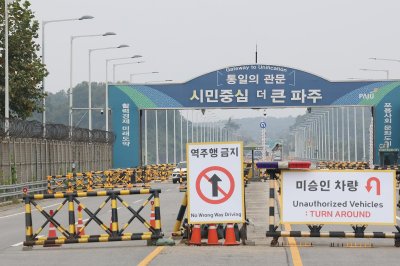
South Korea’s Unification Ministry on Monday released a new white paper focusing on peaceful coexistence with North Korea. This photo shows the Unification Bridge in Paju, across the border from the North, on Oct. 26, 2025. File Photo by Yonhap
The Lee Jae Myung government has shifted its focus to a peaceful “two-state” coexistence with North Korea, rather than pressure and confrontation, the unification ministry’s white paper showed Monday, striking a markedly different tone from its predecessor.
The annual paper reflects the push by the Lee government, which took office in June last year, to repair the strained inter-Korean relationship based on building mutual trust.
The previous conservative Yoon Suk Yeol government sought to bring about change in North Korea through pressure and the influx of outside information.
The latest white paper laid out three key guiding principles: Seoul respects North Korea’s system, does not pursue unification by absorption and does not engage in hostile activities.
Built on these principles, the government has framed its overarching policy as one of “peaceful coexistence and mutual growth on the Korean Peninsula.”
In particular, regarding Pyongyang’s “two hostile states” policy, the document specified the ministry’s stance that highlights the need for a transition to a “peace-oriented two-state relationship” aimed at achieving unification.
At a year-end party meeting in December 2023, the North Korean leader declared inter-Korean relations as those between “two states hostile to each other” and has since pursued hostile policies toward Seoul.
“Considering the reality that the South and the North exist as two de facto states, we intend to develop inter-Korean relations into a relationship of peaceful coexistence while still aiming for unification,” the ministry said.
Critics said the ministry’s “peace-oriented two-state relationship” narrative runs counter to the long-held stance that inter-Korean ties are a “special relationship” tentatively formed in the process of seeking unification, not as state-to-state relations.
Among the measures cited is the Lee government’s decision to halt the sending of anti-Pyongyang leaflets to North Korea and stop loudspeaker broadcasts along the border as steps to ease military tension and rebuild trust.
The paper also outlines plans to revive the Sept. 19 inter-Korean military agreement, signed by former President Moon Jae-in and North Korean leader Kim Jong-un in 2018, and pursue a bilateral accord to establish a systematic foundation for peaceful coexistence.
The shift in policy priorities is visible in the paper’s language. References to “peace” and “peaceful coexistence” surged to 196 from 29 and mentions of “meeting” or “dialogue” rose to 58 from 16.
By contrast, the section on North Korean human rights has been significantly scaled back. The term “North Korea’s human rights” dropped to 26 from 156, and “freedom” fell to three from 43. Mentions of “North Korean defectors” plummeted to just 10 from 203.
In a foreword message for the paper, Unification Minister Chung Dong-young stated, “Peace on the Korean Peninsula is not a choice for us, but a lifeline.”
“As we practice peace through actions rather than words, I hope that the South and the North can sit down together once again as neighbors peacefully coexisting with each other,” he added.
Despite Seoul’s olive branch, inter-Korean relations remain virtually frozen. There has been no inter-Korean human exchange in five years and no economic exchange whatsoever, the paper showed.
Pyongyang, meanwhile, has doubled down on its two-state policy, revising its constitution to remove all references to unification and cutting off remaining ties with Seoul.
Copyright (c) Yonhap News Agency prohibits its content from being redistributed or reprinted without consent, and forbids the content from being learned and used by artificial intelligence systems.