Gaza will not forget, Palestine will remember – Middle East Monitor
Gaza will not forget
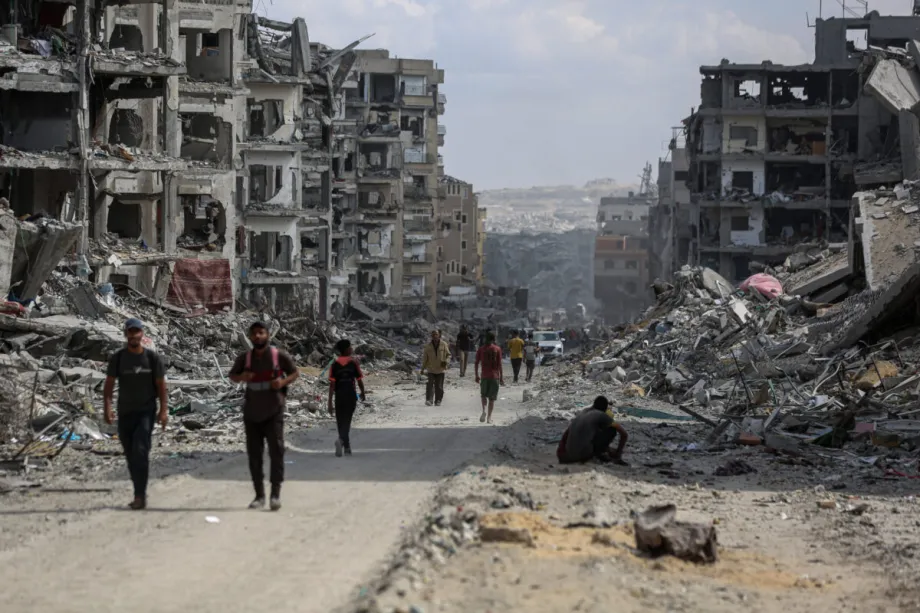
The suffocating smoke still hangs over her ruins, thick with the acrid stench of explosives powder and dust carrying the scent of betrayal and the mark of courage. Her streets, once filled with children’s laughter, became Israeli fields of slaughter. Now they echo with the names and memories of martyrs.
The mass graves, the broken concrete, and the twisted steel are not just evidence of Zionist hatred. They are witnesses to those who stood with her, and to those who failed her. Today, Gaza’s rubble holds more memories than all the nation’s libraries.
Palestine will remember
She will remember the selfless sacrifices of doctors and healthcare workers who refused to abandon their sick patients as bombs rained on their hospitals; the journalists who became the news, targeted for daring to expose the truth; the mothers who wrapped their children in the red, black, green, and white flag of a nation Israel is desperate to erase.
These are not tales of despair, but of defiance, insisting on its right to breathe life amid death.
Gaza will not forget
She will not forget the silence of Western democracies. In a tragic inversion, most European nations, shackled by the ghosts of their past, traded morality for absolution. The self-proclaimed champions of human rights offered Palestinians on the altar of yesterday’s victims to atone for Europe’s sins.
Gaza will not forget the Biden administration, which vetoed every U.N. Security Council resolution calling to end the genocide. Nor Donald Trump, who poured fuel on the fire, then demanded recognition for dousing his own flames.
This week, Arab, Muslim, and world leaders gather like moths around the American arsonist-turned-firefighter, “celebrating” the ashes of Gaza.
Palestine will remember
She will remember the people who rose for Gaza, from Yemen to Dublin, from Cape Town to London and Madrid, while Arab capitals from Cairo to Riyadh slept. Ireland and Spain led the boycott, while Arab countries from the Gulf to Jordan opened their ports and highways to provide alternative routes for Israeli goods, even as Yemen imposed a sea blockade in the Red Sea.
Gaza will not forget — nor forgive — the Arab governments that opened their ports when shipyard workers in Italy refused, delivering American weapons used to annihilate her children and destroy her hospitals.
Palestine will remember
She will remember South Africa — not an Arab or Muslim nation — that led her case before the International Court of Justice, charging Israel with genocide. A country once scarred by apartheid became the moral conscience of a world too timid to speak. In that act of solidarity, South Africa rekindled the universal truth that justice knows no borders.
Palestine will remember the Lebanese resistance that gave its leaders for Gaza’s defense; Yemen, poor in wealth but rich in dignity, whose solidarity never wavered; and Iran, steadfast against Israeli hubris. She will remember Ireland and Spain, who did not turn away when Arabs did, proving that true solidarity transcends borders, faith, and kinship, resting only on shared humanity.
She will remember the heroes of the flotillas who braved waves of hatred and siege to carry messages of compassion; the nameless volunteers who left the safety of their countries to heal the wounded and feed the hungry; the American students who turned campuses into encampments of resistance; the artists, actors, and musicians who risked careers for justice; the employees who lost their jobs protesting the complicity of Google, Microsoft, and other tech giants in Israel’s crimes.
Gaza will not forget those who betrayed her
Palestine will forever be grateful to those who dared to speak the truth when it was dangerous, who marched when it was forbidden, who grieved when it was unfashionable.
Palestine will remember. History will remember. Justice will remember.
For nearly two years, Gaza has endured a genocide so relentless it defies descriptive language. Israel’s war machine has turned hospitals into morgues, UN schools into mass graves, and refugee camps into craters. Yet Gaza refuses to die.
Each time she is bombed “back to the Stone Age,” she rises — like the phoenix — to rebuild, not only her structures but her indomitable will. In that defiance lies the occupier’s greatest fear: memory.
Israel can destroy buildings but not erase remembrance. The siege may starve Gaza’s body, but it nourishes Palestine’s collective soul.
Gaza’s children will grow up with memories no child should bear. But they will also inherit something indestructible: dignity. In every demolished home and every shattered family lives a story that refuses burial.
Gaza’s memory will not fade. For the mind, unlike stone, cannot be occupied. It is the eternal archive of a people’s resilience, passed from one generation to the next, weaving the indelible tapestry of Palestine today.
The ruins of Gaza stand not only as testimony to Israel’s genocide but to the moral collapse of those who enabled it.
Gaza will rise again, brick by brick.
But what will never be resurrected is the Israeli lie, which, for eight decades, cloaked the Zionist project in the guise of victimhood, occupying Western narratives and manufacturing consent.
Gaza will rise — and the Israeli myth will remain buried beneath her rubble, forever.
The views expressed in this article belong to the author and do not necessarily reflect the editorial policy of Middle East Monitor.