India’s Prime Minister Narendra Modi has called for an overhaul of global governance, saying Global South countries are impacted by decisions they are unable to shape. Opening the BRICS summit in New Delhi, he urged leaders to replace the ‘pyramid of privilege’ with a more equal system.
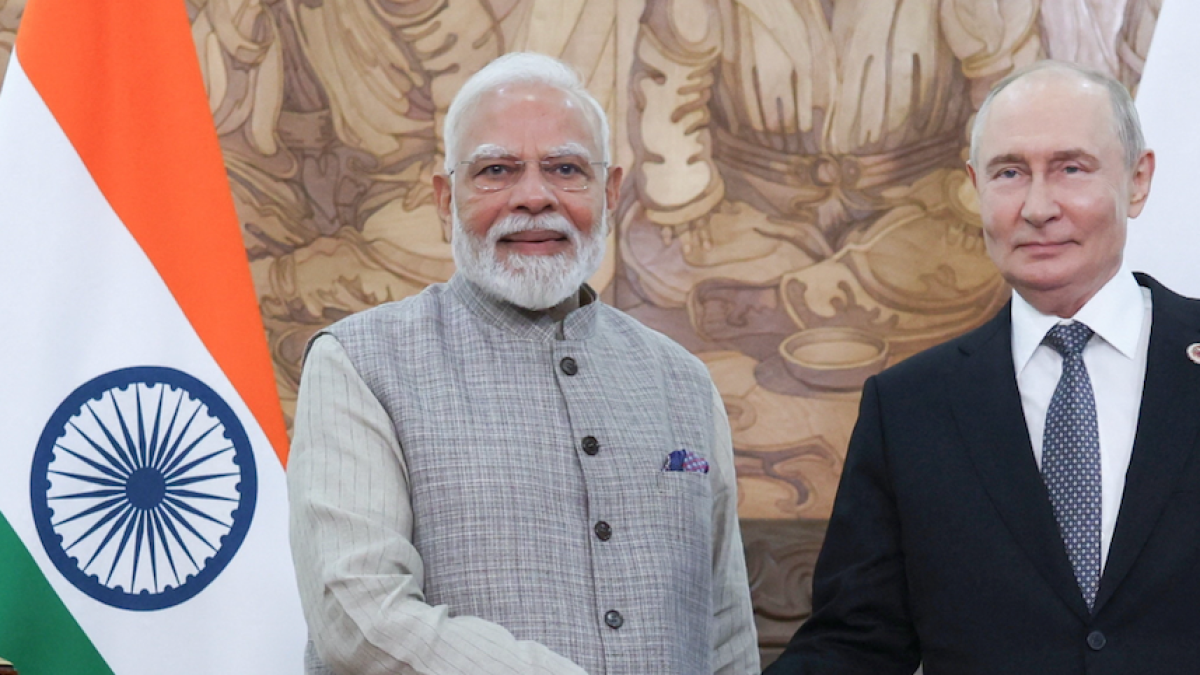
India’s Prime Minister Narendra Modi told Russian President Vladimir Putin that India supports every effort to end the war in Ukraine. The two leaders met in Bishkek at the Shanghai Cooperation Organisation summit.
Leaders of the Shanghai Cooperation Organisation (SCO), including Chinese President Xi Jinping, his Russian counterpart, Vladimir Putin, and Indian Prime Minister Narendra Modi, are set to gather in Kyrgyzstan’s capital Bishkek for an annual summit.
Iranian President Masoud Pezeshkian is also attending the summit, which marks 25 years of its existence.
Recommended Stories
list of 3 itemsend of list
The two-day summit, starting on Monday, comes at a time when the world is grappling with the aftermath of the US-Israel war on Iran, which has upended global energy and financial markets, and the ongoing Russia-Ukraine war.
So, what will be the main agenda of the summit, and will the SCO leaders try to use the gathering to push for a multipolar world and Global South cooperation on trade and security issues, as United States President Donald Trump’s unilateral foreign policy has eroded the global rules-based order?
Here’s what we know:
Who is attending the SCO summit and where is it being held?
This year’s summit is taking place in Bishkek under the motto: Together for Sustainable Peace, Development and Prosperity.
Xi, Putin and Modi will be joined by the Iranian president and leaders of Pakistan, Uzbekistan, Belarus, Kazakhstan, among others.
Turkish President Recep Tayyip Erdogan, United Nations Secretary-General Antonio Guterres and the Association of Southeast Asian Nations (ASEAN) Secretary-General Kao Kim Hourn are also expected to attend the summit.
William Yang, senior analyst for Northeast Asia at the International Crisis Group, noted that the ongoing wars are putting more strain on the rules-based international order, and against this backdrop, the summit serves as an important occasion for several of the world’s rising great powers, including China and India, to elevate their global influence and deepen their engagement and cooperation with other countries in the Global South.
“For years, SCO has been viewed as one of the avenues for China to promote the multipolar world order and form its own bloc with other developing countries. Despite its narrow scope of cooperation at the beginning, SCO member states have sought to expand the scope of their mandate and the number of member states,” Yang told Al Jazeera.
Amid the ongoing conflicts in the Middle East and Europe, Yang said, “China could use this year’s summit to present itself as a great power that advocates for a peaceful resolution of the conflicts, thereby sharpening the contrast with the US.”
“However, these efforts are likely to be limited to rhetoric rather than any substantive proposal for conflict resolution,” he said.
Alicia Garcia-Herrero, chief economist for Asia Pacific at French investment bank Natixis, said the summit is particularly significant because it marks the grouping’s 25th anniversary and offers the first chance to turn last year’s Tianjin strategy, which called for a multipolar world order that fosters mutually beneficial international cooperation, into action. Last year’s summit took place in China’s Tianjin region.
“Putting Modi, Putin and Xi in the same room, with India-China border talks still live and a scheduled Modi-Putin bilateral, is a visible test of how far the recent thaw goes and how Eurasia wants to organise security, connectivity and trade without defaulting to Western institutions,” she told Al Jazeera, referring to the recent India-China talks amid the warming up of New Delhi-Beijing ties.
What is the SCO?
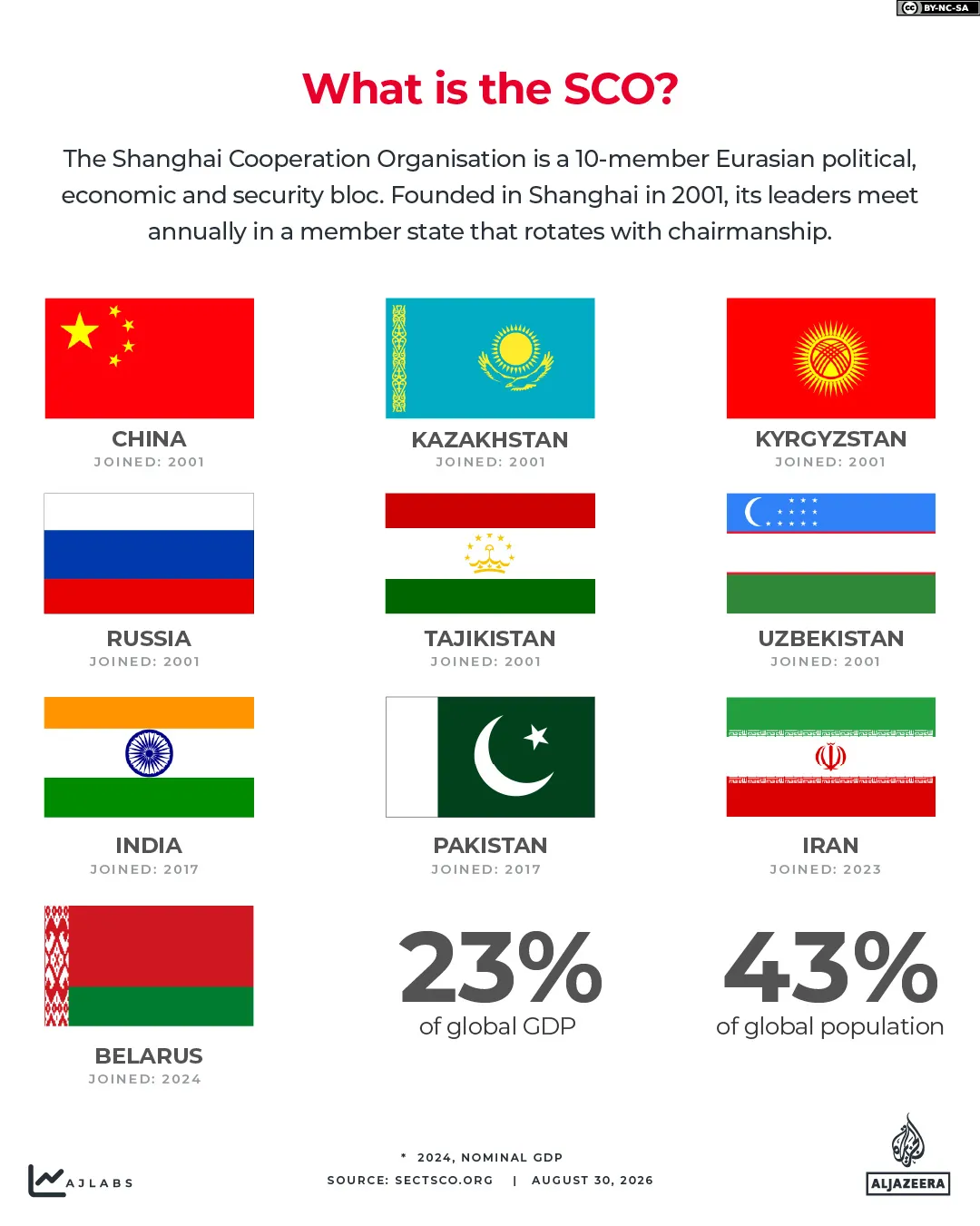
The SCO started in 1996 as a security bloc, dubbed the “Shanghai Five”. It was formed by China, Russia, Kazakhstan, Kyrgyzstan and Tajikistan to settle their border disputes following the end of the Cold War and the collapse of the Soviet Union.
But in June 2001, the grouping evolved into the SCO, and expanded to include Uzbekistan, with headquarters in Beijing. In 2017, the bloc expanded to include India and Pakistan. Iran and Belarus were also added as full members in 2023 and 2024, respectively.
In addition, the organisation has 14 key dialogue partners, including Saudi Arabia, Qatar, Egypt, Turkiye, Myanmar, Sri Lanka and Cambodia.
SCO member states account for 43 percent of the world’s population and 23 percent – or almost a quarter – of the global economy.
Analysts have pointed out that while the SCO emerged with a focus on regional security, the expansion of its mandate to include trade and other Global South concerns means it is difficult to understand what sets the grouping apart from other Global South organisations like the BRICS, which is an acronym derived from the initials of the founding member countries, Brazil, Russia, India, China and South Africa.
Alejandro Reyes, adjunct professor in the department of politics and public administration at the University of Hong Kong, said the SCO has grown into a “counterbalance” to the US-led Asia Pacific alliance aimed at countering China’s rise. India is part of both groupings. “Interestingly, India is part of the SCO, and the US appears to have dropped the Indo-Pacific nomenclature,” he said.
Reyes emphasised that “the SCO is not a coherent anti-US, anti-Western alliance”. “It is better understood as a forum in which countries with very different interests can demonstrate that they have alternatives and strategic room for manoeuvre – agency in this more volatile geopolitical order, dominated by China and the US. It is less an anti-American alliance than a venue for countries hedging against and hinging away from American power,” he told Al Jazeera.
“The significance this year is that current US policies, especially with regard to Iran and continuing US tariff and sanctions action, may be making that hedging more attractive and necessary,” he added.
What is on this year’s agenda?
The US-Israel war on Iran, the Russia-Ukraine war and the economic and social situation in Afghanistan are key issues leaders are expected to discuss this year, according to the SCO Secretariat.
Relations between India and China – Asia’s two major economies – are also expected to be discussed. Last year, Beijing and New Delhi began a rapprochement after five years of tensions over a 2020 deadly border skirmish. Trump’s tariff war on Indian goods last year forced New Delhi to mend ties with Beijing. For the first time since 2018, Modi visited China last year for the SCO summit.
Border tensions between India and Pakistan also persist, and the issue is expected to be discussed at this summit.
Manoj Kewalramani, chairperson of Bengaluru-based think tank Takshashila Institution’s Geostrategy Programme, told Al Jazeera that apart from the traditional security agenda, this year’s summit might include any forward movement on issues of economic integration or financial cooperation architecture.
“In Tianjin, we had the agreement on establishing the SCO Development Bank,” Kewalramani said.
“The Kyrgyz leadership has said that its priority will be to move the needle on the bank, the SCO Development Fund and SCO Investment Fund,” he said, adding that while talks have reportedly been taking place in this direction, there is no clarity on whether any agreements will be announced at this year’s summit.
According to the SCO Secretariat, economic connectivity will be a key topic the group will discuss as the US and Israel’s war on Iran continues to paralyse key maritime routes like the Strait of Hormuz, which has upended global supply chains, the energy market and financial markets.
The group is expected to discuss new trade and transport corridors, such as the 7,200km (4,474-mile) International North-South Transport Corridor, which links the Russian port city of St Petersburg with India’s financial capital, Mumbai, through Iran and ports on the Gulf.
Herrero pointed out that with Modi and Putin scheduled to hold a bilateral meeting, discussions on the Northern Sea Route, which runs through the Arctic coast, are also expected. China last month announced a new shipping route through the Arctic Ocean, aimed at easing global trade amid the blockade of the Strait of Hormuz and attacks in the Bab al-Mandeb in the Red Sea, which will pass through the Northern Sea Route.
According to Indian media reports, Moscow and New Delhi could negotiate the use of the Northern Sea Route by India as the crisis in West Asia continues to affect trade routes.
The SCO will also seek to establish a network of Silk Road stations to support international freight traffic across Eurasia.
Can the SCO agree on all issues?
The Eurasian grouping has often been unable to agree on global geopolitical issues.
For instance, Russia has been able to get most SCO members to align with its interests when it comes to its war in Ukraine, but India has attempted to play a more balanced role – seeking peace and stronger ties with Ukraine, while also buying record levels of oil from Russia.
But this year, Ukraine is expected to feature in discussions, with Turkiye’s Erdogan and Russia’s Putin holding bilateral talks on the matter, according to a Kremlin aide. Europe’s deadliest war since World War II is in its fifth year.
Yury Ushakov, Putin’s foreign policy adviser, said the meeting would take place on the sidelines of the SCO summit.
“There are many issues to discuss. Of course, these include the situation in the Black Sea and the Ukraine issue in general,” he told reporters, referring to the rise in attacks in the Black Sea.
In this photo provided by Kyrgyzstan’s Prime Minister Press Office, Indian Prime Minister Narendra Modi stands on the an aircraft boarding stairs upon his arrival at an international airport outside Bishkek, Kyrgyzstan, on Sunday, August 30, 2026 [Handout/Ergesh Zhusubaiv/Kyrgyzstan’s Presidential Press Office via AP]
The SCO has, however, taken a more collective position on the US-Israel war on Iran and Israel’s genocidal actions in Palestine.
In March, the SCO condemned the US-Israel war on Iran. “The SCO member states considered the use of force as unacceptable and advocate for the resolution of existing differences exclusively by peaceful means, based on dialogue, mutual respect, and taking into account the legitimate interests of all parties, in accordance with the norms of international law and the principles of the UN Charter,” it said in a statement.
India, which has strong ties with Israel, had refused to endorse an SCO joint statement condemning Israel for its attack on Iran in June 2025.
Iranian President Pezeshkian is also scheduled to meet Putin on the sidelines of the summit, according to Iran’s official IRNA news agency. Russia is a close ally of Iran and the two countries cooperate on defence issues. China has emerged as Iran’s biggest economic lifeline as it buys more than 80 percent of its crude oil. Moscow and Beijing have also lent diplomatic cover to Tehran at the UN.
Frictions also exist on how the group views border tensions between India and Pakistan. New Delhi has repeatedly called on the organisation to condemn “cross-border terrorism”, for which it blames Islamabad, a close economic and defence ally of China.
Last July, India demanded that the grouping condemn the April 2025 attack by armed men in Indian-administered Kashmir, in which 26 people were killed. Pakistan has also blamed India for armed attacks inside its territory.
During the Tianjin summit, the bloc condemned “terror” attacks in both India and Pakistan, taking a more balanced position on the issue.
What are Russia, China and India going to gain at the summit?
Reyes from the University of Hong Kong pointed out that all eyes will also be on Russia, China and India.
“For China, the SCO is partly about institution-building. Beijing wants to demonstrate that it can convene a large part of Eurasia around an agenda of security, connectivity, trade and development, while promoting a more multipolar, agentic international order. It also reinforces China’s increasingly important economic position in Central Asia, a strategically key region of the Eurasia landmass,” he said.
“For Russia, the summit is an opportunity to show that it is not isolated internationally. Maintaining strong relationships with China, India, Iran and Central Asia is economically and diplomatically important, given the Ukraine war and Western and other sanctions. But Moscow also has an interest in preserving its own influence in Eurasia rather than simply becoming more and more dependent on China.
“India is in an intriguing position. Modi’s participation is not an indication that India is joining the China-Russia axis, such as it is. India itself describes its SCO priorities as ‘security, connectivity and opportunity’. That is much more consistent with India’s longstanding pursuit of strategic autonomy – its agency amid the great-power rivalry,” Reyes explained.
He added that New Delhi wants “access and influence in Central Asia, continued relations with Russia [from which it buys the bulk of its defence equipment], and a mechanism for managing its difficult but gradually stabilising relationship with China”.
“At the same time, New Delhi maintains important relations with Washington, including through the Quad security arrangement.
“So China and Russia may see the SCO partly as an instrument for building a less US-dominated international order. India, meanwhile, sees it more as one of several overlapping platforms through which it can maximise its own agency.”
What does all this mean to the US?
As part of his unilateral foreign policy vision, Trump has undermined the Western-led international order and lashed out at Global South blocs, such as BRICS, which he sees as a threat to the US’s economic dominance. He has called the grouping “anti-American”.
However, Kewalramani noted that the Trump administration has continued some of its predecessors’ approaches and deepened engagement with countries in the region where this year’s SCO is being hosted, especially with the C5 or Central Asian countries of Kazakhstan, Kyrgyzstan, Tajikistan, Turkmenistan and Uzbekistan.
“Joe Biden had established a leader-level meeting mechanism with C5 countries in 2023. Trump also hosted them in DC in November 2025. [US Secretary of State] Marco Rubio and subsequently Trump are expected to visit the region later [this] year. Kazakhstan has announced accession to the Abraham Accords, becoming the first Central Asian state to join [the Trump-led diplomatic efforts to cajole Muslim countries to recognise Israel]. The US has been engaged with the region on critical minerals and other business deals,” he said.
“In other words, C5 members are also adopting a diversified diplomatic approach, seeking to balance China and Russia’s dominance,” he noted.
“But the fact that you are witnessing these countries meeting with far more purpose to think about alternative financial and energy architectures is a reflection of the limitations of the US’s disruptive foreign policy,” Kewalramani added.
Herrero said for the US, the SCO summit is a reminder that countries like India will keep practising strategic autonomy: it will sit in the Quad and buy US defence equipment while also talking to Moscow and Beijing in a China-heavy forum.
The Quad or Quadrilateral Security Dialogue was established by India, Japan, Australia and the US in 2007 to counter China’s growing influence in the Asia Pacific region. Over the past quarter-century, India has grown closer to the US and its allies, amid shared concerns over Beijing’s rise.
Reyes warned that Washington should be careful not to read the SCO as a consolidated anti-US coalition, even though China, Russia and Iran are members.
“The differences among China, Russia and India are far too substantial to substantiate that label. The more important message is that American economic and geopolitical pressure can sometimes produce convergence among countries that otherwise might disagree with one another more,” he said.
“The SCO’s criticism of unilateral economic measures is significant in that respect. China and Russia explicitly want a less US-dominated international order. India does not necessarily share that objective, but it does want a world in which Washington cannot dictate its foreign-policy choices.”
New Delhi, India — On August 13, Abdul Hafeez returned to the primary school he once went to, in Karisunda, a village in Bankura district in the eastern Indian state of West Bengal.
The 26-year-old was visiting his alma mater as part of a campaign by the Cockroach Janata Party, a popular Indian pressure group, to audit conditions of the country’s under-funded, often dilapidated government-run schools.
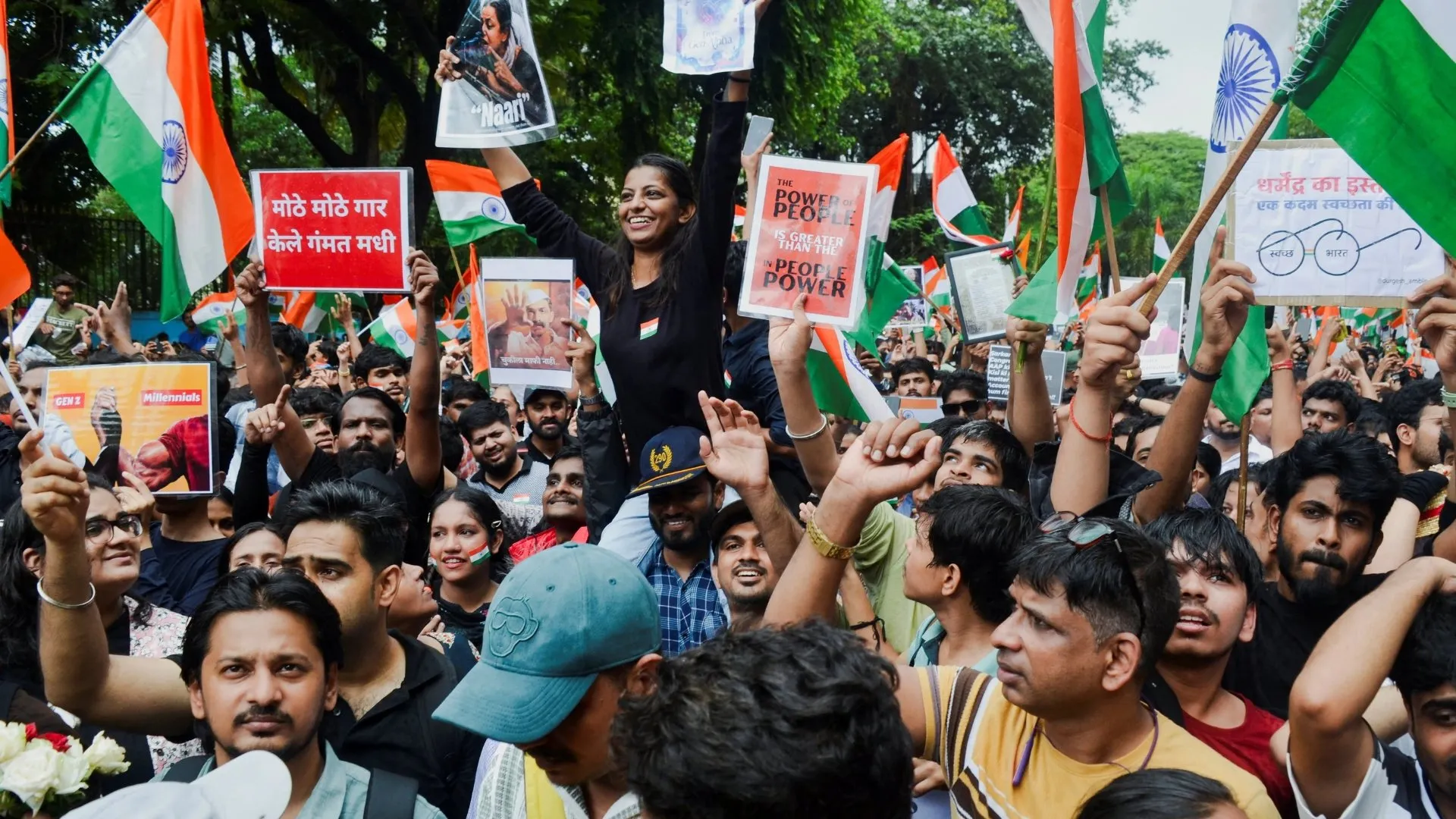
The CJP had just succeeded in forcing the resignation of Prime Minister Narendra Modi’s education minister, Dharmendra Pradhan, in July, after a 37-day sit-in in the national capital that prompted antigovernment Gen Z protests across the country.
But in Bankura, things would turn deadly. Hours after Hafeez’s visit to his school, he alleged that local workers of Modi’s Hindu majoritarian Bharatiya Janata Party (BJP) arrived at his home and assaulted him and his father, Mohammad Mafik. Two days later, Hafeez’s 51-year-old father died from his injuries.
On Sunday, Suvendu Adhikari, the chief minister of BJP-ruled West Bengal, said the attackers were “criminals with no BJP connection” and assured action.
But a day after burying his father, Hafeez told Al Jazeera that he stands firm in calling for accountability and reforms in government-run schools. “We will fight for justice for my father, but these attacks will not stop us from demanding better education,” he said.
That demand marks a new line in the sand for the CJP. Fresh from successfully forcing Modi and his government onto the defensive — the Indian PM has only rarely sacked ministers even in the face of credible accusations of wrongdoing or public pressure — the group has now announced its next battleground: India’s public-funded schools.
CJP leaders have asked their supporters, who thronged the protests in New Delhi from different parts of the country, to visit their nearby schools and audit their conditions.
They are working around a basic four-point checklist for what the CJP is calling its Fix the Schools campaign: drinking water and functional toilets; electricity and usable classrooms; boundary walls and campus safety; and midday meals and teacher attendance.
And the murder of Hafeez’s father has raised the already high stakes in a battle between the well-oiled machinery of Modi’s BJP and the fledgling, thin-on-organisation CJP.
“Abdul went to inspect the [government] school in Bengal where he once studied,” said Abhijeet Dipke, founder of the CJP. “It makes my blood boil that people are being murdered simply for demanding better schools.”
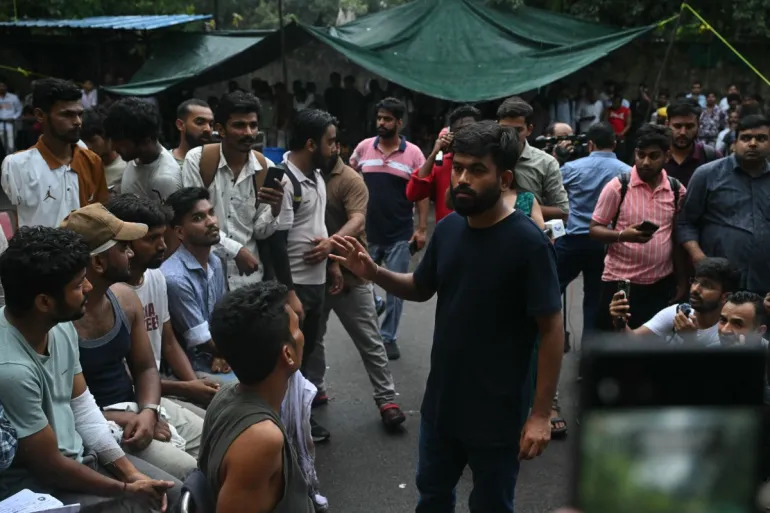
Cockroach Janta Party (CJP) founder Abhijeet Dipke speaks to victims who were injured during a protest demanding the resignation of India’s Education Minister Dharmendra Pradhan over alleged NEET exam irregularities, in New Delhi on July 21, 2026 [Arun Sankar/AFP]
‘A disruptive change’
Ashutosh Ranka, a co-convenor of the Cockroach group, appeared emotional after meeting Hafeez’s family on Monday. He told reporters that the group proposed to press the government for compensation; however, Hafeez requested that a school be named after his father.
In Rajasthan, Ranka’s home state in western India, the group has faced other challenges.
Ranka joined a sit-in with primary school students in Alwar district on August 14 to demand additional rooms, clean toilets and drinking water. Local publications reported that the officials accepted the demands.
On Sunday, the Rajasthan government, also led by Modi’s BJP, imposed restrictions on so-called outsiders entering government schools and on taking photos and videos, citing students’ privacy.
The government notice, which ordered the school management to pursue criminal action against such surveys, came after Ranka had announced visits by CJP volunteers across the state.
Samina Bano, an education-policy expert who has advised several Indian states on reforms, told Al Jazeera that “it is essentially the system itself that is not working anymore for the people”.
In the last 10 years, Bano said, she had found “drunk teachers on duty during spot checks”, fake appointments in rural areas that many teachers do not want to go to, and other systemic failures that she insisted are common in the Indian public school system.
“Education in government-run schools a sorry state of affairs. It requires a disruptive change,” Bano said.
“The real problem is the quality of teaching, learning outcomes and the food,” Bano added, crediting the Cockroach pressure group for bringing the demands for reform into mainstream politics.
“They are bringing it into the discourse, but once people start demanding, there needs to be actual institution building, and that’s different work altogether,” Bano said. “There has to be an appetite to reimagine public education in India.”
Supporters of the Cockroach Janta Party (CJP) chant slogans and wave their mobile phones with their flashlights on as they gather during a sit-in protest demanding the resignation of Indian Education Minister Dharmendra Pradhan, at Jantar Mantar in New Delhi, India, on July 19, 2026 [Anushree Fadnavis/Reuters]
‘Playing to strength’
After Gen Z protesters returned from the streets in New Delhi, the internet was instead flooded with videos of school-going children asking for better facilities across several states. They were blocking roads, circling local administration offices and fighting with bureaucrats.
The Cockroach party tapped into the momentum and announced its next phase in a smart mobilisation strategy, said Asim Ali, a political analyst in New Delhi.
“It plays to their strength of leveraging social media. Without many volunteers [like a traditional political party], they can outsource the grassroots work to followers on social media itself,” he said.
“By leveraging the power of social media, which is now felt in the remotest of corners in India, the Cockroach party has dramatically driven down organisational resource costs of a movement,” Ali added.
But Ali cautioned that this approach of relying on volunteers without political or organisational skills, protest experience or institutional support also exposes them to violence, as happened with the Hafeez family in West Bengal.
Yet the blood spilled in the eastern state hasn’t dimmed the drive from the CJP to demand accountability from authorities.
On Tuesday, Ranka announced on X that multiple venues in West Bengal’s capital Kolkata had cancelled or refused permission to the CJP to hold meet-ups with students.
“This only reinforces the fact that the BJP is scared from the cockroaches,” he wrote. “Cockroaches of Bengal will continue to visit govt schools and push the Bengal govt to get them fixed.
New Delhi, India – On the night of August 4, in a counting hall in the eastern Indian city of Patna, some 1,000km (620 miles) from the national capital, Prime Minister Narendra Modi’s Bharatiya Janata Party (BJP) suffered one of its most stunning political setbacks in 12 years.
Bankipur, a constituency in the legislature of the state of Bihar, had been held by the BJP for three decades. But the fledgling Jan Suraaj Party, led by political strategist-turned-politician Prashant Kishor, ended that reign, winning a seat that the BJP’s national president, Nitin Nabin, had held until just a few months earlier.
The defeat came less than two weeks after India’s Education Minister Dharmendra Pradhan resigned, bowing to seven weeks of student-led protests that had shaken New Delhi and spread to several cities. The Cockroach Janta Party (CJP), a satirical outfit born on Instagram in May after India’s chief justice, Surya Kant, compared unemployed young Indians with “cockroaches” and “parasites”, had led those protests.
Nabin, the BJP chief, had spent the Bankipur campaign denouncing the country’s Gen Z protesters as “a virus and a cockroach gang devoted to breaking the country”.
Instead, it was the BJP’s stranglehold over the constituency that was broken. That surprise electoral verdict has thrust upon India a broader question, say analysts: Will India’s most formidable political machine — the BJP — be forced to change?
A charm offensive, gone slightly wrong
The clearest sign that the BJP treats the Gen Z uprising as more than a passing nuisance is the sheer awkwardness of the party’s response. During the peak of the protests, Modi released a string of selfie-style videos on Instagram addressing the exam paper leaks that led to the protests. He reportedly told cabinet colleagues that young people were “just on Instagram”, urging ministers to court them on the platform with reels rather than media briefings.
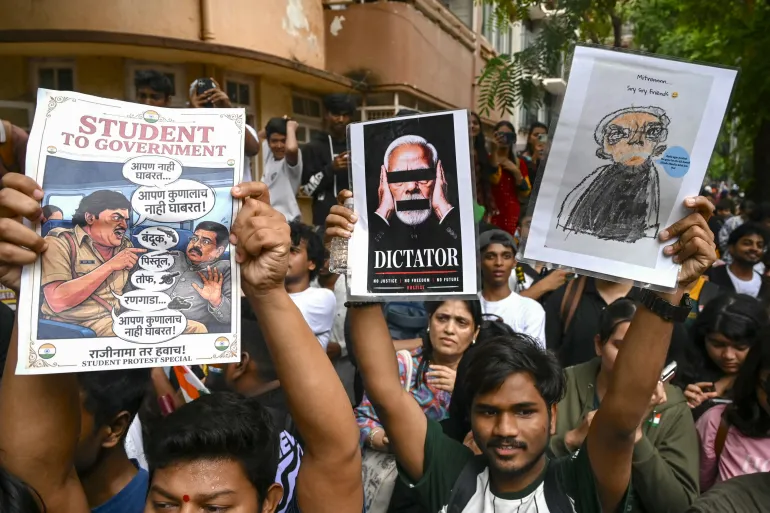
Demonstrators holding posters take part in a protest rally in Mumbai on July 24, 2026, in solidarity with the CJP at New Delhi’s Jantar Mantar [Indranil Mukherjee/AFP]
In Uttar Pradesh, India’s most populous state, the party has launched a Gen Z outreach initiative directing civil administrative officers into schools for career counselling sessions.
The BJP has also released a gym-set video in which young people trade internet slang with an older trainer who steers the talk towards the government’s development record. The slang was laid on so thick that many Instagram users mocked the party, joking that it had seemingly paid young people to write propaganda aimed at their own generation.
After another video of Modi that briefly vanished from Facebook, the parliamentary committee on information technology demanded an apology from Meta chief executive Mark Zuckerberg.
New Delhi-based analyst Asim Ali says this sudden scramble for social media relevance reveals a lot about the party itself.
The BJP once produced narratives that its own supporters would circulate unprompted. Today, he said, much of its messaging “feels more managed and paid for” – a mismatch for a decentralised space that rewards top-down discipline far less than Facebook and WhatsApp once did.
“The party’s communications machinery remains powerful, given its control over the mainstream media,” Ali told Al Jazeera. “But on social media, especially Instagram, it is unable to generate the kind of organic emotional identification that it could around 2011 to 2014.”
Gilles Verniers, a researcher at the Center for International Studies (CERI) at Sciences Po in Paris, described the BJP’s outreach as “a battle for perception” rather than a policy shift.
“There haven’t been any proposals that fundamentally change anything,” he said. “There’s a new minister for education, but he comes from the same background, an old man from the RSS.” The Rashtriya Swayamsevak Sangh (RSS) is the far-right ideological parent of the BJP.
Verniers argued that what was genuinely broken is the BJP’s usual playbook against dissent: branding protesters antinational, foreign-funded or terrorists, as they did during demonstrations against the controversial Citizenship Amendment Act (CAA) in 2019-20. The changed citizenship law, for the first time, introduced a religious test for naturalised citizenship: non-Muslim asylum seekers from India’s neighbouring nations were given a faster track to citizenship.
That past approach towards protests failed this time partly because the movement mocked itself before the state could, and partly because it was pluralistic.
Bollywood and Assamese singer Zubeen Garg, centre, sings during a protest rally by the All Assam Students’ Union and 30 other Indigenous organisations against the Citizenship Amendment Act in Guwahati, Assam, India, on January 9, 2020 [Anupam Nath/AP Photo]
Unlike the anti-CAA or farmers’ protests, it could not be pinned to one religion or community, and also drew in young people from the BJP’s own so-called “upper-caste” Hindu base. It was a “truly caste-blind movement”, Verniers said.
The episode also punctured a notion pushed by the BJP, he said, that Modi held a natural command over the youth.
For the first time, the prime minister “appears his age”, Verniers said of 75-year-old Modi.
“What the movement has done is really turn him into a boomer in the public imagination, and that must really, really hurt,” he added.
Does any of this show up in the numbers?
The BJP lost two of the three by-elections held in the first week of August, in states it governs – Bankipur in Bihar and Datia in Madhya Pradesh. However, it comfortably retained the third, Manjalpur in Gujarat, Modi’s home state.
Opposition leaders drew a straight line from the losses to the student protests, but analysts were more cautious. Ali warned against reading too much into the Bankipur vote.
By-elections, Verniers added, are decided by a fraction of the electorate, “barely a third of the population vote”, and that the BJP’s system of power “has proved very resilient to absorbing setbacks”.
Verniers points to Haryana, where the BJP won a majority a few years after the northern state’s farmers joined a yearlong movement to oppose three controversial agricultural laws. It was an election fought “not on farmers, but on caste”, he said.
What had shifted was not the vote count but a surrounding story now building “into a broader narrative of challenges to the BJP”.
An MP on the ground
Few politicians visited Jantar Mantar, the epicentre of the Gen Z protests in New Delhi, as often as Pushpendra Saroj, 27, a Samajwadi Party member of parliament from Kaushambi in Uttar Pradesh. The Samajwadi Party is the main opposition to the BJP in Uttar Pradesh, India’s most populous state.
Saroj watched a gathering of a few hundred swell into thousands after activist Sonam Wangchuk was hospitalised following a 20-day hunger strike. He credited this to “the aggression from the government” – weeks of silence, alleged cuts to power and water and the July 20 baton charge against protesters in New Delhi. The crowd had grown beyond its student base to include army veterans and even serving police officers.
The politician pointed out that the education minister’s resignation came only after “fingers got pointed at the prime minister directly”.
A simpler sympathy helped, too. “Nobody likes to see children getting beaten up,” Saroj said.
‘This is not a victory in any terms’
For many who marched in New Delhi, the story is bigger than a satirical “Cockroach” Instagram page or a single resignation. Anjali, a postgraduate student and secretary of the All India Students’ Association (AISA) at the University of Delhi, an older left-aligned group that mobilised alongside the CJP, reads the protests as the surfacing of a longer-term anger.
“We know for a fact that this did not originate from a particular remark or any particular leak,” she told Al Jazeera. “This is an accumulated anger of the youth of this country for the last 12 years. As long as communal, casteist, anti-women politics is not ended, this is not a victory in any terms,” she said.
Student activists take part in a demonstration demanding educational reforms as part of the CJP’s movement, in Kolkata, India, on July 24, 2026 [Bikas Das/AP Photo]
Anjali was also critical of who paid the price once the protests ended. Muslim and Dalit students, she said, were “the first to be put behind bars”, the first to face intimidation and police complaints, echoing the 2019 raid on Jamia Millia Islamia, the New Delhi university at the heart of the anti-CAA protests.
In the western state of Goa, police detained two young men for allegedly backing jailed activists Umar Khalid and Sharjeel Imam while celebrating Pradhan’s exit, an episode she reads as part of the same pattern.
What comes next for the CJP movement?
Ali, Verniers and Anjali all agree that a leap into electoral politics is unlikely for the CJP.
Verniers called that restraint from the group so far “tactically smart”, citing the example of the Aam Aadmi Party (AAP), a protest movement that built a successful party but, a decade into power, is “seen as a disappointment” and “on the verge of disappearance” in some former strongholds.
A national campaign demands money, volunteers and organisation that a young, often underemployed movement lacks. Its more durable influence, Verniers suggested, will be on other parties’ agendas, “as an interest group, rather than as a separate political force”, one the opposition has been unusually willing to embrace.
Anjali described AISA’s posture in similar terms: present at Jantar Mantar, but unwilling to let the fight narrow to one resignation. The group, she said, plans to keep building the argument against the government on campuses nationwide.
Al Jazeera reached out to 18 BJP national spokespeople for their responses to this article, but did not receive any replies.
The gap between power and legitimacy
Ali said he did not expect the BJP to trade its Hindu majoritarian politics — an ideology known as Hindutva — for one built on jobs and education, as demanded by CJP-led Gen Z protesters.
“I don’t think the BJP would dilute its Hindutva agenda; if anything, it would double down on it, so that the most salient issue in any election is religious identity.”
That may be, but what has changed, Verniers suggested, is not so much the BJP’s raw political power as its legitimacy.
“Electorally speaking, they are as dominant as they’ve ever been, perhaps more,” Verniers said. He cited the party’s ability to win elections, engineer defections, and outspend rivals, as proof of their continued success and of the BJP having pushed “the boundaries of what is democratically admissible”.
But the authority behind that dominance is what the protests have dented. And that gulf “between the actual power that the BJP has, and its ability to have citizens comply and obey” is harder to repair with a by-election win or a polished reel, he said.
That gap, Verniers said, “is the really important, interesting disconnect” the party now has to live with.
Indian PM said the Maoist-influenced Naxalite armed rebellion is largely gone, but its ideological backers still pose threat.
Published On 15 Aug 202615 Aug 2026
India’s Prime Minister Narendra Modi has said the country has largely eliminated a Maoist rebellion which it battled for decades but still faces a threat from the movement’s ideological backers.
Speaking on India’s Independence Day on Saturday, Modi said India had succeeded in “getting rid of armed Naxals” – referring to members of the Maoist-influenced Naxalite movement that challenged state authority across swaths of central and eastern India.
Recommended Stories
list of 3 itemsend of list
However, he said “dimagi Naxals” (intellectual Naxals) are looking for opportunities to create violence, and need to be “identified and isolated”.
The phrase “dimagi Naxal” echoes the politically charged label “urban Naxal,” a term Modi and leaders of his Bharatiya Janata Party have previously used for activists, academics, intellectuals and other government critics.
While Modi did not mention the protests, he repeatedly highlighted initiatives aimed at young Indians, including AI skills training and free online coaching for competitive exams.
He said India had transformed from a “fragile” economy into the world’s fastest-growing major economy over the past decade and reaffirmed his government’s goal of turning the country into a developed nation by 2047, the centenary of its independence.
India’s Naxalite movement began in 1967 with an uprising in the village of Naxalbari in eastern India, and grew into a decades-long armed rebellion championing the rights of landless farmers, the rural poor and Indigenous communities. Thousands of civilians, rebels and security personnel died in the fighting.
Modi said the Maoist movement had “destroyed the future” of generations of young people and credited his government’s security and development policies with sharply reducing Maoist violence since taking office in 2014.
Rights groups have for years accused India’s government of using anti-terror laws, sedition-related provisions and foreign-funding rules to squeeze civil society and target activists, journalists and groups critical of its policies.