minnesota

US border chief says Trump agrees to end deportation surge in Minnesota | Donald Trump News

US border chief announces the conclusion of a federal operation with 700 immigration agents set to leave Minnesota.

Tom Homan, the US border security chief, says that the immigration crackdown in Minnesota that led to mass detentions, protests and two deaths is coming to an end.

“As a result of our efforts here, Minnesota is now less of a sanctuary state for criminals,” Homan said at a news conference on Thursday.

Recommended Stories

list of 3 itemsend of list

“I have proposed, and President Trump has concurred, that this surge operation conclude,” he continued.

US Immigration and Customs Enforcement (ICE) launched Operation Metro Surge on December 1. Homan added that ICE operations would continue as they did before the operation began.

“Through targeted enforcement operations based on reasonable suspicion, and prioritising safety and security, ICE will continue to identify, arrest, and remove illegal aliens who pose a risk to public safety, as we’ve done for years,” he said.

Federal authorities say the sweeps focused on the Minneapolis-St Paul metro area have led to the arrest of more than 4,000 people. While the Trump administration has called those arrested “dangerous criminal illegal aliens,” many people with no criminal records, including children and US citizens, have also been detained.

Democratic Governor Tim Walz said Tuesday that he expected Operation Metro Surge to end in “days, not weeks and months,” based on his conversations with senior Trump administration officials. He told reporters he spoke this week with both Homan and White House chief of staff Susie Wiles.

Minneapolis Mayor Jacob Frey also said he had a “positive meeting” with Homan on Monday and discussed the potential for a further drawdown of federal officers.

Homan took over the Minnesota operation in late January after the second fatal shooting by federal immigration agents and amid growing political backlash and questions about how the operation was being run.

“We’re very much in a trust but verify mode,” Walz said, adding that he expected to hear more from the administration “in the next day or so” about the future of what he said has been an “occupation” and a “retribution campaign” against the state.

Officials with the Department of Homeland Security did not reply to a request for comment on the governor’s remarks.

Walz said he had no reason not to believe Homan’s statement last week that 700 federal officers would leave Minnesota immediately, but the governor added that that still left 2,300 on Minnesota’s streets.

Homan at the time cited an “increase in unprecedented collaboration” resulting in the need for fewer federal officers in Minnesota, including help from jails that hold deportable inmates.

Source link

Federal authorities announce an end to the immigration crackdown in Minnesota.

The immigration crackdown in Minnesota that led to mass detentions, protests and two deaths is coming to an end, border policy advisor Tom Homan said Thursday.

Democratic Gov. Tim Walz said Tuesday that he expected Operation Metro Surge, which started in December, to end in “days, not weeks and months,” based on his conversations with senior Trump administration officials.

“As a result of our efforts here, Minnesota is now less of a sanctuary state for criminals,” Homan said at a news conference.

“I have proposed and President Trump has concurred, that this surge operation conclude,” he continued.

Federal authorities say the U.S. Immigration and Customs Enforcement sweeps focused on the Minneapolis-St. Paul metro area have led to the arrest of more than 4,000 people. While the Trump administration has called those arrested “dangerous criminal illegal aliens,” many people with no criminal records, including children and U.S. citizens, have also been detained.

“The surge is leaving Minneapolis safer,” Homan said. “I’ll say it again, it’s less of a sanctuary state for criminals.”

Homan announced last week that 700 federal officers would leave Minnesota immediately, but that still left more than 2,000 on Minnesota’s streets. Homan said Thursday that the drawdown began this week and will continue next week. He said he plans to stay in Minnesota to oversee the drawdown.

Minneapolis Mayor Jacob Frey said he had a “positive meeting” with Homan on Monday and discussed the potential for a further drawdown of federal officers.

Homan took over the Minnesota operation in late January after the second fatal shooting by federal immigration agents and amid growing political backlash and questions about how the operation was being run.

“We’re very much in a trust but verify mode,” Walz said, adding that he expected to hear more from the administration “in the next day or so” about the future of what he said has been an “occupation” and a “retribution campaign” against the state.

Walz said he had no reason not to believe Homan’s statement last week that 700 federal officers would leave Minnesota immediately, but the governor added that that still left 2,300 on Minnesota’s streets. Homan at the time cited an “increase in unprecedented collaboration” resulting in the need for fewer federal officers in Minnesota, including help from jails that hold deportable inmates.

Karnowski writes for the Associated Press.

Source link

What is the lowest halftime score in Super Bowl history?

The Seattle Seahawks lead the New England Patriots 9-0 at halftime of Super Bowl LX on a pair of field goals by kicker Jason Myers.

That’s a pretty low score — but it’s not close to being the lowest halftime score in Super Bowl history. That came in Super Bowl IX following the 1974 season.

In a struggle between two classic NFL defenses — Pittsburgh’s Steel Curtain vs. Minnesota’s Purple People Eaters — the only first-half points midway through the second quarter. On second and 7 from his own 10-yard line, Vikings quarterback Fran Tarkenton lost the ball and had to fall on it in the Vikings’ end zone. He was touched by Steelers defensive end Dwight White, who was credited with the sack.

It was the first safety ever in a Super Bowl, giving Pittsburgh a 2-0 lead that stood at halftime. The Steelers went on to defeat the Vikings 16-6 for their first of four Super Bowl wins in a six-year stretch.

Following the 2018 season, the Patriots led the Rams 3-0 at the intermission of Super Bowl LIII, the second-lowest halftime score in Super Bowl history, on a 42-yard field goal by Stephen Gostkowski early in the second quarter.

Source link

Hard hats and dummy plates: Reports of ICE ruses add to fears in Minnesota

For days, Luis Ramirez had an uneasy feeling about the men dressed as utility workers he’d seen outside his family’s Mexican restaurant in suburban Minneapolis.

They wore high-visibility vests and spotless white hard hats, he noticed, even while parked in their vehicle. His search for the Wisconsin-based electrician advertised on the car’s doors returned no results.

On Tuesday, when their Nissan returned to the lot outside his restaurant, Ramirez, 31, filmed his confrontation with the two men, who hide their faces as he approaches and appear to be wearing heavy tactical gear beneath their yellow vests.

“This is what our taxpayer money goes to: renting these vehicles with fake tags to come sit here and watch my business,” Ramirez shouts in the video.

A spokesperson for the Department of Homeland Security and Immigration and Customs Enforcement did not respond to inquiries about whether the men were federal immigration officers. But encounters like Ramirez’s have become increasingly common.

As the sweeping immigration crackdown in Minnesota continues, legal observers and officials say they have received a growing number of reports of federal agents impersonating construction workers, delivery drivers and, in some cases, anti-ICE activists.

Not all of those incidents have been verified, but they have heightened fears in a state already on edge, adding to legal groups’ concerns about the Trump administration’s dramatic reshaping of immigration enforcement tactics nationwide.

“If you have people afraid that the electrical worker outside their house might be ICE, you’re inviting public distrust and confusion on a much more dangerous level,” said Naureen Shah, the director of immigration advocacy at the American Civil Liberties Union. “This is what you do if you’re trying to control a populace, not trying to do routine, professional law enforcement.”

A ‘more extreme degree’ of deception

In the past, immigration authorities have sometimes used disguises and other deceptions, which they call ruses, to gain entry into homes without a warrant.

The tactics became more common during President Trump’s first term, attorneys said, prompting an ACLU lawsuit accusing immigration agents of violating the Constitution by posing as local law enforcement during home raids. A recent settlement restricted the practice in Los Angeles. But ICE deceptions remain legal elsewhere in the country.

Still, the undercover operations reported in Minnesota would appear to be a “more extreme degree than we’ve seen in the past,” said Shah, in part because they seem to be happening in plain sight.

Where past ruses were aimed at deceiving immigration targets, the current tactics may also be a response to Minnesota’s sprawling networks of citizen observers that have sought to call attention to federal agents before they make arrests.

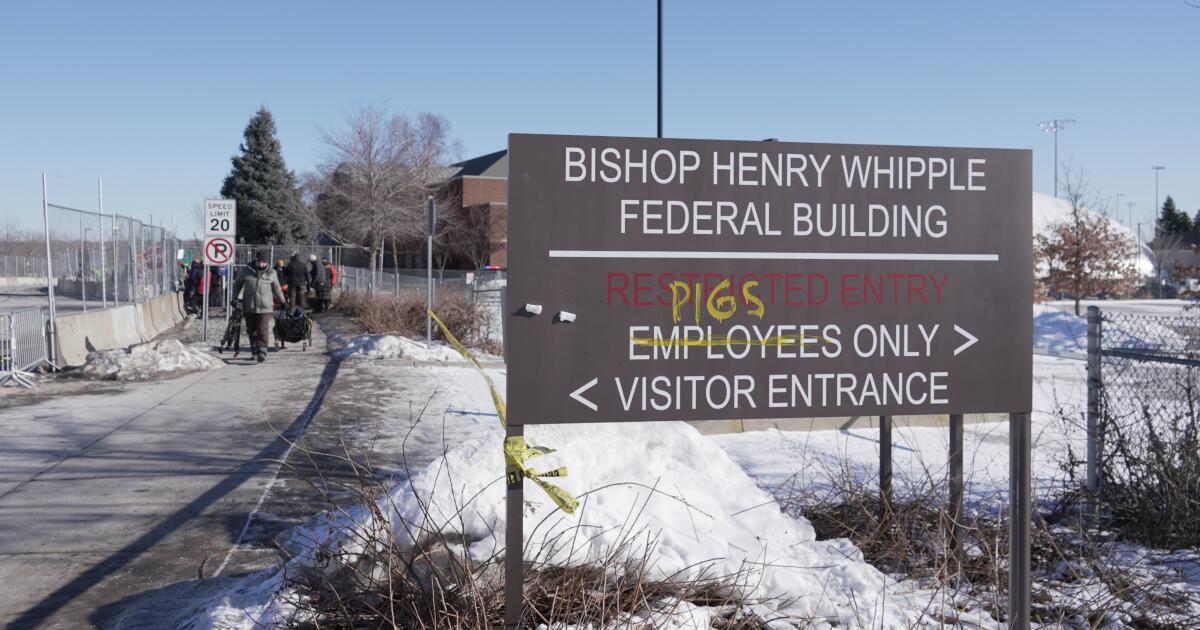
At the Bishop Henry Whipple Federal Building in Minneapolis, the city’s central hub of ICE activity, activists told the Associated Press they had seen agents leaving in vehicles with stuffed animals on their dashboards or Mexican flag decals on their bumpers. Pickups with lumber or tools in their beds were also frequently spotted.

In recent weeks, federal agents have repeatedly shown up to construction sites dressed as workers, according to Jose Alvillar, a lead organizer for the local immigrant rights group, Unidos MN.

“We’ve seen an increase in the cowboy tactics,” he said, though he noted the raids had not resulted in arrests. “Construction workers are good at identifying who is a real construction worker and who is dressing up as one.”

Using vintage plates

Since the start of the operation in Minnesota, local officials, including Democratic Gov. Tim Walz, have said ICE agents had been seen swapping license plates or using bogus ones, a violation of state law.

Candice Metrailer, an antiques dealer in south Minneapolis, believes she witnessed such an attempt firsthand.

On Jan. 13, she received a call from a man who identified himself as a collector, asking if her store sold license plates. She said it did. A few minutes later, two men in street clothes entered the shop and began looking through her collection of vintage plates.

“One of them says, ‘Hey, do you have any recent ones?’” Metrailer recalled. “Immediately, an alarm bell went off in my head.”

Metrailer stepped outside while the men continued browsing. A few doors down from the shop, she saw an idling Ford Explorer with blacked-out windows. She memorized its license plate, then quickly plugged it into a crowdsourced database used by local activists to track vehicles linked to immigration enforcement.

The database shows an identical Ford with the same plates had been photographed leaving the Whipple building seven times and reported at the scene of an immigration arrest weeks earlier.

When one of the men approached the register holding a white Minnesota plate, Metrailer said she told him that the store had a new policy against selling the items.

Metrailer said she had reported the incident to Minnesota’s attorney general. A spokesperson for the Department of Homeland Security did not respond to a request for comment.

A response to obstruction

Supporters of the immigration crackdown say the volunteer army of ICE-tracking activists in Minneapolis has forced federal agents to adopt new methods of avoiding detection.

“Of course agents are adapting their tactics so that they’re a step ahead,” said Scott Mechkowski, former deputy director of ICE enforcement and operations in New York City. “We’ve never seen this level of obstruction and interference.”

In nearly three decades in immigration enforcement, Mechkowski said he also hadn’t seen ICE agents disguising themselves as uniformed workers in the course of making arrests.

Last summer, a Homeland Security spokesperson confirmed a man wearing a high-visibility construction vest was an ICE agent conducting surveillance. In Oregon, a natural gas company published guidance on how customers could identify their employees after reports of federal impersonators.

In the days since his encounter, Ramirez, the restaurant worker, said he has been on high alert for undercover agents. He recently stopped a locksmith who he feared might be a federal agent, before realizing he was a local resident.

“Everybody is on edge about these guys, man,” Ramirez said. “It feels like they’re everywhere.”

Offenhartz writes for the Associated Press.


Source link

After man’s beating by ICE agents, calls for accountability grow

Alberto Castañeda Mondragón says his memory was so jumbled after a beating by immigration officers that he initially could not remember he had a daughter and still struggles to recall treasured moments like the night he taught her to dance.

But the violence he endured last month in Minnesota while being detained is seared into his battered brain.

He remembers Immigration and Customs Enforcement agents pulling him from a friend’s car on Jan. 8 outside a St. Paul shopping center and throwing him to the ground, handcuffing him, then punching him and striking his head with a steel baton. He remembers being dragged into an SUV and taken to a detention facility, where he said he was beaten again.

He also remembers the emergency room and the intense pain from eight skull fractures and five life-threatening brain hemorrhages.

“They started beating me right away when they arrested me,” the Mexican immigrant recounted last week to the Associated Press, which recently reported on how his case contributed to mounting friction between federal immigration agents and a Minneapolis hospital.

Castañeda Mondragón, 31, is one of an unknown number of immigration detainees who, despite avoiding deportation during the Trump administration’s enforcement crackdown, have been left with lasting injuries following violent encounters with ICE officers. His case is one of the excessive-force claims the federal government has thus far declined to investigate.

He was hurt so badly he was disoriented for days at Hennepin County Medical Center, where ICE officers constantly watched over him.

A dubious claim

The officers told nurses Castañeda Mondragón “purposefully ran headfirst into a brick wall,” an account his caregivers immediately doubted. A CT scan showed fractures to the front, back and both sides of his skull — injuries a doctor told AP were inconsistent with a fall.

“There was never a wall,” Castañeda Mondragón said in Spanish, recalling ICE officers striking him with the same metal rod used to break the windows of the vehicle he was in. He later identified it as an ASP, a telescoping baton routinely carried by law enforcement.

Training materials and police use-of-force policies across the U.S. say such a baton can be used to hit the arms, legs and body. But striking the head, neck or spine is considered potentially deadly force.

“The only time a person can be struck in the head with any baton is when the person presents the same threat that would permit the use of a firearm — a lethal threat to the officer or others,” said Joe Key, a former Baltimore police lieutenant and use-of-force expert who testifies in defense of police.

Once he was taken to an ICE holding facility at Ft. Snelling in suburban Minneapolis, Castañeda Mondragón said officers resumed beating him. Recognizing that he was seriously hurt, he said, he pleaded with them to stop, but they just “laughed at me and hit me again.”

“They were very racist people,” he said. “No one insulted them, neither me nor the other person they detained me with. It was their character, their racism toward us, for being immigrants.”

The Department of Homeland Security, which includes ICE, did not respond to repeated requests for comment over the last two weeks on Castañeda Mondragón’s injuries.

It is unclear whether his arrest was captured on body-camera video or if there might be additional recordings from security cameras at the detention center.

In a recent bid to boost transparency, Homeland Security announced a broad rollout of body cameras for immigration officers in Minneapolis as the government draws down ICE’s presence there.

ICE deportation officer William J. Robinson did not say how Castañeda Mondragón’s skull was smashed in a Jan. 20 declaration filed in federal court. During the intake process, it was determined he “had a head injury that required emergency medical treatment,” he wrote in the filing.

The declaration also stated that Castañeda Mondragón entered the U.S. legally in March 2022, and that the agency determined only after his arrest that he had overstayed his visa. A federal judge later ruled his arrest had been unlawful and ordered him released from ICE custody.

‘Hope they don’t kill you’

A video posted to social media captured the moments immediately after Castañeda Mondragón’s arrest as four masked men walk him handcuffed through a parking lot. The video shows him unsteady and stumbling, held up by ICE officers.

“Don’t resist!” shouts the woman who is recording. “‘Cause they ain’t gonna do nothing but bang you up some more.

“Hope they don’t kill you,” she adds.

“And y’all gave the man a concussion,” a male bystander shouts.

The witness who posted the video declined to speak with AP or provide consent for the video’s publication, but Castañeda Mondragón confirmed he is the handcuffed man seen in the recording.

At least one ICE officer later told staff at the medical center that Castañeda Mondragón “got his [expletive] rocked,” according to court documents filed by a lawyer seeking his release and nurses who spoke with AP.

AP interviewed a doctor and five nurses about Castañeda Mondragón’s treatment at Hennepin County Medical Center and the presence of ICE officers inside the hospital. They spoke on condition of anonymity because they were not authorized to discuss patient care and feared retaliation. AP also consulted an outside physician, who affirmed the injuries were inconsistent with an accidental fall or running into a wall.

Minnesota state law requires health professionals to report to law enforcement any wounds that could have been perpetrated as part of a crime.

A hospital spokeswoman declined to say last week whether anyone at the facility had done so. However, after the Jan. 31 publication of AP’s initial story about Castañeda Mondragón’s beating and arrest, hospital administrators opened an internal inquiry seeking to determine which staff members have spoken to the media, according to internal communications viewed by AP.

Minnesota Gov. Tim Walz posted a link to AP’s prior story about Castañeda Mondragón, but his office has not said whether state authorities would pursue answers.

“Law enforcement cannot be lawless,” Walz wrote in the post on X. “Thousands of aggressive, untrained agents of the federal government continue to injure and terrorize Minnesotans. This must end.”

Castañeda Mondragón’s arrest came a day after the slaying of Renee Good, the first  of  two fatal shootings of U.S. citizens in Minneapolis by immigration officers, triggering widespread public protests.

Calls for accountability

Minnesota congressional leaders and other elected officials, including St. Paul Mayor Kaohly Her, called last week for an investigation of Castañeda Mondragón’s injuries.

The Ramsey County attorney’s office, which oversees St. Paul, urged Castañeda Mondragón to file a police report to prompt an investigation. He said he plans to file a complaint. A St. Paul police spokesperson said the department would investigate “all alleged crimes that are reported to us.”

While the Trump administration insists ICE limits its operations to immigrants with violent rap sheets, Castañeda Mondragón has no criminal record.

“We are seeing a repeated pattern of Trump Administration officials attempting to lie and gaslight the American people when it comes to the cruelty of this ICE operation in Minnesota,” U.S. Sen. Tina Smith, a Minnesota Democrat, said in a statement.

Rep. Kelly Morrison, another Democrat and a doctor, recently toured the Whipple Building, the ICE facility at Ft. Snelling. She said she saw severe overcrowding, unsanitary conditions and an almost complete lack of medical care.

“If any one of our police officers did this, you know what just happened in Minnesota with George Floyd, we hold them accountable,” said Democratic Rep. Betty McCollum, whose district includes St. Paul.

A native of Veracruz, Mexico, Castañeda Mondragón came to Minnesota nearly four years ago on a temporary work visa and found jobs as a driver and roofer. He uses his earnings to support his elderly father, who is disabled and diabetic, and his 10-year-old daughter.

On the day of his arrest, he was running errands with a friend when they suddenly found themselves surrounded by ICE agents. The agents began breaking the windows and opening the doors of the vehicle. He said the first person who hit him “got ugly with me for being Mexican” and not having documents showing his immigration status.

About four hours after his arrest, court records show, Castañeda Mondragón was taken to an emergency room in the suburb of Edina with swelling and bruising around his right eye and bleeding. He was then transferred to Hennepin County Medical Center in Minneapolis, where he told staff he had been “dragged and mistreated by federal agents,” before his condition deteriorated, court records show.

A week into his hospitalization, caregivers described him as minimally responsive. As his condition slowly improved, hospital staff handed him his cellphone, and he spoke with his child in Mexico, whom he could not remember.

“I am your daughter,” she told him. “You left when I was 6 years old.”

His head injuries erased past experiences that for his daughter are unforgettable, including birthday parties and the day he left for the United States. She’s been trying to revive his memory in daily calls.

“When I turned 5, you taught me how to dance for the first time,” she reminded him recently.

“All these moments, really, for me, have been forgotten,″ he said.

He showed gradual improvement and, to the surprise of some who treated him, was released from the hospital on Jan. 27.

Long recovery lies ahead

He faces a long recovery and an uncertain future. Questions loom about whether he will be able to continue to support his family back in Mexico. “My family depends on me,” he said.

Though his bruises have faded, the effects of his traumatic brain injuries linger. In addition to the problems with his memory, he also has issues with balance and coordination that could prove debilitating for a man whose work requires going up and down ladders. He said he is unable to bathe himself without help.

“I can’t get on a roof now,” he said.

Castañeda Mondragón, who does not have health insurance, said doctors have told him he needs ongoing care. Unable to earn a living, he is relying on support from co-workers and members of the Minneapolis-St. Paul community who are raising money to help provide food, housing and medical care. He has launched a GoFundMe.

Still, he hopes to stay in the U.S. and to provide again someday for his loved ones. He differentiates between people in Minnesota, where he said he has felt welcome, and the federal officers who beat him.

“It’s immense luck to have survived, to be able to be in this country again, to be able to heal, and to try to move forward,” he said. “For me, it’s the best luck in the world.”

But when he closes his eyes at night, the fear that ICE officers will come for him dominates his dreams. He is now terrified to leave his apartment, he said.

“You’re left with the nightmare of going to work and being stopped,” Castañeda Mondragón said, “or that you’re buying your food somewhere, your lunch, and they show up and stop you again. They hit you.”

Brook, Biesecker, Mustian and Attanasio write for the Associated Press and reported from Minneapolis, Washington, New York and Seattle, respectively.

Source link

Why Bad Bunny’ Super Bowl halftime performance matters to Latinos

A few months back, a discussion broke out in the De Los chat about whether or not Bad Bunny would win album of the year at the 68th Grammy Awards for his LP “Debí Tirar Más Fotos.”

I was firmly in the “yes” camp from the day the nominations were announced and I was right!

But if I’m being honest, I had my doubts that it would happen until the second that presenter Harry Styles called out the Puerto Rican singer’s name Sunday night.

Those in the “no” camp — who were still rooting for him to win — had history in their favor. It’s so rare for any major awards show, but especially the Grammys, to recognize artists at the peak of their powers. It’s almost as if these voting bodies feel that some (usually Black) artists must go through a weird humiliation ritual before being deemed worthy.

You’re reading Latinx Files

Fidel Martinez delves into the latest stories that capture the multitudes within the American Latinx community.

By continuing, you agree to our Terms of Service and our Privacy Policy.

In 2015, Beyoncé’s self-titled LP lost album of the year in favor of Beck’s “Morning Phase.” She was overlooked again when Adele won album of the year for “25” over her seminal album “Lemonade” at the 59th Grammy Awards. Her club classic “Renaissance” also missed out on the top prize in 2023, with Styles’ “Harry’s House” taking home the award.

Rapper Macklemore won the rap album Grammy over Kendrick Lamar’s “good kid, m.A.A.d. City” at the 56th iteration of the award ceremony. At the 2016 Grammys, Lamar’s deeply layered LP “To Pimp a Butterfly” lost album of the year to Taylor Swift’s “1989.” Mumford & Sons’ “Babel” won album of the year in 2013 over Frank Ocean’s “Channel Orange.”

The anti-Blackness in the Recording Academy — the voting body that chooses Grammy winners — cannot be understated.

But in a rare move the voters, which included the Latin Grammy Awards’ voting body for the first time this year, chose the album that actually reflected the cultural zeitgeist.

Really it was less so that I believed Bad Bunny would win as much as I felt that he needed to win.

The past year has been exceedingly trying for the Latinx community as Immigration and Customs Enforcement raids have been conducted throughout the country. It has oftentimes felt as though being Latinx — looking a certain way, speaking Spanish, having certain names — is a crime. I don’t know how many times I’ve seen videos of or heard heartbreaking stories of Latinx people being separated from their families, harassed or even killed due to activities of federal agents.

So even if it was just a moment of recognition for Bad Bunny, I had a lot riding on one win for Latinx people. A win for an album that is unapologetically in Spanish, explored ideas of resistance toward colonization and dared to be joyful, would mean something to me.

When he won, I had the same reaction as him. I couldn’t believe it and I cried — genuine tears in my Latina eyes.

It felt like an acknowledgment that Latinx people exist and matter. I was also moved when he explicitly shouted out immigrant and Latinx communities. There was just something that felt radical, too, in him giving the majority of his acceptance speech in Spanish.

De Los writer Andrea Flores also had faith in Bad Bunny’s Grammys viability from the very beginning.

“I knew Bad Bunny was going to win big at the Grammy Awards the moment he released this album,” she told me. “Bad Bunny made music for Puerto Rico, and the world listened.”

“I cried when I saw that Bad Bunny won album of the year. For me, it felt like sweet vindication for Latinx artists — reggaetoneros, more specifically — who have long been ignored, and at times vilified, by mainstream media for so many years. But what made me even more emotional was seeing posts on X showing Bad Bunny in 2016 as a bag boy at a local Puerto Rican supermarket. He looks familiar in that picture, like a cousin, brother or childhood friend. That was only 10 years ago. It’s proof to me that so much can change if you believe in your art and in yourself.”

It’s weird that a Latinx artist from an American colony is the most powerful cultural figure in the country at the same time that Latinx people face the most tenuous situation in the U.S. that I’ve seen in my life.

When Bad Bunny takes the stage for the Super Bowl halftime show on Sunday, I wish he’d get up there and call out ICE again on an even-bigger stage or do some kind of spectacular act of protest against the vile political class that has always and continues to push through discriminatory policies against non-white communities.

It’d be awesome if that happens, but even if it doesn’t, there will still be something profoundly radical about him simply being there and performing exclusively in Spanish.

Two red roses coming out of a blue manilla folder

(Jackie Rivera / For The Times; Martina Ibáñez-Baldor / Los Angeles Times)

The latest on Trump’s immigration enforcement

People protest against ICE as they march toward South Texas Family Residential Center on January 28, 2026 in Dilley, Texas.

(Joel Angel Juarez / Getty Images)

After killing two U.S. citizens, forcibly extracting immigrants and using force against protestors, some 700 federal agents are being pulled out of Minnesota. About 2,000 officers will remain in the state, White House border czar Tom Homan said early this week.

On Tuesday, immigration officers in Minneapolis pulled their guns on and arrested protestors who were trailing their vehicles, the AP reported.

Meanwhile, my colleague Gavin J. Quinton reported that the Senate isn’t “anywhere close” to reaching an agreement on ICE funding, as Democrats demand “nonnegotiable” ICE reforms.

In some good news, Liam Conejo Ramos — the 5-year-old from Minnesota who was famously photographed wearing a bunny hat and Spider-Man backpack while detained by ICE agents — and his father, Adrian Conejo Arias, were released from a detention facility in Dilley, Texas and are back home in Minnesota.

The duo was released thanks to a ruling from the U.S. District Judge Fred Biery.

“[T]he case has its genesis in the ill-conceived and incompetently-implemented government pursuit of daily deportation quotas, apparently even if it requires traumatizing children,” the judge wrote in his ruling.

Stories we read this week that we think you should read

Unless otherwise noted, stories below were published by the Los Angeles Times.

Politics and Immigration

Arts, culture and entertainment

Latin America

Source link

Finneas defends Billie Eilish’s Grammys speech, slams ‘old white men’

Finneas O’Connell took to social media to defend Billie Eilish and her Grammys acceptance speech from a specific demographic that was angered by her remarks.

“Seeing a lot of very powerful old white men outraged about what my 24 year old sister said during her acceptance speech,” O’Connell wrote Wednesday on Threads. “We can literally see your names in the Epstein files.”

The sibling duo won the Grammy for song of the year Sunday, becoming the first ever three-time winners of the category. The “Wildflower” songwriters were among those wearing “ICE Out” pins at the 2026 Grammy Awards as a statement against the Department of Homeland Security’s immigration-enforcement agency and its tactics after the killings of Renee Good and Alex Pretti in Minnesota sparked a national outcry.

“No one is illegal on stolen land,” Eilish said while accepting the award. “It’s just really hard to know what to say and what to do right now. I feel really hopeful in this room and like we just need to keep fighting, speaking up and protesting. Our voices really matter.”

While some of her speech was censored during the live broadcast, Eilish was also heard saying “F— ICE,” drawing cheers from those in attendance.

Eilish was one of many artists who used their moment on the Grammys stage to speak out against the Trump administration and the federal immigration raids that have been happening in multiple states, including California. Some, including R&B song and performance winner Kehlani, were just as direct in their language condemning ICE. Other winners, including Bad Bunny and Shaboozey, used their speeches to celebrate immigrant communities.

Source link

Minneapolis man is arrested on suspicion of threatening and cyberstalking ICE officers

A Minneapolis man was arrested Thursday on suspicion of cyberstalking and threatening to kill or assault Immigration and Customs Enforcement officers involved in the crackdown in Minnesota.

Federal prosecutors said in a statement that Kyle Wagner, 37, of Minneapolis, was charged by complaint, and that a decision to seek an indictment, which is necessary to take the case to trial, would be made soon.

Court records in Detroit, where the case was filed, did not list an attorney who could speak on Wagner’s behalf. The complaint was filed Tuesday and unsealed Thursday.

Atty. Gen. Pamela Bondi alleged in a statement that Wagner doxed and threatened law enforcement officers, claimed an affiliation with antifa and “encouraged bloodshed in the streets.”

And at the White House on Thursday, press secretary Karoline Leavitt held up Weber’s photo at the daily briefing and said such conduct by “left-wing agitators” won’t go unpunished.

“And if people are illegally obstructing our federal law enforcement operations, if they are targeting, doxing, harassing and vilifying ICE agents, they are going to be held accountable like this individual here who, again, is a self-proclaimed member of antifa. He is a domestic terrorist, and he will be held accountable in the United States,” Leavitt told reporters.

President Trump announced in September that he would designate antifa a “major terrorist organization.” Antifa, short for “anti-fascists,” is an umbrella term for far-left-leaning militant groups and is not a singular entity. It consists of groups that resist fascists and neo-Nazis, especially at demonstrations.

When Trump administration border policy advisor Tom Homan announced Wednesday that about 700 federal officers deployed to Minnesota would be withdrawn immediately, he said a larger pullout would occur only after there’s more cooperation and protesters stop interfering with federal personnel.

According to prosecutors, Wagner repeatedly posted on Facebook and Instagram encouraging his followers to “forcibly confront, assault, impede, oppose, and resist federal officers” whom he referred to as the “gestapo” and “murderers.”

The complaint alleges Wagner posted a video last month that directly threatened ICE officers with an obscenity-laden rant. “I’ve already bled for this city, I’ve already fought for this city, this is nothing new, we’re ready this time,” he said, concluding that he was “coming for” ICE.

The complaint further alleges that Wagner advocated for physical confrontation in another post, stating: “Anywhere we have an opportunity to get our hands on them, we need to put our hands on them.”

It also details how Wagner used his Instagram account to dox a person identified only as a “pro-ICE individual” by publishing a phone number, birth month and year, and address in the Detroit suburb of Oak Park. The complaint says Wagner later admitted that he doxed the victim’s parents’ house.

Federal prosecutors didn’t immediately respond to a request for comment on why the case was filed in Michigan instead of Minnesota. The alleged doxing was the only Michigan connection listed in the complaint.

The U.S. attorney’s office in Minnesota has been hit by the resignations of several prosecutors in recent weeks amid frustrations with the surge and its handling of the shooting deaths of two people by government officers. One lawyer, who told a judge that her job “sucks,” was removed from her post.

Trump’s chief federal prosecutor for Minnesota, Dan Rosen, told a federal appeals court in a recent filing that his office is facing a “flood of new litigation” and is struggling to keep up just with immigration cases, while his division that handles civil cases is down 50%.

Rosen wrote that his office has canceled other civil enforcement work “and is operating in a reactive mode.” He also said his attorneys are “appearing daily for hearings on contempt motions. The Court is setting deadlines within hours, including weekends and holidays. Paralegals are continuously working overtime. Lawyers are continuously working overtime.”

Karnowski writes for the Associated Press. AP reporters Eric Tucker and Nathan Ellgren in Washington contributed to this report.

Source link

Government lawyer is yanked from immigration detail in Minnesota after telling judge ‘this job sucks’

A government lawyer who told a judge that her job “sucks” during a court hearing stemming from the Trump administration’s immigration enforcement surge in Minnesota has been removed from her Justice Department post, according to a person familiar with the matter.

Julie Le had been working for the Justice Department on a detail, but the U.S. attorney in Minnesota ended her assignment after her comments in court on Tuesday, the person said. The person spoke on the condition of anonymity to discuss a personnel matter. She had been working for U.S. Immigration and Customs Enforcement before the temporary assignment.

At a hearing Tuesday in St. Paul, Minn., for several immigration cases, Le told U.S. District Judge Jerry Blackwell that she wishes he could hold her in contempt of court “so that I can have a full 24 hours of sleep.”

“What do you want me to do? The system sucks. This job sucks. And I am trying every breath that I have so that I can get you what you need,” Le said, according to a transcript.

Le’s extraordinary remarks reflect the intense strain that has been placed on the federal court system since President Trump returned to the White House a year ago with a promise to carry out mass deportations. ICE officials have said the surge in Minnesota has become its largest-ever immigration operation since ramping up in early January.

Several prosecutors have left the U.S. attorney’s office in Minnesota amid frustration with the immigration enforcement surge and the Justice Department’s response to fatal shootings of two civilians by federal agents. Le was assigned at least 88 cases in less than a month, according to online court records.

Blackwell told Le that the volume of cases isn’t an excuse for disregarding court orders. He expressed concern that people arrested in immigration enforcement operations are routinely jailed for days after judges have ordered their release from custody.

“And I hear the concerns about all the energy that this is causing the DOJ to expend, but, with respect, some of it is of your own making by not complying with orders,” the judge told Le.

Le said she was working for the Department of Homeland Security as an ICE attorney in immigration court before she “stupidly” volunteered to work the detail in Minnesota. Le told the judge that she wasn’t properly trained for the assignment. She said she wanted to resign from the job but couldn’t get a replacement.

“Fixing a system, a broken system, I don’t have a magic button to do it. I don’t have the power or the voice to do it,” she said.

Le and spokespeople for DHS, ICE and the U.S. attorney’s office in Minnesota didn’t immediately respond to emails seeking comment.

Kira Kelley, an attorney who represented two petitioners at the hearing, said the flood of immigration petitions is necessary because of “so many people being detained without any semblance of a lawful basis.”

“And there’s no indication here that any new systems or bolded e-mails or any instructions to ICE are going to fix any of this,” she added.

Kunzelman and Richer write for the Associated Press.

Source link

US border security chief withdrawing 700 immigration agents from Minnesota | Donald Trump News

United States border security chief Tom Homan has announced that the administration of President Donald Trump will “draw down” 700 immigration enforcement personnel from Minnesota while promising to continue operations in the northern state.

The update on Wednesday was the latest indication of the Trump administration pivoting on its enforcement surge in the state following the killing of two US citizens by immigration agents in Minneapolis in January.

Recommended Stories

list of 3 itemsend of list

Homan, who is officially called Trump’s “border czar”, said the decision came amid new cooperation agreements with local authorities, particularly related to detaining individuals at county jails. Details of those agreements were not immediately available.

About 3,000 immigration enforcement agents are currently believed to be in Minnesota as part of Trump’s enforcement operations.

“Given this increase in unprecedented collaboration, and as a result of the need for less law enforcement officers to do this work in a safer environment, I have announced, effective immediately, we will draw down 700 people effective today – 700 law enforcement personnel,” Homan said.

The announcement comes after Homan was sent to Minnesota at the end of January in response to widespread protests over immigration enforcement and the killing of Renee Nicole Good on January 7 by an Immigration and Customs Enforcement (ICE) agent and Alex Pretti on January 24 by a US Customs and Border Protection (CBP) officer, both in Minneapolis.

Homan said reforms made since his arrival have included consolidating ICE and CBP under a single chain of command.

He said Trump “fully intends to achieve mass deportations during this administration, and immigration enforcement actions will continue every day throughout this country”.

Immigration rights observers have said the administration’s mass deportation approach has seen agents use increasingly “dragnet” tactics to meet large detention quotas, including randomly stopping individuals and asking for their papers. The administration has increasingly detained undocumented individuals with no criminal records, even US citizens and people who have legal status to live in the US.

Homan said agents would prioritise who they considered to be “public safety threats” but added, “Just because you prioritise public safety threats, don’t mean we forget about everybody else. We will continue to enforce the immigration laws in this country.”

The “drawdown”, he added, would not apply to what he described as “personnel providing security for our officers”.

“We will not draw down on personnel providing security and responding to hostile incidents until we see a change,” he said.

Critics have accused immigration enforcement officers, who do not receive the same level of crowd control training as most local police forces, of using excessive violence in responding to protesters and individuals legally monitoring their actions.

Trump administration officials have regularly blamed unrest on “agitators”. They accused both Good and Pretti of threatening officers before their killings although video evidence of the exchanges has contradicted that characterisation.

Last week, the administration announced it was opening a federal civil rights investigation into the killing of Pretti, who was fatally shot while he was pinned to the ground by immigration agents. That came moments after an agent removed a gun from Pretti’s body, which the 37-year-old had not drawn and was legally carrying.

Federal authorities have not opened a civil rights investigation into the killing of Good, who they have maintained sought to run over an ICE agent before she was fatally shot. Video evidence appeared to show Good trying to turn away from the agent.

On Friday, thousands of people took to the streets of Minneapolis and other US cities amid calls for a federal strike in protest against the Trump administration’s deportation drive.

Minnesota Attorney General Keith Ellison and other state and local officials have also challenged the immigration enforcement surge in the state, arguing that the Department of Homeland Security, which oversees ICE and the CBP, has been violating constitutional protections.

A federal judge last week said she will not halt the operations as a lawsuit progresses in court. Department of Justice lawyers have dismissed the suit as “legally frivolous”.

On Wednesday, a poll released by the Marquette Law School found wide-ranging disquiet over ICE’s approach, with 60 percent of US adults nationwide saying they disapproved of how the agency was conducting itself. The poll was conducted from January 21 to January 28, with many of the surveys conducted before Pretti’s killing.

The poll still found widespread support for ICE among Republicans, with about 80 percent approving of its work. Just 5 percent of Democrats voiced similar approval.

Perhaps most worryingly for Republicans ahead of the 2026 midterms in November, just 23 percent of independents – potential swing voters in the upcoming vote – approved of ICE’s actions.

Source link

Homan announces 700 immigration officers to immediately leave Minnesota

The Trump administration is reducing the number of immigration enforcement officers in Minnesota after state and local officials agreed to cooperate by turning over arrested immigrants, border policy advisor Tom Homan said Wednesday.

About 700 of the roughly 3,000 federal officers deployed around Minnesota will be withdrawn, Homan said. The immigration operations have upended the Twin Cities and escalated protests, especially since the killing of protester Alex Pretti, the second fatal shooting by federal officers in Minneapolis.

“Given this increase in unprecedented collaboration, and as a result of the need for less public safety officers to do this work and a safer environment, I am announcing, effective immediately, we’ll draw down 700 people effective today — 700 law enforcement personnel,” Homan said during a news conference.

Homan said last week that federal officials could reduce the number of federal agents in Minnesota, but only if state and local officials cooperate. His comments came after President Donald Trump seemed to signal a willingness to ease tensions in the Minneapolis and St. Paul area.

Homan pushed for jails to alert ICE to inmates who could be deported, saying transferring such inmates to the agency is safer because it means fewer officers have to be out looking for people in the country illegally.

The White House has long blamed problems arresting criminal immigrants on places known as sanctuary jurisdictions, a term generally applied to state and local governments that limit law enforcement cooperation with the Department of Homeland Security.

When questioned, Homan said he thinks the ICE operation in Minnesota has been a success.

“Yeah, I just listed a bunch of people we took off the streets of the Twin Cities, so I think it’s very effective as far as public safety goes,” Homan said. “Was it a perfect operation? No. No. We created one unified chain of command to make sure everybody is on the same page. And make sure we follow the rules. I don’t think anybody, purposely, didn’t do something they should have done.”

Associated Press reporter Corey Williams in Detroit contributed.

Source link

Immigration agents draw guns, arrest activists following them in Minneapolis

Immigration officers with guns drawn arrested activists who were trailing their vehicles on Tuesday in Minneapolis, a sign that tensions have not eased since the departure last week of a high-profile commander.

At least one person who had an anti-ICE message on their clothing was handcuffed while face down on the ground. An Associated Press photographer witnessed the arrests.

Federal agents in the Twin Cities lately have been conducting more targeted immigration arrests at homes and neighborhoods, rather than staging in parking lots. The convoys have been harder to find and less aggressive. Alerts in activist group chats have been more about sightings than immigration-related detainments.

Several cars followed officers through south Minneapolis after there were reports of them knocking at homes. Officers stopped their vehicles and ordered activists out of a car at gunpoint. Agents told reporters at the scene to stay back and threatened to use pepper spray.

There was no immediate response to a request for comment from the Department of Homeland Security and Immigration and Customs Enforcement.

A federal judge last month put limits on how officers treat motorists who are following them but not obstructing their operations. Safely following agents “at an appropriate distance does not, by itself, create reasonable suspicion to justify a vehicle stop,” the judge said. An appeals court, however, set the order aside.

Border Patrol commander Greg Bovino, who was leading an immigration crackdown in Minneapolis and other big U.S. cities, left town last week, shortly after the fatal shooting of Alex Pretti, the second local killing of a U.S. citizen in January.

Trump administration border czar Tom Homan was dispatched to Minnesota instead. He warned that protesters could face consequences if they interfere with officers.

Grand jury seeks communications, records

Meanwhile, Tuesday was the deadline for Minneapolis to produce information for a federal grand jury. It’s part of a U.S. Justice Department request for records of any effort to stifle the Trump administration’s immigration crackdown. Officials have denounced it as a bullying tactic.

“We have done nothing wrong and have nothing to hide, but when the federal government weaponizes the criminal justice system against political opponents, it’s important to stand up and fight back,” said Ally Peters, spokesperson for Mayor Jacob Frey, a Democrat.

She said the city was complying, but she didn’t elaborate. Other state and local offices run by Democrats were given subpoenas, though it’s not known whether they had the same deadline. People familiar with the matter have told the AP that the subpoenas are related to an investigation into whether Minnesota officials obstructed enforcement through public statements.

No bond for man in Omar incident

Elsewhere, a man charged with squirting apple cider vinegar on Democratic U.S. Rep. Ilhan Omar will remain in jail. U.S. Magistrate Judge David Schultz granted a federal prosecutor’s request to deny bond to Anthony Kazmierczak.

“We simply cannot have protesters and people — whatever side of the aisle they’re on — running up to representatives who are conducting official business, and holding town halls, and assaulting them,” Assistant U.S. Attorney Benjamin Bejar said Tuesday.

Defense attorney John Fossum said the vinegar posed a low risk to Omar. He said Kazmierczak’s health problems weren’t being properly addressed in jail and that his release would be appropriate.

Murphy, Raza and Karnowski write for the Associated Press. Raza reported from Sioux Falls, S.D. AP reporters Ed White in Detroit and Hannah Fingerhut in Des Moines, Iowa, contributed to this report.

Source link

Bondi announces 2 more arrests from Minnesota church protest

Feb. 2 (UPI) — U.S. Attorney General Pam Bondi announced the arrest of two more people on Monday in relation to an anti-ICE protest at a church in Minnesota last month.

Ian Davis Austin and Jerome Deangelo Richardson are the latest to be arrested for protesting during a church service at Cities Church in St. Paul, Minn., on Jan. 18. They are among nine people that the Justice Department has indicted for the protest.

“If you riot in a place of worship, we will find you,” Bondi posted on X.

U.S. code describes a riot as a “public disturbance involving an act or acts of violence by one or more persons part of an assemblage of three or more persons.”

The indictment of the protesters does not describe any acts of physical violence but mentions protesters “intimidated the church’s congregants and pastors by physically occupying most of the main aisle and rows of chairs near the front of the church.”

The protesters are charged with conspiracy against the right of religious freedom at a place of worship and conspiracy to injure, intimidate or interfere with the exercise of religious freedom at a place of worship.

On Thursday, federal officials arrested journalists Don Lemon and Georgia Fort who were at the scene covering the demonstration. Both have been released from custody.

Protesters interrupted the church service in response to the ongoing immigration raids by federal agents in the Minneapolis area. Two U.S. citizens were killed by federal agents in Minneapolis last month, Renee Good and Alex Pretti, both 37 years old.

Cities Church was the site of this demonstration due to its pastor, David Eastwood, being an acting field office director for U.S. Immigration and Customs Enforcement.

President Donald Trump referred to the church protesters as “agitators and insurrectionists” in a social media post last month.

President Donald Trump poses with an executive order he signed during a ceremony inside the Oval Office of the White House on Thursday. Trump signed an executive order to create the “Great American Recovery Initiative” to tackle drug addiction. Photo by Aaron Schwartz/UPI | License Photo

Source link

Right-wing influencers target Somali child-care centers across U.S.

It all began after a viral video alleging fraud in Somali-run child-care centers in Minneapolis: strangers peering through windows, right-wing journalists showing up outside homes, influencers hurling false accusations.

In San Diego, child-care provider Samsam Khalif was shuttling kids to her home-based center when she was spooked by two men with a camera waiting in a car parked outside, prompting her to circle the block several times before unloading the children.

“I’m scared. I don’t know what their intention is,” said Khalif, who decided to install additional security cameras outside her home.

Somali-run child-care centers across the United States have become targets since the video caught the attention of the White House amid the administration’s immigration crackdown. Child-care providers worry about how they can maintain the safe learning environments they have worked to create for young children who may be spending their first days away from their parents.

In the Minneapolis area, child-care providers, many of them immigrants, say they’re being antagonized, exacerbating the stress they face from immigration enforcement activity that has engulfed the city.

One child-care provider said she watched someone emerge from a car that had been circling the building and defecate near the center’s entrance. The same day, a motorist driving by yelled that the center was a “fake day care.” She’s had to create new lockdown procedures, is budgeting for security and now keeps the blinds closed to shield children from unwanted visitors and from witnessing immigration enforcement actions.

“I can’t have peace of mind about whether the center will be safe today,” said the provider, who spoke on condition of anonymity for fear of being targeted. “That’s a hard pill to swallow.”

Video’s claims disproved

The day after Christmas, right-wing influencer Nick Shirley posted a lengthy video with allegations that members of Minneapolis’ large Somali community were running fake child-care centers so they could collect federal child-care subsidies.

The U.S. occasionally has seen fraud cases related to child-care subsidies. But the Minneapolis video’s central claims — that business owners were billing the government for children they were not caring for — were disproved by inspectors. Nonetheless, the Trump administration attempted to freeze child-care funding for Minnesota and five other Democratic-led states until a court ordered the funding to be released.

President Trump has repeatedly targeted Somali immigrants with dehumanizing rhetoric, calling them “garbage” and “low IQ” and suggesting that Rep. Ilhan Omar, a Minnesota Democrat who was born in Somalia, should be deported: “Throw her the hell out!” In Minnesota, 87% of foreign-born Somalis are naturalized U.S. citizens.

Trump has zeroed in on a years-old case in which a sprawling network of fraudsters — many of them Somali Americans — bilked Minnesota of an estimated $300 million that was supposed to help feed children and families. His rhetoric intensified after Shirley’s video was posted.

Activists take it upon themselves to investigate

In Federal Way, Wash., and Columbus, Ohio, both home to large Somali communities, right-wing journalists and influencers began showing up unannounced at addresses for child-care operations they pulled from state websites.

In one video, a man arrives at a bungalow-style building in Columbus. He films through the glass front door, showing a foyer with cheerful posters that read “When we learn, we grow” and “Make today happy.”

“It does not look like a child-care center at all,” the man says.

Ohio dispatched an inspector to the address and found that it was, in fact, a legitimate child-care center. The center’s voicemail was hacked, so parents calling heard a slur-laden message calling Somalis “sand rats” and saying they “worship a false religion of baby-raping terrorists,” according to WOSU-FM.

In Washington state, child-care workers called police on the right-wing journalists who kept appearing outside their homes.

Journalists with the right-leaning Washington outlet Center Square filmed themselves pressing a woman for proof that she ran a child-care center for which she was collecting federal subsidies. She refused to answer questions.

“Are you aware of the Somali day-care fraud? We’re just trying to check out if this is a real day care,” one of the journalists said. “Where are the children?”

Local officials speak out

Seattle Mayor Katie Wilson posted a statement on X saying she would not tolerate anyone trying to “intimidate, harass or film Somali child care providers.” Then, Harmeet Dhillon, who heads the Justice Department’s Civil Rights Division, issued her own warning: “Asking questions/citizen journalism are NOT HATE CRIMES in America — they are protected speech, and if Seattle tries to chill that speech, @CivilRights will step in to protect it and set them straight!”

In Ohio, Republican Gov. Mike DeWine held a news conference to debunk a right-wing influencer’s fraud claims about a Columbus child-care center and assured people the state diligently monitored centers that receive public money. He said a child-care provider refusing to let in a stranger should not be read as a sign of fraud.

“It shouldn’t be a shock when someone sees something on social media, and someone is going, ‘I can’t get into this place, no one will let me in,’” DeWine said in a news conference in January. “Well, hell, no! No one should let them in.”

Even after DeWine refuted the claims, Republicans in the Statehouse introduced legislation to more closely monitor child-care centers, including one measure that would require those that take public money to provide live video feeds of their classrooms to state officials.

Advocates say fraud claims are a distraction

Child-care advocates say the fraud allegations are detracting from more pressing crises.

Child-care subsidy programs in many states have lengthy waiting lists, making it difficult for parents to return to work. The programs that subsidize child care for families that struggle to afford it are also facing funding threats, including from the Trump administration.

Ruth Friedman, who headed the Office of Child Care under President Biden, accused Trump and Republicans of manufacturing a crisis for political gain.

“They are using it to try to discredit the movement toward investing in child care,” said Friedman, who is now a senior fellow at the left-leaning think tank Century Foundation.

Health and Human Services spokesperson Andrew Nixon said in a statement that the department “rejects the claim that concerns about child care program integrity are manufactured.” He urged people to report suspected fraud to the government.

Balingit and Kramon write for the Associated Press.

Source link

Five-year-old boy and father detained by ICE return home to Minnesota | Migration News

Liam Conejo Ramos and his father, Adrian, were accompanied home by Texas Democratic Representative Joaquin Castro.

A five-year-old boy and his father, who were detained as part of United States President Donald Trump’s aggressive immigration raids and held at a detention facility in Texas, have returned to their home in Minnesota.

Liam Conejo Ramos and his father, Adrian, who are asylum seekers from Ecuador, spent 10 days in the Dilley detention centre until US District Judge Fred Biery ordered their release on Saturday.

Recommended Stories

list of 3 itemsend of list

US Representative Joaquin Castro, a Texas Democrat, wrote in a social media post that he picked them up on Saturday night at the detention facility and escorted them home on Sunday.

“Liam is now home. With his hat and his backpack,” Castro wrote, including photos of the child. “We won’t stop until all children and families are home.”

Immigration and Customs Enforcement (ICE) agents arrested Liam and his father on January 20 as the boy arrived home from preschool.

Images of the boy with a blue bunny hat and backpack being held by officers spread around the world and added fire to public outrage at the federal immigration crackdown, during which agents have shot dead two US citizens.

Liam was one of four students detained by immigration officials in a Minneapolis suburb, according to the Columbia Heights Public School District.

In a statement, Department of Homeland Security (DHS) Assistant Secretary Tricia McLaughlin said ICE did not target or arrest Liam, and that his mother refused to take him after his father’s apprehension. His father told officers he wanted Liam to be with him, she said.

“The Trump administration is committed to restoring the rule of law and common sense to our immigration system, and will continue to fight for the arrest, detention, and removal of aliens who have no right to be in this country,” McLaughlin said.

Neighbours and school officials say that federal immigration officers used the preschooler as “bait” by telling him to knock on the door to his house so that his mother would answer.

DHS called the description of events an “abject lie”. It said the father fled on foot and left the boy in a running vehicle in their driveway.

Biery said in a scathing opinion that “the case has its genesis in the ill-conceived and incompetently-implemented government pursuit of daily deportation quotas, apparently even if it requires traumatizing children”.

He criticised what he called the government’s apparent “ignorance” of the US Declaration of Independence, which “enumerated grievances against a would-be authoritarian king over our nascent nation”.

Biery also cited the Fourth Amendment of the US Constitution, which protects the right against “unreasonable searches and seizures”.

US Representative Ilhan Omar, a Democrat from Minnesota, posted a photo to social media of her with Liam, his father and Castro, with her holding Liam’s Spider-Man backpack.

“Welcome home Liam,” she posted with two hearts.

Source link

5-year-old Liam Conejo Ramos and father, upon judge’s order, freed by ICE and back in Minnesota

Five-year-old Liam Conejo Ramos and his father, who were detained by immigration officers in Minnesota and held at an ICE facility in Texas, have been released a day after judge’s order, which excoriated the Trump administration for its conduct in the case. They have returned to Minnesota, according to the office of Texas Rep. Joaquin Castro.

The two were detained in a Minneapolis suburb on Jan. 20. He and his father were taken to a detention facility in Dilley, Texas.

Katherine Schneider, a spokesperson for Castro, a Democrat, confirmed that the two had arrived home. She said Castro picked them up from Dilley on Saturday night and escorted them home Sunday to Minnesota.

The Associated Press emailed the Department of Homeland Security for comment on the father and son’s release. There was no immediate response.

Images of the young boy wearing a bunny hat and Spider-Man backpack and surrounded by immigration officers drew outrage about the Trump administration’s crackdown in Minneapolis.

Neighbors and school officials say that federal immigration officers used the preschooler as “bait” by telling him to knock on the door to his house so that his mother would answer. The Department of Homeland Security has rejected that description. It said the father fled on foot and left the boy in a running vehicle in their driveway.

Castro wrote a letter to Liam while they were on the plane to Minnesota, in which he told the young boy he has “moved the world.”

“Your family, school and many strangers said prayers for you and offered whatever they could do to see you back home,” Castro wrote. A photo of the letter was posted on social media. “Don’t let anyone tell you this isn’t your home. America became the most powerful, prosperous nation on earth because of immigrants not in spite of them.”

In a social media post, U.S. Sen. Amy Klobuchar (D-Minn.) welcomed the boy back to Minnesota, saying that he “should be in school and with family — not in detention,” adding, “Now ICE needs to leave.”

Source link

Federal judge denies Minnesota motion to end immigration surge

Jan. 31 (UPI) — Minnesota and the cities of Minneapolis and St. Paul lost their bid to have a federal court order the Department of Homeland Security to end its immigration enforcement effort in the state.

U.S. District Court of Minnesota Judge Katherine Menendez on Saturday denied a motion to enjoin the federal government from continuing its immigration law enforcement surge in the Twin Cities.

“Even if the likelihood of success on the merits and the balance of harms each weighed more clearly in favor of plaintiffs, the court would still likely be unable to grant the relief requested: An injunction suspending Operation Metro Surge,” Menendez wrote in her 30-page ruling.

She cited a recent federal appellate court ruling that affirmed the federal government has the right to enforce federal laws over the objections of others.

“The Eighth Circuit Court of Appeals recently vacated a much more circumscribed injunction, which limited one aspect of the ongoing operation, namely the way immigration officers interacted with protesters and observers,” Menedez said.

“The injunction in that case was not only much narrower than the one proposed here, but it was based on more settled precedent than that which underlies the claims now before the court,” she explained.

“Nonetheless, the court of appeals determined that the injunction would cause irreparable harm to the government because it would hamper their efforts to enforce federal law,” Menendez continued.

“If that injunction went too far, then the one at issue here — halting the entire operation — certainly would,” she concluded.

Menendez said her ruling does not address the merits of the case filed by Minnesota Attorney General Keith Ellison on behalf of the state and two cities, which are named as the lawsuit’s three plaintiffs.

Those claims remain to be argued and largely focus on Ellison’s claim that the federal government is undertaking an illegal operation that is intended to force state and local officials to cooperate with federal law enforcement.

Menendez said Ellison has not proven his claim, which largely relies on a 2013 ruling by the Supreme Court in a case brought by Shelby County, Ala., officials who challenged the 1965 Voting Rights Act.

The act placed additional restrictions on some states based on “their histories of racially discriminatory election administration,” Menendez said.

The Supreme Court ruled a “departure from the fundamental principle of equal sovereignty” requires the federal government to show that geographically driven laws are “sufficiently related to the problem that it targets” to be lawful, she wrote.

Ellison says that the ruling “teaches that the federal government cannot single out states for disparate treatment without strong and narrowly tailored justification,” according to Menendez.

But he does not show any other examples of a legal authority applying the “equal sovereignty ‘test'” and does not show how it would apply to a presidential administration’s decision on where to deploy federal law enforcement to “enforce duly enacted federal laws,” she said.

“There is no precedent for a court to micromanage such decisions,” and she can ‘readily imagine scenarios where the federal executive must legitimately vary its use of law enforcement resources from one state to the next,” Menendez explained.

Because there is no likelihood of success in claims based on equal sovereignty, she said Ellison did not show there is a likelihood that plaintiffs will succeed in their federal lawsuit, so the motion to preliminarily enjoin the federal government from continuing Operation Metro Surge is denied.

Former President Joe Biden appointed Menendez to the federal bench in 2021.

President Donald Trump poses with an executive order he signed during a ceremony inside the Oval Office of the White House on Thursday. Trump signed an executive order to create the “Great American Recovery Initiative” to tackle drug addiction. Photo by Aaron Schwartz/UPI | License Photo

Source link

Trump says immigration agents won’t intervene in anti-ICE protests unless asked to do so

President Trump said Saturday that he has instructed Homeland Security Secretary Kristi Noem to tell agents not to intervene in protests occurring in cities led by Democrats unless local authorities ask for federal help amid mounting criticism of his administration’s immigration crackdown.

On his social media site, Trump posted that “under no circumstances are we going to participate in various poorly run Democrat Cities with regard to their Protests and/or Riots unless, and until, they ask us for help.”

He provided no details on how his order would affect operations by Customs and Border Protection personnel or that of other federal agencies, but added: “We will, however, guard, and very powerfully so, any and all Federal Buildings that are being attacked by these highly paid Lunatics, Agitators, and Insurrectionists.”

Trump said that, in addition to his instructions to Noem, he had directed “ICE and/or Border Patrol to be very forceful in this protection of Federal Government Property.”

The Trump administration has already deployed the National Guard or federal law enforcement officials in a number of Democratic-led cities, including Washington, Los Angeles, Chicago and Portland, Ore. But Saturday’s order comes as opposition to such tactics has grown, particularly in Minnesota’s Twin Cities region.

Minnesota Atty. Gen. Keith Ellison and the mayors of Minneapolis and St. Paul have challenged a federal immigration enforcement surge in those cities, arguing that Homeland Security is violating constitutional protections.

A federal judge ruled Saturday that she won’t halt enforcement operations as the lawsuit proceeds. State and local officials had sought a quick order to halt the enforcement action or limit its scope. Justice Department lawyers have called the lawsuit “legally frivolous.”

The state, and particularly Minneapolis, has been on edge after federal officers fatally shot two people in the city: Renee Good on Jan. 7 and Alex Pretti on Jan. 24. Thousands of people have taken to the streets to protest the federal immigration presence in Minnesota and across the country.

Trump’s border advisor, Tom Homan, has suggested the administration could reduce the number of immigration enforcement officers in Minnesota — but only if state and local officials “cooperate.” Trump sent Homan to Minneapolis following the killings of Good and Pretti, seeming to signal a willingness to ease tensions in Minnesota.

Weissert writes for the Associated Press.

Source link

Judge orders 5-year-old Liam Ramos and his dad released from ICE detention

A 5-year-old boy and his father must be released by Tuesday from the Texas center where they’ve been held after being detained by immigration officers in Minnesota, a federal judge ordered Saturday in a ruling that harshly criticized the Trump administration’s approach to enforcement.

Images of Liam Conejo Ramos, with a bunny hat and Spider-Man backpack being surrounded by Immigration and Customs Enforcement officers, have been a rallying point in the outcry over the Trump administration’s immigration crackdown in Minnesota. It also led to a protest at the Texas family detention center and a visit by two Democratic members of Congress.

U.S. District Judge Fred Biery, an appointee of President Clinton, said in his ruling that “the case has its genesis in the ill-conceived and incompetently-implemented government pursuit of daily deportation quotas, apparently even if it requires traumatizing children.”

Biery had previously ruled that the boy and his father, Adrian Conejo Arias, could not be removed from the U.S., at least for now.

In his order Saturday, Biery wrote: “Apparent also is the government’s ignorance of an American historical document called the Declaration of Independence,” suggesting the Trump administration’s actions echo those that Thomas Jefferson enumerated as grievances against England.

Biery also included in his ruling a photo of Liam Conejo Ramos and references to two lines in the Bible: “Jesus said, ’Let the little children come to me, and do not hinder them, for the kingdom of heaven belongs to such as these,’” and “Jesus Wept.”

He’s not the only federal judge who has been tough on ICE recently. A Minnesota-based judge with a conservative pedigree said this week that ICE had disobeyed nearly 100 court orders in the last month.

Stephen Miller, the White House chief of staff for policy, has said there’s a target of 3,000 immigration arrests a day. It’s that figure that the judge seemed to describe as a “quota.”

Spokespersons from the departments of Justice and Homeland Security did not immediately reply to requests for comment.

Neighbors and school officials say that federal immigration officers in Minnesota used the preschooler as “bait” by telling him to knock on the door to his house so that his mother would answer. The Department of Homeland Security has called that description of events an “abject lie.” It said the father ran off and left the boy in a running vehicle in their driveway.

The government says the elder Arias entered the U.S. illegally in December 2024. The family’s lawyer says he has a pending asylum claim that allows him to remain in the country.

During a visit Wednesday to the South Texas Family Residential Center in Dilley, Texas, by U.S. Reps. Joaquin Castro and Jasmine Crockett, the boy slept in the arms of his father, who said Liam was frequently tired and not eating well at the detention facility housing about 1,100 people, according to Castro.

Detained families report poor conditions including worms in food, fighting for clean water, and poor medical care at the detention center since its reopening last year. In December, a report filed by ICE acknowledged it held about 400 children longer than the recommended limit of 20 days.

Source link

Minnesota nurses doubt ICE claim about man’s shattered skull

Intensive care nurses immediately doubted the word of federal immigration officers when they arrived at a Minneapolis hospital with a Mexican immigrant who had broken bones in his face and skull.

Immigration and Customs Enforcement agents initially claimed Alberto Castañeda Mondragón had tried to flee while handcuffed and “purposefully ran headfirst into a brick wall,” according to court documents filed by a lawyer seeking his release.

But staff members at Hennepin County Medical Center determined that could not possibly account for the fractures and bleeding throughout the 31-year-old’s brain, said three nurses familiar with the case.

“It was laughable, if there was something to laugh about,” said one of the nurses, who spoke to the Associated Press on condition of anonymity because they were not authorized to discuss patient care. “There was no way this person ran headfirst into a wall.”

The explanation from ICE is an example of recent run-ins between immigration officers and healthcare workers that have contributed to mounting friction at Minneapolis hospitals. Workers at the Hennepin County facility say ICE officers have restrained patients in defiance of hospital rules and stayed at their sides for days. The agents have also lingered around the campus and pressed people for proof of citizenship.

Since the start of President Trump’s immigration crackdown in Minnesota, dubbed Operation Metro Surge, ICE officers have become such a fixture at the hospital that administrators issued new protocols for how employees should engage with them. Some employees complain that they have been intimidated to the point that they avoid crossing paths with agents while at work and use encrypted communications to guard against any electronic eavesdropping.

Similar operations have been carried out by federal agents in Los Angeles, Chicago and other cities, where opponents have criticized what they say are overly aggressive tactics. It’s not clear how many people have required hospital care while in detention.

Injuries appeared inconsistent with ICE account

The AP interviewed a doctor and five nurses who work at Hennepin County Medical Center who spoke on condition of anonymity to talk about Castañeda Mondragón’s case and conditions inside the hospital. The AP also consulted with an outside physician who affirmed his injuries were inconsistent with an accidental fall or running into a wall.

ICE’s account of how he was hurt evolved during the time that federal officers were at his bedside. At least one ICE officer told caregivers that Castañeda Mondragón “got his [expletive] rocked” after his Jan. 8 arrest near a St. Paul shopping center, the court filings and a hospital staff member said. His arrest happened a day after the killing of Renee Nicole Good, the first of two fatal shootings in Minneapolis by immigration officers.

The situation reached a head when ICE insisted on using handcuffs to shackle his ankles to the bed, prompting a heated encounter with hospital staff, according to the court records and the hospital employees familiar with the incident.

At the time, Castañeda Mondragón was so disoriented he did not know what year it was and could not recall how he was injured, one of the nurses said. ICE officers believed he was attempting to escape after he got up and took a few steps.

“We were basically trying to explain to ICE that this is how someone with a traumatic brain injury is — they’re impulsive,” the nurse said. “We didn’t think he was making a run for the door.”

Security responded to the scene, followed by the hospital’s chief executive and attorney, who huddled in a doctor’s office to discuss options for dealing with ICE, the nurse said.

“We eventually agreed with ICE that we would have a nursing assistant sit with the patient to prevent him from leaving,” the nurse said. “They agreed a little while later to take the shackles off.”

The Department of Homeland Security, which includes ICE, did not respond to repeated requests for comment on Castañeda Mondragón’s injuries. A deportation officer skirted the issue in the court documents, saying that during the intake process at an ICE detention center, it was determined he “had a head injury that required emergency medical treatment.”

Gregorio Castañeda Mondragón said his older brother is from Veracruz, Mexico, and worked as a roofer. He has a 10-year-old daughter living in his hometown he helps support.

According to his lawyers, Alberto Castañeda Mondragón entered the U.S. in 2022 with valid immigration documents. Minnesota incorporation filings show he founded a company called Castañeda Construction the following year with an address listed in St. Paul.

He appears to have no criminal record. His lawyers told a court that Castañeda Mondragón was racially profiled during the crackdown, and that officers determined only after his arrest that he had overstayed his visa.

“He was a brown-skinned, Latino Spanish speaker at a location immigration agents arbitrarily decided to target,” his lawyers wrote in a petition seeking his release from ICE custody.

Eight skull fractures

Castañeda Mondragón was initially taken to an ICE processing center at the edge of Minneapolis. Court records include an arrest warrant signed upon his arrival by an ICE officer, not an immigration judge.

About four hours after his arrest, he was taken to a hospital emergency room in suburban Edina with swelling and bruising around his right eye and bleeding. A CT scan revealed at least eight skull fractures and life-threatening hemorrhages in at least five areas of his brain, according to court documents. He was then transferred to Hennepin County Medical Center.

Castañeda Mondragón was alert and speaking, telling staff he was “dragged and mistreated by federal agents,” though his condition quickly deteriorated, the documents show.

The next week, a Jan. 16 court filing described his condition as minimally responsive and communicative, disoriented and heavily sedated.

AP shared the details of Castañeda Mondragón’s injuries with Dr. Lindsey C. Thomas, a board-certified forensic pathologist who worked as a medical examiner in Minnesota for more than 30 years. She agreed with the assessment of hospital staff.

“I am pretty sure a person could not get these kinds of extensive injuries from running into a wall,” Thomas said, adding that she would need to see the CT scans to make a more definitive finding.

“I almost think one doesn’t have to be a physician to conclude that a person can’t get skull fractures on both the right and left sides of their head and from front to back by running themselves into a wall,” she said.

ICE officers stay with hospitalized detainees for days

ICE officers have entered the hospital with seriously injured detainees and stayed at their bedside day after day, staffers said. The crackdown has been unsettling to hospital employees, who said ICE agents have been seen loitering on hospital grounds and asking patients and employees for proof of citizenship.

Hospital staff members said they were uncomfortable with the presence of armed agents they did not trust and who appeared to be untrained.

The nurses interviewed by AP said they felt intimidated by ICE’s presence in the critical care unit and had even been told to avoid a certain bathroom to minimize encounters with officers. They said staff members are using an encrypted messaging app to compare notes and share information out of fear that the government might be monitoring their communications.

The hospital reminded employees that ICE officers are not permitted to access patients or protected information without a warrant or court order.

“Patients under federal custody are first and foremost patients,” hospital officials wrote in a bulletin outlining new protocols. The hospital’s written policy also states that no shackles or other restraints should be used unless medically necessary.

“We have our policies, but ICE personnel as federal officers don’t necessarily comply with those, and that introduces tension,” said a doctor who spoke on condition of anonymity because they were not authorized to comment for the hospital.

Hospital spokeswoman Alisa Harris said ICE agents “have not entered our facilities looking for individuals.”

On Saturday, more than two weeks after Castañeda Mondragón was arrested, a U.S. District Court judge ordered him released from ICE custody.

“We are encouraged by the court’s order, which affirms that the rule of law applies to all people, in every corner of our country, including federal officers,” said Jeanette Boerner, director of Hennepin County Adult Representation Services, which filed the lawsuit on Castañeda Mondragón’s behalf.

To the surprise of some who treated him, Castañeda Mondragón was discharged from the hospital Tuesday. A hospital spokeswoman said she had no information about him.

The Justice Department filed court documents this week affirming Castañeda Mondragón is no longer in custody. Prosecutors did not respond to a request for comment on the man’s injuries.

Castañeda Mondragón has no family in Minnesota and co-workers have taken him in, the man’s brother said. He has significant memory loss and a long recovery ahead. He won’t be able to work for the foreseeable future, and his friends and family worry about paying for his care.

“He still doesn’t remember things that happened. I think [he remembers] 20% of the 100% he had,” said Gregorio Castañeda Mondragón, who lives in Mexico. “It’s sad that instead of having good memories of the United States, you’re left with a bad taste in your mouth about that country because they’re treating them like animals.”

Brook, Mustian and Biesecker write for the Associated Press and reported from Minneapolis, New York and Washington, respectively. AP reporters Steve Karnowski and Sarah Raza in Minneapolis; Valerie Gonzalez in McAllen, Texas; and Joshua Goodman in Miami contributed to this report.

Source link