Feb. 14 (UPI) — Two Immigration and Customs Enforcement agents are on administrative leave after investigators said evidence does not match their stories after one shot a Venezuelan man in Minneapolis.
The suspended agents’ names have not been released, and they might be fired and charged with crimes for allegedly lying about the circumstances leading up to the shooting on the night of Jan. 14 after investigators with the U.S. Attorney’s Office in Minnesota finish their review of the incident.
“A joint review by ICE and the Department of Justice of video evidence has revealed that sworn testimony provided by two separate officers appears to have made untruthful statements,” McLaughlin said in an email to Fox News Digital.
“Both officers have been immediately placed on administrative leave pending the completion of a thorough internal investigation,” she said, while referring to the agents’ statements as “false.”
An ICE agent shot Sosa-Celis in the thigh after he allegedly fled an attempted traffic stop and eventually exited his vehicle at an apartment complex.
The agent and Sosa-Celis were treated at a nearby hospital, and Sosa-Celis, Aljorna and Gabriel Alejandro Hernandez-Ledezma were arrested.
U.S. Attorney Daniel Rosen on Thursday filed a motion to dismiss criminal charges filed against Julia Cesar Sosa-Celis and Alfredo Alejandro Aljorna, both of whom are Venezuelan and were accused of beating a pursuing ICE agent with a snow shovel and the handle of a broom.
The agents’ statements were “materially inconsistent” with evidence that recently was discovered, Rosen said.
A federal judge agreed and granted the motion to dismiss on Friday.
Federal authorities announced an investigation Friday of two immigration officers who appeared to have made untruthful statements under oath about a shooting in Minneapolis last month.
It is among at least five shootings in which initial descriptions by the immigration officials were later contradicted by video evidence. Those included the fatal Minneapolis shootings of Renee Good and Alex Pretti, in which bystander video quickly raised questions about how federal officials initially described the incidents.
The inquiry announced Friday came hours after a federal judge dismissed felony assault charges against two Venezuelan men who were accused of beating an Immigration and Customs Enforcement officer with a broom handle and a snow shovel on Jan. 14. The officer, who is not named in court filings, fired a single shot from a handgun that struck one of the men, Julio Cesar Sosa-Celis, in the thigh.
In an unusual reversal, prosecutors asked to dismiss the cases because they said new video evidence contradicted allegations made against the men in a criminal complaint and at a hearing last month.
Here is a look at how the five shootings were initially described and what was later learned:
Julio Cesar Sosa-Celis
Date and location: Jan. 14, 2026, in Minneapolis.
What federal officials said initially: Homeland Security Secretary Kristi Noem said the immigration officer was “ambushed” by Sosa-Celis and others, and fired a “defensive shot” out of fear for his life. “What we saw last night in Minneapolis was an attempted murder of federal law enforcement,” she said.
What came out later: Investigators have not released the new evidence that led charges to be dropped, but cracks were already apparent in a Jan. 21 court hearing. The immigration officer’s testimony recounting the moments before the shooting differed significantly from that of the defendants and three eyewitnesses. Available video evidence did not support the officer’s account of being assaulted with a broom and shovel.
Renee Good
Date and location: Jan. 7, 2026, in Minneapolis.
What federal officials said initially: Noem described the incident as an “act of domestic terrorism” carried out against ICE officers by a woman who “attempted to run them over and rammed them with her vehicle.” She said the immigration agent shot “defensively” to protect himself and the people around him. Good died of gunshot wounds to the head.
What came out later: Videos filmed from multiple angles challenged the administration’s narrative. Shortly before the shooting, Good is seen at the wheel of her SUV that is parked diagonally on a street. She tells an immigration officer, “I’m not mad at you.”
Seconds later, another immigration officer grabs at the driver’s side door while Good’s wife urges her to “drive, baby, drive.” It’s unclear in the videos whether the SUV makes contact with ICE officer Jonathan Ross, who shoots while standing near the front of the driver’s side of the SUV and then twice more while quickly moving to the driver’s side as the vehicle pulls forward.
Alex Pretti
Date and location: Jan. 24, 2026, in Minneapolis.
What federal officials said initially: Homeland Security spokesperson Tricia McLaughlin said Pretti approached Border Patrol officers with a handgun and he “violently resisted” when they tried to disarm him. An agent feared for his life and fired “defensive” shots, she said. Pretti was pronounced dead at the scene. Border Patrol senior official Greg Bovino claimed Pretti intended to “massacre law enforcement,” and Deputy White House Chief of Staff Stephen Miller described him as “a would-be assassin.”
What came out later: None of the half-dozen bystander videos collected by investigators showed Pretti brandishing his gun, which he had a permit to carry. The videos showed Pretti was holding his mobile phone as a masked Border Patrol officer opened fire.
In a tense hearing Thursday in Washington, Republican Sen. Rand Paul of Kentucky made leaders tasked with carrying out Trump’s mass deportation agenda watch a video of the shooting while he repeatedly scrutinized the forceful tactics used by immigration agents. Paul argued that Pretti posed no threat to the agents and said it was clear from the video that he was “retreating at every moment.”
Silverio Villegas González
Date and location: Sept. 12, 2025, in suburban Chicago.
What federal officials said initially: Homeland Security officials said federal agents were pursuing a man with a history of reckless driving who entered the country illegally. They alleged that Villegas González drove at officers and dragged one with his car. The Department of Homeland Security said the officer fired because he feared for his life and was hospitalized with “serious injuries.”
What came out later: Body-camera videos from local police contradicted the Trump administration’s account. Footage showed the agent who shot Villegas González walking around afterward and dismissing his own injuries as “nothing major.”
An autopsy made public in November declared Villegas González’s death a homicide. The report showed he was shot at “close range,” with wounds to his neck and fingers.
Marimar Martinez
Date and location: Oct. 14, 2025, in Chicago.
What federal officials said initially: A Homeland Security Department news release asserted that Martinez and the driver of another car involved in a crash with a Border Patrol officer were “domestic terrorists.” An FBI agent said in court documents that she was chasing the Border Patrol vehicle and drove at one of the officers after they got out of the vehicle. The officer was forced to open fire, the FBI agent alleged, striking Martinez seven times. She was treated at a hospital and arrested on felony assault charges.
What came out later: Videos emerged that her attorneys said showed agent Charles Exum steering his SUV into her truck.
In a text message presented during a Nov. 5 hearing, Exum appeared to brag about his marksmanship. “I fired 5 rounds and she had 7 holes. Put that in your book boys,” the text read.
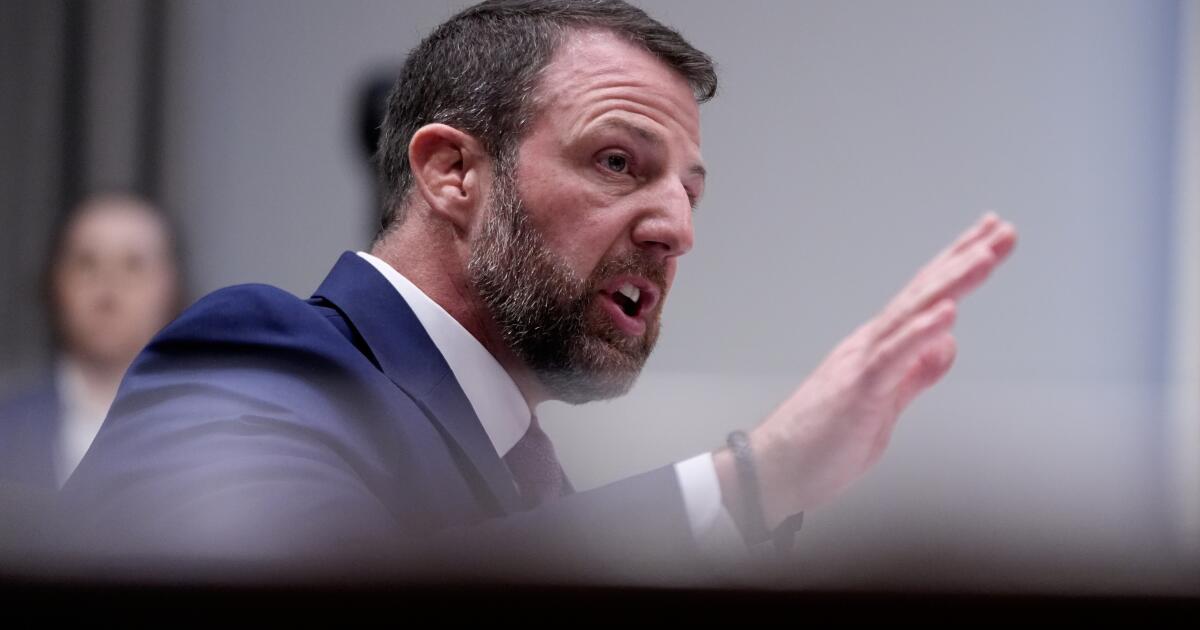
WASHINGTON — The leaders of the agencies enforcing President Trump’s immigration crackdown faced tough questioning on Capitol Hill on Tuesday, with one Democratic lawmaker asking the head of ICE if he would apologize to the families of two U.S. citizens killed by federal agents and called domestic terrorists by Homeland Security Secretary Kristi Noem.
Todd Lyons, acting head of Immigration and Customs Enforcement, declined to apologize to the families of Renee Good and Alex Pretti during the hearing but said he welcomed the opportunity to speak to Good’s family in private.
“I’m not going to speak to any ongoing investigation,” Lyons said.
For the first time since the federal operation in Minneapolis led to the deaths of Good and Pretti, the heads of three immigration agencies testified before the House Homeland Security Committee.
Along with Lyons, the other witnesses were Joseph Edlow, director of U.S. Citizenship and Immigration Services, and Rodney Scott, commissioner of Customs and Border Protection. Their agencies fall under the Department of Homeland Security.
Democrats and some Republicans have called for increased oversight of the Trump administration’s immigration operations since the shootings last month of Good and Pretti, both 37, by federal agents.
In the aftermath of the shootings, the administration replaced Gregory Bovino, a Border Patrol official who led the charge in Minneapolis, with border policy advisor Tom Homan, a former ICE official. Officials also withdrew some agents and began requiring those in Minneapolis to wear body cameras.
“We must take the temperature down and look at the record of enforcement actions through rational eyes,” said the committee’s chair, Rep. Andrew Garbarino (R-N.Y.).
Garbarino asked for commitment from the ICE and CBP leaders to give the committee the full reports and findings of the investigations into the shootings of Good and Pretti once those conclude. Scott and Lyons agreed.
Scott, the CBP commissioner, told the committee members that officers face an unprecedented increase in attacks by people who interfere with law enforcement action. He said these actions are “coordinated and well-funded.”
“This is not peaceful protest,” he said.
Lyons, the ICE leader, told lawmakers that his agency has removed more than 475,000 people from the U.S. and conducted nearly 379,000 arrests since President Trump returned to the White House. He said the agency has hired more than 12,000 officers and agents.
He condemned so-called sanctuary jurisdictions, which limit the collaboration between local law enforcement and ICE, as well as the rhetoric from public officials against ICE.
Lyons testified that 3,000 out of 13,000 ICE agents wear body cameras. Scott estimated that about 10,000 of 20,000 Border Patrol agents wear cameras, adding that “we’re building that program out.”
The agency heads faced intense questioning from Democrats on the committee, including those from California.
Rep. Eric Swalwell (D-Dublin) asked Lyons about his comment last year that the deportation process should work “like Amazon Prime, but with human beings.”
Lyons said the comment had been taken out of context.
“I did say that we need to be more efficient when it comes to removing individuals from the United States, because ICE doesn’t detain people punitively — we detain to remove,” he said. “I don’t want to see people in custody.”
“Well, speaking of human beings, how many times has Amazon Prime shot a nurse 10 times in the back?” Swalwell responded.
Swalwell asked how many agents have been fired for their conduct under Lyons’ leadership. Lyons said he would get that data.
“Can you tell us if, at least — God, I hope at least one person has been fired for their conduct since these operations have begun,” Swalwell said.
Lyons said he wouldn’t talk about personnel.
Swalwell was the one who asked Lyons if he would apologize to the families of Good and Pretti. He also asked if Lyons would resign from ICE. Lyons declined.
Rep. Lou Correa (D-Santa Ana) questioned Lyons about whether carrying a U.S. passport is enough for people to avoid being detained or deported. An October report by ProPublica identified more than 170 instances of U.S. citizens who were detained at raids or protests.
Lyons said U.S. citizens shouldn’t feel the need to carry their passports.
“No American citizen will be arrested for being an American citizen,” Lyons said.
Correa said a number of U.S. citizens in his district, which is majority Latino, have been detained, some for several days.
Lyons said he wasn’t aware of any cases of detained American citizens.
“Are you surveilling U.S. citizens today?” Correa asked.
Lyons said there is no database for protesters.
“I can assure you there is no database that’s tracking down citizens,” he said.
MINNEAPOLIS — For days, Luis Ramirez had an uneasy feeling about the men dressed as utility workers he’d seen outside his family’s Mexican restaurant in suburban Minneapolis.
They wore high-visibility vests and spotless white hard hats, he noticed, even while parked in their vehicle. His search for the Wisconsin-based electrician advertised on the car’s doors returned no results.
On Tuesday, when their Nissan returned to the lot outside his restaurant, Ramirez, 31, filmed his confrontation with the two men, who hide their faces as he approaches and appear to be wearing heavy tactical gear beneath their yellow vests.
“This is what our taxpayer money goes to: renting these vehicles with fake tags to come sit here and watch my business,” Ramirez shouts in the video.
A spokesperson for the Department of Homeland Security and Immigration and Customs Enforcement did not respond to inquiries about whether the men were federal immigration officers. But encounters like Ramirez’s have become increasingly common.
As the sweeping immigration crackdown in Minnesota continues, legal observers and officials say they have received a growing number of reports of federal agents impersonating construction workers, delivery drivers and, in some cases, anti-ICE activists.
Not all of those incidents have been verified, but they have heightened fears in a state already on edge, adding to legal groups’ concerns about the Trump administration’s dramatic reshaping of immigration enforcement tactics nationwide.
“If you have people afraid that the electrical worker outside their house might be ICE, you’re inviting public distrust and confusion on a much more dangerous level,” said Naureen Shah, the director of immigration advocacy at the American Civil Liberties Union. “This is what you do if you’re trying to control a populace, not trying to do routine, professional law enforcement.”
A ‘more extreme degree’ of deception
In the past, immigration authorities have sometimes used disguises and other deceptions, which they call ruses, to gain entry into homes without a warrant.
The tactics became more common during President Trump’s first term, attorneys said, prompting an ACLU lawsuit accusing immigration agents of violating the Constitution by posing as local law enforcement during home raids. A recent settlement restricted the practice in Los Angeles. But ICE deceptions remain legal elsewhere in the country.
Still, the undercover operations reported in Minnesota would appear to be a “more extreme degree than we’ve seen in the past,” said Shah, in part because they seem to be happening in plain sight.
Where past ruses were aimed at deceiving immigration targets, the current tactics may also be a response to Minnesota’s sprawling networks of citizen observers that have sought to call attention to federal agents before they make arrests.
At the Bishop Henry Whipple Federal Building in Minneapolis, the city’s central hub of ICE activity, activists told the Associated Press they had seen agents leaving in vehicles with stuffed animals on their dashboards or Mexican flag decals on their bumpers. Pickups with lumber or tools in their beds were also frequently spotted.
In recent weeks, federal agents have repeatedly shown up to construction sites dressed as workers, according to Jose Alvillar, a lead organizer for the local immigrant rights group, Unidos MN.
“We’ve seen an increase in the cowboy tactics,” he said, though he noted the raids had not resulted in arrests. “Construction workers are good at identifying who is a real construction worker and who is dressing up as one.”
Using vintage plates
Since the start of the operation in Minnesota, local officials, including Democratic Gov. Tim Walz, have said ICE agents had been seen swapping license plates or using bogus ones, a violation of state law.
Candice Metrailer, an antiques dealer in south Minneapolis, believes she witnessed such an attempt firsthand.
On Jan. 13, she received a call from a man who identified himself as a collector, asking if her store sold license plates. She said it did. A few minutes later, two men in street clothes entered the shop and began looking through her collection of vintage plates.
“One of them says, ‘Hey, do you have any recent ones?’” Metrailer recalled. “Immediately, an alarm bell went off in my head.”
Metrailer stepped outside while the men continued browsing. A few doors down from the shop, she saw an idling Ford Explorer with blacked-out windows. She memorized its license plate, then quickly plugged it into a crowdsourced database used by local activists to track vehicles linked to immigration enforcement.
The database shows an identical Ford with the same plates had been photographed leaving the Whipple building seven times and reported at the scene of an immigration arrest weeks earlier.
When one of the men approached the register holding a white Minnesota plate, Metrailer said she told him that the store had a new policy against selling the items.
Metrailer said she had reported the incident to Minnesota’s attorney general. A spokesperson for the Department of Homeland Security did not respond to a request for comment.
A response to obstruction
Supporters of the immigration crackdown say the volunteer army of ICE-tracking activists in Minneapolis has forced federal agents to adopt new methods of avoiding detection.
“Of course agents are adapting their tactics so that they’re a step ahead,” said Scott Mechkowski, former deputy director of ICE enforcement and operations in New York City. “We’ve never seen this level of obstruction and interference.”
In nearly three decades in immigration enforcement, Mechkowski said he also hadn’t seen ICE agents disguising themselves as uniformed workers in the course of making arrests.
Last summer, a Homeland Security spokesperson confirmed a man wearing a high-visibility construction vest was an ICE agent conducting surveillance. In Oregon, a natural gas company published guidance on how customers could identify their employees after reports of federal impersonators.
In the days since his encounter, Ramirez, the restaurant worker, said he has been on high alert for undercover agents. He recently stopped a locksmith who he feared might be a federal agent, before realizing he was a local resident.
“Everybody is on edge about these guys, man,” Ramirez said. “It feels like they’re everywhere.”
MINNEAPOLIS — The sites of the three consequential deaths span just over two miles of south Minneapolis. George Floyd in 2020, Renee Good and Alex Pretti last month.
The death of Floyd, after a police officer dug a knee into his neck for more than nine minutes, was a catalyst for the nationwide Black Lives Matter protests that sought law enforcement reforms and accountability.
Those of Good and Pretti, shot by federal immigration agents, have similarly sparked demands that federal agents to stop using violence in pursuit of President Trump’s mass deportation effort.
The sites are close enough to walk in an hour. So, on Sunday, I did.
Mementos, drawings, signs and flowers are covered by fresh snow outside of Unity Foods where George Floyd was killed in Minneapolis.
George Floyd
Floyd was killed just outside of Cup Foods, since renamed Unity Foods. On a wall outside the convenience store, Esther Osayande’s painting “Sankofa” depicts a bird with its head turned back, surrounded by flames.
The description says it is a metaphorical symbol used by the Akan people of Ghana to express “the importance of reaching back to knowledge gained in the past and bringing it into the present.”
“Sankofa tells us that we as a people can rise above conflicts of ego and treat all beings we meet as brothers and sisters,” it states.
On the same wall, someone spray painted, “My cries are 4 humanity.”
The memorial, known locally as George Floyd Square, encompasses a nearby covered bus stop, where a visitor had written that “race is a made up idea to keep ppl down.” Against the shelter glass, someone had taped a typed notice of emergency. It lists “martyrs” killed by authorities — Good, Floyd, Philando Castile and others before them.
“This ICE operation is somehow simpler AND more malicious than the kill count accumulated by our PD,” the notice reads. “This is slave catching. This is gestapo.”
A memorial to Renee Good at the location where she was shot in Minneapolis.
Nearly six years after Floyd’s death, some of the memorial art has begun to fade under the sun. A metal archway gives way to a plastic A-frame board describing Floyd and the global movement that his murder inspired.
“George’s name has become a rallying cry for those who believe in a better future, one where all people are treated with dignity and respect,” it reads.
Few people gathered at the memorial Sunday morning, but real and fake flowers, blanketed by snow, covered the site. A family with children got out of an SUV and walked around. A young photographer snapped some shots. And a couple took their time weaving through the makeshift garden.
Floyd’s cousin Paris Stevens is co-chair of Rise and Remember, which preserves the memorial and leads tours of the area. She said the organization wanted to give the community a safe space to grieve, “because everybody has lost someone.”
The thread linking the deaths of her cousin, Good and Pretti, Stevens said, is that they all could have been prevented. The fact that people have begun to visit all three sites is a sign of how unjust killings bring out the humanity in people, she said.
“How do we care for one another in times of need?” she asked. The answer, in part, is found in the artwork, writings and flowers at the three memorials.
“For this to happen, it’s like we’re picking up the ball and running again,” she said. “We’ve been here before and we know what to do.”
A memorial for Renee Good marks the location the 37-year-old woman was shot by ICE agent Jonathan Ross on Portland Avenue near East 34th Street in Minneapolis.
Renee Good
Portland Avenue, where Good died less than a mile from Floyd, is lined with Craftsman-style homes. Many displayed “ICE OUT” or “Black Lives Matter” signs — or both — in their front windows.
One window posed a question: “How many weren’t filmed?”
Stapled to a telephone pole was a letter addressed to federal agents: “It might be hard to understand why almost all Our City’s residents are angry with Your Mission (which has changed radically over the past year). This handbill intends to resolve confusion. I hope it finds you well.”
Another telephone pole struck a different tone:
“ICE ARE TERRORISTS KIDNAPPERS MURDERERS.”
On a wooden fence, Good’s portrait accompanied those of Floyd and other Black men killed by police in Minnesota in recent years, among them Daunte Wright, Winston Boogie Smith Jr. and Amir Locke.
A handwritten sign quoted Good’s last words: “I’m not mad at you, dude.”
Keeping snow off of Good’s memorial — not far from where George Floyd was killed — has been a losing battle.
In the center of Good’s memorial, a man gingerly brushed snow from cardboard signs, shook out bouquets of flowers and wiped off teddy bears. It was a losing battle. Snow was falling, leaving fresh white dots on everything he cleared.
A woman walked up with a handful of yellow tulips. “Hello, is there somewhere I should put these in particular?”
“Anywhere is fine,” said the man.
American, Mexican and LGBTQ+ flags hung from the site. One handwritten note, signed by “A DHS employee,” stated: “We will never forget you.”
A sign hangs between two trees near the Good memorial and reads, “The resistance is rooted in love — ICE out!”
Some mourners had shared small tokens of positivity. “Please take a pocket heart,” read one laminated sign. “Keep it with you to be a constant reminder that you are loved!”
Others, knowing Good had been a poet, wrote poems of their own:
Towards new ages imagined yet still out of hand
We’ll build a place safe for us all where you stood
Where love’s lyrics echo we’ll compose what we can
To that I offer these words, would they were as good as
Good’s.
Among the couple dozen people at the site were Kayla Gardner, 29, and three friends. Gardner said she had brought flowers to place at each of the three memorials.
“I wanted to get to Renee and Alex’s,” she said, “but we didn’t want to leave out George, too. He’s right here.”
A memorial for intensive care nurse Alex Pretti.
Alex Pretti
On a traffic pole down the street, above a “Lost Cat” sign, a note in Spanish warns residents of increased immigration police presence since Dec. 22. It advises residents not to leave their homes unless necessary, to have groceries delivered and to establish an emergency plan for their children.
“These are difficult and uncertain moments for our community,” it says.
Lake Street, a hub of Latino businesses, is about halfway between where Good and Pretti were killed. Murals on side streets depict women cooking tortillas on a comal and musicians playing guitar and accordion. Businesses there have responded to the immigration raids in a variety of ways.
A notice in Spanish posted on the door of a western wear shop says, “Closed for the security of our clients.”
A nearby Ecuadorean restaurant, meanwhile, offers delivery but not sit-down service.
A person wipes tears away while visiting the Pretti memorial on Feb. 1.
Pretti died near Glam Doll Donuts, along another vibrant stretch of diverse, immigrant-owned restaurants known as Eat Street. As the days went on after his killing, fewer news cameras turned up, but mourners kept coming.
Standing over the memorial that has grown to take up the length of a building, a man in a The North Face jacket sobbed quietly. Another lighted incense sticks and stuck them in the snow.
Votive candles depicted Jesus, the Virgin of Gudalupe and Mister Rogers.
Candles burn near the Pretti memorial. Some depicted Jesus, the Virgin of Guadalupe and Mister Rogers.
A letter offers a source of comfort: “If I have two rooms, one dark, the other light, and I open the door between them, the dark room becomes lighter without the light one becoming darker. I know this is no headline, but it’s a marvelous footnote.”
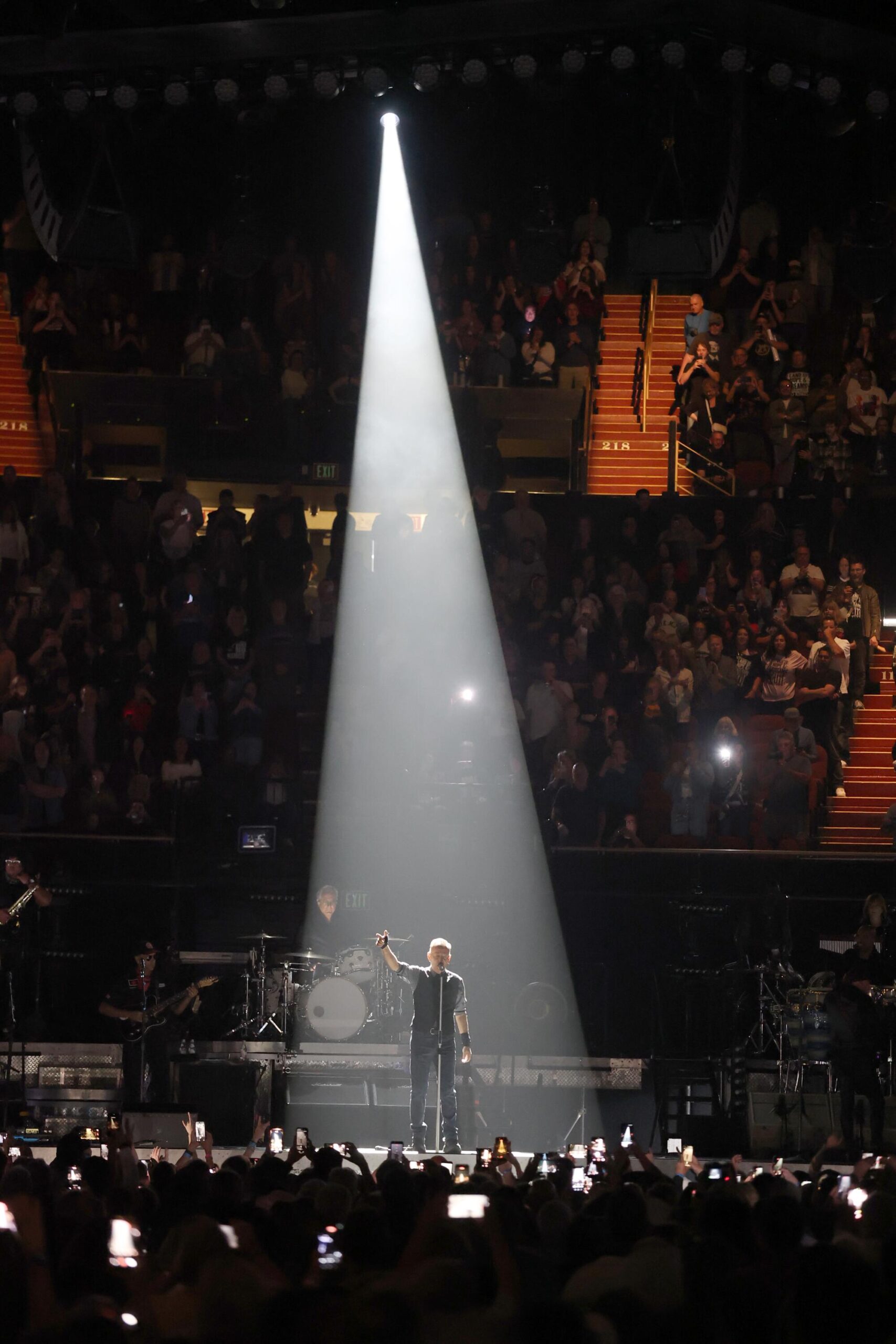
Also on display were lyrics from Bruce Springsteen’s new protest song, “Streets of Minneapolis,” which call out White House Deputy Chief of Staff Stephen Miller and Home Security Secretary Kristi Noem:
It’s our blood + our bones
And these whistles + phones
Against Miller +
Noem’s Dirty Lies.
New artwork appears daily. An oil painting depicting a smiling Pretti in glasses, a beanie and a scarf, was among the most recent.
Leah Dunbar, 50, was moved to tears looking at it. Dunbar, who lives nearby, had brought Somali chicken sambusas for fellow mourners standing in the cold.
The George Floyd memorial marks the spot at the intersection of East 38th Street and Chicago Avenue where he was killed in 2020 at age 46.
Reflecting on his death, she had asked herself, “What is the good that is coming out of this? Do we have space in our lives to see the good?”
“Of course we do,” she said. “Look — people are making, people are creating, people are sharing.”
MINNEAPOLIS — A Minneapolis man was arrested Thursday on suspicion of cyberstalking and threatening to kill or assault Immigration and Customs Enforcement officers involved in the crackdown in Minnesota.
Federal prosecutors said in a statement that Kyle Wagner, 37, of Minneapolis, was charged by complaint, and that a decision to seek an indictment, which is necessary to take the case to trial, would be made soon.
Court records in Detroit, where the case was filed, did not list an attorney who could speak on Wagner’s behalf. The complaint was filed Tuesday and unsealed Thursday.
Atty. Gen. Pamela Bondi alleged in a statement that Wagner doxed and threatened law enforcement officers, claimed an affiliation with antifa and “encouraged bloodshed in the streets.”
And at the White House on Thursday, press secretary Karoline Leavitt held up Weber’s photo at the daily briefing and said such conduct by “left-wing agitators” won’t go unpunished.
“And if people are illegally obstructing our federal law enforcement operations, if they are targeting, doxing, harassing and vilifying ICE agents, they are going to be held accountable like this individual here who, again, is a self-proclaimed member of antifa. He is a domestic terrorist, and he will be held accountable in the United States,” Leavitt told reporters.
President Trump announced in September that he would designate antifa a “major terrorist organization.” Antifa, short for “anti-fascists,” is an umbrella term for far-left-leaning militant groups and is not a singular entity. It consists of groups that resist fascists and neo-Nazis, especially at demonstrations.
When Trump administration border policy advisor Tom Homan announced Wednesday that about 700 federal officers deployed to Minnesota would be withdrawn immediately, he said a larger pullout would occur only after there’s more cooperation and protesters stop interfering with federal personnel.
According to prosecutors, Wagner repeatedly posted on Facebook and Instagram encouraging his followers to “forcibly confront, assault, impede, oppose, and resist federal officers” whom he referred to as the “gestapo” and “murderers.”
The complaint alleges Wagner posted a video last month that directly threatened ICE officers with an obscenity-laden rant. “I’ve already bled for this city, I’ve already fought for this city, this is nothing new, we’re ready this time,” he said, concluding that he was “coming for” ICE.
The complaint further alleges that Wagner advocated for physical confrontation in another post, stating: “Anywhere we have an opportunity to get our hands on them, we need to put our hands on them.”
It also details how Wagner used his Instagram account to dox a person identified only as a “pro-ICE individual” by publishing a phone number, birth month and year, and address in the Detroit suburb of Oak Park. The complaint says Wagner later admitted that he doxed the victim’s parents’ house.
Federal prosecutors didn’t immediately respond to a request for comment on why the case was filed in Michigan instead of Minnesota. The alleged doxing was the only Michigan connection listed in the complaint.
The U.S. attorney’s office in Minnesota has been hit by the resignations of several prosecutors in recent weeks amid frustrations with the surge and its handling of the shooting deaths of two people by government officers. One lawyer, who told a judge that her job “sucks,” was removed from her post.
Trump’s chief federal prosecutor for Minnesota, Dan Rosen, told a federal appeals court in a recent filing that his office is facing a “flood of new litigation” and is struggling to keep up just with immigration cases, while his division that handles civil cases is down 50%.
Rosen wrote that his office has canceled other civil enforcement work “and is operating in a reactive mode.” He also said his attorneys are “appearing daily for hearings on contempt motions. The Court is setting deadlines within hours, including weekends and holidays. Paralegals are continuously working overtime. Lawyers are continuously working overtime.”
Karnowski writes for the Associated Press. AP reporters Eric Tucker and Nathan Ellgren in Washington contributed to this report.
WASHINGTON — Senate Republican Leader John Thune warned Thursday that Congress is not close to an agreement to fund the Department of Homeland Security, signaling that another short-term extension may be the only way to avoid a shutdown as Democrats demand “nonnegotiable” ICE reforms ahead of the Feb. 13 deadline.
The Republicans are increasingly looking to punt the full funding package a second time if negotiations collapse. Speaking on the Senate floor Thursday, Thune said that such a move would not include any reforms lawmakers had previously negotiated, including body cameras for immigration agents.
“As of right now, we aren’t anywhere close to having any sort of an agreement that would enable us to fund the Department of Homeland Security,” he said. “If [Democrats] are coming to the table demanding a blank check or refusing to consider any measures but their own, they’re likely to end up with nothing.”
He spoke hours after House and Senate Democrats announced they were aligned behind a list of 10 demands they say must be passed before approving the Homeland Security funding package through September.
Democrats are pressing for statutory limits on immigration raids, new judicial warrant requirements, body-worn cameras, identification rules for agents and enhanced oversight of Immigration and Customs Enforcement and Customs and Border Protection — reforms they say are necessary to rein in what House Minority Leader Hakeem Jeffries (D-N.Y.) called an agency “out of control.”
Senate Minority Leader Chuck Schumer (D-N.Y.) said Democrats are planning to propose the legislation as soon as possible.
“We want our Republican colleagues to finally get serious about this, because this is turning America inside out in a way we haven’t seen in a very long time,” Schumer said.
The coordinated demands signal unity among House and Senate Democrats after a rocky week on Capitol Hill. In a slim vote, 21 House Democrats joined Republicans on Tuesday to end a partial government shutdown by temporarily extending Homeland Security funding through Feb. 13.
The two-week stopgap, called a “continuing resolution,” was meant to leave time for the two parties to debate how to rein in ICE after the fatal shootings of two U.S. citizens in Minneapolis.
But that truce has quickly unraveled. Republican leaders have little appetite for the full slate of reforms. Some have indicated openness to narrower changes, such as expanding body camera programs and training, but reject mask bans and the removal of Homeland Security Secretary Kristi Noem.
House Speaker Mike Johnson (R-La.) has already ruled out warrant requirements, which would limit immigration agents from entering private property without a court order. In remarks to reporters Wednesday, he also hinted at some interest in attaching voter ID and anti-sanctuary city policies to negotiations.
“It will be part of the discussion over the next couple of weeks, and we’ll see how that shakes out. But I suspect that some of the changes — the procedural modifications with ICE, Immigration and Customs Enforcement — will be codified,” he said.
Johnson was confident the two sides could make a deal without further delays, adding that negotiations are largely between “the White House, Schumer and Senate Democrats.”
President Trump has privately supported the short-term extension to cool tensions while publicly defending immigration agents and expressing skepticism toward Democrats’ reform push, according to House leadership.
White House border policy advisor Tom Homan also announced a drawdown of 700 federal agents from Minneapolis this week as what officials framed as a goodwill gesture amid negotiations.
Karoline Leavitt, the White House press secretary, said Thursday that the administration is willing to consider some of the demands Democrats have made, but said some of their requests are not “grounded in any common sense and they are nonstarters for this administration.”
Leavitt did not specify which reforms the administration was willing to consider. She did, however, say the president is committed to keeping the government open and supporting “immigration enforcement efforts in this country.”
The White House did not respond when asked if the president would support a short-term spending measure should negotiations stall.
Republicans continue to warn that a failure to reach a deal would jeopardize disaster response funding, airport security operations, maritime patrols, and increased security assistance for major national events, including the upcoming World Cup in Los Angeles.
“If we don’t do it by the middle of next week, we should consider a continuing resolution for the rest of the year and just put this all behind us,” said Rep. Andy Harris (R-Md.), chair of the House Freedom Caucus.
Democrats, however, remain adamant that verbal assurances are no longer enough.
“These are just some of the commonsense proposals that the American people clearly would like to see in terms of the dramatic changes that are needed at the Department of Homeland Security before there is a full-year appropriations bill,” Jeffries said.
Times staff writer Ana Ceballos in Washington contributed to this report.
WASHINGTON — One of the brothers of Renee Good, the 37-year-old mother of three who was shot and killed by an immigration agent in Minneapolis, told congressional Democrats on Tuesday that he needed their help.
Luke Ganger said their family had taken some consolation in the thought that his sister’s death might spark a change.
“It has not,” he said.
That is why Ganger and people who had been violently detained by immigration agents gathered to share their experiences with ICE and to ask the government to rein in an agency they described as lawless and out of control.
Tuesday’s forum — not an official hearing because Republicans did not agree to it — was led by Rep. Robert Garcia (D-Long Beach), the top Democrat of the House Oversight Committee, and Sen. Richard Blumenthal (D-Conn.), the top Democrat of the Senate Permanent Subcommittee on Investigations. It was held not in the Capitol, but a nearby Senate office building.
Garcia and Blumenthal convened the forum to gather testimony “on the violent tactics and disproportionate use of force by agents of the Department of Homeland Security.”
All of the incidents referenced in the forum were captured on video.
Democrats heard from three U.S. citizens who are residents of San Bernardino, Chicago and Minneapolis. Also present were Good’s two brothers and an attorney representing their family.
Good’s killing on Jan. 7 has led to a wave of national protests — further inflamed after agents fatally shot ICU nurse Alex Pretti, 37, two weeks later. Protesters have called on federal agents to stop using violence in pursuit of the Trump administration’s mass deportation effort.
From left, Sen. Richard Blumenthal (D-Conn.), Luke Ganger and Brent Ganger arrive to a public forum on violent use of force by Department of Homeland Security personnel.
(Win McNamee / Getty Images)
“Let’s be very clear: these stories are not just about Minneapolis,” Blumenthal said. “These stories span the country.”
Blumenthal called for a “complete overhaul, a rebuilding” of the Department of Homeland Security and its sub-agencies. Such an overhaul, he said, would require body-worn cameras, that officers wear identification and rigorous use-of-force training and policies; acts of violence would require full investigations under the supervision of an independent monitor. Without those reforms, he said he wouldn’t support more funding for DHS.
Ganger said the “surreal scenes” taking place in Minneapolis and beyond are not isolated and are changing many lives.
“The deep distress our family feels because of Renee’s loss in such a violent and unnecessary way is complicated by feelings of disbelief, distress and desperation for change,” he said.
Ganger said his family is “a very American blend” that votes differently and rarely agrees fully on the details of what it means to be a citizen of the U.S. Despite those differences, he said, they have always treated each other with love and respect.
“We’ve gotten even closer during this very divided time in our country,” he said. “We hope that our family can be even a small example to others not to let political ideals divide us.”
The panel heard from Martin Daniel Rascon, of San Bernardino, and three others who described harrowing experiences with immigration agents. Rascon was in a truck with two family members last August when they were stopped by more than a dozen federal agents who pointed rifles at them, shattered a window and then shot at the car multiple times.
Francisco Longoria, the man driving the truck and Rascon’s father-in-law, was later arrested and charged by federal authorities, who alleged he had assaulted immigration officers with his truck during the incident. Longoria’s attorneys said he drove off because he feared for his safety. The charges were dropped a month later.
Marimar Martinez, 30, of Chicago, was shot five times by U.S. Customs and Border Protection agents and then labeled a domestic terrorist and charged with assaulting the agents who shot her. Those charges were also later dropped.
“I’m angry on your behalf, Miss Martinez,” said Rep. Ro Khanna (D-Fremont). “Tell me, what do you want this government to do to apologize to you?”
“I’m sorry. You’re not a domestic terrorist,” she said. “That’s it. For them to admit that they were wrong about everything that they said about me. I just want accountability.”
Aliya Rahman, of Minneapolis, was dragged from her car on the way to a doctor’s appointment and detained by ICE agents after telling them she has a disability. Rahman has autism and is recovering from a traumatic brain injury.
DHS said Rahman was arrested because she ignored multiple commands. Rahman said it takes time for her to understand auditory commands.
Rahman said agents yelled threats and conflicting instructions that she couldn’t process while watching for pedestrians. As she hit the ground face first, she said, she felt shooting pain as agents leaned on her back. She thought of George Floyd, who was killed four blocks away.
Rahman said she was never told she was under arrest or charged with a crime. The agents taking her to the federal Whipple Building referred to detainees as “bodies.” She said she received no medical screening, phone call or access to a lawyer, and was denied a communication navigator when her speech began to slur.
Eventually, she became unable to speak.
“The last sounds I remember before I blacked out on the cell floor were my cellmate banging on the door, pleading for a medic and a voice outside saying, ‘We don’t want to step on ICE’s toes,’” she said.
Rahman said she later woke up at a hospital, where doctors told her she had suffered a concussion.
Rep. Robert Garcia (D-Long Beach) speaks during a public forum on violent use of force by Department of Homeland Security personnel.
(Win McNamee / Getty Images)
Garcia called the forum a step toward accountability because Congress has the right to step in when constitutional rights are violated. He said Democrats have tracked at least 186 incidents of problematic uses of force by federal immigration agents.
“It’s important for the public to recognize that this administration has lied, has defamed and has smeared people that have been peacefully protesting,” he said.
Antonio Romanucci, the attorney representing Good’s family, and who also represented the family of George Floyd, said that while he has handled excessive force cases for decades, “this is an unprecedented and deeply unsettling time.” Floyd was murdered by a Minneapolis police officer in 2020.
“The occupation by ICE and CBP in our cities is way beyond their mission, leading to unnecessary provocation that causes needless harm and death,” he said. “These operations in multiple states have routinely and consistently included violations of the Constitution.”
The current path to hold federal officers accountable is narrow, he said. Congress could pass legislation to add language making it easier for people to file civil lawsuits in cases such as Good’s.
MINNEAPOLIS — Immigration officers with guns drawn arrested activists who were trailing their vehicles on Tuesday in Minneapolis, a sign that tensions have not eased since the departure last week of a high-profile commander.
At least one person who had an anti-ICE message on their clothing was handcuffed while face down on the ground. An Associated Press photographer witnessed the arrests.
Federal agents in the Twin Cities lately have been conducting more targeted immigration arrests at homes and neighborhoods, rather than staging in parking lots. The convoys have been harder to find and less aggressive. Alerts in activist group chats have been more about sightings than immigration-related detainments.
Several cars followed officers through south Minneapolis after there were reports of them knocking at homes. Officers stopped their vehicles and ordered activists out of a car at gunpoint. Agents told reporters at the scene to stay back and threatened to use pepper spray.
There was no immediate response to a request for comment from the Department of Homeland Security and Immigration and Customs Enforcement.
A federal judge last month put limits on how officers treat motorists who are following them but not obstructing their operations. Safely following agents “at an appropriate distance does not, by itself, create reasonable suspicion to justify a vehicle stop,” the judge said. An appeals court, however, set the order aside.
Border Patrol commander Greg Bovino, who was leading an immigration crackdown in Minneapolis and other big U.S. cities, left town last week, shortly after the fatal shooting of Alex Pretti, the second local killing of a U.S. citizen in January.
Trump administration border czar Tom Homan was dispatched to Minnesota instead. He warned that protesters could face consequences if they interfere with officers.
Grand jury seeks communications, records
Meanwhile, Tuesday was the deadline for Minneapolis to produce information for a federal grand jury. It’s part of a U.S. Justice Department request for records of any effort to stifle the Trump administration’s immigration crackdown. Officials have denounced it as a bullying tactic.
“We have done nothing wrong and have nothing to hide, but when the federal government weaponizes the criminal justice system against political opponents, it’s important to stand up and fight back,” said Ally Peters, spokesperson for Mayor Jacob Frey, a Democrat.
She said the city was complying, but she didn’t elaborate. Other state and local offices run by Democrats were given subpoenas, though it’s not known whether they had the same deadline. People familiar with the matter have told the AP that the subpoenas are related to an investigation into whether Minnesota officials obstructed enforcement through public statements.
No bond for man in Omar incident
Elsewhere, a man charged with squirting apple cider vinegar on Democratic U.S. Rep. Ilhan Omar will remain in jail. U.S. Magistrate Judge David Schultz granted a federal prosecutor’s request to deny bond to Anthony Kazmierczak.
“We simply cannot have protesters and people — whatever side of the aisle they’re on — running up to representatives who are conducting official business, and holding town halls, and assaulting them,” Assistant U.S. Attorney Benjamin Bejar said Tuesday.
Defense attorney John Fossum said the vinegar posed a low risk to Omar. He said Kazmierczak’s health problems weren’t being properly addressed in jail and that his release would be appropriate.
Murphy, Raza and Karnowski write for the Associated Press. Raza reported from Sioux Falls, S.D. AP reporters Ed White in Detroit and Hannah Fingerhut in Des Moines, Iowa, contributed to this report.
George Skelton and Michael Wilner cover the insights, legislation, players and politics you need to know in 2024. In your inbox Monday and Thursday mornings.
When government officials arrogantly persist in blatantly lying, the public just might turn angrily against the prevaricators.
Or maybe they’re not lying technically. They simply might not care whether they’re telling the truth, or what it is. Their only intent is to spew a tale that fits a political agenda. Regardless, the citizenry can stomach only so much.
But, in fact, the public rebellion has been building during a yearlong nightmare of unjustified, inhumane, un-American violence by federal immigration agents. Their targets have been people with brown skin suspected of living in the country illegally. Never mind that many not only are documented, they’re U.S. citizens.
Such has been the slipshod and authoritarian way President Trump’s promised mass deportation program has been carried out.
Polls have consistently shown that voters strongly support the president’s goals of protecting the border and also deporting the “worst of the worst” undocumented criminals. But people have increasingly objected to his roughhouse methods, including masked federal agents slapping around and pepper-spraying legal protesters.
It’s not clear whether the two Minnesota citizens victimized by quick-draw federal agents were protesting. You can’t believe the Trump administration.
And that’s the danger in habitually lying: People can become so cynical that most disregard whatever they’re told by their so-called leaders. And that cripples what’s necessary for an ongoing healthy democracy: a cooperative relationship based on trust between citizens and those they’ve chosen to govern.
Some things we do know about the slain Minnesota citizens.
Alex Pretti, 37, was an intensive care nurse in a VA hospital. He was shooting video with his cellphone of agents and protesters when he was pepper-sprayed and wrestled to the ground by several agents as his legally carried handgun was removed. Then he was shot in the back several times.
He was not a “domestic terrorist” and “assassin” who wanted to “massacre law enforcement,” as Trump sycophants immediately lied on TV before backing off, after most of America saw videos of the killing and the president got nervous.
Renee Good, 37, was a mother and poet who appeared merely to be trying to drive through protest chaos when an agent shot her three times through the windshield. She did not try to run down the agent, as the administration claimed.
Good was not “obviously a professional agitator” who “violently, willfully and viciously ran over the ICE officer,” as Trump wrote on social media.
Public outrage at the lying and the brutish immigration enforcement has pressured elected officials into action all around the country.
Sure, you can call it political grandstanding and, of course, much of it is. But good politics and sound democracy involve listening to the public and acting on its desires.
In Sacramento, the state Senate held an emotional two-hour debate over a bill aimed at permitting people to sue federal law enforcement when their constitutional rights are violated. Rights such as the ability to peacefully protest and to be protected against excessive force. Lawsuits already are allowed against state and local officers. But federal agents are practically untouchable.
Senate Bill 747 by Sen. Scott Wiener (D-San Francisco) passed on a 30-10 party-line vote — Democrats for and Republicans against. The measure moved to the Assembly.
The vote was yet another sorry sign of today’s unhealthy political polarization. Not one Republican could break out of the Trump web and vote to hold illegally operating federal agents accountable in civil courts. But neither could one Democrat detect enough fault in the bill to vote against it.
Some law enforcement groups oppose the legislation because they fear it would spur additional suing against local cops. Look for an amendment in the Assembly.
The heated Senate debate reflected Democratic lawmakers’ frustration with Trump — and many of their constituents’ fears.
“The level of anxiety and anger is higher than I’ve ever seen in my 13 years in the Legislature,” Sen. Tom Umberg (D-Santa Ana) told me.
“People are coming into our offices fearful for relatives or friends who are hiding out, afraid to go to doctors’ appointments and their kids are staying away from schools.”
During the debate, several senators mentioned two young protesters who were each permanently blinded in one eye by rubber bullets shot by Homeland Security officers in Santa Ana. Lawmakers also railed against “kidnappings” off the street of people simply because of their skin colors, accents and dress.
“California is not going to let these thugs get away with it,” Wiener vowed.
“There’s a lot of hyperbole on this floor,” Sen. Tony Strickland (R-Huntington Beach) asserted. He called for repeal of California’s “sanctuary” laws that greatly restrict cooperation by state and local officers with federal immigration agents.
Easing those laws is probably a good idea. But more important, we’ve got to restrain undisciplined federal agents from shooting unarmed people in the back.
Sen. Shannon Grove (R-Bakersfield), who revealed that she has been packing a firearm for 30 years, said that Pretti should never have brought his gun to a protest even if it was legal — which it isn’t in California.
And she’s right. But he never brandished the weapon and shouldn’t have paid with his life.
Neither should Pretti have been immediately attacked as a bad guy by lying federal officials. They’re now paying a political price.
MINNEAPOLIS — For weeks, administrators at this charter high school have arrived an hour before class, grabbed neon vests and walkie-talkies, and headed out into the cold to watch for ICE agents and escort students in.
Lately, fewer than half of the 800 sudents show up.
“Operation Metro Surge,” the immigration crackdown in Minnesota that led to nationwide protests after federal agents shot and killed two U.S. citizens, has had students, parents and teachers on edge regardless of their immigration status.
Signs of a fearful new normal are all over the school. Green craft paper covers the bottom of many first-floor windows so outsiders can’t peer in. A notice taped outside one door says unauthorized entry is prohibited: “This includes all federal law enforcement personnel and activities unless authorized by lawful written direction from appropriate school officials or a valid court order.”
Students at a Minneapolis high school classroom with many empty seats on Jan. 29, 2026.
Staff coordinate throughout the day with a neighborhood watch group to determine whether ICE agents are nearby. When they are, classroom doors are locked and hallways emptied until staff announce “all clear.”
Similar tactics have been utilized by schools in other cities hit by immigration raids across the country. The Los Angeles Unified School District established a donation fund for affected families and created security perimeters around schools last summer.
But it appears nowhere have students felt the repercussions of local raids more than in Minneapolis.
Many schools have seen attendance plummet by double-digit percentages. At least three other, smaller charter schools in Minneapolis have completely shut down in-person learning.
At this high school, which administrators asked The Times not to identify for fear of retaliation by the Trump administration, 84% of students are Latino and 12% are Black. Staff and students are being identified by first or middle names.
A balloon sits in a hallway at the high school.
Doors and windows are covered at the school so outsiders can’t see in.
Three students have been detained — and later released — in recent weeks. Two others were followed into the school parking lot and questioned about their immigration status. Several have parents who were deported or who self-deported. Latino staff said they have also been stopped and questioned about their legal status.
“Our families feel hunted,” said Noelle, the school district’s executive director.
Students returned from winter break on Jan. 6, the same day 2,000 additional immigration agents were dispatched to Minneapolis to carry out what Immigration and Customs Enforcement Acting Director Todd Lyons called the agency’s “largest immigration operation ever.” The next day, an ICE officer fatally shot Renee Good, a 37-year-old mother of three.
“I describe that day as if you’re on an airplane and it’s really bad turbulence, and you have to keep your cool because, if you don’t, you lose the entire building,” said Emmanuel, an assistant principal. “It felt like we went through war.”
Attendance dropped by the hundreds as parents grew too afraid to let their children leave home. School leaders decided to offer online learning and scrambled to find enough laptops and mobile hotspots for the many students who didn’t have devices or internet. Some teachers sent packets of schoolwork to students by mail.
A teacher at the Minneapolis high school that administrators asked The Times not to identify for fear of retaliation by the Trump administration. Teachers and students there also asked not to be identified.
Noelle said in-person attendance, which had dropped below 400 students, increased by around 100 in the third week of January. Then federal agents shot and killed 37-year-old intensive care nurse Alex Pretti, and attendance plummeted again.
Rochelle Van Dijk, vice president of Great MN Schools, a nonprofit supporting schools that serve a majority of students of color, said many schools have redirected tens of thousands of dollars away from other critical needs toward online learning, food distribution and safety planning. For students still attending in person, recess has frequently been canceled, and field trips and after-school activities paused.
Even if students return to school by mid-February, Van Dijk said, they will have missed 20% of their instructional days for the year.
“A senior who can’t meet with their college counselor right now just missed support needed for major January college application deadlines. Or a second-grader with a speech delay who is supposed to be in an active in-person intervention may lose a critical window of brain plasticity,” she said. “It is not dissimilar to what our nation’s children faced during COVID, but entirely avoidable.”
At the high school, administrators said they tried to create “a security bubble,” operating under protocols more typical of active shooter emergencies.
Gym class at the Minneapolis school, where many students are so afraid of ICE that they won’t go to the campus.
If agents were to enter the building without a judicial warrant, the school would go into a full lockdown, turning off lights, staying silent and moving out of sight. That hasn’t happened, though ICE last year rescinded a policy that had barred arrests at so-called sensitive locations, including schools.
Tricia McLaughlin, assistant secretary for the Department of Homeland Security, said that blaming ICE for low school attendance is “creating a climate of fear and smearing law enforcement.”
“ICE does not target schools,” McLaughlin said. “If a dangerous or violent illegal criminal alien felon were to flee into a school, or a child sex offender is working as an employee, there may be a situation where an arrest is made to protect the safety of the student. But this has not happened.”
Alondra, a 16-year-old junior who was born in the U.S., was arrested after school Jan. 21 near a clinic where she had gone with a friend, also 16, to pick up medication for her grandmother.
She said that as she was about to turn into the parking lot, another car sped in front of her, forcing her to stop. Alondra saw four men in ski masks with guns get out. Scared, she put her car in reverse. Before she could move, she said, another vehicle pulled up and struck her car from behind.
Alondra shared videos with The Times that she recorded from the scene. She said agents cracked her passenger window in an attempt to get in.
“We’re with you!” a bystander can be heard telling her in the video as others blow emergency whistles.
She said she rolled her window down and an agent asked to see her ID. She gave him her license and U.S. passport.
“Is it necessary to have to talk to you or can I talk to an actual cop?” she asks in the video. “Can I talk to an actual cop from here?”
“We are law enforcement,” the agent replies. “What are they gonna do?”
In another video, an agent questions Alondra’s friend about the whereabouts of his parents. Another agent is heard saying Alondra had put her car in reverse.
“We’re underage,” she tells him. “We’re scared.”
A sign directs students to line up for their school bus route. Bus pickups are staggered, with one group of students escorted outside at a time. This way, the children can be taken back inside the school or onto the bus more easily if ICE arrives.
A Minneapolis Public Radio reporter at the scene said agents appeared to have rear-ended Alondra’s car. But Alondra said an agent claimed she had caused the accident.
“It’s just a simple accident, you know what I mean?” he says in the video. “We’re not gonna get on you for trying to hit us or something.”
“Can you let us go, please?” her friend, visibly shaken, asks the agent at his window.
Alondra and her friend were handcuffed and placed in a U.S. Customs and Border Protection vehicle as observers filmed the incident. At least two observers were arrested as agents deployed tear gas and pepper spray, according to an MPR report.
The agents took the students to the federal Whipple Building. Alondra said the agents separated the friends, looked through and photographed her belongings and had her change into blue canvas shoes before chaining her feet together and placing her in a holding cell alone.
“I asked at least five times if I could let my guardian know what was happening, because I was underage, but they never let me,” she said.
Finally, around 7 p.m., agents released Alondra — with no paperwork about the incident — and she called her aunt to pick her up. Her friend was released later.
Meanwhile, school administrators who saw the MPR video called Alondra’s family and her friend’s.
Alondra said officers didn’t know what had happened to her car and told her they would call her when she could pick it up. But no one has called, and school administrators who helped her make calls to Minneapolis impound lots haven’t been able to locate it either.
Though Alondra could attend classes online, she felt she had to return to campus.
“I feel like if I would have stayed home, it would have gone worse for me,” she said, her lip quivering. “I use school as a distraction.”
The backstage of the auditorium, dubbed the bodega, has been turned into a well-stocked pantry for families who are too afraid to leave their homes.
A volunteer organizes donated items for distribution to families at the Minneapolis high school.
A teacher makes a delivery to a family in Minneapolis.
Teachers and volunteers sort donations by category, including hygiene goods, breakfast cereals, bread and tortillas, fruit and vegetables, diapers and other baby items. Bags are labeled with each student’s name and address and filled with the items their family has requested. After school, teachers deliver the items to the students’ homes.
Noelle said some students, particularly those who are homeless, are now at risk of failing because they’re in “survival mode.” Their learning is stagnating, she said.
“A lot of these kids are — I mean, they want to be — college-bound,” Noelle said. “How do you compete [for admission] with the best applicants if you’re online right now and doing one touch-point a day with one teacher because that’s all the technology that you have?”
On Thursday afternoon, 20 of 44 students had shown up for an AP world history class where the whiteboard prompt asked, “Why might some people resort to violent resistance rather than peaceful protest?”
Upstairs, in an 11th-grade U.S. history class, attendance was even worse — four students, with 17 others following online. The topic was what the teacher called the nation’s “first immigration ban,” the Chinese Exclusion Act of 1882.
Students head to their bus at the high school.
Morgan, the teacher, asked the students to name a similarity between the Chinese exclusion era and current day.
“Immigrants getting thrown out,” one student offered.
“Once they leave, they can’t come back,” said another.
“The fact that this is our first ban on immigration also sets a precedent that this stuff can happen over and over and over again,” Morgan said.
Sophie, who teachers English language learners, led the effort to organize the online school option. She is from Chile and says she has struggled to put her own fear aside to be present for the students who rely on her. Driving to school scares her, too.
“It’s lawless,” she said. “It doesn’t matter that I have my passport in my purse. The minute I open my mouth, they’re going to know that I’m not from here.”
Sophie said she once had to call a student’s mother to say her husband had been taken by immigration agents after another school staffer found his car abandoned on a nearby street.
“Having to have that conversation wasn’t on my bingo card for that day, or any day,” she said. “Having to say that we have proof that your husband was taken and hearing that woman crying and couldn’t talk, and I’m like, what do I say now?”
Close to the 4:15 p.m. dismissal, administrators again donned their neon vests and logged on to the neighborhood Signal call for possible immigration activity.
Students walk to a bus Thursday. Dismissal used to be a free-for-all, with large numbers of students rushing outside as soon as the bell rang.
Dismissal used to be a free-for-all — once the final bell rang, students would rush outside to find their bus or ride or to begin the walk home.
Now pickups are staggered, with students escorted outside one bus at a time. Teachers grab numbered signs and tell students to line up according to their route. If ICE agents pull up, administrators said, they could rush a smaller group of students onto the bus or back inside.
In yet another example of how the immigration raids had crippled attendance, some buses were nearly empty. On one bus, just two students hopped on.
It all began after a viral video alleging fraud in Somali-run child-care centers in Minneapolis: strangers peering through windows, right-wing journalists showing up outside homes, influencers hurling false accusations.
In San Diego, child-care provider Samsam Khalif was shuttling kids to her home-based center when she was spooked by two men with a camera waiting in a car parked outside, prompting her to circle the block several times before unloading the children.
“I’m scared. I don’t know what their intention is,” said Khalif, who decided to install additional security cameras outside her home.
Somali-run child-care centers across the United States have become targets since the video caught the attention of the White House amid the administration’s immigration crackdown. Child-care providers worry about how they can maintain the safe learning environments they have worked to create for young children who may be spending their first days away from their parents.
In the Minneapolis area, child-care providers, many of them immigrants, say they’re being antagonized, exacerbating the stress they face from immigration enforcement activity that has engulfed the city.
One child-care provider said she watched someone emerge from a car that had been circling the building and defecate near the center’s entrance. The same day, a motorist driving by yelled that the center was a “fake day care.” She’s had to create new lockdown procedures, is budgeting for security and now keeps the blinds closed to shield children from unwanted visitors and from witnessing immigration enforcement actions.
“I can’t have peace of mind about whether the center will be safe today,” said the provider, who spoke on condition of anonymity for fear of being targeted. “That’s a hard pill to swallow.”
Video’s claims disproved
The day after Christmas, right-wing influencer Nick Shirley posted a lengthy video with allegations that members of Minneapolis’ large Somali community were running fake child-care centers so they could collect federal child-care subsidies.
The U.S. occasionally has seen fraud cases related to child-care subsidies. But the Minneapolis video’s central claims — that business owners were billing the government for children they were not caring for — were disproved by inspectors. Nonetheless, the Trump administration attempted to freeze child-care funding for Minnesota and five other Democratic-led states until a court ordered the funding to be released.
President Trump has repeatedly targeted Somali immigrants with dehumanizing rhetoric, calling them “garbage” and “low IQ” and suggesting that Rep. Ilhan Omar, a Minnesota Democrat who was born in Somalia, should be deported: “Throw her the hell out!” In Minnesota, 87% of foreign-born Somalis are naturalized U.S. citizens.
Trump has zeroed in on a years-old case in which a sprawling network of fraudsters — many of them Somali Americans — bilked Minnesota of an estimated $300 million that was supposed to help feed children and families. His rhetoric intensified after Shirley’s video was posted.
Activists take it upon themselves to investigate
In Federal Way, Wash., and Columbus, Ohio, both home to large Somali communities, right-wing journalists and influencers began showing up unannounced at addresses for child-care operations they pulled from state websites.
In one video, a man arrives at a bungalow-style building in Columbus. He films through the glass front door, showing a foyer with cheerful posters that read “When we learn, we grow” and “Make today happy.”
“It does not look like a child-care center at all,” the man says.
Ohio dispatched an inspector to the address and found that it was, in fact, a legitimate child-care center. The center’s voicemail was hacked, so parents calling heard a slur-laden message calling Somalis “sand rats” and saying they “worship a false religion of baby-raping terrorists,” according to WOSU-FM.
In Washington state, child-care workers called police on the right-wing journalists who kept appearing outside their homes.
Journalists with the right-leaning Washington outlet Center Square filmed themselves pressing a woman for proof that she ran a child-care center for which she was collecting federal subsidies. She refused to answer questions.
“Are you aware of the Somali day-care fraud? We’re just trying to check out if this is a real day care,” one of the journalists said. “Where are the children?”
Local officials speak out
Seattle Mayor Katie Wilson posted a statement on X saying she would not tolerate anyone trying to “intimidate, harass or film Somali child care providers.” Then, Harmeet Dhillon, who heads the Justice Department’s Civil Rights Division, issued her own warning: “Asking questions/citizen journalism are NOT HATE CRIMES in America — they are protected speech, and if Seattle tries to chill that speech, @CivilRights will step in to protect it and set them straight!”
In Ohio, Republican Gov. Mike DeWine held a news conference to debunk a right-wing influencer’s fraud claims about a Columbus child-care center and assured people the state diligently monitored centers that receive public money. He said a child-care provider refusing to let in a stranger should not be read as a sign of fraud.
“It shouldn’t be a shock when someone sees something on social media, and someone is going, ‘I can’t get into this place, no one will let me in,’” DeWine said in a news conference in January. “Well, hell, no! No one should let them in.”
Even after DeWine refuted the claims, Republicans in the Statehouse introduced legislation to more closely monitor child-care centers, including one measure that would require those that take public money to provide live video feeds of their classrooms to state officials.
Advocates say fraud claims are a distraction
Child-care advocates say the fraud allegations are detracting from more pressing crises.
Child-care subsidy programs in many states have lengthy waiting lists, making it difficult for parents to return to work. The programs that subsidize child care for families that struggle to afford it are also facing funding threats, including from the Trump administration.
Ruth Friedman, who headed the Office of Child Care under President Biden, accused Trump and Republicans of manufacturing a crisis for political gain.
“They are using it to try to discredit the movement toward investing in child care,” said Friedman, who is now a senior fellow at the left-leaning think tank Century Foundation.
Health and Human Services spokesperson Andrew Nixon said in a statement that the department “rejects the claim that concerns about child care program integrity are manufactured.” He urged people to report suspected fraud to the government.
Balingit and Kramon write for the Associated Press.
WASHINGTON — House Speaker Mike Johnson said Sunday that it will be a few days before a government funding package comes up for a vote, all but ensuring the partial federal shutdown will drag into the week as Democrats and Republicans debate reining in the Trump administration’s divisive immigration enforcement operations.
Johnson signaled he is relying on help from President Trump to ensure passage. Trump struck a deal with Democratic senators to separate out funding for the Department of Homeland Security from a broader package after public outrage over two shooting deaths during protests in Minneapolis against the immigration crackdown there. The measure approved Friday by the Senate would fund Homeland Security for two weeks, setting up a deadline for Congress to debate and vote on new restrictions on Immigration and Customs Enforcement operations.
“The president is leading this,” Johnson (R-La.) said on “Fox News Sunday.”
“It’s his play call to do it this way,” the speaker said, adding that the Republican president has “already conceded that he wants to turn down the volume” on federal immigration operations.
Johnson faces a daunting challenge ahead, trying to muscle the funding legislation through the House while Democrats are refusing to provide the votes for speedy passage. They are demanding restraints on ICE that go beyond $20 million for body cameras that already is in the bill. They want to require that federal immigration agents unmask and identify themselves and are pressing for an end to roving patrols, amid other changes.
Democrats dig in on ICE changes
“What is clear is that the Department of Homeland Security needs to be dramatically reformed,” House Democratic leader Hakeem Jeffries of New York said Sunday on ABC’s “This Week.”
Jeffries said the administration needs to begin negotiations now, not over the next two weeks, on changes to immigration enforcement operations.
“Masks should come off,” he said. “Judicial warrants should absolutely be required consistent with the Constitution, in our view, before DHS agents or ICE agents are breaking into the homes of the American people or ripping people out of their cars.”
It’s all forcing Johnson to rely on his slim House GOP majority — which will narrow further after a Democrat was elected to a vacant House seat in a Texas special election Saturday — in a series of procedural votes, starting in committee Monday and pushing a potential House floor vote on the package until at least Tuesday, he said.
House Democrats planned a private caucus call Sunday evening to assess the next steps.
Partial government shutdown drags on
Meanwhile, a number of other federal agencies are snared in the funding standoff as the government went into a partial shutdown over the weekend.
Defense, health, transportation and housing are among those that were given shutdown guidance by the administration, though many operations are deemed essential and services are not necessarily interrupted. Workers could go without pay if the impasse drags on. Some could be furloughed.
This is the second time in a matter of months that federal operations have been disrupted as Congress digs in, using the annual funding process as leverage to extract policy changes. In the fall, Democrats sparked what became the longest federal shutdown in history, 43 days, as they protested the expiration of health insurance tax breaks.
That shutdown ended with a promise to vote on proposals to extend the Affordable Care Act tax credits. But the legislation did not advance and Democrats were unable to achieve their goal of keeping the subsidies in place. As a result, insurance premiums have soared in the new year for millions of people.
Trump wants quick end to shutdown
This time, the administration has signaled its interest in more quickly resolving the shutdown.
Johnson said he was in the Oval Office last week when Trump, along with border advisor Tom Homan, spoke with Senate Democratic leader Chuck Schumer of New York to work out the deal.
“I think we’re on the path to get agreement,” Johnson said Sunday on NBC’s “Meet the Press.”
Body cameras for immigration agents, which are already provided for in the package, and an end to the roving patrols are areas of potential agreement, Johnson said.
But he said taking the masks off and putting names on agents’ uniforms could lead to problems for law enforcement officers as they are being targeted by the protesters and their personal information posted online.
“I don’t think the president would approve it — and he shouldn’t,” Johnson said on Fox.
Democrats, however, said the immigration operations are out of control, and it is an emergency situation that must end in Minneapolis and other cities.
Growing numbers of lawmakers are calling for Homeland Security Secretary Kristi Noem to be fired or impeached.
“What is happening in Minnesota right now is a dystopia,” said Sen. Chris Murphy (D-Conn.), who led efforts to hold the line for more changes.
“ICE is making this country less safe, not more safe today,” Murphy said on “Fox News Sunday.”
“Our focus over the next two weeks has to be reining in a lawless and immoral immigration agency.”
Oakland civil rights attorney James Cook has been on the ground in Minnesota for months figuring out answers to these question as he goes.
A fast-talking Minneapolis native who still lives in the Twin Cities part time, Cook is one of a handful of attorneys who have dropped everything to aid (for free) those caught up in the federal crackdown — protesters, immigrants and detained citizens — too many of whom have found themselves facing deportation, arrest or even been disappeared, at least for a time.
Civil rights attorney James Cook in the rear view mirror as he makes phone calls in his car in Minneapolis.
(Caroline Yang/For The Times)
“They are leaders that are on the ground really helping people through this process,” Minnesota school board member Chauntyll Allen told me.
She’s one of the protesters arrested inside a local church, charged with conspiracy to deprive others of their constitutional rights by Pam Bondi’s politicized Department of Justice, which also Friday arrested journalist Don Lemon for the same incident. Cook is one of the lawyers now representing Allen.
“It shows us that the judicial arm, or some of the judicial arm of our democracy, is willing to step up and ensure that our democracy stands strong,” Allen said of Cook and others like him.
While it’s the images of clashes in the streets that captivate media and audiences, it’s lawyers like Cook who are fighting an existential battle in the background to preserve the rule of law in a place where it is increasing opaque, to put it gently.
The legal work behind detentions has largely been an overlooked battlefield that will likely rage on years after ICE departs the streets, leaving in its wake hundreds if not thousands of long-and-winding court cases.
Beyond the personal fates they will determine, the outcome of the civil litigation Cook and others are spearheading will likely force whatever transparency and accountability can be pulled from these chaotic and troubling times.
It’s time-consuming and complicated work vital not just to people, but history.
Or, as Cook puts it, “I’ll be 10 years older when all this s— resolves.”
Federal agents stand guard against a growing wall of protesters on Jan. 24 in Minneapolis, just hours after Alex Pretti was shot by federal agents.
(Caroline Yang/For The Times)
Cook told me this while on his way to the Bishop Henry Whipple Federal Building where some detainees are being held, maybe. It’s hard to find out. A few years ago, when immigration enforcement in Minnesota ramped up under the first Trump term, activists tried to get the name of the building changed, arguing Whipple, the first Protestant Episcopal bishop in the state, had been an advocate of the marginalized and wouldn’t want his name associated with what the feds were up to.
Cook is well aware that the guns carried by the federal agents are not for show, even without the Boss’ new ballad. Just a few days ago, one of the first times he drove his beat-up truck up to the gate, the federal guards at Whipple pointed their guns at him.
“I’m like, ‘Hey, I’m going to take my keys out of the ignition, drop them on the ground. So please don’t shoot,’” he said.
They lowered the guns, but Cook was scared, a feeling that doesn’t come easy.
Long before his law degree, when he was a punk-rock loving teen in the 1980s, fresh out of Southwest High, the public school not too far from Whipple, a former coach convinced him to give up college dreams and instead pursue a shot at making the first Muay Thai kickboxing team at the Olympics.
The martial art ended up not making it as an official Olympic sport, but the experience launched Cook into a professional boxing and kickboxing career that took him to competitions around the world, and taught him fear is not a reason to back down.
But, “Father Time is undefeated,” Cook said. “I got older and I started losing fights, and I was like, all right, time to get back to life.”
That eventually led him to obtaining a law degree in San Francisco, where after an intern stint as a public defender, he decided he wanted to be a trial attorney, fighting in court.
Civil rights attorney James Cook has been doing pro bono immigration work since the crackdown began in Minneapolis.
(Caroline Yang/For The Times)
He started cold-calling John Burris, another Bay Area lawyer who is an icon of civil rights and police misconduct cases. Burris, who has been called the “Godfather of Police Litigation,” was involved in the “Oakland Riders” case in 2000, when officers were discovered to have planted evidence. He also represented Rodney King, the family of Oscar Grant, and the family of Joseph Mann among many others.
But Burris, a boxing fan, didn’t respond to Cook’s calls until the young lawyer offered him free tickets to one of his fights, which he was still doing on the side.
“And then immediately I got a call back,” Cook said.
Burris said Cook’s history as a fighter intrigued him, but “I did say to James, you can’t be a fighter and lawyer. You can’t get punched in your head all the time.”
Cook did not take this advice.
Still, Burris said, “It was his persistence that I admired, because the type of work we’re involved in, you need people who are dedicated, who have some real commitment to the work, and he showed that kind of consistency and dedication.”
Cook’s been working with Burris more than 20 years now, but until recently, the labyrinth of the immigration system wasn’t his area of expertise. It’s been a crash course for him, he said, on the often arcane laws that govern who gets to stay in America and who doesn’t.
It’s also been a crash course on what a civil rights emergency looks like. Along with his work looking for locked-up immigrants, Cook spends a lot of time on the streets at protests, helping people understand their rights — and limitations — and seeing first hand what is happening.
“If you ever wondered what you would have done in Germany, now is the time,” he said. “Now is the time to do something. People are being interned.”
In the hours after Pretti was shot, Cook was at the location of the shooting, in the middle of the tear gas, offering legal help to anyone who needed it and bearing witness to conduct that will almost certainly face scrutiny one day, even if government leaders condone it now.
Law enforcement officers launch tear gas canisters as they work to push the crowd back and expand their perimeter in Minneapolis on Jan. 24.
(Caroline Yang/For The Times)
“The way the officers chase people down, protesters who were really just protesting lawfully and were beaten and pepper sprayed and gassed — all those are civil rights violations,” Burris said. “And so the law is the guardrails. So there has to be lawyers who are prepared to protect those guardrails and to stand as centurions, as I refer to us.”
Cook has tried to calm protesters, he told me, and prevent clashes. But people are mad, and resolute. His greatest fear is summer — when warm weather could bring even larger crowds if enforcement is still ongoing. He’s worried that the actions of the federal agents will spill over into anger at local cops enforcing local laws, leading to even more chaos.
“I’ve always supported cops as long as they do their job correctly,” Cook said.
For now, he’s taking it one day at a time, one case at a time, one name at a time.
Protesters raise an inverted American flag as law enforcement officers launch tear gas canisters in Minneapolis after Alex Pretti was killed by federal agents.
(Caroline Yang/For The Times)
Tuesday, Cook passed through the armed checkpoint at Whipple carrying a list of about seven people, folks who have been picked up by federal agents for one reason or another, or reasons unknown, and now cannot be located. They are not in the public online system that is meant to track detainees, and family and friends have not heard from them.
If he’s lucky, Cook will get information on one or two, that they are indeed inside, or maybe at a detention center in Texas, where many have been sent. But there will be more whose location remains unknown. He’ll make calls, fill out forms and come back tomorrow. And the tomorrow after that.
“This is what we do,” he said. “I’m always in it for the long run. I mean, you know, shoot, yeah, that’s kind of the way it works.”
WASHINGTON — President Trump said Saturday that he has instructed Homeland Security Secretary Kristi Noem to tell agents not to intervene in protests occurring in cities led by Democrats unless local authorities ask for federal help amid mounting criticism of his administration’s immigration crackdown.
On his social media site, Trump posted that “under no circumstances are we going to participate in various poorly run Democrat Cities with regard to their Protests and/or Riots unless, and until, they ask us for help.”
He provided no details on how his order would affect operations by Customs and Border Protection personnel or that of other federal agencies, but added: “We will, however, guard, and very powerfully so, any and all Federal Buildings that are being attacked by these highly paid Lunatics, Agitators, and Insurrectionists.”
Trump said that, in addition to his instructions to Noem, he had directed “ICE and/or Border Patrol to be very forceful in this protection of Federal Government Property.”
The Trump administration has already deployed the National Guard or federal law enforcement officials in a number of Democratic-led cities, including Washington, Los Angeles, Chicago and Portland, Ore. But Saturday’s order comes as opposition to such tactics has grown, particularly in Minnesota’s Twin Cities region.
Minnesota Atty. Gen. Keith Ellison and the mayors of Minneapolis and St. Paul have challenged a federal immigration enforcement surge in those cities, arguing that Homeland Security is violating constitutional protections.
A federal judge ruled Saturday that she won’t halt enforcement operations as the lawsuit proceeds. State and local officials had sought a quick order to halt the enforcement action or limit its scope. Justice Department lawyers have called the lawsuit “legally frivolous.”
The state, and particularly Minneapolis, has been on edge after federal officers fatally shot two people in the city: Renee Good on Jan. 7 and Alex Pretti on Jan. 24. Thousands of people have taken to the streets to protest the federal immigration presence in Minnesota and across the country.
Trump’s border advisor, Tom Homan, has suggested the administration could reduce the number of immigration enforcement officers in Minnesota — but only if state and local officials “cooperate.” Trump sent Homan to Minneapolis following the killings of Good and Pretti, seeming to signal a willingness to ease tensions in Minnesota.
MINNEAPOLIS — A federal judge says she won’t halt the immigration enforcement surge in Minnesota as a lawsuit over it proceeds.
Judge Katherine M. Menendez on Saturday denied a preliminary injunction sought in a lawsuit filed this month by state Atty. Gen. Keith Ellison and the mayors of Minneapolis and St. Paul.
It argued that the Department of Homeland Security is violating constitutional protections. The lawsuit sought a quick order to halt the enforcement action or limit its scope. Lawyers with the U.S. Department of Justice have called the lawsuit “legally frivolous.”
The ruling on the injunction focused on the argument by Minnesota officials that the federal government is violating the Constitution’s 10th Amendment, which limits the federal government’s powers to infringe on the sovereignty of states. In her ruling, the judge relied heavily on whether that argument was likely to ultimately succeed in court.
The federal government argued that the surge, which it calls Operation Metro Surge, is necessary in its effort to take criminal immigrants off the streets and because federal efforts have been hindered by state and local “sanctuary laws and policies.” State and local officials argued that the surge is political retaliation after the federal government’s initial attempts to withhold federal funding to try to force immigration cooperation failed.
“Because there is evidence supporting both sides’ arguments as to motivation and the relative merits of each side’s competing positions are unclear, the Court is reluctant to find that the likelihood-of-success factor weighs sufficiently in favor of granting a preliminary injunction,” the judge said in the ruling.
U.S. Atty. Gen. Pam Bondi lauded the ruling Saturday on social media, calling it “another HUGE” legal win for the Justice Department.
Federal officers have fatally shot two people on the streets of Minneapolis, Renee Good on Jan. 7 and Alex Pretti on Jan. 24.
WASHINGTON — President Trump moved quickly this week to negotiate with Democrats to avert a lengthy government shutdown over Department of Homeland Security funding, a sharp departure from last year’s record standoff, when he refused to budge for weeks.
Some Republicans are frustrated with the deal, raising the possibility of a prolonged shutdown fight when the House returns Monday to vote on the funding package. But Trump’s sway over the GOP remains considerable, and he has made his position clear at a moment of mounting political strain.
“The only thing that can slow our country down is another long and damaging government shutdown,” Trump wrote on social media late Thursday.
The urgency marked a clear shift from Trump’s posture during the 43-day shutdown late last year, when he publicly antagonized Democratic leaders and his team mocked them on social media. This time, with anger rising over shootings in Minneapolis and the GOP’s midterm messaging on tax cuts drowned out by controversy, Trump acted quickly to make a deal with Senate Democratic leader Chuck Schumer of New York.
“Trump and the Republicans know that this is an issue where they’re on the wrong side of the American people and it really matters,” Schumer told reporters Friday after Senate passage of the government funding deal.
Crisis after Minneapolis killings
Senators returned to work this week dealing with the fallout from the fatal shooting of ICU nurse Alex Pretti in Minneapolis by federal immigration officers, as well as the killing of Renee Good in the city weeks earlier.
Republicans were far from unified in their response. A few called for the firing of top administration officials such as Homeland Security Secretary Kristi Noem and Stephen Miller, the White House chief of staff for policy. Most GOP senators tried to strike a balance, calling for a thorough investigation into Pretti’s killing while backing the hard-line immigration approach that is central to Trump’s presidency.
But many agreed that the shootings threatened public support for Trump’s immigration agenda.
“I’ve never seen a political party take its best issue and turn it into its worst issue in the period of time that it has happened in the last few weeks,” Sen. John Kennedy (R-La.) said. “Some things have to change.”
Democrats quickly coalesced around their key demands.
Sen. Chris Coons (D-Del.) said there “was unanimity” around core principles of enforcing a code of conduct for immigration officers and agents, ending “roving patrols” for immigration enforcement actions and coordinating with local law enforcement on immigration arrests.
It helped that Trump himself was looking for ways to de-escalate in Minneapolis.
“The world has seen the videos of those horrible abuses by DHS and rogue operations catching up innocent people, and there’s a revulsion about it,” Sen. Tim Kaine (D-Va.) said.
“The White House is asking for a ladder off the ledge,” he added.
The painful politics of shutdown
Republicans are also trying to promote their accomplishments in office as they ready for the November midterms and the difficult task of retaining control of both chambers of Congress.
But the prospect of a prolonged shutdown shifted attention away from their $4.5-trillion tax and spending cuts law, the centerpiece of their agenda. Republicans had hoped the beginning of this year’s tax season on Monday would provide a political boost as voters begin to see larger tax refunds.
Republicans are also mindful of the political damage from last year’s shutdown, when they took a slightly larger portion of the blame from Americans than Democrats, according to polling from the Associated Press-NORC Center for Public Affairs Research.
“The shutdown was a big factor, negative for the Republicans,” Trump told Republican senators at the White House in November.
On a practical level, this funding standoff threatened to destroy months of bipartisan work, including long hours over the holiday break, to craft the 12 spending bills that fund the government and many priorities back home.
“We saw what happened in the last government shutdown in regards to how it hurt real, hardworking Americans,” said Sen. Katie Britt (R-Ala.), a member of the Senate Appropriations Committee. “I don’t want that to happen again.”
A two-week funding battle begins
The agreement reached this week, if passed by the House, would avoid a prolonged shutdown and fund nearly every federal department through the end of the budget year in September. But it would not resolve one of the most difficult issues for Congress and the White House: Homeland Security funding.
Instead of a full-year deal, funding for the department was extended for just two weeks, giving lawmakers little time to bridge the deep divides over immigration enforcement.
Democrats are pressing for changes they say are necessary to prevent future abuses, including requiring immigration agents to wear body cameras, carry clear identification, end roving patrols in cities and coordinate more closely with local law enforcement when making arrests. Many Democrats also want tighter rules around warrants and accountability mechanisms for officers in the field.
Those demands have met stiff resistance from Republicans. Some are opposed to negotiating with Democrats at all.
“Republicans control the White House, Senate and House. Why are we giving an inch to Democrats?” Sen. Tommy Tuberville (R-Ala.) wrote on social media.
Republican senators said they would take the fight to Democrats by introducing their own bills, including restrictions on “sanctuary cities,” to show their support for Trump’s policies. That term is generally applied to state and local governments that limit cooperation with federal immigration authorities.
“We’ve let the issue get away. We’re not leading. We’re trying to avoid losing rather than winning,” said Sen. Lindsey Graham (R-S.C.), who held up the spending bills until Senate Majority Leader John Thune (R-S.D.) agreed to give him a vote on his sanctuary cities bill at a later date.
Thune acknowledged the difficulty of the next two weeks, saying that there are “some pretty significant views and feelings.”
“We’ll stay hopeful,” Thune told reporters about the upcoming fight. “But there are some pretty significant differences of opinion.”
Cappelletti and Groves write for the Associated Press. AP writers Lisa Mascaro and Kevin Freking contributed to this report.
After the recent shootings of U.S. citizens Renee Good and Alex Pretti by federal agents in Minneapolis, some police chiefs have joined the mounting criticism of the Trump administration’s immigration blitz.
One voice missing from the fray: LAPD Chief Jim McDonnell.
This week, the chief reiterated that the department has a close working relationship with federal law enforcement, and said he would not order his officers to enforce a new state law — currently being challenged as unconstitutional — that prohibits the use of face coverings by U.S. Immigration and Customs Enforcement and other federal agents.
Top police brass nationwide rarely criticize their federal partners, relying on collaboration to investigate gangs, extremist groups and other major criminals — while also counting on millions in funding from Washington each year.
McDonnell and the LAPD have found themselves in an especially tough position, longtime department observers say. The city has been roiled by immigration raids and protests, and local leaders, including Mayor Karen Bass, have blasted the White House. But with the World Cup and Olympics coming soon — events that will require coordination with the feds — the chief has been choosing his words carefully.
Over the past year, McDonnell has fallen back on the message that the LAPD has a long-standing policy of not getting involved in civil immigration enforcement. Unlike his counterparts in Minneapolis, Portland and Philadelphia, he has largely avoided public comment on the tactics used by federal agents, saving his strongest criticism for protesters accused of vandalism or violence.
In a radio interview last spring, the chief said that “it’s critical that in a city as big, a city that’s as big a target for terrorism as Los Angeles, that we have a very close working relationship with federal, state and local partners.” He boasted that the LAPD had “best relationship in the nation in that regard.”
McDonnell stood beside FBI Director Kash Patel on an airport tarmac last week to announce the capture of a Canadian former Olympic snowboarder accused of trafficking tons of cocaine through Los Angeles. Then, at a news conference Thursday in which city officials touted historically low homicide totals, McDonnell said LAPD officials were as “disturbed” as everyone else by events in other parts of the country, alluding to Pretti’s shooting without mentioning him by name. He said the department would continue to work closely with federal agencies on non-immigration matters.
Explaining his stance on not enforcing the mask ban, McDonnell said he wouldn’t risk asking his officers to approach “another armed agency creating conflict for something that” amounted to a misdemeanor offense.
“It’s not a good policy decision and it wasn’t well thought out in my opinion,” he said.
Elsewhere, law enforcement leaders, civil rights advocates and other legal experts have decried how ICE agents and other federal officers have been flouting best practices when making street arrests, conducting crowd control and maintaining public safety amid mass protests.
After a shooting by agents of two people being sought for arrest in Portland, Ore., in mid-January, the city’s chief of police gave a tearful news conference saying he had sought to understand Latino residents “through your voices, your concern, your fear, your anger.”
Philadelphia Sheriff Rochelle Bilal set off a social media firestorm after she referred to ICE agents as “made-up, fake, wannabe law enforcement.”
In Minneapolis, where the Trump administration has deployed 3,000 federal agents, police Chief Brian O’Hara reportedly warned his officers in private that they would lose their jobs if they failed to intervene when federal agents use force. And in a news conference this week, New Orleans’ police superintendent questioned ICE’s arrest of one of the agency’s recruits.
The second-guessing has also spread to smaller cities like Helena, Mont., whose city’s police chief pulled his officers out of a regional drug task force over its decision to collaborate with U.S. Border Patrol agents.
Over the weekend, the International Assn. of Chiefs of Police, the nation’s largest and most influential police chief group, called on the White House to convene local, state and federal law enforcement partners for “policy-level discussions aimed at identifying a constructive path forward.”
McDonnell’s backers argue that the role of chief is apolitical, though many of his predecessors became national voices that shaped public safety policy. Speaking out, the chief’s supporters say, risks inviting backlash from the White House and could also affect the long pipeline of federal money the department relies on, for instance, to help fund de-escalation training for officers.
Assemblyman Mark González (D-Los Angeles) was among those who opposed McDonnell over his willingness to work with ICE while serving as Los Angeles County sheriff, but said he now considers him a “great partner” who has supported recent anti-crime legislation.
So he said was disappointed by McDonnell’s unwillingness to call out racial profiling and excessive force by federal agents in Minneapolis and elsewhere.
“We have to trust in a chief who is able to say ICE engaging and detaining 5-year-old kids and detaining flower vendors is not what this system was set up to do,” said González, the Assembly’s majority whip. “It would help when you’d have law enforcement back up a community that they serve.”
Inside the LAPD, top officials have supported McDonnell’s balancing act, suggesting that promises by officials in other cities to detain ICE agents rang hollow.
“Have you seen them arrest any? No,” said Deputy Chief Alan Hamilton.
LAPD officers serve on nearly three dozen task forces with federal officials, where they share information and resources to track down criminals, said Hamilton, the department’s chief of detectives. Cooperating with federal partners is essential to tasks including combating “human trafficking on Figueroa” and dismantling international theft rings, he said. As part of these investigations, both sides pool intelligence — arrangements that some privacy rights groups warn are now being exploited in the government’s immigration crackdown.
Hamilton said that “there’s nothing occurring right now that’s going to affect our relationship with the federal government across the board.”
Art Acevedo, a former chief in Houston and Miami, said that for any big-city chief, taking an official position on an issue as divisive as immigration can be complicated.
Being seen as coming out against President Trump comes with “some political risks,” he said.
But chiefs in immigrant-rich cities like Houston and L.A. must weigh that against the potentially irreparable damage to community trust from failing to condemn the recent raids, he said.
“When you don’t speak out, the old adage that silence is deafening is absolutely true. You end up losing the public and you end up putting your own people at risk,” he said. “The truth is that when you are police chief you have a bully pulpit, and what you say or fail to say is important.”
Those with experience on the federal side of the issue said it cuts both ways.
John Sandweg, the former director of ICE under President Obama, said that federal authorities need local cops and the public to feed them info and support operations, but the immigration agency’s “zero tolerance” approach was putting such cooperation “in jeopardy.”
“Ideally, in a perfect world, ICE is able to work within immigrant communities to identify the really bad actors,” he said. “But when you have this zero tolerance, when the quantity of arrests matters far more than the quality of arrests, you eliminate any ability to have that cooperation.”
Times staff writers Brittny Mejia, Ruben Vives and the Associated Press contributed to this report.
Leading Democrats have rolled out a new and unvarnished message — that the U.S. Department of Justice cannot be trusted.
“Let’s be really clear: We can’t trust anything the DOJ does. The DOJ is corrupt. They’re corrupt on every major issue in front of this country,” Rep. Robert Garcia (D-Long Beach), ranking member on the House Oversight Committee, said Friday at a news conference in his district.
“We cannot trust the Department of Justice. They are an illegitimate organization right now under the leadership of [Atty. Gen.] Pam Bondi and the direction of Donald Trump,” House Minority Leader Hakeem Jeffries (D-N.Y.) said during his own news conference in Washington, D.C.
The remarks — which hold profound implications in a two-party democracy meant to be protected and served by a nonpartisan justice system, and which a White House spokesperson called “shameful” — followed a week of equally stunning actions by the Justice Department, where President Trump has installed staunch loyalists, including Bondi, to high-ranking positions.
In recent days, the Justice Department has resisted launching civil rights investigations into two fatal shootings of U.S. citizens in Minneapolis by federal immigration agents. It has since reversed course and launched such an investigation into the second of those incidents, in which 37-year-old Alex Pretti was shot while surrounded by agents, on the ground and disarmed, but has held firm in its decision not to investigate the earlier shooting of 37-year-old Renee Good, who was shot while trying to drive away from a tense exchange with agents.
On Wednesday, the FBI raided and seized voter ballots and other information from the election headquarters of Fulton County, Ga., long a target of Trump’s baseless and disproven claims that widespread voter fraud helped Democrats steal the 2020 election. Bondi was an early backer of those baseless claims, as were other Justice Department appointees.
On Friday, federal agents arrested former CNN anchor Don Lemon and other journalists after their coverage of a protest at a conservative church in Minneapolis. Justice Department officials rejected the defense that Lemon and the other journalists were exercising their 1st Amendment rights as journalists, and accused them of violating the rights of churchgoers.
Also Friday, Justice Department officials released more documents from the Epstein files — a trove of records related to the sexual abuse of minors by the late, disgraced billionaire financier Jeffrey Epstein. Democrats argued that the release was still not complete, in violation of a law passed by Congress mandating that they be made public.
In a statement to The Times, White House spokesperson Anna Kelly dismissed Jeffries’ and Garcia’s remarks as “shameful comments by Democrats who cheered on Joe Biden’s weaponization of the Department of Justice against his political enemies, including President Trump,” and said Trump, Bondi and other administration officials “have quickly Made America Safe Again by taking violent criminals off the streets, cracking down on fraud, holding bad actors accountable, and more.”
The Justice Department did not respond to a request for comment, but officials there have broadly defended the department’s actions as not only justified but necessary for ensuring the rule of law and holding alleged criminals to account.
Thad Kousser, a political science professor at UC San Diego, said both the actions of the Justice Department and the latest statements from Democrats ratcheted up the stakes in the nation’s already tense political standoff — as institutions such as the Justice Department “need to be trusted in the long term” for American democracy to be successful.
“Trust goes up and down in the people in institutions over history, but there’s been a baseline level of support for our Constitution, the way our government is built, and the seal on the building — even if people didn’t trust who was in that building,” Kousser said. “What we may be risking as a country is losing the trust in the building itself, if people think that the might of the federal government is being used to pursue a narrow agenda of one party or one leader.”
Jeffries’ assertion that the Justice Department can’t be trusted came as he denounced Lemon’s arrest. Jeffries said there was “zero basis to arrest” Lemon, and that the arrest was an attempt by the Trump administration to weaponize government against people they disagree with.
Jeffries added that distrust in the federal agency is one of the reasons why House Democrats are pushing for legislative action to require independent investigations by local and state law enforcement in cases when federal agents engage in violent incidents and are accused of wrongdoing — such as the shootings in Minneapolis.
Other leading Democrats have also slammed the Justice Department over the journalists’ arrests.
“The American people deserve answers as to why Trump’s lawless Justice Department is arresting journalists for simply doing their jobs,” said Sen. Alex Padilla (D-Calif.).
“The arrest of journalists for covering a protest is a grave attack on the 1st Amendment and freedom of the press,” said Sen. Adam Schiff (D-Calif.). “And proof the Trump administration is not de-escalating.”
Garcia’s comments came in a wide-ranging news conference at which he also discussed taking on a leading role in impeachment proceedings against Homeland Security Secretary Kristi Noem, who has been overseeing the Trump administration’s mass deportation efforts, including through the deployment of Immigration and Custom Enforcement and Customs and Border Protection agents to Minneapolis, Los Angeles and other major cities.
Garcia denounced the Trump administration’s handling of the Good and Pretti shootings, arguing that independent investigations were needed — as he said were conducted after police shootings in Long Beach when he was mayor there.
“They should bring in either a special counsel [or] some type of special master to oversee an independent investigation,” he said.
He said that was especially necessary given the fact that Noem and other administration officials immediately bad-mouthed Good and Pretti as violent actors threatening agents before any of the facts were gathered — and in direct contradiction to video evidence from the scenes.
“What happened to Renee Good and Alex Pretti was murder by our own government, and our committee is working right now on a major report on both of those incidents so that those that are responsible are held accountable,” Garcia said.
He also called Lemon’s arrest “horrifying,” saying Lemon was “out there reporting” and is now being “essentially attacked” by the Justice Department. “The arrest of Don Lemon might be the single largest attack on the free press and the 1st Amendment in the modern era.”
Garcia noted that the Justice Department had first shopped Lemon’s arrest around to multiple judges, who denied issuing a warrant for his arrest. Administration officials said a federal grand jury handed down an indictment for the journalist, but Garcia suggested the indictment was fraudulently obtained based on the government putting forward information “we cannot trust.”
Decisions around the two Minneapolis shootings and the arrest of the journalists would have passed through the office of Assistant Atty. Gen. Harmeet Dhillon, who heads the Justice Department’s Civil Rights Division.
Dhillon did not respond to a request for comment Friday. However, she has broadly defended her office’s actions online. For days before Lemon’s arrest, she had slammed his actions, writing on X that she and Bondi “will not tolerate harassment of Americans at worship — especially from agitators posing as ‘journalists.’”
Deputy Atty. Gen. Todd Blanche — a former personal attorney to Trump — has broadly defended the department’s actions in Minneapolis, where he said a civil rights investigation into Good’s shooting was unwarranted, and on the Epstein files, which he said have been released in accordance with the law and Trump’s own demands for transparency.
The latter was also something Garcia took issue with Friday, slamming the Justice Department for continuing to withhold some of the files.
“Donald Trump and the Department of Justice just made it clear right now that they intend to withhold approximately 50% or half of the Epstein files while claiming to have fully complied with the law. This is outrageous and incredibly concerning,” Garcia said.
He said his committee subpoenaed all of the files over the summer, and Bondi has yet to comply with that subpoena in violation of the law.
Previously released Epstein records included allegations that Trump was involved in Epstein’s schemes to abuse young women and girls, which Trump — once a friend of Epstein’s — has strenuously denied.
The Justice Department has also taken the unusual step of defending the president in the matter directly, including by releasing a statement last month that the released documents “contain untrue and sensationalist claims made against President Trump.”
“To be clear: the claims are unfounded and false, and if they had a shred of credibility, they certainly would have been weaponized against President Trump already,” the department’s statement said.
Kousser, the politics professor, noted that this is not the first time that concerns about partisanship within the Justice Department have been voiced. He said similar concerns were raised by many Republicans when the Justice Department was prosecuting Trump during the Biden administration.
Such arguments raise serious alarms, he said, regardless of which way they are directed politically.
“If people feel like the Justice Department is only doing the bidding of whoever won the last election, that moves it from a law enforcement body to a political operation in the eyes of average Americans,” he said. “And that would be a huge loss for our democracy.”
MINNEAPOLIS — When U.S. Immigration and Customs Enforcement flooded Minneapolis, Shane Mantz dug his Choctaw Nation citizenship card out of a box on his dresser and slid it into his wallet.
Some strangers mistake the pest-control company manager for Latino, he said, and he fears getting caught up in ICE raids.
Like Mantz, many Native Americans are carrying tribal documents proving their U.S. citizenship in case they are stopped or questioned by federal immigration agents. This is why dozens of the 575 federally recognized Native nations are making it easier to get tribal IDs. They’re waiving fees, lowering the age of eligibility — ranging from 5 to 18 nationwide — and printing the cards faster.
It’s the first time tribal IDs have been widely used as proof of U.S. citizenship and protection against federal law enforcement, said David Wilkins, an expert on Native politics and governance at the University of Richmond.
“I don’t think there’s anything historically comparable,” Wilkins said. “I find it terribly frustrating and disheartening.”
As Native Americans around the country rush to secure documents proving their right to live in the United States, many see a bitter irony.
“As the first people of this land, there’s no reason why Native Americans should have their citizenship questioned,” said Jaqueline De León, a senior staff attorney with the nonprofit Native American Rights Fund and member of Isleta Pueblo.
The U.S. Department of Homeland Security didn’t respond to more than four requests for comment over a week.
Native identity in a new age of fear
Since the mid- to late 1800s, the U.S. government has kept detailed genealogical records to estimate Native Americans’ fraction of “Indian blood” and determine their eligibility for healthcare, housing, education and other services owed under federal legal responsibilities. Those records were also used to aid federal assimilation efforts and chip away at tribal sovereignty, communal lands and identity.
Beginning in the late 1960s, many tribal nations began issuing their own forms of identification. In the last two decades, tribal photo ID cards have become commonplace and can be used to vote in tribal elections, to prove U.S. work eligibility and for domestic air travel.
About 70% of Native Americans today live in urban areas, including tens of thousands in the Twin Cities, one of the largest urban Native populations in the country.
There, in early January, a top ICE official announced the “largest immigration operation ever.”
Masked, heavily armed agents traveling in convoys of unmarked SUVs became commonplace in some neighborhoods. By this week, more than 3,400 people had been arrested, according to Immigration and Customs Enforcement. At least 2,000 ICE officers and 1,000 Border Patrol officers were on the ground.
Representatives from at least 10 tribes traveled hundreds of miles to Minneapolis — the birthplace of the American Indian Movement — to accept ID applications from members there. Among them were the Lac Courte Oreilles Band of Ojibwe of Wisconsin, the Sisseton Wahpeton Oyate of South Dakota and the Turtle Mountain Band of Chippewa of North Dakota.
Turtle Mountain citizen Faron Houle renewed his tribal ID card and got his young adult son’s and his daughter’s first ones.
“You just get nervous,” Houle said. “I think [ICE agents are] more or less racial profiling people, including me.”
Events in downtown coffee shops, hotel ballrooms, and at the Minneapolis American Indian Center helped urban tribal citizens connect and share resources, said Christine Yellow Bird, who directs the Mandan, Hidatsa and Arikara Nation’s satellite office in Fargo, ND.
Yellow Bird made four trips to Minneapolis in recent weeks, putting nearly 2,000 miles on her 2017 Chevy Tahoe to help citizens in the Twin Cities who can’t make the long journey to their reservation.
Yellow Bird said she always keeps her tribal ID with her.
“I’m proud of who I am,” she said. “I never thought I would have to carry it for my own safety.”
Some Native Americans say ICE is harassing them
Last year, Navajo Nation President Buu Nygren said that several tribal citizens reported being stopped and detained by ICE officers in Arizona and New Mexico. He and other tribal leaders have advised citizens to carry tribal IDs with them at all times.
Last November, Elaine Miles, a member of the Confederated Tribes of the Umatilla Indian Reservation in Oregon and an actress known for her roles in “Northern Exposure” and “The Last of Us,” said she was stopped by ICE officers in Washington state who told her that her tribal ID looked fake.
The Oglala Sioux Tribe this week banned ICE from its reservation in southwestern South Dakota and northwestern Nebraska, one of the largest in the country.
The Standing Rock Sioux Tribe of North and South Dakota said a member was detained in Minnesota last weekend. And Peter Yazzie, who is Navajo, said he was arrested and held by U.S. Immigration and Customs Enforcement in Phoenix for several hours last week.
Yazzie, a construction worker from nearby Chinle, Ariz., said he was sitting in his car at a gas station preparing for a day of work when he saw ICE officers arrest some Latino men. The officers soon turned their attention to Yazzie, pushed him to the ground, and searched his vehicle, he said.
He said he told them where to find his driver’s license, birth certificate, and a federal Certificate of Degree of Indian Blood. Yazzie said the car he was in is registered to his mother. Officers said the names didn’t match, he said, and he was arrested, taken to a nearby detention center and held for about four hours.
“It’s an ugly feeling. It makes you feel less human. To know that people see your features and think so little of you,” he said.
Homeland Security did not respond to questions about the arrest.
Mantz, the Choctaw Nation citizen, said he runs pest-control operations in Minneapolis neighborhoods where ICE agents are active and he won’t leave home without his tribal identification documents.
Securing them for his children is now a priority.
“It gives me some peace of mind. But at the same time, why do we have to carry these documents?” Mantz said. “Who are you to ask us to prove who we are?”
Brewer, Peters and Huntington write for the Associated Press. Brewer reported from Oklahoma City and Peters from Edgewood, N.M.
Bruce Springsteen released a new protest song Wednesday condemning “King Trump” and the violence perpetrated by his “federal thugs” — referring to immigration officers — in Minnesota.
“I wrote this song on Saturday, recorded it yesterday and released it to you today in response to the state terror being visited on the city of Minneapolis,” Springsteen wrote on his social media platforms, sharing his new song, “Streets of Minneapolis.” “It’s dedicated to the people of Minneapolis, our innocent immigrant neighbors and in memory of Alex Pretti and Renee Good.”
Good, a 37-year-old mother of three, was shot multiple times and killed by a U.S. Immigration and Customs Enforcement officer during an immigration raid on Jan. 7. Pretti, a 37-year-old ICU nurse at a VA hospital who had protested President Trump’s immigration crackdown and Good’s killing, was shot and killed by ICE agents on Jan. 24.
Both Minnesotans are memorialized by name in Springsteen’s new rock song, which describes the immigration crackdowns and the protests by those who live there. His scathing lyrics also denounce Trump advisor Stephen Miller and Homeland Security Secretary Kristi Noem for their statements following the killings, which were contradicted by eyewitness accounts and video.
“Their claim was self-defense, sir / Just don’t believe your eyes,” Springsteen sings with his familiar rasp. “It’s our blood and bones / And these whistles and phones / Against Miller and Noem’s dirty lies.”
Both Miller and Noem justified the shootings in the immediate aftermath. Miller called Pretti “a would-be assassin,” and Noem accused Good of committing “an act of domestic terrorism.” Videos later surfaced contradicting their statements.
Springsteen, who has long been an outspoken critic of President Trump, also calls out immigration officials for their racism and for claiming “they’re here to uphold the law” yet “trample on our rights” in his new song.
In a statement to the New York Times, White House spokesperson Abigail Jackson said that “the Trump administration is focused on encouraging state and local Democrats to work with federal law enforcement officers on removing dangerous criminal illegal aliens from their communities — not random songs with irrelevant opinions and inaccurate information.”
Multiple celebrities, including Olivia Rodrigo, Pedro Pascal, Billie Eilish and Hannah Einbinder, have also spoken out against ICE and the immigration crackdowns in Minneapolis.
Actor John Leguizamo, a longtime vocal critic of President Trump and his administration, says he’s showing a section of his social media following the door amid the federal government’s relentless crackdown on immigration.
The “Romeo + Juliet” and “Moulin Rouge!” acting veteran, who is Latino, on Wednesday issued a brief and blunt Instagram video message to followers who also support the immigration agency. “If you follow ICE, unfollow me,” he said in his post.
“Don’t come to my shows, don’t watch my movies,” he added. Leguizamo, an Emmy winner, captioned his post: “Abolish ice!”
The actor-comedian, also known for the “Ice Age” films and cult classic “To Wong Foo, Thanks for Everything! Julie Newmar,” is among the Hollywood stars vehemently speaking out against U.S. Immigration and Customs Enforcement and other federal agents amid recent killings. An ICE agent fatally shot Renee Good earlier this month in Minneapolis, where Border Patrol agents on Jan. 24 shot and killed Alex Pretti. An off-duty federal immigration agent fatally shot Keith Porter Jr. in Northridge on Dec. 31. They are among the 20-plus people who have died in a wave of aggressive immigration operations launched by the Trump administration last year.
Fellow actors also using social media to speak out against ICE and other federal immigration agents are Pedro Pascal, Mark Ruffalo and Ayo Edebiri. Musicians including Olivia Rodrigo, Bruce Springsteen, Lady Gaga, Katy Perry, Billie Eilishand Tyler, the Creator have also condemned federal officers.
White House border policy advisor Tom Homan said Thursday during a press conference that street operations in Minneapolis would wind down if agents were allowed into local jails instead and asserted the federal government was not backing down on its aggressive immigration agenda.
“We are not surrendering our mission at all,” he said. “We are not surrendering the president’s mission of immigration enforcement: Let’s make that clear.”
Staff writers Malia Mendez and Jenny Jarvie contributed to this report.