Militarys

U.S. Military’s Shahed-136 Kamikaze Drone Clone Is Getting Hivemind Swarming Capability

The U.S. military’s Low-Cost Uncrewed Combat Attack System, or LUCAS, the recently combat-proven long-range one-way attack drone designed for massed operations, will be equipped with Hivemind autonomy software from Shield AI. The company was selected for the integration effort by the Office of the Under Secretary of War for Research and Engineering (OUSW R&E) as part of an effort to bring AI-enabled swarming and autonomous teaming to LUCAS. The aim of incorporating swarming capabilities onto LUCAS, which is built by SpektreWorks, is something that officials told us about soon after the program broke cover.

The LUCAS program, developed by the Office of the Deputy Assistant Secretary of War for Prototyping and Experimentation under OUSW R&E, is intended to field ‘affordable mass’ by producing large numbers of relatively low-cost drones that can be deployed in coordinated waves to saturate enemy defenses and expand strike capabilities at scale. Each LUCAS drone costs around $35,000, which is a fraction of the price of available missiles with similar range.

Based on the Iranian Shahed-136, LUCAS was used in combat for the first time when a large number of them were fired against Iranian targets in the opening salvos of Operation Epic Fury, the U.S. part of the joint U.S.-Israeli attack on Iran that began on February 28 of this year.

“LUCAS, indispensable,” U.S. Central Command boss Adm. Brad Cooper told TWZ when asked how effective the drones had been and how much they helped preserve magazine depth, given their comparatively low cost and faster and easier production.

Meanwhile, the original Shahed-136, as well as Russian Geran-series developments of it, have rapidly become a signature weapon of the war in Ukraine, acting as Moscow’s primary standoff strike munition. For years now, Shaheds have led Russia’s campaign of bombardment against Ukrainian infrastructure and cities. While the Shahed has a range in excess of 1,000 miles, LUCAS, in its current configuration, is a bit smaller, with a range of around half that distance. A version of the current airframe used for the LUCAS program also serves in a target surrogate role for training and testing.

Under the new effort, Hivemind will act as an AI “pilot” for LUCAS, allowing groups of drones to coordinate movements, maneuver collaboratively, and adapt to changing battlefield conditions in real time. The effort will culminate in an operational demonstration this fall in which a single operator will direct a swarm of LUCAS drones, but initial flight tests with the software installed will take place before then, Shield AI told TWZ.

Speaking to TWZ at the annual SOF Week conference yesterday, Shield AI’s Brandon Tseng explained that much of the work on inserting the Hivemind AI pilot into LUCAS has already been proven by the company’s experiences working with Ukraine.

“LUCAS is a reflection of about two years’ worth of work with OUSW R&E, and a reflection of a lot of the work that we’re doing in Ukraine with one-way attack drones,” Tseng explained. “For the past several months, we’ve been shipping hundreds of AI pilots for one-way attack drones into Ukraine. Those drones have increased the probability of a kill. They have reduced [the] kill chain timeline, they have reduced the cost per effect, instead of, one out of every 10 of these one-way attack drones hitting their target, now they’re 10 out of 10 in terms of what we’re seeing, and it’s really about taking a lot of that development that we’ve done over in Ukraine and bringing it to a program like LUCAS to again increase probability of kill, reduce cost per effect, and increase probabilities of success.”

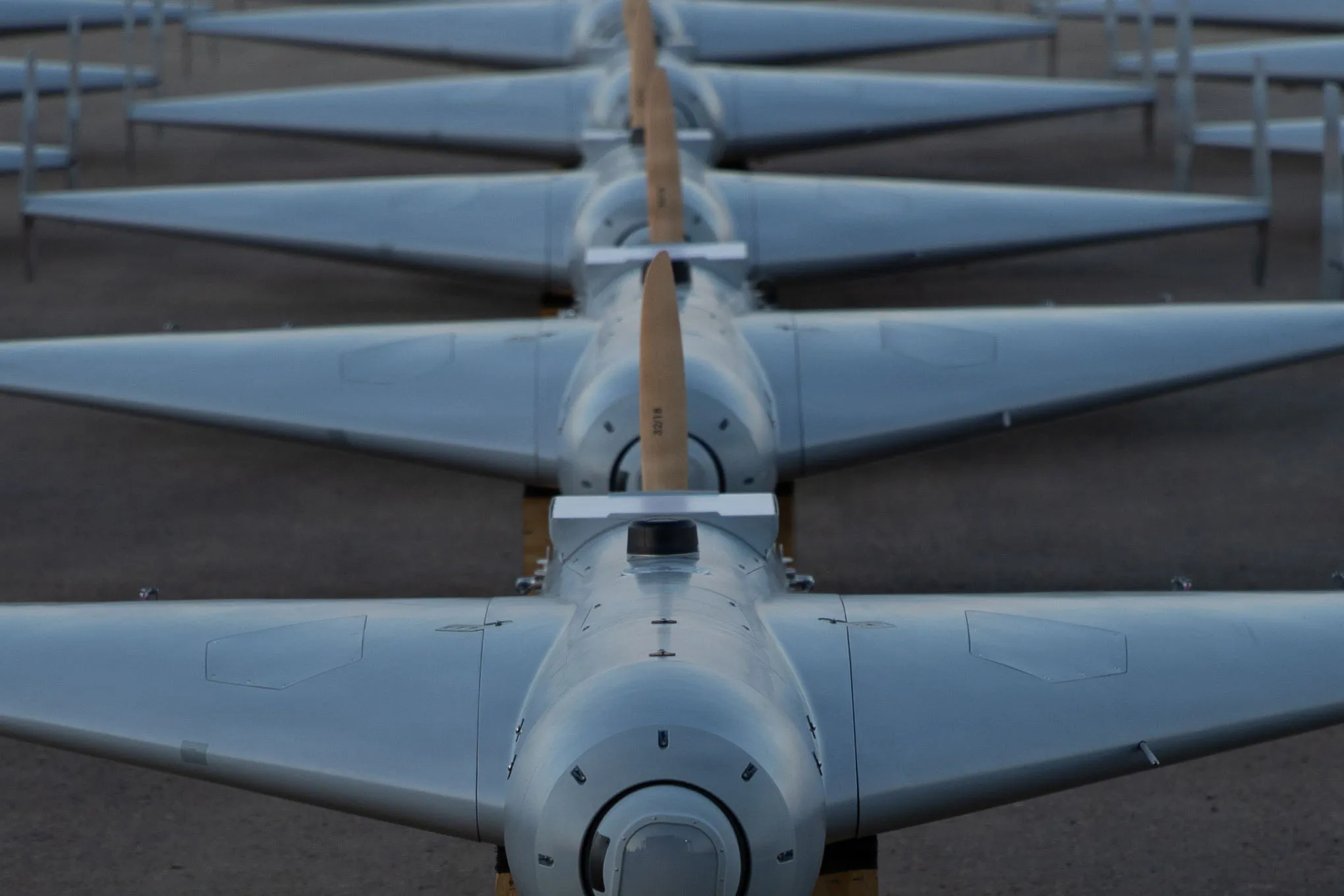
U.S. CENTRAL COMMAND AREA OF RESPONSIBILITY (Nov. 23, 2025) Low-cost Unmanned Combat Attack System (LUCAS) drones are positioned on the tarmac at a base in the U.S. Central Command (CENTCOM) operating area, Nov. 23. The LUCAS platforms are part of a one-way attack drone squadron CENTCOM recently deployed to the Middle East to strengthen regional security and deterrence. (Courtesy Photo)
Low-cost Unmanned Combat Attack System (LUCAS) drones are positioned on the tarmac at a base in the U.S. Central Command (CENTCOM) operating area, Nov. 23, 2025. The LUCAS platforms were part of a one-way attack drone squadron CENTCOM deployed to the Middle East to strengthen regional security and deterrence. Courtesy Photo/U.S. Department of War

In the Ukrainian context, Tseng confirmed that its AI agents are employed across a range of uncrewed platforms. At one end of the scale, these include one-way attack drones with a range of around 62 miles and an overall cost of $8,000, out of which the AI pilot costs around $1,000. At the other end of the scale are much larger and more expensive drones and missiles, including cruise missiles from the Switzerland-based Destinus company.

Returning to the U.S. military, the current effort began with Shield AI working on collaborative autonomy with OUSW R&E, something that began before the second Trump administration. That work was carried forward until the company was one of several down-selected to provide AI pilots for LUCAS.

The effort could represent a significant step toward fielding collaborative autonomy, a long-term goal of massed drone operations, with teams of autonomous systems operating together in dynamic and highly challenging combat environments. These could include ones where GPS is denied and communications are degraded, due to heavy employment of electronic warfare by the enemy.

“LUCAS is about delivering affordable mass, but mass without coordination is limited in value,” Tseng, who is the president and co-founder of Shield AI, said in a media release. “Hivemind is the AI pilot that makes that mass intelligent. It’s the autonomy layer that enables teams of drones to sense, decide, and act at scale. We’re proud to partner with OUSW R&E to put this capability in the hands of the warfighter at the speed of relevance.”

Hivemind is intended to streamline the operation of networked uncrewed systems by allowing a single operator to monitor and direct, as needed, multiple platforms simultaneously during complex, highly-coordinated missions. Using Hivemind, human operators retain authority over strike decisions, while the autonomy software handles navigation, coordination, and general mission execution. The operator can override and redirect the swarm’s operations and redefine its objectives at any time. Automating the swarm’s operations as much as a possible accelerates the timeline from target detection to engagement across a kill chain. The swarm should also be able to collectively act faster than an enemy can react, overwhelming and potentially breaking its decision cycle.

251216-N-NO146-1228 ARABIAN GULF (Dec. 16, 2025) A Low-cost Unmanned Combat Attack System (LUCAS) successfully launches from the flight deck of the Independence-class littoral combat ship USS Santa Barbara (LCS 32) while operating in the Arabian Gulf, Dec. 16. Task Force 59 operated the LUCAS drone, which is part of Task Force Scorpion Strike, a one-way attack drone squadron recently deployed to the Middle East to strengthen regional security and deterrence. (U.S. Army photo by Spc. Kayla Mc Guire)
A Low-cost Unmanned Combat Attack System (LUCAS) drone launches from the flight deck of the Independence class Littoral Combat Ship USS Santa Barbara (LCS 32) while operating in the Arabian Gulf, Dec. 16, 2025. U.S. Army photo by Spc. Kayla McGuire

“It’s our policy that the moral decision behind the use of lethal force is always made by a human, and so ‘human in the loop’ is certainly part of the game for that decision-making process,” Tseng highlighted. “Once you make that decision, in the same way, once you decide to launch a cruise missile, then the AI is actually helping ensure that that decision gets fulfilled.”

For the time being, the U.S. military demands a human operator is ‘in or on the loop’ for kinetic or otherwise potentially deadly actions, as opposed to letting autonomous weapons choose what targets to attack on their own without any extra authorization. While less controversial morally, this can also be a tactical hindrance, slowing the swarm’s potential and adding complexity and vulnerabilities to its operations. The debate around this choice will only get more heated as adversaries bypass this elected restriction in order to get an upper hand in future combat scenarios.

As we pointed out in our initial reporting on LUCAS’s emergence, the fact that some of the LUCAS drones already include miniature SATCOM terminals is very noteworthy. After all, ‘human in the loop’ swarming would not be possible without this form of communications at the beyond line-of-sight ranges these drones fly. At the same time, an entire swarm can be controlled in this manner, even if just a handful are equipped with SATCOM terminals. While a swarm can be mesh networked within line-of-sight, it has to relay all the important information back to an operator. By using some of the drones as SATCOM relay nodes, the entire swarm can be controlled remotely from most places on the planet.

A LUCAS drone equipped with a SATCOM antenna. (DoW)

Regardless, the Hivemind AI pilot will allow appropriately equipped LUCAS drones to perceive their environment, make decisions, and act autonomously without continuous human input. Unlike conventional autopilots tied to fixed flight paths, Hivemind is designed to dynamically adjust mission plans, react to unforeseen conditions, avoid obstacles, and carry out complex tasks with minimal operator oversight.

In terms of how an AI pilot can assist LUCAS drones, including providing autonomous mission execution and swarming in GPS-denied, communications-denied environments, Tseng likened the technology to that which is behind self-driving cars.

“We’re using a lot of the same technical approaches that Tesla or Waymo are using; we use sensors on board these drones and weapon systems to perceive our environment. We got a GPU [graphics processing unit, a specialized electronic circuit designed for digital image processing] that thinks about what to do and is programmed to think about the different missions that it’s executing in said environment, and then we take action, maneuvering the drone or the weapon system in the environment.”

Already, Hivemind has been inserted in a variety of other platforms, including aboard Anduril’s YFQ-44A under the U.S. Air Force’s Collaborative Combat Aircraft (CCA) program, the U.S. Navy BQM-177 test aircraft, the Airbus UH-72B Lakota helicopter, and the Destinus Hornet platform. The company says it has integrated AI pilots for 28 different platforms to date.

Teaming Autonomous Jets: Hivemind + MQM-178 Firejets thumbnail

Teaming Autonomous Jets: Hivemind + MQM-178 Firejets


Tseng said the company wants to start flight testing with Hivemind in July. “I hope they make it operational as quickly as possible,” he added.

The path to operational service should be made easier by previous experience from Ukraine, where it took only eight weeks to put an AI pilot into one of their one-way attack platforms.

However, the final decision on fielding AI-equipped LUCAS drones rests with the customer. “It’s up to the government, and I’m not going to disclose timelines on when the government thinks about fielding it,” Tseng said of the Hivemind-equipped LUCAS drone.

While LUCAS drones without AI pilots have already achieved impressive results in the recent conflict with Iran, according to the Pentagon, Shield AI is meanwhile confident that the capabilities of the platform will be significantly enhanced once they are flying with AI onboard. The results should include increasing the probability of kill, lowering the cost per effect, and increasing overall mission success.

“If you have cheap one-way attack drones, but it takes 10 or 20 of them to destroy a target, they’re no longer that cheap, right?” Tseng contended. “But if all of a sudden you have cheap one-way attack drones, and one out of one can kill it, and now you can kill 20 targets, that is a really low cost per effect, and that’s what the United States is after at the end of the day.”

ARABIAN GULF (Dec. 16, 2025) A Low-cost Unmanned Combat Attack System (LUCAS) launches from the flight deck of the Independence-class littoral combat ship USS Santa Barbara (LCS 32) while operating in the Arabian Gulf, Dec. 16, 2025. Prior to the launch, Naval Air Warfare Center Weapons Division’s Shipboard Weapons Integration Team validated that the ship could safely store, move, and handle the system at sea. Task Force 59 operated the LUCAS drone as part of Task Force Scorpion Strike operations. (U.S. Army photo by Spc. Kayla McGuire)
Another view of a Low-cost Unmanned Combat Attack System (LUCAS) drone launching from the USS Santa Barbara. U.S. Army photo by Spc. Kayla McGuire

Putting an AI pilot in the LUCAS drone is a big deal for the program. If it works as planned, it should help realize the long-held ambition of coordinated swarms of drones, not just drones being deployed en masse.

Using the software, multiple LUCAS drones will be able to share tasks and maneuver cooperatively, making saturation attacks even more effective. As well as the drones dynamically rerouting, avoiding air defenses, and otherwise adapting to changing battlefield conditions, an AI pilot makes it easier for missions to continue despite hostile jamming or loss of datalink connectivity. Indeed, using AI, drone swarms can maintain near-perfect combat efficiency even if it loses members. Drones can be configured with all different payloads, with the swarm’s makeup tailored to each mission, and the AI system can maximize their collective effectiveness at all times.

With flight testing of Hivemind-equipped LUCAS drones expected to start in only a couple of months, we should begin to get a better look at the transformation of these kamikaze drones from expendable individual weapons into groups of networked weapons that collectively equate to much more than the sum of their parts.

Contact the author: thomas@thewarzone.com

Thomas is a defense writer and editor with over 20 years of experience covering military aerospace topics and conflicts. He’s written a number of books, edited many more, and has contributed to many of the world’s leading aviation publications. Before joining The War Zone in 2020, he was the editor of AirForces Monthly.


Source link

Inside the Nigerian Military’s Quiet Gains Against a Fragmented War

In Nigeria’s North East, the Boko Haram insurgent group once carved out territory and declared a caliphate. In the North West, terrorist groups operate as fluid, profit-driven networks, embedding themselves in local economies. In the Middle Belt, communal violence reflects deeper contests over land, identity, and survival. In the South East, separatist agitation by the Indigenous People of Biafra (IPOB) has fused with armed enforcement and criminal opportunism. Along the southern waterways, oil theft and piracy threaten economic lifelines.

Across all these theatres, one institution has remained consistently engaged: the Nigerian military, often as the default responder in the absence of effective civilian governance. Public perception often frames this engagement as a failure as attacks continue and civilians remain vulnerable. A closer, evidence-based reading tells a more complex story, however, though available data remains incomplete and, at times, contested. 

Infographic: 5,295 armed clashes, 909 air/drone strikes, 259 territory recoveries, 218 interventions, 388 cross-border events, 135 surrenders.
The Nigerian military has recorded gains that have accumulated over the years. Infographics: Damilola Lawal/HumAngle.

The Nigerian military appears to have adapted under pressure and recalibrated aspects of its doctrine, and, in key moments, helped reverse trajectories that once pointed toward state collapse. It has delivered tangible gains, some strategic, others tactical, many costly. Still, those gains sit on unstable ground because governance gaps, political interference, corruption, and weak institutional follow-through have repeatedly blunted them. Communities liberated from one threat find themselves exposed to another. 

The North East war: reversing a collapse

By early 2015, Nigeria was on the brink of losing control in the North East. Boko Haram had evolved from an insurgent group into a territorial force controlling large swathes of Borno State and parts of Yobe and Adamawa. It administered territory, collected taxes, and imposed its authority over local populations. Gwoza was declared the headquarters of a so-called caliphate. Entire communities were displaced, and military formations overrun.

The turning point came with a shift in military posture, in which command structures were reconfigured, and the operational headquarters was relocated to Maiduguri, the Borno State capital, bringing leadership closer to the frontline. Coordination with regional forces under the Multinational Joint Task Force (MJTF) also intensified as air and ground operations were synchronised.

The results were immediate and significant, though the durability of these gains has varied across locations. Key towns like Monguno, Bama, Dikwa, and even Gwoza, the symbolic heart of Boko Haram’s territorial claim, fell back under government control in rapid succession. Data from ACLED shows that between 2015 and 2025, the military recovered at least 259 territories. 

With this territorial success, supply routes were disrupted, and fighters were killed in large numbers. Civilians began to return to these areas, in some cases under fragile security conditions. 

It marked the collapse of Boko Haram’s experiment with territorial governance, and the battle for Sambisa Forest reinforced this shift.

Counter-insurgency early in the war featured the rapid reconquest of Boko Haram territory from 2015–16, followed by various clearance ops in 2017–20, which was wound down by 2022. Much of this reconquest was essentially complete by 2021.  Data: ACLED.  Infographics: Damilola Lawal/HumAngle.

For years, Sambisa had functioned as a strategic sanctuary where fighters trained, hostages were held, and leadership structures operated with relative security. It also carried psychological weight. As long as Sambisa remained intact, Boko Haram retained a sense of permanence.

The military’s assault on the forest required sustained effort involving navigating difficult terrain, dealing with improvised explosive devices, and confronting entrenched fighters. Airstrikes softened targets while ground troops advanced in phases, enabling special forces units to penetrate deeper into the forest.

The symbolic impact was significant, though not decisive in ending insurgent capacity. Boko Haram could no longer claim a fixed territorial base for as long as was once the case. Its command structure was disrupted, and its image of invincibility weakened.

And so Boko Haram fragmented into factions. The Islamic State West Africa Province (ISWAP) emerged as a more structured and strategic actor while the Shekau-led faction became more erratic, marked by extreme violence and unpredictability.

The military adjusted again.

Operations shifted from territory holding to mobility and disruption. Intelligence-led raids targeted leadership and logistics. Airpower became central to deep strikes in difficult terrain. Operation Lafiya Dole, the codename for the counter-insurgency operation, transitioned into Operation Hadin Kai, reflecting a recalibrated effort.

Today, the insurgency remains active, particularly in remote areas and along the Lake Chad basin. But the scale and nature of the threat have changed.

The air campaign is sustained and expanding in line with the trend. Over the years, the top regional targets have included the Northeast: 485 strikes (6,063 deaths), the Northwest: 309 strikes (3,629 deaths), and the South-South: 50 strikes (15 deaths). Data: ACLED.  Infographics: Damilola Lawal/HumAngle.

The North West: fighting a war without frontlines

The North West posed a different challenge. Armed groups here are diffuse. It lacks a central command and is driven by economic incentives rather than ideology, so groups form, splinter, and realign quickly. Local grievances and criminal enterprise also intersect here.

Estimates suggest tens of thousands of terrorists operate across this region, covering multiple states including Zamfara, Katsina, Kebbi, Sokoto, and Kaduna. This fragmentation complicates the military response, as frontlines, headquarters, and leadership structures (the usual strategic targets) are not clear. The military has responded by leaning heavily on airpower and targeted ground operations. This has not gone without major problems, such as the repeated “accidental bombing” of civilian populations, which have drawn criticism from rights groups and affected communities. 

Still, airstrikes have been used to hit camps deep within forested areas that are difficult for ground troops to access. Intelligence plays a critical role in identifying targets. Data shows that the sustained air campaign has yielded at least 909 strikes and 10,237 fatalities in 10 years. ACLED data shows that about 560 of these fatalities were civilians.

Ground forces usually conduct follow-up operations to recover weapons and temporarily secure areas.

The airstrikes targeted insurgent sects in the North East, and in the North West, the raids targeted various non-state actor groups with varying agendas. Oil thieves and pirates are mainly the targets in the South South. Data ACLED. Infographics: Damilola Lawal/HumAngle

Large numbers of kidnapped victims have been rescued during coordinated operations. Livestock, often a key economic asset for communities, has been retrieved. Such attacks have also killed some high-profile terrorist leaders, but they have also led to the loss of officers. 

In some areas, these operations appear to have had a temporary stabilising effect, though violence frequently resurges. Communities report periods of reduced attacks, farming activities have resumed in limited corridors, and confidence in security presence has improved, though often temporarily. 

Still, armed violence regenerates as the effects of weak governance in the North East are the same in the North West: new leaders emerge, and fighters disperse and regroup. Economic incentives remain strong. 

The Middle Belt: stabilising a political conflict

Violence in the Middle Belt is often described as a farmer-herder conflict, but the region’s violence reflects a complex mix of land disputes, ethnic tensions, and environmental stress. Armed militias operate alongside opportunistic criminal actors, while cycles of reprisal deepen mistrust between communities. 

There are too many dynamics in play here to reduce the crisis to a “military versus any specific group” conflict. Most of the time, softer kinetic actions, such as arrest and deterrence, are used. 

In certain corridors, the presence of military forces has reduced the frequency of mass casualty events. But the limits are clear. Several parts of the region still depend on self-help vigilante groups, who are often outgunned during terror attacks. 

There is also a growing distrust between communities and security operatives, who are sometimes accused of slow response and complicity. In April, residents of Gashish, a rural community in Barkin Ladi Local Government Area of Plateau State, staged a protest over continued attacks in the community despite military presence. A checkpoint manned by troops of Operation Enduring Peace was destroyed during the demonstration. 

The military has denied such accusations, but independent verification remains limited. 

However, in other areas, the visibility of armed forces has also had a deterrent effect on opportunistic attacks. 

At its core, the conflict in the region is driven by political and environmental factors. It revolves around identity and access to land and water. While military deployments can suppress violence temporarily, they cannot resolve competing claims or rebuild trust between communities. Without political solutions, stability remains provisional.

The military has also recorded arrests where softer kinetic actions and deterrence are required. This cuts across war theatres and international boundaries, notable examples include the 642 Nigerian refugees arrested in Cameroon (2017), the 72 suspects from Jos violence (2018), and 30 men arrested by MNJTF (2022)/ Infographics by Damilola Lawal/HumAngle.

The South East: managing a hybrid threat

The South East presents a hybrid security challenge. Separatist agitation, particularly linked to IPOB, has evolved into a mix of political mobilisation and armed enforcement. The group has enforced sit-at-home orders through violence and intimidation while the Eastern Security Network (ESN) operates in forested areas.

The military’s response has been presented as targeted and intelligence-driven. Operations focus on dismantling camps, intercepting arms, and arresting key figures. Urban centres are secured to prevent escalation into wider insurgency.

Yet the approach carries risks.

Heavy-handed operations have generated grievances. Allegations of abuses have eroded trust in some communities. This complicates intelligence gathering, which is critical in a conflict where fighters blend into civilian populations. 

Targeted and intelligence-driven operations have led the military to dismantle camps, IEDs, and intercept arms across Nigeria, among other gains. This trend is growing in the Southeast. Infographics: Damilola Lawal/HumAngle

The Niger Delta and maritime domain: securing economic lifelines

In the South South and along Nigeria’s maritime corridors, the military, particularly the navy, has delivered some of its most visible successes. A decade ago, the Gulf of Guinea was a global hotspot for piracy. Sustained operations, including improved surveillance, increased naval patrols, and collaboration with international partners, have changed that landscape. These have led to the destruction of illegal refining sites and to arrests that disrupt networks involved in oil theft.

These gains have helped to protect revenue streams, stabilise energy production, and reinforce Nigeria’s position in regional maritime security, although illegal activities have not been fully eradicated. 

“The Nigerian military is overstretched”

According to World Bank data collected from development indicators in 2020, Nigeria has roughly 223,000 active personnel across the army, navy, and air force. The army, which carries out most internal operations, has about 140,000 to 150,000 troops.

In the battlespace, there are simultaneous operations in at least six theatres. That constitutes multi-domain internal security warfare. Nigeria has about 0.1 per cent of its population under arms. When compared to countries facing sustained internal conflict, which often exceed 0.3 to 0.5 per cent, the country is operating below the threshold needed to dominate territory.

On the geography front, Nigeria is over 923,000 square kilometres, with vast forests, porous borders, and ungoverned rural space. It is impossible to hold ground everywhere with the limited available personnel. So troops are cycled, which then leads to fatigue because units stay deployed for long periods with limited rest.

Retired Lt. Gen. Tukur Buratai, the country’s former Chief of Army Staff, recently said, “The military is overstretched, defence budgets are diverted to routine policing duties, and the Armed Forces’ preparedness for conventional threats is reduced.”

However, there are also welfare issues and equipment gaps, especially at the tactical level in remote theatres. The result is predictable: Tactical wins, like killing terror commanders or rescuing hostages are visible, but strategic stagnation remains because you cannot sustain presence everywhere.

Military intervention is a subset of the over 8,259 total military-linked events reported in the past decade. Infographics: Damilola Lawal/HumAngle

The structural constraint: why gains do not hold

Despite these efforts, Nigeria’s security situation remains volatile. 

In many areas, once the military has cleared armed actors, there is limited follow-through by civil authorities, as local administration is weak. So, communities do not experience the full return of the state, allowing armed groups to exploit this gap to re-enter or reorganise.

Economic conditions sustain conflict. Studies have shown that high levels of poverty and unemployment, particularly among young people, create a pool of potential recruits when armed groups offer income, however precarious.

Trust deficits also weaken intelligence because communities that distrust state actors are less likely to share information. This limits the effectiveness of intelligence-led operations and increases reliance on force.

Finally, strategy remains fragmented. Nigeria faces different types of violence that require tailored responses. Yet policy often treats them through a similar lens. Counterterrorism approaches are applied to terrorist attacks, while military solutions are prioritised in conflicts that require political negotiation.

The Nigerian military has played a significant role in preventing state collapse in multiple regions.

At the height of Boko Haram’s expansion, the possibility of sustained territorial loss was real. That threat has been largely reversed. In the North West, despite persistent violence, terrorist groups have not been allowed to consolidate into a territorial authority. In the South East, tensions have been contained below the threshold of full insurgency. In the maritime domain, economic lifelines have been secured.

However, good governance remains the only real pathway out of a cycle of violence. 

Data from HumAngle Tracker

Yet the reality remains harsh. Lives are still lost daily. Families continue to sell everything they own to pay ransoms. The military has contributed to pushing back elements of the threat with measurable, though uneven, success, but it has not eliminated them.


Additional data provided by Mansir Muhammed. 

Source link