California has lost more than a quarter of its immigration judges this year
WASHINGTON — More than a quarter of federal immigration judges in California have been fired, retired or quit since the start of the Trump administration.
The reduction follows a trend in immigration courts nationwide and constitutes, critics say, an attack on the rule of law that will lead to yet more delays in an overburdened court system.
The reduction in immigration judges has come as the administration scaled up efforts to deport immigrants living in the U.S. illegally. Trump administration officials have described the immigration court process, in which proceedings can take years amid a backlog of millions of cases, as an impediment to their goals.
Nationwide, there were 735 immigration judges last fiscal year, according to the Executive Office for Immigration Review, the arm of the Justice Department that houses immigration courts. At least 97 have been fired since President Trump took office and about the same number have resigned or retired, according to the union representing immigration judges.
California has lost at least 35 immigration judges since January, according to Mobile Pathways, a Berkeley-based organization that analyzes immigration court data. That’s down from 132. The steepest drop occurred at the San Francisco Immigration Court, which has lost more than half its bench.
“A noncitizen might win their case, might lose their case, but the key question is, did they receive a hearing?” said Emmett Soper, who worked at the Justice Department before becoming an immigration judge in Virginia in 2017. “Up until this administration, I had always been confident that I was working in a system that, despite its flaws, was fundamentally fair.”
Our government institutions are losing their legitimacy
— Amber George, former San Francisco Immigration Court judge
The administration intends to fill some judge positions, and in new immigration judge job listings in Los Angeles, San Francisco and elsewhere seeks candidates who want to be a “deportation judge” and “restore integrity and honor to our Nation’s Immigration Court system.”
The immigration judges union called the job listings “insulting.”
Trump wrote on Truth Social in April that he was elected to “remove criminals from our Country, but the Courts don’t seem to want me to do that.”
“We cannot give everyone a trial, because to do so would take, without exaggeration, 200 years,” he added.
The National Assn. of Immigration Judges said it expects a wave of additional retirements at the end of this month.
“My biggest concern is for the people whose lives are left in limbo. What can they count on when the ground is literally shifting every moment that they’re here?” said Amber George, who was fired last month from the San Francisco Immigration Court. “Our government institutions are losing their legitimacy.”
Because immigration courts operate under the Justice Department, their priorities typically shift from one presidential administration to the next, but the extreme changes taking place have renewed longtime calls for immigration courts to become independent of the executive branch.
The Trump administration recently added 36 judges; 25 of them are military lawyers serving in temporary positions.
This summer, the Pentagon authorized up to 600 military lawyers to work for the Department of Justice. That took place after the department changed the requirements for temporary immigration judges, removing the need for immigration law experience.
The Department of Justice did not respond to specific questions, but said judges must be impartial and that the agency is obligated to take action against those who demonstrate systemic bias.
Former judges say that, because terminations have happened with no advance notice, remaining court staff have often scrambled to get up to speed on reassigned cases.
Ousted judges described a pattern: In the afternoon, sometimes while presiding over a hearing, they receive a short email stating that they are being terminated pursuant to Article II of the Constitution. Their names are swiftly removed from the Justice Department website.
Jeremiah Johnson is one of five judges terminated recently from the San Francisco Immigration Court.
Johnson said he worries the Trump administration is circumventing immigration courts by making conditions so unbearable that immigrants decide to drop their cases.
The number of detained immigrants has climbed to record levels since January, with more than 65,000 in custody. Immigrants and lawyers say the conditions are inhumane, alleging medical neglect, punitive solitary confinement and obstructed access to legal counsel. Requests by immigrants for voluntary departure, which avoids formal deportation, have surged in recent months.
Many of those arrests have happened at courthouses, causing immigrants to avoid their legal claims out of fear of being detained and forcing judges to order them removed in absentia.
“Those are ways to get people to leave the United States without seeing a judge, without due process that Congress has provided,” Johnson said. “It’s a dismantling of the court system.”

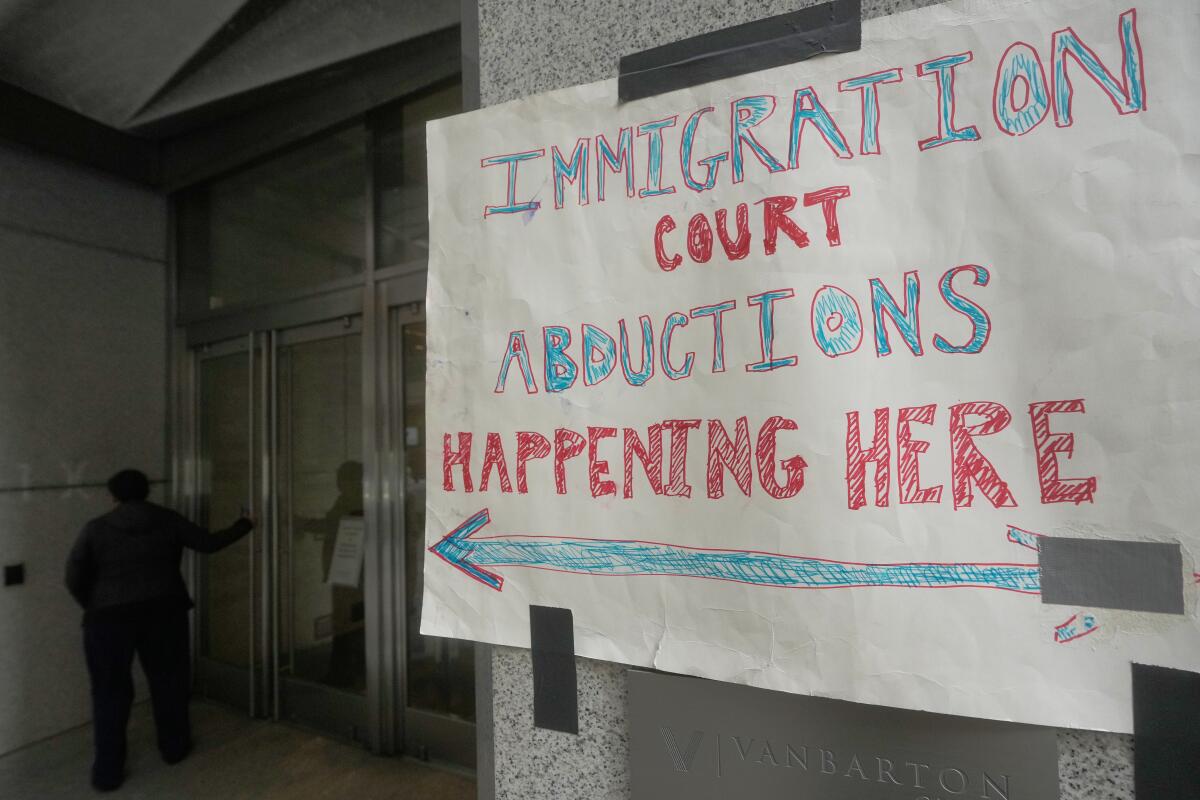
A sign posted outside the San Francisco Immigration Court in October protests enforcement actions by immigration agents. The court has lost more than half of its immigration judges.
(Jeff Chiu / Associated Press)
The judges in San Francisco’s Immigration Court have historically had higher asylum approval rates than the national average. Johnson said grant rates depend on a variety of circumstances, including whether a person is detained or has legal representation, their country of origin and whether they are adults or children.
In November, the military judges serving in immigration courts heard 286 cases and issued rulings in 110, according to Mobile Pathways. The military judges issued deportation orders in 78% of the cases — more often than other immigration judges that month, who ordered deportations in 63% of cases.
“They’re probably following directions — and the military is very good at following directions — and it’s clear what their directions are that are given by this administration,” said Mobile Pathways co-founder Bartlomiej Skorupa. He cautioned that 110 cases are a small sample size and that trends will become clearer in the coming months.
Former immigration judges and their advocates say that appointing people with no immigration experience and little training makes for a steep learning curve and the possibility of due process violations.
“There are multiple concerns here: that they’re temporary, which could expose them to greater pressure to decide cases in a certain way; and also they lack experience in immigration law, which is an extremely complex area of practice,” said Ingrid Eagly, an immigration law professor at UCLA.
Immigration courts have a backlog of more than 3 million cases. Anam Petit, who served as an immigration judge in Virginia until September, said the administration’s emphasis on speedy case completions has to be balanced against the constitutional right to a fair hearing.
“There are not enough judges to hear those cases, and this administration [is] taking it upon themselves to fire a lot of experienced and trained judges who can hear those cases and can mitigate that backlog,” she said.
Complementary bills introduced in the U.S. Senate and House this month by Sen. Adam Schiff (D-Calif.) and Rep. Juan Vargas (D-San Diego) would prevent the appointment of military lawyers as temporary immigration judges and impose a two-year limit of service.
“The Trump administration’s willingness to fire experienced immigration judges and hire inexperienced or temporary ‘deportation judges,’ especially in places like California, has fundamentally impacted the landscape of our justice system,” Schiff said in a statement announcing the bill.
The bills have little chance in the Republican-controlled Congress but illustrate how significantly Democrats — especially in California — oppose the administration’s changes to immigration courts.
Former Immigration Judge Tania Nemer, a dual citizen of Lebanon and the U.S., sued the Justice Department and Atty. Gen. Pam Bondi this month, alleging that she was illegally terminated in February because of her gender, ethnic background and political affiliation. In 2023, Nemer ran for judicial office in Ohio as a Democrat.

Atty. Gen. Pam Bondi, seen here at the White House in October, has dismissed complaints by a former immigration judge who alleged she was fired without cause.
(Evan Vucci / Associated Press)
Bondi addressed the lawsuit in a Cabinet meeting.
“Most recently, yesterday, I was sued by an immigration judge who we fired,” she said Dec. 2. “One of the reasons she said she was a woman. Last I checked, I was a woman as well.”
Other former judges have challenged their terminations through the federal Merit Systems Protection Board.
Johnson, of San Francisco, is one of those. He filed his appeal this month, claiming that he was not given cause for termination.
“My goal is to be reinstated,” he said. “My colleagues on the bench, our court was vibrant. It was a good place to work, despite all the pressures.”