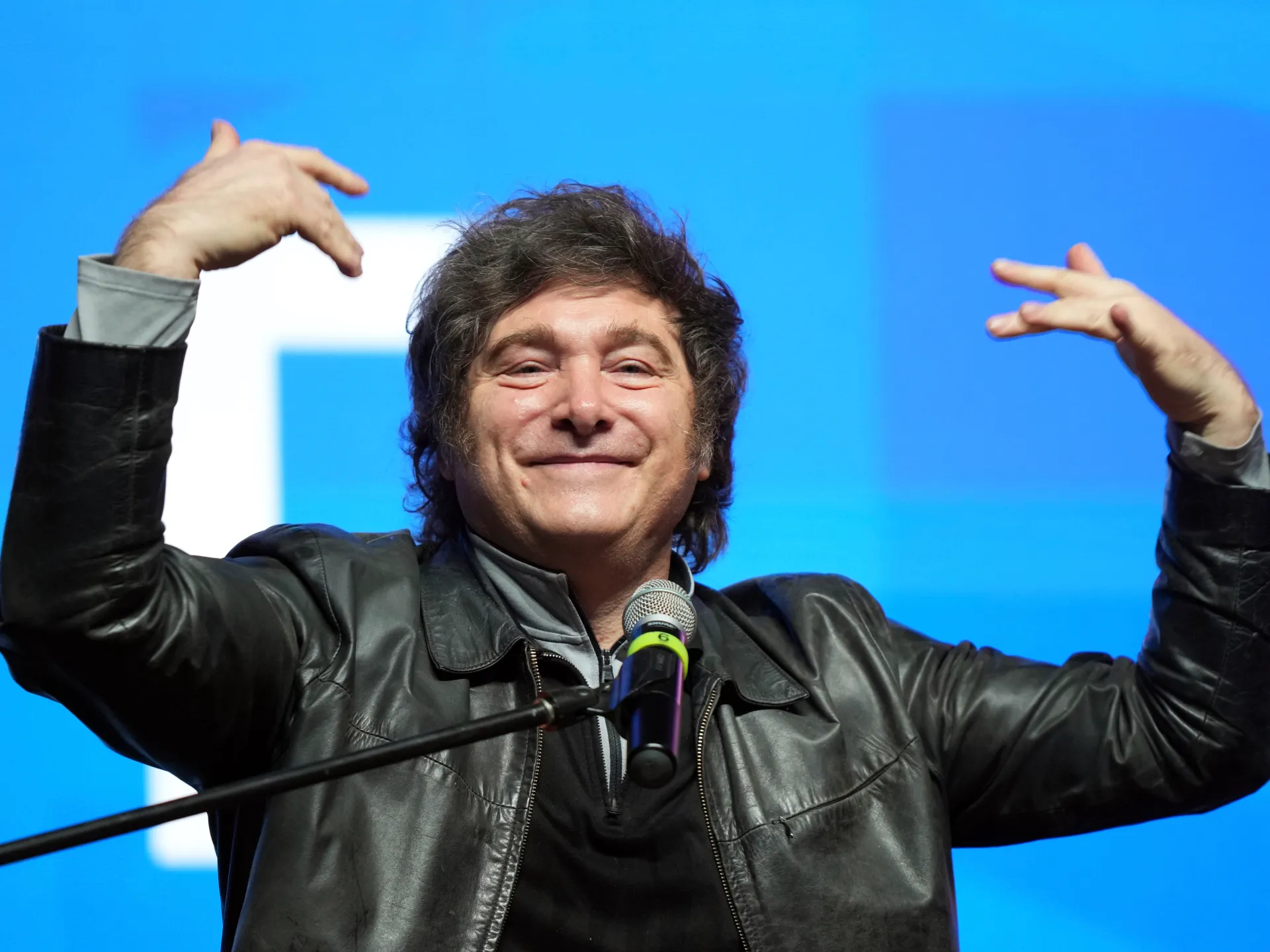
milei

Milei administration in Argentina blocks journalist access to Casa Rosada | Freedom of the Press News

Press freedom advocates have warned of hostile rhetoric towards journalists and increasingly restrictive policies under Milei.

The administration of Argentina’s Javier Milei has restricted access to the presidential palace, the Casa Rosada, as part of an escalating feud with the country’s journalists.

Accredited journalists reportedly arrived at the Casa Rosada on Thursday and attempted to enter the building through fingerprint scanning, as they usually would.

Recommended Stories

list of 3 itemsend of list

But they were unable to pass the scan. As confusion hit the news corps, the head of Argentina’s Secretariat of Communication and Press issued a clarification that their press accreditation had not been revoked.

“The decision to remove the fingerprints of journalists accredited to the Casa Rosada was taken as a preventive measure in response to a complaint filed by the Military Household regarding illegal espionage,” Secretary Javier Lanari wrote on social media.

“The sole objective is to guarantee national security.”

Lanari’s post cites an incident wherein two journalists from the Argentinian channel TN were accused of secretly filming inside the government palace.

After their report was broadcast, the Milei administration accused the journalists of endangering government security by showing parts of the Casa Rosada that were reportedly off limits.

On Wednesday, Milei himself took to social media to call the journalists “repugnant trash”. He then challenged other members of the news media to justify their actions.

“I would love to see that filthy scum — the 95% who carry press credentials — come out and defend what these two criminals did,” Milei wrote on X.

Since then, the president has repeatedly reposted messages critical of the news media, often accompanied by the acronym “NOLSALP” or “NOL$ALP”. It stands for: “We don’t hate journalists enough.”

“Someday, that filthy journalistic scum (95%) will have to understand that they are not above the law. They abused legal precedent. It does not come without a price,” Milei added in one of his posts on Thursday, as he continued to slam the news media.

This week’s actions are the latest in a series of policy changes under Milei designed to tighten restrictions on journalists.

Last year, for instance, his government capped entry to certain rooms in the Casa Rosada and placed other areas out of bounds.

Critics say the policies are part of a wider broadside against journalism in Argentina. The media advocacy group Reporters Without Borders (RSF) has said that, since Milei took office in 2023, the country has seen “a sharp decline in press freedom”.

And PEN International, an organisation for writers, warned last year of a “serious deterioration” in free-speech rights.

It pointed to legislation that further restricted which government documents could be made public and to Milei’s dismantling of public media, as well as the installation of a “mute” button to silence journalists during news conferences.

Already, the decision to bar journalists from entry into the Casa Rosada has faced pushback, including from Argentinian lawmakers.

Marcela Pagano, a former journalist turned deputy in Argentina’s legislature, announced on Thursday that she had filed a criminal complaint against Milei.

“The Casa Rosada is not private property,” Pagano wrote in a statement.

“Still less does a head of state — or his henchmen officials — have the authority to decide whether the press may access the building.”

She called Thursday’s incident “an unprecedented occurrence since the return of democracy” in Argentina in 1983.

“Prohibiting journalists from exercising their freedom of expression is the first step toward silencing any dissenting voice — a situation that we in Argentina have experienced during our country’s darkest moments,” she added. “THEY WILL NOT SILENCE US.”

Source link

Milei pushes sweeping overhaul of Argentina’s electoral system

Proposed electoral reform revives one of Argentine President Javier Milei’s campaign promises. File Photo by Demian Alday Estevez/EPA

BUENOS AIRES, April 22 (UPI) — President Javier Milei said he will send Congress a bill Wednesday to overhaul Argentina’s electoral system, including eliminating primary elections and changing the way political parties are financed.

The proposal revives one of Milei’s campaign promises and places renewed focus on a contentious issue in Argentina: how candidates are selected and how political campaigns are funded.

Milei announced the initiative on X, where he defended the reforms and intensified his criticism of the country’s traditional political establishment.

“We are eliminating the PASO: enough of forcing Argentines to pay for the internal elections of the political caste,” Milei wrote.

PASO, the Spanish acronym for Open, Simultaneous and Mandatory Primaries, is a nationwide system used in Argentina to determine candidates ahead of general elections. Under the current model, all political parties participate in a unified primary election to select candidates for national offices.

The government proposal would eliminate the mandatory national primary process and allow each political party to choose its candidates through its own internal mechanisms.

The PASO system has been in place since the 2011 elections and applies to national offices. The primaries are held every two years in August and determine party lists for congressional races, as well as presidential tickets that compete in the October general elections.

If approved, the reform would mark a significant change to Argentina’s electoral structure. Since its implementation, the PASO system has served both as a mechanism to organize internal party disputes and as an early measure of political strength before general elections.

The government also proposes changes to political financing, an issue that has long generated controversy in Argentina amid concerns over campaign funding sources and the use of public resources. A bill seeks to reduce public financing for political parties and strengthen oversight mechanisms.

Another central component of the proposal is the so-called “Clean Record” initiative, which would bar individuals with final corruption convictions from running for elected office.

In his post, Milei sharpened his confrontational rhetoric.

“Impunity is over. The party is over. Long live liberty, damn it,” he wrote.

According to Argentine newspaper La Nación, the bill also includes broader disqualifications for candidates. Those barred from the electoral registry under existing laws would be ineligible to run, as would people charged with serious crimes that include genocide, crimes against humanity, war crimes and human rights violations.

The proposal also would prohibit members of the armed forces and security services, judges, judicial officials and executives or representatives of companies holding public service concessions or linked to gambling operations from seeking elected office.

The measure further provides that people affected by these restrictions could not hold key executive branch positions, diplomatic posts or leadership roles in state-owned companies.

With the proposal, Milei adds another measure to his broader reform agenda and shifts the debate to Congress, where lawmakers are expected to face intense negotiations in a politically divided environment.


Source link

Argentina’s Milei backs US-Israel war on Iran in Jerusalem visit | US-Israel war on Iran

NewsFeed

Argentina’s President Javier Milei has reaffirmed strong alignment with the US and Israel during a visit to Jerusalem, backing their war on Iran.

His visit with Prime Minister Benjamin Netanyahu included new agreements and closer ties.

Source link