Inside ‘Mighty Real,’ Barry Walters’ history of LGBTQ+ music
For more than 40 years, Barry Walters has been closely watching the dance floors of New York and San Francisco, chronicling the ways in which LGBTQ+ culture has influenced mainstream culture. As a writer for the Village Voice, the Advocate and Spin, among others, Walters became one of music journalism’s most eloquent and crucial voices, championing artists like the Pet Shop Boys and Madonna during their formative years.
Walters’ new book, “Mighty Real,” draws on his deep firsthand knowledge, offering a comprehensive history of LGBTQ+ music from 1969 to 2000. I recently spoke with Walters about Babs, Madge and Bowie.
✍️ Author Chat
In the book, you make a distinction between pre-Stonewall LGBTQ music and post-Stonewall LGBTQ music.
Gay culture before Stonewall really had to be hidden, or at least secretive. I think of Barbra Streisand as a quintessential pre-Stonewall figure. Judy Garland, as well. These women are tough, and even though they sing songs written by men, it’s not in a submissive way. They are singing like they are the champions, even when they are suffering through what men do to women through the torch songs they perform.
What can you say about the encoded nature of certain songs that spoke to gay culture in a way that flew under the radar of hetero listeners in the pre-Stonewall era?
The music that spoke to gay culture, by necessity, had to be encoded. “Secret Love” by Doris Day is a good example. It’s about struggling to have something that’s otherwise forbidden. Sinead O’Connor covered that song. There was a song I loved as a young child called “Have I The Right?” by the Honeycombs, which was written by two British gay men at a time when homosexuality was illegal in England. You know, have I the right to be with whomever I want to be with?
What, in your view, was the big bang of post-Stonewall LGBTQ music?
David Bowie to a large degree. Right around the time that “Hunky Dory” was being released in 1971, he told the Evening Standard newspaper that he was gay, flat out just said it. And it was such a strange thing to say that many people doubted his sincerity.

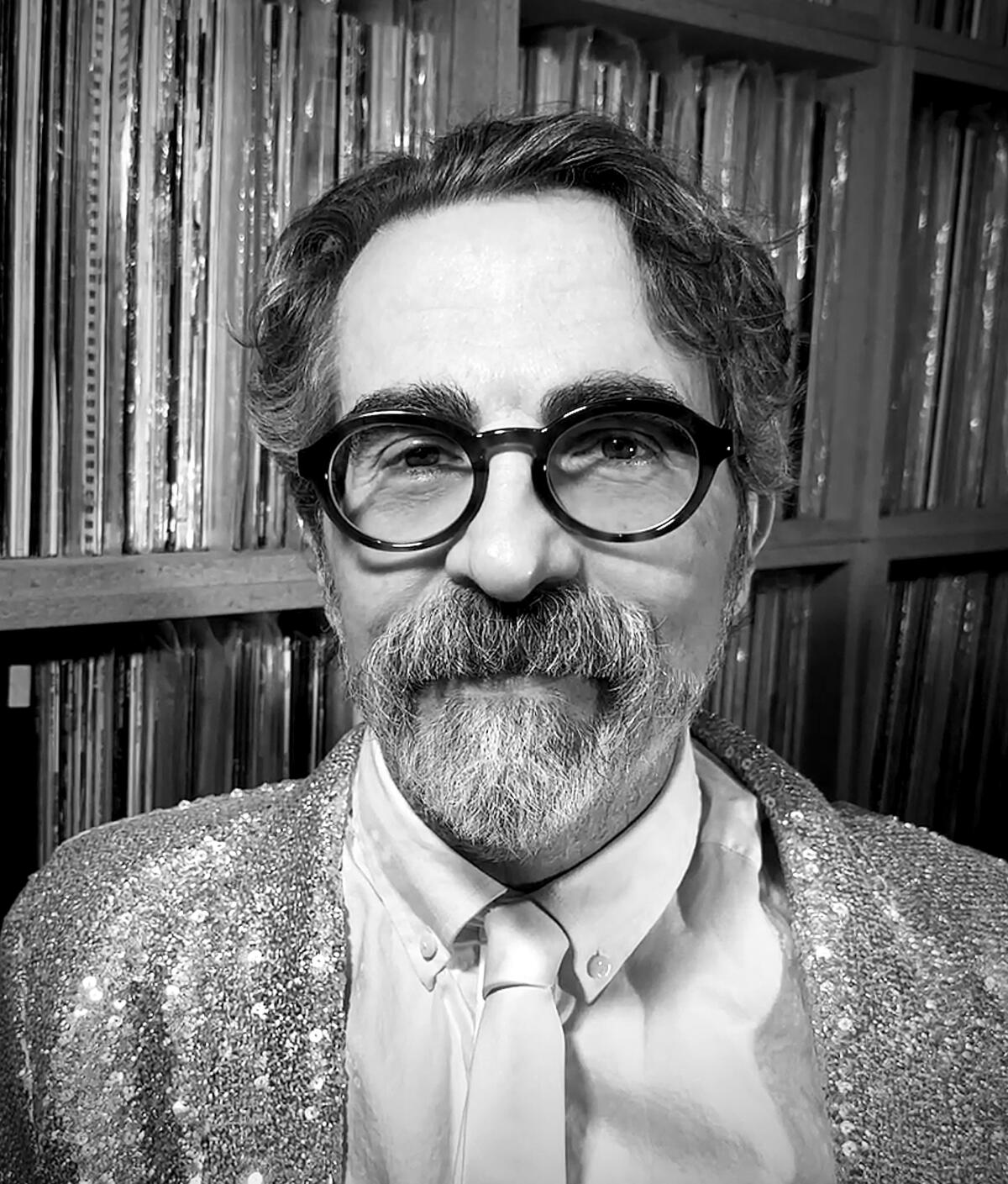
Barry Walters, a writer for the Village Voice, the Advocate and Spin, among others, wrote a new book about the history of LGBTQ+ music.
(Kelly Lawrence for Walters)
I remember seeing Bowie wearing that dress on the cover of “The Man Who Sold The World,” thinking that was the most transgressive act any rock star had ever committed.
And then he performed “Starman” on Top of the Pops in 1972 and he put his arm around his guitarist Mick Ronson, who also looked gorgeous. They were displaying a familiarity men aren’t supposed to have.
I thought I knew everything about pop music, but you have uncovered so many fascinating stories. Tell me about Olivia Records.
Olivia Records was an independent record label in the Bay Area owned and controlled by lesbians for female artists. This is years before punk or indie rock, when so many small labels cropped up. They pioneered so much. They would recruit fans in different cities to man the merchandise and to help get their records in stores. The idea of a merch table was something new at the time. They also created the forerunner of Burning Man. They would go find a farm somewhere and create an impromptu village, with food, sanitation and the rest.
You have given the most space in your book to Madonna, whom you have written about extensively over the years. Why is Madonna such a huge figure in the history of LGBTQ music?
Her art is so queer. I feel like she is one of us. She’s very much like Grace Jones, in that her sensibility is so aligned with gay culture. I related to Madonna on multiple levels. In the early ‘80s, I would see her around town, dancing at the same New York clubs I was frequenting, like Danceteria. She was steeped in gay culture, and then she brought all of this into the mainstream, and that was profound. I also feel like she was misunderstood in many ways. When straight men called her a slut, things like that. That is so far from the truth. She is such a complex artist. If you are making that claim, you don’t know anything about her.
(This Q&A was edited for length and clarity.)
📰 The Week(s) in Books

(Javier Pérez / For The Times)
Pulitzer prize winner Elizabeth Strout has a new novel called “The Things We Never Say,” and Julia M. Klein approves. “[Strout] reprises her familiar themes: the mysteries of human personality, the perils of solitude, the occasional possibility of grace … in deceptively simple, occasionally mannered prose that draws readers in and immerses them in her fictional worlds,” Klein writes.
They’re on a boat! Paula L. Woods climbed aboard a 130-foot yacht in Marina del Rey to soak in the vibes of the Yacht Girls Book Club. “I wanted conversations with like-minded women that were intellectual but fun,” club founder Aloni Ford told Woods. “And talking about books seemed to be the ideal way to achieve that.”
“PEN15” co-creator Anna Konkle has written a memoir called “The Sane One,” and Rachel Brodsky talked to her about it. “In some ways, ‘PEN15’ was a reaction to loving memoirs,” she tells Brodsky. “Raw memory has always been very exciting to me.”
Finally, our Times critics take the measure of this summer’s hottest beach reads.
📖 Bookstore Faves

Kinokuniya bookstores sell Japanese manga, stationery and literature.
(Courtesy of Kinokuniya)
When Kinokuniya opened its first L.A. shop in 1977, it was primarily to provide Japanese expats with imported books and magazines to read in their native tongue. Forty years later, the store has become a locus of Japanese printed matter for Angelenos eager to scoop up Japanese literature and manga in Japanese and English, as well an expansive selection of imported stationery products that, in L.A., can only be found in Kinokuniya’s three stores. I spoke with Sakura Yamaguchi, who manages two of Kinokuniya’s stores downtown (the third is in Mar Vista) about its many-splendored pleasures.
How did the store travel from Japan to Los Angeles?
Books Kinokuniya was founded by Moichi Tanabe in 1927. Located in the Shinjuku district of Tokyo in a two-story wooden building, the first Kinokuniya started with five employees, including Mr. Tanabe himself. In 1969, Kinokuniya opened its first overseas bookstore in San Francisco. The first Los Angeles store opened in 1977.
Who are your customers?
We first started as a store for Japanese customers, so we imported Japanese books and magazines and sold them, mainly. But in the past 10 years, Japanese manga/anime, stationery and literature has been quite popular in the U.S. Therefore our customers are a mix of Japanese-speaking customers and non-Japanese speakers who are interested in Japanese culture.
What percentage of your clientele buys Japanese–language products?
Forty percent Japanese-language products versus 60% English books.
What specific titles are selling for you right now?
“Witch Hat Atelier Grimoire Edition, Volume 1,” “JoJo’s Bizarre Adventure: Purple Smoke Distortion” and the “Strange Houses” series.
Are you seeing more young people turning to printed matter? It seems like there is an analog revival at the moment.
We have been trying to make exclusive editions that come with freebies to make the printed manga more attractive, but without that our English manga sales have been increasing and our main target for the manga is young people. There are many titles that are published exclusively in e-book format, but we frequently hear from customers asking when they will be released in print form. Also, recently there has been a growing number of cases where titles that were originally available only in digital format have later been published as physical books.
Kinokuniya at the Bloc in Los Angeles is located at 700 W 7th St.
(Please note: The Times may earn a commission through links to Bookshop.org, whose fees support independent bookstores.)