Lakers’ Austin Reaves out for rest of regular season with oblique strain
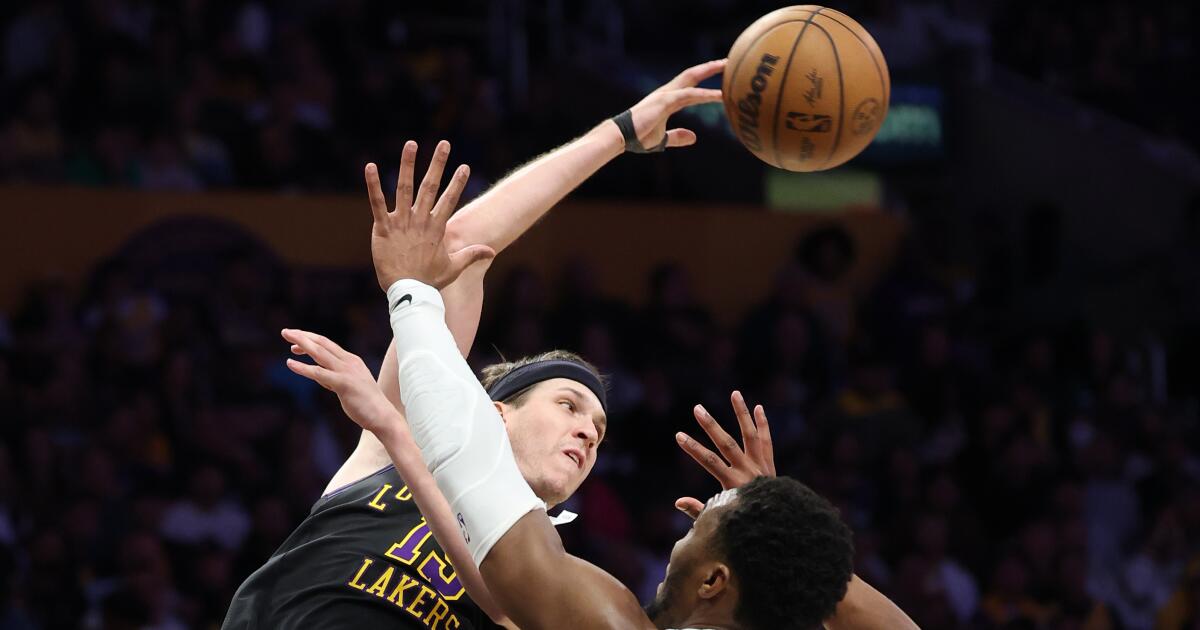
DALLAS — The Lakers will be without their starting backcourt for the rest of the regular season — five more games — after Austin Reaves was diagnosed with a Grade 2 left oblique strain on Saturday.
Lakers coach JJ Redick said Reaves underwent an MRI exam on his left olbique/rib area Saturday.
The team learned earlier this week that Luka Doncic has a Grade 2 left hamstring strain and will be out for the remainder of the regular season — and perhaps beyond.
The Lakers are also dealing with an injury to guard Marcus Smart, who has missed the last six games because of a right ankle contusion and is questionable for the game.
“It’s it’s lingering soreness in the ankle,” Redick said.
Even with all of this, Redick said the Lakers’ “mission hasn’t changed.”
“We want to get the third seed and we want to win a first-round series,” Redick said.
The Lakers are the third in the Western Conference, but Denver, Houston and Minnesota are within striking distance. The Lakers hold the tiebreaker over all three.
They’ll try to hold on to the No. 3 seed over the final five games of the regular season without Doncic, who leads the NBA in scoring (33.5 points per game) and is fourth in assists (8.3).
“I know Luka’s gonna do everything he can to get back on the court,” Redick said. “We don’t know what this recovery timetable looks like.”
The Lakers likely will have to lean more on LeBron James, a role the 41-year-old is more than willing to take on. James has been designated the third option behind Doncic and Reaves yet has still averaged 20.6 points per game, 6.9 assists and 6.0 rebounds in his 23rd season.
“It probably is going to look a little bit differently with Luka being out,” James said after practice. “I’ll figure that out and then, obviously, the coaches will figure it out as well.”
The Lakers are making the mental adjustment of playing without Doncic. After the Mavericks, they’ll have tough games against Oklahoma City, Golden State and Phoenix before finishing against lowly Utah.
“I mean, it’s a challenge for us,” James said. “It’s always got to be a next-man-up [mentality]. But there’s no way you can replace that type of impact. So, it’s going to be a collective group. We all have to figure out a way to do a little bit more. But even now, you got to be even more tightened up on the things that we do. When you lose a special player like that, you can’t have as many mistakes. So, we got to figure that out.”
For Redick, speaking for the first time since news of Doncic’s injury, he had to check on the temperature of his team to make sure his group was in the right space.
The practice Saturday on the campus of Southern Methodist helped.
“I think making sure that everybody’s in the right frame of mind, first of all, and then you know we worked on just offensive stuff, just cleaning up some stuff and being really explicit with what we want to run,” Redick said. “Did some offensive breakdown. It was definitely more of an offensive day.
“We did work on defense to start the practice, but that’s again that’s the primary sort of focus. How do we score, how do we score efficiently, and our defense again is, it’s we’re interchangeable. We’ve been interchangeable now for two-and-a half-months.”
James controversy
James created a bit of controversy when he said on “Bob Does Sports” YouTube video that Memphis should relocate to Nashville.
“I’m not like the first guy to even talk about it in the NBA. We all like, ‘You guys have to move. Just go over to Nashville,” James said.
James, when asked if he wanted to clarify his remarks, then mentioned Milwaukee also as one of his least favorite cities.
“I said Milwaukee as well,” James said. “I’m 41 years old (and) there’s two cities I do not like playing in right now — and that’s Milwaukee and that’s Memphis. What is your problem with it? I don’t like going home [to Cleveland] either. … And I’m from there. People are ridiculous. They also get mad at my son [Bronny James] being on the [Lakers] team, too.
“So, what are we talking about? People need to figure out other ways to put their energy to other things that’s important. Like, seriously? I’m not talking about the city, like the people in Memphis. I don’t like staying at the Hyatt Centric [hotel]. What’s wrong with that? Nothing. What are we talking about? What are we talking about? People need to chill the hell out.”