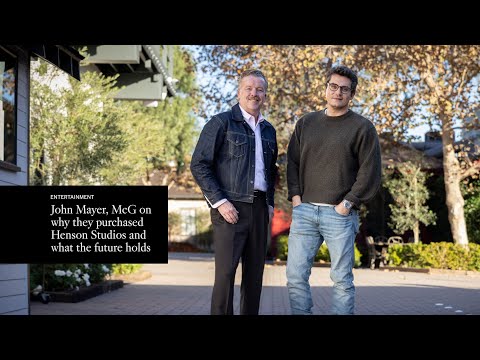
John Mayer and McG on why they bought Hollywood’s Henson Studios
John Mayer calls it “adult day care”: the historic recording studio behind the arched gates on La Brea Avenue where famous musicians have been keeping themselves — and one another — creatively occupied since the mid-1960s.
Known for decades as Henson Studios — and as A&M Studios before that — the three-acre complex in the heart of Hollywood has played host to the creation of some of music’s most celebrated records, among them Carole King’s “Tapestry,” Joni Mitchell’s “Blue,” Guns N’ Roses’ “Use Your Illusion” and D’Angelo’s “Black Messiah.”
In 1985, A&M’s parquet-floored Studio A was where Quincy Jones gathered the all-star congregation that recorded “We Are the World” in a marathon overnight session; in 2014, Daft Punk evoked the studios’ wood-paneled splendor in a performance of “Get Lucky” with Stevie Wonder at the 56th Grammy Awards.
A soundstage on the property has seen nearly as much history, including filming for TV’s “The Red Skelton Show” and “Soul Train” and the production of the Police’s MTV-defining music video for “Every Breath You Take.” More recently, Mayer and his bandmates in Dead & Company took over the soundstage to workshop their cutting-edge residency at the Las Vegas Sphere, not long after Mayer cut his most recent solo LP, 2021’s “Sob Rock,” at Henson.

“I used to come here even if I didn’t quite have anything to do,” says the Grammy-winning singer and songwriter known for his romantic ballads and bluesy guitar heroics. “I just wanted to be around music — to have a place to go as an artist to find some structure in my life.”
Now, with an eye on preserving the spot at a moment of widespread upheaval in the entertainment industry, Mayer and his business partner, the filmmaker McG, have finalized a purchase of the lot, which they bought for $44 million from the family of the late Muppets creator Jim Henson and which they’ve renamed Chaplin Studios in honor of the silent-film giant who broke ground on it more than a century ago.
Their vision for Chaplin, which takes up half a city block between Sunset Boulevard and De Longpre Avenue, is ambitious. “We’re doing our best to create kind of a Warhol’s Factory thing of like-minded artists bumping into each other to do their best work possible,” says McG.
And the duo already have some powerful support behind them.
“A lot of my friends and I were very happy to see that Henson was being taken over by some great people,” Paul McCartney tells The Times in an email. The rock legend, who made 2001’s “Driving Rain” and 2018’s “Egypt Station” at Henson, admits that news of the studio’s changing hands left folks in his world “worried that it might not be handled sensitively.”
“However, we realize now we have no reason to be as John Mayer and McG seem to be doing a fantastic job in keeping the famous studio alive.”
Still, the challenges they face are real: Thanks to advances in cheap audio equipment — and with the economics of streaming having cut into once-lavish recording budgets — even A-list artists often opt these days to record at home rather than shell out to book into an old-line studio like Chaplin. (Consider that at least two of the songs nominated for record of the year at February’s Grammys ceremony — Billie Eilish’s “Wildflower” and Chappell Roan’s “The Subway” — were constructed primarily at home.)
“Everyone with a computer and a microphone has a studio,” Mayer says, and that’s not even accounting for the proliferation of music conjured up by AI out of the digital ether.
On the film side, the ongoing exodus of production from L.A. raises natural doubts about the ability to keep a soundstage busy with clients — doubts, one presumes, that led the owners of Occidental Studios near Echo Park to put that lot up for sale last summer.
“The real estate guys weren’t necessarily saying what a prudent business move this was,” says McG, who directed the 2000 blockbuster “Charlie’s Angels” and executive produced TV’s “The O.C.” “But it’s not about the dividend or the monthly spit-out. I admire John for throwing down.”
Says Mayer: “I love doing things that people tell me aren’t gonna work. That’s how I know I’m onto something.”

McG inside the soundstage at Chaplin Studios.
(Jason Armond / Los Angeles Times)
Mayer, 48, and McG, 57, are lounging on a December afternoon in Mayer’s ranch-hand-chic office, which occupies what once was the mill where wood for Charlie Chaplin’s movie sets was cut. Last night the co-owners threw a holiday party for the studio’s staff and friends; McG breakdanced — “My neck hurts today, but I got through it,” he says — while Mitchell turned up and played the piano in Mayer’s personal Studio C, where she liked to work in the ’70s.
As we talk, Mayer is sipping no fewer than three different smoothies — an approach he says he picked up from the late Apple founder Steve Jobs, who evidently would order multiple smoothies to ensure he wasn’t missing out on a new discovery.
“There’s something I relate to about that,” Mayer says, his Double RL boots propped on a coffee table in front of him. “I’m gonna have this smoothie and a little bit of these other smoothies to figure out: Does that smoothie beat this smoothie as my all-time-favorite order? What if there’s a smoothie out there in the world that you haven’t tried yet that could be your favorite?”
He puts down one cup and picks up another. “This one has wheatgrass in it,” he reports. “Not for me.”
The singer met McG, whose real name is Joseph McGinty Nichol, in 2024 through the studio’s longtime manager, Faryal Ganjehei. Each had ample experience on the lot: In the 1990s, McG shot music videos on the soundstage for the likes of Sublime and Smash Mouth; Mayer first recorded at Henson in 2005 when he cut a version of “Route 66” for the soundtrack to “Cars.”
“You’d think John and I would have known each other just from around here or from Ari Emanuel’s or whatever,” McG says. “But this was actually a bit of an arranged marriage” between two people who’d separately heard rumblings that the Jim Henson Co. might be looking to move its operations. (The company, which makes a variety of children’s television shows, is now headquartered at Studio City’s Radford Studio Center.)
“One year in, we’re still performing vigorous lovemaking,” McG says of his and Mayer’s union.
“Can’t wait to see that in Times New Roman,” Mayer adds.

Herb Alpert, left, and Jerry Moss at A&M headquarters in 1966.
(Bettmann Archive / Getty Images)
Charlie Chaplin, who was born in London, began building the lot in 1917 in a white-and-brown English Tudor style; he went on to direct some of his best-known films, including “Modern Times” and “The Great Dictator,” on the property. After Chaplin left the United States in 1952, the lot was used for episodes of “The Adventures of Superman” and “Perry Mason.”
In 1966, Herb Alpert and Jerry Moss bought the place and made it the base for their A&M Records; they converted two of the lot’s soundstages into high-end recording studios that drew the the likes of Sergio Mendes, the Carpenters, Stevie Nicks, U2 and John Lennon. Henson took over in 2000 and continued to cultivate what many of the studio’s regulars describe as a cozy family vibe.
“It was truly my home away from home,” says John Shanks, who produced hit records by Sheryl Crow, Miley Cyrus and Ashlee Simpson, among many others, at Henson. “My kids celebrated birthdays there — they knew where the candy was in Faryal’s office.”
Mayer and McG say they’re putting $9 million into improvements on the lot — “an up-to-speed-ovation,” the director calls it — but have no plans to make significant structural or stylistic changes. Ganjehei’s staff of around 22 engineers, techs and runners will stay on, as will artists who maintain offices and studios on the property, among them Daft Punk’s production company and the duo of Wendy Melvoin and Lisa Coleman.
“We’ve all seen places we loved get renovated and then you go, ‘Yeah, I don’t like it there anymore,’” McG says.
Such as?
“The Four Seasons on Doheny,” Mayer responds. “They took out the old dining room and put in a Culina, and it’s no fun anymore.” Of Chaplin, he says, “This place has a beating heart. All we have to do is effectively not kill it, right?” He laughs. “Just stay away from the big red button that says, ‘I got an idea.’”
Adrian Scott Fine welcomes that attitude.
“It’s what we like to hear — it’s not what we often hear,” says the president and chief executive of the Los Angeles Conservancy, a nonprofit dedicated to historic preservation. “When places transfer out of long-term stewardship, that always raises our spidey senses: What does this mean for the future? Sometimes they go into safe hands with the next owner. Oftentimes it means radical change, loss of character, maybe demolition or redevelopment. So we’re very hopeful when someone says that because it doesn’t happen enough in L.A.”

John Mayer, right, and McG inside Studio B at Chaplin Studios.
(Jason Armond / Los Angeles Times)
As a show of historical continuity, Mayer and McG initially wanted to call the property Chaplin A&M. But Mayer says he couldn’t get Universal Music Group, which controls the A&M brand, to sign off on the name.
“I’ve never seen fruit so close to the ground before,” he says of the idea to bring back A&M. “Everyone I spoke to did the thing that people at record companies do, where it starts to get very gauzy as it moves up the flagpole: ‘Listen, I get it, but I can’t get the person above me to see it.’” (Moss died in 2023, and a spokesperson for Alpert said he wasn’t available for an interview. A UMG spokesperson didn’t respond to a request for comment.)
More disappointing, Mayer and McG say, was the Henson family’s decision to take down the 12-foot statue of Kermit the Frog — dressed as Chaplin’s Little Tramp character — that presided for 25 years over the lot’s front entrance.
“It was important to the Hensons to have Kermit — that was expressed very early on,” Mayer says of the statue, which the family is donating to the Center for Puppetry Arts in Atlanta. “We might have had the delusion of a reprieve. But they didn’t change their mind.”
“I talk to people I know and they say, ‘My kids go to school on La Brea, and every day we drive by and say, “What’s up, Kerms?”’” McG says. “It saddens me that the people of Los Angeles won’t be able to share in Kermit looking over them. If I sold Randy’s Donuts to a barbecue place, I’d hope the barbecue guy would keep the giant doughnut. It’s in the ‘I Love L.A.’ video with Randy Newman, OK?

Until recently, a 12-foot statue of Kermit the Frog presided over the front entrance to the Henson property on La Brea Avenue.
(AaronP / Bauer-Griffin / GC Images)
“This isn’t a McG thing,” the director adds. “It’s not a John Mayer thing. With the greatest respect, it’s not even a Henson thing. Kermit, to me, had transcended all of that and become a part of the fabric of this community.”
Did they make that emotional case to the Hensons?
“We tried,” Mayer says.
And it fell on deaf ears?
“Indeed,” says McG. (A spokesperson at the Jim Henson Co. declined to comment.)
Mayer has seen the comments on social media blaming him for Kermit’s disappearance, which is no doubt why he’s eager to get the word out that it wasn’t his doing. Yet the singer — a tabloid fixture since the days when he dated Taylor Swift and Jessica Simpson — says he’s not tortured by his haters.
“They should be worried about what I think of them,” he says with a laugh. “Honest to God, sometimes I read stuff and I go, ‘If only you knew …’ And I don’t have to apply that to myself as a balm so I stop feeling bad. I’m at the age now where I’ve seen everything you could possibly write, and I’ve survived.”
Not so long ago, Mayer would happily jump into the rough and tumble of online discourse. “But don’t you find yourself scrolling away from things so obviously designed to outrage you?” he asks. The sun is starting to go down outside — this is the time of day, he says, when Chaplin’s bucolic grounds remind him of Montecito’s San Ysidro Ranch — and he’s getting slightly philosophical.
“Millennials had their brains ripped out by the things they read. Gen Z is beginning to go, ‘I think a lot of these are bots.’ And I think Gen Alpha will be the generation that looks and says, ‘There’s a whole bunch of clankers writing bulls—. We don’t care.’
“My years of trash talking or being critical of any artist in any way — I think they’re over,” he says. “It never felt as good as it feels to run into people in the hallway and be glad they’re here.”
The sense of community Mayer feels — and is trying to nurture — at Chaplin is one reason he’s optimistic the studio will succeed.
“I think we’re leaving an era of ‘I did it myself — aren’t you amazed?’ Look at Dijon onstage at ‘SNL,’” he says of the R&B singer and producer who led an expansive group of musicians through a vivid TV performance in early December. “We’ve heard our hands applauding the fact that people have done it alone, and now we’re turning the corner and loving collaboration again. And you can’t come into a place like this and do it alone.”

“I love doing things that people tell me aren’t gonna work,” John Mayer says.
(Jason Armond / Los Angeles Times)
Even so, bills wait for no vibe shift. Beyond the business of recording, Mayer and McG are eager to make Chaplin’s soundstage a destination for acts in need of rehearsal space — AC/DC was recently in there practicing — as well as for certain high-end live events.
“If Anna Wintour’s gonna do ‘Women of Hollywood,’” McG says, “I need Anna Wintour going, ‘John, it’s got to be at your place.’”
Mayer says he’s fantasized about a sitcom or a talk show taking up residence on the soundstage.
“I hear John’s pretty good friends with Andy Cohen,” McG says of the Bravo host. “We’ll see where his show goes.”
“He looked at it,” Mayer says. “I think he needed more space to be able to do ‘Real Housewives’ reunions. Think about the number of Star Waggons you need for that.”
Yet music remains at the heart of Mayer’s ambitions for Chaplin, which he says he intends to own long enough to “sit down in a chair for a documentary several times, talking about other people’s records that were made here.” (Mayer himself says he’s been “defending the calendar of 2026” to record an album of his own.)
“Every time an artist drives through that gate, they’re taking an emotional risk,” he says. “Hoping they have a song in them but not being sure — it’s a very vulnerable state to be in. Everyone’s walking around, bumping into walls, thinking about what the rhyme is to that word. I want to make this the greatest place you could ever struggle.”